
Daniel Humm courted disaster when he leaned into sustainability and reinvented Eleven Madison Park with a vegan menu.
BY JENNIFER CONRAD, SENIOR WRITER
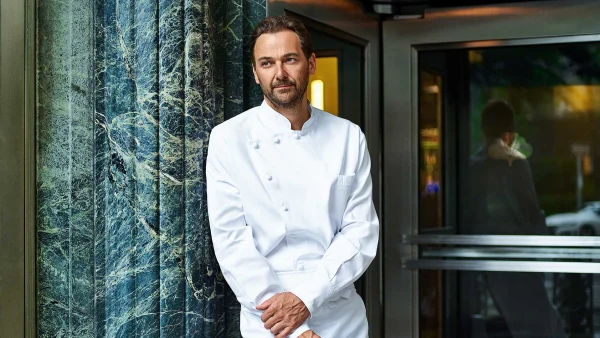
Eleven Madison Park is the kind of restaurant that’s sometimes called a temple of fine dining. In early 2020, Vanity Fair described its duck as “life-changing.” The following year, however, chef and owner Daniel Humm transitioned the Michelin-starred New York City restaurant to an entirely plant-based menu. Switching to vegan dishes meant blowing up the very foundation of his business. Humm believed his restaurant could be an example of how the industry could become more sustainable. But would people pay $400 a head for a vegan dinner?
When Eleven Madison Park reopened in June 2021, it faced a tidal wave of skepticism. A New York Times reviewer panned the restaurant, writing that a beet dish tasted like “Lemon Pledge” and smelled like a “burning joint.” While Eleven Madison Park no longer has a reputation for impossible-to-get tables, the dining room is full and buzzing again. It’s also the first entirely plant-based restaurant to receive three Michelin stars. Inc. spoke to Humm to hear about how he pulled off his plant-based pivot. –As told to Jennifer Conrad
.
“I was a competitive cyclist when I was young and then had an accident and decided to become a chef. I started climbing this mountain of working for the best [restaurants] and winning awards. In 2017, we became the best restaurant in the world [on the World’s 50 Best Restaurants list], and that was sort of the last of the awards. That moment was one of the most disorienting times for me. The whole world is looking at us and opportunities are starting to pour in. For 20 years, every day we talked about how to become the best restaurant in the world. Never for a moment did we talk about what would happen if we reached it.
“During the pandemic I’m like, I did it all. And I enjoyed that climb, but then it just felt emptier and emptier. There was a night where the city was getting shut down. We had everyone together and said, ‘We’re going to clean up, and we’re going to see each other in a few weeks.’ That team has never been together again. We were closed for 16 months. We were facing bankruptcy. We lost a lot of our team because we couldn’t continue to pay them, and that was super heartbreaking.
“I’m a co-founder of an organization called Rethink Food. In New York, before the pandemic there were a million [people who] were food insecure. Within the first two weeks, that number doubled. I decided that we would bring some chefs back, and turn Eleven Madison Park into a community kitchen. We started cooking meals in these little cardboard boxes, like 6,000 meals a day. I felt for the first time in my entire life that my work cooking actually matters.
“You don’t need to be an expert to understand that the food system has issues and that animal farming is one of the biggest contributors to climate change. I wanted to take it to the extreme with Eleven Madison Park, to go fully plant-based, because it pushed us as creatives. We had to take butter away. We had to create a new language: What is the new creaminess or what can add viscosity to a stock? I’m so happy with it because it created this whole new cuisine. We started a farm in Upstate New York. We’re taking inspiration from ancient cuisines from all around the world. Before we just looked at France.
“You’ve got to really nurture [new ideas] before letting other people in. If we’d had 200 people on the payroll in a restaurant that’s in motion, so many people would have told me ‘it will never work’ that I would have been way too scared to do it.
“As we got closer to reopening, I couldn’t sleep at night. ‘We just had almost two years of no money, and now we’re opening a restaurant that is only vegetables. Will anyone even come?’ I’m realizing this isn’t just an artistic endeavor. ‘People are back on the payroll. If [guests] don’t come, then then this whole thing doesn’t matter. If we fail, then no one else is going to try to do it.’
“The first year was very hard. I had to dig very, very deep into me, and the team did as well. I’ve learned a lot from criticism, but the truth is, we believed in the product so much. We really went internal for almost a year, gave no interviews, nothing. We focused on the work. It was like a whisper campaign. We wanted everyone eating here [to become] our ambassador.
“In the darkest of times, it was like, ‘Do we need to bring meat back? Because if this doesn’t work, then 200 people are out of a job.’ Thankfully, we all held each other accountable and said, ‘It’s tough right now, but let’s continue.’ All of a sudden, we saw light again and little things happened. It almost felt like at the very beginning of my career.
“A new universe of influential, important people started coming in, like Malala Yousafzai, people from the U.N., food activists. Our audience is younger. It’s more diverse. It’s people who put their money to something that matters. And, by the way, your experience is way more luxurious than ever before because this is something you can only get in one place.
“A big turning point was when we became the first restaurant to get three Michelin stars as a fully plant-based restaurant. I never saw this coming. Other things started to happen too: We’ve been part of the documentary You Are What You Eat on Netflix. There’s a new investor group that is interested in partnering with me, because we have proven that this is sustainable and viable. It’s a beautiful thing.
“Even if only a little bit of what we do trickles into the mainstream, to me that is what winning looks like today. I don’t believe the entire world needs to be plant-based. But maybe we think a lot more about what we eat.
“If you really want to make change, you have to have a mindset of progress over perfection. You’ve got to try something. It’s less challenging for a smaller restaurant because they’re not under such a microscope. Maybe they have one vegetable option and maybe over time they have three. Try eliminating plastic or stop using plastic wrap. Maybe there are other areas where you’re not perfect, and that’s fine.”
 DigiDame
Robert and I plan to try it out
<
div>
Sent from my iPhone
<
div dir=”ltr”>
<
blockquote type=”cite”>