
STARTUP
Zappos Founder Tony Hsieh’s Newly Uncovered Will Highlights an Important Lesson for Entrepreneurs
The recently discovered document has ignited more in-fighting among Hsieh’s family, friends, and former colleagues. The episode serves as a reminder for founders.
MAY 19, 2025

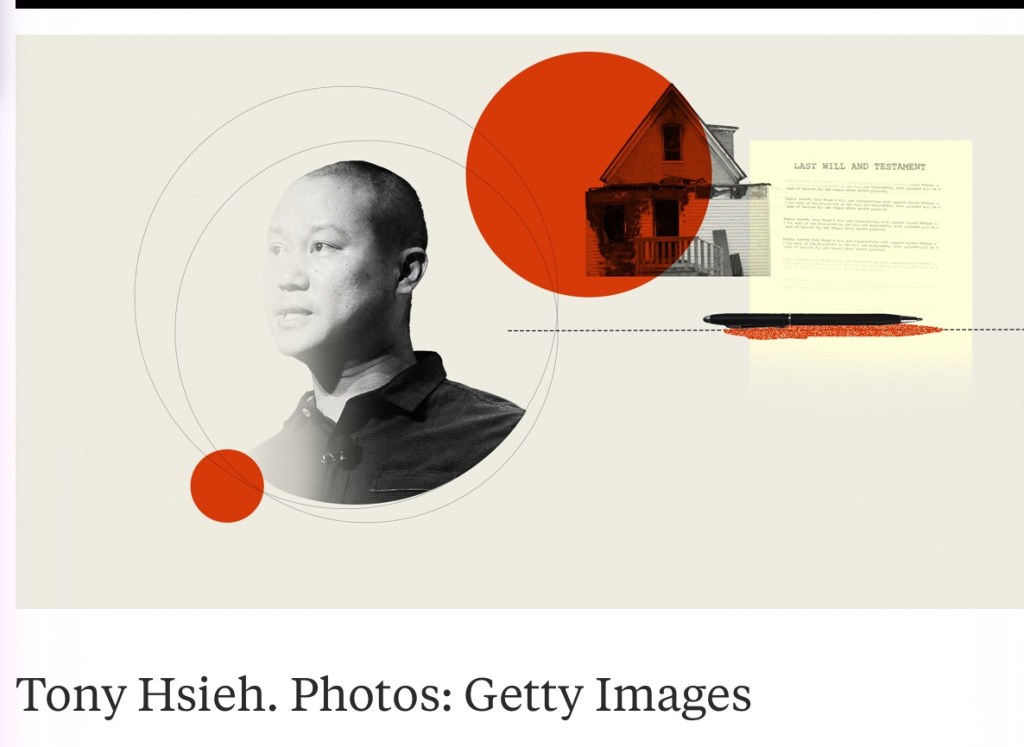
The sudden emergence of Tony Hsieh’s will last month, years after his death in a house fire, has all the tension and intrigue of an HBO drama.
The Zappos founder’s final years were spent in a spiral of drug use and collapsing mental health. During the pandemic, he relocated from Las Vegas and holed up in a mansion in Park City, Utah, growing increasingly manic, claiming that he was working on world peace and eradicating Covid-19, as Forbes reporters documented in a book on Hsieh’s life. He died in 2020 at the age of 46 after succumbing to injuries sustained in the fire, which took place in New London, Connecticut.
The will, included in a court filing in Las Vegas, was found in the possession of a mystery man named Pir Muhammad who died after suffering from Alzheimer’s, The Wall Street Journal reported in April. The will’s emergence added fuel to an already fractious dispute over Hsieh’s estate, which is worth around $500 million. The proceedings are now consumed by in-fighting among Hsieh’s family, close confidants, and former colleagues, some of whom have been described as “sycophants” by Forbes.
Written in 2015, the will includes atypical provisions, like transferring $50 million and a series of Las Vegas properties to trusts tied to unnamed beneficiaries. It gives $3 million to Hsieh’s alma mater Harvard University, and $250,000 to the Ford Foundation and other philanthropic organizations. There is also a no-contest clause in the will, meaning that if any of Hsieh’s family members dispute the contract, they will receive nothing.
For founders who’ve achieved even a fraction of Hsieh’s wealth, estate planning is often an afterthought. “For most clients I deal with, that’s not something that they’re thinking about early on,” says Shavon J. Smith, principal at the Washington D.C.-based SJS Law Firm and the author of small business advice book Tell Me About the Hard Part. “When you’re starting a business, you’re just trying to get it going, you’re just trying to make sure you generate income, make sure you can make payroll, make sure you’re bringing in contracts.
Of course, there are ways to ensure that your business doesn’t become the center of a protracted legal dispute, and that starts with a long-term plan, Smith advises.
If you own a single LLC, your company’s operating agreement should include a clause about whom you’d trust to step in and make decisions about its assets, and how they are willed to certain people, in the event of your death.
When your company is a trust or partnership, there will often be a “death clause” in its operating agreement, Smith says. This clause treats “death, or even disability [as] an automatic trigger to sell your shares to your co-owners as well.”
There are other basic considerations that can very well slip a founder’s mind—like who has access to a software program. “I had a client pass away this summer recently, and it was like, ‘OK, so how are we going to run payroll? Because he was the only person on the account,’” Smith says. The example highlights the necessity of a succession plan that outlines who will control what aspects of the remaining business
Hsieh made a fortune peddling shoes on the internet, eventually selling Zappos to Amazon in an all-stock deal worth around $1 billion in 2009. He was a charismatic and colorful figure who emphasized customer obsession and company culture, publishing a book called Delivering Happiness: A Path to Profits, Passion, and Purpose in 2010.
Hsieh’s will emphasized instilling his beneficiaries lives’ with a “wow factor.” The WSJ reports that Hsieh wrote in the document: “I want my beneficiaries to ‘live in the wow’ and to enjoy [their gifts] as a memorable and meaningful experience.”
Hsieh wasn’t particularly organized with his personal affairs, however. “You’ve got this very wealthy guy who gave his original will to one person, and it appears that that person was incapacitated and then died. In terms of best practices, that’s not the way to go,” says Marc M. Stern, a partner at Greenberg Glusker, a full-service law firm in Los Angeles
It’s important to trust your estate with professionals who can recall important documents at a moment’s notice. “Many clients want their originals, so we send it [when requested], but we retain copies. If something were to happen to somebody, we know that it exists,” Stern says.
Crucially, the most prepared founders understand that in the event of their death, the business is still a living, breathing asset. Understanding debt obligations is paramount, so you aren’t saddling beneficiaries with a bill. Smith recommends life insurance as a way to leverage potential debt.
“When someone comes to me and they have a succession plan, they have thought about what’s going to happen next in the business, and their personal estate planning is done, those people tend to have well-run businesses in general,” Smith explains.
Legal proceedings surrounding Hsieh’s estate will resume later this month.
 DigiDame
This needs to be a movie !!