‘I am a very visual person, whether it’s a beautiful woman or a beautiful painting. I like the way things look’, are the words Larry Gasogian uses to describe his attraction to the business of buying and selling art. The world’s most prosperous dealer, whose billion-dollar empire spans 17 outposts in seven countries, was once described in a GQ interview as ‘the closest thing the art world has to a Caesar’.
The ‘mega-dealer’ who owns the prolific chain of Gagosian galleries is now making headlines with his recent purchase of Andy Warhol’s Shot Sage Blue Marilyn, which has broken records to become the most expensive 20th-century artwork ever sold at auction. Initially priced ‘in the region’ of $200 million, Gagosian bought the piece for $170 million, rising to $195 million (approximately £158.17 million) after additional expenses were taken into account.
ANDY WARHOL’S SHOT SAGE BLUE MARILYN ANGELA WEISS
Gagosian – ‘the most important dealer in the world’ – has been at the forefront of the commercial art industry since the 1960s, representing and promoting a staggeringly impressive list of contemporary artists, including Cy Wombly, Roy Lichtenstein, Alberto Giacometti, Anselm Kiefer, Damien Hirst, Helen Frankenthaler and Zao Wou-Ki. He also manages the estates of some of the best painters in history, including Pablo Picasso, Warhol and William de Kooning.
Gagosian’s house, which he bought 11 years ago for $36.5 million (approximately £29.2 million) is a magnificent white-walled and glass structure designed by revered architect Charles Gwathmey. An artwork in itself, the building holds an astonishing personal collection of modern work, including a piece from Brice Marden’s Cold Mountain series, Picasso’s 1921 portrait of his first wife Olga, a vast painting from Wombly’s Bacchus series and a Jeff Koons glass sculpture, to name a few.
LARRY GAGOSIAN AND ARTIST JEFF KOONS
The 77-year-old dealer started from humble beginnings, once renting out someone’s walk-in closet in Venice Beach for $20 a month and parking cars to pay his way. Gasogian did, in his opinion, ‘eliminate the pretensions of gentility’ that once characterised the art business in the 70s, by injecting a ‘rags to riches’ energy into a world saturated by old money and stuffy senior experts. Gagosian’s career, which he started by selling posters on the streets of Los Angeles, was fuelled by his savvy business mind and his keen eye for quality and real talent. When asked: ‘What does it take to make a great dealer?’ he replied, ‘passion, focus, hard work, and in terms of my profession, having a decent eye’.
With an ultra-competitive disposition, Gagosian is often described as an ‘aggressive’ salesman; this he feels, according to an interview in the Financial Times, is an advantage to his profession. ‘I think if you are not aggressive in business, you will not go very far. It’s the only way I can function. Aggressive doesn’t mean you behave like a monster. It means you are an opportunist, forward-looking. Moving forward, moving forward – that’s my idea of aggressive’. Despite this, the American has a propensity to have fun, ‘You gotta have fun. Fun keeps the juices flowing. It’s just the way I’m wired’.
LARRY GAGOSIAN
A keen swimmer, tennis player and surfer, the art expert is also a self-proclaimed former hippie who ‘smoked pot and grew my hair out’. Friends with Warhol and the late Jean-Michel Basquiat, Gagosian was front and centre of the flourishing Pop Art and abstract movements that emerged in the 60s. Witnessing the glamour and excitement of ‘the factory’ years, the dealer once sold every one of Warhol’s ‘Piss Paintings’ at an exhibition in New York. He now holds company with Jenny Saville (who describes him as having ‘a certain melancholy, as well as incredible energy and a drive’), Hockney and Hirst, and recently helped Bob Dylan sell a large part of his personal collection.
To date, Gagosian employs more than 300 people and has 19 exhibition spaces across the United States, Europe, and Asia designed by acclaimed architects. As well as fostering the careers of some of today’s leading artists, the businessman has also been featured as a subject in several of their works. In 2013, Hockney painted Gagosian sitting on a chair in a suit and loafers as part of a series of 84 portraits. Basquiat, Nathaniel Mary Quinn and Elizabeth Peyton have also depicted his likeness. He reportedly sold the work done of him by Basquiat, much to his regret, once stating ‘can you believe how stupid I am?’, when the subject was broached by an enquiring journalist.
Get your smartphone camera ready. I am going to tell you about one of the most unusual and picturesque things to do in Miami. And I have a story about the underwater world that lies beneath the massive cruise ships that dock in Miami. Forget online dating. If you are looking to get hooked up, Monty’sis the place to go. If you ever wanted an active social life, join us on the all-day art gallery crawl.
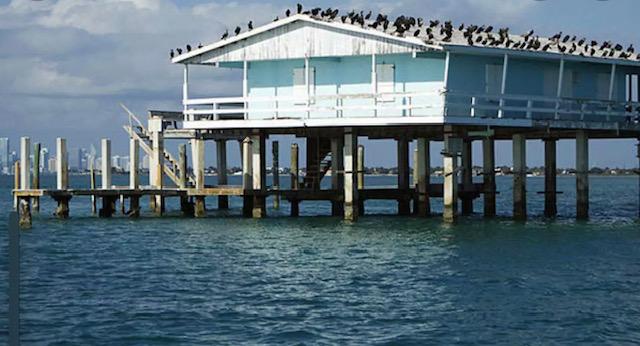
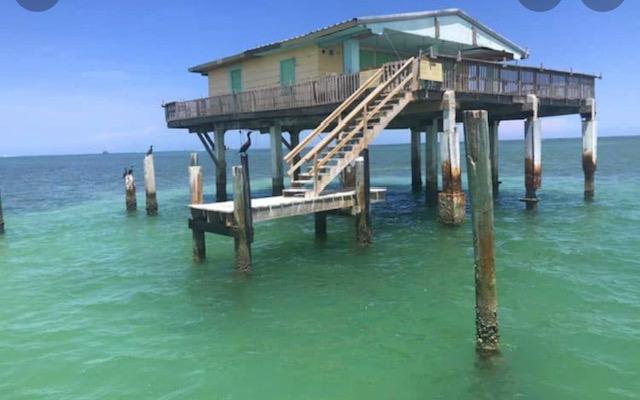
Historical Stiltsville
There is a group of historical stilt houses located right in Biscayne Bay that date back to the 1930’s. The area is called Stiltsville, and the structures stand on wood or reinforced concrete piling, generally 10 feet above the shallow water, which could be one to three feet deep at low tide. And you can only get to there by boat which makes the location very mysterious and exclusive.
Coral Reefs Are Screaming for Help. Is Anything Being Done?
I read about this a few years ago, but here it is again. This time the Associated Press is covering the news. Before we start the story let me explain that this is happening in the waterway next to my condo in Miami Beach. Just below the keels of massive cruise ships, an underwater camera provides a live feed from another world, showing marine life that’s trying its best to resist global warming.
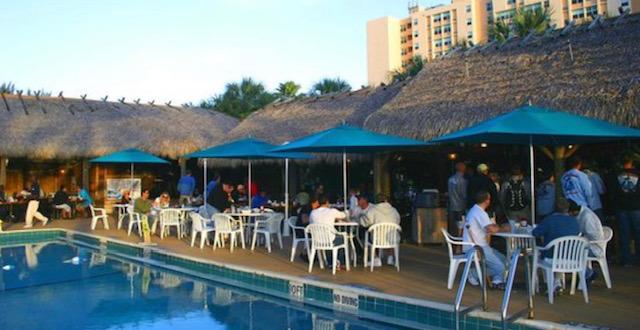
If you’re looking to get hooked up, Monty’s is the place to go. Located right next to the Miami Beach Marina in South Beach, it looks like a shack with a tiki hut roof, but don’t let its modest appearance fool you. It’s the hottest meeting place around. Monty’s may not be classy, but it will give you plenty of candidates in a very relaxed atmosphere.
If you ever wanted an active social life, join us on the all day art gallery crawl. You are going to meet gallery owners, artists, and many new friends from all walks of life. This is such a great way to connect to worlds unknown.
Behold the most expensive single-family residential property ever put up for sale in Florida! Photo courtesy of The Jills Zeder Group/1 Oak StudiosEarlier this year, when the Arsht Estate was listed for a whopping $150 million, it shattered the record for the priciest single-family residential property ever put up for sale in Miami-Dade County — whereupon a three-home compound at 18 La Gorce Cir. in Miami Beach said, “Hold my beer.”
Last week, the oceanfront estate of the late doctor, philanthropist, and University of Miami trustee M. Lee Pearce went on the market for $170 million — promptly one-upping the Arsht’s Estate’s short-lived reign as the county’s priciest residential listing. In fact, the property’s notorious real estate agents, Jill Eber and Jill Hertzberg of the Jills Zeder Group, tell New Times the Pearce compound is actually believed to be the most expensive residential property ever put up for sale in the entire state.
“To the best of our knowledge, it is the highest price on a single folio residential property offered for sale in Florida,” writes one of the Jills (though it’s not clear which one) via email.
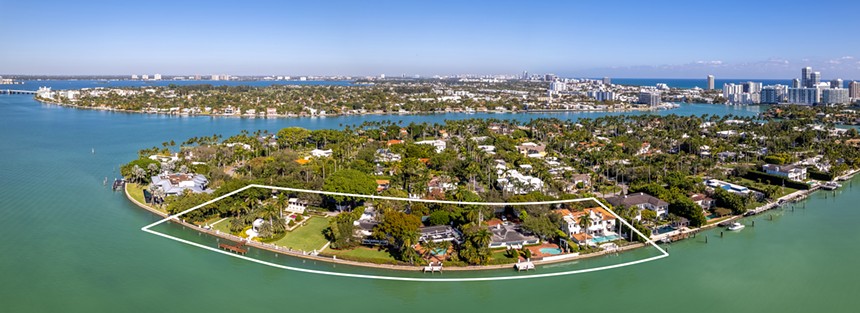
The Pearce compound boasts 600-feet of frontage on Biscayne Bay.
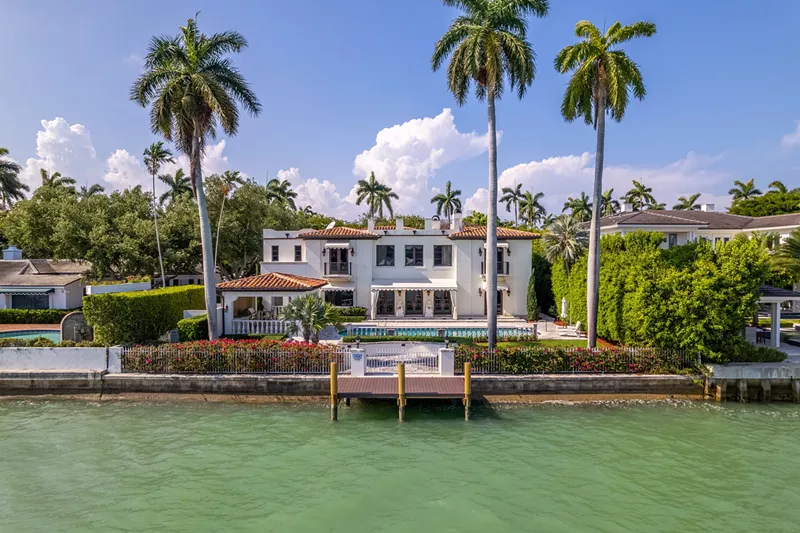
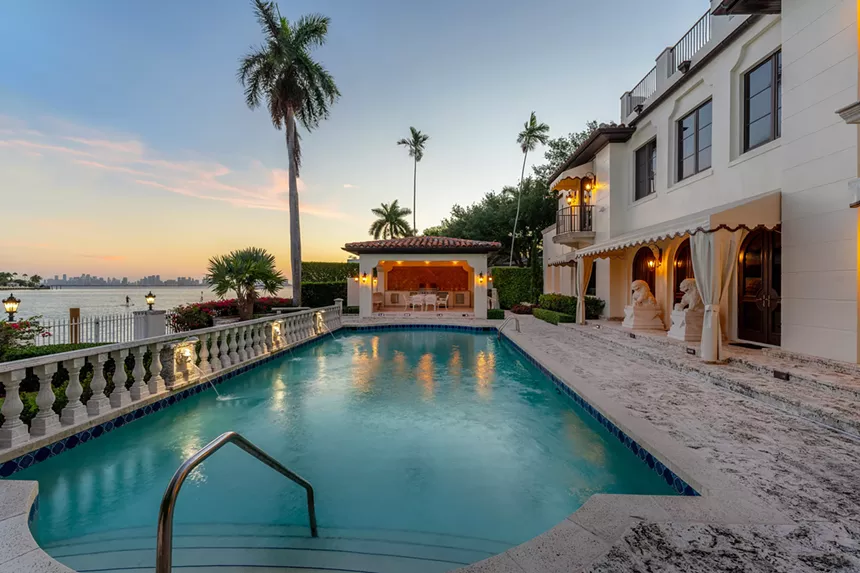
Photo courtesy of the Jills Zeder Group/1 Oak Studios Situated on the exclusive, gated La Gorce Island in Miami Beach, the Pearce compound boasts three homes — two two-story residences and a smaller one-story home with a guesthouse — each with its own private dock. In total, there are 12 bedrooms, 16 full bathrooms, nine half-bathrooms, and three swimming pools.
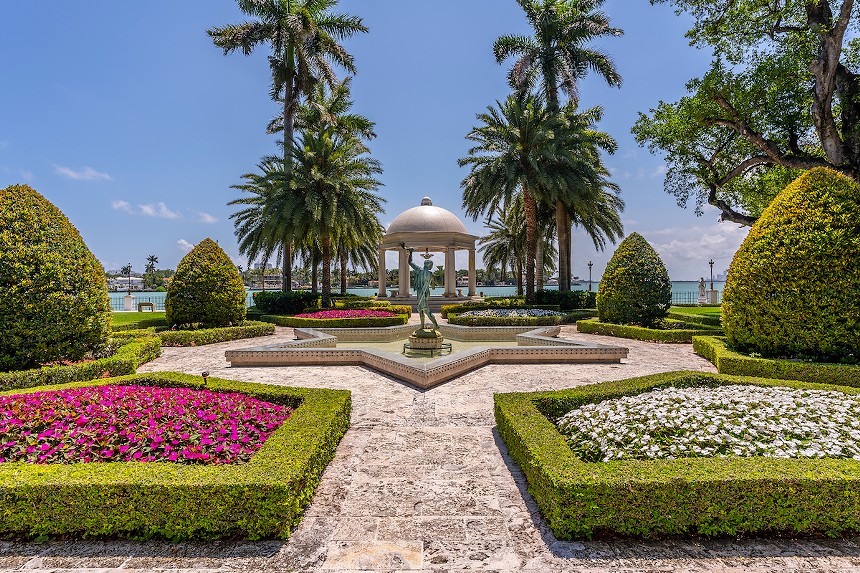
The nearly three-acre property boasts statues of Greek gods and goddesses, opulent marble floors, handpainted frescos on the ceiling, crystal chandeliers, an extravagant Spanish-style courtyard, and 600 feet of frontage on Biscayne Bay with panoramic views of the Miami skyline. Not to mention a wine cellar, a vintage movie theater, and a private waterfront park on the property called “Domaine de la Paix et de l’Amour” (French for “Domain of Peace and Love”), decked out with manicured greenery and a waterfront gazebo.
The owner demolished one of the existing homes to build a private waterfront park.
Photo courtesy of the Jills Zeder Group/1 Oak Studios But, Jill Eber says, the most extraordinary part of the estate is that it is a collection of four different properties.
“Assemblies are highly sought-after and difficult to put together,” she tells New Times. “This one is ready to go.”
Private movie theater
Photo courtesy of the Jills Zeder Group/1 Oak Studios M. Lee Pearce made his money building and operating hospitals, medical facilities, and banks. He purchased the separate properties throughout the 1980s, paying $3.1 million in total for the four lots. (Pearce tore down one of the homes to build his private park.) Pearce died in 2017, and the compound now belongs to his trust. According to the Wall Street Journal, proceeds from the sale will benefit the Dr. M. Lee Pearce Foundation, which provides grants for medical research and music.
The Jills emphasize that the property is rare and in demand. So if you’ve got $170 million to spend and want to live down the road from Cher’s old pad, Eber suggests you move fast.
“For this property,” she advises, “the best is to get involved quickly.”
🌵🌵🌵🌵🌵🌵🌵🌵🌵🌵🌵🌵🌵🌵🌵🌵🌵
‘Little House on the Prairie’ star Melissa Gilbert talks embracing aging, finding love later in life
Melissa Gilbert might have more in common with her “Little House on the Prairie” character than fans realize.
The 58-year-old actress, who played Laura Ingalls Wilder on the beloved series, which first aired in 1974, opened up to “Good Morning America” on Tuesday about embracing the aging process and finding love later in life.
Gilbert recalled how she and husband Tim Busfield, whom she married in 2013, said goodbye to Hollywood to live in “a very rural part of Michigan” for five years before ultimately settling in upstate New York, where they now reside and are enjoying a “sweeter, simpler, more comfortable life.
Actor Timothy Busfield and actress Melissa Gilbert attend the opening night party for ‘Medea’ at the BAM Harvey Theater, Jan. 30, 2020, in New York City.
“I had to get out of Los Angeles to actually age, which I wanted to do,” she said. “I’m excited about this. I love all these changes and watching what’s happening and getting to know this new person.”
Gilbert said she and Busfield, 64, sought “an escape” upon moving from Michigan to New York. The couple found it in a “run-down hunting cabin in the middle of 14 acres,” which Gilbert said they restored largely by themselves.
“I mean, I just got the dirt out from under my fingernails,” she joked.
The “Dancing With the Stars” alum also gushed about Busfield to “GMA,” noting that they were each other’s third marriage and knew what they truly wanted in a spouse.
“I think we were both craving just a more peaceful partnership or [to] be alone,” she said. “We’re just very much equals and we treat each other that way, and I think that’s what makes the difference. He’s my blanket. He’s my comfort place.”
Gilbert also said life with Busfield is never dull.
PHOTO: ‘Little House on the Prairie’, circa 1974. (Silver Screen Collection/Getty Images, FILE)
“We laugh all day long. We constantly crack each other up,” she said. “He’s one of the funniest people I know. I mean, he will walk into a door just to make me laugh.”
Though Busfield, who people may remember from the 1987 TV drama “Thirtysomething” and his recurring role on “The West Wing,” hadn’t seen “Little House on the Prairie” before marrying Gilbert, she recently showed him the first episode and said he “got completely hooked.”
Gilbert said he only calls her “Half-Pint,” her nickname on the show, when the occasion calls for it.
Gilbert’s new book, “Back to the Prairie: A Home Remade, A Life Rediscovered,” is out now.
From San Francisco to Buenos Aires, these spectacular roads are worth traveling to see.
Not all streets are created equal.

Setenil de las Bodegas, Spain.
Located in southern Spain, directly in between Seville and Málaga, Setenil de las Bodegas is a small town of roughly 3,000 people. The whitewashed houses are beautiful, but that’s not what makes this town so special. It’s that the structures are built directly into the rocky cliffs surrounding the region. The result are beautiful natural rock formations hanging over streets, providing shade and stunning views.
Brooklyn, New York
For who walk through the cobblestone street in Brooklyn’s Dumbo neighborhood, the sudden sight of Manhattan Bridge might come as a splendid surprise. At the intersection of Washington and Water Street, locals and tourists alike can take in the majestic beauty of the longest bridge connecting Manhattan and Brooklyn.
Recife, Brazil
Recife is the easternmost major city in Brazil, and the beautiful Rua do Bom Jesus occupies one of the easternmost parts of the city. The colorful street, which is lined with tall palm trees, is brimming with history. Dating back to the 15th century, this street contained the first synagogue built in the Americas, the Kahal Zur Israel Synagogue. The building is still there for visitors to see.
Paris, France
At the turn of the century, Paris’s Montmartre was home to some of the biggest cultural names in the world. Pierre-Auguste Renoir, Pablo Picasso, and Amedeo Modigliani were among the many famous residents of this once-bohemian neighborhood. Today, while Montmartre still has the feel of an artist community, chic stores have moved in, making this one of Paris’s most charming neighborhoods.
Mykonos, Greece
It’s difficult to walk the streets of Mykonos without being taken aback by the beauty. Much of this is due to the cobblestone streets, which wind their way around the whitewashed houses. At certain parts of the island, pedestrians will turn on a street to unparalleled views of the sea.
Águeda, Portugal
Águeda’s Umbrella Sky Project began in 2011 as a part of the Portuguese city’s annual Ágitagueda Art Festival. Each summer, when temperatures soar, a handful of Águeda’s narrow streets feature canopies of colorful umbrellas that provide shade to the pedestrians below.
Pretoria, South Africa
If you’re planning a trip to South Africa, you should consider some time in late September through November. That’s when the stunningly beautiful jacaranda trees go into bloom in South Africa. With purple branches drooping over the streets, any drive or stroll through Pretoria (where, along with Johannesburg, the trees seem to grow in every corner) will promise to be a memorable one. Fun fact: The jacaranda is actually native to Brazil, with the first one having been planted in South Africa in the late 19th century.
Quebec City, Canada
Quebec City makes a strong argument for being Canada’s most beautiful locale. And it’s with streets like Rue du Petit Champlain that makes it tough to beat. The charming, European-inspired street is lined with unique boutiques and bistros.
Colmar, France
Located in Colmar, France, near the border with Germany is one of the most charming towns in Europe. Yet, arguably the most picturesque area in Colmar can be found wandering through the streets of the Old Town. The architecture, which seems untouched by time, with its colorful timber structures, contains an Alsatian aesthetic.
Chengdu, China
Jinli street, which is located in Chengdu, China, is beautiful all throughout the year. Yet, there’s no better time to see the magic of the area than during the Chinese New Year. It’s then that locals light the streets in ceremonial motifs and to stunning effects.
San Miguel De Allende, Mexico
The historic and colorful Aldama Street in San Miguel De Allende is a must-see for any traveler heading to centrally located Mexican city. Roughly 170 miles north of Mexico City, San Miguel De Allende was voted the “2013 Best City in the World” by Travel + Leisure.
Budapest, Hungary
A stones throw away from the mighty Danube River is Budapest’s beautiful. Zrinyi Utca Street. This pedestrian street has some of the best views of Hungary’s famous Saint Stephen`s Basilica.
Perhaps the most surprising thing about Ronald O. Perelman is he’s one billionaire who didn’t get richer during the pandemic.
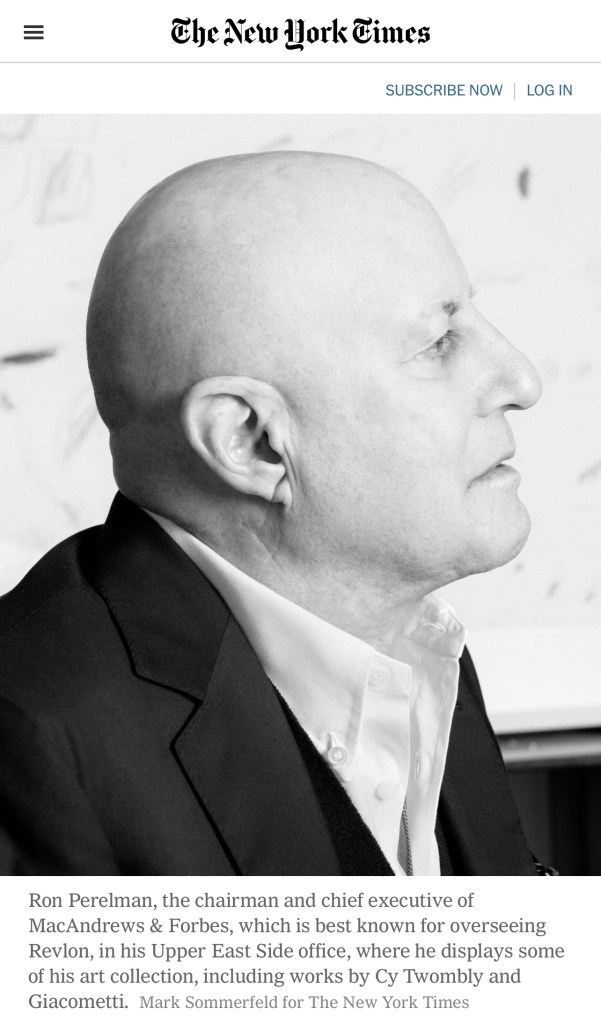
For much of the last three decades, he lived in a townhouse on East 63rd Street that connects to the offices of MacAndrews & Forbes, the holding company where, as chairman and chief executive, he lords over a mini-empire of businesses that have included online gambling (Scientific Games) and supermarket coupons (Vericast), and were — especially in recent years — less well known than he is.
The exception, of course, is Revlon, the cosmetics colossus Mr. Perelman acquired for $2.7 billion in 1985 through a hostile takeover. The purchase turned Mr. Perelman into an emblem of the “greed is good” era and earned him the cachet to shape shift for the one that followed.
He joined elite boards, had Revlon sponsor the Oscars, filled his townhouse with artwork by Jasper Johns, Andy Warhol and Cy Twombly, and bought the Creeks, a 72-acre estate in East Hampton. (The day the Richard Serra sculpture arrived for installation in 2007, no one could pass through town in either direction, because Highway 27 was blocked by his trucks).
On a recent Sunday afternoon, sitting in a modernist chair in his office, his knee pressed against a Giacometti table, Mr. Perelman said Revlon “was never a vanity play.” But he also can’t deny that in recent years, this midpriced beauty line has been a sinkhole, its lip glosses and eyeshadows languishing on CVS shelves as customers migrated online to buy products by Rihanna and Kylie Jenner.
Revlon’s $1.034 billion acquisition of Elizabeth Arden in 2016 was financed largely with loans that grew to $3 billion. Vericast had loans totaling almost as much. And a number of those loans were secured by Mr. Perelman’s properties, artwork and toys. When the pandemic hit and Revlon’s share price fell from $24 to $5, the banks closed in. He began divesting.
Off went a Miró and a Matisse, which sold for a combined $39 million. As well as a Giacometti sculpture that Sotheby’s sold in a private sale where the minimum bid was $90 million. A second Hamptons estate, which was owned by Mr. Perelman and occupied by his second wife, Claudia Cohen, until her death in 2007, went on the market for $115 million, though the amount he (or the banks, depending on whom you ask) will receive for it in an upcoming deal, according to people with knowledge of it, is closer to $80 million.
“Far less than it’s worth” was all Mr. Perelman would say.
He got rid of two jets and placed his 280-foot superyacht on the market for $106 million. Princeton University, to which Mr. Perelman had pledged $65 million to go toward construction of a new residential college, announced in 2021 that the building would no longer be named in his honor when he failed to meet the original payment schedule.
As Mr. Perelman cast it to Bloomberg News in 2020 when reports of his financial situation first surfaced, his decision to sell belongings was driven by the challenging economic moment, a desire to live a less leveraged lifestyle, and shifting priorities, including becoming more of a homebody since he married his fifth wife, the psychiatrist Anna Chapman, in 2010.
Still, even his friends had questions.
They’d seen him out looking gaunt. He was walking with a cane. Was he sick? Was he now only worth a few billion dollars? Or was he actually broke?
“I’ve vacationed with him many times, I talk to him a lot,” Irving Azoff, the music impresario, said, “but he’s very private and we haven’t discussed this. I read the party line and I don’t know.”
‘We’re all complicated, we’re all crazy.’
Although what happened to Mr. Perelman is a story about losing money, it is also a parable for how the game is rigged for those at the top. Here was a very rich man who, despite having a failing business, repeatedly went to the banks for billions of dollars in loans he may never fully pay back. And got them.
But among the 0.1 percenters who take advantage of endless banking tools, Mr. Perelman remains a figure of fascination: incredibly well known, difficult to define.
On the one hand, he is plainly attracted to the spotlight, hosting Apollo Theater fund-raisers at his Hamptons estate where he plays drums onstage with musician friends like Pharrell Williams and Alicia Keys. On the other, he set MacAndrews & Forbes up in ways that colleagues say are designed to evade public scrutiny.
Philanthropic achievements made him the beau ideal for plutocrats as renaissance men. Combustible relationships with family members and business colleagues risked turning him into New York City’s second-most-famous tabloid billionaire.
A 79-year-old cannonball of testosterone whose micromanagement of employees helps explain why Revlon is on its 10th C.E.O. in 36 years (currently it’s his daughter Debra Perelman), Mr. Perelman is bored by sports, waxes poetic about Dries Van Noten, goes to a therapist, donates to Republicans and is, by his own admission, attracted largely to women whose identities cannot be sublimated by guys like him.
He is also an Orthodox Jew. “You just get a get,” he said, referring to the Jewish religious tradition in which a rabbinical court grants permission to divorce.
Of his five marriages, three have ended in ugly divorces.
“We’re all complicated, we’re all crazy,” he said.
‘I would say that’s probably accurate.’
Mr. Perelman grew up in Elkins Park, Pa. His mother, Ruth, did not work outside the home, and Mr. Perelman said she was no pushover. His father, Raymond, was a steel magnate and something of a tyrant.
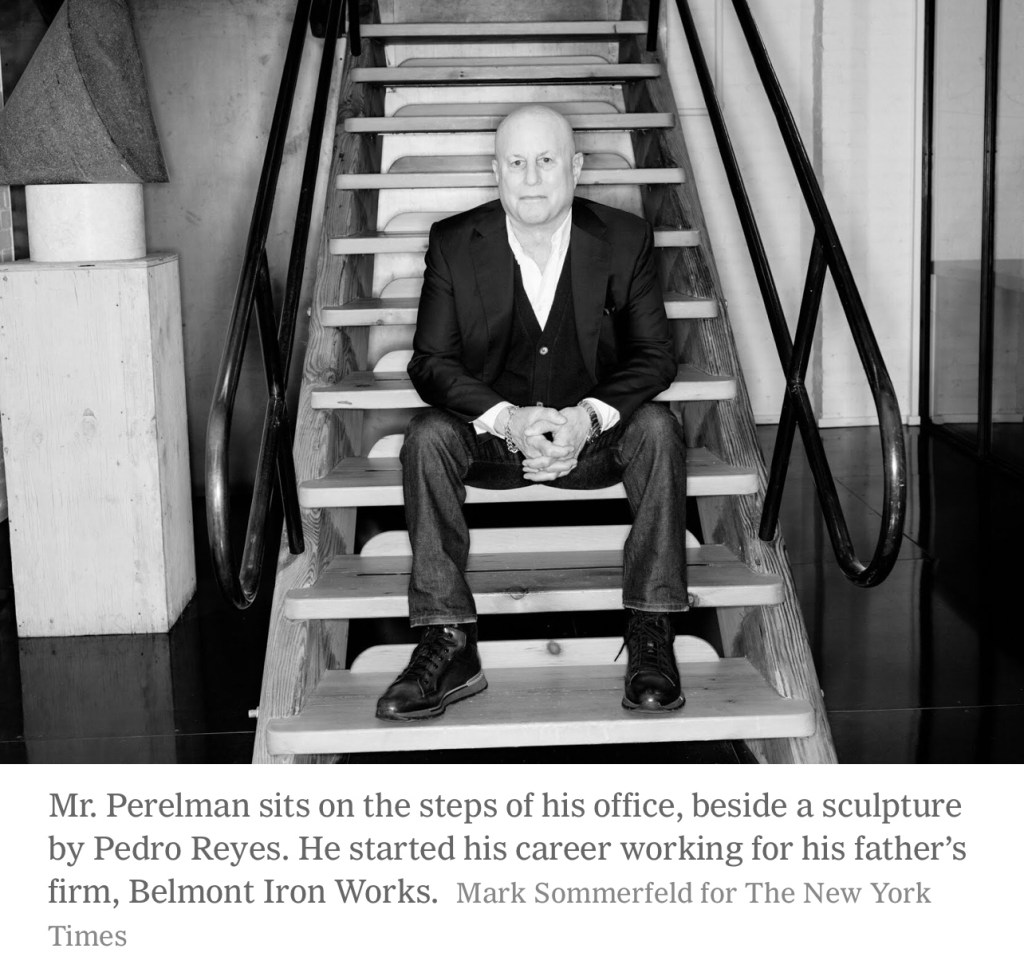
By the time of Ronald’s bar mitzvah, his father — who owned the firm Belmont Iron Works — was already bringing him to business meetings, Mr. Perelman said.
After high school, the younger Mr. Perelman went to Villanova University for a semester, then transferred to the Wharton School at the University of Pennsylvania, where he was a legacy.
Mr. Perelman’s family wasn’t particularly religious. At 18, Mr. Perelman went to Israel and had a spiritual conversion. On another trip he met Faith Golding, a young real estate heiress whose family owned the famed Essex House in Manhattan, and who soon became his first wife.
After receiving his M.B.A. from Wharton in 1966, Mr. Perelman went to work for his father. But he yearned to become Belmont’s chairman, and Raymond had no interest in relinquishing the title. So Ronald left. He and his father barely spoke for several years, a detail that helped establish a narrative of him being mostly self-made, despite it flying somewhat in the face of reality.
Mr. Perelman’s first deal in New York was the acquisition of Cohen-Hatfield, a jewelry company then trading on the American Stock Exchange for a fraction of its book value. He obtained control of it in 1978 with a $1.9 million bank loan and by 1980 made $15 million breaking it apart.
Relationships he’d developed with executives at Drexel, Burnham, Lambert — the epicenter of 1980s junk bonds — led to more leveraged buyouts. Among them were MacAndrews & Forbes (a maker of candy and licorice extract), Technicolor (the film processor), Consolidated Cigar (the largest manufacturer of cigars in the United States) and Pantry Pride (a supermarket chain that he bought shortly after it emerged from bankruptcy).
Mr. Perelman and Ms. Golding moved to 740 Park Avenue, the Gold Coast’s most exclusive co-op. She stayed home with their four children. He had an affair with an Upper East Side florist.
Was it true that the affair came to light when Mr. Perelman bought his mistress jewelry from Bulgari, and the bill — mailed home — was opened by his wife?
“I would say that’s probably accurate,” he said. “But I really knew it was over when she showed me a scrapbook filled with pictures that she’d gotten from a private investigator.”
Le Cirque Perelman
Mr. Perelman never much liked his late-’80s Gordon Gekko-like reputation.
He’d collected art since college, went to Sam Cooke shows on the weekends (never until after the Sabbath), and didn’t talk much about business. “That’s the fun of him,” said the actor Michael Douglas, who in addition to playing Gekko is a good friend of Mr. Perelman’s.
Nevertheless, the showdown at Revlon — a takeover The New York Times described in 1985 as “one of the pivotal corporate battles of modern times” — bore resemblances to “Wall Street.”
Revlon was founded in 1932, and grew to become the second largest makeup company in the United States, behind Estée Lauder. In 1975, Revlon’s founder Charles Revson died, and its new chief executive, Michel Bergerac, used revenue from Revlon’s makeup and skin care lines to expand into health care products and medical testing equipment.
Those things did well while the beauty business languished. By 1983, the stock sank, trading around $35, putting Revlon’s overall market cap far below its worth, if acquired by raiders and sold off piece by piece.
Enter Mr. Perelman, who, in addition to having access to financing from Drexel Burnham, had recently acquired Pantry Pride, from which he obtained a $300 million tax-loss carry-forward that could be used to offset future income from another acquisition.
Mr. Perelman tried at first to charm Mr. Bergerac into joining his takeover effort. When that failed, he deployed the same public relations strategy used by Gordon Gekko, who in “Wall Street” presents hostile takeovers as a public service on behalf of the everyday investors whose portfolios are being decimated by profligate executives. Mr. Bergerac, as Mr. Perelman later told it, lived arguably “the biggest life of any C.E.O. in America,” flying around the world on a 727 he didn’t need, backed by executives with palace-like offices.
One might argue that this was the pot calling the kettle black.
Mr. Perelman took MacAndrews & Forbes private in 1983. One reason for this, according to “The Predators’ Ball,” by Connie Bruck, was that he wanted to have his own plane and have his artwork in his office. He wanted to have MacAndrews & Forbes “as his nest egg,” she writes, “and then he wanted to acquire some other public company, for presenting his face to the financial world.”
The extensive efforts of Mr. Bergerac and his board to keep Revlon away from Mr. Perelman failed. After Mr. Perelman acquired it in November 1985, he broke from form by selling off the strongest part of the business while holding onto its weakest link.
Away went National Health Laboratories, an unglamorous but rapidly growing blood and pathology testing unit that went on to become Labcorp, today a $30 billion S&P 500 company. What remained was Revlon, which, with debt more than five times its $600 million market cap, became an infinity pool of sunken money.
People loved her …
Sometime after Mr. Perelman moved out of 740 Park Avenue, a woman at Le Cirque caught Mr. Perelman’s eye.
She was the heiress to the Hudson News empire and a former editor of The New York Post’s Page Six, who later joined ABC as a correspondent. The best and worst thing about her as a journalist was that people loved her.
Mr. Perelman married Ms. Cohen in January 1985. When he took over Revlon, she became his essential sounding board. He hired Richard Avedon to shoot ad campaigns. Cindy Crawford, Paulina Porizkova and Christy Turlington appeared in them.
Don Johnson met Mr. Perelman when Revlon sponsored one of his speed racing competitions. Melanie Griffith, then Mr. Johnson’s wife, received a Revlon contract.
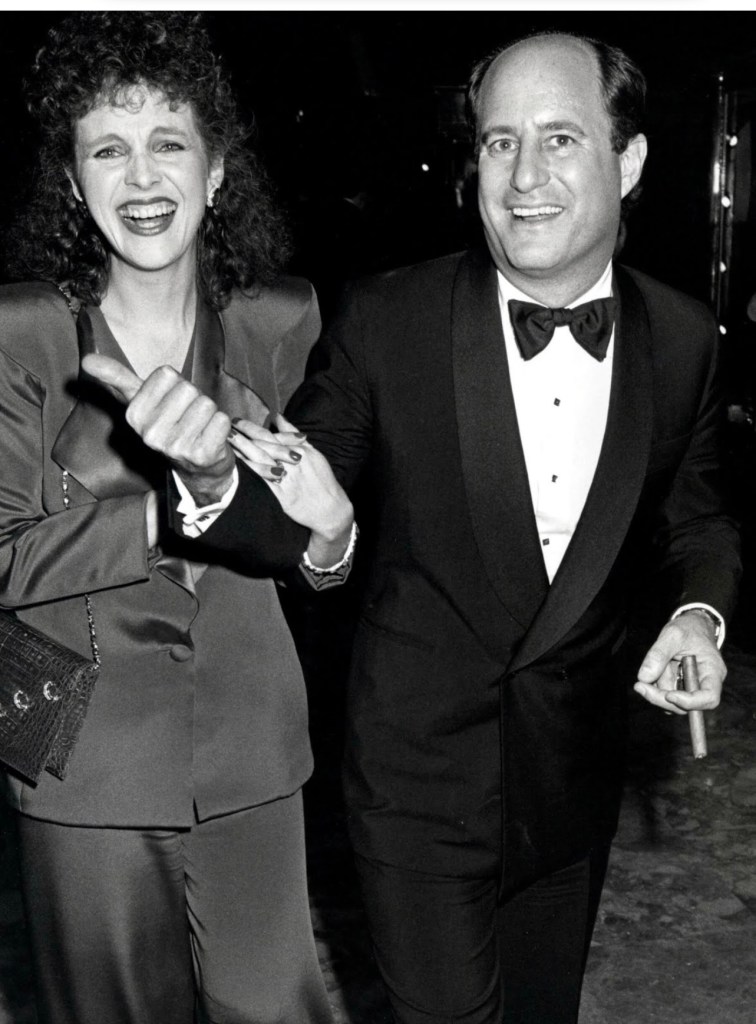
Claudia Cohen and Ron Perelman
In 1992, the two couples were vacationing in Paris and arranged to have dinner. Before it was to take place, Mr. Johnson bumped into the movie producer Mike Medavoy and told him to come along with his wife, the Democratic fund-raiser Patricia Duff.
Mr. Johnson didn’t really want to talk to a reporter about what came next. “Mike’s still a friend,” he said.
But suffice it to say, two divorces were soon underway, and Mr. Perelman and Ms. Duff were soon engaged.
She provided Mr. Perelman access to people in the world of President Bill Clinton while his philanthropy career took off.
In 1994, he donated $10 million to the Guggenheim and was praised for not asking to have his name put on a building. He also gave a consulting gig to Webb Hubbell, the former associate attorney general under Mr. Clinton, who had been indicted on a charge of tax fraud, and was under pressure to supply Kenneth Starr, the Whitewater independent counsel, with information about the Clintons’ business dealings from their time in Arkansas. (Mr. Hubbell ultimately pleaded guilty to a single count of tax fraud.)
No one could say with certainty if that was why, in 1995, Mr. Perelman was appointed by Mr. Clinton to serve on the board of the Kennedy Center, one of the most prestigious posts in American philanthropy.
“I had no idea,” Mr. Perelman said, when asked if he knew the real reason Vernon Jordan, a fixer for the president, sent Ms. Lewinsky to him.
“Anyway, the job offer was rescinded when news of Ms. Lewinsky and Mr. Clinton’s affair came to light. Clearly, it wasn’t going to be such good public relations to have her in Revlon’s public relations department.”
The toes that got stepped on.
People from Mr. Perelman’s team will tell you he is one of the most generous people they have ever met. People from the opposing one will tell you he is vicious. The truth may not be that he is one or the other but both.
Expensive watches are given to employees, trees are planted in parks to honor friends’ dead relatives, and wars ensue with those who cross him. In those circumstances, a principle is usually involved: money.
“Ronald is fierce, fierce, when it comes to people just making the assumption that because he was reported to have a lot of wealth, that they could just go and take it,” Mr. Johnson said. “Some of the toes that got stepped on deserved to be stepped on.”
In 2012, Mr. Perelman sued his art dealer, Larry Gagosian, claiming he’d been repeatedly induced to spend more for works than they were worth. In 2013, Harland Clarke, another Perelman company, sued Michael Milken over a deal. Mr. Perelman said it wasn’t personal, but still. Mr. Milken was — as the former head of high yield securities at Drexel, Burnham, Lambert — largely responsible for turning Mr. Perelman into a billionaire.
Both suits were dismissed.
Less well known: Mr. Perelman is an easy crier.
It happened in the offices of MacAndrews & Forbes during a recent interview as he talked about the end of his marriage to Ms. Duff. In 1996, less than two years after she gave birth to their daughter, Caleigh, Mr. Perelman broke up with her in the back seat of a chauffeured car, while attending the Democratic National Convention.
That isn’t the part that made him cry.
After returning home, Mr. Perelman called his ex-wife, Ms. Cohen. He was staying at his Creeks property. She was at their old dive on Lily Pond Lane, which is 9.5 acres.
Mr. Perelman and Ms. Cohen were not then in a great place. In addition to the way the marriage ended, he had made plain his antipathy for the man with whom she rebounded. In retrospect, Mr. Perelman acknowledged that wasn’t necessarily fair, even if the man is the former New York senator Al D’Amato, to whom personal and professional scandals clung, as The Los Angeles Times once put it, “like a sweaty undershirt.”
“She said, ‘come over,’ and we talked pretty much all night,” Mr. Perelman said, his lips quivering, eyes welling up. “And she never said a word about me giving her a hard time. We just held one another, and I talked about what a jerk I was. After that everything was like before.”
Although not entirely. They weren’t romantically involved.
But she helped him through his epic, three-year divorce with Ms. Duff and stood beside him seven years later when his fourth marriage, to the actress Ellen Barkin, ended. (Also not well: “The last time I saw Ellen, she threw a drink in my face,” he said.)
When Ms. Cohen was diagnosed with ovarian cancer, Mr. Perelman poured money into research he believed could save her. After her death, in 2007, he had her name put on Logan Hall at the University of Pennsylvania, to which he was a major donor, and where she had also gone to college.
To Ms. Cohen’s friends, he seemed like a hero. Then, in 2012, he helped mastermind a lawsuit that his 23-year-old daughter, Samantha Perelman, filed against her uncle, James Cohen, over the amount she inherited from her grandfather Robert Cohen. The suit went to trial, where she lost.
Strategic alternatives
One good way to avoid being the target of a leveraged buyout is to keep the bulk of a company’s shares held back from the public. Mr. Perelman owns more than 85 percent of Revlon’s.
Its largest outside investor is Mittleman Investment Management, a firm in Melville, N.Y., that puts its clients’ money into so-called undervalued companies.
Despite repeated efforts, its chief investment officer, Chris Mittleman, has never been granted a meeting with anyone at Revlon.
In an interview, Mr. Mittleman sounded like a man who has wasted so many years in a loveless marriage, he no longer has the will to leave it, and thus waits for it to be ended for him, either by God, death or a tender offer from Estée Lauder. “That would be an outstanding buyer,” Mr. Mittleman said.
Mr. Perelman has, over the years, “explored strategic alternatives.” Most recently, in 2019, he hired Goldman Sachs to look into it. But a deal never got to what Mr. Perelman calls “the right place.”
Still, it has occurred to Mr. Mittleman, along with others, that perhaps the reason Mr. Perelman never sold Revlon is that he has no interest in doing so, and instead floats the possibility as a way to buy time with bondholders — a debt-laden billionaire’s equivalent of “the check is in the mail.”
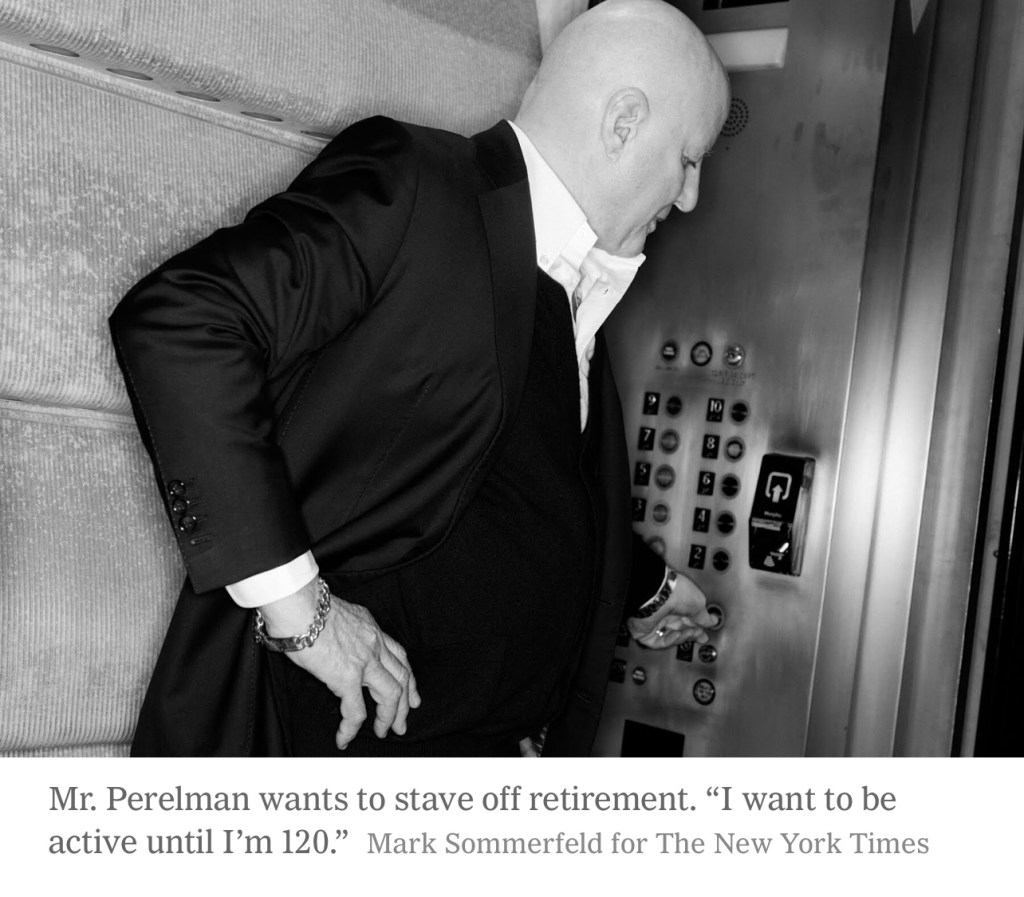
Revlon, a number of them pointed out, is a huge part of his identity. And retirement, he said, is “the beginning of the end. I want to be active until I’m 120.”
In December, Bloomberg News reported that Raymond Perelman, in the last years of his life, extended to Ronald a loan for over $120 million from a nonprofit family foundation registered at MacAndrews & Forbes’s offices.
“I’m not going to talk about it,” he said of the Bloomberg article. (Michael Lehmann, a lawyer for Mr. Perelman, said previously that the transactions referred to in the article were “first vetted and approved by skilled and experienced outside legal and tax counsel.”)
In 2016, Revlon hired Citigroup to put together a loan package for $1.8 billion, which was then amassed from a group of investment firms, with almost all of its holdings provided as collateral. It largely restricted Revlon from obtaining further loans. Or was supposed to.
When things went even further south, Revlon, in 2019 and 2020, worked out deals with a subset of those lenders to obtain $1 billion more, this time serving up the company’s intellectual property as collateral. Which is the corporate equivalent of getting a mortgage on your house and then, when you cannot make the payments, going back and getting a mortgage for the land underneath.
Mr. Perelman said the suit was without merit and, as evidence, noted that it was dismissed. It was — though not for reasons having anything to do with its central allegations.
In August 2020, administrators for Citigroup accidentally wired Revlon creditors the entire remaining balance on the 2016 loan. The wrong box got checked and out went $893 million. When Citigroup’s efforts to retrieve the money failed, no need existed for the lenders to continue their own lawsuit against Citigroup and Revlon. “The lawsuit was withdrawn solely because Citibank paid off the loans and not because the allegations were anything other than meritorious,” said Benjamin Finestone, a lawyer for the plaintiffs.
And because the error was Citigroup’s, the loss belonged to them, rather than to Mr. Perelman. But he still had to do what his friend Richard Parsons said in an interview was “a lot of fast footwork.”
The beachfront property in the Hamptons formerly occupied by Ms. Cohen went onto the market. People from Sotheby’s arrived to collect Mr. Perelman’s art, much of which sold at the bottom end of estimates.
One possible reason is that Mr. Perelman had a habit of trying to get a bargain on everything, according to three art-world figures who insisted on anonymity because they said that commenting on the situation could harm their jobs. This enabled him to get good paintings by great artists, they said, while missing out on masterpieces that begin with sticker shock and ultimately reap the biggest rewards.
“There may be something to that,” Mr. Perelman said. “But I never had anything on my walls I didn’t really love.”
At any rate, he’s not blaming his former dealer, Mr. Gagosian.
“I had dinner with him the other night,” Mr. Perelman said. “One day, I just picked up the phone and said, Look, we haven’t spoken for years but I don’t even know what our fight was about. Do you want to forget about it? He said, ‘I’d like nothing better.’ (Of course, a billionaire with hundreds of millions of dollars worth of art to sell and a dealer capable of selling it have good reason to reunite.)
Mr. Perelman also sold off his interests in A.M. General (which makes Humvees and other military equipment) and Scientific Games, for a combined amount of about $1.6 billion. Mr. Perelman denied that the Creeks is for sale, though at least two real estate brokers indicate that it is.
Mr. Perelman said he is healthy and nearly free of personal debt. “I am not sick, I am not broke,” he said.
Although Revlon continues to have over $3.25 billion in debt, it has been extended to 2024, enabling it to stay out of bankruptcy. And MacAndrews & Forbes remains on East 62nd Street, next to two buildings he owned that were bought for $35 million by the Chapman Group, a real estate company that is owned by his wife’s family.
The Chapman Group even got one of those properties for $10 million, which, given that Mr. Perelman bought it in 2004 for $14.5 million, is a substantial discount.
“He’s making his payments,” Mr. Bloomberg said.
Update, Update, Update
Construction is also continuing on the Ronald O. Perelman Center for the Performing Arts, a 90,000-square-foot three theater building at the World Trade Center. The project is being shepherded by Michael R. Bloomberg, the former mayor of New York, who said there’s no plan to take Mr. Perelman’s name off that building.
Ron Perelman’s former Lenox Hill offices hit market for $160M
Ron Perelman with 35 East 62nd Street and 41 East 62nd Street (Getty, Google Maps)
A whisper listing in Lenox Hill could make a lot of noise if it finds a buyer willing to meet its astronomical asking price.
A pair of buildings on East 62nd Street where billionaire investor Ron Perelman once kept his offices have been placed on the market, according to a person familiar with the listing, who said the owners are hoping they’ll command a price “in excess of $160 million.
The adjacent properties between Park and Madison avenues, which allow for both residential and commercial use, are available separately or can be combined for 41,000 square feet, according to marketing materials seen by The Real Deal.
Representatives for Casa Blanca, which has the listing according to the materials, declined to comment.
The 40-foot-wide building at 35 East 62nd Street features a Renaissance-style facade with a top-floor loggia and Flemish-bonded yellow brick above a limestone base.
Erected in 1904 as a school building by George Keller, the Fleming School operated there until the property was sold to Perelman’s MacAndrews & Forbes holding company for $9 million in 1989. At five stories and 25,000 square feet, it is the larger of the two buildings.
The neighboring building at 41 East 62nd Street is 35 feet wide with a red brick facade laid in English bond and was built in 1896 as a horse stable for Elbridge Thomas Gerry. The 16,000-square-foot building has twin skylights on its fourth-floor mansard roof.
Zoning in the area permits a mix of commercial and residential uses. The Department of Buildings approved plans in July 2021 to remove partitions separating the offices in the larger building. Both buildings received landmark status in 1982.
Perelman, who has held a majority stake in the cosmetics giant Revlon since 1985, bought the smaller building in 2004 for $14.5 million, with both properties becoming collateral for a multitude of loans, property records show.
The Chapman Group, owned by the family of Perelman’s fifth and current wife, Anna Chapman, bought the buildings in April 2021 for a combined $35 million, providing the billionaire investor with cash while he sold a wide range of assets, including his personal art collection.
Demand for cosmetics plummeted while much of the world stayed at home during the pandemic, compounding problems for Perelman’s heavily indebted makeup and skincare company.
A representative for the Chapman Group declined to comment.
The two properties, along with another of Perelman’s at 27 East 62nd Street, became so indebted — and so damaged was Revlon by the pandemic, with shares down over 70 percent since the start of 2020 — that Blackstone executive Tony James bought loans secured by the buildings from Citigroup for $115 million, a 40 percent discount.
Perelman has tried selling other real estate since the pandemic took hold, including his 47-acre estate in East Hampton asking a reported $180 million and a former personal residence at 36 East 63rd Street, for $60 million.
Recently Florida’s Governor Ron DeSantis’s signed the “Parental Rights in Education” bill— some call it the “Don’t Say Gay” bill— some say this bill is just about keeping the topics of sex and gender away from young children, others see it just another attack on the LGBTQ+ community.
Lying On The Beach’s Lois Whitman-Hess and Steve Greenberg explore this controversy with their special guest pioneering journalist Steve Rothaus. Steve has covered LGBTQ+ issues at the Miami Herald for more than two decades. He’s been honored with a GLAAD Media Award for outstanding newspaper columnist and many other awards. The National Lesbian Gay Journalists Association inducted him into its Hall of Fame in 2019, the year he retired from the Miami Herald. Since then, Steve has remained active as a freelance journalist for the Herald, South Florida Gay News and WLRN News.
by Lois Whitman-Hess, Miami Life Editor (12th week)
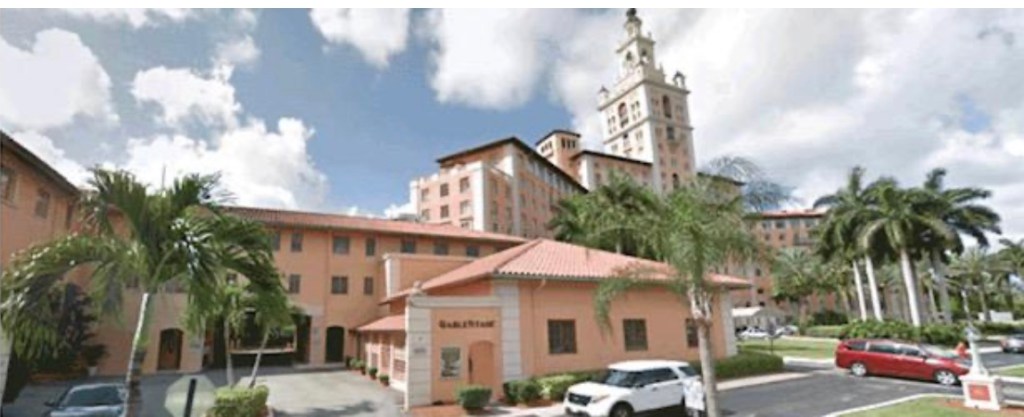
The first time I saw the GableStage Theater, 20 years ago, I didn’t care what play was at the theater, I just wanted to go there all the time, and I still do. If you want to see celebrities, we have the scoop on the restaurants that are celebrity hotspots. If you want to get in the groove, be sure to get tickets for jazz singer Nicole Henry’s performance at the Adrienne Arsht Center. Vizcaya Museum and Gardens, a national historic landmark, welcomes visitors once a month
👏👏👏👏👏👏👏👏👏👏👏👏👏👏👏👏👏👏
My client David Chesky scooped me. He scored this one himself. GMA ran a wonderful segment on David’s animated movie, “The Mice War,” now streaming on Amazon. This is such an important movie for children. No more wars. David, Bravo!
Me too. I received an email last week from a renowned perfume company with that headline. The body of the email went on to say, “We understand that this can be a difficult time for some people. If you would like to opt out of Mother’s Day emails, please let us know.” Alright, I am letting you know. And also, opt me out of Father’s Day and Valentine’s Day and a variety of other holidays that are antiquated and emotionally inefficient in today’s culture.
As a family that has faced profound loss, it is obvious why Mother’s Day is difficult. Of course, the death of a child, in my case my magnificent 32 year- old son to suicide, is the epitome of holiday rejection. The pain of his absence in my life is magnified on that day and triggers the questioning of my feelings of inadequate love to him and my failure to keep him safe and healthy. I always refer to David in the present, and yes, wonder what I could have done differently as his mother.
Intellectually, I have come to terms with the idea that I couldn’t change him. I tried, and I failed. My daughter Elizabeth helps me, as we intellectualize his pain and his demons. We have concluded and accepted that life was just too difficult for him.
But then Mother’s Day arrives every year. I feel like a fraud and a failure that I couldn’t fix or save my son. When Father’s Day arrives, my heart aches for my daughter. Her loss is enhanced by the presence of social media and the profound commercialization of these holidays. On Elizabeth’s first Father’s Day without her dad, I rushed and planned a trip to Paris with her, to remove her from the media in the United States. It worked, and what a pleasure it was to bike ride in the Jardin des Tuileris that Sunday, with no thought or mention of the antiquated holiday.
But, under no condition should I corner the market on disliking Mother’s Day and feeling unhappy or inadequate that day. There are so many complications to the holiday that foster uncomfortable feelings and pain. Let’s explore the various subsets that exist that make these “Hallmark Holidays” horrible. While businesses in the United States are marketing the need to buy cards, flowers, gifts and make dinner reservations, so many people are conflicted and dis-associated with the celebration.
I was discussing Mother’s Day weekend with a friend the other day, and she commented, “I hate Mother’s Day. I miss my Mom so much.” I was taken by surprise. Here she was a woman in her 60’s, with a healthy, happy family that appeared to respect and care for her in her important role of mother. Her pain on this holiday was derived from her own relationship with her mother. She did not associate that day with her role, but was mourning the loss of her own relationship.
And then there are the complications of the day. The families whereby adult children have difficult relationships with their parents, parents that have complicated relationships with their children, the adult child that doesn’t enjoy time spent in this celebration, the introduction of a spouse’s family and their demands on the holiday and balancing your own motherhood with the needs of in-laws and parents. The expectations of the day and the commercialized celebration can be daunting and often disappointing.
More obvious are the changes in the American family. With the societal occurrence and acceptance of single parent families, the prevalence of divorce in our culture, two-Moms or two Dads as a family unit, foster care, adoption and surrogacy- there are so many options to choose from. This evolution in the family unit should force our culture to re-evaluate holidays that alienate and cause uneasiness in our youth and adult population alike. Imagine that child in school that is motherless or fatherless while making an art project or card for a phantom person.
Husbands mourn deceased wives and wives mourn deceased husbands. The break-up of the family from death or divorce certainly doesn’t need reminders of imperfection. As we evolve as a culture, it is probably time to take a good hard look at the holidays that emerged at the turn of the 20th century that no longer reflect our norms and values. Anna Jarvis is considered the founder of Mother’s Day in 1908. After gaining financial backing from the Philadelphia department store owner John Wanamaker, she organized the first official Mother’s Day celebration at a Methodist church.
That same day thousands of people attended a Mother’s Day event at one of Wanamaker’s retail stores in Philadelphia. The onset of commercialization. Anna Jarvis was unmarried and motherless her entire life. Her motivation to establish Mother’s Day as a national holiday was to promote female-centric holidays in a male dominated world. In 1914, President Wilson signed a bill making Mother’s Day a national holiday. By 1920, Jarvis had become disgusted with how the holiday had been commercialized. She outwardly denounced the transformation and urged people to stop buying Mother’s Day flowers, cards and candy. Jarvis also launched countless lawsuits against groups that had used the name “Mother’s Day,” eventually spending most of her personal wealth in legal fees. At her death in 1948, Jarvis had disavowed the holiday altogether, and even actively lobbied the government to see it removed from the American calendar. Alas, to no avail.
Have we not evolved in our culture to re-evaluate and correct holidays that are outdated and obsolete? In our new woke society, it seems impossible that these celebrations have slipped through. I briefly mentioned social media in regard to the holiday, but this single force is probably the most problematic of all. Watching people profess their magnified feelings and love for specific people, enhancing the lives of those that they have lost, or simply presenting their celebrations and “moments” to the world, can and does cause impending inadequacy, fear of missing out (FOMO), depression and unhappiness, in light of others pronouncements.
Social media has become a pervasive tool to demonstrate to the world an often fabricated form of one’s life. Allowing people to post on social media is not my cause, but the examination of its destructive force is. The answer is to turn it off, go off social media that day or days beyond. But, as we know, that is easier said than done. This national addiction affects us all, we know it, but we cannot resist. The proverbial train wreck. And on these holidays, the ultimate train wreck.
Mother’s Day, Father’s Day, Valentine’s Day and other commercialized holidays will come and go on the calendar. Maybe it is time to take a good- hard responsible look at how we present them in our lives, in our businesses, in our classrooms and in our culture. So, the next time you receive a text or email that reads, “We understand Mother’s Day can be a difficult time for some. Text PEACE to unsubscribe,” go ahead-don’t feel guilty or inadequate, feel empowered.
Author
Susan S. Warner
I am an educator, wife and mother. My journey is a perfect example of life’s contradictions. A storybook marriage of 38 years and two magnificent children, I existed in the comfort of an extraordinary cocoon of family and friends. Enter the devasting suicide of my 34-year-old son and then the subsequent death of my husband 6 months later of a virulent cancer in an eight-week diagnosis to death, my story is of acceptance, pushing on and not being defined by social emotional norms. I am living my best life, making choices that define my “right turn” after my catastrophic loss, and characterizing a journey to self-actualization and a commitment to help others who have experienced loss. Rediscovering who I am, what lies ahead and the adventure at hand.
The fall and rise of Marc Roberts, Miami nightclub and condo impresario
Marc Roberts (Photo by Sonya Revell)
From the second floor VIP lounge of E11even nightclub in downtown Miami, Marc Roberts gazed down at a parking lot he bought in the city’s Park West neighborhood. It was late in the afternoon on a recent Thursday, hours before hordes of YOLO partygoers were set to pack Roberts’ lucrative nightlife venue for an early start to the weekend.
“I don’t do any other real estate business except here in this neighborhood,” Roberts said. “There is enough money [to be made] here for me and my family. Thank God, this club does great.”
For more than two decades, Roberts, 62, has bobbed and weaved through South Florida’s real estate world like the big-name boxers he used to represent. In the late 1980s and 1990s, he made his bones as a sports agent and manager whose client roster included then-heavyweight champs Ray Mercer and Shannon Briggs.
In the early 2000s, he left the sports arena and stepped into the real estate ring by doing condo conversions in three states and teaming up with Miami Worldcenter master developer Arthur Falcone to assemble more than 25 acres for the massive $4 billion mixed-use project that today features condos, apartments, office and retail.
However, the 2008 real estate and stock market crash nearly knocked Roberts out of contention. The next three years were marred by a nasty breakup with a longtime mentor and friend whose credit he used to finance close to $100 million in loans used for real estate investment projects, including land purchases tied to Miami Worldcenter, according to court records.
In 2009, Harvey Silverman, a Wall Street trader, filed lawsuits in Palm Beach Circuit Court and New York federal courts that accused Roberts of embezzlement and other chicanery. Roberts countersued Silverman in Miami federal court for leaving him holding the bag on the $100 million in debt they owed several banks.
“2008, 2009 and 2010 were very stressful,” Roberts said. “I lost $50 million in equity and owed the banks $100 million. I went through a lot of sleepless nights.”
Today, Roberts with his business partner, Miami Beach real estate investor Michael Simkins, co-owns 3.5 acres in Park West, including the E11even site. He also owns other downtown Miami properties primed for redevelopment with Los Angeles real estate investor Romie Chaudhari and Titan Capital’s Ira Saferstein.
Since opening in 2014, E11even has become a global brand in the world of late-night entertainment. The baseball hats featuring the nightclub’s distinctive logo have become ubiquitous throughout South Florida and other party spots around the country.
“We have probably sold $10 million worth of hats,” Roberts said. “The cash flow is great and amazing but if you can build a big brand, you can build a billion-dollar business.
That’s why Roberts and his partners are betting that deep-pocketed condo buyers want to live and breathe the E11even brand. These days, Roberts is posing for photos with celebrities buying units at E11even Hotel & Residences and E11even Residences Beyond, a pair of 65-story towers that will rise across the street from the nightclub. The projects are a joint venture between Roberts, Simkins and Kevin Maloney’s Property Markets Group.
The condo-hotel is already fully sold out, while the second condominium is roughly 75 percent sold out, Roberts and PMG principal Ryan Shear said.
“This neighborhood is where all the big boys play,” Roberts said. “To go up 60, 70 stories, you have to have a lot of money. This is going to be a 24-hour district like Times Square. That’s why I stay in this area where I know and believe in.”
Drunk on Kool-Aid
Silverman met Roberts in the late 1980s when Roberts was a boxing promoter and manager, according to four lawsuits The Real Deal reviewed for this story. At the time, Silverman, a trader with Spear, Leeds & Kellogg, invested $60,000 in Roberts’ sports agency, Triple Threat Enterprises. Silverman also helped Roberts get a $250,000 unsecured line of credit that he partially used to cover personal expenses. When Triple Threat went public, Roberts paid off the credit line and Silverman made a profit from his investment, court records state.
By 1995, the pair’s friendship blossomed into a “father-son relationship” and Silverman provided Roberts with a credit line of $600,000 when he started another sports agency, Worldwide Entertainment and Sports. When the company went public, Silverman received stock as consideration for the $600,000.
In 2000, Roberts left the sports representation business and got into real estate investing. He again partnered with Silverman, who used his creditworthiness to obtain bank loans that were going to be used to purchase land Roberts identified and for which he cut deals. Both men were 50/50 partners even though Roberts did not put in any money and Silverman’s credit financed the debt, court records show. null
Between 2000 and 2007, the partnership flourished as Roberts teamed up with Falcone to assemble the land for Miami Worldcenter. At the same time, Roberts also had a company called Sunvest that was converting apartment buildings to condominiums and flipping units to individual buyers. Sunvest bought properties in Florida, Arizona and Nevada, according to court records.
“We converted more than 10,000 units,” Roberts said. “My partners and I made $40 million. I didn’t know 2008 was going to interrupt the party.”
In hindsight, he should have seen the crash coming, Roberts admitted.
“I was getting guys with no income verification buying two, three condos from me,” he said. “I had Countrywide and Wells Fargo in my office. There would be lines of buyers out the door. They would get loans in 30 days. Looking back, I am an idiot for drinking the Kool-Aid.”
The crash also spelled the end of Roberts’ relationship with Silverman. According to a 2009 federal lawsuit in Miami that Roberts filed, Silverman allegedly confided that he would not be able to live up to his promises because his net worth went from more than $300 million to “probably insolvent” due to losses from the stock market collapse. Roberts alleged that Silverman told him that he suffered significant losses and that he would have to pull out of their partnership. As a result, Roberts faced lawsuits by every bank, including Deutsche Bank and Citigroup, that had provided them with credit lines totaling $100 million.
Also in 2009, Falcone left Roberts and his ownership entities with only 1 percent share of the Miami Worldcenter land assemblage, according to sources familiar with their dealings.
“Art and I did a lot of restructuring,” Roberts said. “The moral of the story is not to be saddled with debt. You learn your lessons and pick yourself up.”
Falcone declined to comment for this story.
But Roberts still had to contend with Silverman, who slugged him with three lawsuits the same year in Palm Beach Circuit Court and New York federal courts. Silverman accused Roberts of committing “persistent and flagrant acts of self-dealing, gross and willful mismanagement, including the steady embezzlement of millions of dollars in funds and financing intended for the development projects.”
The fallout from the Silverman lawsuits and foreclosure actions against Roberts led to a string of negative press. A 2009 Forbes story with the headline, “Down and Out in Miami,” summed up the former partners’ troubles as “another indication of the kind of reckless commercial real estate lending that might be lurking on the balance sheets of big banks.”
In his lawsuits, Silverman alleged Roberts raised credit lines at the banks without his knowledge and forged signatures, allegedly diverting some of the cash to “support his lavish and excessive lifestyle.” Silverman claimed Roberts allegedly used partnership funds to buy homes, a Hawaii honeymoon and a Bentley.
In his lawsuit, Roberts countered that Silverman was fully aware that he was withdrawing money from the joint venture for personal expenses. He also denied embezzling any funds and forging signatures, the lawsuit states.
Roberts filed for Chapter 7 bankruptcy in 2010, but two years later he withdrew his petition and the case was dismissed. At the time, he listed liabilities of $266 million and assets of $3.3 million.
Three of the lawsuits were dismissed administratively due to lack of action by either party, court records show. A lawsuit Silverman filed against Roberts and one of the financial institutions, First Bank, was dismissed in 2011 after all parties agreed to drop the litigation.
When reached by phone, Silverman, now 81, said he didn’t want to rehash his dealings with Roberts.
“It was about two people who were supposedly fruitful, good and honest with each other,” he said. “It didn’t work out that way. Our association has been over for many years and it is something I would like to forget. I don’t really care what he does.”
Off the mat
By 2011, Roberts found a compatriot who shares his vision for future redevelopment in downtown Miami’s Park West, a neighborhood populated by gritty industrial warehouses that is the city’s only designated 24-hour nightlife district.
Roberts partnered with Simkins, president of Miami Beach–based real estate firm Innovate Development Group, to buy up 3.5 acres in Park West, including the land where E11even was built, for a combined $19.5 million during a three-year span. Records show Roberts also bought a 6,250-square-foot nightclub space at 60 Northeast 11th Street for $800,000 during the same time period.
The pair met in 2012 when he and his brother, Ronald Simkins, were eyeing new investment opportunities in downtown Miami, Simkins said. By then, Miami Worldcenter was back on track and Wynwood, the trendy arts neighborhood currently going through a development boom, was starting to gentrify, he recalled. Sandwiched between both, Simkins saw development potential in Park West.
He was aware of Roberts’ financial troubles and the legal tussles with Silverman. “I heard anecdotally about what happened with Harvey and I know Marc was dealing with it,” Simkins said. “But it never impacted me. After spending time with Marc, I quickly understood what a great person he is, what a great network he has and what a hard worker he is.”
He and Simkins bought the E11even property from the family of Jack Galardi, a smut kingpin who owned more than 50 adult cabarets across the country and who died shortly before the deal closed in December of 2012, Roberts said. At the time, the property was home to a one-story building that housed the Galardi-owned Gold Rush strip club. The transaction included Gold Rush’s operations, which came with a 24-hour liquor license, Roberts explained.
“Within a week of buying the place, I met with all the big-strip club owners,” Roberts said. “I met the owner of Scores, the owner of Hustler, the owner of Rick’s Cabaret. The first thing they all asked me, ‘How did you get it under contract? Jack promised he was going to sell it to me.’”
The strip club owners also offered similar terms to let them run Gold Rush involving $5 million in renovations, about $100,000 in monthly rent and a 50 percent share of the profits, Roberts claimed. “They came fast and furious,” he said. “One after the other, telling us the same thing. Finally me and Simkins looked at each other and said, ‘Let’s do this ourselves. There’s more cash flow than we thought.’’
After less than a year of operating Gold Rush, the duo decided to tear the building down and replace it with E11even, a three-story party palace at 29 Northeast 11th Street. They brought in a third partner, Dennis DeGori, to run the venue as a hybrid nightclub and adult cabaret. The rooftop terrace is currently being remodeled into a new restaurant. There’s even a little Cirque du Soleil flair featuring performances by aerialists, acrobats and contortionists. And for big-money spenders looking for a little more privacy, E11even offers VIP “whale rooms” with reservations costing several thousand dollars.
“People thought we were nuts,” Roberts said. “And knock on wood, E11even is the most profitable nightclub per square foot in the world, for sure.”
No sleep, no problem
Roberts’ progression from a land-assembling nightclub mogul to condo developer kicked off over drinks at E11even with PMG’s Ryan Shear. “One night when I was here, someone came up to me and said that Ryan wants to say hello,” Roberts said. “He came over to my table and we started talking.”
Shear said the E11even encounter evolved into serious discussions over several meetings with Roberts and Simkins to build a branded tower. Across South Florida, luxury brands such as Fendi, Armani, Bentley, Bulgari and Porsche have partnered with local developers for brand-name condominiums that have been built or under construction in the last decade.
“Marc is a fun guy and he doesn’t sleep,” Shear said. “Like all good relationships, it has evolved. We started talking about doing a deal together and it went from there.
In January, PMG, Roberts and Simkins unveiled plans for E11even Hotel & Residences, a 375-unit tower at 29 Northeast 11th Street. That’s the parking lot that Roberts and Simkins paid $6 million for in 2013, records show. Designed by Sieger Suarez, the proposed project’s units will range from studios to two-bedrooms, plus a penthouse collection, all fully furnished.
A virtual metaverse tour by ArX Solutions takes prospective buyers through the multi-level E11even Day Club and pool. It’s a Las Vega–style amenity spanning 20,000 square feet and featuring cabanas, temperature controlled plunge pools and a 2,200-square-foot party pool. A DJ spins music from a two-story head sculpture. The building will also have a private members’ club, a wellness center and sports lounge.
In November, after selling out the first tower, the partnership announced plans for E11even Residences Beyond, a 461-unit condominium on the same block. The buildings will connect via a sky bridge and a path on the ground level behind the properties, according to plans. Units in both buildings start in the $300,000s. Social media influencers Jake and Logan Paul are each buying penthouses in the second tower, while WNBA player Candace Parker, ESPN co-host Sage Steele and MMA fighter Luke Rockhold are purchasing units in the first building.
“We decided to risk a couple of million bucks doing marketing and sales,” Roberts said. “Right from the start, we sold units like hotcakes. I’ve probably sold 300 directly and indirectly. Almost every athlete is mine. I could tell you some other big names who have bought, but they have not allowed me to use their names.”
Shear said that he expected it would take a year to sell out E11even Hotel & Residences, but only 10 units in the second tower remain. “Both towers are essentially sold out and it took half the time frame,” he said.
Roberts isn’t done reimagining Park West. In 2018, he teamed up with L.A.-based investor Chaudhari to buy a warehouse at 90 Northeast 11th Street where they want to open the first medical-marijuana dispensary in Miami. Roberts and Chaudhari have a pending lawsuit against the city because Miami officials refuse to issue them a permit by claiming cannabis retail stores are prohibited by federal law even though medical marijuana is legal in Florida.
In another deal, Roberts partnered with Titan Capital’s Saferstein to buy a one-acre site within the Miami Worldcenter footprint for $26.7 million in 2020. The purchase brought Roberts full circle to where he began his real estate hustle.
Now 14 years removed from the crash, Roberts said he’s not afraid of bottoming out again. He’s a big believer in cryptocurrencies, which are a volatile investment vehicle. E11even the nightclub and the E11even real estate projects accept payment in digital coins that are immediately converted to fiat money, Roberts noted.
“For one, there are no mortgages [encumbering the land,]” Roberts said. “And we have a nice cash flow [at E11even]. The club could make one-fifth of what it is making now and I will still be able to carry the land. If I gotta go through a cycle, I can do it.”
Like a grizzled prizefighter entering the 12th round, Roberts carries the scars of the financial crisis, but isn’t done being a contender.
“It’s been a rough 20 years,” he said. “We’ve had a lot of good luck.”




















































 DigiDame