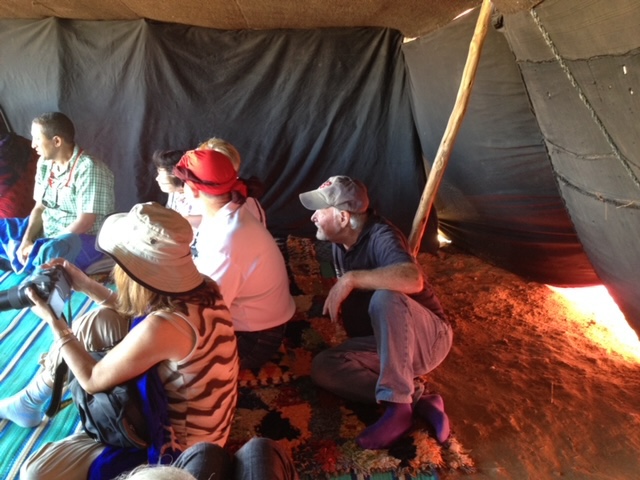
Eliot, Ruth Steinik Greenberg, Howard Greenberg and I went on a trip to Morocco, October 2014. Because of Ruth, Eliot and I traveled the world with the Greenberg’s every year on budget tours. I quickly learned you don’t have to spend a lot of money to have the best of times. Morocco was a fabulous. My heart breaks to think of what’s going on there today. We all want to go back. Each city was stunning and special. We went to Casablanca, Marrakesh, Essouira, Ourzazate, Erfoud, Sahara Desert, Fez, and Rabat. Once again, thank you Ruth. You never thought I would show up each time at the airport. I hated leaving work. After each trip, I hated going back. Xoxoxoxo
Linda Evangelista, the supermodel made famous in the 1990s, revealed in an interview that she survived breast cancer twice in five years.
The fashion model described her diagnoses and multiple health challenges in an interview with The Wall Street Journal Magazine that was published on Tuesday.
Ms. Evangelista, 58, said she was first diagnosed in 2018 after an annual mammogram. The magazine noted that it was the first time she had spoken publicly about her cancer.
Ms. Evangelista did not immediately respond for comment on Tuesday.
In response to her diagnosis, she said, she chose to undergo a bilateral mastectomy, “thinking I was good and set for life. Breast cancer was not going to kill me.”
However, four years later, in 2022, she learned that the cancer had returned, this time in her pectoral muscle.
She recalled telling her surgeon, “Dig a hole in my chest.”
“I don’t want it to look pretty. I want you to excavate. I want to see a hole in my chest when you’re done,” she had said to her doctors. “Do you understand me? I’m not dying from this.”
After a second surgical procedure, Ms. Evangelista in the interview described her current prognosis as “good,” as told by her post-cancer care oncologist.
However, she said, her doctor had given her a “horrible oncotype score,” a number that represents the risk of cancer recurrence.
Still, she said, the uncertainty has made her days more valuable.
“I know I have one foot in the grave, but I’m totally in celebration mode,” she said.
Breast cancer diagnoses have not been the only health issues for Ms. Evangelista in recent years.
Two years ago in an Instagram post, she revealed that side effects from CoolSculpting, a “fat-freezing” procedure, had left her “permanently deformed” and “brutally disfigured” as she had developed paradoxical adipose hyperplasia, an effect in which firm tissue masses develop in the treatment areas.
The condition, she said, caused her to become depressed and reclusive after “not looking like myself any longer.”
She subsequently sued Zeltiq Aesthetics, the company behind the procedure, for $50 million and settled in July 2022for an undisclosed amount.
Ms. Evangelista was one of the top five supermodels in the world in the 1990s, and she has continued to work and has stepped back into the spotlight since her CoolSculpting procedures and side effects. The interview was part of a publicity effort to promote the release this month of a book of photographs of Ms. Evangelista by her longtime collaborator, the fashion photographer Steven Meisel.
In 2022, she appeared on the cover of British Vogue, and beginning on Sept. 20, she will appear in a new Apple TV+ documentary, “The Super Models.” The project will reunite her with other 90s-era supermodels including Christy Turlington, Naomi Campbell and Cindy Crawford. In 1990, the four women famously appeared lip-syncing the lyrics in the George Michael video, “Freedom! ’90.”
Unemployment is near historic lows, and inflation has come way down. We are inflicting a strategic humiliation on Russia by arming Ukraine without putting American forces at risk. The homicide rate fell by about 10 percent across 30 cities compared with last year. Democrats defied electoral trends by holding the Senate, scoring major legislative victories and easily confirming a Supreme Court nominee.
Why, then, do only 20 percent of voters rate the economy as “excellent” or “good,” versus 49 percent who call it “poor,” according to a New York Times/Siena poll? Why are Americans overwhelmingly pessimistic about the country’s future, according to the Pew Research Center? Why does Gallup find a significantly smaller percentage of Americans have confidence in the presidency today than they did in the last, disastrous year of Donald Trump’s tenure? And why is President Biden polling dead even with his predecessor in multiple surveys despite the former president’s 91 felony charges?
Listen to ‘Matter of Opinion’
Three Opinion writers on Trump’s winning strategy, and whether DeSantis — or Biden — stand a chance.
In short, with everything so great, why are people so down? That’s a question that, as The Times’s Reid Epstein wrote last week, stumps the White House and its political allies, who seem to think the problem is a failure to communicate all the good news.
But there’s another explanation: The news isn’t all that good. Americans are unsettled by things that are not always visible in headlines or statistics but are easy enough to see.
Easy to see is the average price of a dozen eggs: up 38 percent between January 2022 and May of this year. And white bread: up 25 percent. And a whole chicken: up 18 percent. As for the retail price of gasoline, it’s up 63 percent since January 2021, the month Biden became president.
Yet none of these increases make it into what economists call the core rate of inflation, which excludes food and energy. The inflation ordinary people experience in everyday life is not the one the government prefers to highlight.
In New York, there were at least 66 arrests. In Boston, just 13.
Easy to see is that the kids are not alright. The causes are many; social media companies have a lot to answer for. But so do teachers’ unions, handmaids of the Democratic Party, who pushed to keep school doors closed during the pandemic, helping themselves while doing lasting harm to children. The Biden administration spent much of its early months saying it wanted more than half of schools open at least one day per week by the 100th day of his presidency.
“It is a goal so modest and lacking in ambition as to be almost meaningless,” Politico’s Playbook newsletter noted at the time.
Easy to see is that the border crisis has become a national one. In May the administration boasted that new policies had contributed to a sharp declinein the “number of encounters” between border patrols and migrants crossing the southwestern border illegally. By August, arrests of migrants who crossed the border with family members had hit a monthly record of 91,000. In New York City alone, more than 57,000 migrants seek food and shelter from the city’s social services on an average night.
Nobody can say for certain how many migrants who crossed the border during Biden’s presidency remain in the U.S., but it’s almost certainly in the millions. In 2021 the president dismissed the initial surge of migrants as merely seasonal. “Happens every year,” he said.
Easy to see is that the world has gotten more dangerous under Biden’s watch. The president deserves credit for arming Ukraine, as he does for brokering a strategic rapprochement between Japan and South Korea. But he also deserves the blame for a humiliating Afghanistan withdrawal that almost surely played a part in enticing Vladimir Putin into launching his invasion of Ukraine and whetted Beijing’s appetite for Taiwan.
How large a part is unquantifiable. Yet it was predictable — and predicted.
Easy to see is that the president is not young for his age. The stiff gait and the occasional falls. The apparent dozing off. The times he draws a blank or struggles to complete a thought. Yet the same people yelling #ResignFeinstein or #ResignMcConnell don’t appear to be especially vocal when it comes to the president’s fitness, as if noting the obvious risks repeating a Republican talking point.
But people notice, and they vote.
Easy to see are tents under overpasses, from the Brooklyn-Queens Expressway in New York to the I-5 in Seattle. And the zombified addicts passed out on sidewalks in practically every city and town. And the pharmacies with everyday items under lock and key to prevent shoplifting. And women with infants strapped to their backs, hawking candy or gum at busy intersections. And news reports of brazen car thefts, which have skyrocketed this year.
“There is a great deal of ruin in a nation,” Adam Smith said. Not all the ruin mentioned above is Biden’s fault, and none of it is irreversible. But there’s much more ruin than his apologists — blinkered by selective statistics and too confident about the president’s chances next year — care to admit.
Roy Lichtenstein and Irving Blum: They Go Way Back
LWH—“I’m sorry I started so late in the business of art. Stories like this make me so happy to learn how relationships developed and certain artists became popular.”
Blum was the dealer who introduced the West Coast to Pop Art and Lichtenstein’s works in the 1960s. Now he’s showing his friend’s rarely seen sculptures.
(Robin Pogrebin reported from Los Angeles, where she is based as the West Coast culture correspondent).
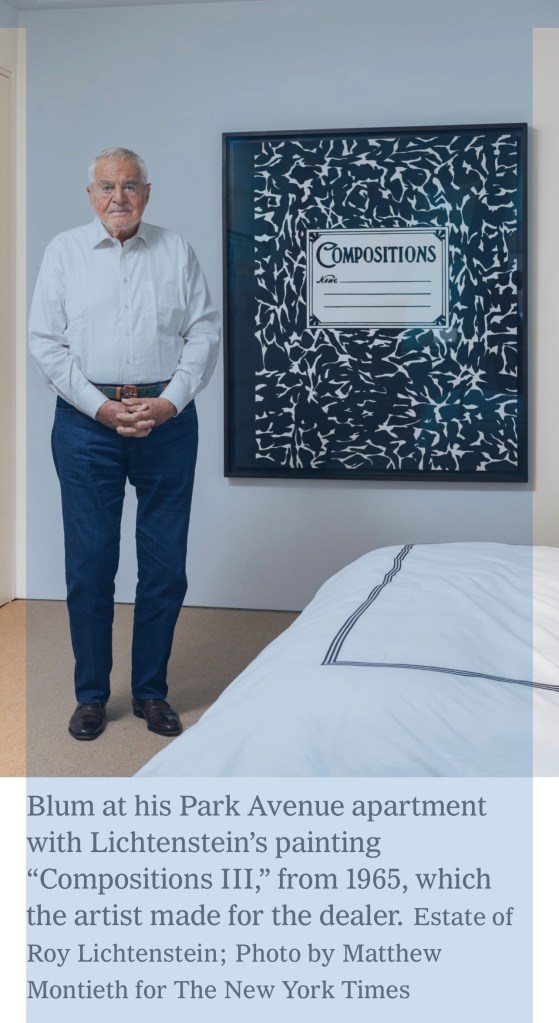
The art dealer Irving Blum remembers walking into Leo Castelli’s New York gallery in 1965 and being taken by Roy Lichtenstein’s painting of a composition book, because he himself had carried one throughout grade school.
Blum called Lichtenstein, a friend of his, and said he needed to see the Pop artist. “He said, ‘How urgent?’” Blum recalled. “I said, ‘Life or death.’ He said, ‘Come on over.’”
At Lichtenstein’s studio, Blum told him he was determined to buy the painting. But it had already been sold to the dealer Ileana Sonnabend, Castelli’s wife. “I said, ‘Roy, I’ve got it: I’ll marry Ileana. I simply have to have that painting.’”
Two months later, a crate arrived at Blum’s gallery with a duplicate version of the composition book and a note from Lichtenstein: “Dear Irving, Not necessary to marry Ileana. Best, Roy.’”
The exchange speaks to the closeness shared by the two men, and now Blum has organized a show of his friend’s rarely seen sculptures that opens at Gagosian on Madison Avenue in New York on Sept. 9 in honor of the centenary of Lichtenstein’s birth.
“I really adored him,” Blum said in a recent interview at his spacious, art-filled home in Bel Air, which he shares with his wife, Jackie. “I love the work, and I bought several things for myself.”
The dealer, now 92 and long retired, drew on his warm memories of the artist when preparing the exhibition, “Lichtenstein Remembered,” which includes about 20 sculptures that haven’t before been shown as a group.
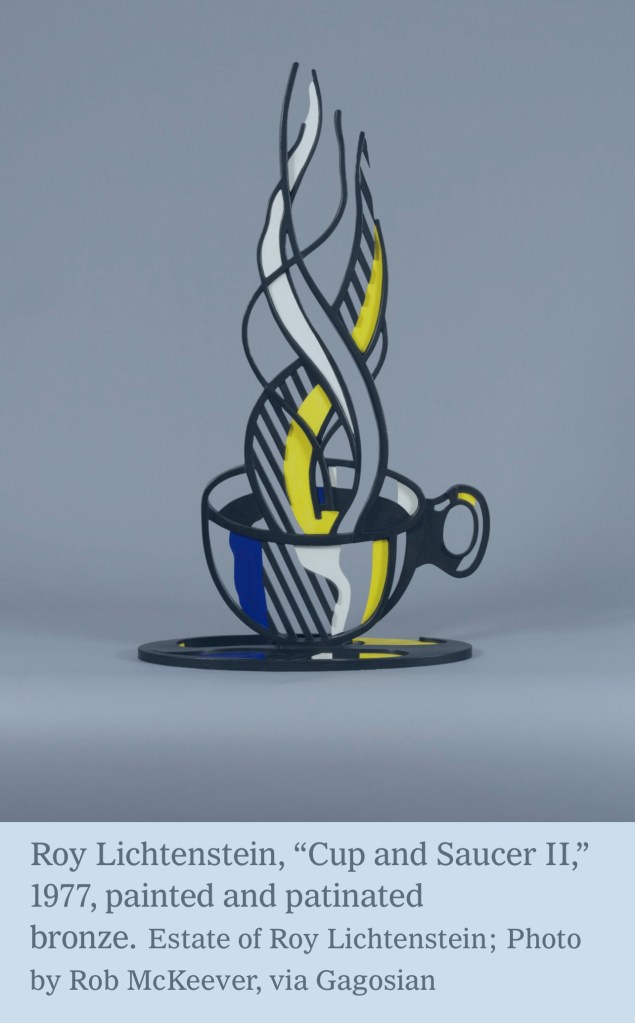
The three-dimensional works — mostly of painted bronze, some of which will be for sale — are like Lichtenstein paintings brought to life, with bold lines of black, yellow, white and blue. “The colors and the palette relate to the colors in many of his paintings, but he really found a way to make sculpture that stands on his own,” the dealer Larry Gagosian said, adding that Blum “has a long history with Roy and Dorothy.”
The artist’s widow, Dorothy Lichtenstein, who is publishing the comprehensive catalogue raisonné on Lichtenstein’s birthday in October, said sculpture was integral to his practice. “Whether he was doing surrealism or German abstractionism, he always made sculpture to go with that,” she said. “It’s whimsical. It has wit and affection.”
Lichtenstein liked to explore the idea of solidity, Dorothy said, which is why he was drawn to making images of water. “Freezing a brush stroke — which is such a free thing — and conceptualizing it, I think intrigued him,” she said. “Water represented something flowing, but also solid in bronze. Or the smoke from a cup of coffee rising. He was always playing back and forth with those images.”
Dorothy said she asked Blum to organize the show because “he really knows Roy’s work from the beginning as a Pop artist” and he and her husband complemented each another. “Irving is very outgoing, and Roy was rather reticent,” she said. “They had the same sense of humor and irony.”
Lichtenstein showed with the famous dealer Castelli, whom Blum sought to emulate when in 1958 he bought the artist Edward Kienholz’s share of the Ferus Gallery on North La Cienega Boulevard in Los Angeles for $500. Blum ran Ferus with its other founders, Walter and Shirley Hopps, until Walter left in 1960 to become a curator at the Pasadena Art Museum in California (now the Norton Simon). After that, Blum ran Ferus on his own until it closed in 1966.
Blum gave Castelli’s artists a Los Angeles platform at Ferus. “He was a big influence,” Blum said. “Whenever I’d go to New York — I couldn’t afford to go more than a couple of times a year — that was my first job: to see Leo and talk about what he was doing.”
“It was hard at the beginning,” Blum said. “Not a lot of business.”
It was Castelli who introduced him to Andy Warhol, whom Blum met at the artist’s New York studio, viewing his unfinished cartoon paintings. “I liked him, but I thought what he was doing was just too mystifying,” Blum said. “I had no way to track it.”
When Blum visited again, six months later, he saw three of Warhol’s Campbell’s Soup Can canvases on the floor leaning up against the wall. Warhol told him that he was going to make 32 of them. “I said, ‘How come?’” Blum recalled. “He said, ‘Well, there are 32 varieties, so I’m going to do them all.’”
Blum said he persuaded Warhol to let him show all 32 of them in Los Angeles in 1962 by telling the artist, “movie stars come into the gallery.”
Five of the soup cans sold, but then Blum had the idea to keep all the paintings together and the buyers agreed to sell them back, having not yet picked them up. (Only the actor Dennis Hopper initially resisted, Blum said.) Blum then purchased the set for $1,000, paying Warhol $100 a month over 10 months, and in 1996, transferred them to the Museum of Modern Art in a transaction that was part gift, part $15 million sale.
“Irving made it possible for us to buy that work of art, pure and simple,” said Glenn D. Lowry, MoMA’s longtime director. “It really gave us the arc that we needed to represent Warhol well.”
Blum has also donated other works to institutions, including Ellsworth Kelly’s “Spectrum IV” to MoMA, Warhol’s “Ten-Foot Flowers” acrylic and silk-screen ink on linen to the Met, and Frank Stella’s “Ctesiphon 1” to the Museum of Contemporary Art in Los Angeles.
Blum was a late arrival to the art world. Born Dec. 1, 1930, in New York, where his father owned furniture stores, Blum moved to Phoenix when he was 10.
After attending college in Tucson, he served in the Air Force and then went to New York, where he met Hans Knoll, the German-born furniture maker, who offered him a job at Knoll in Midtown Manhattan. Blum met the collectors who came to visit galleries in the area.
“Betty Parsons, Sidney Janis, Eleanor Ward of the Stable Gallery, Martha Jackson — they were all within walking distance,” he said. “I began going to them and visiting and chatting. A guy called Sam Kootz had a wonderful gallery and was available in a way that dealers are not available now.”
The architect and designer Florence Knoll asked Blum to help her find art to decorate a Connecticut life insurance office. Blum came back with a painting by Josef Albers — a pioneer of color in abstract art — and he was on his way. Then in 1956 the gallerist David Herbert took Blum to meet Ellsworth Kelly.
“That was the beginning of a relationship that went on for 50 years,” said Blum, who bought a small black-and-white painting from Kelly that day for $75 that currently hangs in his home. (He also has an apartment on Park Avenue.)
Blum remembers going up to the roof at Kelly’s home in Coenties Slip — a street in Lower Manhattan populated by struggling artists — where a barbecue gathering included the painters Jasper Johns, Agnes Martin and James Rosenquist.
“It was a hotbed of artistic activity,” Blum said.
In Los Angeles — where Pop Art had yet to become a common term — Blum was a bridge to the West Coast variation, showing Billy Al Bengston, Robert Irwin and Ed Ruscha. He mounted his first Lichtenstein show in 1963. In an essay for the Gagosian exhibition’s catalog, the actor and collector Steve Martin describes wandering into the Ferus gallery in the 1960s and buying a Ruscha print for $125 from Blum — “the upbeat, astute, proselytizing champion of the new art.”
From 1957 to 1966, Blum’s Ferus gallery was the heart of the Los Angeles scene, presenting the early solo shows of Ken Price, Larry Bell and Frank Stella.
“Ferus represented the pluralism of American art as well as — if not better than — any New York gallery of its era,” Roberta Smith wrote in The New York Times in 2002.
In Amy Newman’s oral history, “Challenging Art: Artforum, 1962-1974,” Philip Leider, the founding editor of Artforum magazine, said: “Without Ferus there was nothing,” adding, “Irving was the scene.”
“He spoke brilliantly, not very deeply, but brilliantly,” Leider continued, “like a dealer should.”
In 1973, Blum relocated to the Blum-Helman Gallery in New York, where he spent 20 years.
Sitting at his dining room table recently, Blum gestured to one of his favorite Lichtenstein paintings, which dominates his entry foyer, “Two Paintings: Dagwood, 1983,” featuring the comic-strip character and two other images separated by vertical lines.
Blum recounted his experience with the painting through his dialogue with Lichtenstein: “He said, ‘How do you read it?’” Blum recalled. “I said, ‘I read it as a portrait of Dagwood.’ He said, ‘It’s more complicated. It’s art history in the 20th century: On the left hand side is Expressionism, in the middle Formalism and at the end Pop.’”
“He said it encapsulates all of it,’” Blum continued. “And I said, ‘I’ll buy it.’”
A man with terminal cancer was told he only had a few months to live. He returned to his homeland of Ikaria, Greece — a Blue Zone — and lived for 3 more decades.
By Hilary Brueck,
Stamatis Moraitis.
Stamatis Moraitis was diagnosed with terminal lung cancer when he was in his 60s.
He moved from the US back home to Ikaria, Greece to die.
Instead, Moraitis spent an additional 32 years thriving in his ancestral home, which is a longevity hotspot.
When Stamatis Moraitis was 66 years old, his doctors told him he had just six to nine months left to live.
Moraitis, who’d spent most of his adult life living in suburban New York and Florida, was getting short of breath, unable to finish a day of work like he used to. It’s terminal lung cancer, his American doctors all said.
So, the Greek father of three decided to move back to his homeland, on the isolated Mediterranean island of Ikaria , with his wife Elpiniki. He didn’t want his family to be burdened with the thousands of dollars he knew an American funeral would cost. Let me be buried beside my family, by the sea, and where it’ll only cost my relatives a few hundred dollars , he thought.
But back on Ikaria, the Greek island parked halfway between Athens and Turkey, something remarkable happened. Moraitis didn’t know it at the time, but he was returning to a unique, isolated spot, an island where people routinely live past 100. He had entered a Blue Zone .
Eventually, he started planting grapevines for a backyard vineyard. He recognized he would not be around to enjoy the wine by the time the plants were ready for harvesting, but at least his wife would have the vines as a tangible way to remember him.
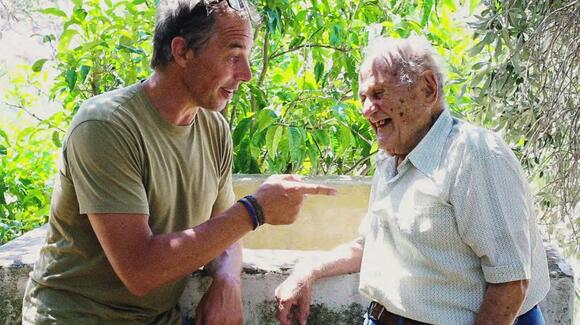
Three decades later, he was still above ground, and cultivating all sorts of fruits and vegetables — including grapes for wine and olives for oil — on his family’s homestead, when author and longevity expert Dan Buettner visited Ikaria to learn about the island’s longevity tricks.
“I asked him: what’s your secret?” Buettner said, in the new Netflix docuseries “Live to 100: secrets of the Blue Zones.” “He just kind of shrugs his shoulders and goes ‘I don’t know! I guess I just forgot to die .'”
Where you live can impact your longevity
Dan Buettner and Stamatis Moraitis.
Netflix
We can’t know for sure exactly what happened to Moraitis, precisely why he lived an additional three decades after his terminal lung cancer diagnosis. It’s possible that Moraitis might have had some unique genetic qualities that so-called SuperAgers often exhibit , which can help protect them from diseases like cancer taking over.
But, Buettner suspects there is also, likely, a major component of our longevity that is not about who we are inside, but rather, what we surround ourselves with — the people, the plants, the air, the lifestyle. One oft-cited study of Danish twins suggests genetics are only responsible for about 20 to 25% of our longevity.
“He didn’t do anything consciously to try to get healthier,” Buettner said. “All he did was change his environment.”
The projects include more opportunities for walking and exercising, improving sidewalks and building out bike lanes, as well as making healthier, plant-based meal options more accessible at grocery stores and restaurants, and providing opportunities for people to connect with their purpose, through volunteering, walking groups, gardening, or mural painting.
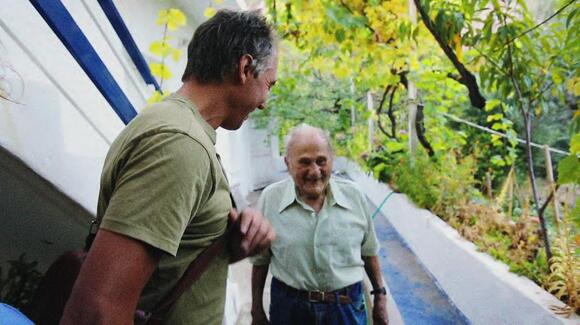
Dan Buettner met Stamatis Moraitis in his backyard garden.
For Moraitis, his environment had him climbing up a ladder to pick olives and harvest grapes up until the very end of his life.
“I’m still drinking wine and working,” Moraitis told the BBC in early 2013 , just a few weeks before his death, at 98 years old (or was it 102? Moraitis couldn’t ever remember, exactly). “I’m no doctor, but I think the wine helped. I’ve done nothing else, except eat pure food, pure wine, pure herbs.”
His daily chores gave him purpose. If he wanted to cook with olive oil, or drizzle it on his salads, he had to go out and get the olives to press.
“Easy or not, tough! I have to do it,” he said with a laugh. Read the original article on Insider
Pablo Picasso and J. Robert Oppenheimer, as played by Cillian Murphy.GEORGE STROUD/GETTY IMAGES; COURTESY UNIVERSAL PICTURES
In Christopher Nolan’s three-hour biopic Oppenheimer, there are just as many atomic bomb tests as there are Picasso paintings: one each. But both figure prominently at different moments in this film, which is nested with allusions to elements from J. Robert Oppenheimer’s life that aren’t represented, including a surprising connection to Picasso’s work that dates back to the physicist’s childhood.
Early on in the film, Oppenheimer, as played by Cillian Murphy, rises as a physicist in training. He meets the legendary scientist Niels Bohr, who devised a legendary model for atoms that is still used today, and is turned on to the magic of the discipline. “Can you hear the music?” Bohr asks Oppenheimer at one point, referring to the imagined sounds of invisible particles going about their business.
Oppenheimer can, and we do, too. Against Ludwig Göransson’s swooning score, the camera journeys down from the clouds and into an unnamed museum, where Oppenheimer admires Woman Sitting with Crossed Arms (1937), a painting now held by the Musée Picasso in Paris. It’s one of many images Picasso painted of Marie-Thérèse Walter, the woman who Picasso began seeing romantically when he was 45 and she was 17 in 1927.
Picasso’s image of Walter is notably abstracted, with one eye having slid downward, one breast warping the shape of a hand underneath, and one shoulder missing entirely. Many have discussed portraits like this one as emblematic of Picasso’s violence toward women; others have acclaimed them as shining examples of formalist experimentation.
Oppenheimer would seem at first blush to side with the latter interpretation, casting this painting amid quick cuts of sparks of light and swirls of blue. These shots, in addition to representing life moving into abstraction, are meant to connote how the titular physicist has begun to conceive the bomb he would later realize. He is made to seem like a genius, not unlike how Picasso has long appeared to many.
Yet Picasso’s bad behavior has recently been cast as Pablo-matic, and the same could be said of Oppenheimer, who in this film is revealed to be a philanderer, dating at least two women who occupy small slices of his narrative, only to be disposed of when they’re no longer relevant to him. That Oppenheimer finds transcendence in Woman Sitting with Crossed Arms may not be so simple after all.
The painting’s appearance also may have something to do a with a small biographical detail that isn’t included in Nolan’s film at all but does appear in the book upon which it is based, Kai Bird and Martin J. Sherwin’s 2005 biography American Prometheus: The Triumph and Tragedy of J. Robert Oppenheimer.
Bird and Sherwin point out that Oppenheimer’s parents maintained an art collection in his childhood home. Alongside works by Rembrandt van Rijn, Édouard Vuillard, Pierre-Auguste Renoir, and Vincent van Gogh, the biographers report, there was a Blue Period Picasso painting, Mother and Child (1901). (It would appear that Bird and Sherwin are referring to a work now owned by the Harvard Art Museums, but that institution’s provenance does not list the Oppenheimer family’s collection.) If the young Oppenheimer really did see Picasso paintings such as Mother and Child, he probably would’ve appreciated the artist’s work.
Then there are the connections between Picasso’s art and science. Some have divined similarities between developments in Picasso’s art and developments in physics. In 2002, Arthur I. Miller even wrote a book that paralleled the biographies of Picasso and Albert Einstein, himself an Oppenheimer character. As Miller points out, one quote from Gertrude Stein could apply just as equally to Picasso as it could to Einstein or even Oppenheimer: “The things that Picasso could see were the things which had their own reality, reality not of things seen but of things that exist.”


























 DigiDame