Only An Audiophile Would Understand Ken Fritz’s Passion

Thank you Franklin Karp for sharing this story with me.

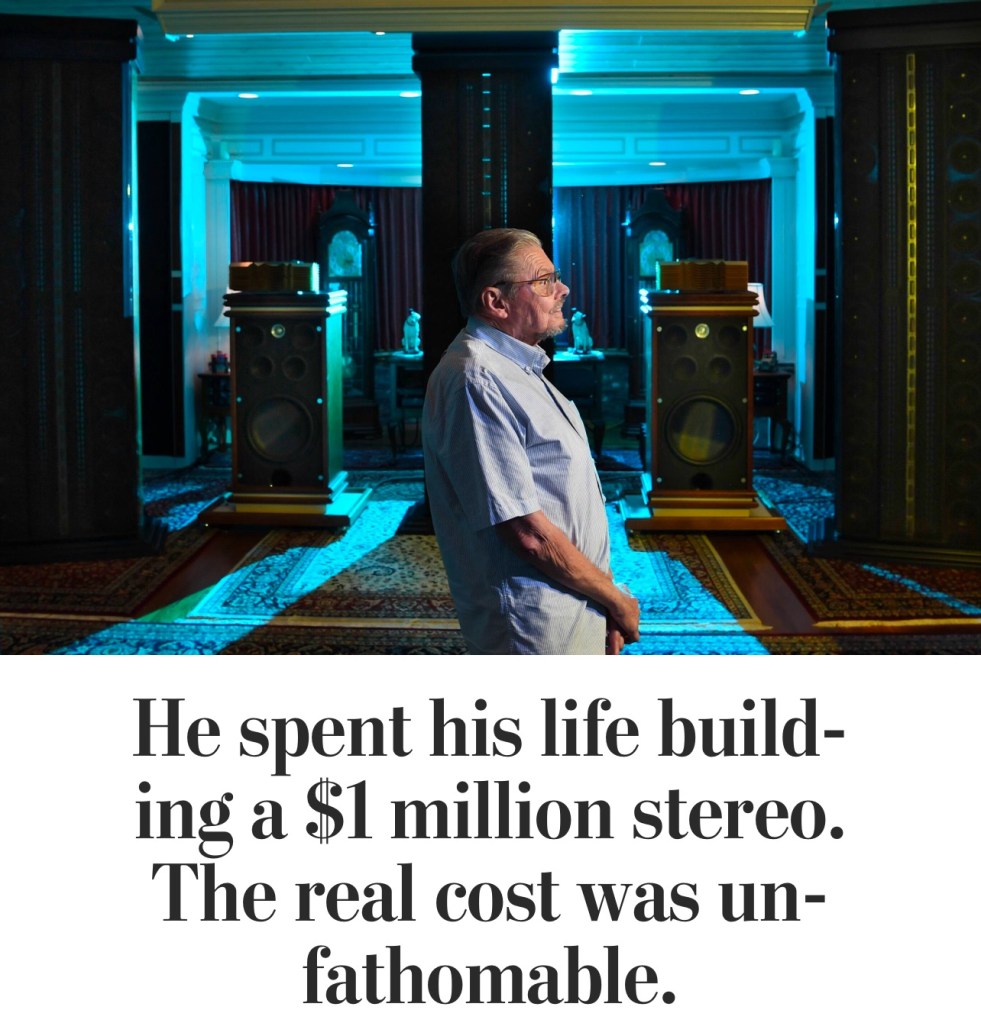
Ken Fritz turned his home into an audiophile’s dream — the world’s greatest hi-fi. What would it mean in the end?

Ken Fritz was years into his quest to build the world’s greatest stereo when he realized it would take more than just gear.

It would take more than the Krell amplifiers and the Ampex reel-to-reel. More than the trio of 10-foot speakers he envisioned crafting by hand.

And it would take more than what would come to be the crown jewel of his entire system: the $50,000 custom record player, his “Frankentable,” nestled in a 1,500-pound base designed to thwart any needle-jarring vibrations and equipped with three different tone arms, each calibrated to coax a different sound from the same slab of vinyl.

“If I play jazz, maybe that cartridge might bloom a little more than the other two,” Fritz explained to me. “On classical, maybe this one.”

No, building the world’s greatest stereo would mean transforming the very space that surrounded it — and the lives of the people who dwelt there.

The faded photos tell the story of how the Fritz family helped him turn the living room of their modest split-level ranch on Hybla Road in Richmond’s North Chesterfield neighborhood into something of a concert hall — an environment precisely engineered for the one-of-a-kind acoustic majesty he craved. In one snapshot, his three daughters hold up newsiding for their expanding home. In another, his two boys pose next to the massive speaker shells. There’s the man of the house himself, a compact guy with slicked-back hair and a thin goatee, on the floor making adjustments to the system. He later estimated he spent $1 million on his mission, a number that did not begin to reflect the wear and tear on the household, the hidden costs of his children’s unpaid labor.

“My dad had a workshop,” is how Rosemary, the youngest girl, now 56, puts it. “We were forever building, rebuilding.”

But for the final flourish of his epic engineering project, in 2020, Fritz would go it alone.

He found just the right suction cups, four in total and the perfect size, from a company in Germany. He ordered a small vacuum pump online.

It would allow him to place a record on the turntable without even lifting the disc.

It was hardly the Frankentable’s most expensive enhancement, but it would fulfill a desire he could scarcely have imagined when he began his lifelong search for the perfect sound:
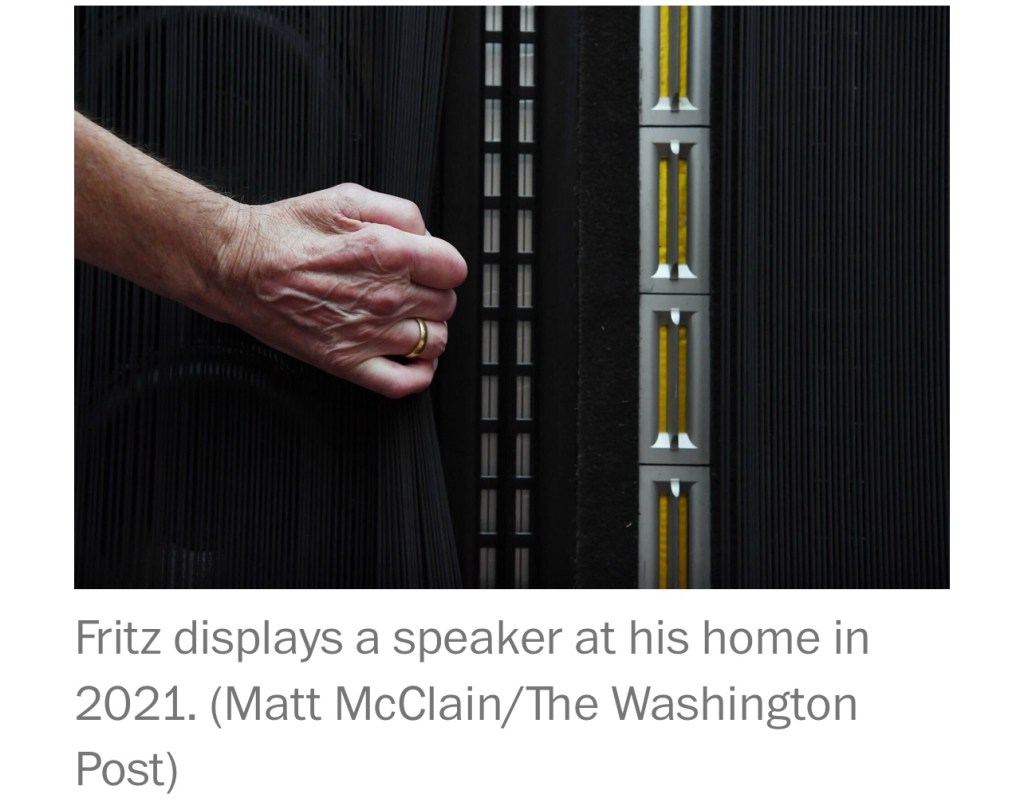
What’s the value of the world’s greatest stereo? Soon, everyone would know. But for now, just hit play.

Camille Saint-Saëns’s Symphony No. 3. It’s a favorite. Famous for its glorious pipe organ, it was the last symphony finished by the great French romantic composer.

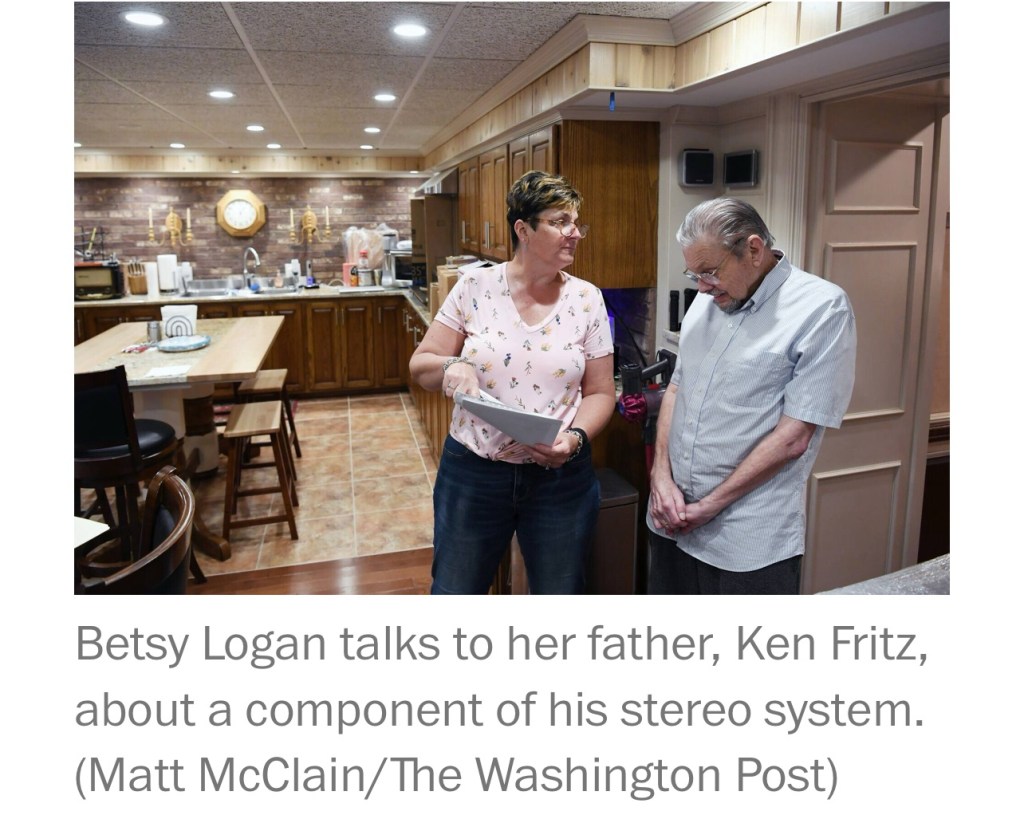
“Should we listen, Dad?” asked Betsy, 59, the oldest of Fritz’s five children, and the only one up to help inventory his life’s work as his 80th birthday approached.

Fritz laughed.

“You won’t get a no from me,” he said.

The music builds slowly, lush strings answered by woodwinds, until the organ crashes into the mix and sparks a cascading piano dialogue that requires four hands. Its fullness and power washed over Fritz’s listening room.

He was a boy at the dawn of the hi-fi revolution. This was 70 years ago, long before holograms and virtual realities tried to fool our brains into seeing something that’s not there, when stereo first sold us an auditory experience like no other.

Just lower the needle, and an invisible 70-piece big band was transported into your living room — or a whispering crooner would come to life on the couch cushion beside you.

The trick, pioneered in the early 1930s by engineers working at Bell Labs in New York and Abbey Road Studios in London, was in the two channels of sound. Recorded from separate microphones and played back through separate speakers, they could simulate the swirling warmth and depth of life.

By the 1950s, the first bulky hi-fis were marketed for home use, blowing open the closed feel of the old phonographs — and offering a newly affluent nation a sophisticated new field of connoisseurship to conquer. The Mantovani Orchestraor Rosemary Clooney, pouring out of the Klipschorns with the after-dinner martinis.

One day, Fritz’s teacher at his Milwaukee grade school set up a turntable and speakers in the classroom. He was stunned by the beauty of the classical music. But he was especially thrilled by the sense of being on the cutting edge of a new technology.

Within a couple of years, teenage Fritz had bought his own recording machine and started capturing the music of live bands. He started the Hi-Fi Club at Bay View High School and took a part-time job in an appliance store that sold audio gear. With his earnings, he picked up a Heathkit, one of the hot, new build-it-yourself amplifiers, for $49.

You probably know a Ken Fritz. Maybe you are a bit of one yourself. Prosperous mid-century America produced a lot of Kens. The kind of people who gave their all to their hobbies — bowling, gardening, woodworking, stamp collecting — and refused to pay somebody else to manifest their dreams for them.

Like a lot of kids born to the children of the Depression, Fritz absorbed his DIY ethos from the previous generation. When their ’51 Chevrolet broke down, Ken Fritz Sr. didn’t have the money for a mechanic. So he took the engine apart himself and figured out how to install new piston rings. “He had never done that before,” Fritz recalled. “But he was smart enough to know how.”

At an audio show in 1957, Ken Jr. met Saul Marantz — an engineering legend in this burgeoning field, who a decade earlier had been so driven to convert an old car radio for home use that he took it apart and reconstructed it into a new invention, a preamplifier he dubbed the Audio Consolette. For a kid like Fritz, it was better than meeting Willie Mays.

“He looked like the guy on ‘Breaking Bad,’ just a little, but smaller,” Fritz recalled. “I told him I wanted to buy his amplifier. He knew I didn’t have the money.”

Fritz persuaded his boss at an audio shop to set Marantz up as a dealer. That earned him a discount, though he still had to work Saturdays to make up the rest.

After college, he worked for a business that made fiberglass molds and eventually moved to Virginia. He started his own company there, settling into the family home on Hybla Road in the mid-’70s.
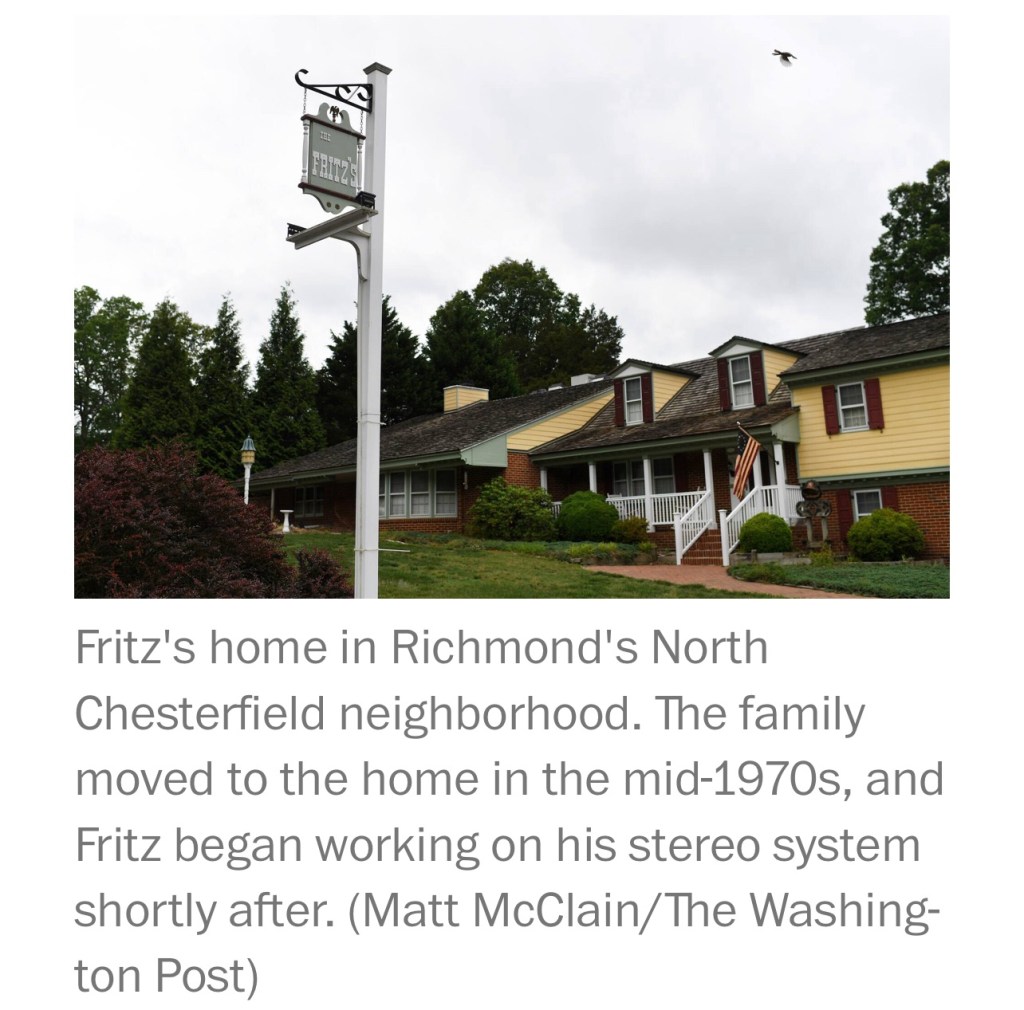
He added a workshop and eventually built a swimming pool, something of a sop to his wife, Judy, and their kids, since he was too busy for travel or vacations. His company consumed the days. His audio obsession filled the nights and weekends.

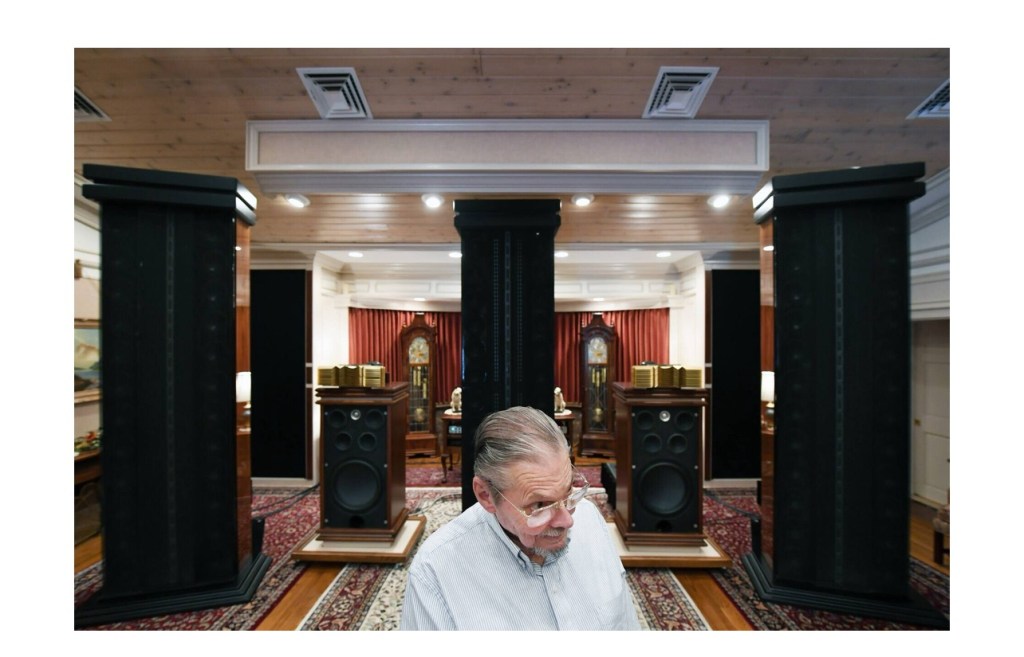
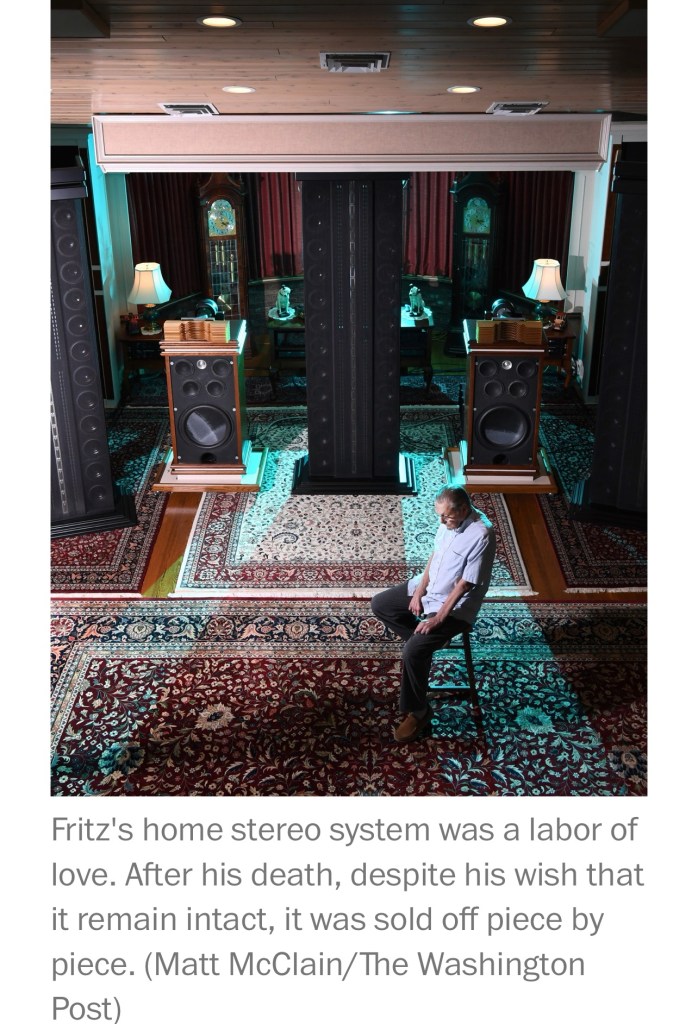
In the 1980s, Fritz launched his project by blowing up the living room into a listening room, a 1,650-square-foot bump-out based on the same shoe box ratio, just under 2 to 1, that worked magic in concert halls from the Musikverein in Vienna to the Concertgebouw in Amsterdam. The idea was that the acoustic waves would similarly roll off Fritz’s long, cement-filled walls and 17-foot-high, wood-paneled ceiling to bathe the listener in music.

He got his older son, Kurt, to help pour the concrete floors. Then he worked alongside a construction crew to put up the 12-inch-thick walls and the sound panels to line them.

To minimize hum and potential electrical interference, Fritz outfitted the room with its own 200-amp electrical system and HVAC system, independent from the rest of the house.

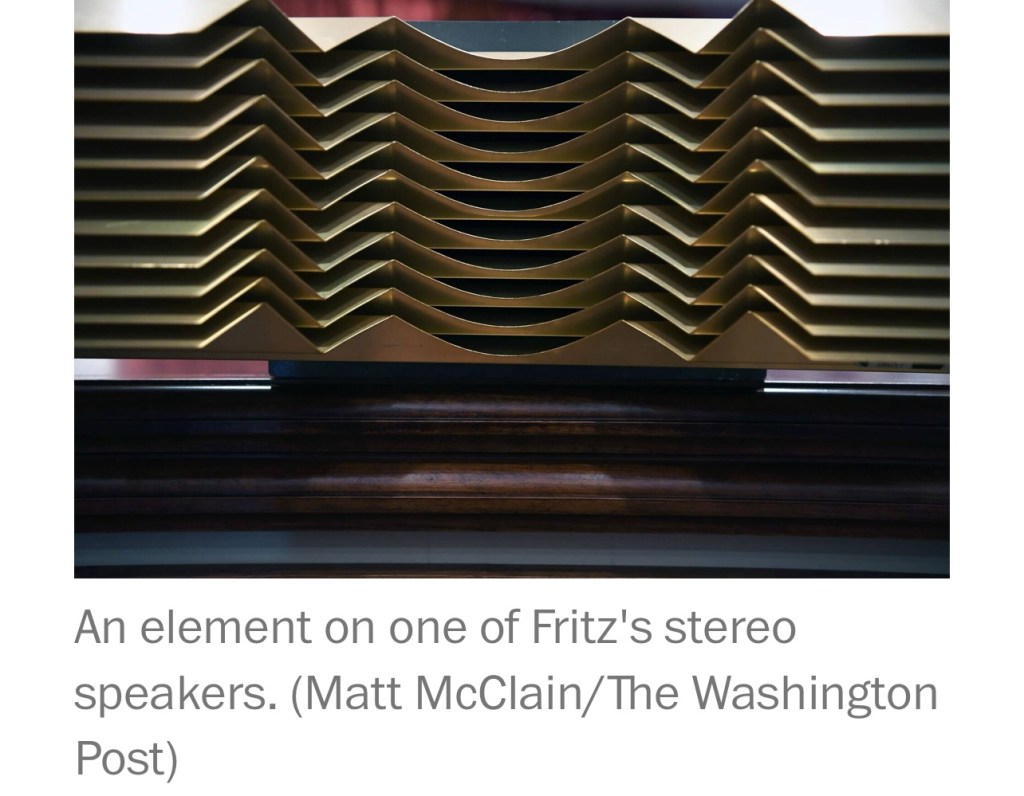
He crafted by hand the three 10-foot speakers that loomed like alien monoliths at the head of the room, with the help of Paul Gibson, a former employee at his fiberglass company. Each 1,400-pound slab pulsed with 24 cone drivers for the deeper tones and 40 tweeters — 30 shooting into the room, 10 toward the crimson curtains draping the wall behind — to project the upper-range sounds.

He bought only a few of the components ready-made from a retailer. Fritz and his audiophile friends believed it was idiotic to invest in the kind of top-shelf equipment that gleamed from the glossy pages of High Fidelity magazine. Only a home-crafted system could achieve the audio you desired.

“You’re going to spend $250,000 for the name brand on the rack so everybody comes in and will be impressed,” scoffed Mark Mieckowski, a retired electrician who had helped Fritz fine-tune his system over the years. “DIY, there’s no name tags, nobody knows nothing. And I guarantee you those will probably sound a million times better.”

It was thrilling work. At night, Fritz would lie in bed and think about the progress he had made that day and the tasks that lay ahead for the next.

“I firmly believe that by the time a person, man or woman, is 19, 20, 21, they know what they’re going to do with their life,” he said. “And if you’re on that path and things are being done to your satisfaction, it’s easy to keep going to look for the next goal.”
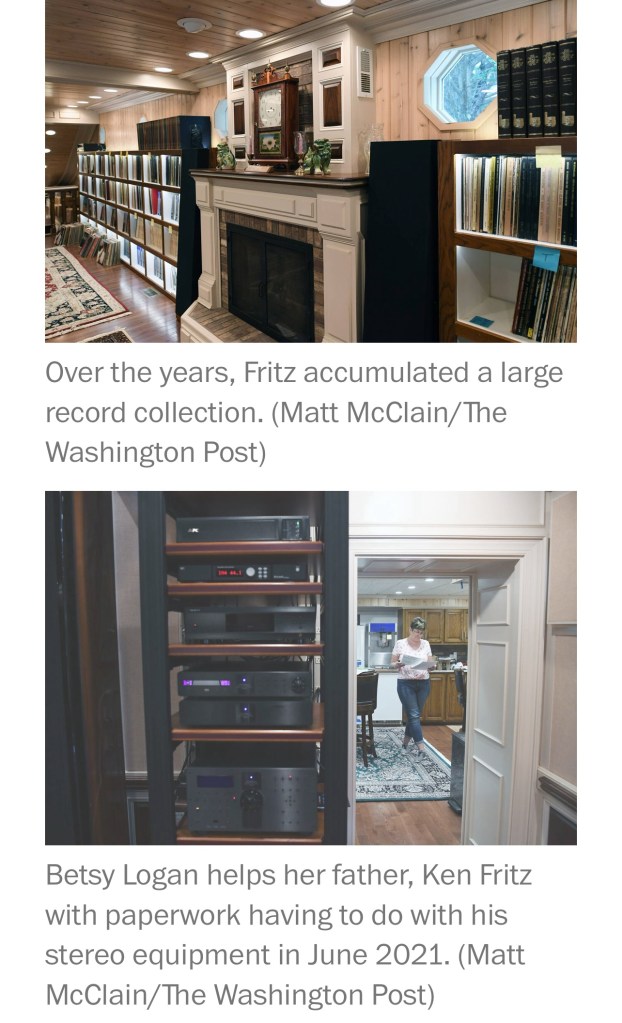
Not everyone in the rapidly metastasizing house on Hybla Road shared this excitement.

In the faded photos taken as they worked alongside him, the five Fritz kids are offering pinched smiles, at best.

“Nobody wanted to come to our house, because he wanted to put them to work,” said his daughter Patty, 58. “I think we went camping twice, never took vacation. It was just work, work, work.”

Fritz thought he was teaching them about hard work and focus. A hard-driving boss at his company, he brought the same energy to his after-hours hobby, which he sometimes seemed to think of as everybody’s hobby.

He could be short. He held grudges. Devoted to sound, he often seemed not to listen.

Judy drank too much in those days. She also was unimpressed by her husband’s music. When he played “Swan Lake,” she’d call it “Pig Pond” in front of the kids and crank up the TV to annoy him.

After the divorce, she stopped drinking and found a longtime partner. Fritz moved on as well, finding happiness with Sue, who worked on making molds at his company; they married in 1995.

The biggest strain remained with older son Kurt, whom Fritz had once hoped would take over his business. But Kurt moved to New York for a job as a technology consultant. He needed the distance.

“Growing up, I had to get up at 6 in the morning to work,” Kurt, 55, said. “I basically was his slave.”

As he got older, Fritz sometimes wondered if he could have made space within his own vast ambitions to consider other people’s goals and wishes.

“I was a father pretty much in name,” Fritz told me. “I was not a typical father or a typical husband.”

The big blowup with Kurt came in 2018, about two years after Fritz had declared that, at last, the world’s greatest stereo and listening room was complete. Kurt, on a visit home, decided to ask his father for a couple of family heirlooms: his grandfather’s 1955 Chevy and an old Rek-O-Kut turntable.

It wasn’t the size of the ask. The record player wasn’t worth more than a few hundred dollars. But the tone of the demand set off Fritz. He heard in it a sense of entitlement.

“It could have been a monkey wrench, the way he told me,” Fritz recalled later. “I told him: ‘Not going to happen.’”

It was past 1 a.m. when Kurt, with a few drinks in him, told his father he was going to stay up later and listen to some more music. All the work he had put into building that stereo system — pouring concrete, painting the walls — now Kurt wanted to enjoy it.

But Fritz hit the off switch on the Krells. And Kurt delivered the words the two of them could never come back from.

“I need you to die slow, m—–f—–,” he told his father. “Die slow.”

His meaning was coldly clear to both of them.

Just a few months before, Fritz had noticed a weakness in his right hand. The diagnosis: amyotrophic lateral sclerosis — the progressive and inevitably fatal neurological disorder known as ALS.

That was it. Fritz called his attorney and disinherited Kurt.
His doctor had explained the cruel reality of Fritz’s disease. A small percentage of people go on to live years with ALS, continuing to work and function. But for most others, the transformation is rapid and devastating. People in the prime of life and health are robbed of muscular control and eventually the ability to speak, swallow and breathe.

For Fritz, there was initial hope, as he began treatment at Duke University Medical Center in North Carolina and continued to stay on his feet, that his case would progress slowly. But one day in 2020, he tried to use the Frankentable and found he couldn’t lift his arms.

“I can’t listen to these records anymore,” he told Sue.

“Well, if you want to sit down and tell me what you want to hear, I can put it on,” she replied.

But Fritz was not ready to relinquish control over his creation. That sparked the suction-cup idea. Fatal condition? Like all other hurdles on the path to the world’s greatest stereo, he would simply try to out-engineer it.

His plan was ingenious. It would involve rigging the suction cups to secure a record so he could shift it onto the turntable with a mere flip of a switch — a tiny gesture he felt confident his failing body would still allow for a while.

But before getting too deep into the project, he stopped. His neurological deterioration was accelerating. By the time he finished constructing the device, he realized, he wouldn’t even be able to remove a record from its sleeve.

A friend in Texas mailed Fritz a hard drive packed with thousands of songs, from Motown to Mozart. Now he could play music with his iPad. It might not have had the analog warmth of a Shaded Dog vinyl pressing of Arthur Rubinstein playing Beethoven, but on the Fritz system, through those mighty speakers, it wasn’t half-bad.

His younger son, Scott, 49, offered another welcome distraction.

They, too, had clashed over the years and occasionally stopped talking. Scott didn’t like how his father sometimes treated people. There was the time that Fritz blew up when a friend didn’t return some borrowed microphones promptly and insisted Scott go retrieve them, even though the man’s wife had just died. And Scott hatedhow his dad acted toward Kurt.

“He definitely taught me my work ethic,” Scott said. “But I don’t need to spend time with people who behave like that.”

Still, the two maintained a special bond, Scott having followed their shared passion into a career as a sound engineer in Chicago. In 2018, he and a filmmaker friend, Jeremy Bircher, drove to Virginia to make a documentary: “One Man’s Dream.”

The 58-minute film opens with Fritz, moodily backlit at his record shelves, grazing a hand across the jacket spines before landing on Tchaikovsky’s “Swan Lake.” In slow-motion close-ups, we see him press the disc to the turntable with a custom weight, lower the needle of an Air Tight PC-1 cartridge to the spinning grooves and carry a glass of wine to the paisley wing chair in the center of the Historic Williamsburg-meets-Victorian listening room. He faces those stalagmite speakers as the brass section collides with the swooning strings, taking it all in with a mesmerized smile.

Some audio professionals found it unbearable.

“You’re mining the lunatic fringe,” Jonathan Weiss, the owner of Brooklyn-based high-end audio boutique OMA, warned me when I told him about this story. Fritz, he argued, was the kind of obsessive who gives audiophiles a bad name.

But Steve Guttenberg, host of the popular Audiophiliac YouTube channel, shared the documentary with his 240,000 subscribers, calling Fritz “one of a kind.” It has now been viewed more than 1.9 million times on YouTube.

“This room/house must be listed in UNESCO World Heritage List. So much passion, soul and heart!” wrote one of the thousands of commenters.

“This is truly something that needs to be conserved,” wrote another, “as a memory to this inspiring man.”
One day in April 2021, Fritz hosted a small listening party. Before the pandemic, he frequently invited the entire Richmond Audio Society for sound and sandwiches. But on this day, it was just two of his closest audio-geek friends and me.

Ray Breakall, a professional piano tuner whose record collection is split between jazz and classical, remembered the first time Fritz played for him a 1950s recording of the Chicago Symphony Orchestra with Fritz Reiner conducting.

“It was almost like the orchestra was in the room,” Breakall said. “That’s impossible if the room isn’t this size. Very scary and very realistic.”

Mieckowski — the sound buddy whose tastes ran more toward Five Finger Death Punch, a thrash-metal combo from Nevada, and who didn’t even own a turntable — was there, too.

“I can flat-out say this is the best system I’ve ever heard,” said Mieckowski. “Period.”

They talked more about the room, Fritz occasionally piping in but more often sitting back and listening, seemingly worn out. Betsy put out deli meat and rolls, and Fritz worked his way slowly through a sandwich, cutting up the pieces small enough to swallow. He seemed re-energized by the time they returned to the stereo.

“Here’s a great rock song, and it gets your juices going,” Fritz told us.

He punched up “Do You Love Me,” the 1962 hit featured so prominently in the musical melodrama “Dirty Dancing.”

And here it was, the inevitable moment in every meeting with an audiophile, when the proud owner of the system in question presses play.

I had experienced it when Weiss invited me to the OMA showroom to listen to the enormous horn speakers he sells for about $300,000 a pair; and when I sat in the cramped basement of veteran stereo-and-vinyl journalist Michael Fremer as he blasted the Beatles’ “Rubber Soul” through his Wilson speakers.

They all want to know: What do you think?

But as Fritz cranked the loudest version of the Contours hit I’d ever heard, it was impossible to listen critically. Was the bass flabby or tight? Did the mids sound right? What about the drums? The voice?

Fritz nodded, his eyes brightening. I found myself reflexively smiling, meeting his look with an expression of wonder, mouthing “wow.”

I was rooting for a man who had devoted his life to this system. I wanted it to sound better than any other. Even if I really couldn’t tell.

Was it truly “wow?” Or merely loud?

I noticed Mieckowski shake his head, involuntarily and almost imperceptibly, as soon as the music kicked in. He remained politely appreciative in front of his friend. But later, I followed him out to his car, where he confessed that, no, it sounded off that day.

He speculated that the Fritzes had probably been watching a DVD in the listening room and accidentally left the speakers on movie mode. A common mistake. But the fact that Fritz could no longer detect an imperfection in a system he had spent years honing to his impossibly high standards was a heartbreaking reminder of his friend’s physical decline.

“He can’t remember half the time what he’s listening to and what he’s left on,” Mieckowski said, referring to the system’s smorgasbord of settings.

Three years earlier, in Scott’s documentary, Fritz had talked frankly about his condition, the limited number of years that remained for him and his hope that the world’s greatest stereo system would live on without him.

“I’d hate like heck to see this room parted out,” he had said. “That’s just like breaking up a dream.”

But on this night, Mieckowski had a glimpse of the not-so-distant future. Fritz’s stereo system may as well have been a load-bearing wall. His dream had been woven into the actual structure of his home. They were virtually inseparable.

And who would want to buy a stereo that cost more than the house?

“Anybody that’s got that kind of money,” Mieckowski said, “doesn’t want to live here.”

They gathered in the listening room one last time. Ken Fritz was turning 80. His sons weren’t there. Kurt remained estranged. Scott couldn’t make it down from Chicago. But Fritz’s three daughters and their husbands came and sang “Happy Birthday.” He sat for a portrait and even had a small spoon of ice cream, as much as his constricted throat muscles could tolerate.

It was February of 2022. Six years after he had finished his life’s project. Four years after he was told he only had so much longer to enjoy it.

Betsy, while helping him inventory his collection, had observed how her hard-charging dad had softened. He was able to share his regrets about his style of fathering. But he had no regrets about the hours, weeks and years that he had devoted to the world’s greatest stereo.

At some point, Betsy flicked the power on the 35,000-watt amplifiers and put on a selection of Christmas songs. Fritz always preferred his booming classical works, but the holiday tunes worked as background music, since they still had the 10-foot tree and the garlands on the banister. And Fritz wasn’t making a lot of musical choices anymore.

He was beyond the point where music could make him feel better, especially since he could no longer operate the system himself.

In April, around the time Betsy arranged to put a hospital bed on the ground floor so Fritz could avoid the stairs, she also tried to broker a peace.

Kurt called and tried to talk to his father. Betsy urged him to take the call. Fritz refused. In the end, they never spoke. On April 21, 2022, Fritz died.

And then it fell to Betsy to try to fulfill her father’s last, greatest wish.

For a time, it looked like an old audiophile pal of her father’s would buy both the house and the system. But he and his wife changed their minds.

Betsy talked to dealers about looking for other potential buyers. They were not enthusiastic.

Adam Wexler, with the Brooklyn-based StereoBuyers, told her he could resell the Krells. The custom-designed equipment would be a lot harder.

“Hi-fi is extremely subjective,” Wexler told me later. “So this guy built something that sounded good to him. How many people out there are going to say, ‘These are the speakers for me’ — and go through the hassle of acquiring these gigantic speakers that probably wouldn’t fit in most people’s homes, even if you could get them to their homes?”

Late last summer, Betsy realized she had to let go. Another couple wanted to buy the house — but not the stereo. She made a deal with a local online auction site, eBid Local, to catalogue and sell her father’s life’s work.

These people knew nothing about concert-hall acoustics, setting the vertical tracking angle or the magic of the perfect “Swan Lake” recording. They knew marketing.

“We euphemistically refer to it as the ‘million-dollar, monumental, magical, musical masterpiece,’” said David Staples, the owner of eBid Local. “It may be the best, most elaborate and exquisite private residential audiophile system in the country, perhaps even in the world.”

Many of the records her father had spent a lifetime collecting had already been sold — and Betsy understood that the system itself would almost certainly be parceled out to multiple buyers as well.

So what, ultimately, would be the value of the world’s greatest stereo?

The auction closed just before Thanksgiving.

The Frankentable? There were 44 bids, the top at a mere $19,750.

The 10-foot-tall speakers? After 18 bids, an Indiana man named Carlton Bale snagged all three for $10,100. Less than you’d pay for a pair of Yamaha NS-5000 bookshelf speakers.

A fan of Fritz’s YouTube documentary, Bale had set out a couple of years ago to build what he imagined would be “the second-best loudspeaker in the world” — until he heard about the Fritz auction.

“I thought, ‘Do I really have the time to build the speakers I want that probably aren’t going to sound as good as the ones Ken built?’” Bale recently recalled, after driving to Virginia with a U-Haul to fetch them last month. The price, he conceded, was “a steal. The bargain of a lifetime.”

The total take for the million-dollar stereo system, including the speakers, the turntable, the dozens of other components from detached cones to the reel-to-reel decks? $156,800.

But perhaps that was always going to be its fate. Last summer, when pressed about the value of Ken Fritz’s life’s work, Staples had demurred.

The value, the auctioneer said, was whatever somebody else was willing to pay for it.
About this story

Design and development by Brandon Ferrill. Design editing by Eddie Alvarez. Photo editing by Moira Haney. Video by Allie Caren. Senior video producing by Nicki DeMarco. Audio production by Bishop Sand. Story editing by Amy Argetsinger. Additional editing by Phil Lueck and Christopher Rickett. Additional support by Maddie Driggers.

Geoff Edgers, The Washington Post’s national arts reporter, covers everything from fine arts to popular culture. He’s the author of “Walk This Way: Run-DMC, Aerosmith, and the Song That Changed American Music Forever.”

Wonderful Conversations

Enter the world of art by meeting artists, collectors, and gallerists who will tell you how and why they love their creative life.

Episode 1 —Doug Garr .

Doug Garr is a friend of mine who has spent 40-plus years as a journalist, editor, author, blogger, ghostwriter and speechwriter. Doug is the guy who helped New York Governor Mario Cuomo sound so good at the mic. If that’s not astonishing enough, Doug is also an active skydiver with an expert license rating of 2,200 jumps.

One day I will interview Doug about his life as a dare devil. Today I want him to tell us all about his connection to art.

He was married for nearly 42 years to the late Meg Perlman, a prominent art curator. Everyone in the art world knew her. Most knew Doug too because he accompanied Meg to art events around the world.

Meg was the founding director of the Pollock-Krasner House and Study Center in East Hampton, N.Y. She also worked at the Museum of Modern Art, and the Metropolitan Museum of Art. Meg was the director of the James Brooks and Charlotte Parks Brooks Foundation. Meg also served as the curator of a number of important private art collections, including those of William A.M. Burden, Mrs. John D. Rockefeller III, Sandra Rockefeller Ferry, Senator and Mrs. John D. Rockefeller IV, and the Pierre Noel Matisse Trust, among others.

Meg was the one who discovered Jackson Pollock’s paint drippings under the floor coverings of the Pollock-Krasner House and Study Center in East Hampton, N.Y. She instantly became world famous.

The Art Lovers Forum Podcast is also available on popular podcast sites:

Apple Podcasts – https://podcasts.apple.com/us/podcast/art-lovers-forum-podcast/id1725034621

Spotify – https://open.spotify.com/show/5FkkeWv83Hs4ADm13ctTZi

Amazon Music – https://music.amazon.com/podcasts/77484212-60c5-4026-a96f-bd2d4ae955c6

Audible – https://www.audible.com/pd/Art-Lovers-Forum-Podcast-Podcast/B0CRR1XYLZ

iHeartRadio – https://www.iheart.com/podcast/1323-art-lovers-forum-podcast-141592278/

Contact:
Lois Whitman-Hess
loisw@hwhpr.com

To Be Admired

Artful Living Magazine

Design Icon Ralph Lauren Takes Us Inside His Stylish Homes

By Ralph Lauren

Reprinted with permission © Ralph Lauren: A Way of Living, Rizzoli New York, 2023

What I do is about living. It’s about living the best life you can and enjoying the fullness of the life around you — from what you wear to the way you live to the way you love.

Our homes are a canvas for living. Whether we live in the city, the country, on a farm, at the beach, in a penthouse or cabin, each is home and tells our story. And just as we dress differently in each of these places, we want to live differently as well.

My homes have always offered refuge, warmth and comfort for my family and me. My recent book celebrates those homes and the collections they’ve inspired since the first Ralph Lauren Home Collection in 1983. Just like my collections for men and women, my home collections have traveled far beyond the lifestyles and borders of America. They are inspired by the way people live out their dreams all over the world.


New York City

I remember the first time I visited the Guggenheim. Walking into that white, soaring space away from the noise of the city had a powerful effect on me. When Ricky and I found our apartment on Fifth Avenue, not far from the museum, I had that feeling in mind. We wanted it to feel more like a loft, totally open and clean, and with a focus on city views. I wanted a downtown loft, but uptown on Fifth Avenue.

This was in some ways our real first home. I wasn’t looking for glamour or making an impression. It was just the simple, almost primitive desire to have a kind of freedom — room for our three children to race around and room to take stock of ourselves and to discover who we really were and what we wanted.

Personally, I needed that open space and serenity. That’s why we had the apartment done all in white — white lacquer tables, white canvas sofas — with natural bamboo armchairs, polished-wood floors and lots of plants. It was such a relief to come back to after a long day of looking at endless swatches, patterns and colors. Part of that peacefulness came from the views of the sky and the Central Park Reservoir and watching the lights coming on all over Manhattan at the end of the day.


Montauk

I think I was 25 when I first came out to the Hamptons. Even when I didn’t have a house, I’d drive out. It was so beautiful. I wanted to be able to feel the fresh air and wind. I wanted a home where I could feel simplicity and peace.

After Ricky and I were married and had our first child, Andrew, we rented a house in Southampton — a faded red barn that sat in a big meadow. It was the perfect place for a young family. A couple summers later, we moved to Amagansett. By then, Andrew had a younger brother, David, and the two of them loved chasing each other down to the beach. When Dylan was born, we found a charming shingled saltbox house in East Hampton, right on the ocean. It was in a compound of six other cottages set off from the main roads with lots of little private paths for running and biking with the children. Those summers when the children were so little are the ones I’ll always remember. Life was so simple and easy.

Then we discovered the house in Montauk. It was built in 1940 by an architect who had worked with Frank Lloyd Wright. It had such integrity, constructed to follow the contours of the land. The low ceilings and warm wood gave it a modern kind of coziness.


Colorado

When I first came to Colorado, I didn’t want to build a new house; I wanted to find an old one. Someone told me about a 100-year-old barn on a large piece of property looking out at the San Juan Mountains. I remember so well the morning Ricky and I went to look at it: the light on the meadows and striking the barn. We immediately knew this was where we wanted to live.

I love land for itself — the look and beauty of undisturbed land. I felt pained to have to build here at all, so I chose low, inconspicuous sites where the houses would be half-hidden by the trees. Driving by on the road, you could miss the Lodge, our family house. It looks like a little log cabin from the outside, but when you go inside, it seems spacious. Our pole-rail fences handcrafted of locally sourced pine border our land along the highway for more than seven miles. We constructed them so that the rails face outward for a smooth appearance. The fences are part of the journey to our home.

I love the character of old things. I built the house out of old barn wood. I wanted a screen door with a squeak. If something’s really old, let it feel that way. Over time, the Lodge has become a home to things we felt belonged here — Native Americanpaintings, pottery, woven baskets, serapes, weavings and trade blankets. Their bold color and handcrafted textures bring a special beauty and brightness against the dark wood of the cabin walls.


Bedford

Though we had our houses in the mountains and by the beach, we realized that we wanted a getaway closer to home — a place we could get in the car and drive to on the spur of the moment. We started taking drives north of the city and eventually discovered a house and property nestled in what we felt to be one of the most beautiful parts of America. There were little dirt roads that wandered through woods and fields, passing paddocks of horses, stables and weathered red barns set off by miles of rustic stone walls. It was rural yet sophisticated, which was perfect. I like faded and old — a certain kind of genteel shabbiness. It’s a reverence for integrity. This property had that; it was sort of a combination of a hunting lodge and a stately home.

The mood was right, but we wanted to give it a warmth and individuality, and at the same time, a glamour. It was the kind of house where we could express our love of antiques and timeless elegance, yet at the same time be young and eclectic.


Jamaica

When I was a kid, I always looked forward to summer because I could go out and play ball and go swimming. Then, years later, I discovered Jamaica. In the middle of winter, I could step out of time.

We went there on holiday as a young family more than four decades ago. It wasn’t long before we moved into a romantic old villa on the highest point of Round Hill, a resort overlooking the Caribbean. We called it High Rock. It had a spirit and a glamour that harkened back to the days when Grace Kelly, Noël Coward, the Astaires, Errol Flynn and Ian Fleming wintered there — there was a timelessness that we loved. Surrounded by a jungle of trees and flowers, it was our own Garden of Eden.

Commemorating the 40th anniversary of the iconic tastemaker’s home collection, Ralph Lauren: A Way of Living celebrates the timeless lifestyles and product innovations that have emerged throughout his legendary career. Reprinted with permission © Ralph Lauren: A Way of Living, Rizzoli New York, 2023.

.


Search

Ralph Lauren Bio

.

Ralph Lauren (/ˈlɔːrən/; LOR-ən; Lifshitz; born October 14, 1939) is an American fashion designer, philanthropist, and billionaire businessman, best known for the Ralph Lauren Corporation, a global multibillion-dollar enterprise. He has become well known for his collection of rare automobiles, some of which have been displayed in museum exhibits. He stepped down as CEO of the company in September 2015 but remains executive chairman and chief creative officer. As of April 2022, his net worth was estimated at US$6.9 billion.[2]

Ralph Lifshitz
October 14, 1939 (age 84)

New York City, U.S.Alma matter Baruch College occupation(sExecutives chairman, Ralph Lauren Corporation board member of Ralph Lauren Corporation
Club Monaco Spouse

Ricky Lauren

)

Early life

Career

Personal life

Family

On December 20, 1964, Lauren married Ricky Ann Loew-Beer in New York City. She is the daughter of Margaret Vytouch and Rudolph Loew-Beer. The two had met six months earlier, in a doctor’s office where she was working as a receptionist; on alternate days she was teaching dance. She is the author of The Hamptons: Food, Family and History.[35] The Laurens are members of the Park Avenue Synagogue in Manhattan, leading the synagogue’s capital campaign that ended in 2019.

They have three children: Andrew Lauren (b. 1969), a film producer and actor; David Lauren (b. 1971), an executive vice president at Ralph Lauren Corporation; and Dylan Lauren (b. 1974) In September 2011, David married Lauren Bush, granddaughter of former U.S. President George H. W. Bush. Lauren and David have three children and live in Manhattan. Dylan Lauren, owner of Dylan’s Candy Bar in New York City, was married in June 2011 to hedge fund manager Paul Arrouet. Dylan and Paul had twins on April 13, 2015, via surrogate in New York City.

In April 1987, Ralph Lauren underwent surgery to remove a benign brain tumor and made a full recovery.

Lauren owns a 17,000-acre cattle ranch in Ridgway, Colorado, and a 17,000 sq foot manor built in 1919 in Bedford, New York.

Automobile collection

Ralph Lauren is well known as a collector of automobiles, with about 100 automobiles, some being extremely rare. He owns a 1962 Ferrari 250 GTO, two Ferrari TRs, three 1996 McLaren F1s (one of them an ultra-rare McLaren F1 LM), a Mercedes-Benz 300 SLGullwing, a 1929 Bentley 4½ Litre(“Blower Bentley”), one Bugatti Type 57SC Atlantic, a 1937 Bugatti Type 57SC Gangloff, a Porsche 911 GT3 RS, a Bugatti Veyron, a 1930 Mercedes-Benz SSK “Count Trossi” (aka “The Black Prince”), a 1938 Alfa Romeo 8C 2900B Mille Miglia.[49] and a rare Lamborghini Reventón Roadster.

His cars have won “Best of Show” at the Pebble Beach Concours d’Elegance twice, his 1938 Bugatti Type 57SC Atlantic won in 1990 and his 1930 Mercedes-Benz SSK “Count Trossi” roadster won in 1993. In 2005 his collection was displayed at Boston’s Museum of Fine Arts. Seventeen cars from his collection were exhibited at the Musée des Arts Décoratifs, Paris, in 2011.[51] In 2017, Lauren’s now $600 million dollar car collection took center stage during New York Fashion Week.

Philanthropy

Lauren has focused a substantial amount of his philanthropy to address cancer. In 1989, he co-founded the Nina Hyde Center for Breast Cancer Research at Georgetown University Hospital in Washington D.C. in memory of the late Post fashion correspondent. He served as chairman and created the name and symbol for Fashion Targets Breast Cancer, a charitable initiative of the CFDA that founded in 1994 that marshals the goodwill and services of the fashion industry to raise public awareness and funds for breast cancer internationally. In 2003, Lauren supported the establishment the Ralph Lauren Center for Cancer Care and Prevention in Harlem, Manhattan, New York City. The Center is a collaboration between Ralph Lauren, Memorial Sloan-Kettering, and North General Hospital in Harlem.

In 2014, the Ralph Lauren Corporation partnered with the Royal Marsden, the largest and most comprehensive cancer center in Europe, to develop a world-class breast cancer research facility. They opened the Royal Marsden Ralph Lauren Center for Breast Cancer Research in 2016.[56] In 2023, the Ralph Lauren Center for Cancer Prevention was opened at the Lombardi Comprehensive Cancer Center of Georgetown University.

In 2000, the Ralph Lauren Corporation launched its Volunteer Program, which energizes employees and creates meaningful connections with the communities in which they work. On Friday, September 15, Ralph Lauren Corporation launched the Pink Pony Campaign, a national initiative to reduce disparities in cancer care by raising awareness as well as enhancing prevention, screening, and treatment in poor and underserved communities. Similarly, in 2006, the Polo Jeans G.I.V.E. (Get Involved, Volunteer, Exceed) campaign was created to inspire and encourage community service through volunteerism by supporting the efforts of dedicated volunteers and their causes, including Habitat for Humanity.

The Polo Ralph Lauren Foundation established the American Heroes Fund following the September 11th attacks to allow Polo’s 10,000 employees worldwide, as well as their customers, the opportunity to participate in the relief effort.

The Polo Fashion School was established in 2004, in which company executives work with inner-city youth to offer insights into the fashion business.

The Star-Spangled Banner, the original 1813 flag that inspired Francis Scott Key to write the United States National Anthem, was preserved by a $10 million contribution to Save America’s Treasures from Polo Ralph Lauren in 1998. The flag was then unveiled on Wednesday, November 19, 2008, in a new gallery at the Smithsonian National Museum of American History, in Washington, D.C. Ralph Lauren Corporation announced in July 2013 its commitment to restore the elite École des Beaux-Arts in Paris, one of the most influential art schools in France.

Politics

As recently as 2012, with a $35,800 donation to the Obama Victory Fund, Lauren made regular small donations to U.S. Democratic candidates. In 2022 the Ralph Lauren Corp, through individuals, donated $63,000 to democratic organizations and individuals

Unusual, Loud Banging Celebration Noises Woke Us Up This Morning. Eliot Hess quickly photographed the reason why. Guests were shaking noise makers and blowing horns so everyone in the area could witness the inaugural arrival

PortMiami welcomes Icon of the Seas, world’s largest cruise ship.

By CBS Miami Team
January 10, 2024 / 6:42 AM EST / CBS/CNN

MIAMI – PortMiami welcomes an “Icon” on Wednesday.

Royal Caribbean’s new addition to its international fleet, Icon of the Seas, is a record-breaking city at sea. The 1,198-foot ship is the largest cruise liner in the world.

Icon of the Seas was officially handed over to Royal Caribbean at the Meyer Turku shipyard in Turku, Finland, on November 27, 2023.

It’s spent the last few weeks in Puerto Rico undergoing regulatory inspections.

“We’ve been on Icon now for quite a few weeks on her journey to Miami. We went from Finland to Spain and then from Spain to Puerto Rico. We are now about to pull into Miami. It’s been a crazy few weeks finishing up the last of our construction. We are really starting to stress test our venues to make sure that when our guests get here that everything is perfect, that everything is always what we dreamed it would be,” said Jennifer Goswani, Director of Product Development for Royal Caribbean International as the ship sailed to its new home port.

It’s 2,805 cabins and can hold up to 5,610 guests and 2,350 crew members. It’s expected to generate approximately $43 billion for the economy.

The enormous 20-deck vessel has seven swimming pools with six water slides. Royal Caribbean claims the ship has the tallest waterfall, tallest water slide, and the largest water park at sea.

The Hideaway will be home to the world’s first suspended infinity pool at sea, while Chill Island will hold four of the ship’s seven pools and an adults-only zone. Thrill Island will feature a ropes course/thrill ride that allows guests to swing 154 feet above the ocean, as well as a FlowRider wave simulator and a mini golf course.

Those on board will be able to enjoy a host of exciting features, including eight neighborhoods and 40 or so different bars and dining options.

Icon of the Seas’ maiden voyage from PortMiami is set for January 27th. It will offer year-round Eastern or Western Caribbean adventures with the likes of St. Maarten, Mexico, St. Thomas, and Royal Caribbean’s private island, Perfect Day at CocoCay in the Bahamas, on the itinerary.

Icon of the Seas takes the “world’s largest cruise ship” title from Wonder of the Seas, another vessel in the Royal Caribbean fleet, which measures 1,188 feet in length and holds 18 decks.

Thank You Trish Posner For Sharing This Story With Me

Inspired by her aunt’s battle with cancer, Canan Dağdeviren developed a wearable ultrasound monitor that can screen women between regular checkups. She says it could save 12 million lives a year.

woman holding device connected to brashaped tech

In 2015, Canan Dağdeviren was working as a postdoc at MIT when she learned that her aunt, Fatma, had been diagnosed with an aggressive form of breast cancer. Dağdeviren, whose work focused on building flexible devices that could capture biometric data, flew to the Netherlands to be with her relative in those last moments.

At her aunt’s bedside, Dağdeviren sketched an idea for an electronic bra with an embedded ultrasound that would be able to scan breasts much more frequently and catch cancers before they got the chance to spread.

It was just a way of offering her aunt a slice of solace at an unimaginably difficult time. But when Dağdeviren became a faculty member at MIT the following year, the bra stayed on her mind. Today, she’s an assistant professor of media and arts at the MIT Media Lab, where she leads the Conformable Decoders research group. Her lab’s mission is to harness and decode the world’s physical patterns—one thing that means is creating electronic devices that conform to the body and capture data.

Six and a half years later—delayed by funding struggles and technical hurdles—Dağdeviren has finally succeeded in bringing that off-the-cuff sketch to life. Her team’s latest invention is a wearable, flexible ultrasound patch that sits in the cup of a bra, held in place by magnets. “Now the technology is not a dream on a piece of paper, it’s real, that I can hold and touch and I can put on people’s breasts and see their anomalies.”

Breast cancer screening is an imperfect science. The best method doctors have is a mammogram, typically performed every two to three years for women once they turn 40 or 50. A mammogram involves an X-ray, meaning the radiation limits how frequently the test can be done. And boobs are, well, boob-y. The procedure involves squishing the breast tissue between two plates, which is not only uncomfortable, but can deform a tumor if it’s there, making it harder to image. Mammograms also don’t spot cancer as well for women with dense breast tissue.

But the ultrasound patch Dağdeviren and her team created—a palm-sized, honeycomb design, made with a 3D printer—conforms to the shape of the breast, and captures real-time data that could be sent directly to an app on a woman’s phone. (That’s the plan: Currently, the device has to be hooked up to an ultrasound machine to view the images.) “You can capture the data while you’re sipping your coffee,” Dağdeviren says. Making the patch involved miniaturizing the ultrasound technology, which her team did by incorporating a novel piezoelectric material, which can turn physical pressure into electrical energy.

The problem Dağdeviren and her team are tackling—catching breast cancer quicker—is mammoth. One in eight women will be diagnosed with breast cancer in her lifetime; in 2020, 685,000 people (men and women) died due to breast cancer. Instead of having one data point about your breasts every two years, if you scanned every day with a device like Dağdeviren’s, you could have 730 data points to work from, with the potential to catch malignant lumps much sooner. Dağdeviren says the device has the potential to save 12 million lives a year. 

In July 2023, her team published their first proof-of-concept paper about the technology in the journal Science Advances, where they demonstrated that the scanner could spot cysts as small as 0.3 centimeters in diameter in the breasts of a 71-year-old woman. Now they’re gearing up to carry out a larger trial with more participants, and Dağdeviren is planning to enlist the help of female faculty across MIT to test out the technology.

Dağdeviren doesn’t see the technology limited to catching breast cancer. The rest of the human body is up for inspection, too: She even placed it on her belly when she was pregnant to watch her baby kicking inside. She plans to start her own company to license it to health care systems once it gets approval from the US Food and Drug Administration.

To begin with, Dağdeviren wants the technology to be made available to high-risk women like her, who have a family history of breast cancer. She also wants it to reach underserved female populations, like Black and brown women, and women in poorer countries who may not have access to screening programs.

Ultimately, Dağdeviren wants to give people the opportunity to know what’s happening inside their bodies every day, the same way we check the weather forecast. “Isn’t it funny, you know everything about the outside—how come you don’t know about your own tissues in this century?”

This article first appeared in the January/February 2024 edition of WIRED UK

A Consumer’s Guide: What Men and Women Should Know About Unhealthy Ingredients in Cosmetics

My client, Marcha Isabelle Chaudry, Esq


By: Marcha Isabelle Chaudry, Esq.,

Founder, The Equity and Wellness Collaborative


Miami, FL — It’s vital for both men and women to be aware of the potentially harmful ingredients in cosmetics. With the recent passage of the Modernization of Cosmetics Regulation Act of 2022 (MoCRA), it’s time to take a closer look at what’s in our products and understand the importance of making informed choices.


Chaudry added, “We must scrutinize what we apply to our bodies. By staying informed and cautious, we can protect our health and advocate for safer beauty and personal care products.”


The Equity and Wellness Collaborative is a public policy consultancy providing strategic solutions to businesses for FDA compliance, program development, and planning across critical sectors encompassing cosmetics, clinical trials, dietary supplements, and women’s health.


The Risks Hidden in Your Cosmetics

Despite regulatory advancements, not all cosmetics are created equal. Some products on the shelves may contain ingredients that pose risks to your health. Knowing what to look out for is key to safeguarding your wellbeing.


Unhealthy Ingredients to Watch Out For:


1. Mercury in Anti-Aging Creams: Recent studies have discovered dangerous levels of mercury in some anti-aging creams. Mercury, a toxic element, can have severe health implications, including skin and neurological damage.


2. Chemicals in Hair Dyes and Straighteners: There is a growing body of evidence linking certain chemicals in hair dyes and straighteners to serious health concerns, such as breast and uterine cancer. These findings underscore the need for careful consideration when choosing hair care products.


3. Parabens and Phthalates: Commonly used as preservatives in various cosmetics, these chemicals are known to disrupt hormonal balance and have been associated with reproductive issues and certain types of cancer.


4. Formaldehyde Releasers: Used in hair straightening products and nail polishes, these compounds can release formaldehyde, a known carcinogen, into the air, posing risks to both users and salon professionals.


5. Synthetic Fragrances: Often a blend of undisclosed chemicals, synthetic fragrances can trigger allergies and have been linked to reproductive and developmental toxicity.


The Importance of Reading Labels

Understanding ingredient lists is crucial. Look for products with fewer and more natural ingredients. Be skeptical of claims like “organic” or “natural,” as they are not always regulated.


The Role of Consumers in Product Safety

While MoCRA has enhanced regulatory oversight, it’s essential to remember that not all products undergo stringent safety testing. Consumers must stay informed about product recalls and research their cosmetics. It’s important to note that cosmetic manufacturers are still not required to obtain FDA approval before market release. This means consumers continue to shoulder some responsibility in ensuring product safety. Vigilance in product selection, understanding ingredient lists, and staying informed about product recalls remain crucial.


Alternatives and Safe Practices

1. Prioritize Transparency: Choose brands that disclose full ingredient lists.

2. Patch Testing: Test new products on a small skin area before full use. 

3. Stay Informed: Follow updates on cosmetic safety and recalls.

4. Seek Certified Products: Look for certifications like “EWG Verified” for safer choices.


Lois Whitman-Hess

HWH PR

(917) 822-2591

loisw@hwhpr.com

Rebirth In 2024

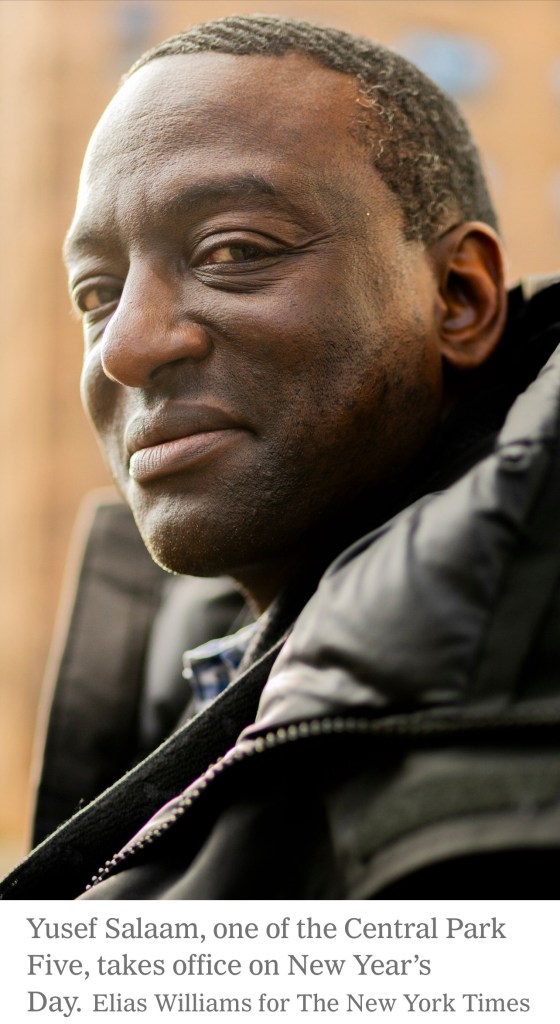
He Was One of the Central Park Five. Now He’s Councilman Yusef Salaam.

Mr. Salaam will take office 34 years after a wrongful prosecution for rape led to his spending nearly seven years in prison.

By Katherine Rosman

Yusef Salaam stood at the front of the City Council Chamber in Lower Manhattan with his right hand raised and his left hand on the Quran held by his wife. It was the one that his mother gave him when he was 15 years old and standing trial for a crime he did not commit. Its pages, filled with notes and bookmarks, were kept intact by a cloth cover that Mr. Salaam made during nearly seven years in prison.

Surrounded by relatives including his mother, sister and some of his children, Mr. Salaam was asked by Michael McSweeney, the city clerk, to repeat an oath.

With each passage that Mr. McSweeney recited and Mr. Salaam repeated, their voices took on volume and urgency: “I will support the Constitution of the United States and the Constitution of the State of New York,” Mr. Salaam said. “I will faithfully discharge the duties of the office of council member of the ninth district, in the borough and county of New York, in the City of New York, according to the best of my ability.”

“Council Member Salaam,” Mr. McSweeney said, “Congratulations.”

Mr. Salaam’s family broke into cheers. He placed his hand over his heart.

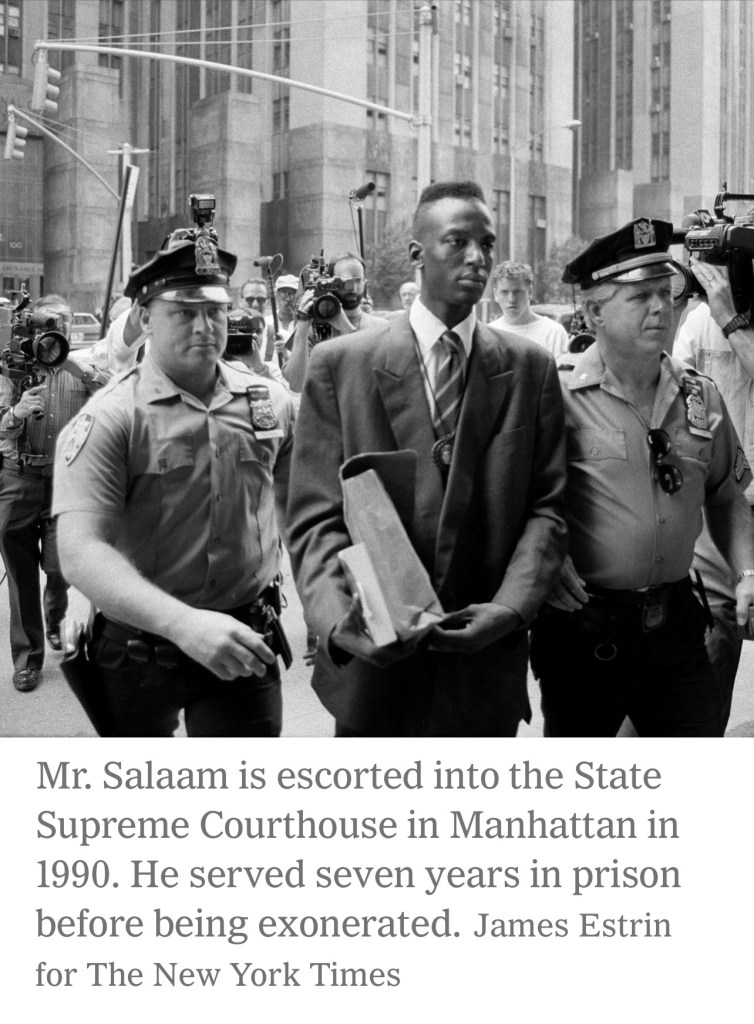
It was one day and 21 years after his exoneration from a first-degree rape conviction in a case so brutal that it had stunned a crime-weary city and aligned New York’s political, law enforcement and media establishment squarely against him and his co-defendants.

In 1990, Mr. Salaam was sent to prison as one of the “Central Park Five.” This summer, he beat two incumbent State Assembly members in a Democratic primary and officially won the Council seat in an uncontested election in November. He will take office on New Year’s Day.

Mr. Salaam is a political neophyte whose skill as an operator within the byzantine universe of the city’s municipal government is completely untested. “I’m not a part of that world,” he acknowledged. “It takes time.”

His value to his constituents in Harlem is not measured, at least not yet, by a talent for weighing policy matters or solving neighborhood problems.

He brings to his community the power and the symbolism of his own life story. “Everything — every single thing — that I experienced has prepared me for this,” Mr. Salaam said before being sworn in on Dec. 20. “I needed to be in the belly of the beast, because now I can see that those who are closest to the pain need to have a seat at the table.

Those who have followed the story closely, watching Mr. Salaam’s rise from a powerless member of the Central Park Five to an elected official in the very city that wronged him so terribly, appreciate the astonishing arc of his life.

“This is what justice looks like,” said Ken Burns, one of the directors of the 2012 “Central Park Five” documentary that told the hard-to-stomach story of the arrest, conviction and exoneration, weaving together interviews with the five men and details about the conduct of the police and the press.

“It is a testament to the resilience of the man who is about to take this position, and I think we can only just stand in awe,” Mr. Burns said.

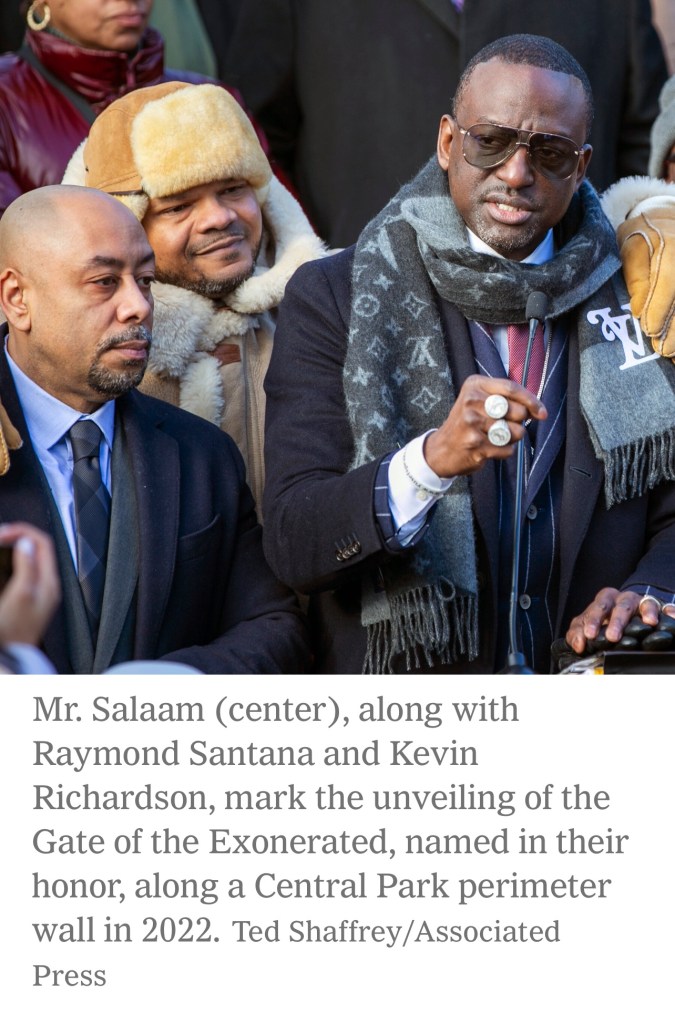
For the other men who made up the Central Park Five — “my brothers,” as Mr. Salaam refers to Kevin Richardson, Raymond Santana, Korey Wise and Antron McCray — it is “a full-circle moment,” said Mr. Santana.

“There is a lot of emotion in knowing that we are all these years later still trying to make a difference, still trying to give back,” he said.

Does New York deserve the effort?

“Not at all,” Mr. Santana said. Then he added, “But the people do.”

When Mr. Salaam, now 49, walks the streets of Harlem, even on a blustery cold day when few are outdoors, he is recognized. “I’ve really been a public citizen since I’ve been 15,” he said.

One day in December, he left the campaign office on West 135th Street and headed east. He shook his head at a man on a bicycle who whizzed by on the walkway. “I really want to get these bikes and scooters off the sidewalk,” he said. “I want there to be quality of life in Harlem.”

Darryl T. Downing, a marketing consultant, stopped to say hello. “Let me shake your hand,” Mr. Downing said. He had met Mr. Salaam during the campaign and thought his experience would benefit Harlem. “He knows about renaissance,” Mr. Downing said. “He knows about rebirth.”

Mr. Salaam ambled on, chatting easily with other constituents as he strode the neighborhood that has defined the most important events in his life.

In April 1989, along with other Black and Latino teenagers, he was accused of the rape and assault of a white woman who had gone for a nighttime jog in Central Park. Mr. Salaam had been near the park with a friend and happened upon a larger group of teenagers whom the police and the press later accused of “wilding” — a term which, from that moment, entered the lexicon of New York, creating a fear that large groups of young men of color were suddenly marauding through the city.

New York in the 1980s was already on edge because of crime and violence, and the report of “wilding” and a rape in Central Park amplified the panic. Mayor Edward I. Koch called the teenagers “monsters.” A Daily News front page headline said, “Wolf Pack’s Prey: Female jogger near death after savage attack by roving gang.” Donald Trump, then a prominent developer, took out full-page advertisements in newspapers including The New York Times about the case. “Bring Back the Death Penalty,” the headline said.

In two trials, juries convicted the five teenagers based on false confessions, inconclusive physical evidence and no eyewitness testimony. (Mr. Salaam never signed a confession, nor was he videotaped providing one.)

The five unsuccessfully appealed their convictions and maintained their innocence.

Better Not Bitter

In 1997, Mr. Salaam was released from prison. He moved back into the Schomburg Plaza housing development in Harlem with his mother but, as a felon and registered sex offender, struggled to find work. He was ill-equipped at 23 to pick up the life he left at 15. Coming home was the most exciting time of my life, but it was also the most challenging,” he said. “You don’t know how to live.”

He found relief in books and motivational speakers. He tried to internalize Nelson Mandela’s words, “Resentment is like drinking poison and then hoping it will kill your enemies.”

In early 2002, after four of the Central Park Five had finished serving their prison terms, a man named Matias Reyes, a murderer and serial rapist who was already in prison, confessed to the rape, providing a DNA match to evidence found at the scene. By year’s end, a judge voided the convictions of the five men.

In 2007, Mr. Salaam met and then married his wife, Sanovia Salaam, becoming a father to her three children, in addition to the three daughters from his first marriage. (Together they also have four children, ages 7 to 15). He began to work with the Innocence Project, a criminal justice reform group that seeks to overturn wrongful convictions, and is now a member of the board.

But he said he and the others still lived under the shadow of the crime.

That began to change in 2011, when the book “The Central Park Five” by Sarah Burns led to a documentary of the same name, directed by Ms. Burns, her husband, David McMahon, and her father, Ken Burns.

Mr. Burns, Mr. Salaam said, “gave us our voices back.”

The film helped Mr. Salaam build a career as a motivational speaker. The release of the Ava DuVernay Netflix series “When They See Us” and his own memoir, “Better, Not Bitter” heightened his renown.

A few years after the documentary aired, bringing widespread attention to the injustices suffered by the young men, the city agreed to a settlementpaying each about $1 million for each year they served in prison.

“The compensation is a Band-Aid,” Mr. Salaam said. “It’s not complete justice, but it gives you the opportunity to finally take a break from the rigors of what life had become for us.”

Mr. Salaam and his wife decided to raise their family in Stockbridge, Ga., near Atlanta. They lived in a nice house, surrounded by deer, rabbits and humming birds. But it was almost too peaceful. When he looked up at the sky, it reminded him of “The Simpsons.”

“It felt like I retired,” he said.

Mr. Salaam had been traveling the country and speaking to audiences about racial justice, and he began to think about running for public office.

“You could go into politics anywhere,” he said a cousin told him, “but anywhere other than New York is Off Broadway.”

The timing was good. In 2022, Keith Wright, the New York County Democratic leader, flew to Atlanta to ask Mr. Salaam to consider running for City Council. The meeting confirmed his perception of Mr. Salaam as a figure of intellectual heft and righteousness, he said.

“Yusef is Harlem’s version of Nelson Mandela,” he said.

Much of the political establishment, including Mayor Eric Adams, supported Mr. Salaam’s more seasoned primary opponents. And while some in Harlem privately say they are reserving judgment, others say his inexperience is not a concern — and may perhaps provide a breath of fresh air. “Harlem suffers from a tenacious grip that the old guard retains on positions of power,” said Shawn Hill, a founder of the Greater Harlem Coalition, a group of community-based organizations working for systemic justice.

Now that he has won, Mr. Salaam knows there will be a learning curve at City Hall — and that he will have to manage his constituents’ expectations.

He found a four-day orientation session illuminating. A portion of one day was spent learning how a road gets fixed, to show the complications of municipal government.

“The process isn’t like, ‘Oh, I want a road built, let me block the street for a second with no permits and just have my friends help and, oh, shucks, how am I going to get a cement truck?’” he said. “It’s a whole process, and it might not happen tomorrow. It might not even happen during the entire time of your elective office.”

Mr. Salaam shared with voters his vision for a “new Harlem renaissance” and said he hopes to focus on the quality of public schools, availability of affordable housing and keeping young people engaged in their community.

He said his background leads many to miscast him as a far-left progressive. “People think I am ‘Defund the Police’ and ‘Abolish Prisons,’ but we need prisons for real criminals,” he said.

“I mean, if we abolished prisons, where would Donald Trump go,” he said, allowing himself the quickest smile. Mr. Trump declined to comment.

Many people at a fund-raising celebration held at Melba’sRestaurant in Harlem after Mr. Salaam’s swearing-in mentioned Mr. Trump — mostly to note Mr. Salaam’s transcendence amid Mr. Trump’s legal woes.

“A movie script writer could not make this up,” said Hisham Tawfiq, who grew up in the neighborhood. He recalled the way that the police seized on the term “wilding” amid the Central Park Five case. “You all going wilding?” he said a police officer once asked him, pointing a gun at him and a group of friends on the subway just after Mr. Salaam’s arrest in 1989.

“Imagine how many brothers and sisters were harassed like that because of that incident,” he said.

Mr. Salaam’s supporters talked local politics, as waiters passed trays of macaroni-and-cheese bites and fried chicken and waffles. For many, it was also a night of personal reflection.

“It’s incredible that our last name is now a part of a legacy,” said one of his daughters, Poetry Salaam, 20.

Kevin Richardson came from New Jersey to toast Mr. Salaam.

During their incarceration, the two men were for a time housed in the same prison. When they saw each other at meals, they would link eyes, lift a milk carton and call out, “To the good life.”

Mr. Richardson remembered it as an act of hope. “We had to change the dynamic,” even for a moment, he said.

Now, he said, “I’m a girl-dad.” He took a look around the room. “Life is good.”

Soon Mr. Salaam addressed the crowd. “You all stood by me, you all stood with me, you carried me up,” he said.

As he campaigned through the district, “You all were telling me that I was what you had hoped for,” Mr. Salaam said.

He added, “What people see in me, I see in you.”

Katie Rosman is a reporter for the Metro desk, contributing narratives and profiles about people, events and dynamics in New York City and its outer reaches. More about Katherine Rosman