We all know that our smartphones track us, but do we really know to what extent? Ronan Farrow does. After becoming the target of cyber-surveillance while reporting on Harvey Weinstein, the Pulitzer Prize–winning journalist—and son of Mia Farrow and Woody Allen—took matters into his own hands. He began investigating the billion-dollar commercial-spyware industry, traveling to Tel Aviv, Barcelona, and New York to understand how our phones are monitored. Turns out, it’s worse than we thought.
In Surveilled, Farrow uncovers how companies such as NSO Group operate with minimal oversight, selling spyware capable of hacking and controlling the devices of 450 million people (think activists, reporters, and politicians) without their knowledge. Directed by Perri Peltz and Matthew O’Neill, the documentary unveils the secrets, dangers, and staggering scale of the covert world behind our screens. —Jeanne Malle
🌺🌺🌺🌺🌺🌺🌺🌺🌺🌺🌺🌺🌺🌺
Happy Holidays
No matter what you’re celebrating, we’re celebrating with you.
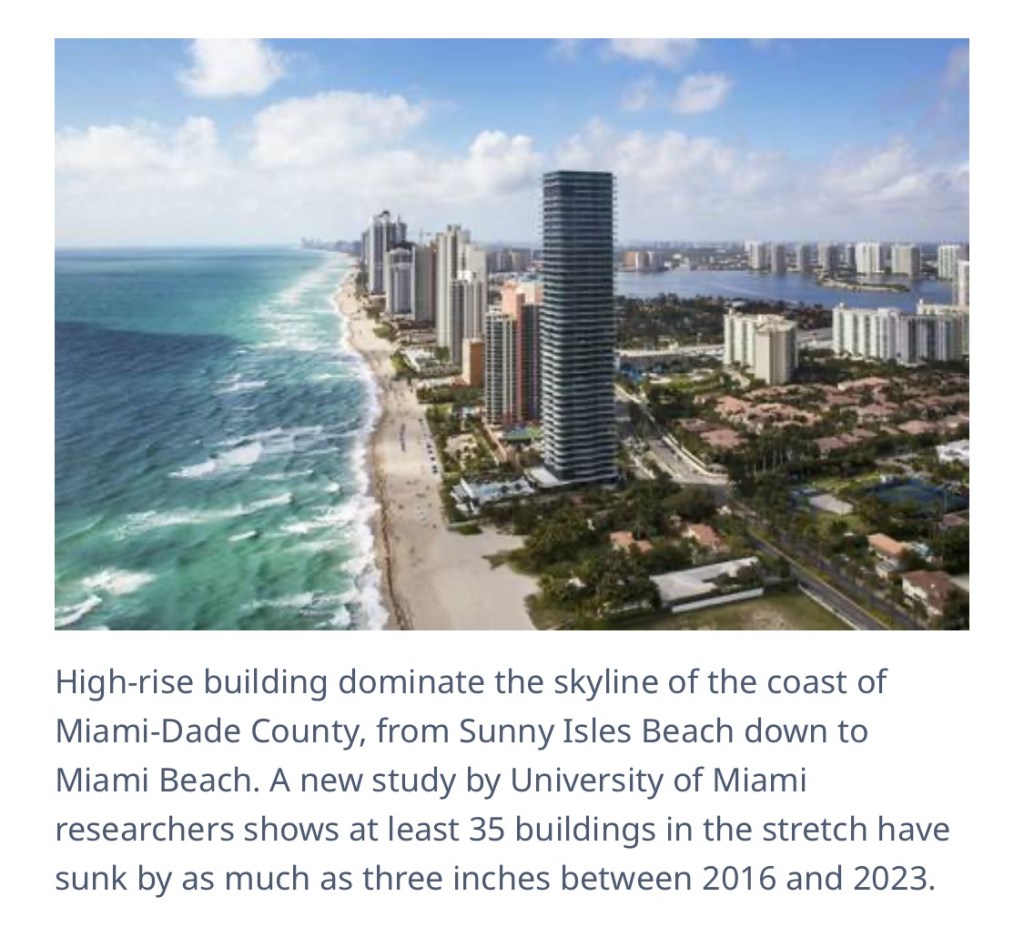
A new study by University of Miami researchers shows a string of beachside high rises in Sunny Isles, the skyline shown here, along with Bal Harbour, Surfside and Miami beach have been sinking into the ground at unexpected rates. Experts say it could be a sign of rising sea levels accelerating the erosion of limestone bedrock under the barrier islands.
MATIAS J. OCNER mocner@miamiherald.com
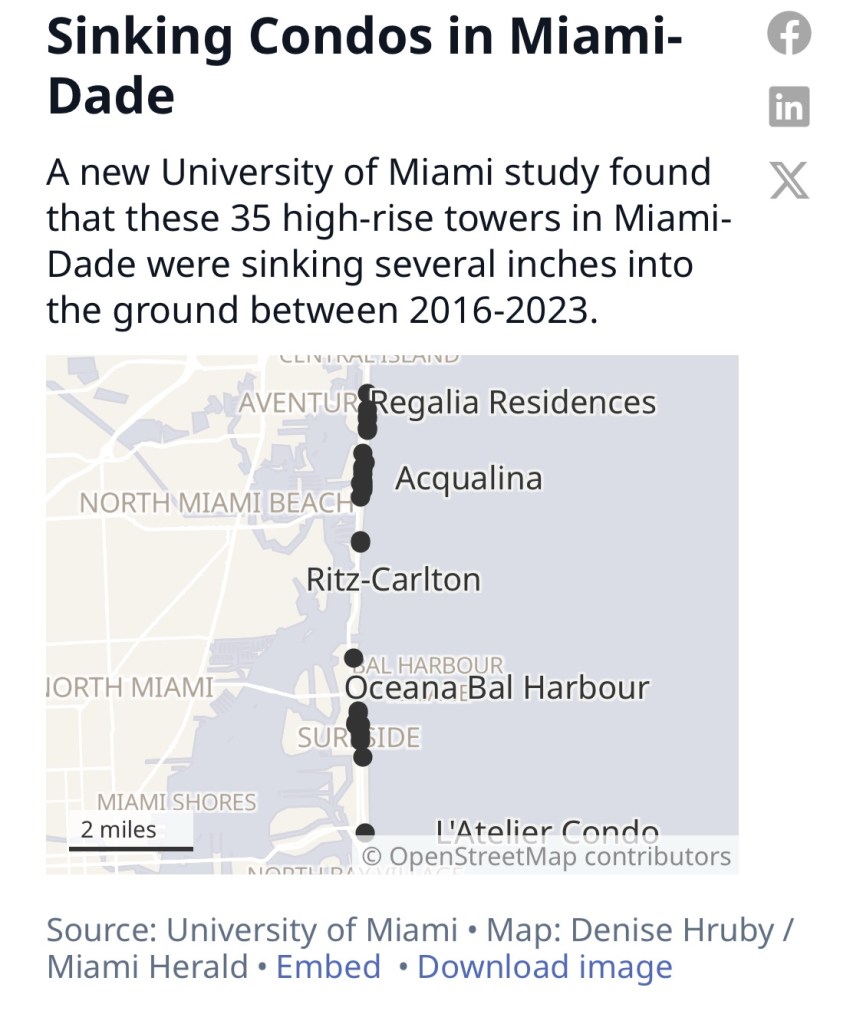
Dozens of luxury beachfront condos and hotels in Surfside, Bal Harbour, Miami Beach and Sunny Isles are sinking into the ground at rates that were “unexpected,” with nearly 70 percent of the buildings in northern and central Sunny Isles affected, research by the University of Miami found.
The study, published Friday night, identified a total of 35 buildings that have sunk by as much as three inches between 2016 and 2023, including the iconic Surf Club Towers and Faena Hotel, the Porsche Design Tower, The Ritz-Carlton Residences, Trump Tower III and Trump International Beach Resorts. Together, the high rises accommodate tens of thousands of residents and tourists. Some have more than 300 units, including penthouses that cost millions of dollars.
“Almost all the buildings at the coast itself, they’re subsiding,” Falk Amelung, a geophysicist at the University of Miami’s Rosenstiel School of Marine, Atmospheric and Earth Science and the study’s senior author, told the Miami Herald. “It’s a lot.”
Preliminary data also shows signs that buildings in downtown Miami, Brickell, and along Broward and Palm Beach coasts are sinking, too.
Globally, similar subsidence within such a large area has never been reported, the university said in a statement.
Experts called the study a “game changer” that raises a host of questions about development on vulnerable barrier islands. For starters, experts said, this could be a sign that rising sea levels, caused by the continued emission of greenhouse gases, is accelerating the erosion of the limestone on which South Florida is built. “It’s probably a much larger problem than we know,”
Paul Chinowsky, a professor of civil engineering at the University of Colorado Boulder, told the Herald. Initially, researchers looked at satellite images that can measure fractions of an inch of subsidence to determine whether the phenomenon had occurred leading up to the collapse of Champlain Towers in Surfside, the 2021 catastrophe that killed 98 people and led to laws calling for structural reviews of older condos across the state.
The researchers did not see any signs of settlement before the collapse “indicating that settlement was not the cause of collapse,” according to a statement. Instead, they saw subsidence at nearby beachside buildings both north and south of it. Surprising findings “What was surprising is that it was there at all. So we didn’t believe it at the beginning,” Amelung said, explaining that his team checked several sources that confirmed the initial data. “And then we thought, we have to investigate it,” he said. In total, they found subsidence ranging between roughly 0.8 and just over 3 inches, mostly in Sunny Isles Beach, Surfside, and at two buildings in Miami Beach – the Faena Hotel and L’atelier condo – and one in Bal Harbour.
It’s unclear what the implications are or whether the slow sinking could lead to long-term damage, but several experts told the Herald that the study raises questions that require further research as well as a thorough on-site inspection. “These findings raise additional question which require further investigation,” Gregor Eberli, a geoscience professor and co-author of the study, which was published Friday in the journal Earth and Space Science, said in a statement. Lead author Farzaneh Aziz Zanjani pointed to the need for “ongoing monitoring and a deeper understanding of the long-term implications for these structures.” Though the vast majority of affected buildings were constructed years or decades before the satellite images were taken, it is common for buildings to subside a handful of inches during and shortly after construction — a natural effect as the weight of the building compresses the soil underneath.
And sinking doesn’t necessarily create structural issues. “As long as it’s even, everything’s fine,” Chinowsky said, placing his hands next to each other, “the problems start when you start doing this,” he said, then moving one hand down faster than the other. But such uneven sinking, known as differential subsidence, can cause significant damage to buildings, he said. “That’s where you can get structural damage,” he said. More research is needed to determine whether the buildings are sinking evenly or not. An uncertain impact “Sometimes it can be dangerous, sometimes not – it will have to be evaluated,” said Shimon Wdowinski, a geophysicist at Florida International University, told the Herald.
Wdowinski worked on a different study that showed that the land surrounding the Champlain Towers – not the buildings themselves – had been subsiding back in the nineties, though that alone couldn’t have led to the collapse. The National Institute of Standards and Technology (NIST) has yet to release a final report on the cause but a Herald investigation pointed to design and construction flaws as well as decades of maintenance issues.
High-rise building dominate the skyline of the coast of Miami-Dade County, from Sunny Isles Beach down to Miami Beach. A new study by University of Miami researchers shows at least 35 buildings in the stretch have sunk by as much as three inches between 2016 and 2023. For the 35 buildings shown to be sinking in the University of Miami’s study, he said, the next step is to check the integrity and design plans. “If there is differential subsidence, it could cause structural damage, and it would need immediate attention,” he said. Cracks in walls, utilities that are breaking, or doors and windows that don’t shut as easily as they used to are all signs of differential subsidence, said Gangarao Hota, a professor of civil engineering and the director of the constructor facilities center at West Virginia University. “In some extreme scenarios, the buildings at some point sink much more dramatically with time,” he said. If that subsidence is differential, “then it is very, very serious,” Hota said.
Cities react to study Larisa Svechin, the mayor of Sunny Isles Beach, where more than 20 buildings are affected, said that “my priority is the safety of our residents.” Contacted by the Herald Saturday afternoon, she said she was not aware of any structural issues but called an immediate meeting with the city manager. Following that meeting, she said that all required building inspections are up to date and that “the law also requires inspection records to be posted online and shared with residents.”
Charles Burkett, the mayor of Surfside, told the Miami Herald that he had not heard of the study nor was he aware of any subsidence of buildings. “I’d like to know if it’s unsafe,” he said on Saturday, adding that he will “review [the study] in due time.” Other officials could not be reached immediately, and several of the affected buildings contacted by the Herald said that management would not be available for comment before Monday.
Some settlement appears to have started right around the time when the construction of new buildings nearby began, and when vibration might have caused layers of sand to compress further – just like shaking ground coffee in a tin will make room for more. The pumping of groundwater that seeps into construction sites could also cause sand layers to shift and rearrange. Though there appears to be a strong link to nearby construction for some buildings, it is unlikely to be the only explanation for the 35 sinking buildings, as some settlement had started before any construction began nearby, and it persisted after construction ended, the researchers found.
“There’s no sign that it’s stopping,” Amelung said of the settlement. The possible climate connection Experts also pointed to the impact the emission of fossil fuels and the resulting warming of the climate is having on the overall stability of Miami-Dade’s barrier islands. For one, rising sea levels are now encroaching on sand and limestone underneath our feet. That could lead to the corrosion of the pillars on which high-rises stand – a serious issue, Hota said, though if that’s the case “there may be a way to salvage these buildings,” by fixing the foundation. Stronger waves, fresh water dumped by heavier rainfalls and more sunny-day flooding could also add to the erosion of the limestone that all of South Florida is built on, Chinowsky said.
Already a soft rock that is riddled with holes and air pockets, further erosion could destabilize the base of most constructions, Chinowsky said, comparing it to “standing on sand, and someone came with a spoon and started taking the sand out.” “I would expect that they would see this all throughout the barrier islands and on into the main coastline – wherever there is limestone, basically,” he said.
“That’s what makes the whole South Florida area so unique, because of that porous rock, the limestone, all that action is happening where you can’t see it, and that’s why it’s never accounted for to this level,” he said. This climate report is funded by Florida International University, the John S. and James L. Knight Foundation and the David and Christina Martin Family Foundation in partnership with Journalism Funding Partners.
The Miami Herald retains editorial control of all content. If you have questions for the climate team, please email climate@miamiherald.com University of Miami researchers say sea rise may be contributing to unexpected subsidence of buildings from Sunny Isles to Miami Beach. Pedro Portal pportal@miamiherald.com
Everyone has a dirty secret. Mine is that I tried Mounjaro. I know, don’t. Maybe I should have written this under a pseudonym. As anyone who knows me will tell you, I’m not fat.
But as a fully paid-up member of the Y.C.N.B.T.R.T.T.O.T.T. (You Can Never Be Too Rich, Too Thin, or Too Tanned) generation with a doctorate in dieting, I was too curious to resist. What would it be like to rid myself of the low-level hunger and guilt that was, previously, my permanent state? What would it be like to be content with the way I looked in a bikini? And so for six weeks this past summer, without telling my partner, I went on the shot.
Scroll forward to today, and I am empirically, incontrovertibly, even by my own antediluvian standards, “thin.” From any angle in any changing room, however badly lit, my butt looks absolutely fine. No item of clothing in my wardrobe is remotely tight. My underwear doesn’t mysteriously shrink and get all “friendly” in the wash.
I have changed my constitution, and though the physical difference is quite subtle, because I carried most of my weight around my middle, the psychological effect has been huge. Mostly in a good way, but not 100 percent. Now that I’m not a professional dieter anymore, I can’t help feeling unemployed.
Don’t get me wrong: I’ve become evangelical about this drug. It’s a revelation not to be such a Labrador around food. (I continue to use it, taking half the lowest dose—2.5 mg.—every other week to remain, well, more of a cat.)
What a joy it is to have become one of those people who can eat just one M&M and leave food on my plate. For me, after all these years, the bread basket is finally neutral territory.
Given how fraught the issue of weight is for so many people, it wouldn’t surprise me if the public-health authorities eventually put Mounjaro in the water. (Well, maybe not if R.F.K. Jr. is in charge of Health and Human Services.)
Just wait until Eli Lilly brings out retatrutide, a new triple-action drug that is said to shed fat, lower blood sugar, improve one’s lipid profile, and even decrease cardiovascular risk. It’s supposedly even more effective, and comes with fewer side effects, than Mounjaro, which can cause nausea and gastrointestinal issues. By the end of the century, obesity and alcoholism may all but cease to exist.
And yet.
I can’t shake off this vague air of meh-ness. As we know, nature abhors a vacuum, and all this energy I devoted over the decades to the pursuit of “thinness” needs a new place to roost.
Longing, wanting, working toward something is part of the human condition. I liken the sensation to the flatness I felt as a kid after tearing open all my Christmas presents at dawn. (The Swedes got it right, making it all about Christmas Eve.)
To paraphrase Marc Lewis, the cognitive neuroscientist, addiction expert, and author of the best-seller The Biology of Desire, we are wired less for pleasure than for desire. “Once the food is in your mouth, there’s really nothing more you have to do to improve your odds of survival and procreation,” he writes.
There have not been many conclusive clinical studies of the effect of GLP-1 drugs like Mounjaro on sex drive, but if you scroll through Reddit—guilty—you’ll see that there are swathes of users who not only abstain from food and drink but also the pursuit of pleasure. (My personal experience? I don’t know you well enough yet.) Draw your own conclusions, but maybe we need to fear Mounjaro more than artificial intelligence in terms of the end of the line for humanity.
So where do we go from here? I have no plans to end my drug use right before the holiday season. What joy it will be to wake up on New Year’s Day without feeling like a giant, guilty tick.
On the other hand, since food no longer has the power to arouse me as it once did, Christmas (which has always been about the eating for me) has kind of lost its allure. Stollen? So what. Mince pies slathered in homemade brandy butter? Same. Thanks to Mounjaro, it seems that I may have already opened most of my presents.
Christa D’Souza is a London-based writer who contributes to the Daily Mail and The Sunday Times
Eliot and I walked around Art Basel and some of the other art fairs last week (Untitled, Design Miami, Art Miami and Scope) thinking that the exhibitors were going to be somewhat disappointed with their sales results this year. We saw some of the galleries that we know fairly active while others admitted that they lost money exhibiting.
I was stunned when I read Artsy a few days ago which reported, that there was a healthy number of galleries who sold paintings in the millions. Artsy is a newsletter about the world’s emerging and established artists. They make it easy for new and experienced collectors to discover, buy, and sell art. Everything you’ll ever need to collect art, you’ll find on Artsy
I am giving you the list of activities from Artsy because it’s a good one to reference for your own interest and also to have when talking to others about the artists that did well this year. You will sure to impress others.
Art Basel registered more than 75,000 visitors this year, down from last year’s reported attendance figure of 79,000).
There were 286 galleries from 28 countries—up from last year’s 277—and included 34 first-time exhibitors, the largest batch of newcomers in over a decade. South and Central America had a strong showing, with 19 galleries from Brazil alone.
Leading the reported sales was Hauser & Wirth, which sold David Hammons’s Untitled (2014) for $4.75 million during the VIP preview on Wednesday.
Martha Jungwirth’s Ohne Titel, aus der Serie “Francisco de Goya, Stillleben mit Rippen und Lammkopf” (2022) for €430,000 ($454,000), Ohne Titel, aus der Serie “Australidelphia” (2020) for €420,000 ($444,000), and Ohne Titel (2022) for €310,000 ($327,000).
Daniel Richter’s Mausefalle des Gewissens (2023) for €420,000 ($443,000).
David Salle’s New Pastoral, Floral Dress (2024) for $350,000.
Tom Sachs’s Portrait de Dora Maar(2024) for $190,000.
Other works by Jungwirth, Longo, Joan Snyder, and Erwin Wurm sold for five-figure sums.
David Hammons
Rock Head, 2000
White Cube
Ilana Savdie
Revenge Fantasies, 2024
White Cube
White Cube’s reported sales were led by David Hammons’s Rock Head(2000) for $2.35 million.
Pace Gallery’s reported sales were led by Sam Gilliam’s Whispering Wind(1972), which sold for $1 million. Other sales reported by the gallery included:
Almine Rech’s sales were led by a work by Tom Wesselmann, which sold for a price in the range of $1.25 million–$1.5 million. Other sales reported by the gallery included:
A work by Larry Poons for a price in the range of $180,000–$200,000.
Sprüth Magers’s reported sales were led by Richard Artschwager’s Exclamation Point (Yellow) (2001) for $425,000. Other sales reported by the gallery included:
Galerie Lelong & Co.’s sales were led by Mildred Thompson’s Radiation Explorations (1994) for “approximately” $275,000. Other sales reported by the gallery included:
Cardi Gallery’s sales were led byRoberto Matta’s Ecce Fumo (1973) for $290,000 and Carla Accardi’s Omaggio a Matisse (1964) for €140,000 ($148,000). The gallery also sold a trio of works by Davide Balliano for €50,000, €40,000, and €30,000, respectively ($52,800, $42,200, and $31,000).
RYAN LEE sold Herbert Gentry’s Le Jardin (1960) for $145,000 and two additional works by the artist for $22,000 and $18,000 apiece.
Templon’s sales were led by two Omar Ba works which each sold for $40,000–$120,000 apiece. The gallery also sold two works by ROBIN KID A.K.A. THE KID for $35,000–$100,000, and five works by Chiharu Shiota for €16,000–€120,000 ($16,900–$126,000) each
Goodman Gallery sold “several” William Kentridge works for prices ranging from $30,000–$550,000. The gallery also sold a work by Carrie Mae Weems for $180,000 and works by Yinka Shonibare for prices ranging from £150,000–£225,000 ($191,00–$287,000). Other sales included “several” works by Kapwani Kiwanga for prices ranging from €60,000–€115,000 ($63,000–$121,000).
Gavlak’s sales were led by two “historical” works by Judy Chicagofor a combined total of $150,000 and a Cecily Brown monotype for $125,000. The gallery also sold a painting by Robert Peterson, two paintings by Kris Knight, and a new work on paper by Jose Alvarez for five-figure sums.
Michael Kohn Gallery’s sales were led by Lita Albuquerque’s She has shifted scales on the planet, so can we see (2021) for $125,000 and Nir Hod’s 100 Years is Not Enough(2024) for $90,000. The gallery also sold works by Hod, Mark Innerst, and William Brickel for five-figure sums.
Richard Saltoun reported the sale of four works by Greta Schödl for prices ranging from $5,000–$25,000 apiece. Charles Moffett—another of Artsy’s best booths from the fair—sold four sculptures by Kim Dacresfor $7,000–$35,000 each and four works by Melissa Joseph for $10,000–$20,000 each
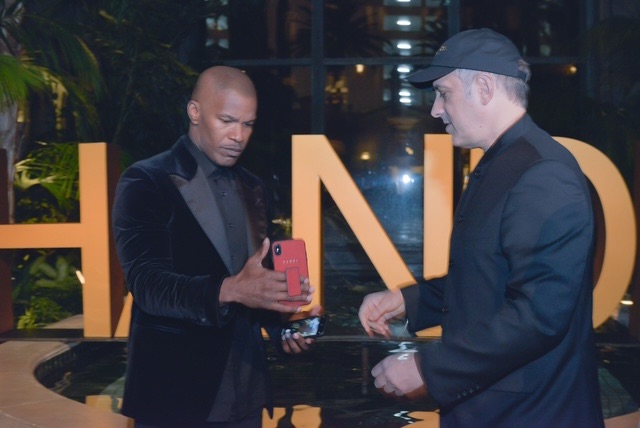
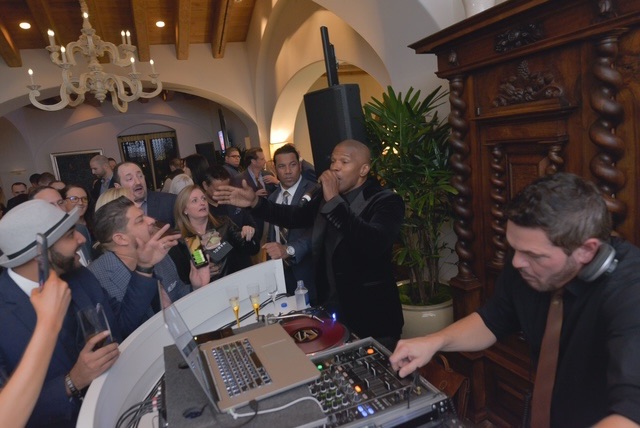
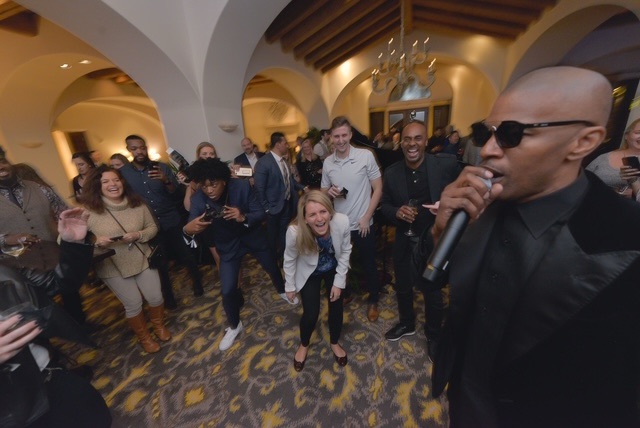
The reason I am posting this story from Variety is because Jamie Foxx hosted a party for my client HandL in Las Vegas during the 2019 CES. It was the most outrageous party ever. Jamie went all out for HandL owner Allen Hirsch. Jamie acted like a DJ at a wedding all night long singing and dancing with everyone.
We couldn’t believe our eyes that a major celeb like Jamie would give so much of himself to the crowds that showed up that night.
Just ask writer/singer extraordinaire Dan Rosenbaum. Dan sang several songs with Jamie and we were all in disbelief that this was happening. Client Allen Hirsch, owner of HandL, had record breaking sales that CES and the brand is still a favorite among consumers everywhere.
Everyone wishes Jamie a long, healthy life. Thank you Jamie. Now read his amazing story in Variety.
In his new Netflix comedy special “What Had Happened Was,” Jamie Foxx finally told the story behind the mysterious and harrowing medical emergency that left him hospitalized and fighting for his life in 2023.
Emerging on stage and proclaiming “I’m back!” as he danced and hyped up the crowd, Foxx said his life was saved just 400 yards from the Atlanta theater, at Piedmont Hospital. The Oscar and Grammy winner held back tears as he discussed his “mystery illness,” saying, “Please, Lord, let me get through this.”
“April 11, I was having a bad headache, and I asked my boy for Aspirin. I realized quickly that when you’re in a medical emergency, your boys don’t know what the fuck to do,” Foxx joked.
He said before he could even take the Aspirin, he blacked out and remained unconscious for weeks. “I don’t remember 20 days,” Foxx said. He was told that his friends took him to a doctor in Atlanta who gave him a cortisone shot and sent him on his way. “What the fuck is that?” Foxx quipped. “I don’t know if you can do Yelps for doctors, but that’s half a star.
His sister Deidra Dixon, who he described as “4-foot-11 of nothing but pure love,” knew that Foxx was experiencing something much more severe. “She says, ‘Get him in the car. That ain’t my brother right there,’” Foxx said.
“She drove around — she didn’t know anything about Piedmont Hospital, but she had a hunch that some angels [were] in there.”At Piedmont, a doctor told Dixon that Foxx was “having a brain bleed that has led to a stroke,” and that if they didn’t operate on him as soon as possible he would die. “My sister knelt down outside the operating room and prayed the whole time,” Foxx said.
He said it “was kind of oddly peaceful” being unconscious, adding, “I saw the tunnel. I didn’t see the light.” Foxx then joked, “It was hot in that tunnel. Shit, am I going to the wrong place in this motherfucker? Because I looked at the end of the tunnel, and I thought I saw the Devil like, ‘C’mon.’ Or is that Puffy [Sean Combs]?”
After the procedure, the doctor told Dixon that Foxx “may be able to make a full recovery, but it’s going to be the worst year of his life.” Foxx concurred: “That’s what it was.” As he entered his recovery process, Foxx said Dixon and his daughter Corinne Marie Foxx “cut it all off” and shielded Foxx from the outside world. “They didn’t want you to see me like that. And I didn’t want you to see me like that,” Foxx said, choking up. “I want you to see me like this.”
When he fully woke up, at a Chicago rehabilitation center on May 4, Foxx didn’t understand why he found himself in a wheelchair. And despite what he was being told, he could not wrap his head around the fact that he had a stroke. He told the audience about his long road to recovery and the reluctance to being bathed by a nurse — before she told him she had already been bathing him for weeks, he just couldn’t remember. “I couldn’t wipe my own ass,” Foxx said.
“I lost everything, but the only thing I could hold onto was my sense of humor,” Foxx said, before repeating a mantra of the comedy special: “If I could stay funny, I could stay alive.”
The comedian then cycled through celebrity impressions, including Denzel Washington, Dave Chappelle, Mike Tyson, Jay-Z and Donald Trump.
He said during the first 15 days of his hospitalization, the doctors thought he would die because his vitals were too high, and he needed to be kept calm. “You know what [is] the worst thing to have when you’re trying to stay calm in the hospital room? Black family members,” Foxx joked before imitating his panicked kin.
Foxx said he didn’t want his youngest daughter, 14-year-old Anelise Bishop to see him in that state. Nonetheless, she snuck into his hospital room with her guitar and started playing music, causing Foxx’s vitals to go down.
“It was God in that guitar,” Foxx said, calling the incident a “miracle.” “That’s my spiritual defibrillator.”
Bishop then walked on stage donning a Rickenbacker electric guitar for a father-daughter duet that had the audience (and Foxx and Bishop) wiping away tears.
“You had to make it because I always dreamed we would perform together on stage one day,” Bishop said.
Elsewhere in the special, Foxx discussed the internet conspiracy theories surrounding his medical emergencies (“Y’all motherfuckers really thought I was a clone”) and his spirituality (“God gave me a second chance”).
Foxx also showed a brief highlight reel of his most iconic characters and led the theater in dance and a singalong. The “Ray” and “Dreamgirls” star sat down at the piano to perform a gospel number and a rollicking song about why he’s done dating white women.
Ending things on a sweet note, Foxx offered his sincere thanks to everybody who prayed for his recovery, to his nurses and doctors, to his family, to God and to the city of Atlanta. As he shook the hands of the audience members in the front row, Foxx sang, “Thank you for my body. Thank you for my soul.”
This comes as no surprise to me. Thank you Gail Williams for sharing The Atlantic story to confirm what I believe to be true, most of the time.
Success in school is not the same thing as success in life. University administrators assumed that people who could earn high grades would continue to excel later in their career.
But school is not like the rest of life. Success in school is about jumping through the hoops that adults put in front of you; success in life can involve charting your own course. In school, a lot of success is individual: How do I stand out? In life, most success is team-based: How can we work together? Grades reveal who is persistent, self-disciplined, and compliant—but they don’t reveal much about emotional intelligence, relationship skills, passion, leadership ability, creativity, or courage.
For Years, KAWS Kept His Prolific Collecting Practice on the DL. Now He’s Giving Us a Peek at His Monumental Trove
Brian Donnelly’s jaw-dropping collection is the subject of the Drawing Center’s latest exhibition, which has put just a fraction of the artist’s expansive trove on view.
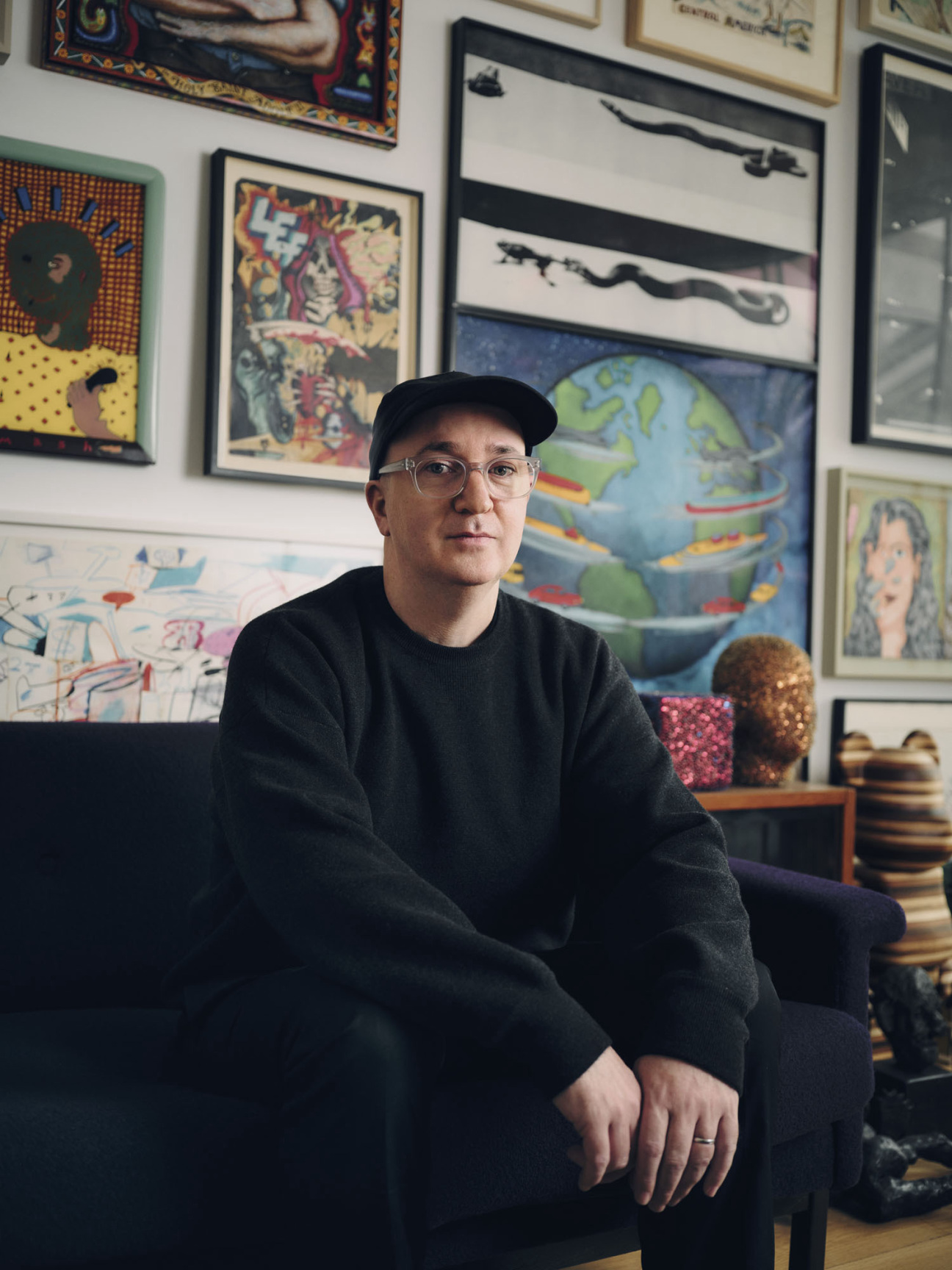
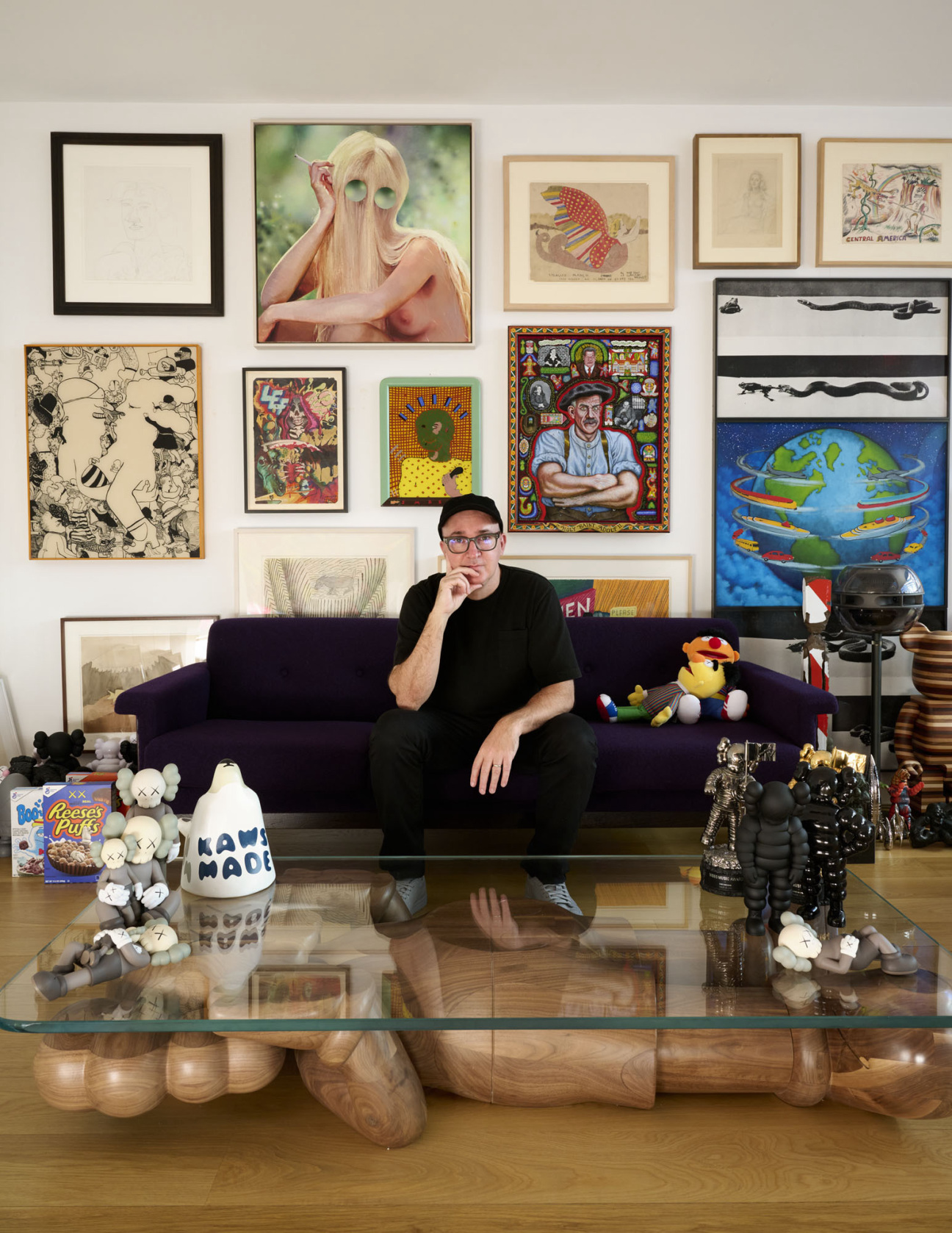
Brian Donnelly in Brooklyn studio. All images courtesy of Donnelly.
“I don’t think my practice has much of an effect on the works I acquire, I simply collect works I am naturally drawn to,” explains Brian Donnelly—better known under his artistic pseudonym KAWS, whose personal auction record is sitting at $14.8 million. “But there could be some subconscious elements at play …”
Donnelly’s artistic output may not tidily mirror his vast and far-ranging collecting habit, but the two are intimately tied nonetheless. The Drawing Center, which is currently hosting a show of over 300 works on paper pulled from the the artist’s personal holdings, likens the trove to a personal reference library for his creative investigations. “Looking at works in my collection is a good way for me to get out of my head and take a break from my own practice,” Donnelly admits. “It’s refreshing to step away and look at work that’s totally different from mine and see things from another perspective.”
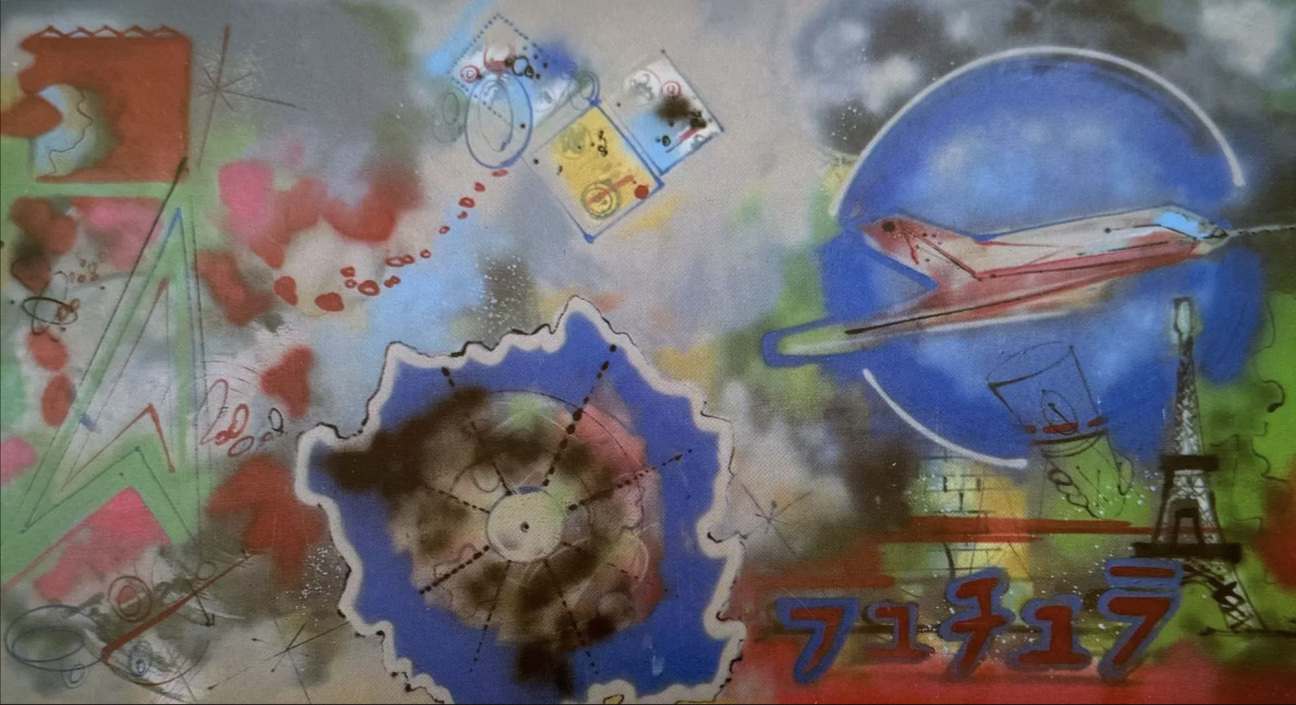
In addition to resurfacing drawings the artist has kept in storage, “The Way I See It: Selections from the KAWS Collection” also lifted some of the works on view straight from Donnelly’s walls—going so far as to reconstruct the layout the artist devised for them in his Brooklyn home. In the midst of their temporary move to Manhattan, Donnelly took a moment to let CULTURED peek inside his prolific collecting practice. Futura 2000, World Tour Action, 1984.
Where does the story of your personal collection begin?
I always collected things like stamps or trading cards growing up, so I always had that kind of mindset within me. When I was younger and doing graffiti, we would all trade black book drawings and small paintings with other artists and writers that you would meet. That was the first art I owned by other people.
What is the first piece you ever bought? How about the most recent?
The first piece I bought from a gallery was a Raymond Pettibon drawing from David Zwirner in 2000. It was a drawing of a fly with the word “SWAK!” (like the sound of a fly swatter) written on it. “SWAK” being “KAWS” backward, I took it as a sign and bought it as a birthday present for myself. This morning I purchased a painting by Futura 2000 titled World Tour Action, 1984. It’s a painting I’ve wanted for a while and was the invitation image for his show at Tony Shafrazi.
Which work in your home provokes the most conversation from visitors?
I don’t have many visitors.
How do you discover new artists or work?
When I find an artist I’m interested in, I tend to go down a rabbit hole researching where they were from, who their peers were, what was going on around them at the time, etc. This leads me to discover new artists all the time and learn about different movements and groups as a whole. In regard to new artists coming up now, I discover them in all kinds of ways––whether through word of mouth or often on Instagram, honestly. That also allows me to connect with them directly from time to time.
Which artist are you currently most excited about and why?
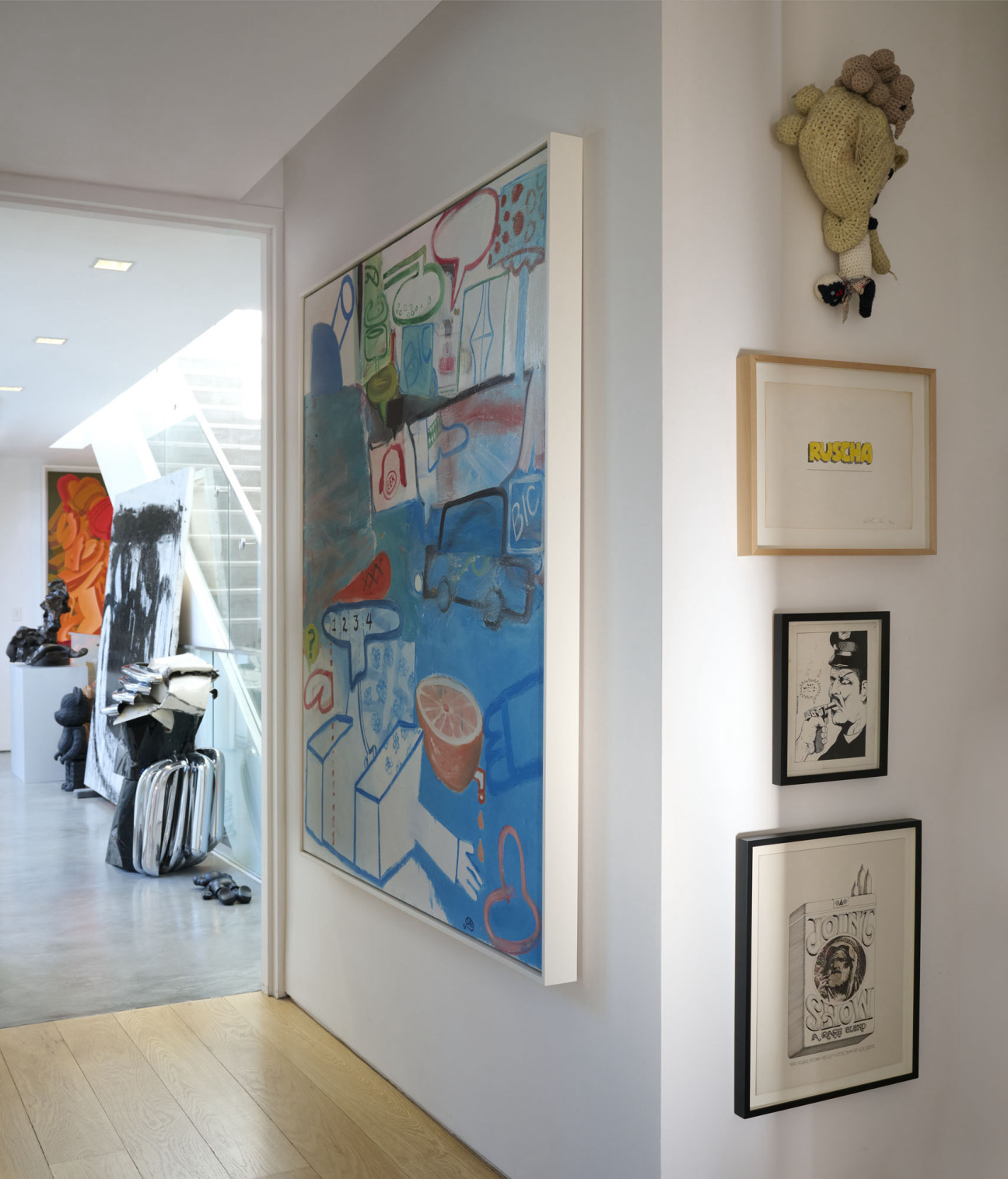
I just finished hanging the show at the Drawing Center, so I would say there are about 60 artists I’m currently very excited about.On left wall: Peter Saul, Untitled (Blue Interior), 1960.
What factors do you consider when expanding your collection?
I see my collection as a research library that I can use to investigate artists and works that I am interested in. Sometimes I acquire a work by an artist so that I can study it in relation to other works by that artist––that allows me to see how their processes change over time.
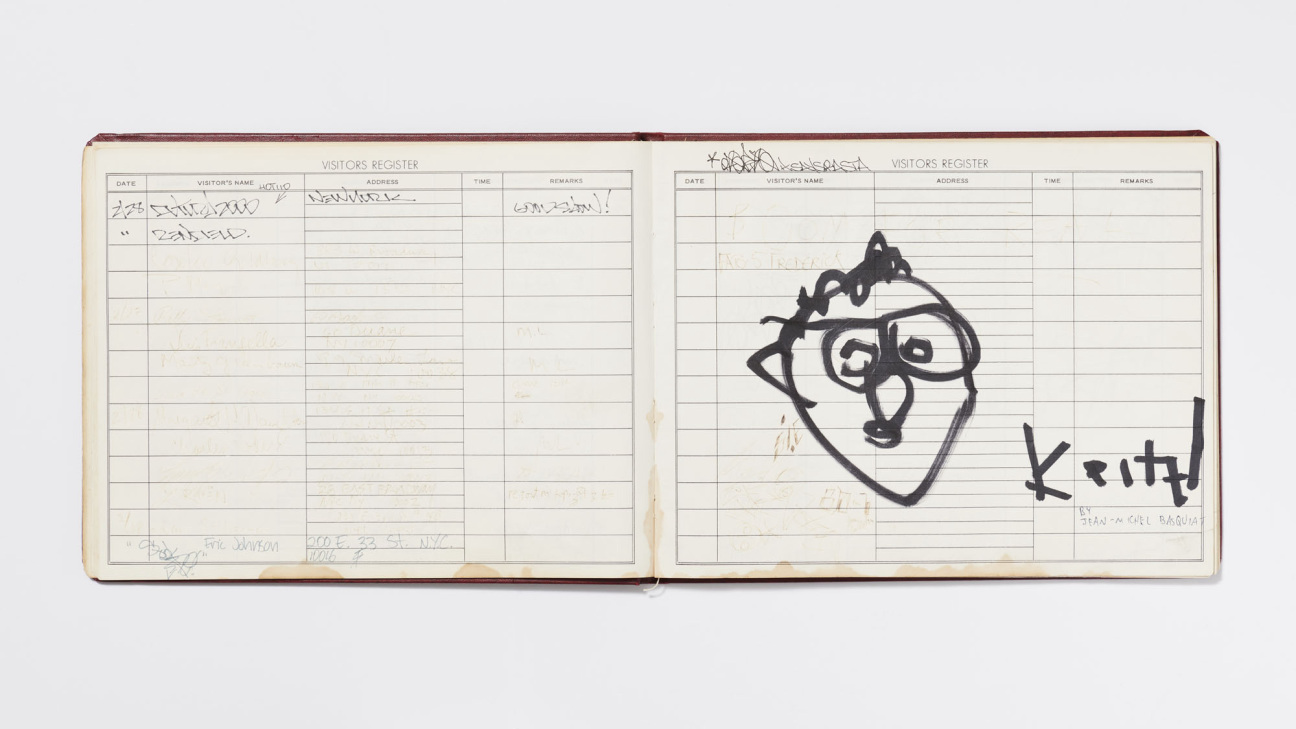
For example, Peter Saul is an artist I collect whose work has changed a lot over the years. It’s interesting to look at his works from different eras side by side and see that progression. Owning a work and living with it on your wall is a totally different experience than visiting a museum. You can really see how your relationship with a work changes over time and sometimes things wind up taking on more or less meaning after a while.Mudd Club Register Book, showing a drawing by Jean-Michel Basquiat, 1981. Photography by Brad Bridgers.
You have a Mudd Club sign-in book in your collection. Are there any other surprising mementos of the art world you’ve been able to pick up along the way? How do these fit into your collecting habits?
I enjoy collecting all kinds of ephemera and source material that relates to artists and their work. It helps inform the work and gives you more insight into what the artist was thinking or their process. Sketchbooks or original works for things like posters or album art deepen the story and allow you to make connections you might not have seen before. A similar group of works I own are the sign-in books for 51X Gallery. It’s so interesting seeing who turned up to these shows and left notes.
















































 DigiDame