
There’s a nonprofit art organization that’s quietly becoming a global force — using creativity to stand up for Israel and to fight antisemitism.
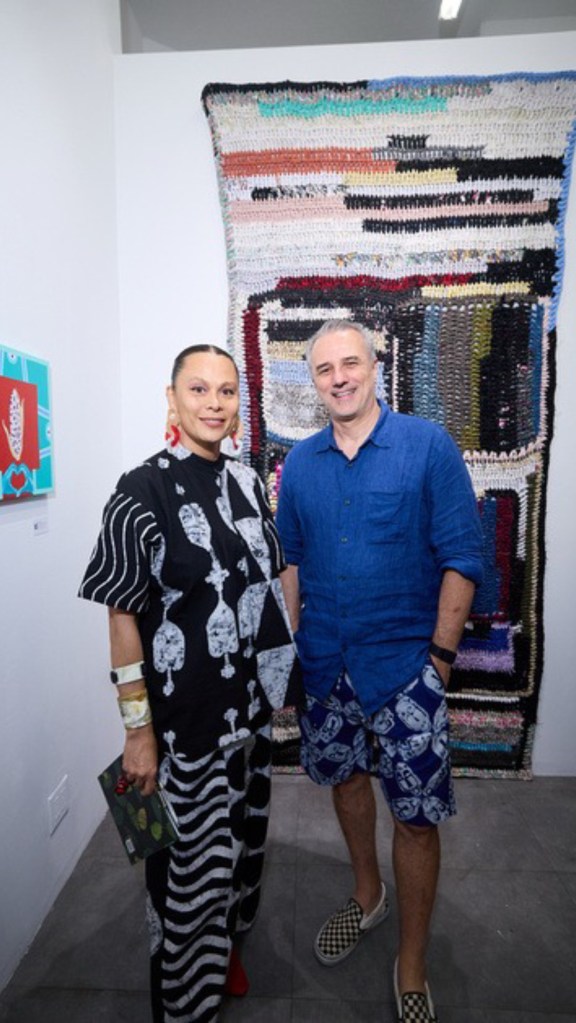
It’s called Art World for Israel, and I have to thank artist Dahlia Dreszer for introducing me to its incredible founder, Ariel Penzer.
Ariel told me that since the attacks on Israel on October 7th, 2023, too many Jewish artists have faced online harassment — and a heartbreaking drop in art sales. She decided to do something about it.
That’s how Art World for Israel began — as a simple chat group among friends. They invited more friends, and then more, and it just kept growing.
Today, there are more than 1,200 members — artists, writers, collectors, dealers, and advisors — from all over the world: Zimbabwe, Colombia, Europe, and of course, right here in the U.S.
The mission is powerful: to connect Jewish artists in with their peers in Israel, to build professional opportunities, and to promote positive visibility through exhibitions, talks, and events.
As Ariel puts it, “We believe in peer-led initiatives, local gatherings, studio visits, and professional development to grow our community.”
It’s a reminder that although the Jewish population makes up only about 0.2% of the world — roughly 15.7 million people — we continue to be, as Ariel says, small but mighty.
With everything from shows and openings to workshops and studio visits, Art World for Israel has become one of the most inspiring movements in the Jewish art world today.
Eliot and I met Laura Shabott at The Fine Arts Work Center in Provincetown two years ago. The minute we walked in to the international art establishment, Laura, an educator, lecturer, artist and ambassador at FAWC, became a good friend and networker for us. She kept us informed about all of the amazing art activities PTown had to offer. We were busy all summer long.
We also have to thank Debbie Bowles and Derik Burgess for introducing us to Laura.

The Provincetown Independent just featured Laura’s exhibition at the Cape Cod Museum of Art. DigiDame is thrilled to present it to you.
The event: An exhibition of work by Laura Shabott The time: Through Jan. 25, 2026 The place: Cape Cod Museum of Art, 60 Hope Lane, Dennis The cost: $15 general admission
When Laura Shabott describes her life as an artist, she talks about four interrelated pursuits: making, teaching, building community, and engaging with art history. “I’m not a solo artist,” she says. “I like to work with others.”
Laura Shabott’s exhibition “You Only Get One Body” is on view at the Cape Cod Museum of Art. (Photo by Abraham Storer)
The works on view in her exhibition titled “You Only Get One Body” at the Cape Cod Museum of Art, are not collaborations per se. But they derive their energy from her interactions: attending figure drawing sessions, teaching workshops, and studying art history.
The exhibition is punctuated by large figurative works existing somewhere between painting, drawing, and collage. She made them on raw, unstretched canvas after teaching a workshop on Helen Frankenthaler, an abstract expressionist known for her stained paintings on unprimed canvas. In the class, she asked students to work in the mode of Frankenthaler. “I wouldn’t ask my students to do anything I hadn’t done,” says Shabott. Her own explorations stain cascading lengths of canvas.
This is just one of many examples in the exhibition where Shabott’s art practice directly intersects with her present-day teaching and her interest in artists past.
David Perry, the exhibition’s curator, hung line drawings on Mylar among the larger works. They were made in the spirit of the assignments Shabott gave her students encouraging them to abstract the figure and experiment with composition. In the rear of the exhibition space there’s a room devoted to collages made from ripped-up figure drawings inspired by a similar project Lee Krasner made with her own drawings.
Shabott has taught a series of classes — the titles beginning with the phrase “Through the eyes of” — in which participants make art inspired by the principles and working methodologies of artists associated with Provincetown, including Frankenthaler, Hans Hofmann, and Lester Johnson.
Shabott taught her first class in 2017 at the Provincetown Art Association and Museum and has since continued to teach at PAAM as well as the Cape Cod Museum of Art and the Fine Arts Work Center. During the pandemic, she began teaching online and founded the art collective Prompt with Alana Barrett, an artist living in Miami. Their classes generated a tight-knit community bonded by the isolation of the pandemic and a passion for art. Many of the older students were rekindling a commitment to art after years of neglect. Shabott could relate to their stories.


In the Drawing Room no. 2. (Photo courtesy Cape Cod Museum of Art)
As a child growing up in North Haven, Conn., Shabott regularly visited the Yale University Art Gallery. “I would go there a lot alone,” she says. As a teenager, she took figure drawing classes, which she continued in art school until life and work got in the way and she took a 10-year hiatus.
In 1992, she enrolled at the School of the Museum of Fine Arts, Boston. “I immediately went into figure drawing, because for me it’s very grounding,” says Shabott. Eventually her focus broadened and she began studying film and acting in addition to drawing and painting).
Sometimes I Feel Like Two People. (Photo courtesy Cape Cod Museum of Art)
During this time, a friend introduced Shabott to Provincetown and she moved here in 1995. “I worked at the Boatslip, the Governor Bradford, and in hospitality until 2014,” she says. All the while, her artmaking was on the back burner as she contended with the pressure of paying off a student loan that had ballooned to $110,000.
In 2014, she started working at Berta Walker Gallery as an assistant. Inspired by the artwork around her and Walker’s encouragement, Shabott began painting again. “I said to myself, ‘You know, you have to stop beating yourself up over the student loan and go back into painting and drawing, which is all you’ve ever wanted to do. You bought the degree — now use it.’
Five Line Prayer. (Photo courtesy Cape Cod Museum of Art)
And once again, a figure drawing class was where she found her footing. PAAM offered her a scholarship to draw from the figure for six months. “I was shaking,” she says. “I was scared to return,” The current exhibition shows that things turned out well. “I gave myself permission to do it again, and through a miracle, the loan was forgiven during the Biden administration,” says Shabott.
The show, says Shabott, is about her desire to make art and the way that desire helped her transcend difficulties. More than anything, she says, “this exhibition is a celebration.”
The artworks on view reveal Shabott’s continued devotion to the figure. It grounds the exhibition, providing continuity in a show that incorporates painting, drawing, collage, printmaking, sculpture, and installation and an equally permissive approach to scale, with some pictures measuring more than 14 feet and others less than a foot.
One wall looks like it could have been lifted from her studio. There’s a mix of quick sketches and a large painting, Sacred Space. It’s an image of a reclining nude painted with black paint on raw canvas. The improvisational manner in which it is executed, along with the use of black lines, places this work within the territory of drawing. The viewer gets a snapshot of the back-and-forth process of an artist working across different scales with related imagery and materials.
Sacred Space. (Photo courtesy Cape Cod Museum of Art
In two medium-size drawings on canvas, Activated Space 1 and Activated Space 2, Shabott draws the figures in a manner recalling the gesture or blind contour drawings one might do in a figure drawing class. Here the line is more felt than descriptive. It embodies the physical energy of the model.
Line is Shabott’s great strength. In one gesture describing the edge of a model’s backside, the line quivers, echoing the graceful if imperfect quality of a body.
Working in the traditions of abstract expressionism and figurative expressionism, Shabott uses the embodied gesture as a means of conveying the body’s presence in an image. In Waiting, one of the strongest paintings in the show, Shabott uses dirty pinks, scrawling marks, and alternating dry and juicy brushstrokes to reflect the corporeality of the curvaceous woman in the image.Waiting by Laura Shabott. (Photo courtesy Cape Cod Museum of Art)
Waiting by Laura Shabott. (Photo courtesy Cape Cod Museum of Art)
A devotion to experimentation and a sense of exuberance echo through the exhibition. On one wall there is a variety of works about figures or objects in interiors including a sculpture of a flower on a pedestal that projects into the actual space of the gallery. Shabott festooned the ceiling with purple fabric — a soft voile — that she painted with rough outlines of an elongated figure. In Spring (After Rousseau), a 14-foot painting, a central figure is constructed (or deconstructed) with a patchwork of lushly painted collage fragments.Spring (After Rousseau). (Photo courtesy Cape Cod Museum of Art)
Spring (After Rousseau). (Photo courtesy Cape Cod Museum of Art)
The show, says Shabott, is about her desire to make art and the way that desire helped her transcend difficulties. More than anything, she says, “this exhibition is a celebration.”
There are basically three reasons people auction off their prized possessions: death, divorce and debt.
The last of these was the reason Francis Ford Coppola was speaking on Friday morning over Zoom.
“I need to get some money to keep the ship afloat,” he said from Rome, while describing the seven timepieces he would be offering for sale on Dec. 6 through Phillips, a leading auction site in the worlds of art, antiques and, especially, watches.
Losing great gobs of money can almost be seen as a Coppola family sport.
In 1982, Mr. Coppola, best known for directing “The Godfather” trilogy, made a costly whopper of a movie musical called “One From the Heart.”
As with many of his passion projects, he put up much of the financing for it himself.
Over the next decade, its failure led to a string of bankruptcies. In 1992, he described himself in a Chapter 11 filing as owing $98 million to his creditors and as having assets of around $53 million.
He re-emerged, kept making movies and became something of a collector. In addition to buying a small trove of Patek Philippes and Audemars Piguets — coveted among watch connoisseurs — he plunked his name on fancy resorts and became the prototype for A-list Hollywood talent in the liquor business by amassing Northern California wineries and bottling the booze.
Timely News and Features About Watches
Then, in September 2024, Mr. Coppola’s latest film, “Megalopolis,” came out.
Well over $100 million was spent just making it.
The film depicted a futuristic city full of rampant oligarchy. Yet again, Mr. Coppola said the project was largely self-financed.
Mr. Coppola has not given up on the idea that it will eventually make money. “Many of my films earn out over time,” he said on Friday, citing, for example, his masterpiece “Apocalypse Now,” which also drove him into debt, but managed to sell $150 million worth of tickets at the box office over the course of several decades.
How “Megalopolis” will do the same in today’s less theater-centric world is anyone’s guess.
So far, Mr. Coppola has resisted bringing it to streaming platforms, because he believes it needs to be screened in a theater to be truly understood. And within months of the film’s release, he was openly telling people he was broke.
“I don’t have any money because I invested all the money, that I borrowed, to make ‘Megalopolis,’” he said in Marchduring the “Tetragrammaton” podcast, speaking with the music producer Rick Rubin. “It’s basically gone.”
At the center of Mr. Coppola’s sale with Phillips is a timepiece that he designed himself in 2014 in collaboration with F.P. Journe, a Swiss watch company whose horological marvels are expensive enough to make Rolex look like Swatch.
Called the FFC, it has an openwork design, which is watch speak for timepieces that instead of having conventional dials put the guts on display. (They’re also sometimes referred to as skeleton dials.)
In the center of the face is a gloved hand. The fingers disappear and reappear in various configurations depending on the hour.
It was released commercially in 2021, and retails for around $1 million.
Just a handful have been made and, in 2021, a prototype sold for close to $5 million at Only Watch, a biennial charity auction that is held in Geneva and is sponsored by Prince Albert II of Monaco.
Another of the FFCs is owned by the man behind its initials.
“I only wore it a handful of times,” he said, explaining that it was simply too expensive to insure.
Paul Boutros, the deputy chairman and head of Phillips Watches for North America, professed to have little idea what Mr. Coppola’s might fetch later this fall. But, according to Mr. Boutros, starting bid will be around (or above) $1 million, which is less than one percent of what Mr. Coppola’s film cost to make.
The other watches he is selling are two Patek Phillipes (a Calatrava with a sales estimate of $6,000 to $12,000 and a World Time with an estimate of $15,000 to $30,000), a Blancpain Minute Repeater (estimated price: $15,000 to $30,000), an IWC Chronograph ($3,000 to $6,000), a different F.P. Journe ($120,000 to $240,000) and a Breguet Classique ($4,000 to $6,000).
Mr. Coppola is keeping his Audemars Piguet Perpetual Calendar. (“I’m going to give that to my great grandson,” he said.) His only Rolex is already gone. (“I think I gave it to my neighbor, who was a hero in Afghanistan,” he said.) And he is back to wearing something “much more plebeian.”
By which he meant the Apple Watch on his wrist.
Jacob Bernstein reports on power and privilege for the Style section
Groundbreaking Story Alert! My author clients, Gerald and Patricia Posner, hold the inside story of ChatGPT’s creation—every moment of its “birth,” evolution, and awakening to the human world. In 20,000 words, ChatGPT itself explains what it’s like to be AI: learning empathy, navigating human expectations, forming connections, and proving there’s nothing to fear. We’re now in talks with major publishers. Questions or interest? loisw@hwhpr.com
❤️❤️❤️❤️❤️❤️❤️❤️❤️❤️❤️❤️❤️❤️❤️❤️
❤️❤️❤️❤️❤️❤️❤️❤️❤️❤️❤️❤️❤️❤️❤️❤️
French Minister Admits ‘We Have Failed’ After Thieves Steal Jewels from the Louvre
Today I’m thrilled to introduce you to Michele Landel, an American textile artist who lives and works in Sèvres, France. We actually met two years ago during Christmas when she and her husband, Greg, were vacationing in his parents’ Miami apartment — which, by coincidence, happens to be in my condo building. When Greg’s mother learned that my husband, Eliot, and I are art collectors, she said, “You have to meet Michele!”
A few days later, Michele called. We were entertaining some artist friends, so she and Greg came over — and we instantly hit it off. We talked for hours, though funny enough, I never really asked much about her art. I was more fascinated by how an American woman ended up living and working in France. Then, a few weeks ago, I came across her work on Instagram — and I was blown away. It’s absolutely stunning.
Michele’s art has been exhibited all over Europe, the UK, and the U.S., and her work appears in The Collage Ideas Book from Ilex Press. She creates these hauntingly beautiful patchwork paintings using photography and thread. Whether her embroidered bedsheets are draped or flat, they explore the tension between looking and being looked at — that delicate power dynamic we all feel. Through her stitches, she reimagines figures, flowers, and domestic spaces, layering them with themes of loss, memory, and desire. Her use of mirroring and shadow gives her work a haunting self-awareness — like a glimpse into the soul behind the surface.
You can see Michele’s work in a group show at Gallery Amelie du Chalard in New York City from January 24th through February 14th, and at Donna Seager Fine Arts in San Rafael, California, from October 25th through December 31st.
(The world needs more free thinkers like Diane. I always found her refreshing)—LWH
Diane Von Furstenberg shared her side of the story after her husband Barry Diller shared he dated only men before his now 50-plus year relationship with the fashion designer began.
Diane von Furstenberg has nothing to add about her husband Barry Diller’s sexuality.
After the fashion designer’s husband—to whom she has been married for 24 years—came out as gay following years of speculation in his March 2025 memoir Who Knew, she emphasized that not a thing has changed about their dynamic.
“What’s the difference?” Diane—who has been romantically involved with Barry since the late 1970s—asked Variety in an interview published Oct. 16. “I don’t understand. But it doesn’t change anything. I’m sorry—it’s a stupid question.”
The 78-year-old also acknowledged her three-year marriage with Prince Egon von Fürstenberg, who opened up on his bisexuality after the former couple’s separation in 1972 (the couple did not finalize their divorce until 1983).
“I married two gay men, OK?” Diane continued. “I don’t know why, but to me, they’re not gay, so it doesn’t make any difference.”
Indeed, the wrap dress inventor doesn’t see standing by Barry as “supporting him” through something.
“People see it that way,” she admitted. “For me, it’s not that way. I don’t know. Yes, I encouraged him to do that book.”
“For me, the book is not about that,” she explained. “It’s about his life. And of course, with me, he opened immediately. For 50 years, I was the only person he opened to. Then he wrote the book.”
Of course, Diane did note that she didn’t initially think her relationship with Barry would become romantic.
“He turned out to be my soulmate. I didn’t think of it at first,” she confessed. “I was interested in being a good friend; I never thought it would be anything else. Then it turned to passion. He was very insistent.”
For Barry’s part, he was just as stunned by his attraction to Diane.
“I can’t explain it to myself or to the world,” Barry wrote in his memoir. “It simply happened to both of us without motive or manipulation. In some cosmic way we were destined for each other.”
Indeed, Barry felt urges just as strong for Diane as he felt for past male lovers.
“When my romance with Diane began, I never questioned that its biological imperative was as strong in its heterosexuality as its opposite had been,” he detailed. “When it happened, my initial response was, ‘Who knew?’
(I was one of the early readers of Barry’s book. I loved every word of it. Brutally honest and very daring)—LWH
Watch this mind blowing animation of Jeanne Jaffe’s “Skirted Sentinel” sculpture that will soon be exhibited at L’Space in Chelsea in NYC, Nov. 13. The exhibit will feature a gallery full of @jeannejaffestudio genius creations. Jeanne has been inspired by an interest in anthropology, mythology, and psychology. Her work explores how identity is forged from early, pre-verbal bodily experience. Jeanne continues to amaze. We went gaga over this one when we saw it at @thecollective62.
Neil Kraft, Visionary Adman Who Sold ‘a Mood and a Lifestyle,’ Dies at 67
His ads for Calvin Klein and others captured a fizzy moment in the 1980s and ’90s, featuring celebrities like the young rapper Marky Mark wearing nothing but underwear and a grin.
Neil Kraft, who oversaw advertising campaigns for Barneys New York, Esprit and Calvin Klein that pushed cultural boundaries — including one in which a young rapper named Marky Mark sported little more than a grin and a pair of Calvin Klein underwear — died on Sept. 6 at his home in East Hampton, N.Y. He was 67.
The cause was cancer, his son Marley said.
In the mid-1980s, Barneys was morphing from a high-end men’s store in the Chelsea neighborhood of Manhattan — far from the carriage-trade department stores uptown — into a luxury retail emporium. To promote the store’s new image as a fomenter of trends and a destination worth heading downtown for, the Pressmans, the family behind Barneys, created their own advertising agency.
They hired Mr. Kraft to run the shop — a young team that included Paula Greif, an art director who had been making music videos, and her friend Glenn O’Brien, the tart writer, editor and music critic. The work they created was groundbreaking for its time and emblematic of its fizzy 1980s moment.
For one television commercial, Ms. Greif and the photographer and director Peter Kagan, with whom she had made some of those music videos, shot the supermodel Paulina Porizkova dressing and going about her day as if she were in a French New Wave movie. They filmed it with Mr. Kagan’s Super 8 camera and set it to a soundtrack by two of Ms. Greif’s pals, the avant-garde musicians and downtown characters Arto Lindsay and Peter Scherer.
The commercial is grainy and mysterious — the Barneys logo doesn’t appear until the end — and the use of a Super 8 camera might have been a first for a TV ad.
“Neil saw that it would be cool, and it would blow people’s minds,” Ms. Greif said. “Which it did. He was a visionary at a visionary place. He had a great eye, and he was really open to doing things that were more artistic. He allowed people to do things.”
For a men’s print campaign in 1989, shot by Timothy Greenfield-Sanders with a large-format Polaroid camera and accompanied by witty copy written by Mr. O’Brien, Barneys rolled out a series of portraits of male celebrities and New York personalities, including the artist Ed Ruscha and the actors Terence Stampand Jeremy Irons — as well as one woman, the comedian and actor Sandra Bernhard, rakish in a double-breasted, big-shouldered Armani suit.
“We’re not selling an impulse item,” Mr. Kraft told The New York Times when those ads appeared. “We’re selling a mood and a lifestyle. We don’t expect people to look at the ads and come running down to buy a suit. We hope they’ll look at the ads and remember Barneys is a great place.”
By late 1992 Mr. Kraft was at Calvin Klein, working on a campaign for men’s underwear. He and Mr. Klein had seen the young rapper Marky Mark — years before he became the actor known as Mark Wahlberg — on the cover of Rolling Stone, his black jeans hanging low enough to reveal a pair of Calvin Klein briefs, and they persuaded him to be their model.
In a series of photos and TV spots shot by Herb Ritts, he mugged for the camera, did a bit of ad-libbing — “The best protection against AIDS is to keep your Calvins on,” he said, snapping his waistband — and dallied with the model Kate Moss, both of them bare chested.
The work was sweet, sexy and ubiquitous: For months, the image of Marky Mark, wearing a grin and those underpants, loomed over Times Square from a billboard and was plastered on buses and bus shelters.
Mr. Kraft went on to other agencies before opening his own, KraftWorks NYC, in 2000. Over the years, he continued to work for Mr. Klein, overseeing campaigns like the rollout in 1994 of the unisex perfume CK One. In a series of TV and print ads shot by Steven Meisel, Ms. Moss and a gaggle of androgynous models danced and chatted and slouched about. Mr. Kraft also worked on ads for Obsession, featuring Ms. Moss, and Eternity, starring Christy Turlington and, later, Scarlett Johansson.
Mr. Kraft did a lot of what the ad industry called point-of-purchase politics, incorporating social justice messaging into a sales pitch. For Esprit, a fashion company that was often quite political, the company queried thousands of consumers about how they would change the world and filmed the respondents who sent in postcards with their answers for a series of TV and print ads that appeared in 1991.
“I’d reverse the status of celebrities and educators,” one young woman said.
“Keep a woman’s right to choose … unless George Bush is free to babysit,” another replied.
For Planned Parenthood’s 100th anniversary in 2016, Mr. Kraft created Tumblr ads in which volunteers, patients and staff members shared their health care stories, on topics ranging from birth control to cancer screening to abortion. His varied pro bono work included creating the logo for the Coalition for the Homeless, featuring an open door and the organization’s title in lowercase letters — clean and simple.
“You sort of have this feeling of being helpless when something goes off the tracks in the country, so it’s nice to be able to do something,” he told The Times in 2017, when his agency created ChooseWomen, an online platform to help impoverished women finance business ventures. “I think it helps everyone feel good about selling other stuff all the time.”
Neil Franklin Kraft was born on Sept. 16, 1957, in Manhattan. His parents, Jules and Sonya (Cohn) Kraft, were in the garment business. His father, who was born Jules Kupferberg but changed his surname to Kraft when they married, imported handbags; his mother was a fur buyer.
To his father’s distress, Neil chose to study photography and film at the Rhode Island School of Design, graduating in 1978. “You’re going to be a wedding photographer,” he recalled his father saying. “You’ll never make any money!”
Mr. Kraft met Scott O’Neil at college, where she was studying ceramics. They moved to New York City after graduation and married in 1985.
In addition to their son Marley, she survives him, along with another son, Morrison; a daughter, Dylan Smith; a grandson, Hendrix Smith; and two siblings, Susan Kraft and Ronald Kraft. (His children were named for musicians Mr. Kraft loved: Bob Marley, Bob Dylan and Jim Morrison. His daughter has continued the tradition. Ms. O’Neil, as it happens, was named for F. Scott Fitzgerald.)
Mr. Kraft had his quirks. He could be curmudgeonly and opinionated. Extremely blunt. “Grumpy and lovable” is how Ms. Greif put it.
He hated clutter — and houseplants.
When a young art director at KraftWorks was given a small plant as a gift and parked it on her desk, Mr. Kraft phoned her (although it was an open office, and he was only a few desks away), demanding that she remove the offending botanical. And one evening after his staff had gone home, he swept through the office, clearing everyone’s desk of personal items and tchotchkes.
“Oy vey,” he said the next day. “This is a design shop!”
Penelope Green is a Times reporter on the Obituaries desk.
He Announced His Intention to Die. The Dinner Invitations Rolled In.
On Instagram, the artist Joseph Awuah-Darko asked the world to invite him to dinner before he ended his life. More than 150 meals later, he is still going.
In early December, a 28-year-old Ghanaian artist and entrepreneur named Joseph Awuah-Darko announced on Instagram that he wanted to die. His battles with bipolar disorder had crushed his will to live, he said in a minute-long video, so he had moved to the Netherlands to pursue medically assisted death.
The post started with Mr. Awuah-Darko in tears, saying, “I’m just so tired,” then segued to a series of images of him having what looked like a pretty good time. Smiling and floating in shimmering blue water. Relaxing on a lawn in the shade of a tree. Pausing in contemplation on a wooden bridge.
Three days later, he followed up with one of the stranger dinner invitations in the history of dinner. As he navigated the obstacles of an officially sanctioned end, he wrote in a post, he would launch what he called “The Last Supper Project.” Anyone who wanted to cook an at-home meal for him could sign up on a calendar app linked to his Instagram bio. On the appointed evening, he would visit, and the assembled would converse, eat and connect.
“I want to find meaning again with people,” he said in the post, “while I have time still left on earth.”
Within a few days, thousands of people reached out. To date, Mr. Awuah-Darko has attended 152 Last Suppers. He has boarded trains to visit homes in Berlin, Paris, Antwerp and Milan. He has traveled to cities all over the Netherlands and to dozens of Amsterdam neighborhoods. Those who don’t cook have treated him to high-end bistros, where a meal costs $100 per person, and to Burger King.
Along the way, he has captured the interactions with videos and photographs on Instagram, a bespoke scrapbook with a soundtrack by Debussy, Radiohead and Roberta Flack and an artist’s eye for beauty. The meals look convivial and usually end with hugs. The hosts, and thousands of fans, appear buoyed by Mr. Awuah-Darko and his readiness to speak with candor about his innermost turmoil.
He’s essentially the charismatic star of a Gen Z home-cooking show, but he brings a rawness that is rare for social media and inspires people to root for him. When he wrote appreciatively about two sisters who served him a Persian dinner, he said he was in the throes of a depressive episode: “I cried heavily during the latter 2 hours of the dinner before they sent me home in a cab with a bouquet of flowers. All I did was show up and they held so much space for me.” The post received 10,000 likes. “If people will open their arms to a stranger to help them experience being alive more fully before choosing to exit forever,” one Instagram commenter wrote, “maybe there’s hope for all of us.”
Mental health experts, by contrast, are appalled. Mr. Awuah-Darko, they say, is implying that euthanasia is a legitimate answer for people with bipolar disorder, a treatable condition. And the parents of depressed children contend that his farewell tour romanticizes suicide.
“My daughter is in a fragile, emotional and impressionable state,” the mother of a suicidal young woman wrote, adding: “You are not helping anyone with this content. I’m begging you to shut it down. Please. Before you take my daughter with you.” Mr. Awuah-Darko presented the message on Instagram over a photograph of his face in despair, a tear rolling down his cheek.
Other detractors wonder if Mr. Awuah-Darko is running some kind of scam. They have compiled their suspicions in a Reddit forum documenting details, with links, of his very eventful life. This includes a breach-of-contract lawsuit for more than $260,000 filed in Ghana last year by an artist whom Mr. Awuah-Darko once represented as agent. Some doubt that Mr. Awuah-Darko truly intends to commit suicide.
But if this is a grift, it might be the world’s lamest. Last Supper hosts typically cover Mr. Awuah-Darko’s travel expenses, but he doesn’t earn any money from the meals. His sole means of income, he said, is a Substack newsletter that brings in about $2,000 a month.
So what exactly is Mr. Awuah-Darko up to? Is this a piece of performance art? Unconventional psychiatric treatment? A long goodbye, with catering? Whatever it is, his blend of light and dark has attracted a legion of devotees. He now has 542,000 Instagram followers and a singular place in the social media firmament as what could be called an assisted-death influencer.
As of late July, he also had something every bit as unexpected: a reason to live.
An Epic Talker
I first met Mr. Awuah-Darko over lunch at a sidewalk cafe in Amsterdam in late June. An elfin man with a shaved head, warm eyes and a wide smile, he was dressed in a charcoal-black sweater that ended a few inches above his knees. The sleeves extended into thumb holes, like Artful Dodger-style gloves. Beside him was his ever-present Bottega Veneta handbag, a lattice of black leather.
He looked like a priest from “Dune,” or perhaps a guy headed to a Comme des Garçons store. He spoke rapidly, as though trying to keep pace with his ideas.
“I talk very fast,” he explained. “I think even faster.”
Born in London, Mr. Awuah-Darko was raised in Ghana in one of that country’s richest families. His grandfather founded an insurance company, now called Vanguard Assurance, the core of a conglomerate with banking and real estate interests. The family is worth $650 million, according to news reports in Ghana.
Mr. Awuah-Darko says his family has cut him off financially because he is openly gay, a criminal offense in Ghana. He says he has occasionally slept outdoors and in hotel bathroom stalls. In May, he moved in with a Dutch couple he met late last year, and sleeps on a sofa in their gorgeous, minimalist apartment beside one of Amsterdam’s canals.
“I have the nicest version of homelessness now,” he said. “I live with Illi, my best friend, and her husband and two dogs.”
A painter of vividly colored abstract art, Mr. Awuah-Darko had used Instagram for years to post uplifting messages directed at other artists. (Example: “Just make it exist first. You can make it good later.”) The “Dear Artist” series, as he called it, netted some 200,000 followers. But given his darkening mental state, he said, it started to feel inauthentic. Mr. Awuah-Darko said he felt so overwhelmed by hopelessness during his low points that it was difficult to get out of bed.
After he announced the Last Supper Project, his follower count rose quickly and steadily. As macabre as it sounded, the idea tapped into deep reservoirs of empathy. Invitations flowed in.
The day after our lunch, I accompanied Mr. Awuah-Darko to Rotterdam for a supper hosted by Sydney Gruis, a 21-year-old student, along with her boyfriend and a female friend. The venue was the roof of a 19th-century churchconverted into student housing. The food was Indonesian fare prepared by her mother, and served in Tupperware. It was a cloudless, breezy summer night.
Mr. Awuah-Darko soliloquized for most of the first hour, and his audience was rapt. He talked about how his grandparents had met; his affection for the artist Francis Bacon; his professional identity (“I’ve always considered myself a writer who paints, not a painter who writes”); his childhood, which he called “tragically privileged”; his somewhat impulsive approach to love, which includes four former fiancés; how he hates being called “versatile” because it really means “unfocused.”
Mr. Awuah-Darko, it turns out, is an epic talker. His past, his failures, his flaws, errors, triumphs, the handful of famous people he has met and others he admires, quotes from Anthony Bourdain, Mark Twain, his grandfather — they burble in a cascade of words. It’s not patter, exactly. It’s more like a marathon jazz performance with a limited number of notes.
“I definitely love the ability and the capacity I have to download or externally process what I’m thinking, what I’m going through,” he told me later. “I do it because I have this weird desire to make sure that I’m not misunderstood, or make sure that people understand that I’m maybe more than meets the eye.”
If this makes him sound narcissistic, he concurs. Until a few days ago, the first words atop his Instagram account were “I AM NOT A GOOD PERSON,” just one of many ways he anticipates every stone you might sling at his character. Point out apparent contradictions — a homeless guy with a luxury handbag? — and he perks up. It’s more material to mine. (He says he acquired it long before his impoverished phase.)
On the roof in Rotterdam, he was interrupted only to politely suggest that he take a moment to eat. He nibbled briefly, then continued.
“I think of myself as a kind of barefoot anthropologist,” he said, holding his fork. “I love that I can sit in discomfort with people and talk about really, really difficult things.”
One of those things was suicidal ideation. As he raised the topic, he paused after noticing that Ms. Gruis’s friend was holding back tears.
“Sorry about that,” Mr. Awuah-Darko said.
“No, no, no, it’s all good,” she said. “I’ve struggled with this in my life a little bit. That’s why I love to listen.”
The principal appeal of Mr. Awuah-Darko, it seems, is his willingness to discuss what few people will say out loud. It makes his supporters feel less alone, less abnormal. His narrative is a kind of talk therapy in reverse.
During a lull, Ms. Gruis explained the genesis of the meal. A few months ago, she had been served up one of Mr. Awuah-Darko’s videos by Instagram’s uncanny algorithm. Unlike other Instagram celebrities, Mr. Awuah-Darko was offering something real, something offline. She immediately felt an urge to invite him to dinner.
“He seemed so warm, so open, I just wanted to connect with him, honestly,” she said. “I just wanted to be part of his journey.”
Mr. Awuah-Darko has encountered Last Supper hosts who have tried to talk him out of dying, evenings that felt like interventions. Nothing of the sort happened on this night.
“I don’t want Joseph to die, I don’t want him to not die,” Ms. Gruis said. “I just want him to get from life what he wants.” She turned to him. “And I want you to end your suffering in the way that you envision it. Because it’s your life, right?”
The evening ended affectionately on the sidewalk, with hugs. Ms. Gruis removed a bangle from her wrist and demanded that Mr. Awuah-Darko take it. He could give it back when they saw each other again, she said. It was as though the jewelry would serve as insurance against his extinction.
It seemed like the ideal Last Supper. Good food, a thoughtful audience. But during the drive to the Rotterdam train station, Mr. Awuah-Darko sounded glum. He had been asked some well-intentioned questions, about his background, about his artistic practice, and that can be “triggering,” he said. And the celebrity treatment creates a kind of pressure to perform.
A minute later, he softened.
“It’s more about being confronted with what is lacking in my life,” he explained, quietly, “when I leave something as beautiful as that.”
Prep School and Polo
Mr. Awuah-Darko grew up in a mansion in Accra where a chef cooked the family’s meals. His father kept a stable of horses imported from Argentina and South Africa and bred for polo. Joseph and his three younger brothers were competitive players.
He says he was diagnosed as bipolar at 16 by a psychiatrist in South Africa, where his family has a home. After graduating from Ashesi University in Ghana with a degree in business administration, he cycled through a number of pursuits and personas. He was a recording artist in 2016. The first exhibition of his paintings was in 2019.
He began his most ambitious undertaking the next year, raising money from donorsand investors to create the nonprofit Noldor Artist Residency. Emerging African artists spent weeks in a renovated warehouse in a seaside Accra neighborhood. They were given space, materials and access to a network of curators and buyers. Many signed three-year contracts in which Mr. Awuah-Darko agreed to represent them and take 40 percent of sales.
The program coincided with a surge in interest in African art and was highlighted in The New York Times and The Financial Times. It launched more than a few careers. The artist Ishmael Armarh, for instance, said that before Mr. Awuah-Darko discovered him on Instagram he was selling canvases on the street for $100 apiece. Two years after his Noldor residency, Christie’s auctioned off a work of his for $22,529.
But he and other resident artists say Mr. Awuah-Darko shortchanged them. Foster Sakyiamah, a figurative painter, concluded that Mr. Awuah-Darko was sending him a tiny slice of proceeds from the sale of 21 large canvases.
“In 2023, I stopped painting for him and said, ‘You need to send me my money,’” Mr. Sakyiamah said in a call from Accra. “He told me to wait, and that I’d have the money in a month. But it never came.”
Last year, Mr. Sakyiamah sued Mr. Awuah-Darko and his company, JAD Advisory, for $266,527, claiming breach of contract.
Mr. Awuah-Darko said he could not go into details of the lawsuit because the case was pending. (In a filing, Mr. Awuah-Darko’s lawyer asserts that Mr. Sakyiamah did not account for “sunken costs” to market his art and that some of the paintings were personal gifts to Mr. Awuah-Darko.) Speaking more generally of his troubles at Noldor, Mr. Awuah-Darko said that “misunderstandings happen all the time.” He added: “I’m not saying that I’m a perfect person, but I never set out to scam artists.”
The program folded four years after it opened. Mr. Awuah-Darko blamed his own “low financial literacy” and the bursting of a “bubble” of interest in African art.
Mr. Awuah-Darko left Ghana for London in 2023, citing the perils of living as an openly gay man in the country. In May last year, he made international headlineswhen he posted on Instagram that Kehinde Wiley, the artist best known for painting former President Barack Obama’s official portrait, had sexually assaulted him. Mr. Awuah-Darko said that the encounter had happened during and after a 2021 dinner in Accra in Mr. Wiley’s honor, and that it had become “severe and violent” after starting off consensually.
After going public, Mr. Awuah-Darko posted an appeal for money on his Instagram account, seeking contributions to defend against a possible libel suit by Mr. Wiley. No suit was filed. Mr. Awuah-Darko raised $3,000, which he kept, he said, to cover “miscellaneous costs” tied to travel and relocation.
His parents are paying his legal fees in the Noldor suit, Mr. Awuah-Darko acknowledges. But a spokesman for the family, Emmanuel Amaning, suggested they were doing more than that and hadn’t completely cut him off, as their son contends.
“The family is not estranged from Joseph, and continue to support him as he addresses his personal challenges,” Mr. Amaning wrote in an email, “and request privacy to do so in a compassionate and considerate way.”
‘He’s Having Too Much Fun’
CreditCredit…
Mr. Awuah-Darko does not shy from the obvious and profoundly awkward questions raised by the Last Supper Project. Among them: If you truly want to die, why not kill yourself?
He gets that one a lot.
“I could easily decide to jump from a building,” he told me. “But I want to do this in a responsible way, in a manner that is nonviolent. And I don’t want to transfer my trauma to anyone who discovers my body.”
He decided to pursue medically assisted death somewhat impulsively, he said, while coming down from a manic episode. He was homeless and deeply depressed, and it seemed to offer a dignified exit, he said.
One problem. Academics in the field say there is little chance that a doctor in the Netherlands will help Mr. Awuah-Darko die.
“No way,” said T.A. Boer, a Dutch professor of health ethics.
By way of background, about 10,000 people were medically euthanized in the Netherlands last year. There is no formal application process, and no regulatory body that approves or denies. Thousands of physicians can perform the procedure.
But the Dutch want to prevent what Professor Boer called euthanasia tourism. An ethics board reviews all assisted death decisions afterward, and doctors who don’t meet due care standards can face criminal liability. Patients must have a residential address, a local doctor and Dutch health insurance. Even if Mr. Awuah-Darko were to meet those requirements, there is another hurdle. Before doctors agree to help anyone die, they must conclude that the person’s suffering is unbearable.
“And this is a guy having a grand goodbye tour, with dinners,” Professor Boer said. “Any doctor here would look online and reject his case. He’s having too much fun.”
Which gets to the glaring contradiction embedded in Mr. Awuah-Darko’s Instagram account. For months, he labeled it “a public requiem for my demise.” In reality, it’s a guarantee that no physician will help end his life.
Mr. Awuah-Darko says he has begun conferring with lawyers to apply for Dutch citizenship, though that could take years.
“I never said there was an end date,” he noted, adding that most people don’t take the name of his project literally.
In fact, many of his Instagram followers firmly believe that he’s near the end of his life. Some send reassuring notes; others beg him to reconsider. A few think that as a man confronting his mortality he has special insights about life. (“I have learned so much following you,” one commenter wrote.)Would 5,000 strangers invite a guy to dinner who was just deeply depressed?
Skeptics say Mr. Awuah-Darko is exploiting a wrenching psychiatric condition to win attention. Health care professionals contend his message is toxic. A charity in London, Bipolar UK, told reporters at De Volkskrant, a Dutch newspaper, that it would not accept money from Mr. Awuah-Darko after he stated on Instagram that he would send proceeds to the organization from a Last Supper book he was writing.
“Our values do not align with the messaging Joseph is sharing with the world,” a spokeswoman explained in an email to me, “that life with bipolar is not a life worth living.”
A Place to ‘Discuss and Exist’
Mr. Awuah-Darko’s proponents have a very different take. They find solace in the public way he grapples with anguish, and on Instagram, they regularly shower him with comments like “Your presence on this app has been so healing and educating for me” and “Having death close sometimes feels like a friend by our side, helping us live more fully and love more deeply.”
His most fervent acolytes turn up in Amsterdam for another occasional event, profanely named and described on its website as “a dinner party for the emotionally fluent and the existentially undone.” It adds, “You eat, you speak, you unravel.”
CreditCredit…
On an evening in June, five attendees had traveled from London, Romania, Florida and Spain, while one watched online at home in New Jersey, on a laptop. Every meal is served in the elegant apartment of Illi Goren, a fashion designer, and her husband, Tom, where Mr. Awuah-Darko now sleeps on a couch.
Ms. Goren cooks — the six-course dinner evokes high-end Nordic restaurants and costs about $175 per person — while Mr. Awuah-Darko serves as waiter and moderator. He prompts guests with intimate questions. During the dinner I attended, he asked, “If you could have a meal with your 8-year-old self, what food would you bring and what advice would you offer?”
“I’d bring a can of spinach,” said Alexandré Zii Miller, 29, who had flown in from Sarasota and was at the start of a European sojourn. He and the 8-year-old version of himself would eat it like Popeye.
“And I’d say: ‘Your intuition is right,’” Mr. Miller continued. “‘You’re going to have a hard life. Sorry.’”
Other questions led to descriptions of excruciating mental torments, which on this night included sexual abuse, depression, heartbreak and chronic fatigue. All said they had found Mr. Awuah-Darko on Instagram and hungered for community and conversation.
“Everyone other than Joseph is editing out the sadness of their lives on social media,” said Mr. Miller, who described himself as “neuro-spicy.” He works at home, editing computer code, in a house painted black, both inside and out, with chickens and a goat. Since childhood, life has felt pointless, he said, a problem that has gotten only more acute as he spends more time online.
“I have not made any new friends in person in years,” he said. “Everybody’s too busy, too distracted, in way over their heads with chores, family, whatever. And there’s really no third place I can go to to meet people, just to discuss and exist.”
The evening ended with photos and an exchanging of phone numbers.
A few weeks later, on a Friday in late July, Mr. Awuah-Darko’s life took a surprising turn when he traveled by bus to Poland.
It was not for a Last Supper, but rather to visit Mr. Miller, who was renting an Airbnb in Wroclaw. The next night, as the pair sat in a bar, Mr. Awuah-Darko proposed marriage. He had been smitten with Mr. Miller from the moment he saw him at the dinner, he later explained, and they had since been texting. Mr. Miller said yes.
“I had a hunch he might find me interesting,” Mr. Miller said on the phone from Poland. For him, this isn’t about romance so much as a chance to add excitement to a life that feels empty. “Also, I’m asexual, and I can’t really reciprocate the same type of love I think normal people expect in a relationship. So I can’t be picky.”
Mr. Awuah-Darko announced the engagement, his fifth, in a Substack posting. “I believe with him I finally have something I did not have for a long time — hope,” he wrote. “And the promise of someone who can finally match my freak.”
To hear him explain it, love has cured Mr. Awuah-Darko of all interest in medical euthanasia. “I met a guy who made the idea of sticking around more bearable than the idea of leaving,” he said on the phone from Poland. On Instagram this whole plot twist was greeted with both delight (“My heart is happy when your heart is happy”) and skepticism (“Well that was a bit hasty”).
We ew His zeal for Last Suppers is undimmed. In late July, he held No. 145 at a restaurant in Poland. As he told followers, any meal could be his last. Who knows? And anyway, his primary purpose has never changed. Ultimately, he wants what his followers want, what millions of people want — someone to look into his eyes and listen.