Wiser Than Me with Julia Louis-Dreyfus Lemonada Media
LWH says. “One of the things that keeps you young is doing activities you never did before. I don’t mean skydiving, or wearing a bathing suit where your tush is hanging out for all to see. I’m talking about going out of your comfort zone. It’s one of those things that will make you feel like you have a strong future. Let’s not waste the next 10 years worrying about being invisible. Older women need to challenge themselves in order to feel vibrant and relevant. I’ve been telling friends for years that everyday I feel more and more invisible. Not anymore. The first thing I’m going to do is listen to Julia Louis-Dreyfus’s podcast. I hope to become inspired and energized. Julia is a gal you can depend on. Her whole career has been about investigating life and creating positive conclusions. Here she goes again.”
Julia Louis-Dreyfus wants to know why the hell we don’t hear more from older women, so she’s sitting down with Jane Fonda, Carol Burnett, Amy Tan, Diane von Furstenberg, Isabel Allende and Fran Lebowitz (and more!) to get schooled in how to live a full and meaningful life. Join the Emmy award winning-est actress of all time on her first-ever podcast where each week she has funny, touching, personal conversations with unforgettable women who are always WISER THAN ME™.
The following story appeared in Prevention Magazine.
Julia Louis-Dreyfus, 62, opened up about aging in a new interview.
“Older women are very much made invisible in our culture,” she said.
Her podcast, Wiser Than Me, celebrates and explores the lives and accomplishments of esteemed older women.
Julia Louis-Dreyfus is joining the good fight: Like Christie Brinkley, Paulina Porizkova, Brooke Shields, Jamie Lee Curtis, and others—all of whom are outspoken aging advocates—the Seinfeld star is tired of older women fading into society’s proverbial background. And like her aforementioned peers, she refuses to be one of them. Now, the star is opening up about aging and the way society treats “older women.”
“Older women are very much made invisible in our culture,” Dreyfus, 62, recently told People. “And that’s tragic.”
That’s why she is approaching this act of her life with enthusiasm. For one, she’s starring in the blockbuster film You Hurt My Feelings, out May 26, and she has a new podcast with Lemonada Media titled Wiser Than Me, a show in which she interviews esteemed women who have lived full lives. Dreyfus told People the podcast idea came to her while watching Jane Fonda’s documentary, Jane Fonda in Five Acts.
“[As] I was watching it, I was thinking, God, you know, we just don’t hear from older women,” she said. “We don’t do a deep dive very often into the lives of older women. They’ve lived, they have all this experience under their belt, and why aren’t we hearing from them?”
In attempting to remedy that, so far, she has spoken with Fonda, Fran Lebowitz, and Diane von Furstenberg, among others. And in her interview with von Furstenberg, she asked the fashion mogul, 76, what she thought about the phrase “aging gracefully,” to which Von Furstenberg replied: “Just call it livinggracefully.”
Dreyfus couldn’t agree more, adding that, at 62, she’s currently living out her childhood dreams. “I always wanted to get older. I really did,” she said. “This is gonna sound strange … but even when I started to develop as a teenager and my breasts started coming in, and I noticed that they were very upright, I used to push them down—because I wanted them to look like my mother’s breasts that would hang a little bit more.”
Even back then, she saw the beauty in aging. And now she’s bringing it to the rest of the world. “I want to accomplish so much more,” she told People of her new ventures. “More, more, more. I’m loving it. I want to have my health, keep doing really cool gigs, and make new friends along the way.”
We love the Seinfeld star’s perspective and can’t wait to see what the years hold for her
Wiser Than Me with Julia Louis-Dreyfus Lemonada Media
A growing number of Americans actively avoid the news. And that is a problem for a well-informed democracy.
My tech expert girl friend Robin wrote this article for Techonomy, a well known tech newsletter. It’s scary but it’s right on. If we all run away from the news, who is going to take care of us? You know what happened the last time people looked away from the take over events happening in their country? Let’s not make the same mistake.
Not only do we not read the news, but in a growing number of cases, we actively avoid it. And that is a problem, not just for journalists and media, but for a well-informed democracy.
The Reuters 2023 Digital News Study is a pretty depressing look at the current news media landscape. The study came out just before Independence Day in the U.S. In a moment when we should be celebrating freedom of the press and the right to unfettered information, we’re tuning out. According to the study, nearly 40% of the US population (most of them women, by the way) do not engage with the news. It’s a gloomy and complex picture.
Journalists, editors, trusted sources, and news outlets are no longer the go-to sources for a new generation of news consumers. Only around a fifth of respondents (22%) in the Reuters study say they prefer to start their new’s journeys with a news website or app – that’s down 10 percentage points since 2018. A younger audience prefers news from social communities such as TikTok, Instagram, and Snapchat. And the news they want comes from celebrities, influencers, and social media personalities, not journalists. Trust in news outlets has fallen. Subscription prices place a financial burden on those who need to cut back on non-essential expenditures. And many just avoid the news because it leaves them feeling despondent.
Death by a Thousand Digital Cuts
The news catastrophe did not happen suddenly. Print media has been declining in the U.S. and around much of the world for almost two decades. A look at the morning commute on any subway or bus worldwide makes it clear that digital consumption and smartphones have replaced the broadsheet. In 2020 alone, more than 300 U.S. newspapers closed. Print and digital ad revenues for news sites saw double-digit decreases in 2020. Only 20% of U.S. news readers pay to access online editions of their favorite newspapers. Only 3% of U.S. adults cite print newspapers as their primary information source. And the number of newspaper newsroom employees has dropped by 50% since 2008. The downward spiral is only continuing.
Blame the Internet
At its inception, the Internet promised to be the Camelot of information. It was supposed to widen democratic debate and access to information. But as the Reuters study shows, respondents are tuning out the news in favor of other online experiences such as shopping, community, and social media.
Today the Internet amplifies the polarization of information. It’s no secret that algorithms feed you more of what you want to see and hear, leaving little room for exposure to alternate opinions. Less than a third (30%) say that “having stories selected for me on the basis of previous consumption is a good way to get news, 6 percentage points lower than when we last asked the question in 2016,” says Reuters.
Trust
Trust in the news has fallen across markets worldwide by a further 2 percentage points in the last year reversing – in many countries – the gains made at the height of the coronavirus pandemic according to the Reuters study. Axios reports that 56% of Americans agree with the statement that “journalists and reporters are purposely trying to mislead people by saying things they know are false or gross exaggerations. And 58% think that “most news organizations are more concerned with supporting an ideology or political position than with informing the public.” Findings from Gallup show similar sentiments with just 7% of Americans reporting having “a great deal” of trust and confidence in the media. Meanwhile, 28% of U.S. adults say they do not have very much confidence and 38% have none at all in newspapers, TV, and radio.
Notably, says Gallup, this is the first time that the percentage of Americans with no trust at all in the media is higher than the percentage with a great deal or a fair amount combined.
The Price of Staying Informed
Social media is (thus far) free. News sites often are not. You can hunt around for bargains but on average a basic newspaper subscription to the Washington Post, Bloomberg News, New York Times, Wall Street Journal and others will set you back about $120/year. If you’ve got a choice between the similarly priced Netflix, Apple TV, and other more entertaining services, which will you choose? I’ve written about how subscriptions make us stupid in previous columns and listed the extraordinary costs of staying informed.
According to Reuters, inflation, war, the pandemic, layoffs and uncertain economic times have taken a toll on our paid news consumption. “Across a basket of 20 richer countries, 17% paid for any online news – the same figure as last year. Norway (39%) has the highest proportion of those paying, with Japan (9%) and the United Kingdom (9%) amongst the lowest. Amongst those canceling their subscription in the last year, the cost of living or the high price was cited most often as a reason. In the United States, Germany, and the United Kingdom, about half of non-subscribers say that nothing could persuade them to pay for online news, with lack of interest or perceived value remaining fundamental obstacles.”
Disengagement
People avoid news in part because of hopelessness and despair. Amanda Ripley, a journalist and author, made news when she confessed to having sworn off the news. After reading the paper, she writes,”I felt so drained that I couldn’t write — or do anything creative. I’d listen to Morning Edition and feel lethargic, unmotivated, and the day had barely begun. Ripley is not alone. The U.S. has one of the highest news avoidance rates in the world.
About 4 out of 10 Americans sometimes or often avoid contact with the news — a higher rate than at least 30 other countries, according to the Reuters study.
AI Again
While still in its infancy, AI is poised to replace many of the jobs in the newsroom from fact-checking, to research and editing, to writing first drafts of the story. In May, NPR tweeted: Elon Musk’s “massive space sex rocket” had exploded on launch. Alas, it turned out to be an automated mistranscription of SpaceX. CNETback tracked its decision to use AI to write stories after a series of very public retractions.
On the flip side, RADAR (Reporters And Data And Robots) was launched in 2018 with grant support from Google’s Digital News Innovation Fund. It provides AI-generated, data-driven articles to digital, print, and broadcast outlets across the UK and Ireland. The Wall Street Journal and New York Timesuse AI to help with content moderation. Follow DataJournalism.com for more stories on AI and the future of journalism.
What’s to Be Done?
Some of the news media problems are intergenerational. Younger consumers are most likely to embrace one-siderism journalism while older consumers prefer to hear all sides of an issue. Lionel Barber, former editor of the Financial Times, writes an important essay about how journalism can regain trust. He encourages young journalists to embrace the principles of fair journalism but believes that there is room for op-eds and opinions as well.
Outlets like the New York Times have repeatedly tried everything from puzzles (theWordle wunderkind), to special kids’ sections, to recipe mania in order to get people to pay for their subscriptions. Quick visualizations, experiments with VR storytelling, and photojournalism work are the high-tech equivalents of catering to a younger audience.
To avoid feeling helpless about the news James E. Causey, a former editor at the Milwaukee Journal Sentinel, espouses solution-oriented journalism. He says that it’s more community-focused, offers deep reporting, and discusses how a situation might be addressed. NPR and other public stations, fare well in Reuters when it comes to “trust”. Public radio, in particular, does a laudable job of fostering community, soliciting opinions,, and making listeners the focus of its stories. Can news journalists learn the art of community and feedback? Will that be enough to make us read the news again?
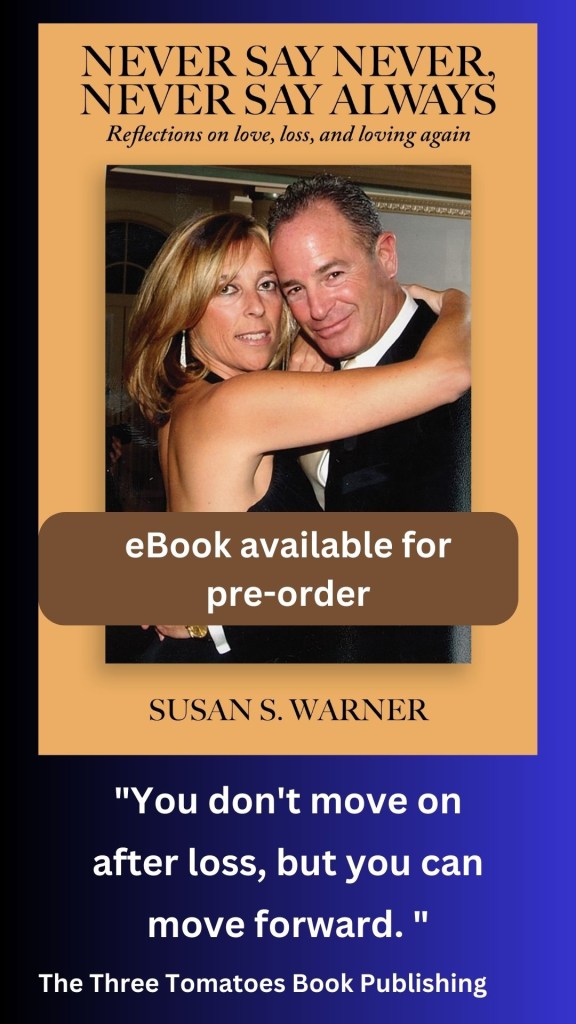
I have been a book consultant for many years. I help authors focus on what’s important, make every page captivating, help them tell the story in a meaningful way, find a home for their words, and then make the world thirsty for what they have to say. “Never Say Never, Never Say Always” is a true story about a journey none of us want to go on but we all will. It will prepare you for your future and make you cherish what you have now. I am so proud of Susan S. Warner. Her writing is brilliant and she is willing to share her hardships and new found happiness.
Www.susanswarner.com for her podcasts on the same subject.
🌺🌺🌺🌺🌺🌺🌺🌺🌺🌺🌺🌺🌺🌺🌺🌺🌺🌺
I’m halfway though The Covenant of Water. Abraham Verghese’s 724-page novel that spans the years 1900 to 1977 in Kerala, on South India’s Malabar Coast. It tells the story of three generations of a family. It’s also a testament to the progress in medicine and to human understanding. Oprah says it is one of the most masterful literary novels published in recent years.
Two flying machines, with their own engine, flew by my window this morning in Miami Beach. I got dizzy just watching them. Hence, a shaky video.
🌺🌺🌺🌺🌺🌺🌺🌺🌺🌺🌺🌺🌺🌺🌺🌺🌺🌺
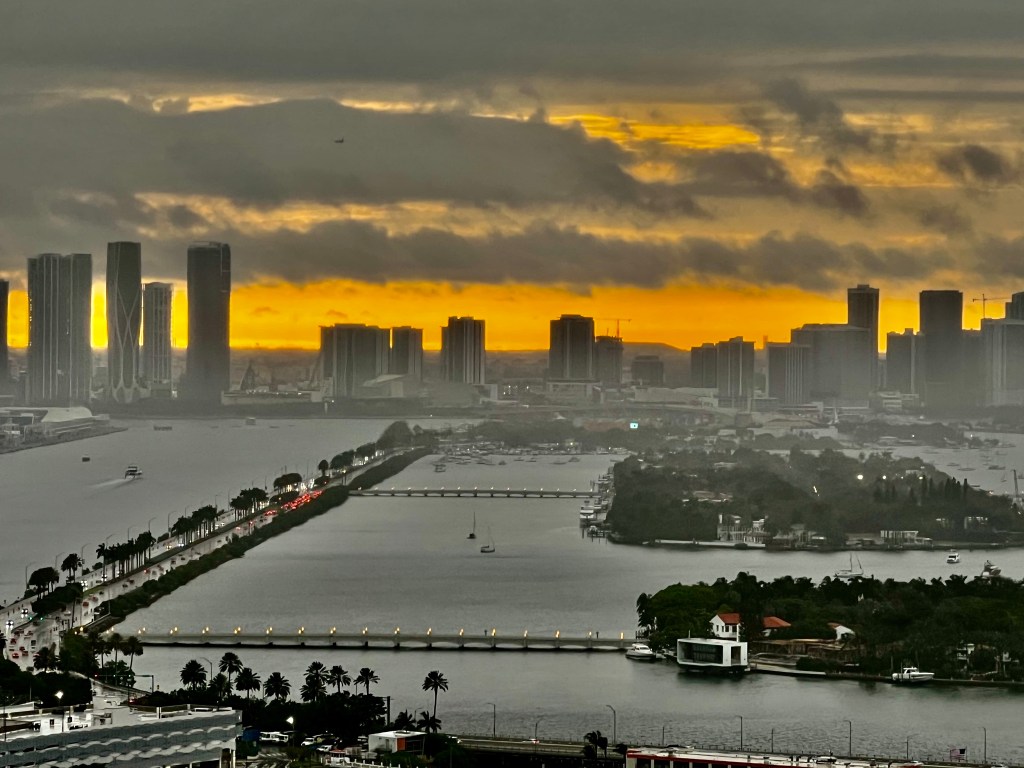
Sunrise in Miami Beach yesterday by me
After the rain by Eliot Hess
🌺🌺🌺🌺🌺🌺🌺🌺🌺🌺🌺🌺🌺🌺🌺🌺🌺🌺
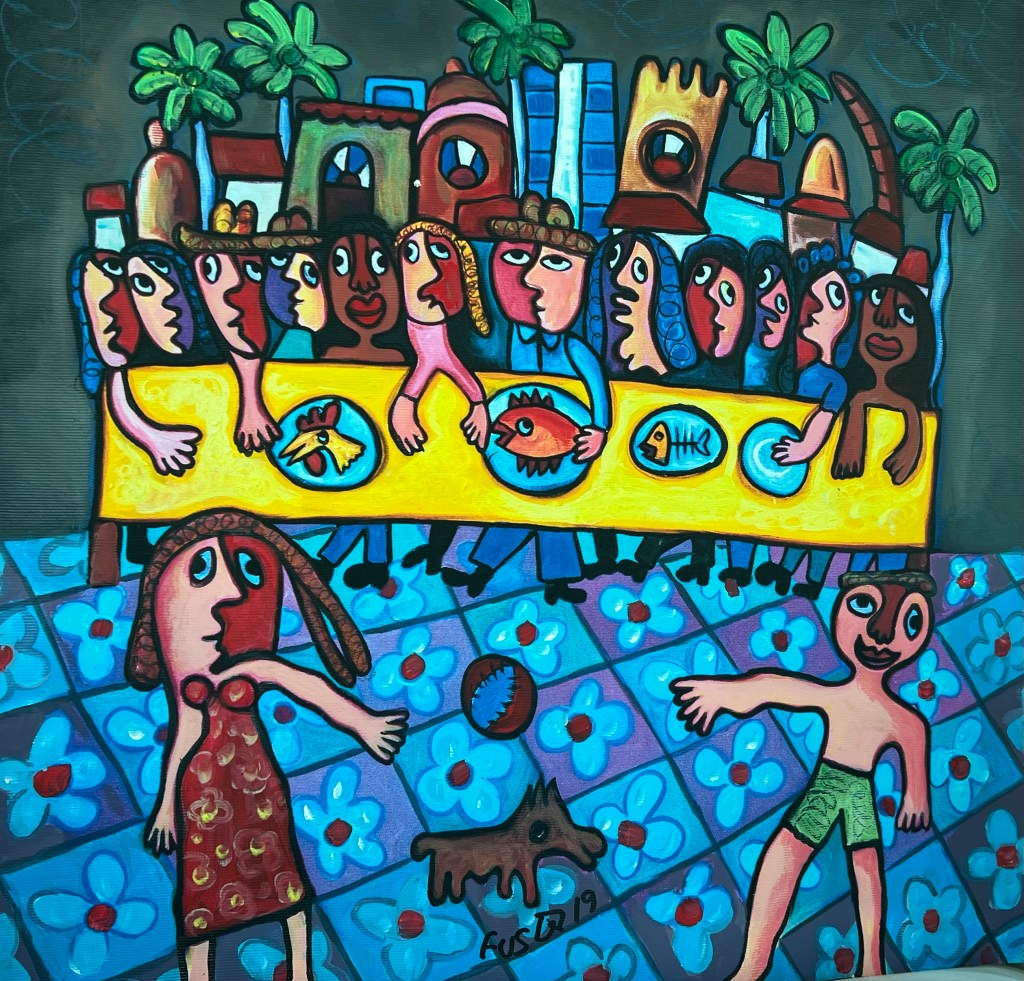
Extensive public-art installations by local artist José Fuster, with colorful, whimsical mosaics. Fusterlandia, museum in Havana, Cuba. I am so happy I own this piece. I’ve been to Cuba twice. I went back the second time to buy this painting. #fusterlandia #fuster #cuba #cubatravel @people2peopletours Carmen Santamarina
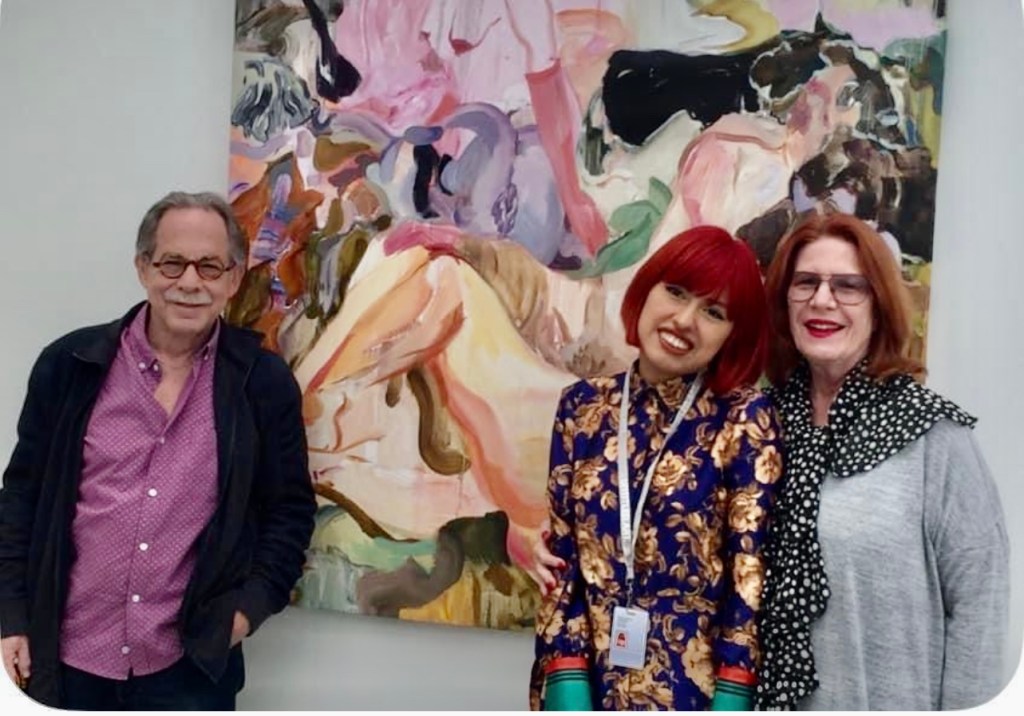
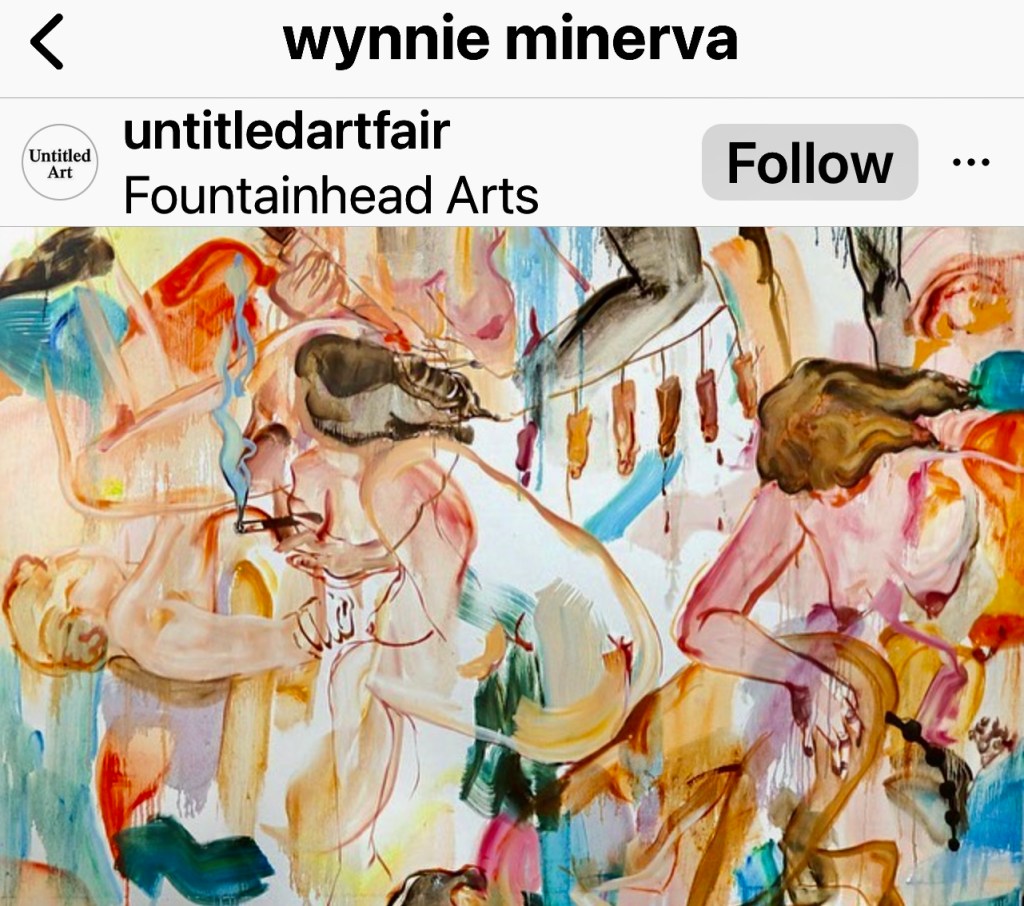
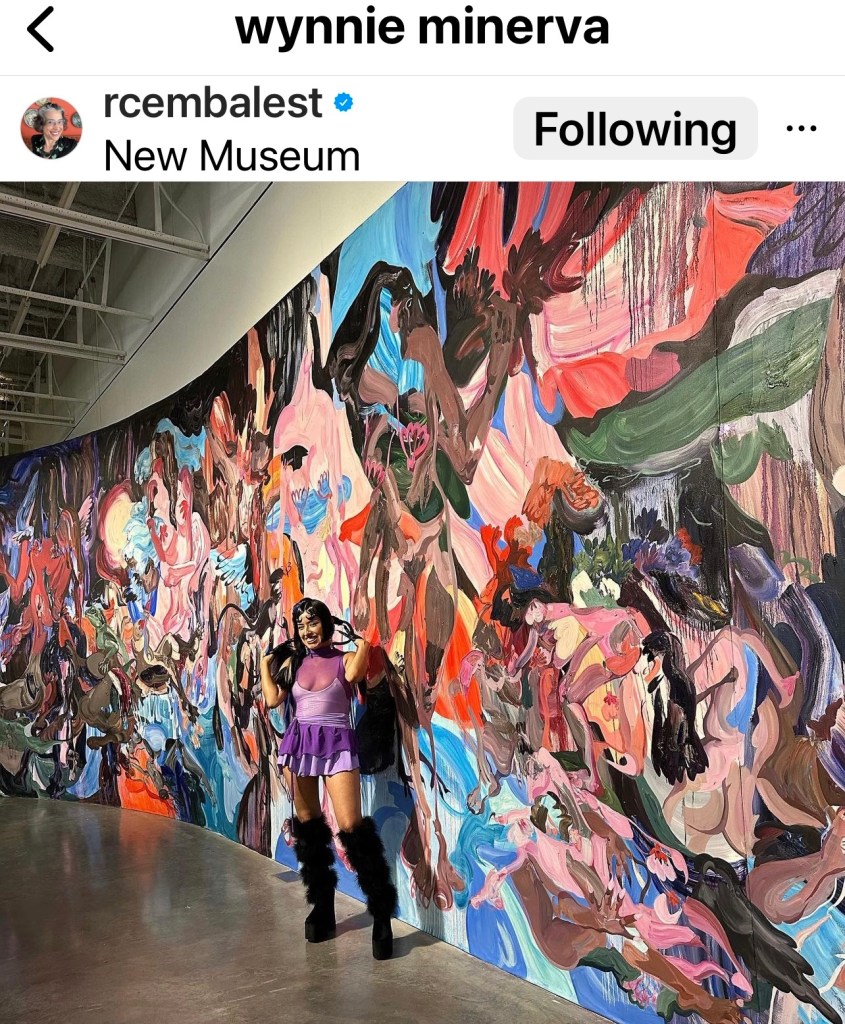
Eliot and I own a Wynnie Mynerva painting. We bought it at Untitled, one of the satellite art fairs during Art Basel in Miami, December 2019. We met Wynnie a few days before the art fairs began. She was a resident at Fountainhead Arts. We immediately liked their work. We had no idea at the time that Wynnie would have a major exhibit at the prestigious New Museum in lower Manhattan. We are so proud of them.
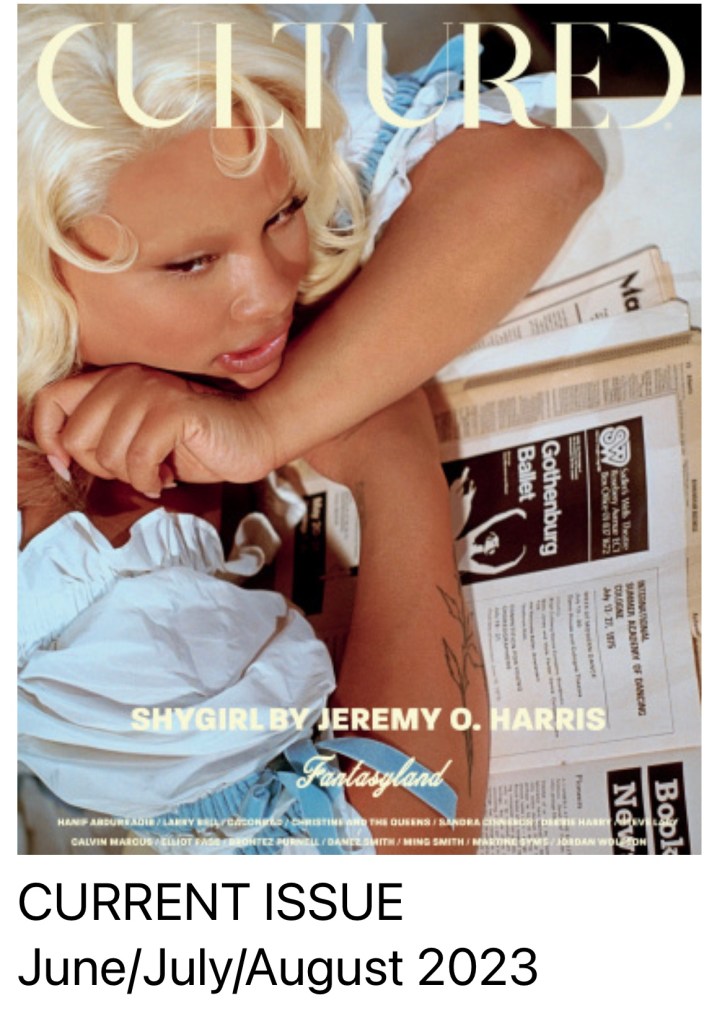
Wynnie gets very personal in their recent interview in Cultured magazine. Their creativity knows no boundaries. That’s why we love abstract expressionism so much.
Wynnie is represented by Ginsberg Galeria, Lima, Peru.
The Peruvian rebel sat down with New York-based artist Carlos Motta to discuss “The Original Riot,” their first solo museum exhibition in the United States
Wynnie Mynerva Brings Their Rib—and a 70-Foot-Long Painting—to the New Museum for Their U.S. Debut
The Peruvian rebel sat down with New York-based artist Carlos Motta to discuss “The Original Riot,” their first solo museum exhibition in the United States.
Stigmata, according to the Encyclopedia Britannica, are the “bodily marks, scars, or pains corresponding to those of the crucified Jesus Christ.” These wounds allegedly first made their appearance on one of Catholicism’s more beloved saints, the Italian mystic Saint Francis of Assisi, in 1224.
Almost exactly 800 years later, Wynnie Mynerva chose to appropriate another physical emblem of religious lore. The Peruvian artist surgically removed their lowest rib—otherwise known as the Adam’s rib—for their first solo museum exhibition in the United States.
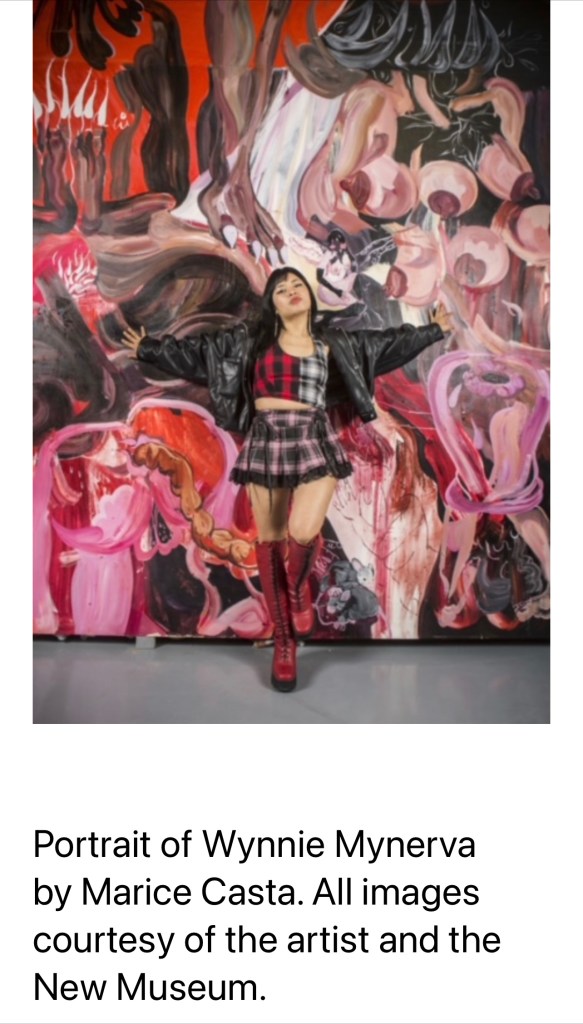
Organized by Bernardo Mosqueira, an alum of CULTURED’s 2023 Young Curators list, New Museum’s “Wynnie Mynerva: The Original Riot” reimagines the story of Adam and Eve with a 70-foot-long painting—the largest to have ever been displayed at the institution—and a sculptural installation showcasing Mynerva’s bodily relic.
The New York exhibition, which opened to the public yesterday, is not the first time Mynerva has incorporated corporeal modifications into their artistic practice. In 2021, for “Closing to Open” at Madrid’s Ginsberg Gallery, they had their vagina sewn three-quarters of the way shut. The artists sees the traces left by each surgery as “weapons,” symbolic offerings they instrumentalize in their fight against the dictums of capitalism, patriarchy, and organized religion.
With “The Original Riot,” they offer an alternate narrative to Genesis, centering Eve and introducing Lilith, who according to Mesopotamian and Jewish mythologies, was in fact the original woman, sculpted of the same clay as Adam and banished from heaven for refusing to defer to her male counterpart.
Read right to left, like the Torah and Quran, the panoramic painting overwhelms the viewer with its orgiastic scenes and lush mosaic of colors. To honor Mynerva’s U.S. debut, the artist sat down with Carlos Motta, Bogotá-born and New York-based artist of the extreme and intimate, to chat about growing up in a violent society, making unsellable work, and masturbating in front of Jesus Christ.
Carlos Motta: I wanted to start off with the topic of religion. What was it like growing up Catholic in Peru?
Wynnie Mynerva: My mother always left space for God at our family dining table. The Catholic depiction of God has always been very present in my home life–the Ten Commandments, praying at home, etc. Peru is a highly conservative country, and religion acts like a gateway for conservative lifestyles.
Christians have a rule over decisions made by the state. The archbishop of Lima comes in to talk with the president when any political decision is being made. And these religious figures are part of our own small mythology, and we make decisions according to these characters–the different renditions of Maria, Jesus, God…
Motta: While growing up, did you feel like these figures repressed you, or were they simply a fantasy? In my case, I almost had a fetishized view of Christian imagery.
Mynerva: It was more of a fantasy for me. You find the most pleasure when experimenting with what’s forbidden. I used to masturbate, and a picture of Christ would be staring at me—it was right in the middle of my room. I remember my mother telling me, “I’m putting this picture of God here so that he can take care of you,” but then every time I masturbated I thought, He isn’t taking care of me, he’s looking at me masturbating.
Motta: When did you start thinking that confronting religion critically could nurture your art practice?
Mynerva: I saw religion as a performance—acting and following a script and repeating itself every year. In a way, I got tired of these performances and the whole idea of what my life could be through religion. That’s when I started reinterpreting and manipulating these religious images, contaminating them with other information. I also find it interesting how religion has used painting to indoctrinate. Painting is a tool for reproduction that can make an image look solemn with techniques like chiaroscuro in large paintings, used to decorate churches in Latin America. This is something I like to do in my work, too: use elements of painting to generate other ideologies.
Motta: Another part about religious iconography that I always found interesting was the fact that it exalts suffering. We suffer through life in order to be liberated after death. You’ve used this same idea of suffering by removing one of your ribs, or sewing your vagina closed. Why do you use your body in this sort of subversive way?
Mynerva: I don’t think I did it consciously in the beginning, I understood this recently when I would repeatedly pursue projects that required cuts, surgeries, lacerating my body… I grew up in a violent society. I remember how people would be murdered on the streets and left for dead, all cut up, no one tried to help them. Or they would die in gang fights; they would kill each other in front of us. It overwhelms me to think about a future where my body isn’t violated. Even here in the U.S., I’m always expecting something bad to happen.
Motta: In Colombia it’s common for sicarios, people who are hired to kill, and others engaged in violent work, to find hope in God. They ask God and the Virgin for good luck before murdering someone. “God doesn’t see,” he doesn’t discriminate according to the social hierarchy, something very prominent in Latin America that in some way acts as a foundation for violence. What role does class and the class-stratified society of Peru play in your work?
Mynerva: My job becomes hard when I don’t have the tools to represent a specific class with dignity. I don’t think I have them right now. My family didn’t have a lot of money when I was growing up. I got a very basic education, and we hardly had enough income to eat. I’m scared that this will be fetishized, because a lot of times I work according to my own experiences … I worked on this project that I have yet to present with my mom, where I sweep the streets because my mother was a housekeeper her whole life. I sweeped the streets during the pandemic for a month, and we thought about experimenting with how our spaces treat us. I’m trying to be careful with this idea because at the end of the day, what are our alternatives to traditional methods as artists? And where do these experiences make sense?
Motta: Your paintings are too big to exist in a space; they try to defy the logic of consumption because owning paintings is historically tied to the higher class. How does it feel to be someone who could potentially sell a lot of paintings?
Mynerva: That’s why I think I’ve developed this strategy to make paintings that are unsellable because of how big they are. It also helps calm my desire to paint. Every artist wants to produce a lot of art because it’s our calling. But that can be a problem because you end up with a lot of products that can be sold or even resoldin negotiations you’re not a part of. So the market ends up eating all your work.
Motta: This is your biggest painting. Can you talk about the painting’s dimensions and the reason behind it?
Mynerva: It’s 20 meters by four meters. It has a sort of curved structure. For me, paintings are bodies, and that’s why the door we see cuts the painting in the middle. The painting is my body. The cut in the middle is how the viewer can access my body. When you go through that door, you’ll find my rib. A painting makes people want to come closer. My art is going to be approached and that makes my public bigger, which is what I want. I don’t want people to need to know a lot about art or pedagogy to be able to understand my work. My parents can understand this painting. That’s how I measure whether it’s accessible or not because they, as well as a lot of the people I grew up with, didn’t have access to a cultural center or an art gallery or a museum.
Motta: You took out one of your ribs for this exhibition. Tell us about this piece and how it relates to painting.
Mynerva: The piece is really related to the story of Genesis. I’m reimagining the story of Adam and Eve, but focusing on the never-narrated relationship between Eve and Lilith. There are Jewish and Mesopotamian versions of the story that talk about the figure of Lilith, who supposedly precedes Eve as the first woman, created out of the same clay God created Adam with. Adam tried to have sex with Lilith, she didn’t want to be under him, and he raped her. At the moment of the violence, she calls all the names of God asking for help. God comes and punishes her for saying his names out loud. He gives her a vagina in flames, expels her from paradise, and then creates Eve from Adam’s rib to be his subservient, obedient, good wife. Lilith also represents the feminine and that is free, full of sexual desire. She represents a collective wish, in a way.
Eve and Lilith are opposites of each other: one’s a saint and the other’s a whore. Neither of them will ever satisfy Adam’s wishes or the wishes of patriarchy. I created this alternate story that to me seems a lot more realistic where the two first feminine figures meet, share experiences, and organize a rebellion. As a symbol of this rebellion, Eve removes her Adam’s rib and gives it to Lilith. I thought it would only be appropriate if I used my own rib.
Wynnie Mynerva, Remnant of the first cut, 2023.
Motta: When you tell me you took out your rib, I felt that pain. And I think the public is also going to feel this pain when they see it.
Mynerva: The public should know that this isn’t a theoretical or aesthetic tool. It’s a weapon, a strategy that I offer to people and that I believe in. This wasn’t a surgery that some artist paid a doctor lots of money to perform; it’s a surgery that is actually often done for cosmetic purposes and that now is done for artistic purposes. It’s like a tattoo!
Motta: How do you relate this to the piece about your vagina in “Closing to Open,” 2021, especially now that you “finished” the piece?
Mynerva: The surgery for closing my vagina has been quite beneficial. I was a person that felt violated every time I had sex, because I didn’t want to have vaginal sex but people didn’t bother to ask what I really wanted. By closing it I created this act of resistance. It doesn’t have to do exclusively with a work of art as something separated from life, it has more to do with the fact that I took this personal decision to stop reliving an experience I found catastrophic. It’s me trying to find my body again. I love theory, but there’s something powerful about something you can touch and feel, that bleeds and sweats.
“The Original Riot” is on view through September 17, 2023 at the New Museum in New York.
At a time when the state of Florida has become ground zero for those who want to silence the voices of so many, Books & Books found it critical to bring Chasten Buttigieg to the Miami area to celebrate the publication of I Have Something to Tell You – A Memoir for Young Adults,” said Mitchell Kaplan.
On this episode of The Literary Life, Chasten is joined by Mayra Hidalgo Salazar, Deputy Executive Director of the National LGBTQ Task Force. Many personal stories were shared, including coming out to his father, his life with Pete Buttigieg and their two children, and the time they met Cher.
Please listen and share this timely episode, recorded before hundreds of supporters at the Coral Gables Congregational Church…”Because love is love is love,” Pastor Laurie Hafner.
BOSTON – The chairs were set up, the wine was chilling for the kiddush, and the homemade baked goods for the oneg ready to be served. The blue and white balloons were dancing expectantly in the breeze.
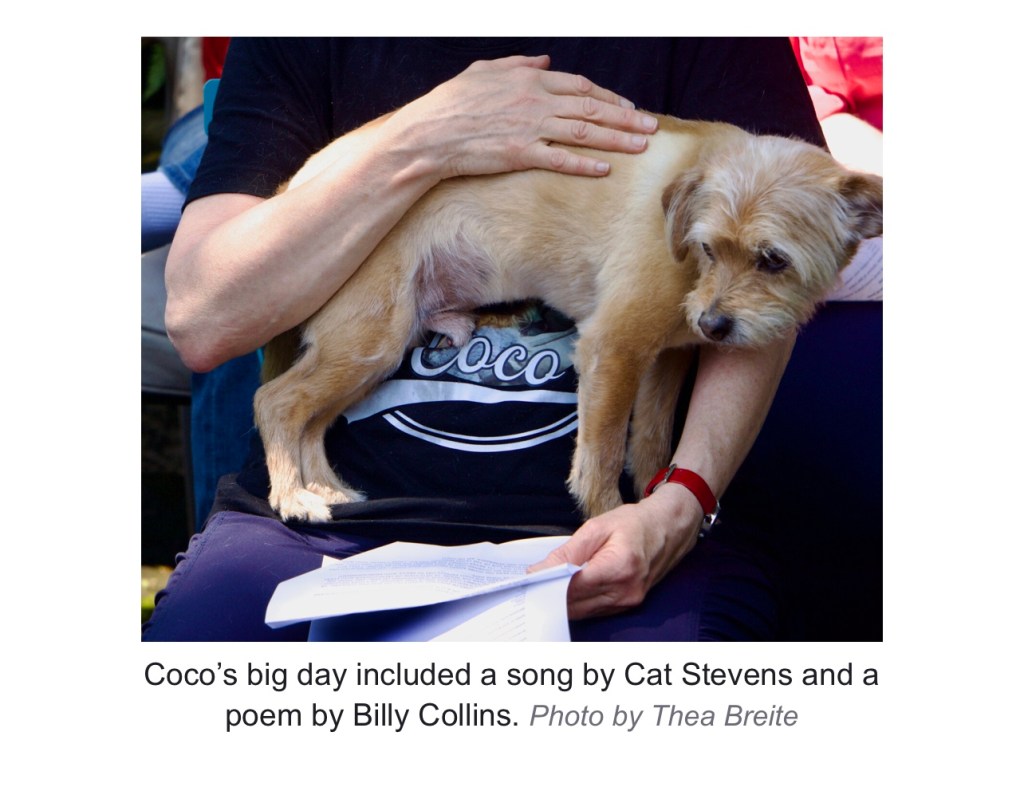
Then came the guests. Bessie. Joy. Bella. Lyla. Carl. Miggy. Lui. Daisy. A dozen dogs, plus their humans, although Kesem, a Maltipoo, couldn’t attend because of an injury. (He fell off the grooming table.) Mookie had a scheduling conflict, but sent a card extending best wishes on “your wonderful simcha!”
He wore a yarmulke and a tallit, designed with scholarly precision by my sister Judy in Houston. Two rabbis officiated.
No doubt I’ve lost some readers by now. I can picture the eyes rolling, sense the disdain.


Bark Mitzvahs — and yes, there have been enough of them to merit a Wikipedia entry — have been derided by Jews more observant than myself as everything from the desecration of a sacred tradition to liberal-leaning Judaism run amok.
And it’s not only Jews who think it’s bonkers. “I don’t mind dogs getting together,” a dog-loving Christian friend told me before declining my invitation. “But I don’t see how you make it into a religious thing. This is way out there.”
Let me just say that there was a time when I, too, rolled my eyes at the anthropomorphizing of dogs — the hosting of dog weddings, the drop-ins at yappy hours — let alone a parody of a sacred Jewish coming-of-age ceremony.
And maybe if I didn’t feel so indebted to Coco, the barky rescue dog my son adopted for me after my husband died; or if I weren’t so dog tired of living under an oppressive blanket of pandemic anxiety and isolation, so hungry for some communal expression of giddiness and joy, I might feel the same way today.
But why not celebrate, Jewishly, the life of our loyal old dogs?


I took my inspiration from Rabbi Steve Gross of the Houston Congregation for Reform Judaism, who’s officiated at five Bark Mitzvahs in his temple’s parking lot since 2016, each drawing as many as 200 dogs. It was my sister who told me about it and persuaded me to come this year. I flew there from Boston, but the Bark Mitzvah was rained out and I couldn’t be there for the rain date.
Still, Gross was in good spirits when I met him at the synagogue that morning, even as the rain soaked the giant blue sparkly “BARK MITZVAH” sign on the lawn.
He explained the idea for a Bark Mitzvah was two-fold. “First, there is the slightly tongue-in-cheek playfulness that dog lovers have when their dogs become 13,” he said. “People would say to me, ‘I think it’s time for a Bark Mitzvah.’”
He’d also seen that Episcopal and Catholic churches he engaged with around the city designated a special day to bless animals. His synagogue has about 250 families, many with dogs, so it seemed like an auspicious place to host something similar, call it a Bark Mitzvah, and open it up to the wider community. He estimates about one-third of the pets are “non-Jewish dogs.”
“Oh my gosh, this is probably one of the most attended events in our entire congregation,” said Gross, who is currently dogless. “Two hundred people in my parking lot is more than I get on a Friday night.”
The event starts out with a short ceremony, Gross said, with “a recognition of the value dogs bring to us as human beings and a reminder of God’s creation in our lives every day.” There is a shehechiyanu celebrating the joy pets bring to humans’ lives, and a reading from the Book of Genesis about the day God created animals.
“It’s a way to generate community around a shared interest,” Gross said. “When people are in line to enjoy a cookie at the oneg after Shabbat, there’s a little bit of superficial conversation that takes place. At the Bark Mitzvah – and we could have called it the Jewish Day of Blessing Dogs, which is catchy, right? – what you see happen is what happens at dog parks all the time. Dogs, just like babies, open up a deeper level of conversation with total strangers.”
There is also a “mitzvah” component. The 40 or so vendors in the parking lot include animal rescue organizations and Animeals on Wheels, which delivers dog meals to Meals on Wheels clients so they don’t feel compelled to share their own food and resources with their pets.
This is also dog merch a-plenty – “Chewish” bone-shaped dog toys, pet-friendly flooring, a climate-controlled mobile dog gym equipped with treadmills. (“A mitzvah for the owners,” Gross said.)
He acknowledges he’s gotten pushback from some community members who consider a Bark Mitzvah disrespectful, even disgraceful. “They say we’re elevating dogs to the level of people. That dogs don’t have any halakhic authority.” But Gross pushes back on the pushback.
“You can be playful for Purim but not a Bark Mitzvah? Maybe they are not understanding that Bar Mitzvahs aren’t being made fun of. We are utilizing one term for something else; we do that all the time with Hebrew words,” he said, citing the only-in-Texas example of an event in Houston hosted by an Orthodox congregation. Meant for shul members who pack heat, it was called “Glocks & Bagels.” (He allows that “lox” isn’t Hebrew, but stands by his point.)
“I honestly think this is a beautiful way for us to celebrate our pets,” he said. “It elevates that love in a way that can be shared.”
The Bark Mitzvah eventually took place in April, though the numbers were a bit diminished — only about 100 dogs showed up — because of bad weather. Coco turned 13 in April, too, so back in Boston I began the preparations for his own Bark Mitzvah in my back yard.
Some of it came together easily — the Bark Mitzvah cake, the cookies shaped like bones and fire hydrants, the doggie bags, identifying a Mitzvah project to support, in this case Shultz’s Guest House, a local dog rescue shelter.
A bigger challenge was finding a rabbi who wouldn’t think I was unhinged. I reached out — apprehensively — to Rabbi Michael Swarttz of Beth Tikvah Synagogue in Westborough, Massachusetts; I’d met him years ago in my neighborhood dog park.
“I’m writing with what might seem like a bizarre question,” I emailed, re-introducing myself and outlining my plan.
“Your idea is not bizarre to me at all,” he wrote back. “I would love to participate. I have thought of trying to do one at my congregation.” Even better, his wife, Carol Glass, was also a rabbi and wanted to co-officiate. Both of them, I learned, later, thought of Bark Mitzvahs as a creative way to celebrate the bond between two species.
“I really believe that animals have a soul, as do all things that are alive,” Glass told me. “In terms of looking at God and my connection to Judaism, I’ve always had an impulse to dig into Judaism and broaden it, and make it more inclusive. Not to buy into the tradition that it can’t be malleable, or added to, or changed.”
We worked together on the flow of the service. Each dog was recognized by name. We sang, and listened to an old Cat Stevens number called “I Love My Dog.” Swarttz read a poem exalting dogs (“Dharma,” by U.S. Poet Laureate Billy Collins). Glass, a hospice chaplain and spiritual director, said a Mi Sheberach (prayer for healing) for Kesem and for “all pets in need/ so that they may know life and health, joy and peace.”
I’d been expecting chaos in my yard, but the animals all sat calmly with their humans and listened attentively to the rabbis, or so it seemed. This may have been the only barkless day in Coco’s life.
I spoke about my attachment to Coco and wished him, in Yiddish, a much longer life, biz hundert un tsvantsik. Until 120, canine hara.
Finally, we all threw dog treats, and yelled – what else? “Muzzle tov!”
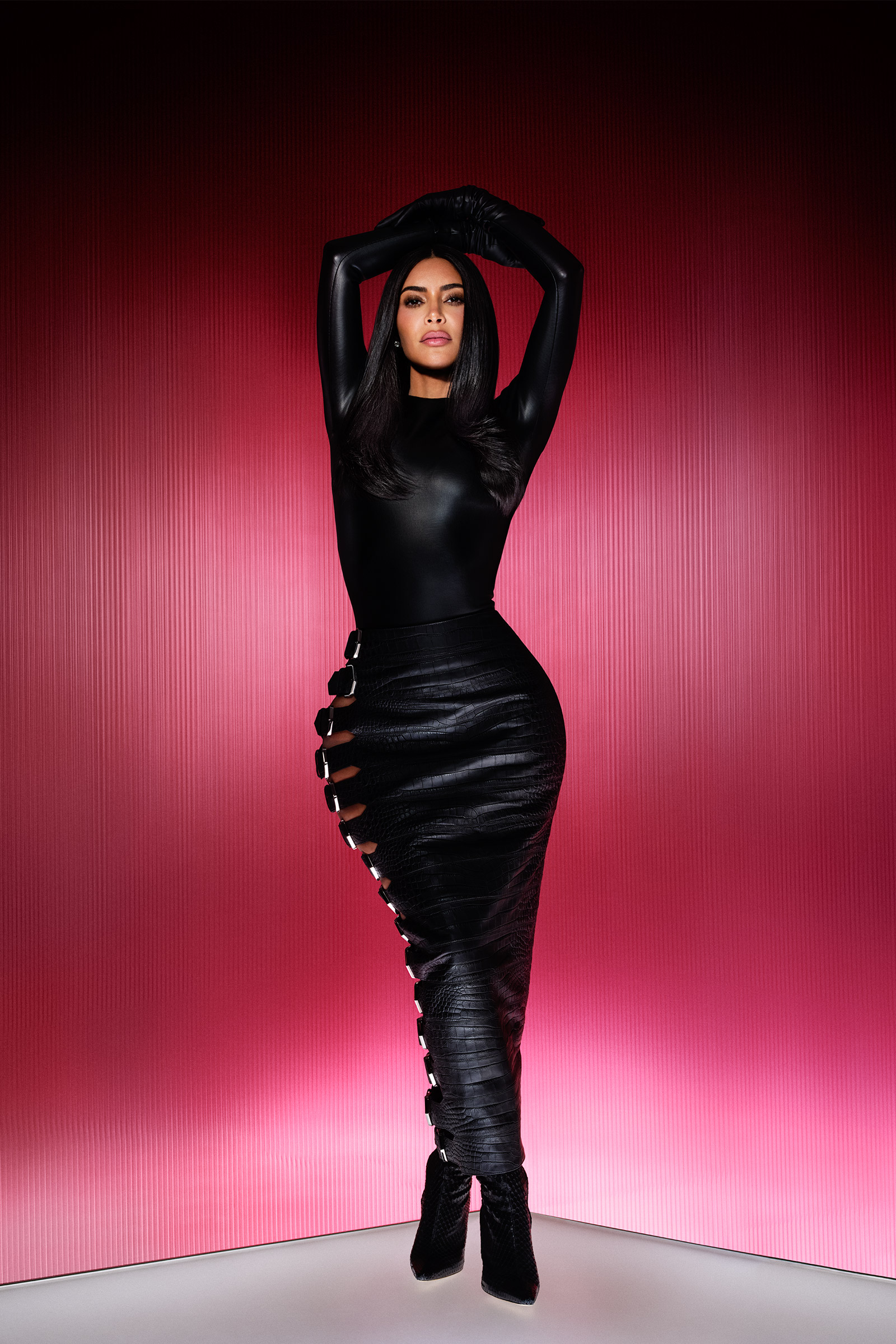
British people have a name for their royal family that grasps at its weird status as both a family and a money-making enterprise. They call it ‘The Firm.” The U.S. has dispensed with the monarchy, but it still has The Firm. They’re known as the Kardashians. The Kardashians live lives of fairy-tale glamor and opulence, their influence powered not by a factory or an investment portfolio, but by making the most fascinating version of themselves. And they work hard at it.
Unlike the monarchy, the Kardashians are at liberty to market their name and have done so liberally. The most successful of these name-trepreneurs is Kim, the middle daughter. She has created many brands, but it is her shapewear line, Skims that has really caught fire. It took in $500 million in revenues last year, according to CEO Jens Grede, and sales were up 86% year over year in April, at a time when the sector was down generally. Founded in 2019, it was valued early last year at $3.2 billion. (That’s $2 billion higher than iconic shapewear brand Spanx ever rose.)
In this interview, Kardashian, who is on her first ever TIME cover this week representing Skims as one of TIME’s 100 Most Influential Companies of 2023, discusses the role she plays at Skims, and how the brand has changed the way people see her, and how it led to her founding her own private equity fund late last year.
Tell me a little bit about what a day at Skims looks like for you?
I’ll get up, I’ll work out, I’ll take my kids to school and then I’ll come straight here to my office and have Skims meetings about what our next campaigns will look like and what our next commercial will look like and photographers and directors that I want to work with and who I think will be good for what campaign. Then I’ll have a full fit meeting that will take maybe an hour to two hours. And I’ll have a fit model to see it on a different body type. I always like to see it on myself. I know how I like things to feel. There’s never been a product that I haven’t seen and approved. Maybe one time, when there was a supply chain issue, where I said ‘O.K. we need this product. Let’s do it in a ribbed material.’ I don’t happen to be the biggest fan of ribs and now it’s our best-selling fabric. So of course, I’ll keep it but that was surprising to me.
Did you notice a tipping point, where you thought, ‘Oh, this is going to be so much bigger than my other businesses?’
Obviously you dream big and you have big hopes but this definitely exceeded everything that I ever imagined especially starting as primarily a shapewear brand. I’m also the kind of person where I never get too excited, but there are those moments. I remember I walked into some Hollywood party and there were a lot of well-known people and one of the girls, an actress, she literally yelled ‘Skims!’ as soon as I walked in the room, and someone just lifted her top and goes, ‘I’m wearing a Skims!’ I don’t know if it’s called imposter syndrome or whatever, I still always feel that, but I think it’s part of what keeps me going. I never dreamed that this would be my life.
Do you think Skims’ success has changed the way people see you?
I do. I think at the beginning when I didn’t really understand where my path or my career was going because I was just kind of winging it, I would do licensing deals with a lot of different companies that would contradict themselves, like a cupcake brand with a weight loss pill at the same time. I wanted to eat that cupcake, but I also wanted to lose weight. I think people maybe have appreciated or seen growth and an evolution. And I think that people can see the work in it.
Beauty standards have expanded, but let’s not pretend they don’t exist. You’re the model for many of your campaigns. Do you worry about aging?
I understand that maybe in my 50s I’m not going to be wanting to pose in my underwear and do campaigns all the time. Some days I feel confident, some days I don’t. I am mindful of that. Having a sustainable brand was always the goal. I love being a part of the campaigns, but I am very realistic that it’s not sustainable forever to be in every single one of them. I mean, I hope we all give ourselves as much grace as possible. We’ll do anything we can to look as young as we can. We’re not going to go out not trying, but I am realistic that there will be a time when I might do certain campaigns that are pajamas and robes and more covered up.
Skims was launched in 2019. In 2021, it was valued at $1.6 billion, and then nine months later at $3.2 billion. Is that kind of success important to you?
I do think it’s important when people want to invest. It validates that people believe that you will be successful, and they will invest themselves to help grow the business. I’ve learned so much about that space. Especially having started my private equity fund and learning about the companies that they invest in and what it really takes to grow a business.
Tell me a bit about SKKY Partners; what sort of companies are you hoping to invest in?
Anything from consumer brands to even [the] food and beverage space; anything from fashion and retail to beauty and haircare. We have a really good team; my partners did the investments in brands like Supreme and Beats by Dre and were able to build them up and sell them and there’s something really culturally relevant about those. In order to ultimately make an investment, we have to feel we really believe in the culture behind what the brand is. I’ve been on both ends; I’ve been on the side where I’ve had investments that have been great relationships, and I’ve had investments that maybe a partner didn’t really understand the DNA of what I was about. I’ve just done so many licensing deals and deals that just haven’t worked out. And I feel like I can really support them on the other end to really be a founder’s investor. I think we have a different perspective and a different advantage that people are really recognizing in this space.
Do you think that without Skims you would have been able to start a private equity fund?
I don’t think I would have had the curiosity and the information to understand what a real good investor brings to the table. I’m close with ours, and I have a lot of friends in the business now and I’ve learned a lot and I don’t think I would have understood it enough. Skims has taught me everything.
You’ve had so much success. What do you still feel like you will have left to prove? Why are you still working so hard?
I think I’m just a curious person. And I just like to learn. There are times when I get a bit overwhelmed, which is really rare. And I will take a minute and just say ‘Can we clear my schedule for a day? I just need to be with my babies, and I just need to take it all in.’ I am getting to a place where I feel like there’s nothing more precious than time. I think sometimes people don’t realize how important time is and live their life as if it’s endless. I think I’ve realized that for a really long time because of my dad passing when I was 22. I do have limits and it’s not that I feel like I need to prove anything. It’s that I just genuinely like trying new things and seeing what I like and don’t like and sometimes I like to do things that are just uncomfortable. I think sometimes you need a little kick in that way to see what you’re really made of.
On a recent flight to Chicago, Allison Levy said she was “white-knuckling” the armrest as the plane rumbled and shook for brief periods of time.
Ms. Levy, 47, who lives in Arlington, Va., started to take deep breaths and tried to reassure herself: “It’s like a bumpy road — it’s not a big deal.”
But, she added, “if I knew the person next to me, I’d definitely grip their thigh.”
Airplane turbulence, which is usually caused by large changes in airflow in the Earth’s upper atmosphere, is generally a minor nuisance.
But this year alone, there have been multipleinstances of severe turbulence on flights that have led to dozens of passenger injuries. And scientists have warned that we may have bumpier flights in the years ahead because of elevated carbon dioxide emissions that are warming the atmosphere, which can alter the speed and direction of the wind.
This is unwelcome news for everyone, especially those of us who are already scared of flying, like Ms. Levy.
Here are several ways to help calm your nerves if you’re eager to travel but dreading potential turbulence.
Put things in perspective.
Turbulence is not usually a cause for concern. It’s far more common to encounter low to moderate turbulence than the severe kind that throws heavy drink carts into the air.
“While pilots can ease most turbulence, it is still unavoidable or unexpected for some flights, but planes are designed to safely withstand the impacts,” the Air Line Pilots Association, a prominent pilots’ union, said in a statement.
It may also help to know that, according to a 2020 study, it has never been safer to travel on a commercial airline.
Passenger injuries from turbulence are rare. In the 13 years spanning 2009 to 2022, for example, a total of 34 passengers were seriously injured because of turbulence, according to data from the Federal Aviation Administration. And the last turbulence-related death on a major airline happened more than 25 years ago, the National Transportation Safety Board said in a 2021 report.
Traveling by plane is much safer than traveling by car: The odds of dying during a commercial flight in the United States are too small to calculate, according to the National Safety Council. Meanwhile, the chances of dying in a motor vehicle crash are 1 in 93, the nonprofit advocacy group says.
Skip the alcohol.
It might be tempting to reach for an alcoholic beverage in the hopes of calming your nerves, but “remember that what you eat and drink impacts your anxiety and how you are feeling,” said Dr. Uma Naidoo, the director of nutritional and metabolic psychiatry at Massachusetts General Hospital and the author of “This Is Your Brain on Food.”
Too much alcohol is dehydrating and can also produce feelings of nausea. That’s a bad combination with turbulence, which can leave passengers queasy, too.
“Staying hydrated, perhaps skipping the coffee or wine on the plane, can help create a sense of calm,” Dr. Naidoo said.
Try deep breathing.
If turbulence (or the mere thought of it) makes your heart race, taking steps to control your breathing can be a simple and powerful way to help soothe your body, Dr. Naidoo said. One example is 4-4-8 breathing: Take a breath in for four counts, hold your breath for four counts and then exhale for eight counts. Repeat.
“With practice, they can become a normal part of your response to stress and anxiety,” Dr. Naidoo said.
Consider therapy.
Some travelers might find it helpful to try exposure therapy, which involves gradually facing specific fears and anxieties until they feel less frightening.
Brenda K. Wiederhold, a psychologist in San Diego, regularly sees patients who have an intense fear of flying. For more than two decades, she has used both real-life scenarios and virtual reality to help expose patients to various scenarios like airplane turbulence.
Turbulence is akin to rolling waves, she tells her clients. “You don’t think, Oh my goodness, this boat is going to crash!” she said. Instead, you think: There are waves today.
Other patients, including some with anxiety disorders, may benefit from medication like Xanax, but such a drug should be taken only under supervision of a doctor.
Buckle that seatbelt.
Strong turbulence can sometimes appear without warning, a phenomenon known as clear air turbulence. The Federal Aviation Administration advises passengers to wear their seatbelt at all times, not just when the seatbelt light is on, and to secure children under the age of 2 in an F.A.A.-approved car seat or restraint device to reduce the possibility of injuries during unexpected turbulence.
“The biggest danger is not being secured,” said Kristie Koerbel, who has worked as a flight attendant for 21 years. “If you are seated with your seatbelt fastened, there is no reason to fear turbulence.”
Plan ahead.
Where you sit can make a difference. Passengers in window seats are less likely to be struck by any projectile objects, suitcases falling out of overhead bins or ceiling tiles coming down, said Sara Nelson, the president of the largest flight attendant union. In addition, seats near the front and next to the wing will typically be less bumpy compared to the back of the aircraft. In severe turbulence, though, where you’re sitting won’t make a difference, Ms. Nelson said.
Think about what calms you in general and try to do some of those activities on the flight. For her trip to Chicago, Ms. Levy brought a sketchbook for doodling, her favorite music and some crossword puzzles. She also spoke to her doctor about taking a low dose of Xanax (though she isn’t convinced that it helped).
Finally, keep an eye on the weather. Thunderstorms typically develop in the warmer months of spring, summer and fall, according to the National Weather Service, and can create turbulence. If you have the flexibility to postpone your flight, you might try for a day with clearer skies in the hopes of a smoother ride.
And remember, “the plane is not going to take off if it’s not safe,” Ms. Nelson said.