Listen to the YouTube below. Ann-Margaret sounds terrific.—LWH
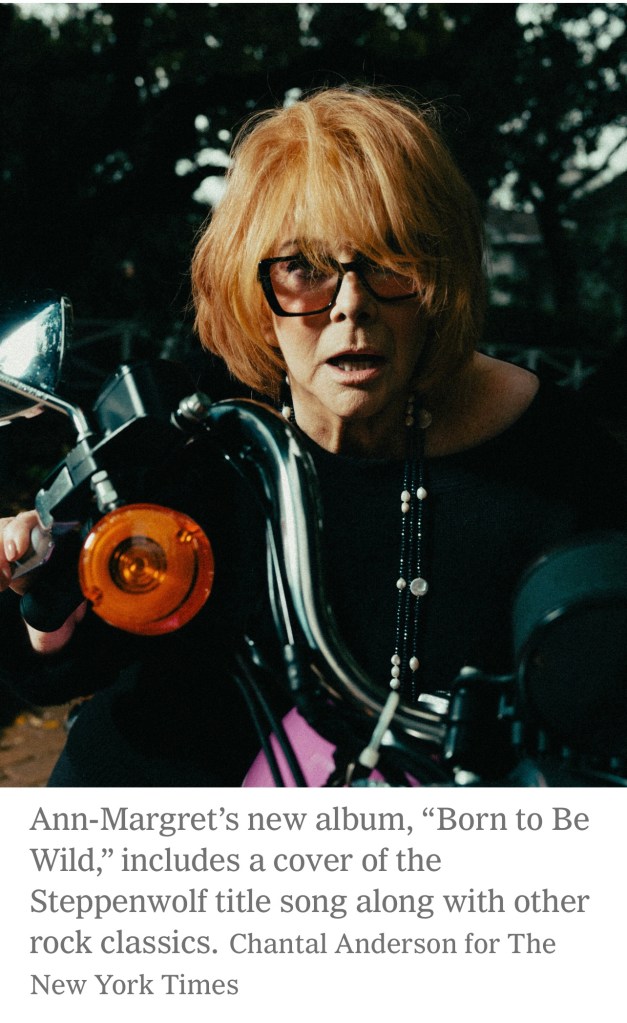
Ann-Margret’s new album, “Born to Be Wild,” includes a cover of the Steppenwolf title song along with other rock classics.Credit…Chantal Anderson for The New York Times
The actress and musician, who first burst out in “Bye Bye Birdie” in 1963, is releasing a new album of old rock covers featuring guests like her “Tommy” co-star Pete Townshend.
By Jim Farber
Ann-Margret has always spoken in a voice that falls somewhere between a purr and a coo. But at her home on a recent rainy day in Los Angeles, she broke up her usual gauzy tones with deep and gutsy growls. “One, two, three o’clock rock!!!” she half-bellowed and half-yelled over a video chat, echoing the opening line from “Rock Around the Clock,” Bill Haley’s raucous 1954 smash.
A few minutes later, she snarled through the opening salvo of “Splish Splash,” the highly caffeinated 1958 hit by Bobby Darin, only to follow it with the outburst, “I love rock ’n’ roll!” Her tone was far more Joan Jett than Kim McAfee, the sprightly character she played in “Bye Bye Birdie,” the movie that simultaneously made her a household name and the hottest pinup of 1963.
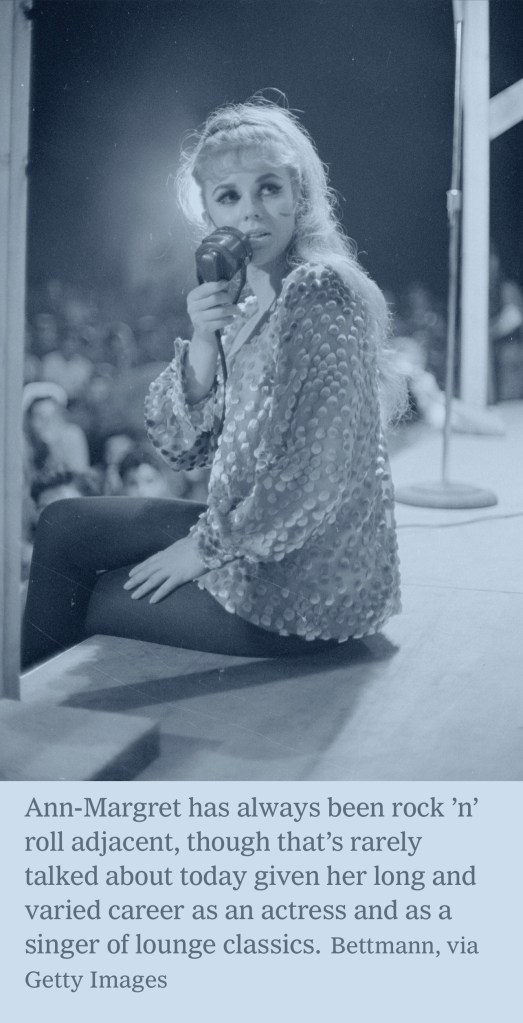
Ann-Margret — pronounced as one name, not two — has always been rock ’n’ roll adjacent, though that’s rarely talked about today given her long and varied career as an actress and a singer of lounge classics. She co-starred with Elvis Presley in one of his most beloved films, “Viva Las Vegas,” provided a flirty foil to a character meant to affectionately send him up in “Birdie,” and had a personal relationship with him of varying description.
She also commanded a lead singing role in Ken Russell’s gaudy movie version of the Who’s rock opera “Tommy,” and earned a Grammy nomination for best new artist in 1962 after scoring a Top 20 hit with “I Just Don’t Understand,” one of the first recordings to feature a fuzz-toned guitar. Her song inspired a Beatles cover on the BBC two years later and, in 2014, the band Spoon recorded a version of her take, not the Fab Four’s.
Yet, it’s only now, at the improbable age of 81, that Ann-Margret is getting the chance to assert herself as a full-on rock ’n’ roll goddess — if a winking one. On Friday she will release “Born to Be Wild,” the first album in the star’s career of 60-plus years to focus squarely on rock standards, all of which she handpicked, including Steppenwolf’s biker anthem referenced in the title and “Rockin’ Around the Christmas Tree,” which Elvis famously gyrated through in his own version.
A host of legit rockers leaped at the chance to support her in this lark of a project, including the “Tommy” creator Pete Townshend, who sang and played whiplash guitar on her version of the Everly Brothers’ “Bye-Bye Love”; Steve Cropper, who added Memphis cred to “Son of a Preacher Man”; and Joe Perry, who shot stinging solos into her take on “Rock Around the Clock.” The album also features cameos from peers like Cliff Richard (82) and Pat Boone (88).
“What she has done is extraordinary,” Townshend said by phone from London, adding an expletive for emphasis. “She picked up the silver thread that links her to the very genesis of rock ’n’ roll history. There’s a mischievousness to that, a light touch that’s perhaps necessary but also real.”
Townshend compared receiving the invitation to play on her album to the time, in 1993, when he “was summoned to play with the Ramones. You know you won’t say no,” he added.
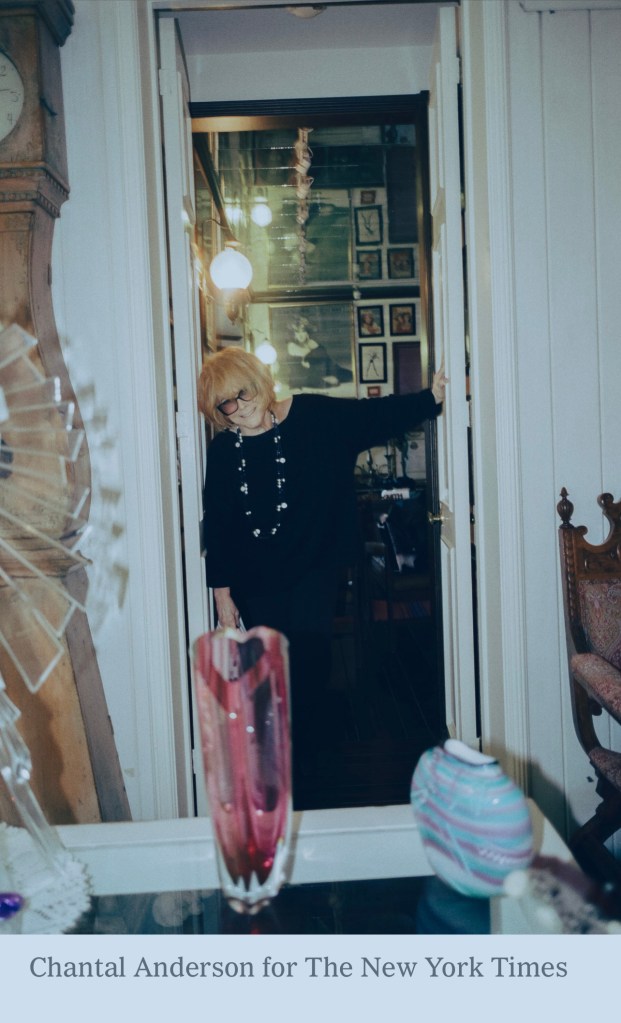
From the dining room of the Benedict Canyon home she has lived in since 1968, Ann-Margaret said she’d long harbored hopes of making a record like “Born to Be Wild.” “Deep inside I’ve wanted to do this kind of album forever,” she explained. She alluded to her outfit — a black sweater, tight leggings and leather boots that rose past the knee: “This is what I’ve been wearing since I first came to Los Angeles,” she said. “This is what I’m comfortable in.”
She’s just as comfortable with language that dates from the ’50s, peppering her speech with words like “gadzooks” and “egad.” Looking youthful with her trademark auburn sweep of hair, Ann-Margret has also retained the coquettish character that first made her a star, giggling often when she speaks and never giving away more than she wants to. It was her original image, more than her music, that inspired Brian Perera, the head of Cleopatra Records, which specializes in projects of a historical nature, to propose the album to her.
“When you look at vintage photos of her, she’s wearing a leather jacket and riding a motorcycle, so the thought of her doing a rock ’n’ roll record really fit,” he said in an interview.
The “Born to Be Wild” album cover drives that home. It reproduces a 1967 poster created for her first Vegas show that finds her in a form-fitting jumpsuit while straddling a Triumph Tiger motorcycle. “I don’t think I can get into that jumpsuit today,” she said, and laughed. “But I can sure try!”
Ann-Margret has always been hot for motorcycles. Her father and uncle rode them when she was a child in Sweden, and when she saw Marlon Brando straddle one in “The Wild One,” “that was it. I had to have one,” she said. “I didn’t know many women who rode bikes back then.”
She still rides a Harley specially designed for her in lavender. It makes a perfect complement to her Cadillac, finished in her favorite shade: “Hot pink!” she exclaimed.
It could be a twin to Elvis’s famously pink Caddy. The relationship between Ann-Margret and E.P., as she calls him, has been the subject of gossip for decades, but she still won’t speak about the personal aspects of it — only their creative link. “We looked at one another and all of a sudden, I would do a pose and he’d be doing the same pose. We connected that way,” she said.
Her record company tried to stress the connection by having her record “Heartbreak Hotel,” but she never had much of a career as a hitmaker. It was her acting in “Carnal Knowledge” — praised in a New York Times review from 1971 — that convinced Townshend that she could really deliver in “Tommy.” While he called the major male actors in the 1975 film — Jack Nicholson and Oliver Reed — “egomaniacal, whiskey drinking lunatics,” he said that Ann-Margret was a consummate professional. She even carried off the absurdity of playing Roger Daltrey’s mother though she was just two years his senior.
One of Ann-Margret’s most famous moments in “Tommy” involved geysers of baked beans being shot directly at her. “They came down a chute and then — pow! — it threw me about five feet back!” she said. “And it smelled!” She recalled that Russell said her character was meant to be experiencing a nervous breakdown during the scene, but to some viewers it looked more like she was having an orgasm. “That’s fine with me!” she added brightly.
Townshend thinks the director, Russell, took a bit too much pleasure in having her do the scene repeatedly. “Ken loved to have a beautiful woman in his clutches covered in beans,” he said. “Let’s just do it again!”
For the new album, he believes Ann-Margret made a perfect choice in having him perform with her on the Everly Brothers song. “My acoustic guitar style is loosely based on Don Everly’s,” he said.
Pat Boone, who played Ann-Margret’s love interest in the 1963 musical “State Fair,” was at first taken aback by the song she chose for their duet, “Teach Me Tonight,” which he called “a love scene in a song.” “I thought, ‘What am I doing singing this?’” Boone said. “I’m 87 at that point and she’s got to be 80. I had to do it humorously.”
So he ad-libbed the lines “I think we just wrote an octogenarian love song” and “I’ll have to turn up my hearing aid.” For the record, “I don’t wear hearing aids,” Boone added with a laugh.
More saucy wit appears in a song Ann-Margret chose from her Vegas act, “Somebody’s in My Orchard,” which includes lines like “Somebody digs my fig trees/Somebody loves their juice.” “Oh, to see people’s faces when they finally realize what I’m singing about,” she said mischievously.
Despite all the album’s humor, Paul Shaffer, who played piano on “The Great Pretender,” insists that her Vegas-style approach to music isn’t just camp. “She delivers the goods,” he said.
When comparing her with young female entertainers like Taylor Swift and Demi Lovato, he added, “Aren’t they really doing Ann-Margret’s act?”
Like all of the album’s guests, Shaffer recorded his parts separately from the star. He noted that her voice on the recording is lower and huskier than when she last cut an album, a gospel work reflecting her faith that was released 10 years ago. But Perera of Cleopatra Records believes Ann-Margret’s chestier tone works for the grinding sound of early rock. He added that “there isn’t a lot of new music coming from artists whose careers started in the ’50s and early ’60s. That makes it special.”
The musicians who appear beside Ann-Margret on the album marveled over her ability, at 81, to convey a come-hither sexuality in her singing. To her, it makes an important point — that eroticism doesn’t have a cutoff date. At the same time, she made sure to deliver her sensuality with humor, and kept the tone of the music light.
The only time she turned sad in our talk was when mentioning her husband, the actor Roger Smith, who served as her manager for much of their 50-year relationship and who died in 2017. Last year, she also lost her old friend and “Bye Bye Birdie” co-star Bobby Rydell, who died before he could finish a track he started for the album. Small wonder, when asked about how she feels about her upcoming 82nd birthday, she said, “I’m just happy to be alive. I have the same friends I’ve had for 60 years, and I feel the way I felt when I first met them.”
Singing has the same effect: “I feel the way I felt when I was 10 years old whenever the music plays.”
On the evening of Jan. 15, 2021, in a remote Arizona desert town, Christine Benton saved a life.
She and her husband, Brian Benton, were traveling the country in a recreational vehicle and had parked near other R.V.ers at a winery in Willcox. As the couple were eating dinner, someone started shouting from an R.V. behind them. A woman had collapsed and was in cardiac arrest. She had no pulse. Frantic, her husband called 911 while two other people started cardiopulmonary resuscitation.
“She looked like she was gone,” said Ms. Benton, a retired paramedic firefighter.
But Ms. Benton had made a consequential decision before she and her husband started out: She had bought a personal automated external defibrillator, or A.E.D., which can shock a person’s heart back to life if it suddenly stops beating. Her plan was to to keep it with her, just in case. It was expensive, it was highly unlikely she would ever use it and her husband was hesitant. But she was adamant.
“If I were ever in a situation where I could save a life and I didn’t have an A.E.D., I could never live with myself,” she told her husband at the time.
As a firefighter, Ms. Benton had been trained to use a defibrillator. She knew that if someone’s heart stopped, a rescuer should start CPR immediately, pushing hard and rhythmically on the chest, while another rescuer went to get an A.E.D. As soon as that second rescuer returned, the A.E.D. should be used.
And Ms. Benton knew that A.E.D.s were easy to use, even for someone with no training. The device speaks to rescuers and tells them how to proceed.
But even though all states have laws requiring that A.E.D.s be available in public places, Ms. Benton worried that if someone had a cardiac arrest in a place where the nearest A.E.D. was miles away, the person might die — minutes count when reviving someone in cardiac arrest. For every one-minute delay in resuscitation, the likelihood of survival falls by up to 10 percent.
But emergency medicine specialists are divided on whether it makes sense for anyone to buy one.
They know that A.E.D.s in public places like airports, where thousands of people pass by every day, can make a difference and they urge people to use them if they see someone who needs help. In the U.S., 85 to 90 percent of people who have sudden cardiac arrests do not survive and many cannot be revived, often because resuscitation attempts start too late.
But the situation is different in the home.
For one, there is the expense — the devices often cost more than $1,000, making them far less affordable to the average person than home medical devices like a blood pressure monitor or a pulse oximeter. While there are efforts to develop cheaper A.E.D.s, they are still underway, according to Monica Sales, a spokeswoman for the American Heart Association.
The price is not the only thing that gives some specialists pause. The odds are so stacked against a dramatic save that it has proved impossible to show that personal A.E.D.’s make a difference.
An estimated 1,000 people a day in the U.S. have sudden cardiac arrests, in which the heart stops beating and the person is technically dead. But that represents a minuscule portion of the American population.
Even people at high risk of a sudden cardiac arrest were not helped by home A.E.D.s, a large study showed. It involved 7,001 people who had previously had heart attacks and who were randomly assigned to receive an A.E.D. or to be in a control group.
Despite the huge number of study participants, very few had cardiac arrests and, even when they did, the arrests often did not occur at home or were not witnessed. In the end, just eight people in each group were resuscitated at home. The authors concluded that even if the study’s size were doubled, there would be too few events to detect an effect of home A.E.D.s.
But think of an A.E.D. like a fire extinguisher, said Dr. Benjamin Abella, an emergency medicine specialist at the University of Pennsylvania. You might never use it, but having one might one day save a life.
“I think it’s a terrific idea” to own one, Dr. Abella said. He recently ordered an A.E.D. for himself.
For the same reason, the American Heart Association supports anyone who wants to get an A.E.D., said Dr. Comilla Sasson, a vice president at the American Heart Association and an emergency medicine physician at the University of Colorado Denver.
“If we could just reduce the stigma around, ‘Hey, I can’t do this because I’m not a medical professional,’” she said. “And you don’t need to have CPR certification to use an A.E.D.”
But Dr. Sumeet S. Chugh, director of the Center for Cardiac Arrest Prevention at Cedars Sinai in Los Angeles, has his doubts.
“I don’t think we have the data to support widespread prophylactic purchases of A.E.D.s even if you can afford it,” he said. And, he added, many who go into cardiac arrest do not have a shockable condition. One example is asystole, a flat line on the heart monitor indicating there is no electrical activity in the heart. An A.E.D. cannot revive people with unshockable rhythms. Other patients are not discovered in time for their heart to be shocked back to life.
That was the situation that Mary Newman found herself in. Ms. Newman, co-founder of the Sudden Cardiac Arrest Foundation, which promotes awareness of cardiac arrest and has a support group for survivors, has an A.E.D. But when her mother collapsed in the bathroom during a family vacation, no one realized she was missing. By the time the family found her, it was too late to save her.
Yet there are rare examples of people who did save a life with a personal A.E.D.
One involved Esley Thorton, Jr. of Bismarck, N.D.
At about 8 a.m. on Nov. 25, 2019, Mr. Thornton sank into his favorite chair, inexplicably tired.
A few minutes later his wife, Melinda, heard an odd noise and came running into the room. “His body was contorted,” she said. “He was gasping for air.”
Then he stopped breathing. His heart had stopped.
Ms. Thornton screamed for her son Rhannon, who called 911 and grabbed an A.E.D. that another son, who works for the A.E.D. maker Stryker, had given his parents as a gift two years earlier.
Rhannon put the device’s pads on his father’s chest. It said, “No pulse, administer shock,” Ms. Thornton recalled.
He pressed a button.
“Shock administered,” the device said.
“We heard him take a deep breath,” Ms. Thornton said. Her husband’s heart was beating again.
An ambulance came eight minutes after the 911 call — long enough that without Rhannon’s help, Mr. Thornton might have died or had serious brain damage.
One of the paramedics was astonished, telling the family that he had been a paramedic for 22 years but had never before seen a personal A.E.D. used in a patient’s home.
In Ms. Benton’s case, the woman whose heart had stopped began breathing again less than 20 seconds after Ms. Benton shocked her heart with the A.E.D.
Without the A.E.D., the woman, Karen Schluter, would have died — CPR alone would not have been sufficient in that remote location where it took about half an hour for an ambulance to arrive.
Yet no one would have predicted that Ms. Schluter was at risk. She was 52 and athletic — an avid bicyclist.
Now Ms. Benton and Ms. Schluter are good friends. Ms. Schluter has purchased an A.E.D. and so have others whose R.V.s were parked there that evening.
When the Bentons returned to their R.V. after their A.E.D. saved Ms. Schluter’s life, Mr. Benton looked at his wife and said, “I am sure glad you didn’t listen to me about buying that A.E.D.”
Gina Kolata writes about science and medicine. She has twice been a Pulitzer Prize finalist and is the author of six books, including “Mercies in Disguise: A Story of Hope, a Family’s Genetic Destiny, and The Science That Saved Them.” @ginakolata • Facebook
Elon Musk painted over the ‘w’ on Twitter’s sign at its San Francisco headquarters, changing it to ‘Titter’
Elon Musk painted over the “w” in Twitter’s name on the sign outside its San Francisco headquarters. He said Twitter’s landlord told the company that the sign was legally required to read as “Twitter.” “So we painted it background color. Problem solved!” Musk tweeted on Sunday.
Elon Musk appears to really want the sign outside Twitter’s San Francisco headquarters to say “Titter” — and he was ready to have some paintwork done to make it happen.
In a tweet on Sunday, the social media platform’s CEO posted a picture of the sign with the “w” painted over in white to blend in with the background.
Musk wrote in his caption: “Our landlord at SF HQ says we’re legally required to keep sign as Twitter & cannot remove ‘w’, so we painted it background color. Problem solved!”
Musk’s scheme to change the “Twitter” sign to “Titter” appears to have been in the works for a few days, per photos of the building uploaded to the platform by several Twitter users.
Last Thursday, entrepreneur and programmer William LeGate tweeted a picture of the sign, which had the “w” obscured.
“Elon Musk, in a remarkable show of maturity, has removed the “w” from Twitter’s logo outside their San Francisco HQ,” LeGate’s caption read.
The building’s landlord, SRI Nine Market Square LLC, did not immediately respond to Insider’s query on why the initial alteration was unacceptable, and whether the new, painted-over signage would be allowed.
Musk has made several drastic changes to the company’s San Francisco headquarters since he took over Twitter. In January, he tried to sell hundreds of things from the office to boost income for Twitter, like kitchen appliances, Twitter sculptures, furniture, and even office plants.
And in December, Twitter cut janitorial services in the headquarters, forcing employees to bring their own toilet paper to the office.
The disagreements over the Twitter sign are the latest in the longstanding feud Musk has had with the building’s landlord, SRI Nine Market Square LLC. The landlord sued the Musk-owned Twitter in January. The lawsuit accused Twitter of not paying rent of roughly $3.4 million per month in December and January for the headquarters’ Market Street premises.
Separately, Musk has also been tinkering with Twitter’s interface. Last week, Musk replaced Twitter’s bird logo with the Shiba Inu — or doge — mascot. Following this change stocks of the meme cryptocurrency that Musk supports, called Dogecoin, soared by 20%.
Musk did not immediately respond to Insider’s requests for comment.
We now view his crowning masterpiece “Les Demoiselles d’Avignon” through a scrim of unsettling questions.
Please, I beg of you. DO NOT MENTION his name to me.
It was always the same with him. Women who revered him as the blazing sun around which life revolved invariably suffered the indignity of his womanizing and malice. I remember my shock when I read years ago that Françoise Gilot, one of his muses, accused him of pressing a lighted cigarette to her cheek during an argument, as if to brand his seal into her skin.
I am not suggesting that Picasso’s paintings be removed from museums. That would be foolish and self-defeating. But would it hurt to ignore Picasso for the moment? It’s just common sense that an artist can cause offense only so many times before you begin to seek out more uplifting company. There are countless artists less acclaimed than Picasso who deserve our attention. Go see a show by a woman artist today. The current season in New York happens to be a bonanza, with major exhibitions by Sarah Sze and Gego (Gertrud Goldschmidt) at the Guggenheim, and Cecily Brown at the Met.
Picasso’s offenses go beyond his boorish treatment of women. He was disrespectful of entire cultures. Asked in 1920 to contribute a few lines to a magazine article on African art, he notoriously snapped: “African art? Never heard of it.” It was a surprising statement from a man who had helped himself to African riches — not pearls and gemstones, but rather intellectual property, African ideas and forms that would prove essential in the invention of Cubism. He had excitedly visited the Trocadero, the ethnographic museum in Paris whose display cases were stuffed with ceremonial masks from the Ivory Coast and other colonial booty, artifacts that would help free a generation of Western artists from the centuries-old obligation to treat painting as an imitation of nature.
We will never know who, exactly, created the masks that Picasso borrowed for his “Demoiselles d’Avignon” (1907), that crowning masterpiece in which five prostitutes rendered in pink tones gaze out from a Barcelona brothel, their angled arms and torsos heralding the tilting space of Cubism. The painting, which lives at the Museum of Modern Art, is as close as Picasso ever came to issuing a manifesto. But today we view its surface through a scrim of unsettling questions. The two figures on the right are outfitted with West African masks — sophisticated and spiritually laden objects that Picasso yanked out of context and reduced to mere props in a crude sexual fantasy.
Picasso’s “Les Demoiselles d’Avignon,” from 1907, heralds the radically tilting space of Cubism. The two prostitutes on the right are wearing West African masks.Estate of Pablo Picasso/Artists Rights Society (ARS), New York; via The Museum of Modern Art
Like most critics, I subscribe to rule No. 1 of cultural appreciation: One must separate an artist’s life and work. Works of art are inevitably made by imperfect human beings. And it does not diminish the inherent integrity of a painting or a sculpture to contemplate its maker’s peccadilloes and ethical lapses.
But Picasso is different, in part because he drew so much attention to his private life, capitalizing on a media industry that had not existed for Degas or Cézanne or other of his predecessors. It is easy to picture him, a short, compact man with a cannonball head and Svengali eyes, posing for Life magazine in his striped Breton sailor’s shirt. He modeled shirtless as well, a bare-chested pugilist in boxer shorts, waving a Gauloise cigarette. His work was so explicitly autobiographical that he referred to it as his “diary.” It could be divided, he said, into seven distinct styles, each one tethered to one of his female muses.
By now we feel like we know them, starting with Fernande Olivier, his first muse, an artists’ model whom he immortalized as a doleful presence beneath a black mantilla, as if to emphasize his Spanish origins. Olga Khokhlova, a Russian ballerina born in Ukraine, was his first wife, her wavy auburn hair pulled back to reveal her porcelain skin in a famous portrait. They were still marriedwhen he took up with 17-year-old Marie-Thérèse Walter, an athletic blonde then living with her parents. She inspired his inordinately prolific “miracle year” of 1932, which produced such masterworks as “Girl Before A Mirror” and “Le Rêve (The Dream).” She is easy to recognize in his paintings, with her yellow hair and boneless body, a tumbling jumble of circles and spheres.
Marie-Thérèse Walter was known as Picasso’s “golden muse” and her blond hair makes her easy to recognize in his paintings.Apic/Getty Images
“Girl Before a Mirror” (1932), a Cubist painting by Picasso of Walter contemplating her reflection, her body a jumble of circles and orbs.Estate of Pablo Picasso/Artists Rights Society (ARS), New York; via The Museum of Modern Art
In 1935, only two months after Walter gave birth to their daughter Maya, Picasso fell in love with Dora Maar, a daring photographer admired by the Surrealists. A dark beauty with blue-black hair, she became the subject of Picasso’s Weeping Women paintings, and appears as spiky and jagged as Walters had been fecund and round. Maar underwent shock therapy after he left her for Gilot, a painter herself who achieved enduring fame by becoming the first of Picasso’s muses to walk out on him, to extricate herself from the Minotaur’s labyrinth-prison. I have occasionally spotted Gilot from a distance on the Upper West Side of Manhattan, a 101-year-old artist in a red coat, out for an afternoon walk. You rock, Françoise!
Picasso’s “The Weeping Woman” (1937) shows his lover Dora Maar weeping into a handkerchief, her lips trembling.Estate of Pablo Picasso/Artists Rights Society (ARS), New York; via The Museum of Modern Art
At the risk of piling on, we might also acknowledge Picasso’s dereliction as a father and grandfather. His lovers at least chose his company and presumably reaped occasional rewards. His four children, by contrast, never signed on for adventures with Pablo — or for their eventual abandonment by him. After 1964, when Gilot published her best-selling “Life with Picasso,” he reportedly refused to accept a visit or even a phone call from their children, Claude and Paloma. The saddest life was surely that of his grandson Pablito, who, at age 24, was turned away from Picasso’s funeral by his widow, Jacqueline Roque; he went home and committed suicide by drinking bleach.
And yet. While accounts of his unsavory private life proliferated over the years — there was, for instance, Arianna Huffington’s “Picasso: Creator and Destroyer” (1988), and “Picasso: My Grandfather” (2001) by Pablito’s sister, Marina Picasso — they did not tarnish his image. Rather, it seems, they enhanced his myth as a man of supersized passions. In the popular imagination, Picasso’s masculine bravado, like van Gogh’s madness, was taken as a perverse confirmation of his creative genius. It had no discernible effect on the art-world machinery that has kept his work on perpetual view at major museums and top-flight galleries, and kept his auction prices sky-high.
Françoise Gilot with Pablo Picasso and his nephew Javier Vilató, captured on the beach in Golfe-Juan, France, August 1948, by Robert Capa.Robert Capa/International Center of Photography/Magnum Photos
For this reason, I feel indebted to the #MeToo movement, which has led us to collectively reconsider types of abuse that were once ignored or laughed off. In the 50 years since Picasso’s death, it goes without saying that nothing has changed about him or his work. But we have changed dramatically as a society; we believe in the rightness of calling out the behavior of people who think their privileged status amounts to a license to abuse. It is too late to demand penance from the dead. But it is not too late to demand a modicum of decency from the living.
How should we feel about Picasso? There is no unified answer, just as there are no unities of form in his work. Isn’t that what made him so radical? He understood the impossibility of seeing things in one fixed way, even relatively simple things, like a mandolin or a bowl of oranges on a tabletop. Instead he showed us how multiple views, superimposed, can coexist in the same painting, at the same moment, in the same head.
The act of looking, he seemed to say, does not produce a static and unchanging picture, but constant fluctuations in perception. So perhaps it’s fitting that no artist has been the subject of more shifts in viewpoints than he himself. I love him. I hate him. Picasso has left me forever divided.
🌺🌺🌺🌺🌺🌺🌺🌺🌺🌺🌺🌺🌺🌺🌺🌺🌺🌺
Today, I Love Him
He produced so many sensitive and empathetic images of women, and some of the most civic-minded masterworks of the 20th century.
When I was a teenager, Pablo Picasso’s “Guernica,” that colossal antiwar painting rendered in newspaper tones of black and gray, was on loan to the Museum of Modern Art. The artist had sent it to New York before World War II to safeguard it from Francisco Franco, the dictator who ended democracy in Picasso’s native Spain.
“Guernica” stayed here for more than four decades, and growing up under its spell enlarged my sense of what art could be. Art, it seemed, was not about the pursuit of refinement and social polish but an encounter with the kind of raw, screaming emotion adolescents have no trouble grasping.
I remained a Picasso worshiper, even as friends decorated their dorm rooms with posters by Matisse — blankly elegant images of all-blue nudes scrubbed of any detail. They enchanted but they lacked the earthy potato-life that sprang from so many Picasso images. His pencil lines pushed through space and curved against gravity like some new type of wind-resistant plant that botanists had yet to name.
It is not hugely cool to profess a love for Picasso these days. His status as the greatest of all modern artists, which was taken as an article of faith for much of the 20th century, has worn thin in a #MeToo world. Part of the problem is that his self-advertised image as a sexual conqueror, a Don Juan with a paintbrush, no longer charms. As we know from an ever-growing shelf of biographies and memoirs, he could be an unrepentant bully. He mistreated his numerous wives and mistresses, ensnaring them in a sadistic two-step of seduction and abandonment in violation of all standards of decency.
As we contemplate the 50th anniversary of Picasso’s death, on April 8, and the cornucopia of 40-plus museum exhibitions that will commemorate him, in New York and across Europe, I find myself pulled between disapproval of the man and a critic’s adoration of his art. And, as in the case of critics who have cringed at the offending views of Ernest Hemingway, Richard Wagnerand T.S. Eliot, the art love wins out. I cannot agree with feminist critics who write off Picasso as a pseudo-master whose work has been overrated and artificially propped up by the patriarchy.
Pablo Picasso’s “Guernica” (1937) viewed by visitors at the Reina Sofía Museum in Madrid. The painting is a symbol of the terrible suffering that war inflicts.Estate of Pablo Picasso/Artists Rights Society (ARS), New York; Emilio Parra Doiztua for The New York Times
One of the great ironies surrounding his life is that a man who behaved so callously toward women produced so many sensitive and empathetic images of them, not to mention some of the most civic-minded masterworks of the 20th century. This is what Picasso’s detractors — like Hannah Gadsby, the Australian comedian and Picasso basher, who will help curate a Picasso show at the Brooklyn Museum opening on June 2 — often miss.
If there is an argument to be made in 2023 that he should be ignored on the basis of his misbehavior, there is another to be made for the need to look deeply at his art again. Since his death the rise of feminism has provided a lens through which to reconsider his work and especially his representation of women. And there is much we are just beginning to notice.
For starters can we please retire the oft-cited plaint that he reduced women to sex objects? Women were the dominant subject of his art and he viewed them as sources of vulnerability and strength. They appear in a wide range of personas and moods. He painted women who were intellectuals and artists. Women who engaged with the world or turned away from it in dreamy reverie. Women with two profiles and vertically stacked eyes, icons of emotional complexity. In 1937, he painted the anguished women of “Guernica” — noble messengers alerting the world to the horrors of the Spanish Civil War.
Has any other visual artist left us with such a vivid pantheon of female characters? Paul Cézanne, by contrast, rendered his wife Hortense as a severe matron who appears less animated than the apples in his still lifes. Edgar Degas was less interested in the interior lives of his ballerina-subjects than in the animal awkwardness of their bodies and the pleasure of glimpsing them from behind. Amedeo Modigliani’s stylized portraits make his hundreds of female subjects look like part of an extended family whose members have a genetic predisposition for long faces and giraffe necks.
Picasso, by contrast, brought the weight of lived experience into his work, even when he was tethered to archetypal subjects. He can fairly be called the foremost painter of mother and children of the 20th century. One of my favorite-ever paintings is “The Mother,” at the St. Louis Art Museum, in which a 30-ish woman appears in bony profile, hurrying into town, beneath a cloudy, green-smudged sky. As she grips the hand of her chubby toddler (who chomps distractedly on an apple) and carries her second child on her shoulder, she exemplifies motherhood purged of the usual Renaissance-style bliss. Here, instead, is a woman who will go to the ends of the earth for her children and isn’t expecting anyone’s thanks.
“The Mother” (1901), an early painting by Picasso, shows a view of motherhood purged of Renaissance idealization. Here is a woman who will go to the ends of the earth for her children.Estate of Pablo Picasso/Artists Rights Society (ARS), New York; via Saint Louis Art Museum
In “Gertrude Stein” (1905-6), Picasso depicts the American expatriate writer’s immense talents in her hulking presence.Estate of Pablo Picasso/Artists Rights Society (ARS), New York; via The Metropolitan Museum of Art
And in the pantheon of Picasso superwomen, let’s not forget Gertrude Stein, the American expatriate writer who took a shine to the young Spaniard. Stein, who was 15 years older than him, traipsed regularly up the steep hill in Montmartre to pose in his studio in the fabled Bateau-Lavoir. His famous portrait of her, at the Metropolitan Museum, brilliantly transforms her extra 30 pounds and linebacker shoulders into a sign of her immensity as a writer. Dressed in her usual brown corduroy coat, she is as monumental as any of the biblical sibyls gazing down from the Sistine ceiling.
For years we focused on Picasso as Mr. Modernism, the audacious avant-gardist who co-founded Cubism in the years before World War I. Working with Georges Braque, he shattered the single-point perspective that had prevailed in painting since the Renaissance. Instead of replicating literal reality, he sought, in the twisting tornado of Analytic Cubism (1910-12) and later in the wider and sunnier planes of Synthetic Cubism, to dismantle the process of seeing, to capture the little shifts of perception that occur in time as you contemplate any sight.
His myth has been burnished by his prodigious output — he produced an estimated 13,500 paintings, in addition to astounding quantities of drawings, prints, sculptures and ceramics — as well as his embrace of contradictory styles. He veered between opposite poles of abstraction and realism, between the gaunt, poetic figures of his Blue Period and the zaftig matrons of his Rose Period, between the paper-lightness of his wildly inventive collages and the bulbous tonnage of his sculpted bronze heads. As Jackson Pollock, his much-younger American admirer, once remarked, “That guy missed nothing!”
When I was in college, studying art history, I was taught that Picasso was a Prometheus-like figure who gave the gift of artistic fire to Pollock and his fellow Abstract Expressionists in the war-torn ’40s. But his influence began waning in the early ’60s, when Modernism yielded to Post-Modernism, with its emphasis on pastiche and irony. The new art god was Marcel Duchamp, an expatriated Frenchman who was living quietly in Greenwich Village, a wry, cerebral artist-philosopher who claimed to have given up art for chess. What is art? Anything, Duchamp contended, even a store-bought bottle rack, and his exaltation of found objects eventually became its own art-school orthodoxy, leading two generations of artists to marginalize painting as passé.
“Bottlerack” by Marcel Duchamp, 1961 version of a 1914 original that the artist proclaimed to be a work of art and called a “readymade.”Association Marcel Duchamp/ADAGP, Paris/Artists Rights Society (ARS), New York; via Philadelphia Museum of Art
Today, however, when so many younger artists are thinking about their personal stories and feelings of social marginalization — whether through race, gender or ethnicity — the medium of painting has returned to prominence. And Picasso himself, hyper-conscious of his Andalusian origins and expatriate status in France, can be seen as a forerunner of the recent turn to autobiography in art.
Two new books argue as much. Pascal Bonafoux’s “Picasso: The Self-Portraits” is an attractive volume that brings together the artist’s 170 self-portraits in various mediums, including photography. And in “Picasso the Foreigner,” the French writer Annie Cohen-Solal cuts through the usual fluff about Parisian bohemia (goodbye absinthe) and takes us instead north of the city, to the archives building of the French police. Consulting yellowed documents, she tracks the xenophobia that followed Picasso in his adopted homeland, where the police branded him an alien. Tellingly, he never became a French citizen, which may partly explain the mood of disenfranchisement that infuses the early work of his Blue Period and especially his scenes of “saltimbanques” or circus performers, like “The Frugal Repast,” his first-ever etching, in which emaciated lovers with spindly El Greco fingers have nothing in this world but each other.
Pablo Picasso, “The Frugal Repast” (1904, printed 1913). The etching captures his empathy for socially marginalized, down-and-out people.Estate of Pablo Picasso/Artists Rights Society (ARS), New York; via The Metropolitan Museum of Art
One of the significant shows this year, “Picasso and El Greco,” opening at the Prado Museum in Madrid on June 13, will look at how the young Picasso was shaped by his 16th-century Greek-born predecessor, whose flame-like forms appeal to everyone’s inner expressionist.
In New York, the Picasso-themed exhibitions will be modestly scaled. A small but promising show opening May 12 at the Guggenheim Museum, “Young Picasso in Paris,” centers on “Le Moulin de la Galette,” a newly conserved masterwork from the permanent collection. Completed in 1900, it was among Picasso’s first canvases in Paris as a 19-year-old newcomer torn between the realism of the Spanish past and the loose brushwork of French Post-Impressionism.
I recently visited the Guggenheim’s conservation lab, where the painting looked dazzling. Set at a famous dance hall near the artist’s studio, “Le Moulin de la Galette” gives off a glowy energy. Picasso clearly delighted in the sight of the dozen or so women gathered at the hall — with their bright red lips and rouged cheeks, their fur stoles and long dresses, their animated gestures as they whisper to each other, heads pressed together. The male figures, by contrast, are total duds; they’re basically faceless. In the upper left corner of the painting, three gentlemen in top hats perch on a raised platform, coldly assessing the attractiveness of the women.
Picasso’s “Le Moulin de la Galette” (1900) shows a dance hall scene with vibrant lights and women sitting or standing, whispering with each other. They hint at Picasso’s fascination with female figures as the heroes of modern life.Estate of Pablo Picasso/Artists Rights Society (ARS), New York; via Solomon R. Guggenheim Museum
Pierre-Auguste Renoir’s “Dance at Le Moulin de la Galette,” a touchstone of Impressionism, 1876.Musée d’Orsay
The painting recalls earlier French paintings, especially Renoir’s “Dance at Le Moulin de la Galette,” a touchstone of Impressionism set in the wholesome light of midafternoon. Picasso’s canvas is more enticing because it is set at night and suffused with so much radiance, whether in the women’s expressions or in the electric lights that stretch in a garland across the top of the canvas, tiny blurs of yellow flashing against the enveloping mist of velvety, Velazquez-like darkness.
The conventional view of the painting holds that the women are “dolled-up cocottes,” as John Richardson glibly put it in his biography of Picasso. Yet it needs to be said that the women are more alive than the men. They hint at Picasso’s fascination with female figures as the heroes of modern life.
So how could I ever turn on Picasso? I won’t. Not ever. He sustained a remarkable intensity of feeling as he shifted from the convincing realism of this early paintings to the splintered shards of Cubism. It was a spectacular leap, and you suspect it was driven by his knowledge that everyone’s life appears to be broken into pieces when glimpsed close up
The Jayda Knight fan club at the Miami City Ballet in the North Miami bandshell. Jayda created the clever animated art behind the dancers. The piece is called Dazzling Creatures. Applauding her: me, Eliot, Nellie Chi, author Deborah Desilets, Dawn McCall, Jayda Knight, aka Flying Knight, and friend. What a gorgeous night.
Videos of Jayda Knight’s, aka Flying Knight, art work in action. This presentation in the North Miami bandshell was so creative that the Miami City Ballet, asked her and dance choreographer Sean Miller to develop future productions. Whoa baby!
Jayda Knight, aka Flying Knight, was the star of the Miami City Ballet last night in the North Miami bandshell as she created all of the background art work to appear in “Dazzling Creations”. Bravo Jayda.
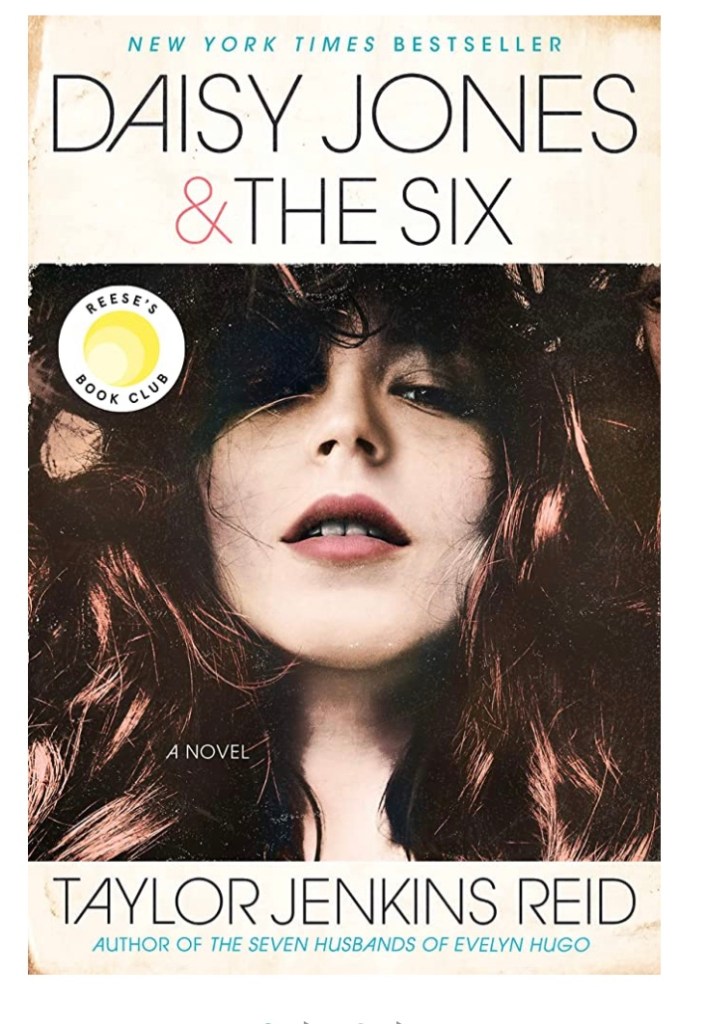
I have read all of Taylor Jenkins Reid’s books. One is better than the other. The Mashable newsletter compared the book to the TV series. Both were terrific. Jenkins Reid is 39 years old.
In episode 8, Daisy Jones and The Six finally go on tour and it goes down a little differently than in the book. Credit: Lacey Terrell / Prime Video
How does a good band become a great band?
Daisy Jones and the Sixadapts Taylor Jenkins Reid’s novel of the same name that follows the rise and fall of the titular Daisy Jones (Riley Keough) and The Six, featuring dreamy frontman Billy Dunne (Sam Claflin), guitarist Graham Dunne (Will Harrison), bassist Eddie Loving (Josh Whitehouse), keyboardist Karen Sirko (Suki Waterhouse), and drummer Warren Rhodes (Sebastian Chacon).
It’s a story of rock-and-roll heartbreak, with massive highs and lows, and the show cranks up the drama. From the “Honeycomb” name change to Camila and Eddie, here are the biggest changes Daisy Jones and the Six has made so far.
The novel takes the shape of an oral history of The Six’s dynamite rise to stardom and infamous split. It’s told entirely through interviews with the band, other key players, and eyewitnesses. The interviews are conducted roughly 30 to 40 years after the band’s split, as the members reflect on their time in the band with distance and (some) maturity. Each member remembers how everything went down slightly differently, leaving what really happened elusive and up to interpretation. The author’s note reads: “It should also be noted that, on matters both big and small, sometimes accounts of the same event differ. The truth often lies, unclaimed, in the middle.”
The show’s first episode opens with Daisy and each member of The Six beginning their interviews, which take place only 20 years after the breakup. Lazy aging makeup aside, the shortened time since the band split changes the band member’s perspective — the difference between 40 and 60 years old is stark — and leaves them with rawer emotional wounds from their time in the band and more to lose.
Additionally, unlike in the book, we actually see a cohesive story of the rise of the band in the moment; there’s no ambiguity over what went down. The show relies much less on the interviews, and they instead serve to establish a sheen of nostalgia and offer insight into the different band members’ perspectives.
Creation of The Six
The show messes with the band’s origin story and timeline.Credit: Lacey Terrell / Prime Video
In the book, Billy and Graham start the band together and bring members in, truly embodying their original band name, The Dunne Brothers.null
In episode 1, Graham alone decides to start a band with his crew of nerdy friends — Eddie, Warren, and Chuck — in order to get his girlfriend back. He tempts them to join by saying his cool older brother Billy will join too. But in his interview, Billy claims, “I never agreed to be in their band. I said I would listen and maybe give them some pointers.”
Despite his initial reluctance, Billy immediately takes charge. This change establishes a power dynamic within the band and Billy’s dictatorship much earlier on than in the novel. The decision compensates for changes to The Six’s timeline, hones in on Billy’s centrality from the start, and foreshadows the precarious nature of The Six.
The wedding
In the book, The Dunne Brothers are performing at their first wedding gig when Billy and Graham spot their estranged father, who is drunkenly dancing with a much younger woman. Their dad doesn’t so much as spare his sons a glance, and Billy deals with it by chugging beers and asking out a pretty cocktail waitress – and his future wife – Camila (Camila Morrone).
The show amps up the drama at the wedding to the max. Billy confronts their father, smashes his guitar, and Graham punches him in the face. Moments later in the parking lot, Billy announces to the band, “We’re going to be the biggest band in the fucking world!” This sequence effectively sets up Billy’s deep-rooted daddy issues, but it also alters his character by having him seek validation in music and fame, sidelining Camila’s importance.
In the show, Camilla and Billy’s meet-cute takes place at a laundromat where she humbles him. But fear not, he still uses the atrocious line “You give me your number, and I’ll write you a song.”
Chuck D.D.S.
Right before the band has their first small break opening for The Winters in the show, Chuck quits to go to dental school. This is a major tonal shift from the book, in which Chuck is drafted to Vietnam and dies six months later. In the show, Chuck serves as a source of doubt —suggesting a safer, more financially secure option for the band — rather than inspiration for the band to pursue their dreams.
In episode 2, Warren says, “Maybe ol’ Chuckie was right. Maybe this was all just a big mistake, and we should have stayed at home with our moms to save money on rent and become dentists.” It’s one of a series of changes that both sanitizes and adds levity to the source material.
The Five: Where is Pete?
Camila is the unofficial sixth member in the show. Credit: Lacey Terrell / Prime Video
The show nixes The Six’s bassist Pete Loving entirely. In the book, Pete is Eddie’s older brother, and he brings Eddie into the band to be the rhythm guitarist when Chuck is drafted. Pete’s whole thing is having a girlfriend back on the East Coast. In the show, Eddie is an original band member and is forced to switch to bass when Chuck leaves, one of many seeds of resentment planted. null
The show explains away the misnumbered name during a brief scene where Karen suggests The Six, claiming Camila as the unofficial sixth member. Plus, Warren adds, they can’t be The Five because there’s The Dave Clark Five and The Jackson Five. The show has Camila much more involved in the band than she was in the novel, so this explanation makes sense, to some extent.
Timeline of The Six
In the show, the band powers through Chuck’s departure, opens for The Winters, and meets their future keyboardist, Karen. After their performance, they receive life-changing advice from their future tour manager Rod Reyes: “Get the fuck out of Pittsburgh.”
With no planning or further direction from Rod, they decide to move to LA that same night and leave the next morning. At first, Camila refuses to come to LA, but by morning she’s changed her mind and gets in the van, which robs us of one of several essential Billy and Camila moments! More on this later.
The show reduces Rod’s role and downgrades him from The Six’s manager to their touring manager. In the book, the band has an established relationship with Rod, not to mention a lot more experience before moving out to LA. The band opens for The Winters for several shows on their Northeastern tour, where they convince Karen to join the band. When Karen joins, they change their name from The Dunne Brothers to The Six. They get more gigs and catch the eye of Rod in NYC, who sets up more shows for them on the East Coast and then helps them move to LA, where he hooks them up with gigs.
The lack of planning adds drama, humor, and excitement to the show — as if being in a rock-and-roll band isn’t already enough.
Teddy Price
One of the most memorable scenes from episode 2 is unique to the show. It features Billy accosting Teddy Price (Tom Wright) at the grocery store and getting him to agree to listen to one of their songs. Billy is fixated on having Teddy produce their album from the start. On the show, he’s not just their producer but also their main point of contact in the music industry. He essentially absorbs some of Rod’s role, as well as that of Daisy’s manager, Hank.
In the book, The Six’s intro to Teddy is much less exciting, and his mythos grows as he becomes a father figure to Billy and Daisy. Rod introduces the band to Teddy at the Troubadour, they play him 10 songs, and he gets them a record deal.
In the show, Teddy approaches Daisy after she performs at the Troubadour and offers to shape her. She doesn’t want to be shaped and storms off. A similar power struggle ensues in the book, but only after she’s been signed to Teddy’s record label and forced to sing covers.
Regardless, it’s Teddy who consistently gets through to Billy and Daisy and pushes them.
Camilly
Camila’s character suffers the most in its translation to screen.Credit: Lacey Terrell / Prime Videonull
Perhaps the changes that will upset fans of the novel most are made to Camila, Billy’s wife. In the book, Camila is a force, Billy’s rock in his struggle with addiction, and comfortable with her position as a rising rockstar’s stay-at-home wife. The show suggests otherwise.
In the show, Camila is introduced as a photographer rather than “wife of Billy Dunne.” She’s constantly recording and photographing the band, giving her a more official role. When she moves to LA with Billy, she acts as a quasi-manager, cold-calling record labels, sending photos of the band to newspapers, and is even folded into the band’s name.
In the book, Camila and Billy break up when The Six relocates to LA. And in one of the more romantic moments, Billy calls Camila and says, “If I had a record contract, would you marry me?” Camila accepts and comes out to LA to be with him.
In episode 2, Camila reveals her pregnancy to Billy the day before The Six leaves for tour, and it’s only then that they decide to get married. They proceed to have a full-blown wedding that night, with proper decorations and guests. However, Billy and Camila’s wedding is one of the most memorable scenes in the novel; they get married last minute in the middle of the night, and Karen decorates trees with aluminum foil. Between the proposal and wedding changes, the show presents Camila and Billy’s relationship less romantically, setting up viewers to be team Daisy and Billy.
In the show, the first tour is told primarily from Camila’s perspective of the pregnant wife at home, while in the book we really see Billy’s downfall and heroin addiction.
Simone
Daisy’s best friend and disco icon Simone Jackson (Nabiyah Be) has a much larger role in the show and gets to be a character in her own right rather than a talking head that adds context to Daisy. In the show, we see her career play out as a foil to Daisy’s, which also allows for more disco content!
SevenEightNine
In episode 3, it’s revealed that Billy’s stint in rehab gets The Six dropped from their label. Additionally, they were forced to pay their advance back, and the band members are now working odd jobs. Billy quits the band to focus on being a faithful husband and father, while initially barely doing either of those things. The remaining members of The Six audition new frontmen before deciding on…Eddie. C’mon, you can’t be serious. The show does everything in its power to increase Eddie’s animosity towards Billy, and the bitter bassist is no match for Billy’s charisma and stage presence.
In the show, Billy writes a song, plays it for the band, and is welcomed back with open arms – aside from Eddie. Teddy likes it and brings it to the label, but The Six has burned too many bridges, and the label isn’t willing to take another chance on them. Teddy brings in Daisy as a last-ditch effort to try to fix the song.
In the book, none of this happens! Billy returns from rehab and immediately starts working on the band’s second album, SevenEightNine. Daisy is brought in because they aren’t confident they have a lead single. These changes both delay Daisy and the band’s first encounter and raise the stakes. Everyone loves an underdog, and it’s a fun twist to make Daisy and The Six underdogs together.null
Look At Us Now (Honeycomb)
Billy and Daisy’s chemistry while performing “Look At Us Now (Honeycomb) is palpable. Credit: Lacey Terrell / Prime Video
In episode 4, “Look At Us Now (Honeycomb),” the song Daisy and Billy wrote at the end of episode 3, comes out and catches on like wildfire. Invited to perform at Diamond Head Festival in Hawaii, Daisy and Billy butt heads, but the show is undeniably magical. However, after Billy tells the press that Daisy and The Six won’t be collaborating again, they fight and Billy tells her to “have a nice life.”
In the book, Daisy and Billy first perform “Look At Us Now (Honeycomb)” – which is just called “Honeycomb” – at The Whisky in Los Angeles, where The Six is doing a residency to promote SevenEightNine. One night Daisy is in the crowd, so they bring her on stage to perform. It goes so well that their record label announces that Daisy will open for The Six on their world tour, The Numbers Tour.
Without The Six’s second album and accompanying tour, the show fast tracks Aurora,and the Diamond Head performance amps up the magic of Daisy and Billy’s first live performance together.
Daisy joining the band
In episode 4 everyone wants Daisy to join The Six except for Billy. Camila intervenes and invites Daisy to their housewarming party. Billy almost comes around and makes a halfhearted attempt to invite her to join the band, but Daisy stands her ground and walks away from him. The power goes out and the band, including Daisy, have an impromptu candle-lit acoustic performance that changes everything. By the start of episode 5, Daisy is an official member of The Six.
In the book, Daisy has a moment of clarity on The Numbers Tour where she fires her abusive manager, Hank — who is cut entirely from the show, diluting Daisy’s character — on the night that Jonah Berg of Rolling Stone magazine is in the crowd. Hank sabotages Daisy and takes her backing band with him. Daisy scrambles and ends up doing her opening set with Eddie playing guitar. Then, Billy comes out and takes the guitar from Eddie to do an intimate rendition of “Honeycomb.” For the first time on the tour Daisy stays on stage for the rest of The Six’s set. Eddie is pissed at Billy for overshadowing him and smashes his guitar. This memorable performance sets into motion the dynamics of the band that define the novel and lead to their breakup.
Jonah’s headline for the Rolling Stone article is “The Six That Should Be Seven,” which forces Billy’s hand in allowing Daisy to join the band. The sequence of events that leads to Daisy joining The Six is much more exciting in the novel and gives you the sense that it almost didn’t happen. In the show, the decision for Daisy to join the band is less external and more of an inevitability. It emphasizes the relationships between Daisy and members of The Six and highlights her new found family.
Karen and Graham
After encouragement from Camila, at the end of episode 4 Graham kisses Camila, and she politely rejects him. Then, Caroline introduces herself to Graham. In episode 5, Graham, Karen, and Caroline go to the beach. Karen sees Graham’s attractive qualities through Caroline’s eyes and realizes she wants him. When they arrive home from the beach Karen jumps his bones.
In the book, Graham and Karen’s luggage gets mixed up on The Numbers Tour, and Graham returns a duffle of bras and underwear to Karen. Karen says to him, “Oh, I bet you just love having your hands on my panties,” and Graham replies, “If I get my hands on those panties, I want to have earned it the old-fashioned way.” Later that day, Karen calls Graham’s hotel room and asks why he’s never made a move on her. He says, “I don’t take shots I know I’ll miss.” She replies, “I don’t think you’ll miss, Dunne.” Then Graham sprints over to her hotel room, and they share a passionate kiss.
The show thankfully devotes more time to developing Karen and Graham’s relationship, and it’s a joy to watch the fan-favorite characters get more screen time.
Daisy and Billy kissing in a tree
Daisy in the process of writing another incriminating song about Billy. Credit: Lacey Terrell / Prime Video
By episode 6 the tension between Daisy and Billy is undeniable and immediately gets complicated. Jonah from Rolling Stone is writing his first story on Daisy Jones and The Six and observes a charged moment between Daisy and Billy. Daisy exits, leaving Billy and Jonah alone in the studio together. Billy tells Jonah, “It’s not what you think man… It’s not exactly [an act], but it’s not real life either.” Jonah later relays this to Daisy, and she’s understandably upset and lashes out by not showing up to record the next day. Billy goes looking for Daisy and finds her strung out in the pool, inspiring him to write “More Fun To Miss.” The next day, while recording the song, Daisy storms out of the studio.
They fight in the parking lot, and Daisy says, “You want me to sing your song? I’ll fucking sing your song if you tell me the truth. Tell me that there is nothing going on between us.” In response, Billy kisses her. She makes her triumphant return to the studio and sings her heart out.
The sequence makes for great television and suggests that for Billy their relationship is about the music…or at least that’s what he’s telling himself. Billy manipulating Daisy for the music becomes a central theme in their relationship.
In the book, these two scenes happen separately. Billy writes “Impossible Woman,” the book equivalent of “More Fun To Miss,” and pushes Daisy to sing it in a feral, exceptionally raw way. It’s only after writing a couple of more emotionally charged songs that Billy tells Daisy he “likes a lot about her” and she leans in to kiss him. Their lips “barely graze,” and Billy cuts it off. In the novel, their relationship is about making great music, but Daisy is also a source of temptation for Billy, and he grapples with how acting on his feelings for her would result in him losing control of his sobriety and family. In the book we see the tension rise between Daisy and Billy, but we never get the pay off that the show gives us.
Love…rectangle?
By the time Billy and Daisy are writing Aurora in the book, Camila and Billy have had twin girls. However, they are completely cut from the show. During that period, Camila would put their three daughters to bed and wait up for Billy. The show has Billy getting home late every night. Additionally, Billy writes the titular track, “Aurora,” about Camila, so while the rest of the album explores Daisy and Billy’s relationship, they choose to center the album around song about Camila. These changes simplify his relationship with Camila and his betrayal.
Because Camila is more involved in the band in the show, when Daisy joins the band Camila isn’t just sidelined from her relationship with her husband, but from her unofficial role in the band. This makes Billy’s duplicity cut even deeper.
In episode 6, after Billy kisses Daisy, Camila accompanies Billy to the Aurora album shoot. Billy and Daisy get into a fiery fight, while Camila observes at a distance and captures the moment on her camera. From Camila’s perspective, we hear damning snippets of their argument that include the phrase “your wife.” In the book, Camila is not involved in the Aurora album shoot at all.
In one of the most jaw-dropping changes from the book, Camila gets together with Eddie in retaliation. The show heavily hinted at Eddie’s feeling for Camila. This unnecessary change serves to increase hostility between Eddie and Billy, but Eddie was spiteful enough in the book! Putting Eddie and Camila together makes The Six excessively messy.
In the novel, Camila also flirts with infidelity by meeting up with a high school crush, and it’s implied it’s more than just friendly.
Related Stories
Simone the struggling disco star
Episode 7 begins with Simone arriving at the NYC club where her long-distance lover Bernie (Ayesha Harris) DJ’s; it’s also where the two women promote Simone’s music, culminating in a record deal. As stated above, Simone is a minor character in the book, which gives the show creators freedom to expand her character. In the book, all we know about Simone’s career is that her first album flops and her record label drops her. Then, she gets signed to a different record label and finds international success with her R&B dance hits in Europe; she leaves to tour Europe while Daisy is working on her debut album.
Daisy’s escape to Hydra
Daisy goes to a Greek Island instead of Thailand. Credit: Laney Terrell / Prime Video
The show draws out 3.5 pages of the novel into an entire episode. When the band goes on break after completing Aurora, Daisy disappears to Hydra, a Greek island. She sends Simone a telegram that reads, “I need you – Daisy,” and Simone and Bernie drop everything, potentially at the expense of their careers, to meet her in Greece. There they find Daisy engaged to Nicky (Gavin Drea), who claims to be of Irish nobility. During Simone and Bernie’s stay in Greece, Daisy and Nicky get married, and Simone fights with Daisy about returning to The Six.
Simone discovers that Daisy lied about her identity to Nicky – she told him she’s a poet. Nicky is clearly manipulative and twists Simone’s sexuality against her by telling Daisy that Simone only wants her to return to The Six because she’s in love with her. Daisy falls for Nicky’s trap and gets into a friendship-altering fight with Simone that results in Simone leaving Hydra. But the fight was for nothing because then Nicky finds Daisy’s Rolling Stone cover and encourage her to go back to LA.
In the book, Daisy escapes to Thailand and sends Simone a postcard with an entirely different tone: “Come to Phuket. Bring coke and a lipstick.” Then she meets Nicky, who is Italian “royalty,” and leaves with him to Florence and then Rome before Simone arrives. Daisy and Nicky get married, and Simone finally tracks Daisy down in Rome and drags her back to LA.
Spending more time with Daisy away is an attempt at fleshing out her headspace, feelings for Billy, and why she marries Nicky, but the show is at its most compelling when Daisy and Billy are in the same room!
Per usual, the show amps up the drama of Daisy’s trip. She’s essentially gone missing and doesn’t return until after the album release party and tour rehearsals. In the book, she comes back to do press for Aurora and tour rehearsals. The most frustrating change is small but carries emotional weight. In the show, present-day Daisy says, “I don’t regret that day,” in reference to her wedding day, but in the book she says, “I regret that marriage, but I don’t regret that dress.” The modification validates Daisy’s toxic relationship with Nicky and doesn’t do justice to Daisy’s character development.
The tour
In episode 8, Daisy Jones and The Six finally go on their first tour, and tension between Daisy and Billy is at an all-time high — and not in a sexual way. At the same time, Daisy is on a self-destructive downward spiral that’s exacerbated by receiving a letter from her absentee mother.
Billy notices Daisy’s increased drug use and approaches Rod about it. He suggests talking to Nicky. Billy and Nicky’s conversation quickly escalates, and Billy throws the first punch. In the book, Nicky and Billy get in a blow-out confrontation, but it never gets physical. Nicky steps in when Billy and Daisy fight over Billy, offering her his jacket in the studio. Nicky tells Billy, “You stay away from her…You don’t talk to her, you don’t touch her, you don’t even look at her.
Episode 8 culminates with Daisy overdosing. Billy goes to Daisy’s hotel room with the intention of kicking her out of the band and finds Nicky panicking in the doorway. Billy storms into the room and finds Daisy passed out in the shower. Rod calls a doctor, and Billy cradles Daisy in his arms. She wakes up and says, “It’s you.”
In the novel, Daisy overdoses in Rome while the band is on break from tour. She wakes up in the shower with Nicky leaning over her. She has a come-to-Jesus moment: “While I had no idea whether or not I overdosed or what exactly happened that night, I could tell he had been truly terrified. And all he did was put me in the shower.” She waits until Nicky takes a nap, then packs her bags and leaves him a message that she wants a divorce.
Billy saving Daisy is a cliche and does a disservice to her character and robs her of an important, self-preserving decision.
Teddy’s heart attack
In episode 9, Teddy has a heart attack at the Saturday Night Live after party. He’s rushed to the hospital. While he’s in surgery, Daisy and Billy reflect on their careers and addictions, and they decide to turn over a new leaf in their relationship. Then, Teddy wakes up. In the book, Teddy doesn’t come to the band’s SNL performance, and Billy gets a call early the next morning that Teddy died from a heart attack. Daisy and the band fly out to Los Angeles for the funeral, and his death serves as a catalyst for Billy and Daisy’s final downward spiral.
The hometown show
After Teddy’s health scare, the band plays their hometown show in Pittsburg. Tensions are rising between the members of the band – Billy takes Eddie’s bass to play with Daisy, and Karen and Graham grapple with Karen’s pregnancy – and the show tries to replace the trauma of Teddy’s death with the drama of the hometown show. After the show, Daisy and Billy do the crossword at his parents’ house and talk about the future. Billy tells Daisy that he’ll never leave Camila; unfortunately, Camila happens to see them through the window during this intimate moment, and it has the reverse effect, instilling her with doubt over their marriage.
In the book, the band takes a break after Teddy’s death, and when they return to touring, they are all messily mourning. Camila and the girls joined Billy on tour, so there isn’t that same marital tension leading into the final show.
The end of The Six
Camila arrives for the Chicago show and all hell breaks loose. Credit: Laney Terrell / Prime Video
In the final episode, Camila arrives in Chicago for the show. She gets into a yelling match with Billy about Daisy where Camila tells Billy, “we have both done things,” and Billy admits that he kissed Daisy for “like a second.” The fight culminates in Camila begging Billy to “tell me that you don’t love her,” but Billy’s reply falls short: “Nothing ever happened, and nothing ever will.” Then, Camila confronts Daisy and tells her that she and Billy deserve each other and leaves.
Later, Eddie and Billy come to blows when Eddie reveals that he’s quitting the band because — shockingly — he’s felt sidelined by Billy the entire time he’s been in the band. Billy gives it right back to Eddie, and then Eddie hints at his relationship with Camila, so Billy punches him in the face. In the book, none of these confrontations happen.
In the show, Daisy opens a letter from her mother and calls her, only for her mother to call her a “selfish little shit.” Immediately after the call, Daisy nosedives out of control and is doing copious amounts of cocaine and drinking heavily. While the conflict with her mother simplifies Daisy’s breakdown, we do get the epic line, “Next time you want to hear my voice, why don’t you try the fucking radio.”
Billy calls Camila and begs her to come to the show that night; thinking that she’s left him for good, he ends his sobriety and takes a shot. He continues to drink heavily before the show, and with nothing to lose, he kisses Daisy before they go on stage.
Daisy and Billy are all over each other during the final show, and during the break before the encore, they are passionately making out. They pause to do coke, and Billy proposes that they be “broken together,” but Daisy realizes that she doesn’t want to be broken anymore. The band goes on stage for their final song, and Daisy gives a speech that encourages Billy to leave the concert early to chase after Camila. Billy and Camila reconcile, and Daisy tells Rod she’s quitting the band to go to rehab.
In the book, Daisy and Billy do a particularly raw, exposed rendition of “Honeycomb” and are forced to grapple with their feelings for each other. Heartbroken over Daisy, Billy goes to the hotel bar and drinks half a glass of tequila. Meanwhile, Camila comforts Daisy, who is similarly suffering in her hotel room. The two women have a heart to heart, and Camila tells Daisy that Billy loves her but they are tearing each other apart and that Daisy is worth saving from the wreckage of their relationship. By morning, Daisy is gone.
Without Teddy’s death, the show has to amp up the tension leading up to the band’s conclusion, with marital drama between Billy and Camila and maternal drama with Daisy. That decision makes the reason for Daisy and Billy’s simultaneous spiral more confusing. In the book, it’s clear that Daisy and Billy ruin each other.
Julia’s big reveal
In the show, it’s revealed that Billy and Camila’s daughter Julia is the one interviewing everyone when Billy recounts his reconciliation with Camila after the concert because she also remembers that night.
In the book, Julia remembers Daisy and Camila’s talk and corroborates Daisy’s memory of the night because Camila is no longer alive. This change robs Julia and Daisy of the special connection they have in the book.
Daisy and Billy’s reunion
In the show, Julia shows Daisy and Billy a clip of Camila before her death giving them the go-ahead to meet up again. Then Billy is shown arriving at Daisy’s front door. The ending of the book is more ambiguous. It ends with an email written by Camila giving Daisy and Billy her blessing to write her a song.
Elena Cavender
Elena is a tech reporter and the resident Gen Z expert at Mashable. She covers TikTok and digital trends. She recently graduated from UC Berkeley with a BA in American History. Email her at elena.cavender@mashable.com or follow her @ecaviar_(Opens in a new tab).
Elián González, the Cuban boy found clinging to an inner tube near Florida shores who became the center of an international child custody dispute as well as a political battle between Cuba’s late leader Fidel Castro and Cuban exiles in Miami, is set to become a member of the island’s National Assembly after Cubans go to the polls Sunday.
González, 29, was proposed as a candidate for the municipality of Cárdenas, in Matanzas, where he lives and works as assistant director of AT Comercial Varadero, a food import company run by the Cuban Ministry of the Armed Forces.
Married and father of a 2-year-old girl, González said in an interview with the Juventud Rebelde newspaper that he had been encouraged by the Castro brothers to enter politics and thought Fidel Castro “would be proud” of his nomination. He has sometimes spoken in the past about how Cuba’s population has lost confidence in government institutions.
And because Cuba’s electoral system is designed in a way official candidates face no competition and only need a small percentage of the vote to get elected, there’s little doubt that González, who as a boy was at the center of one of the most emotional stories in Miami’s history, will become a member of the same government his mother tried to escape from.
In this file photo taken April 22, 2000, in Miami, Elián González is held in a closet by Donato Dalrymple, one of the two men who rescued the boy from the ocean, right, as government officials search the home of Lazaro González for the young boy. The boy was eventually reunited with his father in Cuba, but the ordeal put a spotlight on bitter relations between the U.S. and Cuba. (AP Photo/Alan Diaz, File)
“Throughout these years, my family has been very important, trying to maintain that simplicity, that humility of always staying in the right place where I should be, not believing that I was different from anyone or that I deserved something better,” he said in an interview with Cuban television station TvYumurí after he was nominated. He also praised his teachers, who he said made him understand that he “was not the star of that story, the star was the people.”
González, then 5 years old, was rescued by fishermen on Thanksgiving Day 1999 when he was spotted on an inner tube floating at sea near Fort Lauderdale. His mother, Elizabeth Brotons, who took him on the dangerous trip to flee the island regime, drowned with a dozen other passengers when their small fishing boat capsized. The boy miraculously survived.
In Cuba, his father, Juan Miguel Gonzalez, wanted him back. But in Miami, some of his relatives believed the boy should stay in the United States. After all, the boy’s mother died trying to get him freedom, the relatives said at the time.
Then politics entered the scene.
After the economic crisis in Cuba in the 1990s known as the Special Period, Castro needed an issue that could revive old ideological battles and reinvigorate his grip on the population. And he seized on the opportunity, quickly making Elián’s return a subject of national priority and the beginning of a years-long propaganda campaign that would be known as the Battle of Ideas.
In Miami, local politicians quickly made it their mission to resist Castro and support the claims of the boy’s relatives in the U.S. to keep him here. A media frenzy followed in both countries, and Elián became the center of a diplomatic crisis and legal dispute that made headlines around the world. No less dramatic was the middle-of-the-night raid by federal agents on his relatives’ Little Havana home that put an end to it all after U.S. Attorney General Janet Reno ordered that the boy should return to Cuba.
A photograph of the boy’s scared face when a federal agent points his gun in his direction further enraged Cuban exiles. But after seven months, he eventually returned to Cuba with his father after the Miami relatives exhausted all legal pathways to get him to stay.
His life, however, never quite returned to normal. The entire country knew who he was, his face printed on thousands of banners and T-shirts. While he was in Miami, Cuban state workers and students held weekly rallies calling for his return, and a daily television show was dedicated to discussing any developments in the case.
On the island, González received a military education and became a vocal supporter of the Castro brothers, who, after his return to the island developed a close relationship with him and his father, who went from a waiter at a Varadero restaurant to a member of the National Assembly.
Over the years González was frequently seen in public with Fidel and later Raúl Castro. When he graduated as an industrial engineer in July 2016, he read a letter his class sent to Fidel Castro promising to “fight from any trench that the Revolution demands.” And when Castro died a few months later, González said he had been “like a father until he became a friend. And like my father, I wanted to show him everything I achieved so that he could be proud of me.” His Facebook account is full of pictures with Fidel Castro and hashtags like #FidelViveenMí, Fidel lives in me, and #YoSoyFidel, I am Fidel.
In 2020, González announced he was going to be a father of a girl and that he had become a member of the Communist Party.
He has rarely spoken of his family in Miami, but in a 2015 interview with ABC News he said he wanted to visit the United States and was willing to talk to his relatives — if they acknowledged it was wrong to keep him from reuniting with his father.
Though not surprised, Manny Díaz, the lawyer who represented the boy’s Miami relatives during the saga and who later became mayor of Miami, said he was saddened to hear about González’s choices.
“How does he explain the fact that his mother gave her life to bring him to freedom, and he’s now a representative of a system that oppresses people, jails anyone who dissents, kills people who dissent and is an economic failure?” he asked.
In Miami, Elián played with Díaz’s daughter. When Diaz saw them together, he said, he saw children — not a battle between democracy and communism.
Diaz said he knew that Elián’s return to the island would involve indoctrination. Elián, he said, was groomed to be a poster child for the Cuban government.
Donato Dalrymple, 63, one of the fishermen who rescued him at sea and the man appearing in the iconic photo the night of the raid trying to shield him from the armed federal agent, said he isn’t surprised to hear about González’s new role. Dalrymple said he noticed something different about Elián from watching him play with his cousins in Miami.
“He was always a leader,” he told the Miami Herald.
For Dalrymple, González’s future as a lawmaker could be a good change for the island nation.
“I live with high hopes,” he said. “I wish him all the best.
Kathryn and Dan Mikesell, co-founders of Fountainhead Arts hosted the annual woman’s history month event tonight for The Women’s Fund Miami-Dade https://womensfundmiami.org/. Mayor Daniella Levine Cava, Miami-Dade County’s first-ever woman Mayor, elected in November, 2020, was an honored guest. The Woman’s Fund creates positive change for women and girls through grantmaking, advocacy, research and leveraging collective impact.The four pillars: Economic Mobility, Leadership, Health & Well-being, and Freedom From Violence
Mayor Daniella Levine Cava, Miami-Dade County’s first-ever woman Mayor, elected in November, 2020, was an honored guest.
Miami is big on presenting movies on the water. Fountainhead Arts premiered a foundation video
Me, Alison, Hesty , Fountainhead artistFountainhead’s Nicole Martinez delivering second baby this weekend. Congrats ! Fountainhead’s Francesca Nabors with members Lucy, Emily, me and HestySpring McManus, art advisor and Melissa Wallen, director of De La Cruz Collection