Today’s guest is someone who quite literally lives between worlds—both geographically and creatively.
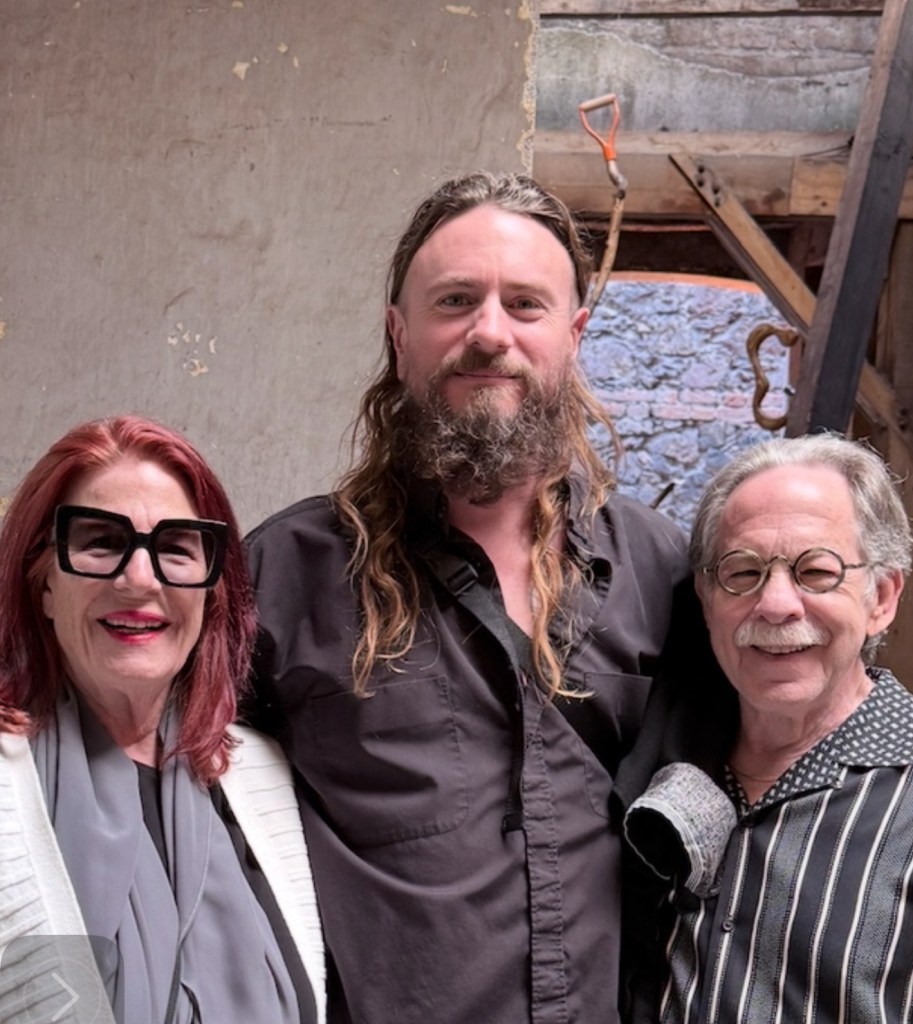
Leslie Moody Castro is an independent art curator and writer who splits her time between Austin, Texas, and Mexico City, a rhythm she’s kept for over twenty years. Her practice is deeply rooted in movement, collaboration, and conversation—whether across borders, between disciplines, or within communities.
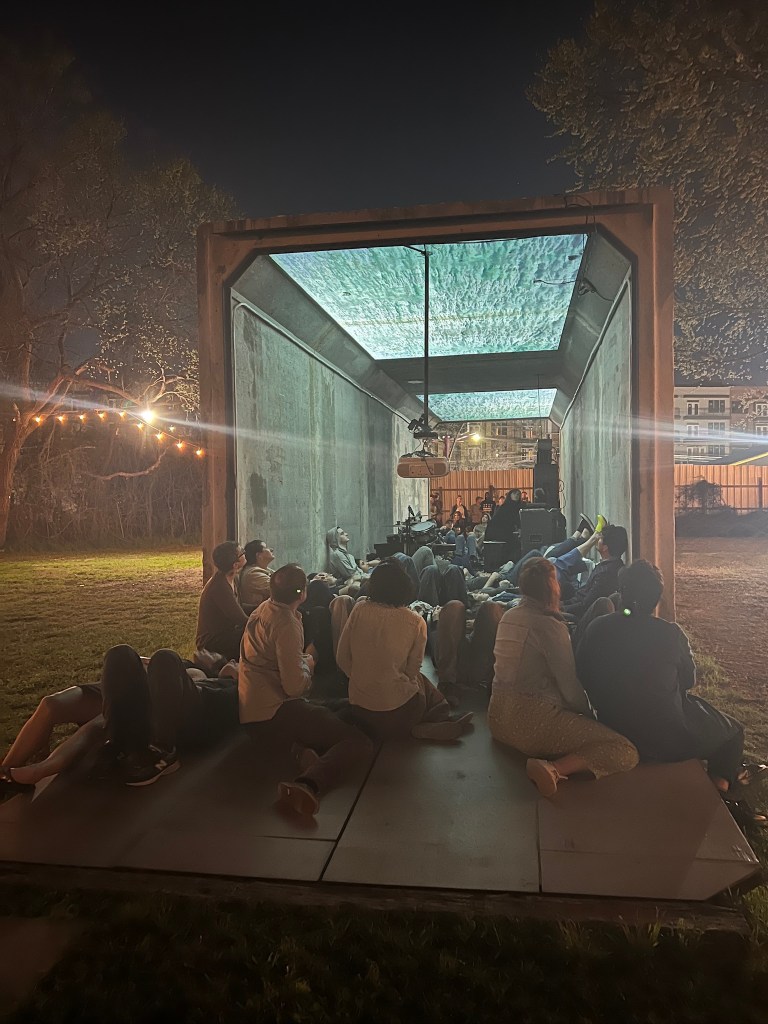
For nearly two decades, Leslie has produced and curated projects across Mexico and the United States, always with an eye toward creating spaces for dialogue and exchange. She’s the co-founder of Unlisted Projects Residency and Co-Lab Projects, a unique, artist-run nonprofit in Austin dedicated to experimental and collaborative art. (Fun fact: Co-Lab is housed inside five massive concrete culverts)—those structures that usually carry water underground—gifted by a neighboring concrete factory. Leslie, and partner Sean Gaulager, along with their team transformed the concrete culverts into an imaginative and unconventional exhibition space on an acre of Texas land).
In 2022, she was both the inaugural curatorial fellow at New Mexico State University and curator-in-residence at Casa Otro in Mexico. Her work has earned two National Endowment for the Arts grants and a State Department fellowship for her research on borders.
Leslie’s global perspective is also shaped by residencies from Estonia to Tepoztlán, from Miami to Mexico City. She’s curated several major biennials, including the 2018 Texas Biennial, the 2021 Amarillo Museum Biennial, and most recently, the 2024 Aurora Biennial. From 2021 to 2024, she was also the guest editor of Glasstire, Texas’s leading online arts magazine.
She’s the founder of AtravesArte, a platform dedicated to transborder art practices—and she’ll be the first to tell you: Mariachi makes everything better.
Click below to hear all about Co-Lab, the art gallery housed inside five massive concrete culverts, structures that usually carry water underground—gifted by a neighboring concrete factory. Leslie, and partner Sean Gaulager, along with their team, transformed the concrete culverts into an imaginative and unconventional exhibition space on an acre of Texas land).
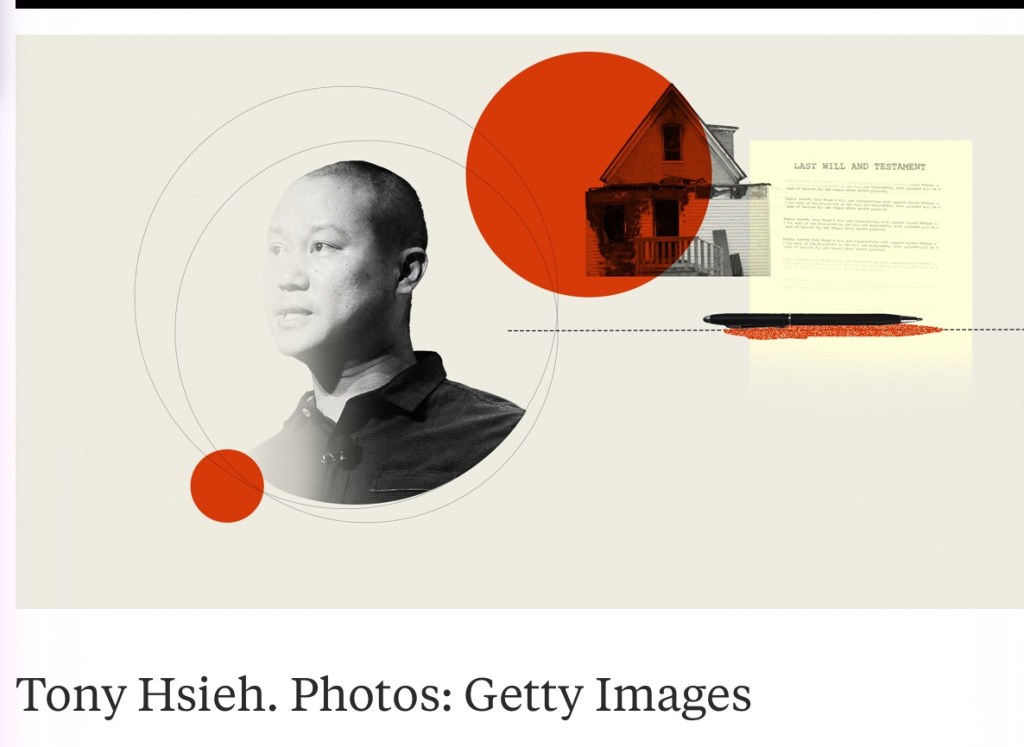
Zappos Founder Tony Hsieh’s Newly Uncovered Will Highlights an Important Lesson for Entrepreneurs
The recently discovered document has ignited more in-fighting among Hsieh’s family, friends, and former colleagues. The episode serves as a reminder for founders.
MAY 19, 2025
The sudden emergence of Tony Hsieh’s will last month, years after his death in a house fire, has all the tension and intrigue of an HBO drama.
The Zappos founder’s final years were spent in a spiral of drug use and collapsing mental health. During the pandemic, he relocated from Las Vegas and holed up in a mansion in Park City, Utah, growing increasingly manic, claiming that he was working on world peace and eradicating Covid-19, as Forbes reporters documented in a book on Hsieh’s life. He died in 2020 at the age of 46 after succumbing to injuries sustained in the fire, which took place in New London, Connecticut.
The will, included in a court filing in Las Vegas, was found in the possession of a mystery man named Pir Muhammad who died after suffering from Alzheimer’s, The Wall Street Journal reported in April. The will’s emergence added fuel to an already fractious dispute over Hsieh’s estate, which is worth around $500 million. The proceedings are now consumed by in-fighting among Hsieh’s family, close confidants, and former colleagues, some of whom have been described as “sycophants” by Forbes.
Written in 2015, the will includes atypical provisions, like transferring $50 million and a series of Las Vegas properties to trusts tied to unnamed beneficiaries. It gives $3 million to Hsieh’s alma mater Harvard University, and $250,000 to the Ford Foundation and other philanthropic organizations. There is also a no-contest clause in the will, meaning that if any of Hsieh’s family members dispute the contract, they will receive nothing.
For founders who’ve achieved even a fraction of Hsieh’s wealth, estate planning is often an afterthought. “For most clients I deal with, that’s not something that they’re thinking about early on,” says Shavon J. Smith, principal at the Washington D.C.-based SJS Law Firm and the author of small business advice book Tell Me About the Hard Part. “When you’re starting a business, you’re just trying to get it going, you’re just trying to make sure you generate income, make sure you can make payroll, make sure you’re bringing in contracts.
Of course, there are ways to ensure that your business doesn’t become the center of a protracted legal dispute, and that starts with a long-term plan, Smith advises.
If you own a single LLC, your company’s operating agreement should include a clause about whom you’d trust to step in and make decisions about its assets, and how they are willed to certain people, in the event of your death.
When your company is a trust or partnership, there will often be a “death clause” in its operating agreement, Smith says. This clause treats “death, or even disability [as] an automatic trigger to sell your shares to your co-owners as well.”
There are other basic considerations that can very well slip a founder’s mind—like who has access to a software program. “I had a client pass away this summer recently, and it was like, ‘OK, so how are we going to run payroll? Because he was the only person on the account,’” Smith says. The example highlights the necessity of a succession plan that outlines who will control what aspects of the remaining business
Hsieh made a fortune peddling shoes on the internet, eventually selling Zappos to Amazon in an all-stock deal worth around $1 billion in 2009. He was a charismatic and colorful figure who emphasized customer obsession and company culture, publishing a book called Delivering Happiness: A Path to Profits, Passion, and Purpose in 2010.
Hsieh’s will emphasized instilling his beneficiaries lives’ with a “wow factor.” The WSJ reports that Hsieh wrote in the document: “I want my beneficiaries to ‘live in the wow’ and to enjoy [their gifts] as a memorable and meaningful experience.”
Hsieh wasn’t particularly organized with his personal affairs, however. “You’ve got this very wealthy guy who gave his original will to one person, and it appears that that person was incapacitated and then died. In terms of best practices, that’s not the way to go,” says Marc M. Stern, a partner at Greenberg Glusker, a full-service law firm in Los Angeles
It’s important to trust your estate with professionals who can recall important documents at a moment’s notice. “Many clients want their originals, so we send it [when requested], but we retain copies. If something were to happen to somebody, we know that it exists,” Stern says.
Crucially, the most prepared founders understand that in the event of their death, the business is still a living, breathing asset. Understanding debt obligations is paramount, so you aren’t saddling beneficiaries with a bill. Smith recommends life insurance as a way to leverage potential debt.
“When someone comes to me and they have a succession plan, they have thought about what’s going to happen next in the business, and their personal estate planning is done, those people tend to have well-run businesses in general,” Smith explains.
Legal proceedings surrounding Hsieh’s estate will resume later this month.
Taylor Jenkins Reid is leaning against a railing in the sun outside Los Angeles’ famed Griffith Observatory. We’ve picked this place to talk about her ninth book, Atmosphere, a space thriller and love story set at NASA in the 1980s, but as the iconic Hollywood sign shines in the hills behind her, the scene feels almost too on the nose.
Reid, despite her ability to blend in with the tourists milling about, is not just any author. She is one of the most successful novelists working today, her books not only beloved by readers but also hot commodities in the film and TV industry. Atmosphere, out June 3, is poised to be one of the biggest books of the summer, if not the year, with a movie adaptation already planned. So it feels a bit inevitable when a man in a backpack taps her on the shoulder, his phone camera open.
Then the plot twist: “Will you take a picture … of us?” he asks, gesturing to his wife and son. Reid gamely starts snapping, bending down to get the right angle.
“I’m chasing a feeling. Maybe it doesn’t matter if I’m fancy. Maybe I’m just fun.”
-Taylor Jenkins Reid
Julia Johnson for TIME
While this family clearly has no idea who Reid is, there are many, many people for whom this encounter would be huge. Despite grumbles that no one reads anymore, Circana BookScan data shows book sales are up—there were more than 797,000,000 print books sold in the U.S. last year, up 2% from 2023 and 14% from 2019. And the contemporary women’s fiction category, where Reid is often listed, ended 2024 with a nearly 30% increase in sales over 2019 numbers, according to analyst Kristen McLean. But in recent years, as celebrity-led book clubs have proliferated and TikTok has driven demand, a select group of authors—Reid, Colleen Hoover, Emily Henry, Kristin Hannah, and romantasy favorites Sarah J. Maas and Rebecca Yarros among them—have become the North Stars of the industry. They’re not just popular writers; they’re brands, known entities with whom fans feel a deep connection.
Reid’s novels—which center and largely appeal to women, who have long bought more fiction than men—create conversations on social media, have been selected by heavy hitters like Reese Witherspoon and Jenna Bush Hager for their book clubs, and virtually all are being or already have been adapted; Daisy Jones & the Six became an Emmy-winning series. Reid’s eight novels before Atmosphere, five of which are New York Times best sellers, have sold more than 21 million print, e-book, and audiobook copies in 42 languages, per her agent. And, according to two industry sources, the scuttlebutt is that she recently signed a five-book deal for an eye-popping $8 million—per book. (Her agent declined to confirm.)
Given all this, you’d be forgiven for thinking that Reid, 41, might be a little miffed by the lack of recognition at Griffith. But where she grew up in Acton, Mass., vanity was a strict no-no: “You would never want to be caught thinking you were something.” So she’s still trying to reconcile her “uncool life in the Valley,” where she lives with her husband and daughter, with how the world responds to her work. When people ask how she feels about having another best seller or the fact that Serena Williams wants to work with her, she isn’t quite sure how to react. “Well, what do you want me to feel?” she thinks. “Like I’m hot sh-t?” None other than Stevie Nicks expressed interest in collaborating on Daisy Jones, but, for Reid, it still feels like this can’t be real life. “That happened to somebody else, I think,” she jokes. “It happened to Taylor Jenkins Reid, right? God bless her. Good for you, babe.”
If you spent any time on BookTok in 2021, you probably saw young women, faces streaked with tears, sharing their love for Reid’s fifth novel, The Seven Husbands of Evelyn Hugo, which had been published four years earlier. This followed Witherspoon’s 2019 selection of Daisy Jones for her book club—and her announcement that she would produce an adaptation.
Publishing, like so many industries, changed with the pandemic. “Both because people suddenly had time to read, and also with the arrival of BookTok in late 2020, genre fiction like romance and authors like Hoover and Reid took off,” says McLean. After Evelyn Hugo went viral, suddenly readers were looking for other books by Reid—many of them, according to Barnes & Noble senior director of books Shannon DeVito, arriving in stores to film content and find backlist titles. Word of mouth has always been key to an author’s success. “It can’t be reverse engineered,” Reid says. “It just happens when it happens.”
That it would happen for Reid, though, was hardly expected, especially considering she didn’t originally set out to write books. The woman who now regularly fields offers to put her work onscreen initially wanted to be in the movie business.
She got her start as a casting assistant, but began writing on the side, even finishing a manuscript that was never published. In 2012, she asked her husband how he’d feel about her taking time off to focus on fiction. Within a month, she had a draft for what became her first novel, Forever, Interrupted. That book, published in 2013, sold poorly. Her second, After I Do, didn’t do much better.
But once readers found Reid’s books, the appeal was clear. Evelyn Hugo, Daisy Jones,2021’s Malibu Rising, and 2022’s Carrie Soto Is Back, a loosely connected quartet, tell the stories of women navigating the pressures of fame in male-dominated spaces. Reid’s storytelling feels immersive—she takes you deep inside the worlds she builds, and delivers the gossipy details you want to hear. Her protagonists are specific, bold, and unapologetic. They have a way of lingering with you after the story ends. “You feel like they’re just sort of out there, living in the world somewhere,” says Ballantine publisher Jennifer Hershey, Reid’s editor on her four latest books, including Atmosphere.
Advertisement
The romance novelist Emily Henry, a close friend of Reid’s, finds something “healing” in her work. “So many of us do have fears about being too much or too little, or not performing our womanhood correctly, not being friendly enough or pretty enough or passive enough or sparkly enough,” says Henry, whose latest novel Great Big Beautiful Life is a No. 1 New York Times best seller. “I love that she writes these women who are very aware of how the world sees them and how they may fall short in the eyes of others, and their arc is never about trying to change that thing or trying to justify their existence.”
Reid’s books are also, as more literary readers might say, “easy to read,” often looked down upon by highbrow critics. She says her aim was always to write the kind of novels you could binge in a weekend, but the more she published,the more reviews came in, and she found herself chafing at the criticism: “Oh, this person said they liked my book, but they didn’t find it to be high art. How can my sentences be better? How can my work be more literary? I fell into that trap quite a bit, looking for approval.” When Malibu Rising came out, Reid was proud—she thought this multigenerational family drama, of all her books, would be the one embraced by the literati. The reviews “leveled” her. One person called it “Candy Land Franzen.” She remembers how she talked herself out of the sting. “Because I know you’re trying to insult me, it hurts,” she says. “But I am not writing as complex stories as Jonathan Franzen—that wasn’t the point. So it probably is Candy Land Franzen. And maybe I lovebeing Candy Land Franzen.”
Writing a book that’s easy to read, Reid contends, is extremely difficult. She has to think about the reader’s experience on every page. “I’m chasing a feeling,” she says. “Maybe it doesn’t matter if I’m fancy. Maybe I’m just fun.”
An estimated 16 million unsolicited manuscripts are submitted to agents’ “slush piles” each year, according to Laura McGrath, a professor at Temple University who uses data to study literature and literary culture. To get published at all, even if you sell poorly, is a feat. “It’s just sad to me, when I talk to aspiring writers and they’ll talk about Taylor Jenkins Reid as though anyone could do this,” McGrath says.
Libby McGuire, publisher of Atria—which published Evelyn Hugo and reportedly won Reid back from Ballantine with that massive deal—emphasizes that there’s a path to success as an author without ascending to the level of a phenomenon. If you rely solely on the New York Times best-seller list, she says, you might miss books that are still selling well over time. “When I talk to my friends at other houses, everyone has these books that are quietly succeeding,” McGuire says. “It’s just that they’re selling 2,000 to 3,000 a week.” But the lack of transparency around advances and sales, combined with sensational stories like Reid’s, leads to a skewed perception of what success looks like for a typical author, McGrath says. “We lose sight of the fact that there is a workaday writer churning out a book a year or a book every couple of years, who is making a reasonable living or still has a day job.”
In the Penguin Random House antitrust trial three years ago, the publishing giant revealed that only 35% of its books are profitable and of those, 4% bring in the majority of profits, suggesting that the company runs on the success of just a tiny handful of authors. To some in the industry, the gap between what authors like Reid are offered—face time with internal sales reps, booksellers, and media, marketing and publicity support, the opportunity to tour—and what the majority receives is unfair.
Reid reportedly got less than $100,000 when she sold Evelyn Hugo—somewhere between $50,000 and $99,000, per Publishers Marketplace—which seems laughable now that it’s sold more than 10 million copies.But she feels fortunate to have started small. “You could say, well, publishers should put all of the energy equally behind all the books. But if they do that, they can’t publish as many,” she says. “The only way they were going to publish Forever, Interrupted was to take a chance on me, give me a low advance, not put a ton of energy behind it, and see what happened.” For companies that take a volume approach, the real boon is when one of the smaller bets, like Evelyn Hugo, becomes a runaway hit.
“I always describe it as like a game of Hungry Hungry Hippos,” says Reid’s agent Celeste Fine, who specializes in representing big-name writers like Nicholas Sparks and Jennifer Weiner. “Authors to these corporations are just like marbles, like nom nom nom.” Over the years, Fine has observed a “mission creep,” where publishers expect not only exceptional books, but also marketing and sales acumen, engagement on social media, and the ability to entertain a crowd on tour. It’s as if they’re saying, “Not only are we paying for the book—now we own a piece of you, the human, and you should be grateful,” Fine says. She believes an author like Reid deserves to be treated like a business partner: “She has earned the right to be as certain about what she’s getting out of the next 10 years of her career as any CEO with their benefit packages.”
There are no guarantees in publishing, but Atmosphere is a solid bet. The novel follows Joan Goodwin, an astrophysicist who joins NASA’s space-shuttle program in the early ’80s. There she meets Vanessa Ford, a woman who challenges her understanding of who she is. In Reid’s first thriller, she pumps up the stakes with a disaster on the shuttle in the first few pages.
She studied the works of Andy Weir, read about Apollo 13, and pored over NASA documents. Paul Dye, a retired NASA flight director, helped her untangle the technical details. But for all of Reid’s research, the idea for the book really started with a desire to tell a particular type of story. “It just felt like time for me to write a very high-stakes, dramatic love story,” she says. She asked herself: “What is my Titanic?”
Reid knew she wanted to explore how intimate a connection could be between one character in space and one on the ground, and that those characters would both be women. She also knew this choice would lead her into another debate about identity. Who is allowed to write what type of characters has long been a fraught subject in publishing, with some arguing that authors should write only from perspectives they inhabit and can therefore be trusted to represent truthfully, and others encouraging the ideas of allyship and creative freedom. Though Reid is white, some of her characters are not, and the way she wrote Carrie Soto, a Latina, in particular yielded some criticism she took to heart. “What I was being told was I don’t have the range necessary to pull off what I’m trying to pull off,” she says. So when it comes to race, for now she’ll stick to what she knows.
Her response was not the same when it came to writing about sexuality, but then neither was her experience. The publication of Evelyn Hugo,ultimately a love story about two women, led to questions about why Reid, who is married to a man, writes queer characters. “I am very private,” she says. “So at first, I just sort of let people assume what they were going to assume.” But now, as she prepares for the topic to resurface around Atmosphere’s release, Reid wants to be very clear about something those close to her have always known: she is bisexual. “It has been hard at times to see people dismiss me as a straight woman, but I also didn’t tell them the whole story,” she says.
When Reid was a teenager, she began expressing herself through her appearance. “I got hit pretty quickly with, Why can’t you dress more like a girl? Why don’t you do your nails? Why do you talk that way? Can’t you be a little bit quieter?” she says. “I started to get people who would say, ‘Oh, I get why you dress like a boy—you’re gay.’” But that label didn’t feel right to her—her first love was a boy, and still people told her to just wait and she’d see. Then, when she fell for a woman in her early 20s, her friends also doubted her for that. “This was the late ’90s, so nobody was talking about bisexuality. And if they were, it was to make fun of people,” Reid says. “The messages about bisexuality were you just want attention or it was a stop on the way to gayville. I found that very painful, because I was being told that I didn’t know myself, but I did.”
Reid’s husband, the screenwriter Alex Jenkins Reid, recently came across the idea that a person’s identity is like a house with many rooms. “My attraction to women is a room in the house that is my identity—Alex understood this book was about me spending time in that room,” Reid says. “He was so excited for me, like, ‘What a great way for you to express this side of you.’ And he helped me get the book to be as romantic and beautiful as it could be.”
Reid knows being married to a man gives her “straight-passing” privileges that others in the LGBTQ community do not have, so she wants to speak thoughtfully about what it means for her to share this part of her life. “How do I talk about who I really am with full deference to the life experiences of other people?” she asks. “Basically where I came down is I can talk about who I am, and then people can think about that whatever they want.”
As our conversation shifts back to Atmosphere and its other themes, she leads me to the basement level of Griffith Observatory and stops in front of her favorite exhibit, a representation of time since the creation of the universe made with more than 2,000 pieces of jewelry in celestial shapes.
“This is 400 million years after the Big Bang, and we’re only right here,” she says, gesturing to the long wall as we walk. We pass the billion-year mark, the 10-billion-year mark, and still we have yet to reach the moment when human life began. “You start to realize the amount of time a human is alive is so short, and yet all of our problems seem immense,” Reid says. To her, it’s reassuring. No matter what any one of us does, the universe will keep expanding.
Still from TV series Daisy Jones & The Six. Josh Whitehouse (Eddie Roundtree), Sebastian Chacon (Warren Rojas), Sam Claflin (Billy Dunne), Riley Keough (Daisy Jones), Will Harrison (Graham Dunne), Suki Waterhouse (Karen Sirko) Lacey Terrell—Prime Video/Amazon Studios
The next day, at an open-air café in West Hollywood, we sit down for lunch beside a 20-something actor describing his recent Nickelodeon gig. This seems as good a place as any to talk about the many projects Reid has in development.
There are the previously announced adaptations of Carrie Soto, executive produced by Serena Williams, for Netflix; Malibu Rising, which was with Hulu but, Reid’s producing partner Brad Mendelsohn tells me, now needs a new distributor; and Forever, Interrupted, executive produced by and starring Laura Dern and Margaret Qualley, in development with A24 for Netflix.
But there’s also news: Reid and Mendelsohn envision a global theatrical release for Atmosphere,and just brought on Anna Boden and Ryan Fleck, the duo behind Half Nelson, Mississippi Grind, and Captain Marvel, to write and direct. And, independent of her adaptations, Reid and her childhood friend Ashley Rodger wrote a jukebox Chicks musical, Goodbye, Earl, about two friends who team up to kill one’s abusive husband, with the Chicks signed on as executive producers. “It’s got Thelma and Louise vibes,” says Mendelsohn, a partner at Circle Management + Production. “It’s a story about what you would do to protect your friend,” Reid says. “I’m writing it from how I feel about Ashley, and she’s writing it from how she feels about me. There were a lot of tears, and a lot of making each other laugh.”
Meanwhile, fans can’t stop talking about even the projects for which there is no news. Stevie Nicks herself has expressed her eagerness for a second installment of Daisy Jones. And, though the show was released more than two years ago, star Riley Keough still sees posts from people pleading for more. “Being able to play—or watch or read—a woman who’s beating her own drum is inspiring. It speaks to something within all of us, the desire for that freedom of self,” Keough says. That said, she doesn’t have high hopes for a return: “The way the show was made very much wrapped it up.”
And for years, fans have speculated about casting for a promised Netflix Evelyn Hugo movie. So many have clamored for Jessica Chastain to play the redheaded actor Celia St. James that she’s had to clarify multiple times that it’s not happening. Ana de Armas and Eiza González, meanwhile, have both expressed interest in playing Evelyn. (Emily Henry’s vote is for de Armas: “I know that she already played Marilyn Monroe, but she’s an even more perfect Evelyn Hugo.”) “We’re not casting until we have a script that’s ready,” Mendelsohn says. “There’s so much attention on it because of the fan base that there is a pressure to get it right.”
Reid, the former casting assistant, says she has strong opinions but is keeping them to herself. One thing she will share is her desire to update the story. Evelyn Hugo came out just months before #MeToo went viral. “There was no Harvey Weinstein conversation when I finished that book,” she says. “We have a real opportunity here to further that conversation, and to make the movie better than the book.”
For all the glamour that Hollywood projects bring, Reid is clear on the real benefit of adaptations. She thought the money she’d get from selling screen rights would be what changed her life. “But actually you need the movie, the TV show, whatever it is, to come out and be a hit,” she says. That’s what gets your books back on display and readers back in stores, which shows your publisher they should invest more in you. “If you can get that snowball going once, you can ride that goodwill for a while.”
And, ultimately, that’s the point: longevity. Reid wants to be the kind of author who can experiment with genre, write whatever she wants to write, and still be embraced—like Stephen King, whose brand is so much bigger than any given book. “It’s a lot of pressure,” Reid says. “But the thing I try to keep in mind, and that my agents certainly help me keep in mind, is that you have to keep your eye on what the actual goal is: I hope I produce work that makes people happy often enough that they’ll give my next one a chance.”
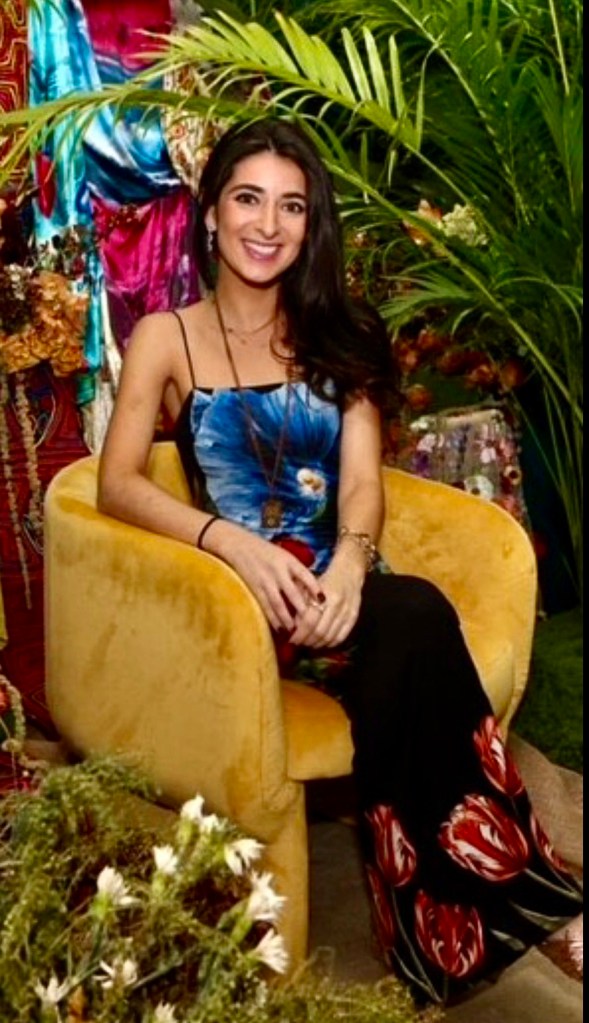
I have never met an artist as exuberant as Dahlia Dreszer. She is so passionate about her work that she throws concerts, discussions, and special speaking engagements just to gather important collectors together with like-minded people. She recently built an immersive environmental experience in the gallery, Green Space, in Miami. The title of the show, “Bringing the Outside In,” is all about transforming elaborate garden installations in domestic spaces. It was amazing.
Visitors felt like they were sitting in the Garden of Eden, or some sort of unspoiled paradise. They were surrounded by large-scale garden photographs featuring complex arrangements of flowers, ancestral textiles, and cultural artifacts. The compositions were rich with information, color, and detail that bleed to the edges of the frame.
Dahlia is very inventive finding the most beautiful flowers for her walk-through arrangements. Many are picked after they are discarded from weddings or other super celebrations. You must also listen to this podcast to learn how she preserves them and revives their brilliant colors. Don’t miss the part where she tells you how she incorporates artificial intelligence into her exhibits and what future designs may look like. Dahlia is just a bundle of energy, inside and out.
I’m posting this only because the topic pops into recent conversations I have had with friends. I know it’s silly but we need a little silly in our lives. If we enjoyed ‘The White Lotus,’ we just want it to continue a bit longer.
‘Tension’ Between ‘The White Lotus’ Stars Walton Goggins and Aimee Lou Reed Has ‘Fractured the Vibe’
BY NICHOLAS ERICKSON
The success of The White Lotus has been betrayed by a reported feud between the show’s lead stars, Walton Goggins and Aimee Lou Wood, and a source exclusively tells Life & Style it’s driven a huge wedge between the rest of the cast as they feel compelled to pick sides.
“There is obviously a major rift between Walton and Aimee,” the insider says. “It’s very awkward for everyone because Aimee and Walton won’t say what kicked off their issues, but something happened and he’s completely disengaged from everyone as a result.”
The drama reportedly began while the team was on-location in Thailand during filming and production for season 3 of the award-winning HBO series. Walton, 53, who’s career of late has been red hot coming off an Emmy nomination and his roles in Justified, Vice Principals, and Quentin Tarantino’s The Hateful Eight, joined the show with much anticipation from fans, but the source notes he and Aimee, 31, had some sort of a disruptive fallout while on set. They were said to be friendly early on, which makes their apparent feud all the more puzzling.
Aimee was at the party to celebrate the finale episode. She seemed to be in a great mood, mixing and mingling with everyone,” the insider shares. “People were speculating about whether Walton would show up or not, and when his name came up Aimee looked uncomfortable, but she didn’t say anything.”
Walton ultimately skipped the wrap party, which raised some eyebrows among fellow cast members and the crew, according to the insider, who adds his absence highlighted how far their relationship has deteriorated behind the scenes.
“They were all so close at one time, it was like a summer camp situation,” the insider continues, “but this has fractured that vibe.”
The White Lotus has been one of HBO’s biggest hits of late and a frequent topic of conversation when discussing new directions for series’ to take to remain fresh as television becomes bogged down with an ever-expanding offering of mediocre programming. With each season set in a different locale, the show’s formula mixes social commentary with ensemble drama to great effect. Season 1, set in Hawaii, swept the Emmys the year of its debut in 2021 with 10 wins. Season 2, this time in Sicily, won two Golden Globes and critical acclaim, building huge anticipation for season 3, which creator Mike White previously promised would be “longer, bigger, crazier” than ever before, with new, more philosophical themes woven into its Thai setting.
While both Walton and Aimee have kept their reported feud far from prying eyes and safe from the public, bits and pieces of what’s going on have been apparent. They unfollowed each other on Instagram after the finale earlier in April, but refollowed each other just before attending the Met Gala on May 5.
“No one wants to assume the worst or side against Walton, but this whole situation has definitely brought a dark cloud over things,” the source adds. “There’s a tension when it comes up, which is sad because at one point they all said they’d be friends forever
The media mogul publicly addressed being gay for the first time, while also celebrating his marriage to Diane von Furstenberg. “Today he opened to the world,” she said.
During his decades as a media mogul, Barry Diller has held an array of powerful titles, serving as chairman and chief executive of Fox, Paramount Pictures and, most recently, IAC. The positions have made Mr. Diller a boldfaced name and a billionaire.
Now, however, Mr. Diller, 83, has embraced a new role: that of an openly gay man.
“While there have been a good many men in my life, there has only ever been one woman,” Mr. Diller writes, calling his relationship with Ms. von Furstenberg “the miracle of my life,” despite it causing “confusion and lots of speculation.”
At the same time, Mr. Diller also writes of a quiet suffering he felt by hiding his sexuality, and a fear of exposure that “stunted any chance of my having a fulfilling personal life.”
He added that he “had discovered I could separate myself from anything painful or terrifying by just locking it away, putting it into a distant box and having to deal with it hopefully never.”
In the memoir, Mr. Diller says his early sexual experiences with men came during his teenage years “cruising in West Hollywood, darting in and out of side doors of bars along Melrose Avenue.”
“I never discussed my personal life, lowlight as it was, with anyone,” Mr. Diller writes, saying that despite suspicions about his sexuality, he “never wanted to make any declarations.”
“So many of us at that time were in this exiled state, so stunted in the way we lived,” he writes, adding that he “hated having to live a pretend life.”
Intent on keeping his “private life distinctly private,” as he put it, Mr. Diller says he came up with a series of rules — “my own personal bill of rights” — to guide his behavior and public persona, including living “with silence, but not with hypocrisy.”
“I wouldn’t do a single thing to make anyone believe I was living a heterosexual life,” he said. “I wouldn’t tell, and I wouldn’t allow myself to be asked.”
He added that he decided to “never bring a man as a date to a heterosexual event — not that there were many guys I was serious enough about to bring.”
“But I’d never bring a woman as a ‘beard,’ either,” he wrote.
He later came to regret those rules.
“It wasn’t courage,” he writes. “It was simply the minimum conditions of my conduct, and I recognize it now as the opposite of courage.”
Mr. Diller characterizes his relationship with Ms. von Furstenberg as one of “romantic love and deep respect, companionship and world adventuring,” including periods of separation and subsequent reunion, saying they “have spent 50 years intertwined with each other in a unique and complete love.”
Reached in Venice, Ms. von Furstenberg said in an interview that she did not see Mr. Diller’s announcement as a “coming out,” but rather as Mr. Diller simply telling the truth.
“All I can tell you is Barry and I have had an incredible life, love for 50 years,” she said. “We have been lovers, friends, married, everything. And, you know, for me, the secret to honor life, and to honor love, is never to lie.”
“Today, he opened to the world,” she added. “To me, he opened 50 years ago.”
Ms. von Furstenberg said “we never had to talk about our relationship, we lived our relationship,” including the last five years during which Mr. Diller was writing his memoir.
“He’s been private all his life, but not with me,” she said. “So for me, it doesn’t feel strange.”
A spokesman for Mr. Diller, Paul Bogaards, said the memoir, which is being released May 20, speaks for itself.
In the excerpt in New York, Mr. Diller describes a whirlwind romance with Ms. von Furstenberg after they met in 1974, including his giving her 29 diamonds for her 29th birthday a year later. “I didn’t know what to wrap them in, so I put them in a Band-Aid box,” he writes.
The couple would later separate, before reigniting their relationship and eventually marrying at City Hall in Manhattan. (The party that followed, at Ms. von Furstenberg’s Greenwich Village home, was more glamorous, drawing guests like the designer Calvin Klein, while André Leon Talley, the famed fashion editor, said the wedding was “everything that it should be for two people who have been through thick and thin.”)
Mr. Diller, who currently serves as chairman and senior executive at the Expedia Group and at IAC, a sprawling digital media and technology company, said he had “lived for decades reading about Diane and me: about us being best friends rather than lovers.”
“We weren’t just friends. We aren’t just friends,” Mr. Diller writes, calling it “an explosion of passion that kept up for years.”
“And, yes, I also liked guys, but that was not a conflict with my love for Diane,” he said. “I can’t explain it to myself or to the world. It simply happened to both of us.”
Jury selection in Sean Combs’ sex trafficking and racketeering criminal trial will begin Monday, as both the hip-hop mogul’s high-powered defense team and Southern District of New York prosecutors are expected to quiz prospective jurors on their feelings about wealthy individuals and Combs’ self-described “swinger” lifestyle. Both sides will begin the process of whittling down 150 peopleinto a final jury pool of 12 men and women and six alternates for the celebrity criminal trial that is expected to last at least eight weeks. Jury selection is expected to last three days and opening statements are set for Monday, May 12.
The 55-year-old Bad Boy Entertainment founder pleaded not guilty to five felony counts of racketeering conspiracy, sex trafficking and transportation to engage in prostitution following his arrest last September. He faces 15 years to life in prison if convicted on the charges, and has already rejected a plea deal. Prosecutors will begin Monday’s voir dire by giving general instructions and presenting a brief overview of the charges to the pool.
The heart of the government’s case alleges that Combs used his sprawling, billion-dollar business as a “criminal enterprise” that allegedly used physical violence, threats and coercion to fulfill Combs’ “sexual gratification,” which included the alleged sex trafficking of two former girlfriends between 2009 and 2024.
Potential jurors have already been given a lengthy questionnaire about their general knowledge of the case. They were asked if they watched crime shows, where they gathered their news from and if they had an opinion on hip-hop. Other questions included if prospective jurors had ever experienced a traumatic event and if they “believe that wealthy people get away with things that the less wealthy do not.”
Combs’ defense team also probed people’s thoughts regarding what some would consider taboo / nontraditional sexual habits. “There may be evidence in this case about people having multiple sexual partners,” came one question. “Is there anything about this that would make it difficult for you to serve as a fair and impartial juror in this case?”
The line of questioning seems to be central to Combs’ defense. His lawyers have claimed that the alleged criminal sexual encounters — referred to as “freak-offs” — were not only consensual, but part of his alternative lifestyle. “There’s a lifestyle, call it swingers or whatever you will, that he thought was appropriate because it was common,”
Combs’ lead defense attorney Marc Agnifilo argued in a pretrial conference last month. “Many people think it’s appropriate because it’s common.”Possible jurors were also given a list of witnesses and alleged victims who might be called to testify. Prosecutors asked if they personally knew anyone on the list, of if they or any immediate family members had dealings with anyone on the list.
Likely on that list of names is R&B singer Casandra “Cassie” Ventura, who is expected to testify against her longtime ex-boyfriend Combs. Ventura has been at the center of prosecutors’ case (identified in court papers as Victim-1), who was allegedly sex trafficked between 2008 and 2018. The timeline aligns with dates that Ventura detailed in her since-settled civil lawsuit against Combs.
Over the course of their decade-long relationship, Ventura claimed her music label boss routinely forced her to have sex with male escorts while he watched and masturbated. During these encounters, Ventura alleged she was supplied copious amounts of alcohol and illicit substances, including Ecstasy, ketamine, GHB and cocaine. If she refused to participate, Ventura alleged, Combs would beat her Prosecutors have painted Combs as dangerous and abusive, claiming Combs forced at least two romantic partners to submit to his will and sexual fantasies through manipulation, coercion, threats, and violence, including once attempting to beat down a woman’s door with a hammer.
He is also accused of forced labor and abusing his staff, maintaining control over certain employees’ lives by leading them to “believe they would be harmed — including by losing their jobs — if they did not comply with his demands,” according to prosecutors.Combs’ team denied the accusations, saying they have former employees who could speak of their positive working experience with Combs.
They also have claimed that despite Combs’ self-admitted history of violent behavior in regard to his treatment of Ventura, that Combs is coming to court a changed man.
The father of seven is said to have sought professional help and gone to rehab years prior to address his substance-use issues. However, a Rolling Stone investigation from January found Combs was still volatile, still taking altering substances, and was still allegedly sexually abusive up until his arrest. Rolling Stone also previously uncovered a pattern of abusive behavior dating back to Combs’ time at Howard University.
Ever since the 2021 collapse of the Champlain Towers South condominium in Surfside, Miami, every high rise in South Florida had to be inspected and repaired to make sure that tragedy never happens again. Buildings three stories or taller, especially those near the coastline, are subject to mandatory milestone inspections, often every 10 years, to ensure structural integrity. These inspections, mandated by Florida Statute 553.899, help identify potential safety hazards and ensure buildings meet structural safety standards.
Everyone is grateful that we have these new rules and regulations. However, we all have been living in a constant construction zone for almost two years with perhaps another year to go. That means our windows were covered over, our balconies were closed off, no use of pools or other outside amenities, and several hours a day of loud disturbances from hammering and drilling.
The most dramatic event for many of us is when a helicopter is flying very close over our building to deliver necessary equipment. It’s unnerving to hear the roar of the engines and the winds that are created directly over our heads.
On Wednesday, April 30, 2025, there was a helicopter flyover and mobilization of equipment taking place at our property, This was in preparation for the elevators modernization project. The Miami Beach Police Dept.was on hand to assist with coordination and safety measures throughout the event. This is how we were notified and prepped.
Murano at Portofino – Helicopter Flyover and Mobilization – Important Update – 4.29.25
Time: 9:30AM – 12:30PM
*Weather permitting
What to Expect:
Main Entrance – The main entrance and circular driveway will be temporarily closed and there will be a temporary access point to the building during the mobilization. Our staff will be stationed to direct visitors and residents to the main lobby.
Garage Exit – Residents must use the rear gate located on the north side of the building to exit the garage during the helicopter mobilization. Please proceed with caution when exiting the garage.
Valet Service: Our valet team will be temporarily stationed away from the front entrance of the building to ensure safe access to the vehicles.
Front Gate – The front gate will be used only to enter the garage, please note our valet staff will be stationed at the front gate during the closure of the circular driveway. Please proceed with caution when entering the garage.
Visitors & Guests – Please note our team will be directing guests to Tower 1 to reach the lobby level while the front entrance is closed due to the mobilization.
Beach Club – Access to the Beach Club will be restricted from 9AM – 12:30PMwhile the helicopter performs multiple drop off’s.
Dog Park – Access to the dog park will be temporarily restricted starting at 7:30AM to allow our elevator company to stage their equipment safely, and will reopen after the mobilization has been completed.
Marina Boardwalk: Some areas will be temporarily closed, and pedestrian traffic will be detoured during the flyover. These areas will reopen once the helicopter operation is complete.
Please be aware that you will likely experience increased aerial activity and temporary noise during this time. We recommend closing your shades/blinds during this time for privacy.
We kindly ask all residents with balconies overlooking Fisher Island to remove or secure any loose items from their terraces before the event, due to the helicopter’s proximity and potential downdraft.
If you have any questions please contact the Management office. Thank you for your cooperation and understanding during this time. It hasn’t been an easy process for everyone in South Florida, but we had no choice. Better to be safe than sorry
Andrew Gross, Best-Selling Writer of Thrillers, Is Dead at 72
A successful New York apparel executive, he switched gears in midlife and became a novelist, writing numerous best sellers, including five with James Patterson.
Andrew Gross in 2009. One popular series of books he wrote featured a detective who probes the dark doings behind the mansion gates of Greenwich, Conn.Credit…Jann Cobb
Andrew Gross, a member of a prominent New York apparel family who abandoned a career in the rag trade to write nearly 20 crime and political thrillers, including five with the fiction juggernaut James Patterson that hit No. 1 on the New York Times best-seller list, died on April 9 at his home in Purchase, N.Y. He was 72.
The cause was a rare form of bladder cancer, his wife, Lynn Gross, said.
In his solo career, Mr. Gross was known for works such as “Eyes Wide Open” (2011), “15 Seconds” (2012), “No Way Back” (2013) and “Everything to Lose” (2014), as well as his popular series featuring the character Ty Hauck, a detective who probes the dark doings behind the mansion gates of Greenwich, Conn.
He later turned his sights from high-adrenaline contemporary potboilers, often involving ordinary people sucked into a whirlwind of criminal intrigue, to historical thrillers.
His 2016 effort, “The One Man,” centers on a young Jewish man who escapes the Krakow ghetto early in World War II and later joins an American intelligence effort to rescue a renowned physicist from the Auschwitz concentration camp. Booklist called it “as moving as it is gripping” in a starred review.
Mr. Gross’s novel “The One Man,” from 2016, centers on a young Jewish man who escapes the Krakow ghetto early in World War II and later joins an American effort to rescue a physicist from the Auschwitz concentration camp.Credit…Minotaur Books
Ultimately a prolific writer, Mr. Gross started late: He was in his 40s when he decided to trade the spreadsheets and quarterly reports of the business world for the long, lonely hours of a literary career.
Mr. Gross was a grandson of Fred P. Pomerantz, the founder of Leslie Fay Inc., whose dresses and sportswear were being sold in more than 13,000 stores around the country when Mr. Pomerantz died in 1986.
For a time, Mr. Gross served as senior corporate vice president of the company, running its sportswear division, as well as president of its Head Sports Wear subsidiary, known for its ski, golf and tennis apparel. He later became a top executive at Le Coq Sportif and Sun Ice, a Canadian sportswear company.
Wearying of the corporate world, Mr. Gross decided to perform a career about-face. “Basically,” he said in a 2015 interview published on the website LinkedIn, “I came home without a job one night and announced to my wife and three kids that I wanted to write a novel.”
Easier said than done. It took three years to write, edit and attempt to sell his first novel, “Hydra,” a political thriller that was never published. Late in the process, after double-digit rejections, he recalled in a 2017 interview, he was sitting in his den and wondering “what cliff to drive our S.U.V. off” when he received a call from Mr. Patterson’s publisher asking if he would be willing to talk to Mr. Patterson.
An editor at the publishing house, he learned, had sent Mr. Gross’s manuscript to Mr. Patterson, a veritable fiction factory in human form. (As of this year, he has churned out more than 200 books in various genres, including thrillers and children’s books, and sold more than 400 million copies.)
Mr. Gross, who spent part of the year in Palm Beach, Fla., recalled in a 2016 interview with The Palm Beach Post that the editor had written on the manuscript, “This guy does women well!”
Mr. Patterson soon invited Mr. Gross to breakfast, telling him that “he had several projects he wanted to write and not enough time to do them,” Mr. Gross recalled on his professional website. “I had the incredible foresight to say yes.”
Mr. Gross teamed up with James Patterson to write “2nd Chance” (2002), part of a series of novels about a group of women in San Francisco who crack murder cases. Credit…Little, Brown and Company
Their first book together, “2nd Chance” (2002), was the second installment of Mr. Patterson’s highly regarded Women’s Murder Clubseries, about a group of women in San Francisco, including a police detective and a newspaper reporter, who band together to crack murder cases. (In 2007, the series was spun off into a short-lived ABC drama starring Angie Harmon.)
To a literary neophyte, Mr. Patterson’s tutelage was invaluable, Mr. Gross wrote on his website: “It was like a combination MFA and MBA rolled into one.”
As for the writing itself, “we always began with a concept and an outline that came from him, which we fleshed out into a detailed chapter-by-chapter outline,” Mr. Gross recalled. “No writer’s block here, the road map was always there.
Thanks to Mr. Patterson’s clout, he added, “my first book was a No. 1 best seller” on the Times list.
Howard Andrew Gross was born on May 18, 1952, in Manhattan to Aaron Gross, who ran an active-wear company, and Leslie Fay Pomerantz, whom the family apparel company was named after.
Mr. Gross in 2006. Before turning to fiction, he was an executive with his family’s apparel company.Credit…Jann Cobb
After graduating from the Barnard School for Boys, in the Riverdale section of the Bronx, Mr. Gross enrolled at Middlebury College in Vermont, where he received a bachelor’s degree in English literature in 1974. In 1982, he earned a master’s degree in business administration from Columbia Business School.
His fruitful partnership with Mr. Patterson included “Lifeguard” (2005), about a Florida lifeguard lured by love into a multimillion-dollar robbery, and “Judge & Jury” (2006), about an aspiring actress whose life spins out of control after she lands on the jury in the trial of a brutal Mafia don. (The story was inspired by Mr. Gross’s own experience as a juror in a mob trial.)
Mr. Gross struck out on his own in 2007 with “The Blue Zone,” a novel about a woman whose seemingly perfect life unravels after her father is arrested and charged with laundering money for a drug ring.
In “The Blue Zone” (2007), a woman’s life unravels in a crime story centering on a drug ring.Credit…William Morrow“Button Man” (2018) is about a garment industry executive who has to fend off the mob.Credit…Minotaur Books
In addition to his wife of 42 years, Mr. Gross is survived by their daughter, Kristen Gross Magyar; their sons, Matthew and Nicholas; a half sister, Liz Scopinich; and five grandchildren.
In 2018, Mr. Gross published what he considered his most personal work, “Button Man,” about someone from a poor Jewish family on the Lower East Side of Manhattan who fights his way up the ladder in the garment trade only to find himself in a Depression-era standoff with vicious Jewish mobsters. (“Button man” is not an apparel term, he explained in a 2020 video interview, but mob slang for a hit man.)
“It’s a tribute to my grandfather,” Mr. Gross told Publishers Weekly, referring to Mr. Pomerantz. “He was as tough as any gangster you’ll read about in the novel. He was single-minded and driven and set a high bar for himself, and he succeeded.”























 DigiDame