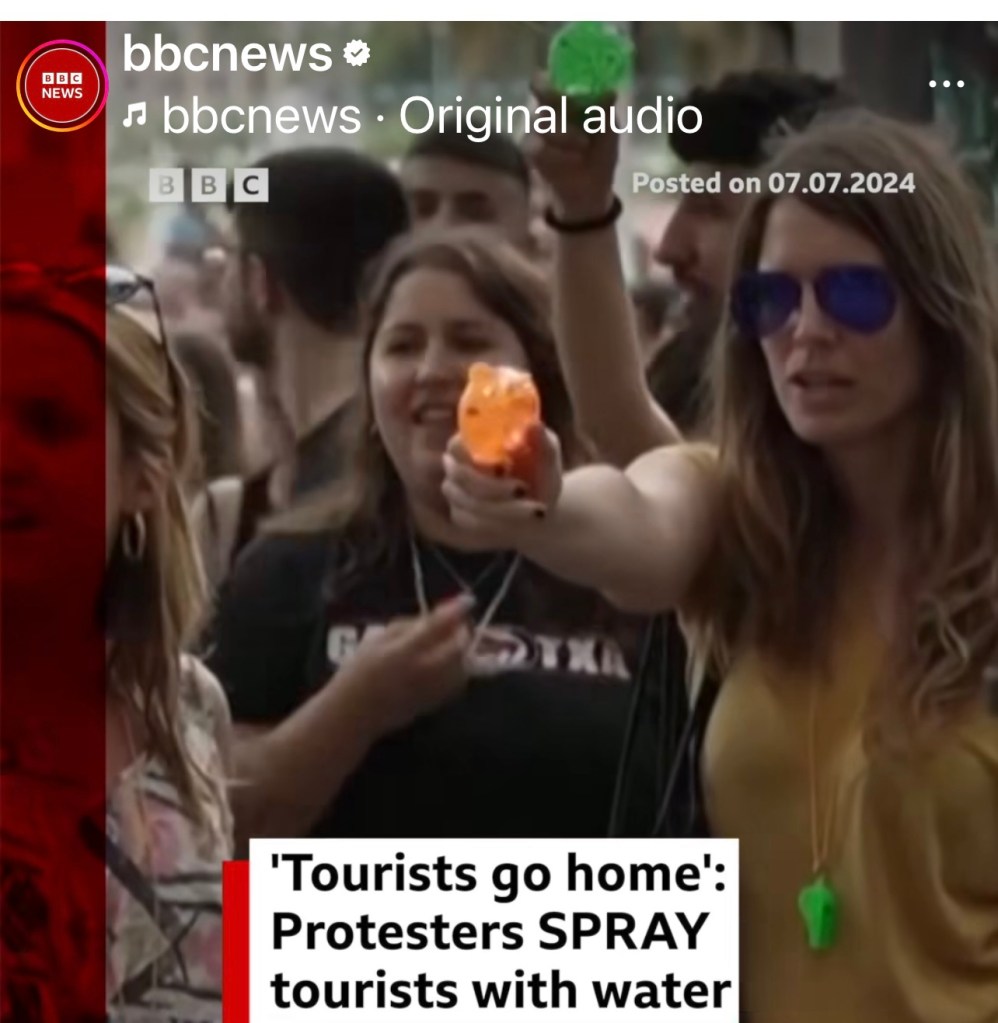
Barcelona protesters throw items and spray travelers with water while shouting ‘tourists go home’
A man ducks and a woman covers her ears as protesters interrupt their meal in Barcelona.
The protesters — angry about the city’s long-standing problems with overtourism — used thick police-style tape to block hotel entrances and sidewalk cafes in the small neighborhood of Barceloneta in a symbolic effort to close the establishments.
Mass tourism troubles hit fever pitch in Barcelona, Spain, on Saturday as protesters threw items and sprayed travelers with water guns and canned drinks, while shouting “tourists go home.”
The crowd, which numbered some 3,000 people, according to local media, also marched holding a large banner demanding that city officials “decrease tourists now.”
Videos and photographs show people attempting to avoid the crowds — some walking away from their tables mid-meal — while others, including restaurant staff, verbally sparred with anti-tourism activists.
The demonstration coincides with Barcelona’s peak summer travel months. In 2023, hotel occupancy rates neared 80% in July and August, as the city of 1.6 million people swelled to accommodate more than 4 million visitors, according to the Barcelona City Council.
But the delicate dance between locals and visitors had spiraled long before that.
Hotels in the city quadrupled from 1990 to 2023 to accommodate a rush of travelers, which surged from 1.7 million to 7.8 million during the same period, according to the Barcelona City Council. That doesn’t include the millions who travel to the city’s outskirts, too, it notes.
The city also buckles under the weight of the Barcelona Cruise Port as day-trippers descend on the city by the thousands. The port processed some 2.2 million passengers in 2023, up from 560,000 in 2000, according to its website.
A woman dining at a restaurant in Barceloneta being confronted by a protester.
The result is a city in which many locals can no longer afford to live, activists say — most notably because of the housing market, where rents have increased 68% in the past decade, according to Barcelona’s mayor, Jaume Collboni.
Collboni announced in June that Airbnb-style short-term house rentals would be banned in the city by 2028. The move would add some 10,000 apartments back into the long-term rental market.
Two tourists on bicycles being stopped in front of a demonstration against mass tourism in Barcelona on July 6, 2024.
A report published by Barcelona’s City Council in 2023, titled “Perception of Tourism in Barcelona” shows more residents feel tourism is beneficial, rather than detrimental, to the city. However, the gap between these numbers has closed through the years, it showed.
Half of the 1,860 respondents surveyed said they modify where they go in the city because of tourists. “They avoid a widespread area around the city centre (Plaça Catalunya, La Rambla, Gothic Quarter, Raval, Old Town, Waterfront), as well as the Sagrada Família area. In terms of specific spaces, Park Güell tops the list of those deliberately avoided.”
Even those who recognize the economic contribution of tourism are becoming disillusioned by the sheer number of travelers in the city, according to the report.
“More and more people believe that Barcelona has reached its tourism capacity limit,” it states
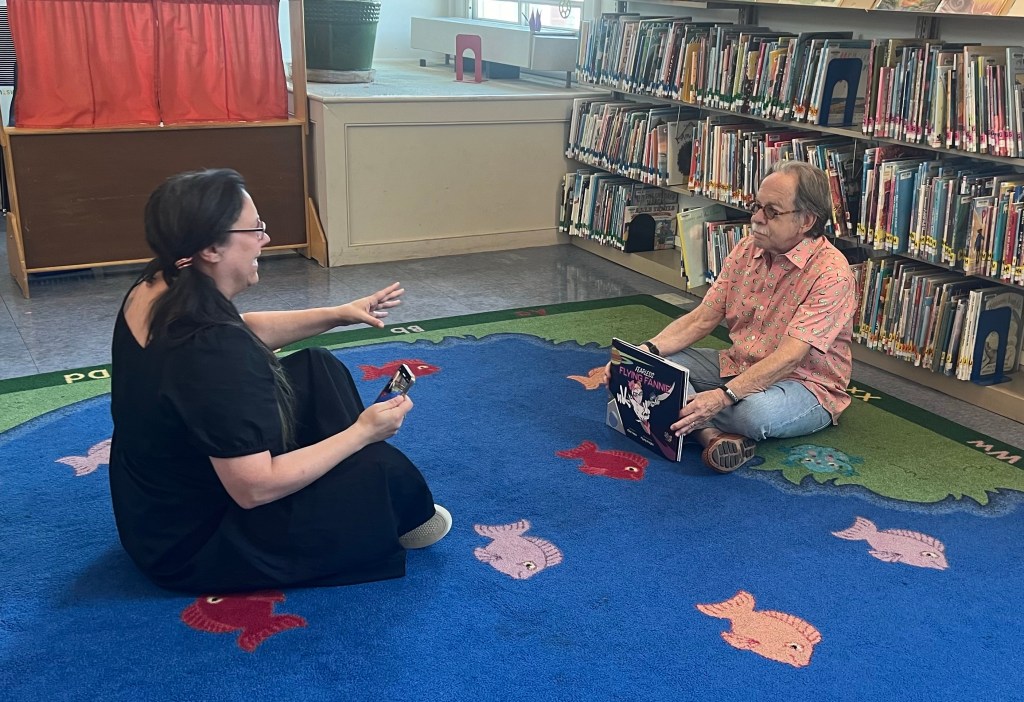
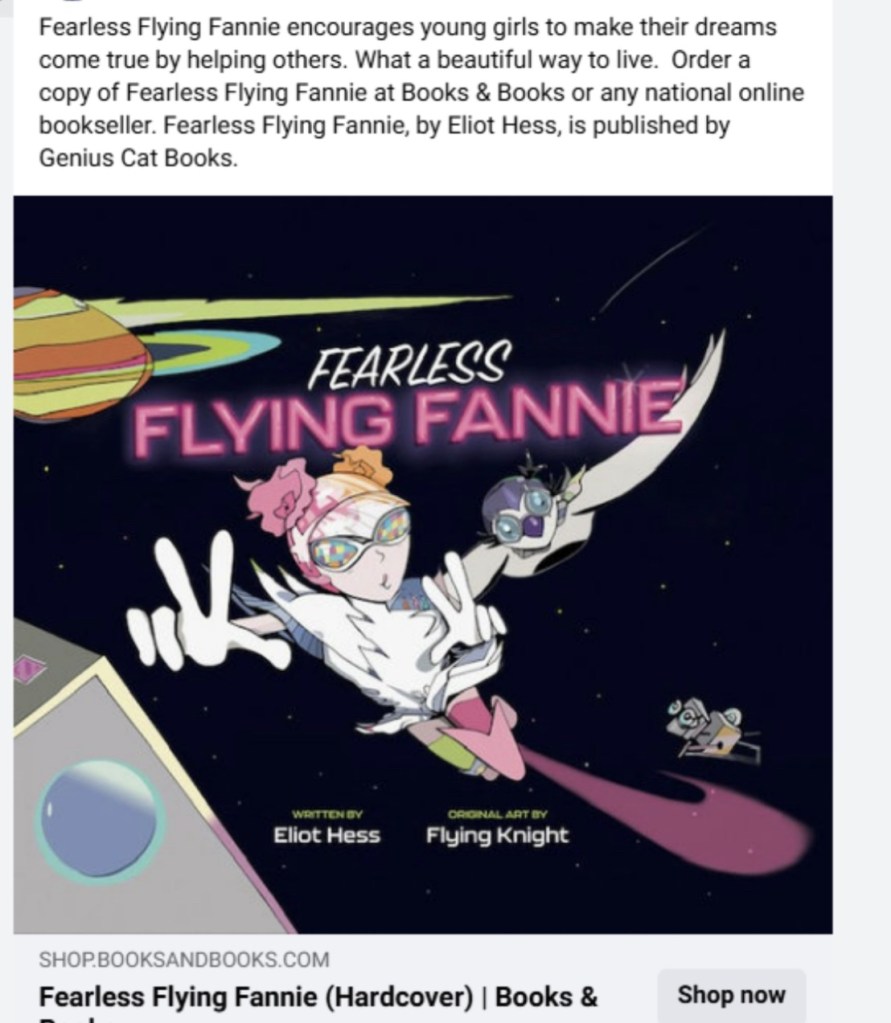
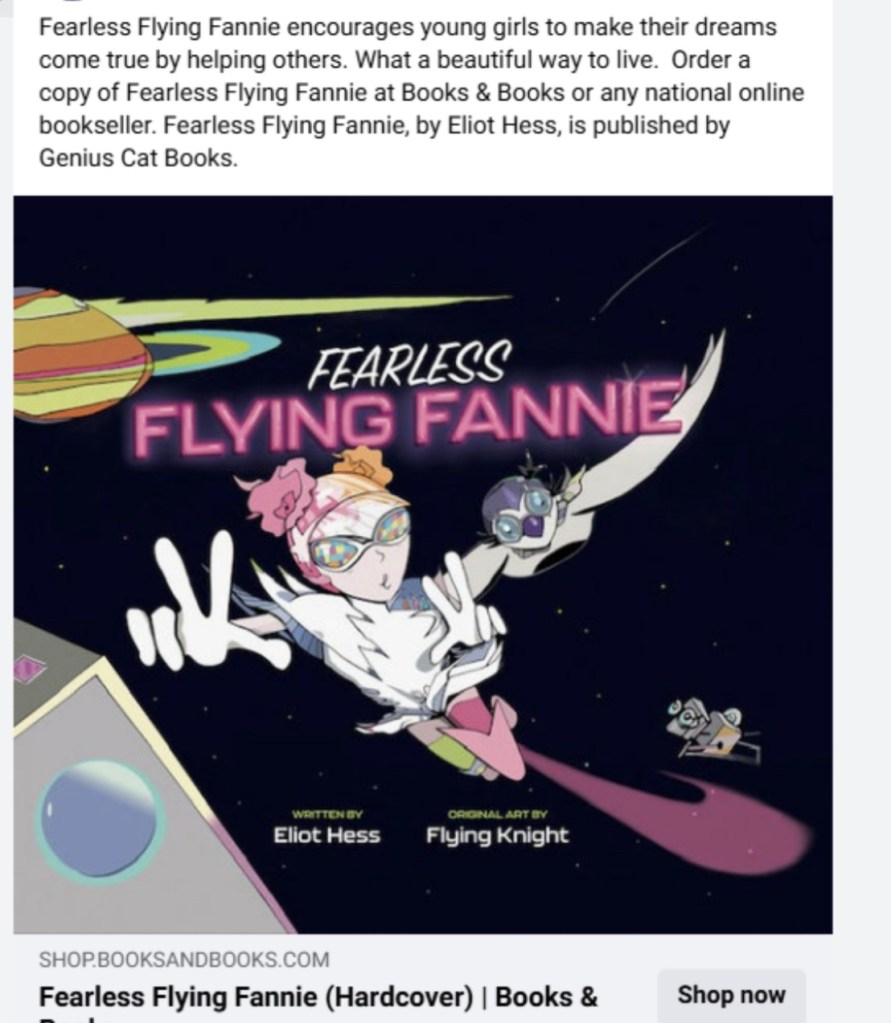
Thank you @provincetownlib (Provincetown Public Library) for promoting @fearlessflyingfannie (Fearless Flying Fannie) online. Your presentation with flying feathers is so inspiring and imaginative.. @librarygrl83 (Courtney Francis) you are very special.
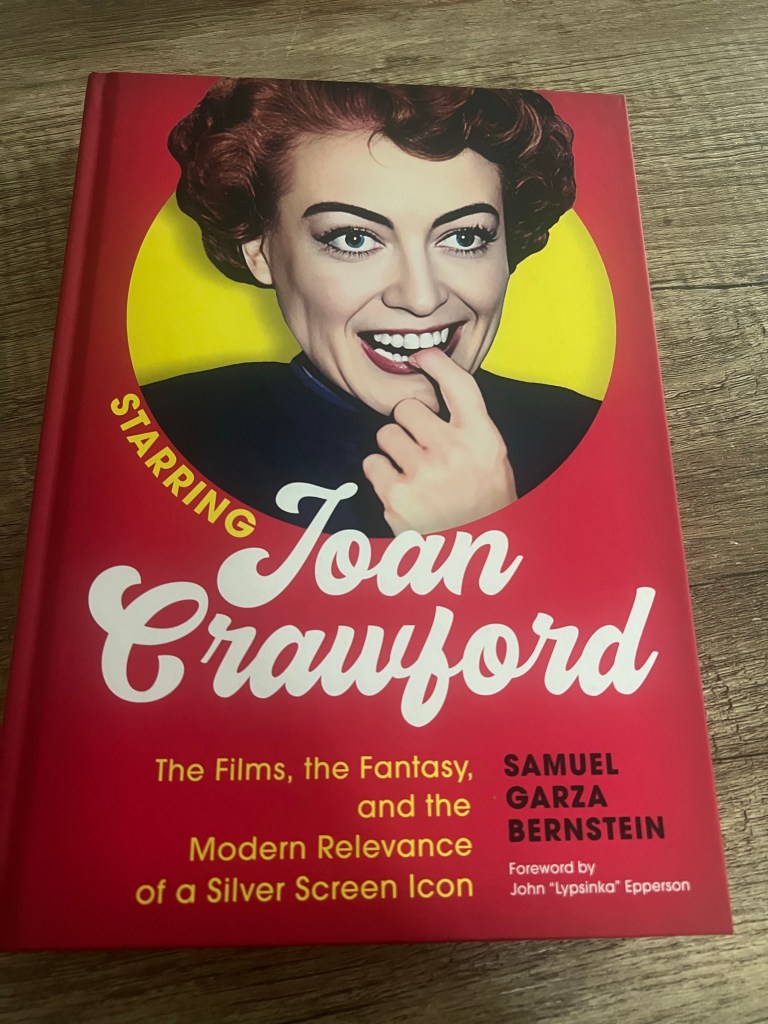
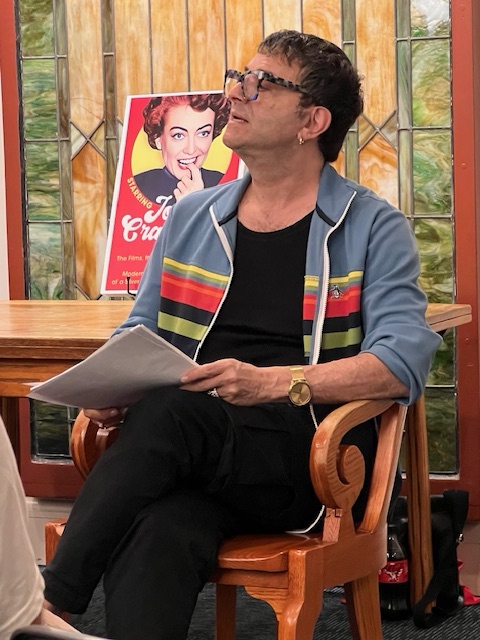
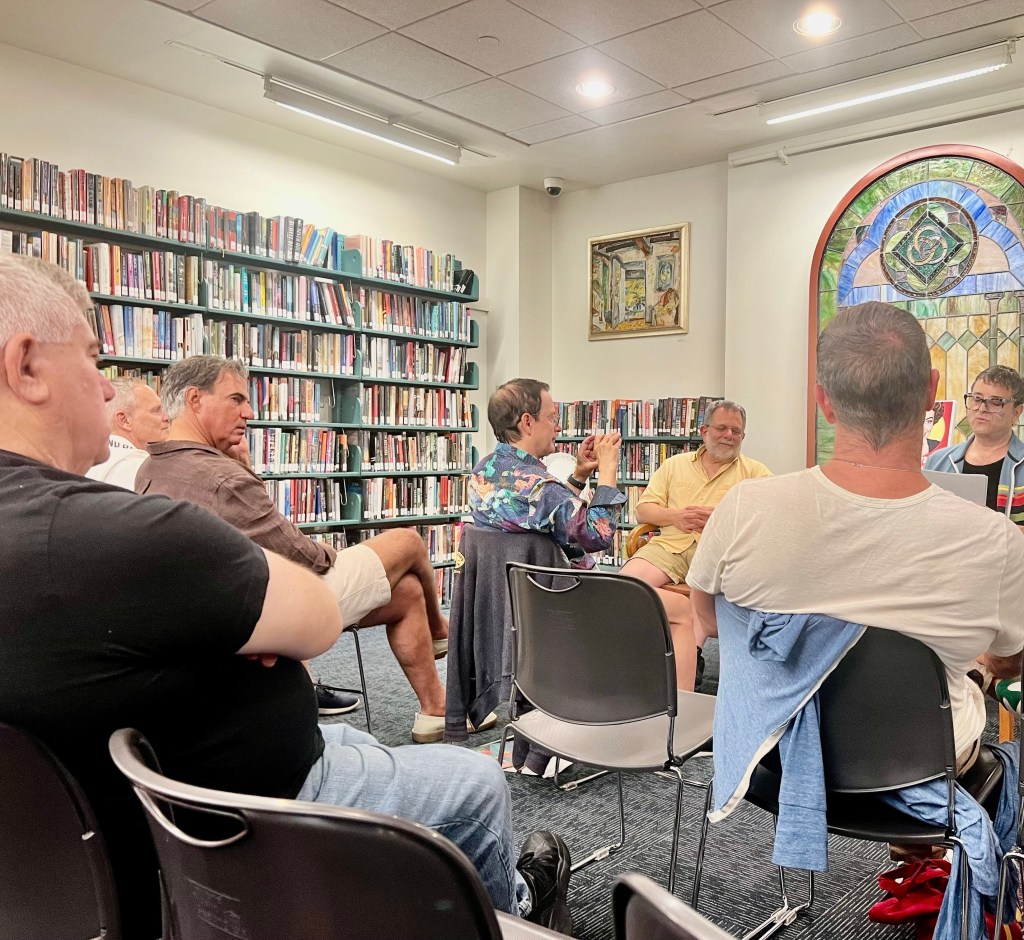
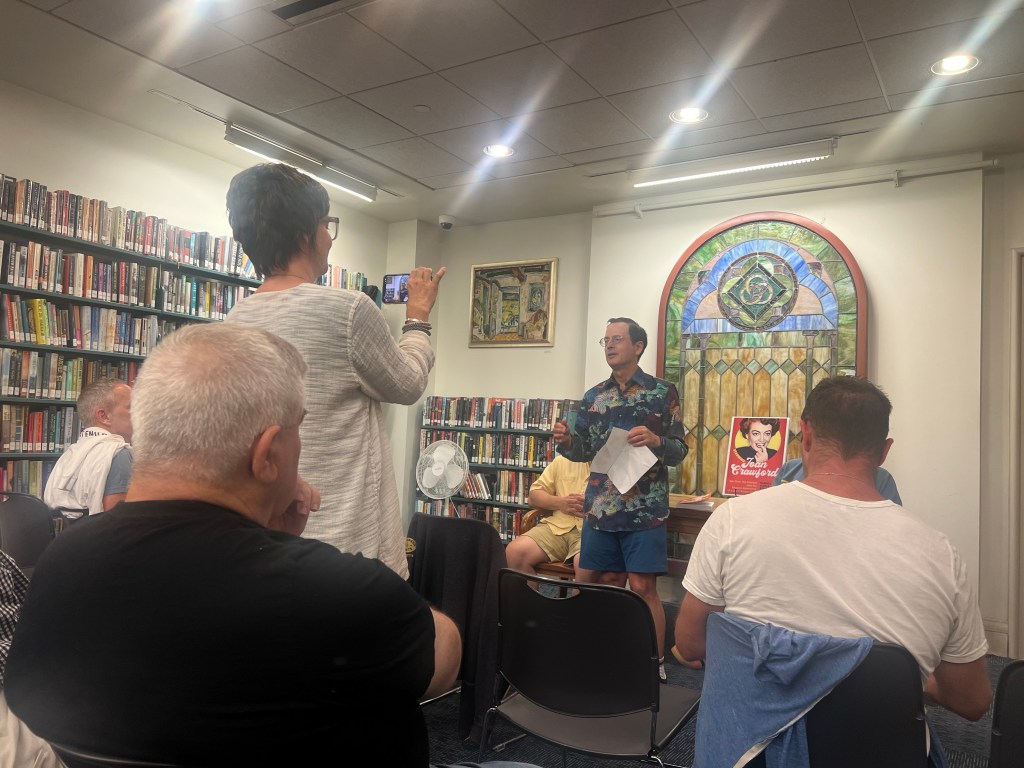
East End Books Ptown put on quite a performance last night at the Provincetown Public Library by featuring Sam Bernstein and his Joan Crawford book. Oh, the stuff we learned. Sam was so entertaining that the audience stayed well beyond the designated time. Can’t wait to read the book. Thank you Jeff G. Peters.
————————————————
“It’s one of the only places in the world where unconventional people are not just tolerated, but preferred.” The words of Michael Cunningham, an American novelist and screenwriter.
He wrote the introduction to the “Artists of Provincetown,” a book and exhibit at the Provincetown Art Association and Museum, PAMM. We were at PAMM yesterday.
Cunningham says, “When anyone asks me why I’m so attached to Provincetown I generally say something along the lines of, “It’s one of the only places in the world where unconventional people are not just tolerated, but preferred.”
I’m not happy about the fact that the world at large considers artists, writers, musicians and others anyone who creates something out of nothing to be “unconventional.” I’d prefer a world in which people who harbor no urge to create are the unconventional ones.
We do, however, live in this world. In this world, people who create can, for the most part, only be reconsidered for the title conventional if they and their work become famous. The urge to create, and the stunningly hard work it requires, doesn’t always mean much. Success means a great deal. In a city like New York, people who are initially interested in the fact that you’re an artist or a writer or a musician tend to become less interested if they learn that you aren’t yet represented by a gallery, have yet to publish anything, have not yet released a hit song.
And so we, whether we live full time or part time in Provincetown, have collectively established a world within the larger world a place where creators are not only honored and respected for their efforts, but are honored and respected whether or not they’ve become famous. They are, in fact, honored and respected if they never become famous.
Provincetown knows, in ways many other places don’t, that significant work doesn’t always = widespread recognition.
This understanding has been shared among us for well over a hundred years. We who live in Provincetown now are the great-great-grandchildren of Hans Hofmann, who might have been speaking about Provincetown itself when he said that his aim in painting was to create pulsing, luminous, and open surfaces that emanate a mystic light.
We are, as well, the great-great-grandchildren of Eugene O’Neil and Susan Glaspell whose plays, in the 1920s, were equally locally renowned. It doesn’t matter, not really, that only one of them went on to be inducted into the literary canon.
Both were lauded for their work as they were creating their work.
It helps that Provincetown’s moody beauty, and its relative isolation, imply the making of art more powerfully than do many other places. How else, exactly, are we to respond to blinding blue autumn skies arcing over the glittering blue-black Atlantic, or to misty spring afternoons when the lilacs seem to have blossomed overnight those interludes during which Provincetown all but whispers, you have no other home than this. We are not, of course, compelled to depict Provincetown directly. But any response to Provincetown and its surroundings other than elation can feel more than a little miserly. At certain hours, on certain days, it’s easy to feel as if there are only two possible responses: fall to our knees, or do whatever we can to pay it homage in other, more corporeal ways. Or both.
Making art, like those beatific days in Provincetown, can be transcendent. I feel reasonably sure that all the artists pictured here have had their share of good and great days—the days when it pours out, when it’s coming through you as well as from you, when you know with absolute certainty that you’re using your gifts to their outermost limits. The days when the work itself whispers, you have no other home than this.
On the other hand, art has a way of turning off the tap, sometimes as suddenly and unexpectedly as it turned the tap on. Making art can, with surprising swiftness, turn from an ecstatic outpouring of our love, our rage, our pure astonishment at life itself into an effort that more nearly resembles pushing a piano up a flight of stairs.
Provincetown, too, can be as difficult as it is rapturous. Its challenges range from hurricanes and floods to ever-more-astronomical rents. Living in Provincetown now is only slightly less expensive than living in San Francisco, or Tokyo. I’m not sure how artists, unless they have trust funds, can move to Provincetown today. I’m not sure, for that matter, how artists who’ve been here for decades are able to remain, if they’re able to remain at all.
Along with Provincetown’s catastrophic expense, Commercial Street in the summers is as crowded as a subway at rush hour. The artistic impulse can wither a bit in the face of all those tourists, all those souvenirs and t-shirts. In winters, it’s possible to walk down Commercial Street, past the boarded-up shops and restaurants, without seeing a single other person. There are almost no year-round jobs. Provincetown is remote, not just literally but in the worldly sense, as well. If you live here it’s easy to imagine, for better and for worse, that there’s no other world but Provincetown.
I should add that, for some of us, those are virtues, not liabilities. Still. As far as I know, at least nine of out ten of the artists portrayed in this book have made significant efforts not only to get here but to stay here.
Most work, of any kind, isn’t easy, from performing surgery to mixing drinks behind a bar. I wouldn’t want to over-romanticize those who create. I can, however, say with confidence that many of the people portrayed here have, along with the good days, survived periods of deep loneliness, crippling doubt, and a periodic sense of futility that tends to strike us not as a fallow period but as truth, revealed. How could we have failed to realize that we can’t really do this at all? Not to mention the desire to produce something too great for any living being to produce, which can miniaturize our own attempts.
Producing art, like living in Provincetown, requires a degree of daily determination, in the face of the doubts and the foods; in the face of landlords who, without notice, double our rent.
There are, in short, many sensible reasons not to live in Provincetown, just as there are many sensible reasons not to create. It’s always a gamble, for everyone. Will it be a hit, or a miss, not only for others but for you, yourself?
And how much longer can we put off paying the electric bill before they turn our power off? As occupations go, being an artist is one of the least reasonable of all possibilities.
And yet, everyone portrayed in this book has insisted on remaining unreasonable. For me, a working definition of an artist is someone who persists not only in creating art but in living, as best we can, with an ideal that remains, despite our every effort, slightly out of reach. The artists in these portraits, then, are not only accomplished, but are survivors. Victorious survivors. Full disclosure: I’m in the book, too. All gratitude to Ron Amato and Pasquale Natale for bringing this book to fruition. The book is important now, and it’ll be important in the future, as a record of those who found their way to a town on a remote spit of sand and produced work that will endure, even after its creators are gone. For all of our differences, everyone in this book is engaged in the same effort.
Everyone in this book has, by dint of hard work and the summoning of magic, produced something that the world requires, if it is to survive at all.
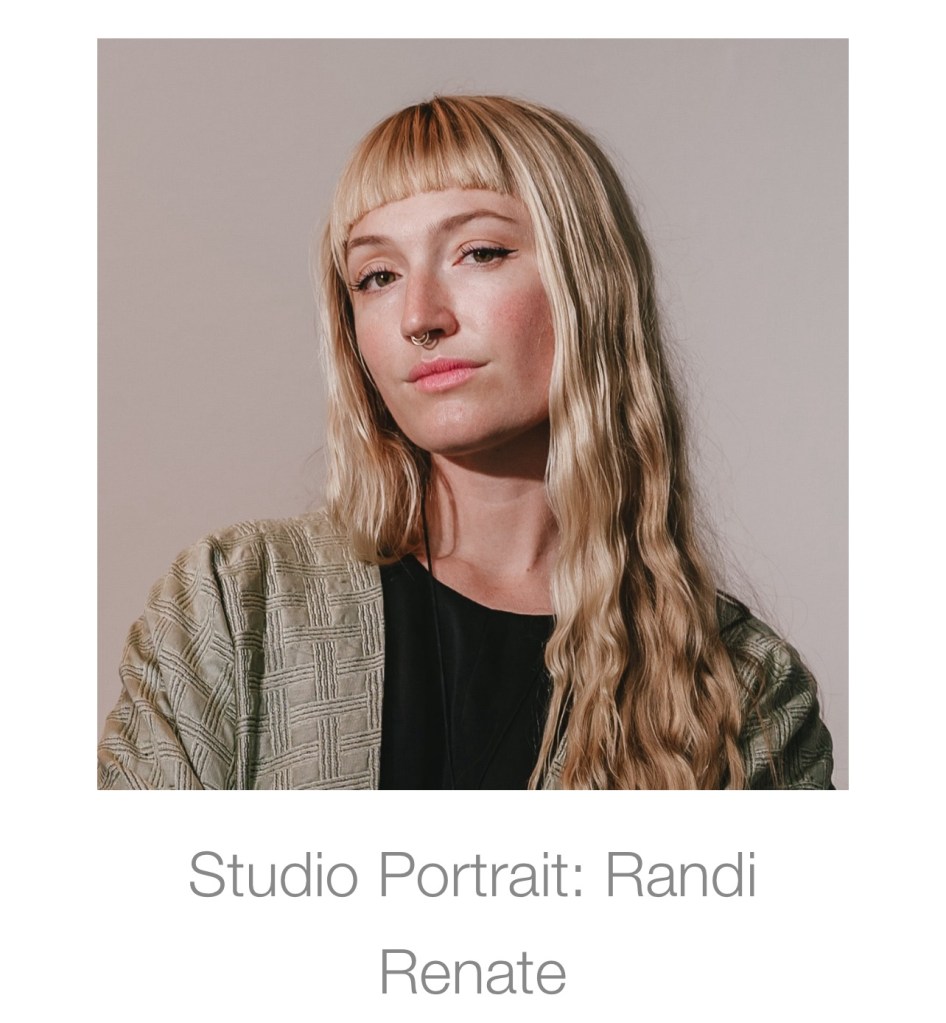
HESSE FLATOW is pleased to announce that Randi Renate will be our artist in residence for the month of July.
On the occasion of her residency, she will present a solo exhibition of her sculptural work in the gallery’s Amagansett location, on view from July 20 through August 3.
As an individual who explores the world spatially, Renate has interests that lie in between architectural memory (embodied and dissociated), subaqueous states (psychic and physical), and allocentric entanglement (human and non-human). Her diverse, large-scale architectonic structures agitate an investigation on the somatic and cognitive ways of understanding our embodied being-in-the-world.
Randi received a BFA in Studio Art and a BA in Philosophy from the University of Texas at Austin in 2014 and moved to Berlin where she maintained a studio and artist-run project space, TRACE.
She is a 2020 MFA graduate of the Sculpture Department at the Yale School of Art. She is the recipient of numerous fellowships including Socrates Sculpture Park in Queens, NY, Lighthouse Works on Fishers Island, NY, Vermont Studio Center in Johnson, VT, Bemis Center for Contemporary Art in Omaha, NE, Fountainhead in Miami, FL, and Santa Fe Art Institute in Santa Fe, NM.
Randi Renate has shown both internationally and nationally, with solo and group exhibitions at Socrates Sculpture Park in Queens, NY, and ROCKELMANN & and Galerie im Turm in Berlin, DE among others. Her 2021 permanent public sculpture, “blue is the atmospheric refraction I see you through,” at the Adirondack History Museum, was made in part by the 2021 New York State Council of the Arts DEC Community Arts Grant and featured in Interior Design Magazine.
Her most recent public sculpture in NYC for the 2022 Socrates Annual exhibition “Sink or Swim Climate Futures.”
Randi also produces the podcast CORALESCENCE: conversations highlighting the connection between art and science. These episodes are “studio visits” she conducts with scientists and other researchers in their fields, exploring a broad range of topics like coral conservation, neuroscience, cosmology and beyond.
July 20 – August 3, 2024 Opening Reception: July 20, 5-7PM 68A Schellinger Road, Amagansett, NY
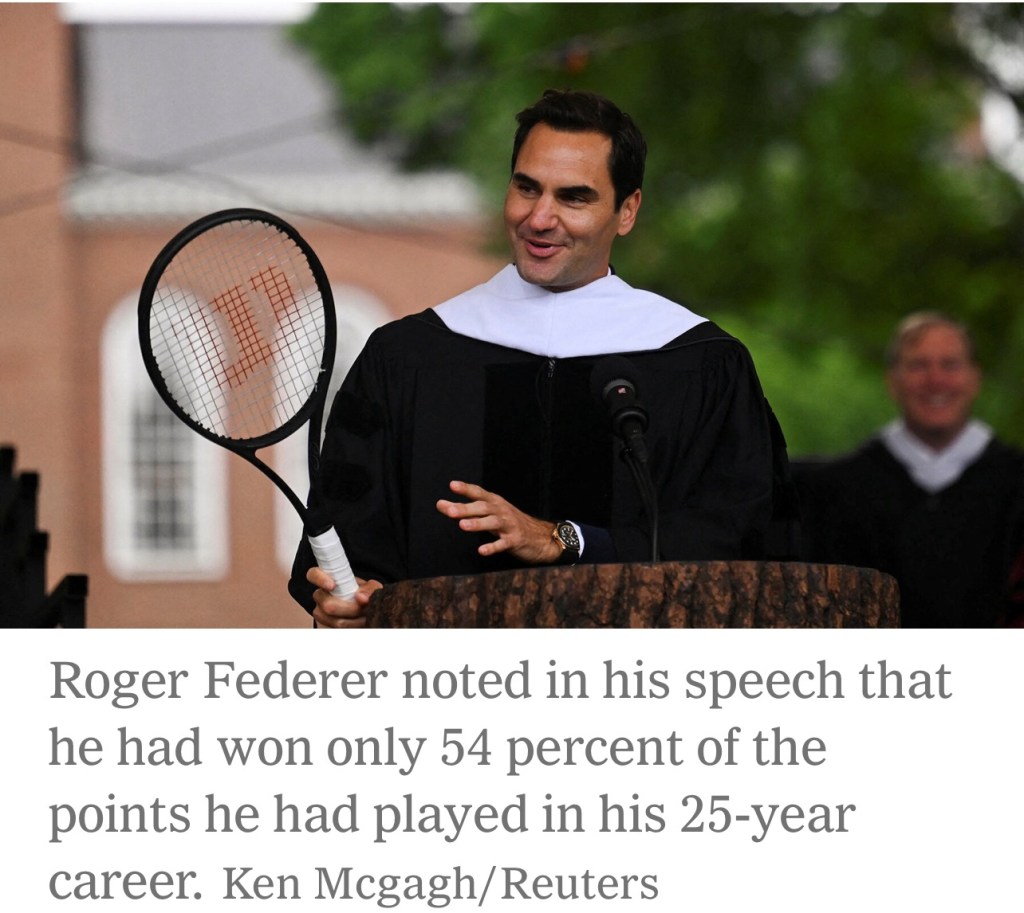
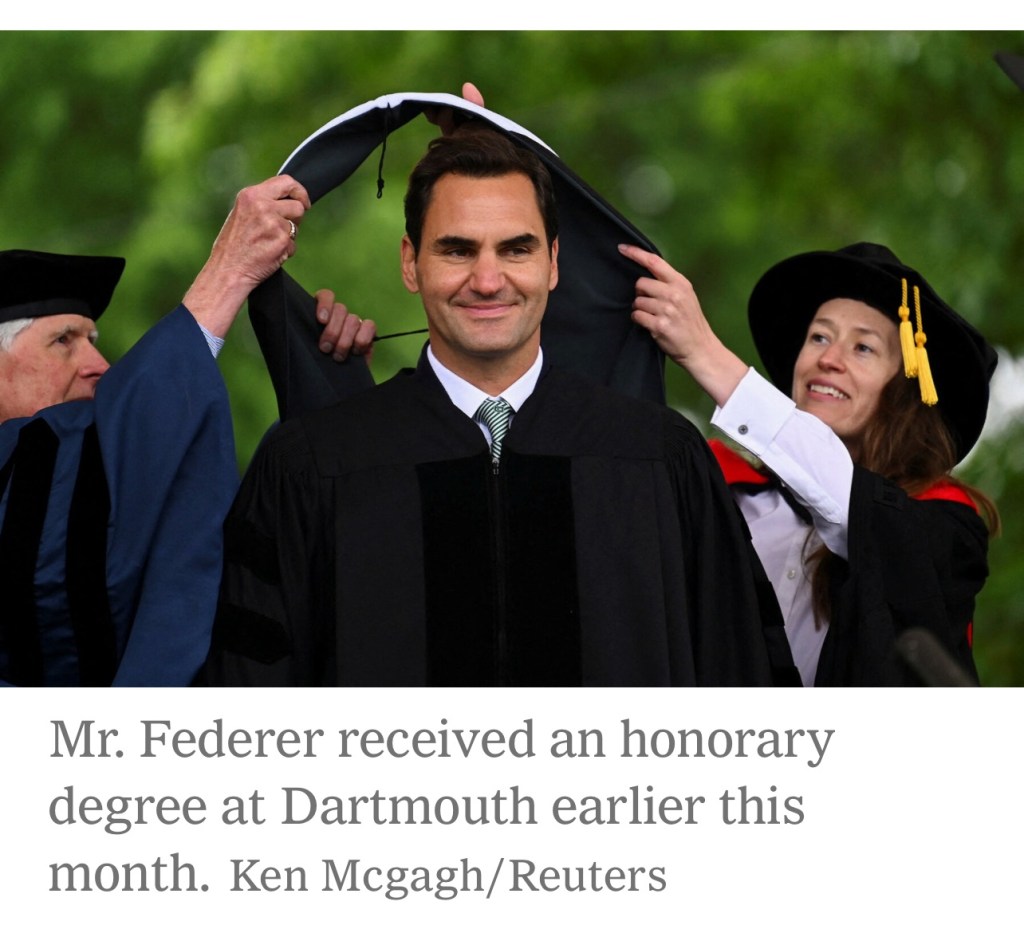
There are thousands of commencement addresses on college campuses each spring. Most are unremarkable and go unremarked upon. But occasionally one gets people talking and gains traction online. That was the case with the speech given by the retired tennis champion Roger Federer at Dartmouth College in Hanover, N.H., on June 9.
Mr. Federer, who dropped out of school in his native Switzerland at 16 to play professionally, noted early in his remarks that he was not an obvious choice for a commencement speaker.
“Keep in mind, this is literally the second time I have ever set foot on a college campus,” he told the more than 2,000 graduates.
After some warm-up jokes about beer pong (which is said to have been invented at a Dartmouth fraternity party) and a few shout-outs to local institutions (“I got a chance to hit some balls with my kids at the Boss Tennis Center … I also crushed some chocolate chip cookies from Foco”), Mr. Federer got down to business and offered the graduates some tennis lessons that doubled as life lessons.
The part of the speech that has caught on with audiences far beyond the Ivy League environs of the Dartmouth campus — prompting numerous TikTok videos, many of them set to inspirational string music — was his reframing of his years of dominance on the tennis court.
“In the 1,526 singles matches I played in my career, I won almost 80 percent of those matches,” Mr. Federer said. “Now, I have a question for all of you. What percentage of the points do you think I won in those matches?”
The answer was 54 percent.
“In other words,” he said, “even top-ranked tennis players win barely more than half of the points they play.”
He went on, “The truth is, whatever game you play in life, sometimes you’re going to lose. A point, a match, a season, a job.”
A video of Mr. Federer’s speech has garnered more than 1.5 million views on Dartmouth’s YouTube channel, putting it in the company of earlier commencement addresses that have left a lasting impression.
In 2011, Conan O’Brien, a Harvard graduate, stood behind the same tree-stump lectern at Dartmouth and roasted the idea of elite higher education to uproarious laughter. Mr. O’Brien’s speech continues to be watched as a comedy master class, with 4.8 million YouTube views.
A 2005 speech by the writer David Foster Wallace to the graduating class of Kenyon College, titled “This Is Water,” circulated online as a transcript in the pre-social-media days and, in 2009, was published as a book.
Another noteworthy commencement speech, known as “Wear Sunscreen,”was not delivered as an address but rather written as a 1997 column for The Chicago Tribune by the journalist Mary Schmich. (It was the speech Ms. Schmich would have given, if asked.) Her piece inspired a hit spoken-word song by Baz Luhrmann, “Everybody’s Free (to Wear Sunscreen),” and was also published as a slim book, “Wear Sunscreen: A Primer for Real Life.”
Mr. Federer’s decision to quit school seemed to work out for him. Over a 25-year career, he won 103 tour singles titles, including 20 Grand Slam titles, and was acknowledged as one of the greatest tennis players. Two years after his retirement, Dartmouth awarded him an honorary doctorate, citing his work as an athlete, entrepreneur and philanthropist.
Grabbing a racket toward the end of his speech, he left the Dartmouth graduates with one final lesson: “OK, so, for your forehand, you’ll want to use an eastern grip. Keep your knuckles apart a little bit. Obviously, you don’t want to squeeze the grip too hard.”
Then he added, with a smile, “No, this is not a metaphor! It’s just good technique.”
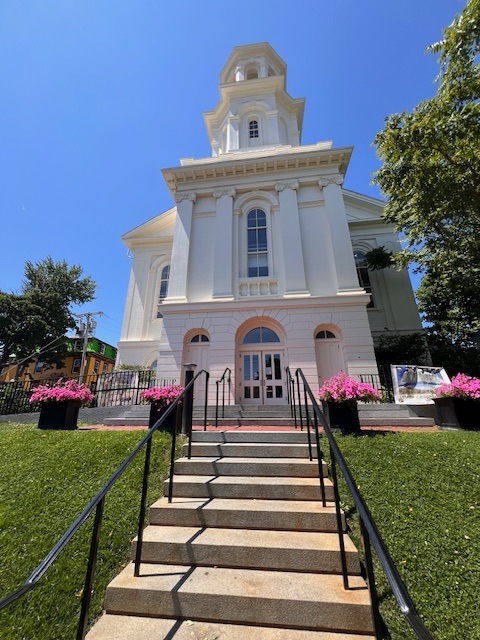
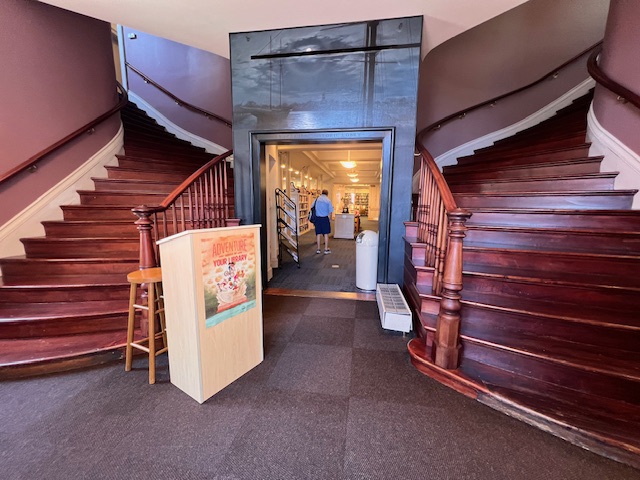
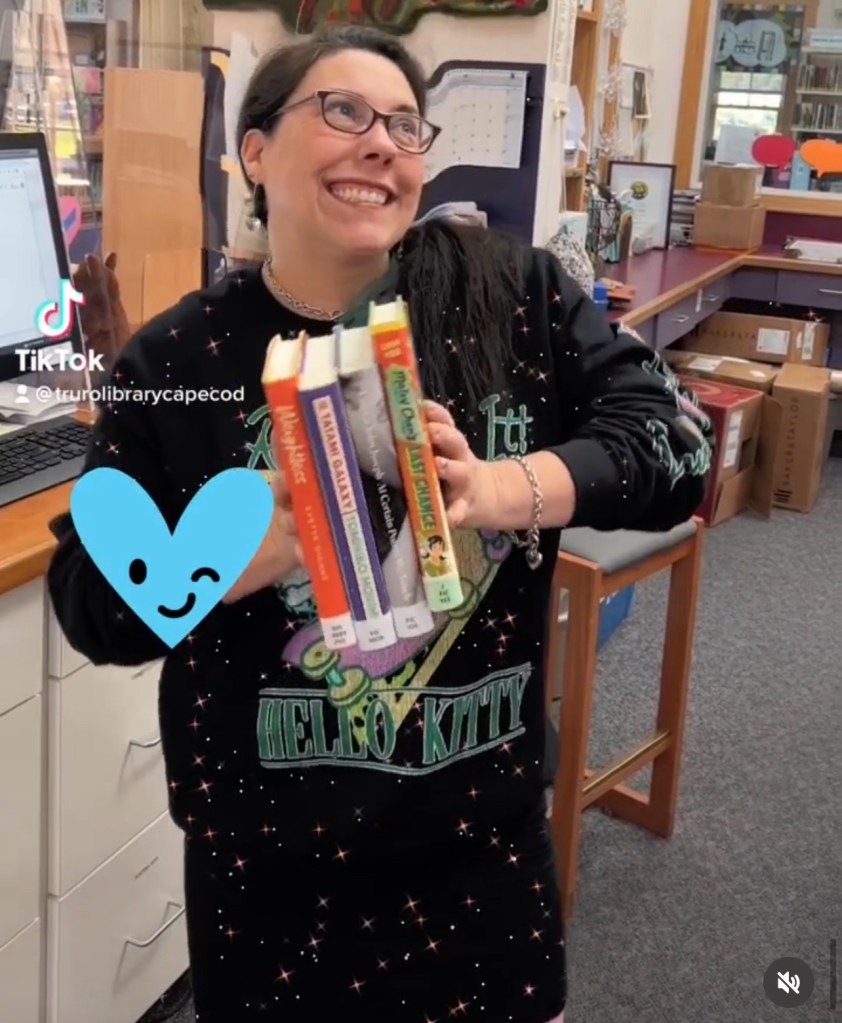
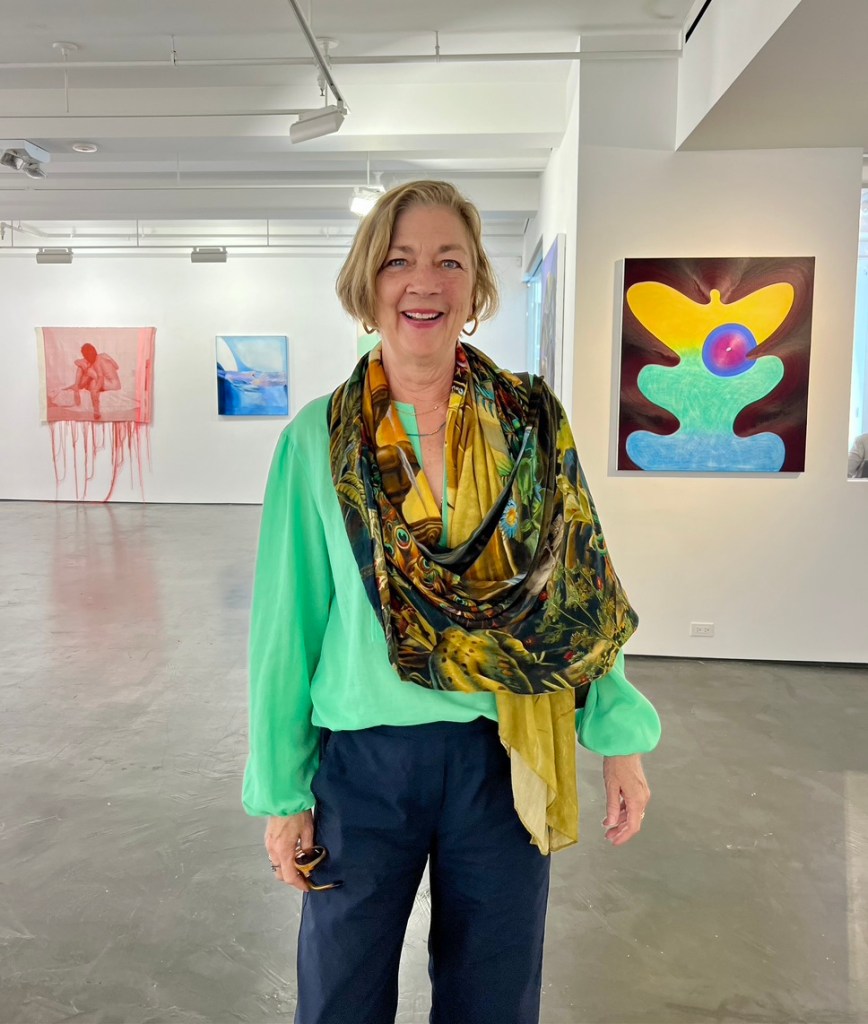
I walked into the Provincetown Public Library to see if I could secure a reading for Eliot’s book and I met a grown up Fearless Flying Fannie. The assistant director of the library calls herself Library Girl. Courtney Francis has the moxie that we wish for all girls and boys in the future. She shows her power by helping others. We will announce the events we are planning together very soon. Thank you Gail Williams for telling me not to miss seeing the inside of this historic establishment.
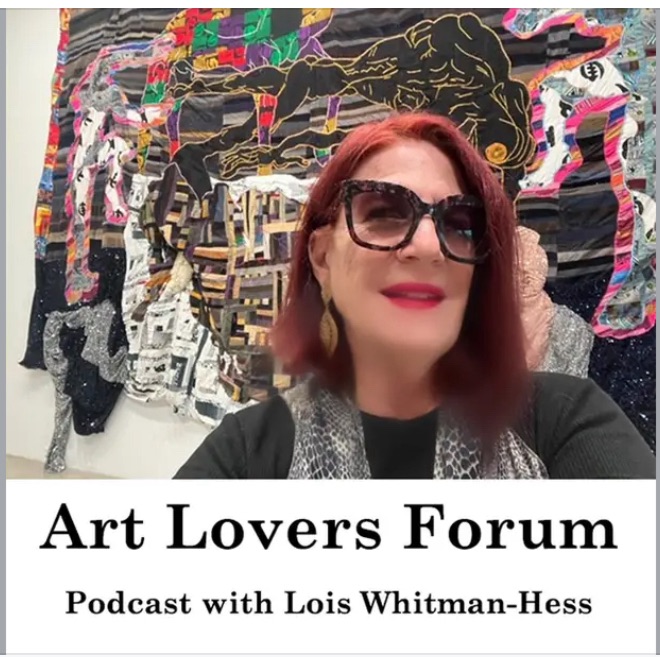
If you want to expand your horizons in the art world, listen to this episode of Art Lovers Forum. I am speaking to Dianne Beal, an independent curator and private art dealer in Washington D.C., Paris, and Miami. Dianne is a good friend of mine.
She is absolutely a well-known specialist of non-conformist art. Let’s put it this way, the bipartisan political power couple, Mary Matalin and James Carville, are just two of her celebrity status clientele.
Dianne has developed an excellent reputation for promoting intellectually challenging projects in Washington, Paris and most recently, Miami. During the pandemic, she created an online artist interview series Square Dose and spends time now organizing diverse exhibitions with impactful curatorial themes. After operating galleries in Washington, DC in the early part of her career and then founding Galerie Blue Square in Paris in 2007, Dianne continues to focus on art projects that link local and international concerns. She has collaborated with American university art museums as well as major museums, including the Louvre Museum and Museum of Modern Art in Paris.
Curatorial exhibitions include The Color of Light (2021-22) featuring five international artists and three venues in Latvia and France; Riga Photography Biennale (2018); Tribute -Yves Ullens (2017) Mark Rothko Art Centre, Riga, Latvia; RED!!! Russian American XXI c. Visions (2017) George Mason University; Crude – Andrei Molodkin (2013) American University; and Russian Constructivist Roots: Present Concerns (1997-98), University of Maryland, University of New Hampshire, Dickinson College, and The World Bank which traced the legacy of the Russian avant-garde movement of the 1920s and 1930s through the works of 13 leading contemporary Russian artists.
From 2011 – 2014, Dianne served as a consultant to UBS bank, acting as a private guide to its top Private Wealth clients at Art Basel Miami Beach. Galerie Blue Square hosted a booth of its artists at Art Paris Art Fair at the Grand Palais for several years.
Dianne has been invited to give interviews and has delivered lectures at leading universities and has served as guest curator and juror for various public and private exhibitions. In 2010, she contributed to a book published by the National Center for Contemporary Art in Moscow about émigré artists. Dianne earned a Bachelor of Arts in Russian and East European Studies from the University of Michigan and a Master of Arts in International Affairs from the George Washington University. She speaks French and Russian.