Neil Kraft, Visionary Adman Who Sold ‘a Mood and a Lifestyle,’ Dies at 67
His ads for Calvin Klein and others captured a fizzy moment in the 1980s and ’90s, featuring celebrities like the young rapper Marky Mark wearing nothing but underwear and a grin.
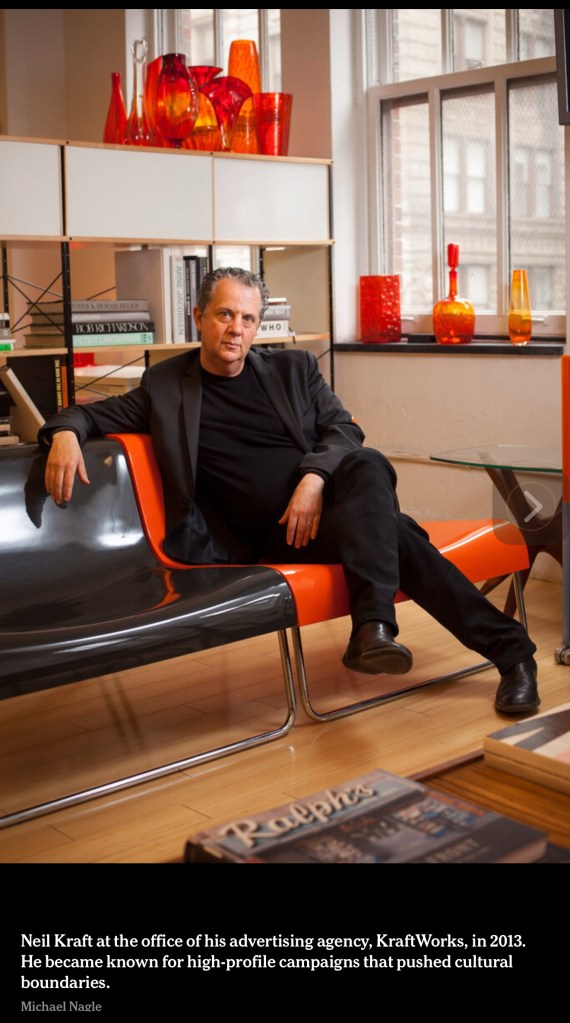
Neil Kraft, who oversaw advertising campaigns for Barneys New York, Esprit and Calvin Klein that pushed cultural boundaries — including one in which a young rapper named Marky Mark sported little more than a grin and a pair of Calvin Klein underwear — died on Sept. 6 at his home in East Hampton, N.Y. He was 67.
The cause was cancer, his son Marley said.
In the mid-1980s, Barneys was morphing from a high-end men’s store in the Chelsea neighborhood of Manhattan — far from the carriage-trade department stores uptown — into a luxury retail emporium. To promote the store’s new image as a fomenter of trends and a destination worth heading downtown for, the Pressmans, the family behind Barneys, created their own advertising agency.
They hired Mr. Kraft to run the shop — a young team that included Paula Greif, an art director who had been making music videos, and her friend Glenn O’Brien, the tart writer, editor and music critic. The work they created was groundbreaking for its time and emblematic of its fizzy 1980s moment.
For one television commercial, Ms. Greif and the photographer and director Peter Kagan, with whom she had made some of those music videos, shot the supermodel Paulina Porizkova dressing and going about her day as if she were in a French New Wave movie. They filmed it with Mr. Kagan’s Super 8 camera and set it to a soundtrack by two of Ms. Greif’s pals, the avant-garde musicians and downtown characters Arto Lindsay and Peter Scherer.
The commercial is grainy and mysterious — the Barneys logo doesn’t appear until the end — and the use of a Super 8 camera might have been a first for a TV ad.
“Neil saw that it would be cool, and it would blow people’s minds,” Ms. Greif said. “Which it did. He was a visionary at a visionary place. He had a great eye, and he was really open to doing things that were more artistic. He allowed people to do things.”
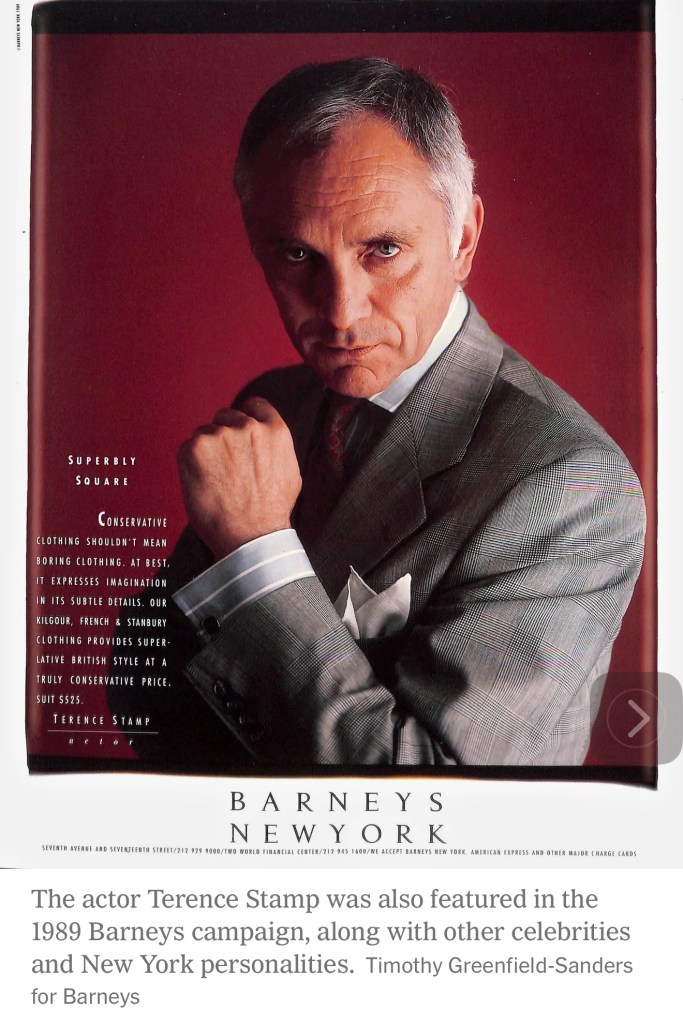
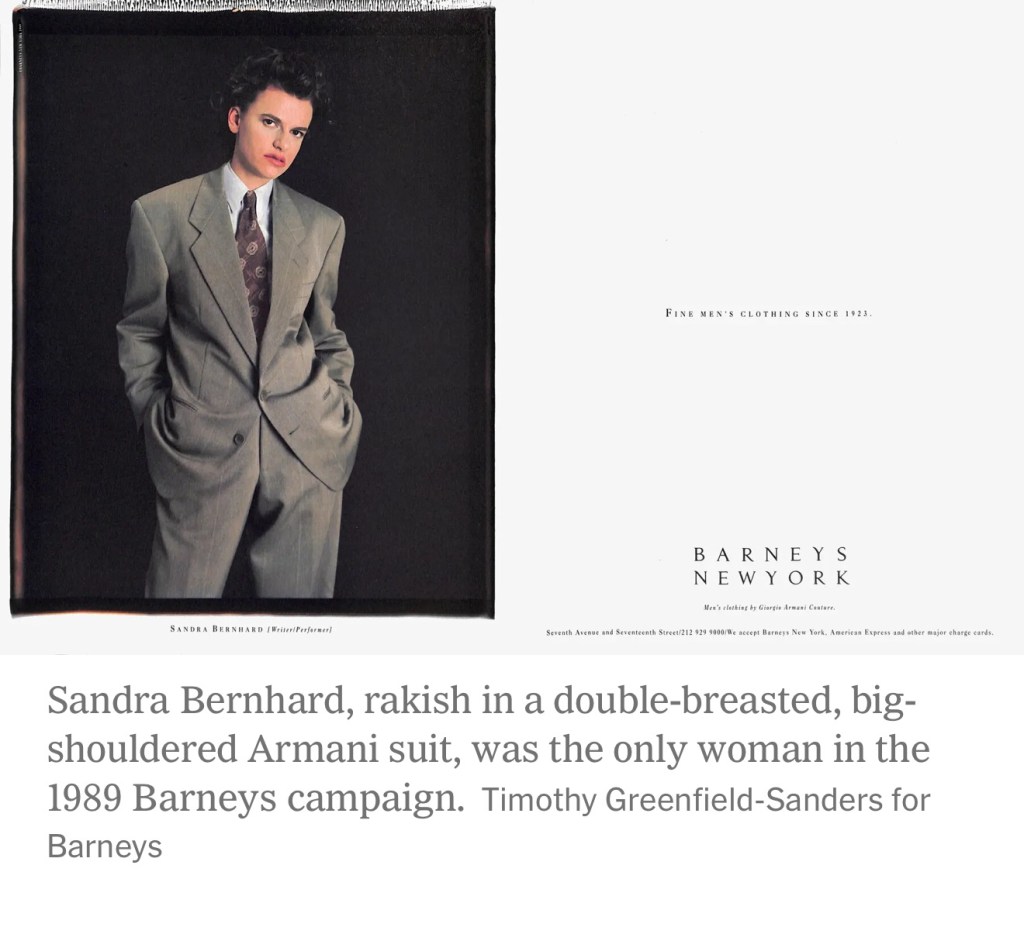
For a men’s print campaign in 1989, shot by Timothy Greenfield-Sanders with a large-format Polaroid camera and accompanied by witty copy written by Mr. O’Brien, Barneys rolled out a series of portraits of male celebrities and New York personalities, including the artist Ed Ruscha and the actors Terence Stampand Jeremy Irons — as well as one woman, the comedian and actor Sandra Bernhard, rakish in a double-breasted, big-shouldered Armani suit.
“We’re not selling an impulse item,” Mr. Kraft told The New York Times when those ads appeared. “We’re selling a mood and a lifestyle. We don’t expect people to look at the ads and come running down to buy a suit. We hope they’ll look at the ads and remember Barneys is a great place.”
By late 1992 Mr. Kraft was at Calvin Klein, working on a campaign for men’s underwear. He and Mr. Klein had seen the young rapper Marky Mark — years before he became the actor known as Mark Wahlberg — on the cover of Rolling Stone, his black jeans hanging low enough to reveal a pair of Calvin Klein briefs, and they persuaded him to be their model.
In a series of photos and TV spots shot by Herb Ritts, he mugged for the camera, did a bit of ad-libbing — “The best protection against AIDS is to keep your Calvins on,” he said, snapping his waistband — and dallied with the model Kate Moss, both of them bare chested.
The work was sweet, sexy and ubiquitous: For months, the image of Marky Mark, wearing a grin and those underpants, loomed over Times Square from a billboard and was plastered on buses and bus shelters.
Mr. Kraft went on to other agencies before opening his own, KraftWorks NYC, in 2000. Over the years, he continued to work for Mr. Klein, overseeing campaigns like the rollout in 1994 of the unisex perfume CK One. In a series of TV and print ads shot by Steven Meisel, Ms. Moss and a gaggle of androgynous models danced and chatted and slouched about. Mr. Kraft also worked on ads for Obsession, featuring Ms. Moss, and Eternity, starring Christy Turlington and, later, Scarlett Johansson.
Mr. Kraft did a lot of what the ad industry called point-of-purchase politics, incorporating social justice messaging into a sales pitch. For Esprit, a fashion company that was often quite political, the company queried thousands of consumers about how they would change the world and filmed the respondents who sent in postcards with their answers for a series of TV and print ads that appeared in 1991.
“I’d reverse the status of celebrities and educators,” one young woman said.
“Keep a woman’s right to choose … unless George Bush is free to babysit,” another replied.
For Planned Parenthood’s 100th anniversary in 2016, Mr. Kraft created Tumblr ads in which volunteers, patients and staff members shared their health care stories, on topics ranging from birth control to cancer screening to abortion. His varied pro bono work included creating the logo for the Coalition for the Homeless, featuring an open door and the organization’s title in lowercase letters — clean and simple.
“You sort of have this feeling of being helpless when something goes off the tracks in the country, so it’s nice to be able to do something,” he told The Times in 2017, when his agency created ChooseWomen, an online platform to help impoverished women finance business ventures. “I think it helps everyone feel good about selling other stuff all the time.”
Neil Franklin Kraft was born on Sept. 16, 1957, in Manhattan. His parents, Jules and Sonya (Cohn) Kraft, were in the garment business. His father, who was born Jules Kupferberg but changed his surname to Kraft when they married, imported handbags; his mother was a fur buyer.
To his father’s distress, Neil chose to study photography and film at the Rhode Island School of Design, graduating in 1978. “You’re going to be a wedding photographer,” he recalled his father saying. “You’ll never make any money!”
Mr. Kraft met Scott O’Neil at college, where she was studying ceramics. They moved to New York City after graduation and married in 1985.
In addition to their son Marley, she survives him, along with another son, Morrison; a daughter, Dylan Smith; a grandson, Hendrix Smith; and two siblings, Susan Kraft and Ronald Kraft. (His children were named for musicians Mr. Kraft loved: Bob Marley, Bob Dylan and Jim Morrison. His daughter has continued the tradition. Ms. O’Neil, as it happens, was named for F. Scott Fitzgerald.)
Mr. Kraft had his quirks. He could be curmudgeonly and opinionated. Extremely blunt. “Grumpy and lovable” is how Ms. Greif put it.
He hated clutter — and houseplants.
When a young art director at KraftWorks was given a small plant as a gift and parked it on her desk, Mr. Kraft phoned her (although it was an open office, and he was only a few desks away), demanding that she remove the offending botanical. And one evening after his staff had gone home, he swept through the office, clearing everyone’s desk of personal items and tchotchkes.
“Oy vey,” he said the next day. “This is a design shop!”
Penelope Green is a Times reporter on the Obituaries desk.
He Announced His Intention to Die. The Dinner Invitations Rolled In.
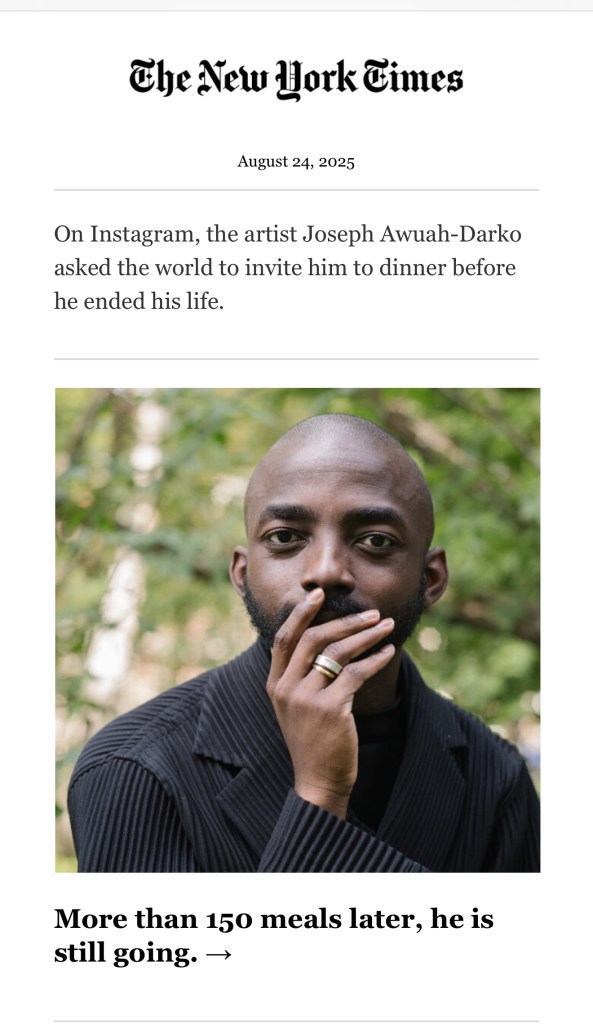
On Instagram, the artist Joseph Awuah-Darko asked the world to invite him to dinner before he ended his life. More than 150 meals later, he is still going.
In early December, a 28-year-old Ghanaian artist and entrepreneur named Joseph Awuah-Darko announced on Instagram that he wanted to die. His battles with bipolar disorder had crushed his will to live, he said in a minute-long video, so he had moved to the Netherlands to pursue medically assisted death.
The post started with Mr. Awuah-Darko in tears, saying, “I’m just so tired,” then segued to a series of images of him having what looked like a pretty good time. Smiling and floating in shimmering blue water. Relaxing on a lawn in the shade of a tree. Pausing in contemplation on a wooden bridge.
Three days later, he followed up with one of the stranger dinner invitations in the history of dinner. As he navigated the obstacles of an officially sanctioned end, he wrote in a post, he would launch what he called “The Last Supper Project.” Anyone who wanted to cook an at-home meal for him could sign up on a calendar app linked to his Instagram bio. On the appointed evening, he would visit, and the assembled would converse, eat and connect.
“I want to find meaning again with people,” he said in the post, “while I have time still left on earth.”
Within a few days, thousands of people reached out. To date, Mr. Awuah-Darko has attended 152 Last Suppers. He has boarded trains to visit homes in Berlin, Paris, Antwerp and Milan. He has traveled to cities all over the Netherlands and to dozens of Amsterdam neighborhoods. Those who don’t cook have treated him to high-end bistros, where a meal costs $100 per person, and to Burger King.
Along the way, he has captured the interactions with videos and photographs on Instagram, a bespoke scrapbook with a soundtrack by Debussy, Radiohead and Roberta Flack and an artist’s eye for beauty. The meals look convivial and usually end with hugs. The hosts, and thousands of fans, appear buoyed by Mr. Awuah-Darko and his readiness to speak with candor about his innermost turmoil.
He’s essentially the charismatic star of a Gen Z home-cooking show, but he brings a rawness that is rare for social media and inspires people to root for him. When he wrote appreciatively about two sisters who served him a Persian dinner, he said he was in the throes of a depressive episode: “I cried heavily during the latter 2 hours of the dinner before they sent me home in a cab with a bouquet of flowers. All I did was show up and they held so much space for me.” The post received 10,000 likes. “If people will open their arms to a stranger to help them experience being alive more fully before choosing to exit forever,” one Instagram commenter wrote, “maybe there’s hope for all of us.”
Mental health experts, by contrast, are appalled. Mr. Awuah-Darko, they say, is implying that euthanasia is a legitimate answer for people with bipolar disorder, a treatable condition. And the parents of depressed children contend that his farewell tour romanticizes suicide.
“My daughter is in a fragile, emotional and impressionable state,” the mother of a suicidal young woman wrote, adding: “You are not helping anyone with this content. I’m begging you to shut it down. Please. Before you take my daughter with you.” Mr. Awuah-Darko presented the message on Instagram over a photograph of his face in despair, a tear rolling down his cheek.
Other detractors wonder if Mr. Awuah-Darko is running some kind of scam. They have compiled their suspicions in a Reddit forum documenting details, with links, of his very eventful life. This includes a breach-of-contract lawsuit for more than $260,000 filed in Ghana last year by an artist whom Mr. Awuah-Darko once represented as agent. Some doubt that Mr. Awuah-Darko truly intends to commit suicide.
But if this is a grift, it might be the world’s lamest. Last Supper hosts typically cover Mr. Awuah-Darko’s travel expenses, but he doesn’t earn any money from the meals. His sole means of income, he said, is a Substack newsletter that brings in about $2,000 a month.
So what exactly is Mr. Awuah-Darko up to? Is this a piece of performance art? Unconventional psychiatric treatment? A long goodbye, with catering? Whatever it is, his blend of light and dark has attracted a legion of devotees. He now has 542,000 Instagram followers and a singular place in the social media firmament as what could be called an assisted-death influencer.
As of late July, he also had something every bit as unexpected: a reason to live.
An Epic Talker
I first met Mr. Awuah-Darko over lunch at a sidewalk cafe in Amsterdam in late June. An elfin man with a shaved head, warm eyes and a wide smile, he was dressed in a charcoal-black sweater that ended a few inches above his knees. The sleeves extended into thumb holes, like Artful Dodger-style gloves. Beside him was his ever-present Bottega Veneta handbag, a lattice of black leather.
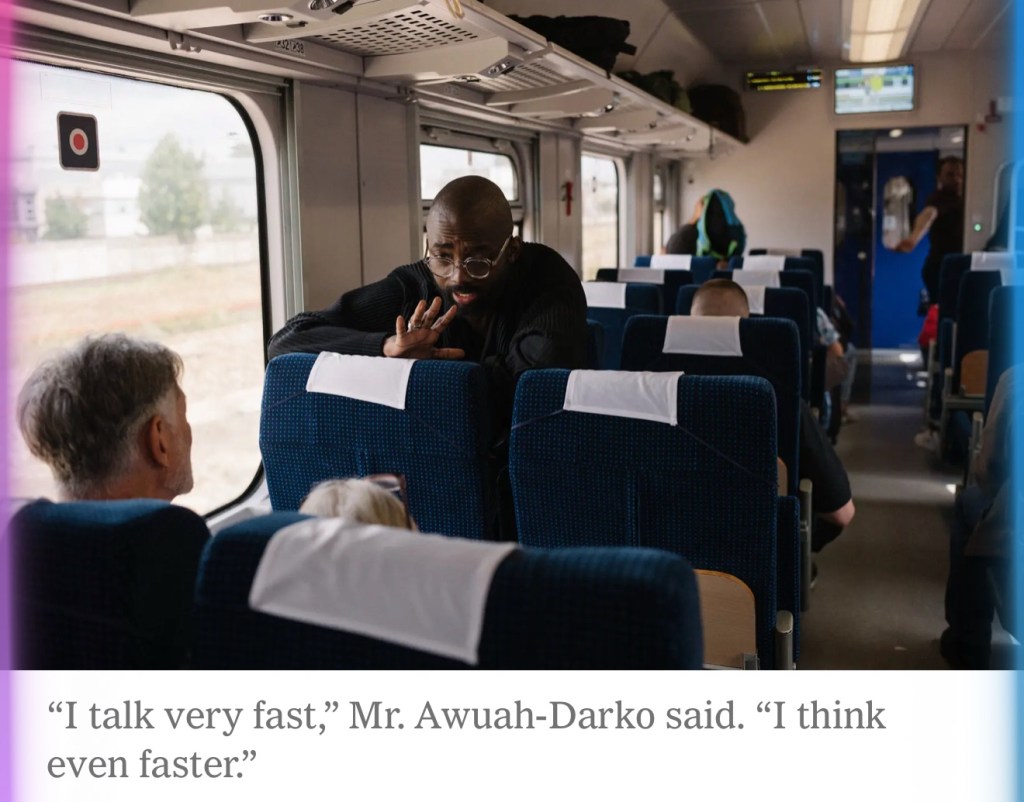
He looked like a priest from “Dune,” or perhaps a guy headed to a Comme des Garçons store. He spoke rapidly, as though trying to keep pace with his ideas.
“I talk very fast,” he explained. “I think even faster.”
Born in London, Mr. Awuah-Darko was raised in Ghana in one of that country’s richest families. His grandfather founded an insurance company, now called Vanguard Assurance, the core of a conglomerate with banking and real estate interests. The family is worth $650 million, according to news reports in Ghana.
Mr. Awuah-Darko says his family has cut him off financially because he is openly gay, a criminal offense in Ghana. He says he has occasionally slept outdoors and in hotel bathroom stalls. In May, he moved in with a Dutch couple he met late last year, and sleeps on a sofa in their gorgeous, minimalist apartment beside one of Amsterdam’s canals.
“I have the nicest version of homelessness now,” he said. “I live with Illi, my best friend, and her husband and two dogs.”
A painter of vividly colored abstract art, Mr. Awuah-Darko had used Instagram for years to post uplifting messages directed at other artists. (Example: “Just make it exist first. You can make it good later.”) The “Dear Artist” series, as he called it, netted some 200,000 followers. But given his darkening mental state, he said, it started to feel inauthentic. Mr. Awuah-Darko said he felt so overwhelmed by hopelessness during his low points that it was difficult to get out of bed.
After he announced the Last Supper Project, his follower count rose quickly and steadily. As macabre as it sounded, the idea tapped into deep reservoirs of empathy. Invitations flowed in.
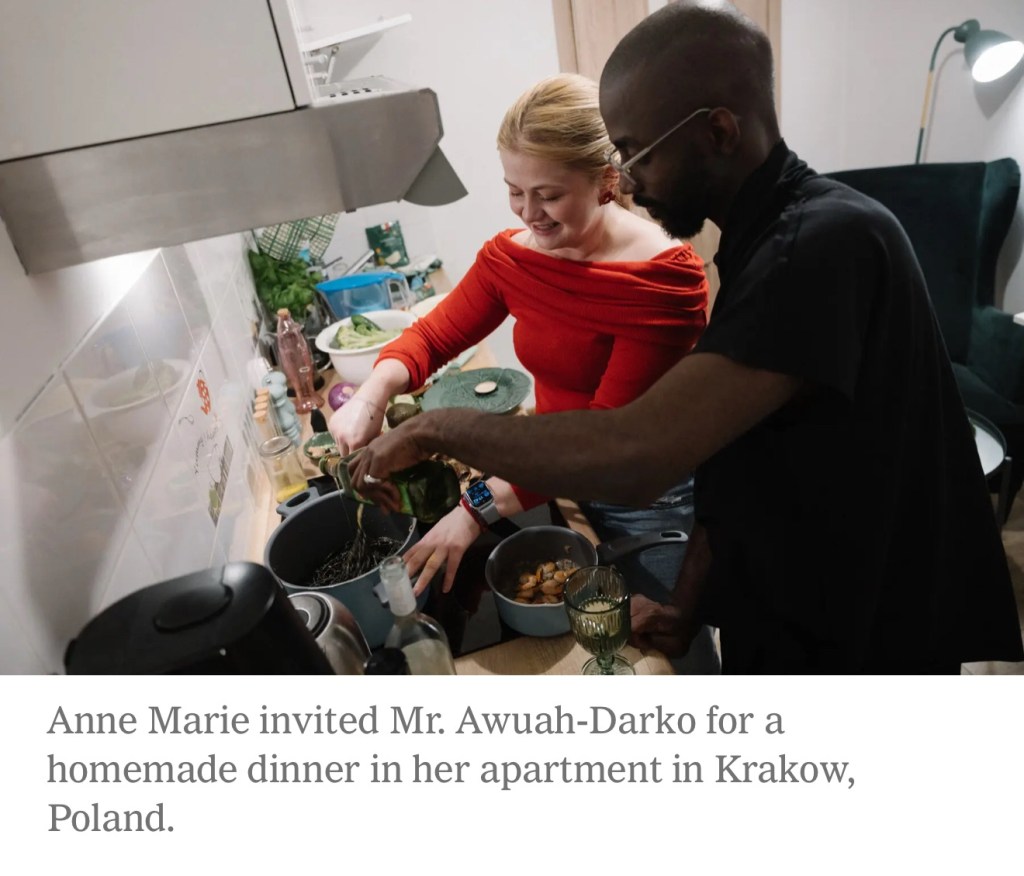
The day after our lunch, I accompanied Mr. Awuah-Darko to Rotterdam for a supper hosted by Sydney Gruis, a 21-year-old student, along with her boyfriend and a female friend. The venue was the roof of a 19th-century churchconverted into student housing. The food was Indonesian fare prepared by her mother, and served in Tupperware. It was a cloudless, breezy summer night.
Mr. Awuah-Darko soliloquized for most of the first hour, and his audience was rapt. He talked about how his grandparents had met; his affection for the artist Francis Bacon; his professional identity (“I’ve always considered myself a writer who paints, not a painter who writes”); his childhood, which he called “tragically privileged”; his somewhat impulsive approach to love, which includes four former fiancés; how he hates being called “versatile” because it really means “unfocused.”
Mr. Awuah-Darko, it turns out, is an epic talker. His past, his failures, his flaws, errors, triumphs, the handful of famous people he has met and others he admires, quotes from Anthony Bourdain, Mark Twain, his grandfather — they burble in a cascade of words. It’s not patter, exactly. It’s more like a marathon jazz performance with a limited number of notes.
“I definitely love the ability and the capacity I have to download or externally process what I’m thinking, what I’m going through,” he told me later. “I do it because I have this weird desire to make sure that I’m not misunderstood, or make sure that people understand that I’m maybe more than meets the eye.”
If this makes him sound narcissistic, he concurs. Until a few days ago, the first words atop his Instagram account were “I AM NOT A GOOD PERSON,” just one of many ways he anticipates every stone you might sling at his character. Point out apparent contradictions — a homeless guy with a luxury handbag? — and he perks up. It’s more material to mine. (He says he acquired it long before his impoverished phase.)
On the roof in Rotterdam, he was interrupted only to politely suggest that he take a moment to eat. He nibbled briefly, then continued.
“I think of myself as a kind of barefoot anthropologist,” he said, holding his fork. “I love that I can sit in discomfort with people and talk about really, really difficult things.”
One of those things was suicidal ideation. As he raised the topic, he paused after noticing that Ms. Gruis’s friend was holding back tears.
“Sorry about that,” Mr. Awuah-Darko said.
“No, no, no, it’s all good,” she said. “I’ve struggled with this in my life a little bit. That’s why I love to listen.”
The principal appeal of Mr. Awuah-Darko, it seems, is his willingness to discuss what few people will say out loud. It makes his supporters feel less alone, less abnormal. His narrative is a kind of talk therapy in reverse.
During a lull, Ms. Gruis explained the genesis of the meal. A few months ago, she had been served up one of Mr. Awuah-Darko’s videos by Instagram’s uncanny algorithm. Unlike other Instagram celebrities, Mr. Awuah-Darko was offering something real, something offline. She immediately felt an urge to invite him to dinner.
“He seemed so warm, so open, I just wanted to connect with him, honestly,” she said. “I just wanted to be part of his journey.”
Mr. Awuah-Darko has encountered Last Supper hosts who have tried to talk him out of dying, evenings that felt like interventions. Nothing of the sort happened on this night.
“I don’t want Joseph to die, I don’t want him to not die,” Ms. Gruis said. “I just want him to get from life what he wants.” She turned to him. “And I want you to end your suffering in the way that you envision it. Because it’s your life, right?”
The evening ended affectionately on the sidewalk, with hugs. Ms. Gruis removed a bangle from her wrist and demanded that Mr. Awuah-Darko take it. He could give it back when they saw each other again, she said. It was as though the jewelry would serve as insurance against his extinction.
It seemed like the ideal Last Supper. Good food, a thoughtful audience. But during the drive to the Rotterdam train station, Mr. Awuah-Darko sounded glum. He had been asked some well-intentioned questions, about his background, about his artistic practice, and that can be “triggering,” he said. And the celebrity treatment creates a kind of pressure to perform.
A minute later, he softened.
“It’s more about being confronted with what is lacking in my life,” he explained, quietly, “when I leave something as beautiful as that.”
Prep School and Polo
Mr. Awuah-Darko grew up in a mansion in Accra where a chef cooked the family’s meals. His father kept a stable of horses imported from Argentina and South Africa and bred for polo. Joseph and his three younger brothers were competitive players.
He says he was diagnosed as bipolar at 16 by a psychiatrist in South Africa, where his family has a home. After graduating from Ashesi University in Ghana with a degree in business administration, he cycled through a number of pursuits and personas. He was a recording artist in 2016. The first exhibition of his paintings was in 2019.
He began his most ambitious undertaking the next year, raising money from donorsand investors to create the nonprofit Noldor Artist Residency. Emerging African artists spent weeks in a renovated warehouse in a seaside Accra neighborhood. They were given space, materials and access to a network of curators and buyers. Many signed three-year contracts in which Mr. Awuah-Darko agreed to represent them and take 40 percent of sales.
The program coincided with a surge in interest in African art and was highlighted in The New York Times and The Financial Times. It launched more than a few careers. The artist Ishmael Armarh, for instance, said that before Mr. Awuah-Darko discovered him on Instagram he was selling canvases on the street for $100 apiece. Two years after his Noldor residency, Christie’s auctioned off a work of his for $22,529.
But he and other resident artists say Mr. Awuah-Darko shortchanged them. Foster Sakyiamah, a figurative painter, concluded that Mr. Awuah-Darko was sending him a tiny slice of proceeds from the sale of 21 large canvases.
“In 2023, I stopped painting for him and said, ‘You need to send me my money,’” Mr. Sakyiamah said in a call from Accra. “He told me to wait, and that I’d have the money in a month. But it never came.”
Last year, Mr. Sakyiamah sued Mr. Awuah-Darko and his company, JAD Advisory, for $266,527, claiming breach of contract.
Mr. Awuah-Darko said he could not go into details of the lawsuit because the case was pending. (In a filing, Mr. Awuah-Darko’s lawyer asserts that Mr. Sakyiamah did not account for “sunken costs” to market his art and that some of the paintings were personal gifts to Mr. Awuah-Darko.) Speaking more generally of his troubles at Noldor, Mr. Awuah-Darko said that “misunderstandings happen all the time.” He added: “I’m not saying that I’m a perfect person, but I never set out to scam artists.”
The program folded four years after it opened. Mr. Awuah-Darko blamed his own “low financial literacy” and the bursting of a “bubble” of interest in African art.
Mr. Awuah-Darko left Ghana for London in 2023, citing the perils of living as an openly gay man in the country. In May last year, he made international headlineswhen he posted on Instagram that Kehinde Wiley, the artist best known for painting former President Barack Obama’s official portrait, had sexually assaulted him. Mr. Awuah-Darko said that the encounter had happened during and after a 2021 dinner in Accra in Mr. Wiley’s honor, and that it had become “severe and violent” after starting off consensually.
After going public, Mr. Awuah-Darko posted an appeal for money on his Instagram account, seeking contributions to defend against a possible libel suit by Mr. Wiley. No suit was filed. Mr. Awuah-Darko raised $3,000, which he kept, he said, to cover “miscellaneous costs” tied to travel and relocation.
His parents are paying his legal fees in the Noldor suit, Mr. Awuah-Darko acknowledges. But a spokesman for the family, Emmanuel Amaning, suggested they were doing more than that and hadn’t completely cut him off, as their son contends.
“The family is not estranged from Joseph, and continue to support him as he addresses his personal challenges,” Mr. Amaning wrote in an email, “and request privacy to do so in a compassionate and considerate way.”
‘He’s Having Too Much Fun’
CreditCredit…
Mr. Awuah-Darko does not shy from the obvious and profoundly awkward questions raised by the Last Supper Project. Among them: If you truly want to die, why not kill yourself?
He gets that one a lot.
“I could easily decide to jump from a building,” he told me. “But I want to do this in a responsible way, in a manner that is nonviolent. And I don’t want to transfer my trauma to anyone who discovers my body.”
He decided to pursue medically assisted death somewhat impulsively, he said, while coming down from a manic episode. He was homeless and deeply depressed, and it seemed to offer a dignified exit, he said.
One problem. Academics in the field say there is little chance that a doctor in the Netherlands will help Mr. Awuah-Darko die.
“No way,” said T.A. Boer, a Dutch professor of health ethics.
By way of background, about 10,000 people were medically euthanized in the Netherlands last year. There is no formal application process, and no regulatory body that approves or denies. Thousands of physicians can perform the procedure.
But the Dutch want to prevent what Professor Boer called euthanasia tourism. An ethics board reviews all assisted death decisions afterward, and doctors who don’t meet due care standards can face criminal liability. Patients must have a residential address, a local doctor and Dutch health insurance. Even if Mr. Awuah-Darko were to meet those requirements, there is another hurdle. Before doctors agree to help anyone die, they must conclude that the person’s suffering is unbearable.
“And this is a guy having a grand goodbye tour, with dinners,” Professor Boer said. “Any doctor here would look online and reject his case. He’s having too much fun.”
Which gets to the glaring contradiction embedded in Mr. Awuah-Darko’s Instagram account. For months, he labeled it “a public requiem for my demise.” In reality, it’s a guarantee that no physician will help end his life.
Mr. Awuah-Darko says he has begun conferring with lawyers to apply for Dutch citizenship, though that could take years.
“I never said there was an end date,” he noted, adding that most people don’t take the name of his project literally.
In fact, many of his Instagram followers firmly believe that he’s near the end of his life. Some send reassuring notes; others beg him to reconsider. A few think that as a man confronting his mortality he has special insights about life. (“I have learned so much following you,” one commenter wrote.)Would 5,000 strangers invite a guy to dinner who was just deeply depressed?
Skeptics say Mr. Awuah-Darko is exploiting a wrenching psychiatric condition to win attention. Health care professionals contend his message is toxic. A charity in London, Bipolar UK, told reporters at De Volkskrant, a Dutch newspaper, that it would not accept money from Mr. Awuah-Darko after he stated on Instagram that he would send proceeds to the organization from a Last Supper book he was writing.
“Our values do not align with the messaging Joseph is sharing with the world,” a spokeswoman explained in an email to me, “that life with bipolar is not a life worth living.”
A Place to ‘Discuss and Exist’
Mr. Awuah-Darko’s proponents have a very different take. They find solace in the public way he grapples with anguish, and on Instagram, they regularly shower him with comments like “Your presence on this app has been so healing and educating for me” and “Having death close sometimes feels like a friend by our side, helping us live more fully and love more deeply.”
His most fervent acolytes turn up in Amsterdam for another occasional event, profanely named and described on its website as “a dinner party for the emotionally fluent and the existentially undone.” It adds, “You eat, you speak, you unravel.”
CreditCredit…
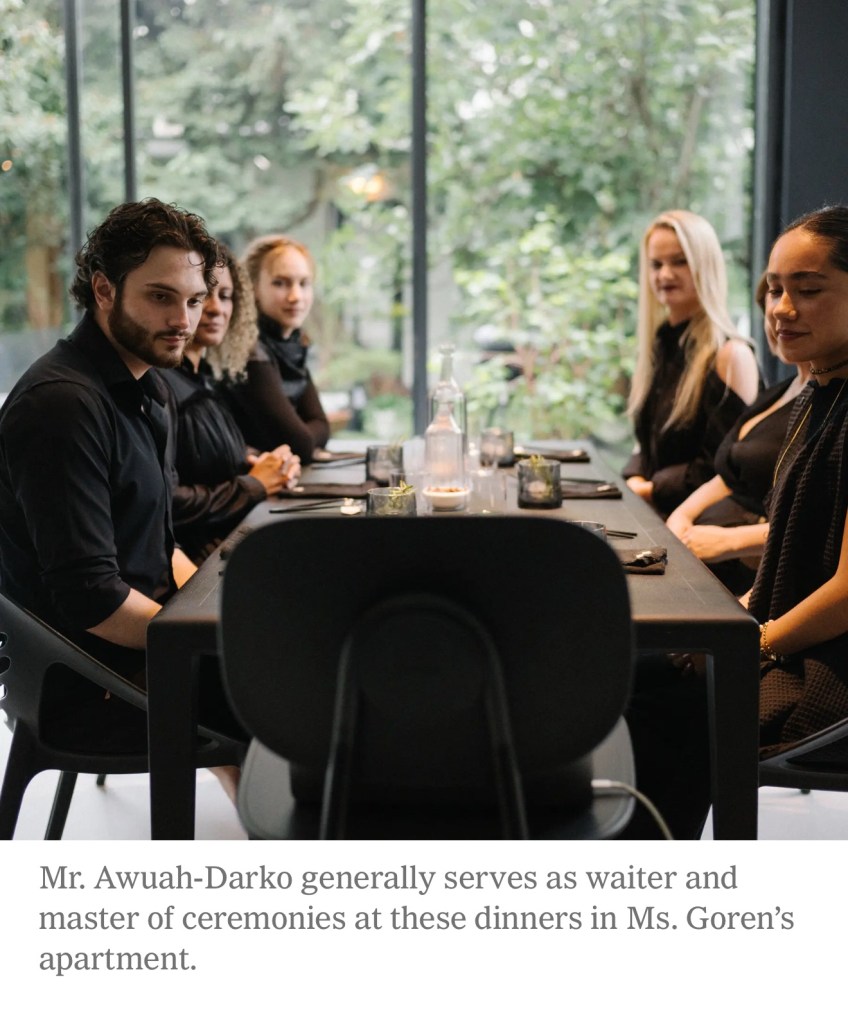
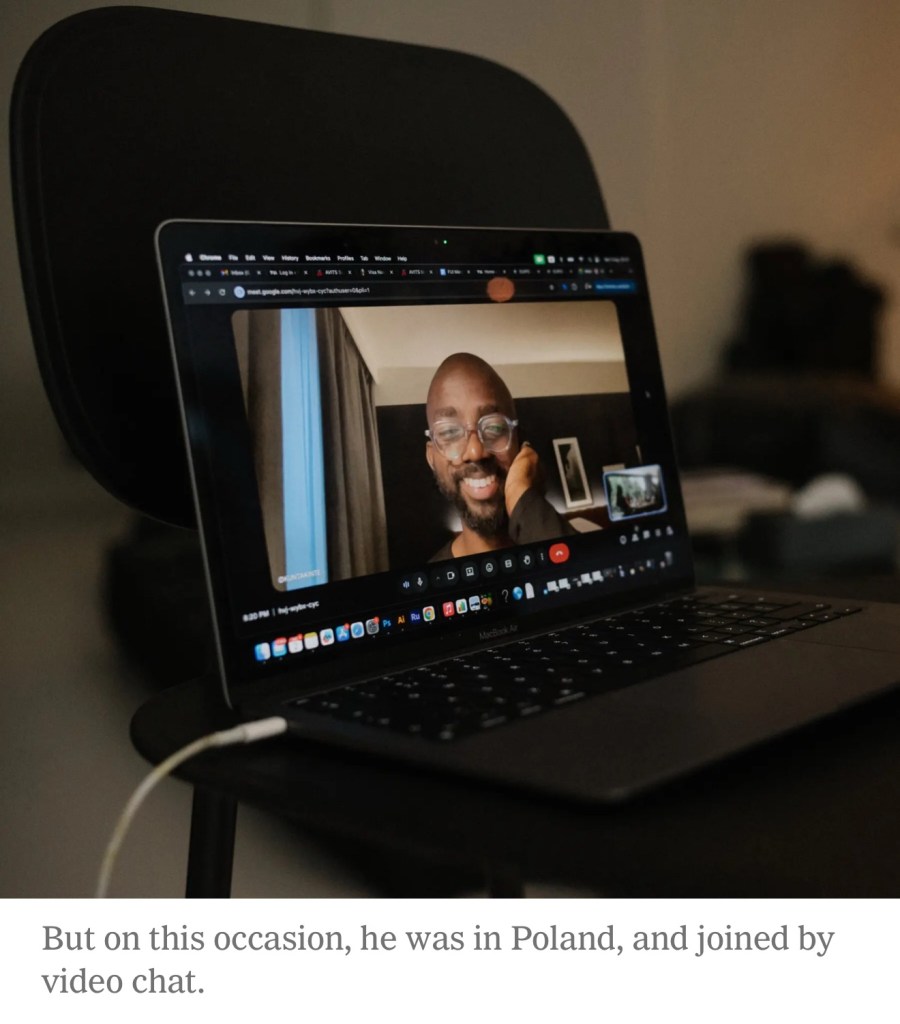
On an evening in June, five attendees had traveled from London, Romania, Florida and Spain, while one watched online at home in New Jersey, on a laptop. Every meal is served in the elegant apartment of Illi Goren, a fashion designer, and her husband, Tom, where Mr. Awuah-Darko now sleeps on a couch.
Ms. Goren cooks — the six-course dinner evokes high-end Nordic restaurants and costs about $175 per person — while Mr. Awuah-Darko serves as waiter and moderator. He prompts guests with intimate questions. During the dinner I attended, he asked, “If you could have a meal with your 8-year-old self, what food would you bring and what advice would you offer?”
“I’d bring a can of spinach,” said Alexandré Zii Miller, 29, who had flown in from Sarasota and was at the start of a European sojourn. He and the 8-year-old version of himself would eat it like Popeye.
“And I’d say: ‘Your intuition is right,’” Mr. Miller continued. “‘You’re going to have a hard life. Sorry.’”
Other questions led to descriptions of excruciating mental torments, which on this night included sexual abuse, depression, heartbreak and chronic fatigue. All said they had found Mr. Awuah-Darko on Instagram and hungered for community and conversation.
“Everyone other than Joseph is editing out the sadness of their lives on social media,” said Mr. Miller, who described himself as “neuro-spicy.” He works at home, editing computer code, in a house painted black, both inside and out, with chickens and a goat. Since childhood, life has felt pointless, he said, a problem that has gotten only more acute as he spends more time online.
“I have not made any new friends in person in years,” he said. “Everybody’s too busy, too distracted, in way over their heads with chores, family, whatever. And there’s really no third place I can go to to meet people, just to discuss and exist.”
The evening ended with photos and an exchanging of phone numbers.
A few weeks later, on a Friday in late July, Mr. Awuah-Darko’s life took a surprising turn when he traveled by bus to Poland.
It was not for a Last Supper, but rather to visit Mr. Miller, who was renting an Airbnb in Wroclaw. The next night, as the pair sat in a bar, Mr. Awuah-Darko proposed marriage. He had been smitten with Mr. Miller from the moment he saw him at the dinner, he later explained, and they had since been texting. Mr. Miller said yes.
“I had a hunch he might find me interesting,” Mr. Miller said on the phone from Poland. For him, this isn’t about romance so much as a chance to add excitement to a life that feels empty. “Also, I’m asexual, and I can’t really reciprocate the same type of love I think normal people expect in a relationship. So I can’t be picky.”
Mr. Awuah-Darko announced the engagement, his fifth, in a Substack posting. “I believe with him I finally have something I did not have for a long time — hope,” he wrote. “And the promise of someone who can finally match my freak.”
To hear him explain it, love has cured Mr. Awuah-Darko of all interest in medical euthanasia. “I met a guy who made the idea of sticking around more bearable than the idea of leaving,” he said on the phone from Poland. On Instagram this whole plot twist was greeted with both delight (“My heart is happy when your heart is happy”) and skepticism (“Well that was a bit hasty”).
We ew His zeal for Last Suppers is undimmed. In late July, he held No. 145 at a restaurant in Poland. As he told followers, any meal could be his last. Who knows? And anyway, his primary purpose has never changed. Ultimately, he wants what his followers want, what millions of people want — someone to look into his eyes and listen.
Meet artists Randi Renate and Beatriz Chachamovits
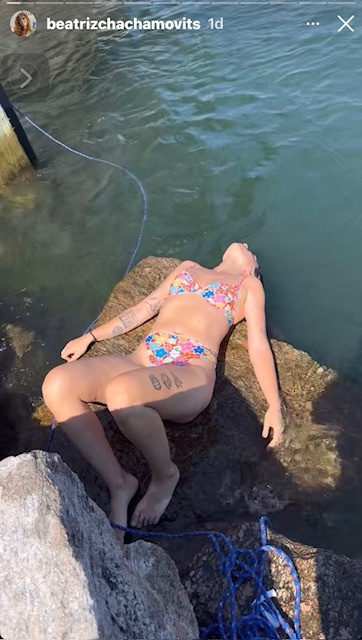
Eliot and I met them a few years ago through Fountainhead Arts and have been friendly ever since. They are environmental artists who are helping to clean up our ocean and save coral reefs.
They both scuba dive all over the world on a frequent basis to keep up-to-date on all environmental conditions. They are highly educated and avid readers.
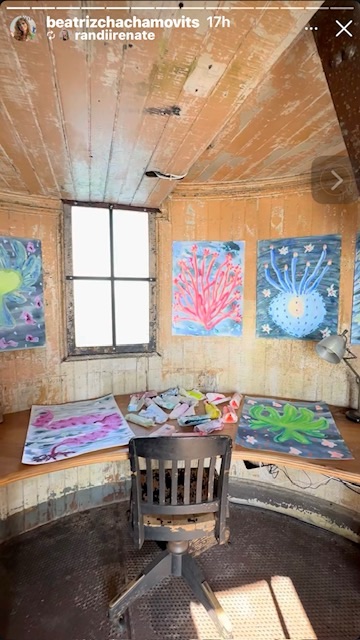
Beatriz and Randi are quite remarkable. They are constantly on the go visiting artist residencies worldwide in order to network and create paintings and sculpture in many different environments. They also teach art and environmental studies at museums, galleries, cultural centers, and makeshift locations.
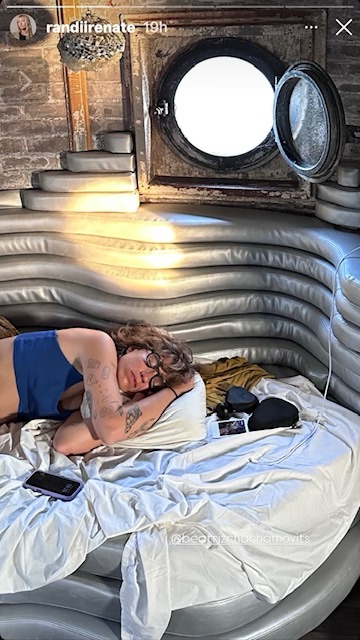
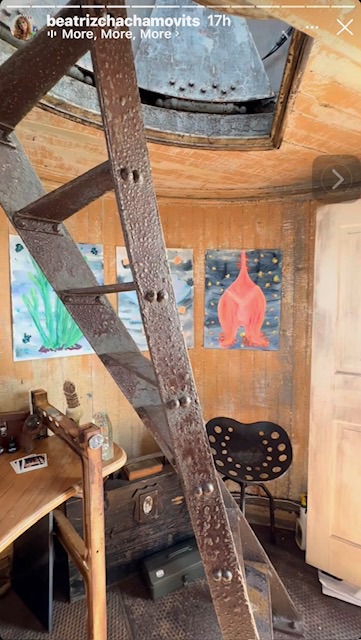
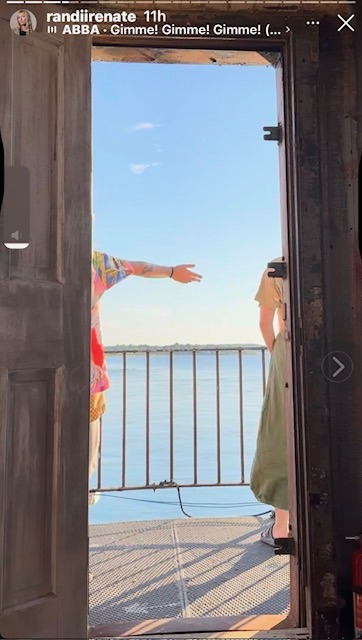
I’m always amazed at what they do because I just don’t meet many women like them. They just completed a residency at the Orient Point Lighthouse on Long Island. They stayed with Eliot and I in PTown before this one-of-a kind adventure.
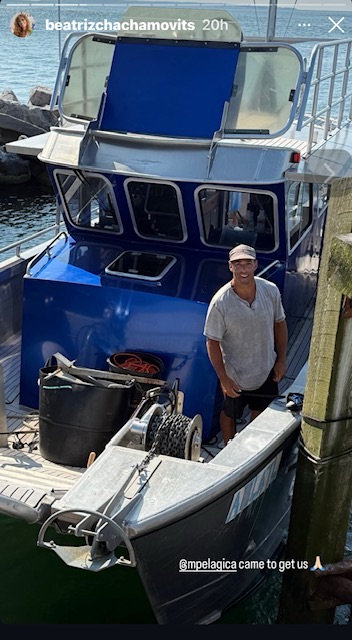
For one week, they were living alone on a small island, a mile in circumference, in a lighthouse. A fishing boat took them from the mainland of Long Island to the island. If they needed help they had to call the coast guard—that’s if the cells and internet were working. It was spotty at best.
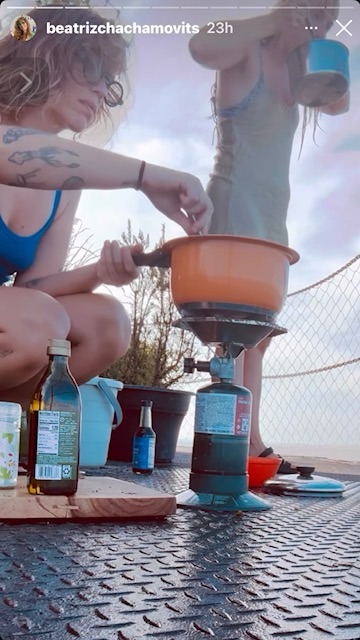
They cooked on a camp stove and bathed in the water. I won’t describe the toilet conditions but just let’s say they were challenging. I could never do it.
Randi and Beatriz are not me. They thrive on conditions like this so they can be close to nature and create art that reflects their findings. Eliot and I admire them.. They partner on a lot of projects but they also have many other artists that they collaborate with.
Beatriz and Randi live a life of adventure trying to save our planet. They are totally dedicated to their work and dare to live in a non-traditional world. It’s very exciting to be around them.
“I’m going to trip!” Ken Fulk yelled as he barreled down the stairs of the Flemish Revival building in Lower Manhattan where his design company has a New York office. Mr. Fulk, who was rushing to catch a helicopter, had a Louis Vuitton monogram duffle bag in one hand and an Away suitcase in the other. He stuffed them into a car idling outside before climbing in and being whisked away to a helipad on the Hudson River.
From there, Mr. Fulk, 60, flew to the Hamptons to meet with the owner of a home he is decorating there. Later that Wednesday in early April, he had another flight to catch — this one to Verbier, in the Swiss Alps, where he had a meeting about another project.
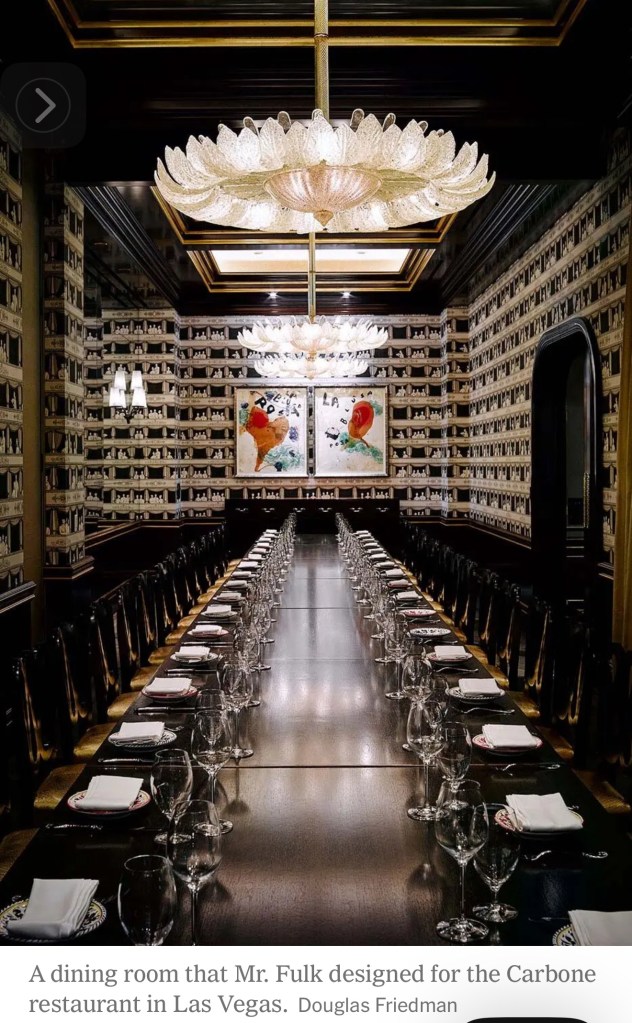
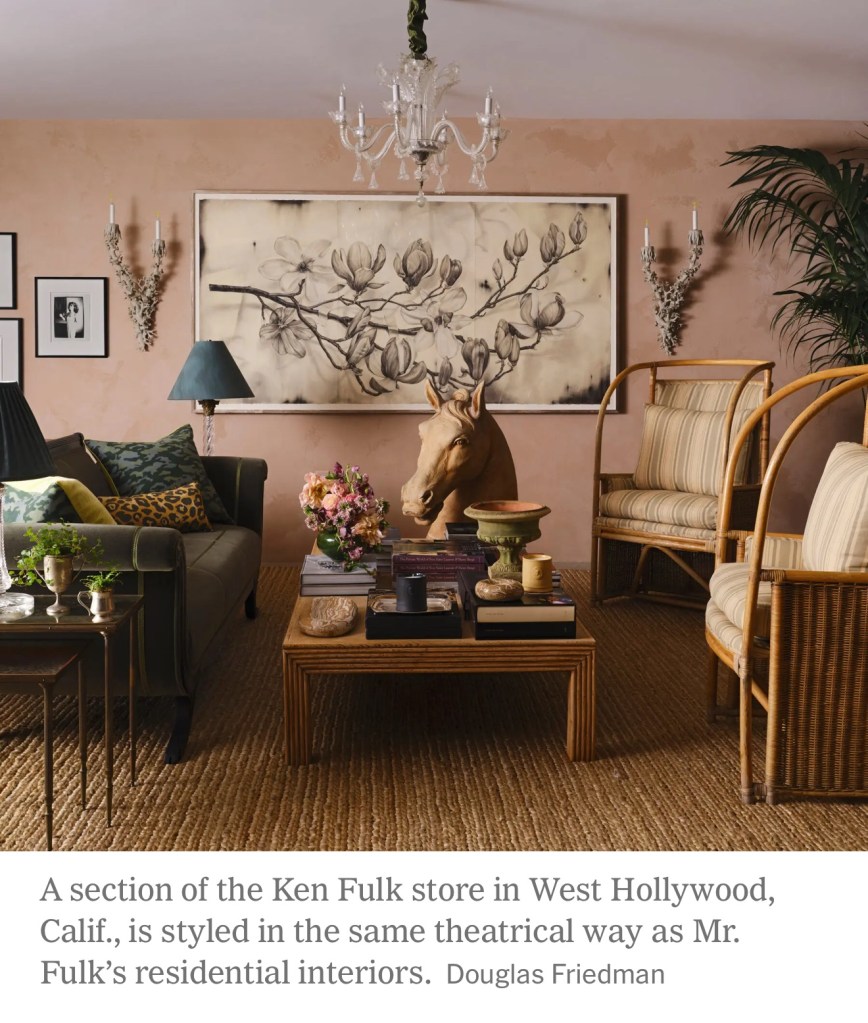
Mr. Fulk, who lives primarily in San Francisco, started his interior design business there in the 1990s. In recent years, he has been exporting his taste to places across the country and the world. Along with decorating the homes of fashion designers, technology executives and diplomats, he has given his touch to private clubs like the ‘Quin House in Boston and restaurants like Carbone. After designing its locations in Las Vegas and Miami, he is now working on its outpost in London, which is expected to open this summer.
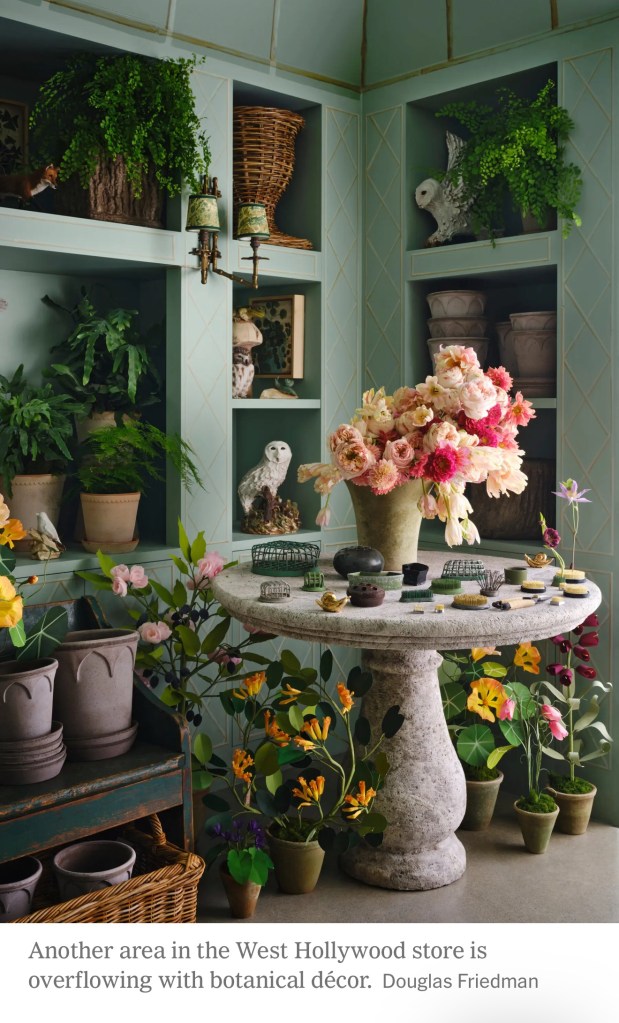
The globe-trotting and creativity his career has demanded is “what I was built to do,” said Mr. Fulk, who recently opened namesake stores selling Ken Fulk-branded home goods in San Francisco and in West Hollywood, Calif. He is planning to open a third in New York later this year.
The West Hollywood store is not far from the site of another project, the Beverly Hills Hotel. Inside, Mr. Fulk is designing a spate of new spaces, including what he described as a “palm-lined, Copacabana supper club” and a lobby bar.
“We are not touching the Polo Lounge,” Mr. Fulk said of the hotel’s marquee establishment, a famously clubby hangout for Hollywood titans. “There would be rioting out front.”
He was joking. But Mr. Fulk’s aesthetic, which can evoke descriptors like “maximalist” or “more-is-more,” is somewhat the opposite of quiet luxury. Wendy Goodman, the design editor of New York Magazine, characterized it as “unabashedly unapologetic luxury.”
“It isn’t for everybody,” Ms. Goodman said. “But on the other hand, in design, you see a lot of things that are very safe because people don’t know how to express themselves. Ken knows what he wants. He’s all about the comfort of luxury, which is very seductive. He has a sense of how people want to sit and talk together.”
His client list includes various San Francisco elites. Mr. Fulk has worked with former Vice President Kamala Harris, a former district attorney there, and with Trevor and Alexis Traina, a wealthy and well-connected couple who live in the city. They had him redecorate the U.S. Ambassador to Austria’s residence in Vienna after Mr. Traina was appointed to the position during the first Trump administration. In one room of the home, Mr. Fulk mixed disparate pieces from the Trainas’ art collection, including an abstract Rudolf Bauer painting and a large Tina Barney photograph, with Josef Hoffmann furniture upholstered in powdery pink velvet.
Earlier in his career, Mr. Fulk was the go-to decorator for Silicon Valley figures like Kevin Systrom, a founder of Instagram, and Sean Parker, the creator of Napster and the first president of Facebook. Mr. Fulk also orchestrated Mr. Parker’s 2013 wedding, a medieval fantasia set among the redwoods of the Big Sur region in California, at which custom outfits by a “Lord of The Rings” costume designer were provided to each guest.
“Ken is an imagineer,” said the fashion designer Zac Posen, another client. Mr. Fulk decorated his rental home in San Francisco after Mr. Posen moved to the city last year to take the creative reins at Gap Inc. The residence was built in the 1850s by a ship captain, a history Mr. Fulk nodded to with furnishings like old boat lights and anchor chains.
“It has the feeling of being in a ship, very aquatic,” said Mr. Posen, who has known Mr. Fulk since the early 2000s, and who tapped him to collaborate on a recent campaign for Banana Republic, a brand under Mr. Posen’s umbrella. “Ken understands the theater and fantasy of life.”
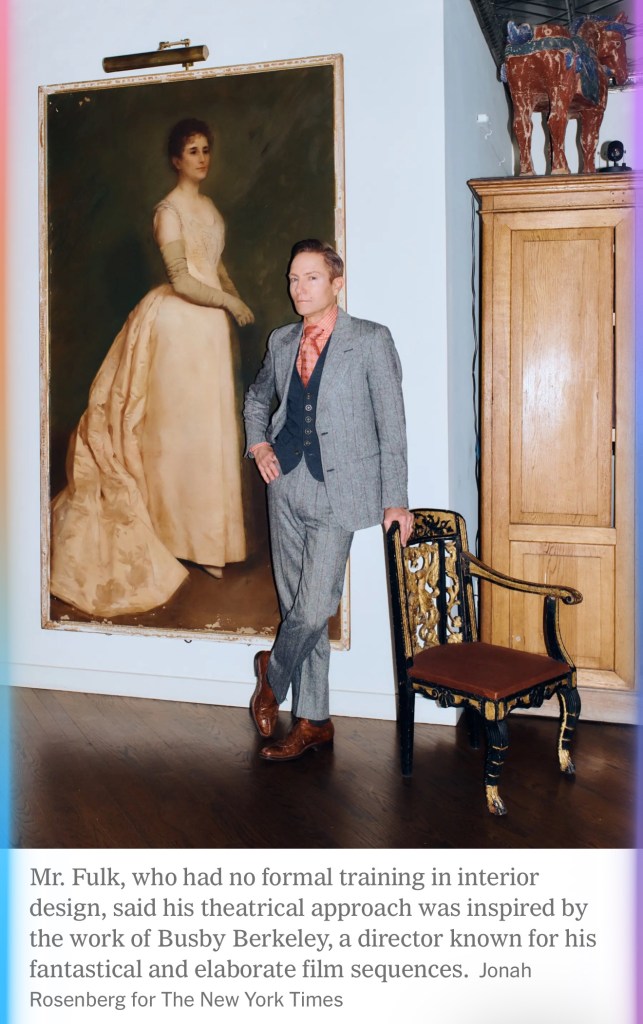
Mr. Fulk said that, in a word, his aesthetic could be called optimistic. “There is a theatrical nature to it, but nothing is there just by happenstance,” he added, explaining that he has fashioned himself less after the decorators Dorothy Draperand Tony Duquette, whose exuberant interiors are detectable in Mr. Fulk’s work, and more after Busby Berkeley, the director known for his fantastical and elaborate film sequences. (“Ken Fulk: The Movie in My Mind” was the title of a hefty coffee table book about Mr. Fulk released by Assouline in 2022.)
At his company, Ken Fulk Inc., which now has about 100 employees, design projects often begin in the same way that films do. “We write a script,” Mr. Fulk said. For the Carbone restaurant he designed in Miami, he described the narrative as “Maria Callas waking up next to Frank Sinatra in the Gritti Palace.”
“I think it’s because I was never trained,” Mr. Fulk added about his approach. “I can’t draw a circle.”
He studied history and English at Mary Washington College, now the University of Mary Washington, in Fredericksburg, Va., and moved to San Francisco after briefly living in Washington, D.C., and Boston. After working in restaurants and starting some unsuccessful businesses — a company that sold shower curtains and pajamas, another that sold and licensed children’s books — Mr. Fulk got his first decorating gig when a friend in San Francisco asked him to put together his apartment. After that, he worked as a house stager and landed more interior design jobs by word of mouth.
“I was always the friend with taste,” said Mr. Fulk, a fastidious dresser whose exuberance is reflected by his preferences for bow ties, boyish Thom Browne suits and wearing his hair in a tidy “Leave It To Beaver” coif. “I’ve done all my own shopping since I was 6,” he added.
Mr. Fulk and his older sister grew up in Harrisonburg, Va., a small town in the Shenandoah Valley. Their parents owned bars and restaurants in the area. He described his life back then as comfortable, if not as grand as his aspirations. “When I was 4 years old, I said I wanted to live in a penthouse in Manhattan, even though I had never left my hometown,” he said.
He has yet to get that penthouse — lately, when in New York, he has been staying at a hotel near his office. In San Francisco, he and his husband, Kurt Wootton, 59, have a home in the Clarendon Heights neighborhood. The couple, who met in Boston in 1991, have three golden retrievers (Duncan, Ciro and Sal), a wire‐haired dachshund (Wiggy), and also own a ranch in Napa Valley, along with a waterfront house in Provincetown, Mass.
Mr. Wootton, who formerly worked in retail at companies like Neiman Marcus and Williams Sonoma, said that Mr. Fulk “is very much the conductor of this thing called life.” He added that, when his husband isn’t working, they are often cooking together (they like Indian and Italian cuisine) or relaxing with their dogs.
Mr. Fulk also owns the Mary Heaton Vorse house in Provincetown, an 18th-century home across the street from his residence, which he runs as an arts center that hosts events, offers temporary residencies to working artists and occasionally serves as a guesthouse for friends like the actress Jennifer Coolidge, who crashed there last summer when Mr. Fulk’s home was full. (He established a similar operation in San Francisco, called Saint Joseph Arts Society.) Mr. Fulk bought the Vorse house in 2018 for $1.17 million — a price with as many digits as his fee for decorating homes, which he said now starts “in the low seven figures.”
He travels between his residences as he and his staff work on dozens of projects at once. “My superpower is saying yes to stuff,” Mr. Fulk said, explaining that his voracious appetite for new opportunities partly resulted from living through the AIDS epidemic in the 1980s and 1990s. He came away from that time with a mentality of “do everything right now,” he said.
Jobs Mr. Fulk is currently devoted to include a new boutique hotel in Barcelona and his namesake retail business, where people can buy Ken Fulk candles ($125) and caviar sets ($365) along with décor and jewelry and from other makers. He opened the stores with the help of Dave DeMattei, a former chief financial officer at Gap Inc., whom Mr. Fulk hired in the same capacity at Ken Fulk Inc. in 2023.
The thinking behind the retail expansion, Mr. DeMattei said, was that “not everyone can afford the houses Ken does, but they can go in now and buy a little piece of it.” Mr. Fulk, he added, “is 24-hours-a-day, workaholic, never says no.”
Another thing that Mr. DeMattei has encouraged Mr. Fulk to do: television. Last year, he signed with Creative Artists Agency. But Mr. Fulk isn’t sure if the small screen is for him.
“TV is great, and I know it’s popular, but it isn’t me,” he said. Instead, he hopes his work could be the subject of, yes, a film (specifically a documentary).
“I would like to preserve some pieces of it that way,” he said. “It’s all so terribly cinematic.”
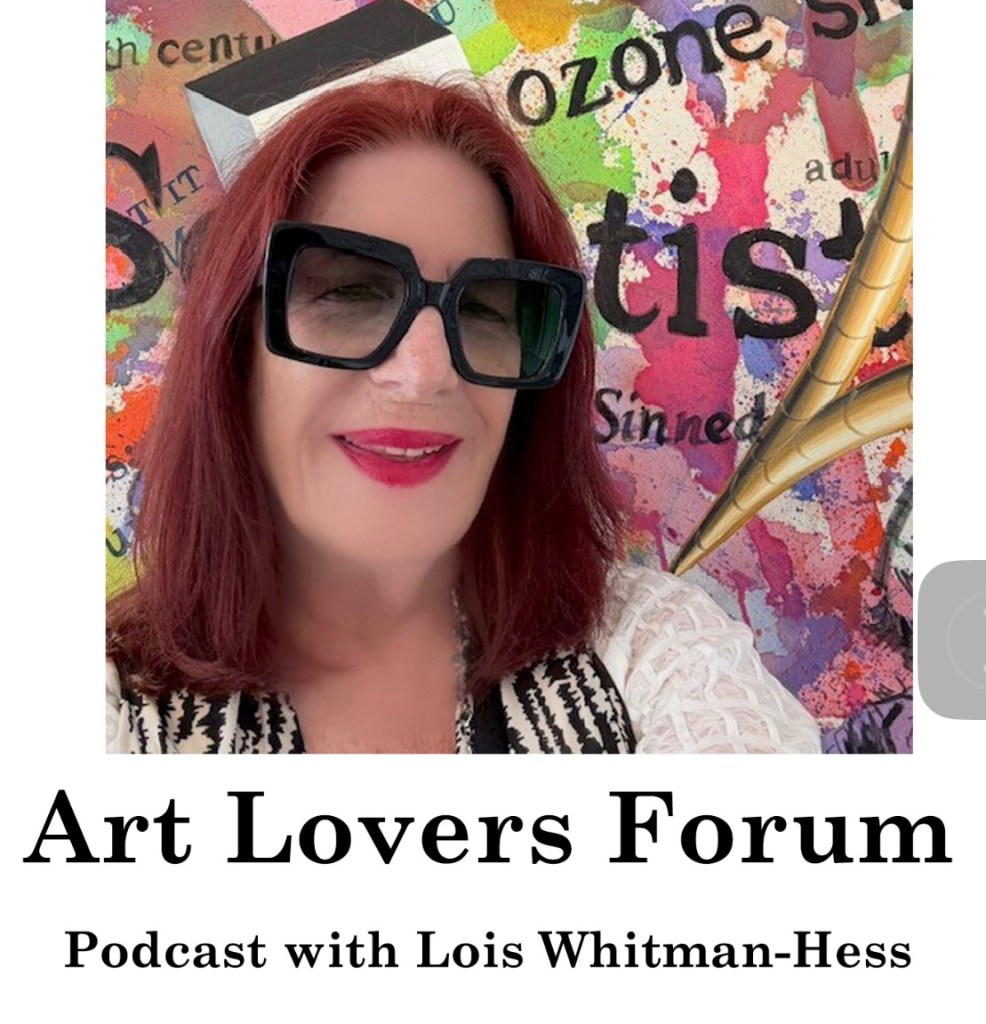
Welcome to Art Lovers Forum. Today we spotlight the bold, electrifying work of Cuban-American artist Alex Núñez, whose newest installation at the Faena Art Project Room in Miami Beach is a must-see this summer.
Titled “There’s a Gator in the Pool,” this site-specific immersive experience isn’t just art—it’s a full-body encounter. Núñez transforms the gallery into a surreal aquatic landscape, using glitter, gold leaf, neon paint, and mutant coral forms to reflect the fragile beauty and quiet chaos of our environment.
Known for her layered, high-energy works that pull from pop culture, memory, and ecological tension, Núñez invites viewers to step into a shimmering, disorienting world where danger and delight coexist. This is art you don’t just view—you feel it under your feet, around your body, and in your gut.
Whether you’re an art collector, a curious local, or a visitor looking for something unforgettable, this is one of the most talked-about installations of the season. Stick around—we’re diving deep with Alex on the inspirations behind her work, how Miami, Cuba, and New Orleans shaped her visual language, and why she believes beauty can be both seductive and unsettling.
NEW YORK MAGAZINE Kyoto Has Zero Zen A great exchange rate, ChatGPT, and kimono-wearing bros have turned Kyoto into the loveliest tourist trap on earth.
The art world is in the midst of change. I know of three galleries that closed in the last month. Is it reeling from the lack of creativity at the galleries? Have the galleries expanded too fast and raised prices too high? Is it a new generation buying art differently? Have the endless events like Basel and Frieze changed the consumer? Is it the ability for the artist to connect directly to a collector through social media? More than likely it is a combination of all these questions.
I have met artists who have been hurt by gallerists pushing their prices into places they shouldn’t be. Many of those artists didn’t sell for years or watched their prices peak before tumbling back down to reality, although it had nothing to do with the work, just the price.
There are the gatekeepers just like all industries where we have seen more monopolies. The newest wave in the art world is a group of people helping the uber-wealthy collect pieces that are of museum value as another asset class for their families. There are also new agencies and individuals who help the artists get into museums, or specific collections or help with their PR, where this has been something that gallery has done in the past. Is the gallery becoming only a vessel for selling artists work?
I do believe that there will be some major shifts happening in the art space in the years to come. Art reflects the times, and perhaps what is happening now is an indication of the cultural shifts that are happening, including younger generations that are looking at art very differently than the generations before them.
Since its founding in 1857, The Atlantic has excelled in covering matters of war, peace, and national defense. Nathaniel Hawthorne served as the magazine’s Civil War correspondent (Abraham Lincoln himself said that a favorable article in The Atlantic could save him “half a dozen battles”). The strategist Alfred Thayer Mahan advanced the idea of America as a global naval power in the pages of The Atlantic. We published the letters of General George S. Patton; the Cold War analysis of William “Wild Bill” Donovan, the founder of the CIA; and Frances FitzGerald’s historic reporting on Vietnam.
Today, as the post–World War II international order constructed and maintained by the United States is under unprecedented pressure (from within and without), issues of national defense and America’s role in the world are among the most urgent we face. Which is why The Atlantic is committed to rapidly and dramatically expanding the scope and scale of our coverage. Imagine an intersection at which American national security, defense spending, the rise of China, technological innovation, regional conflict, and the future of liberal democracy all meet; this is where you will find The Atlantic and our stellar team of reporters.
The expansion of our national-security coverage is built on superb talent: Journalists joining our team include such brilliant reporters as Vivian Salama and Nancy Youssef, who, until recently, covered the Pentagon and national security forThe Wall Street Journal; and Shane Harris, Missy Ryan, and Isaac Stanley-Becker, who covered defense and intelligence for The Washington Post. They will be working alongside Mark Bowden, the author of Black Hawk Down, and Tom Nichols, who taught at the Naval War College until joining us as a staff writer in 2022, among other great reporters. Our team is growing each month, and you should expect to find in The Atlantic the very best coverage of national security anywhere in journalism.
In our forthcoming print issue, devoted to the 80th anniversary of the Trinity test and the atomic bombing of Hiroshima and Nagasaki, you will find Tom’s examination of why the power to launch nuclear weapons came to rest with a single American—and the dangerous consequences for national security; Ross Andersen on how nuclear ambitions in east Asia are accelerating as American power recedes; retired Special Forces officer Mike Nelson on the myth that soldiers need to choose between lethality and professionalism; Andrew Aoyama’s essay about the Japanese American activist Joseph Kurihara, who was interned during WWII, after fighting for the U.S. during WWI; and Noah Hawley on Kurt Vonnegut and the bomb.
To read all of these stories—and everything else in The Atlantic—you’ll need a subscription. In my opinion, it’s worth it. A subscription not only gives you unlimited access to our journalism; it also supports our journalists in dangerous times.
Four years ago, an unconscious Kentucky man began to awaken as he was about to be removed from life support so his organs could be donated. Even though the man cried, pulled his legs to his chest and shook his head, officials still tried to move forward.
Now, a federal investigation has found that officials at the nonprofit in charge of coordinating organ donations in Kentucky ignored signs of growing alertness not only in that patient but also in dozens of other potential donors.
The investigation examined about 350 cases in Kentucky over the past four years in which plans to remove organs were ultimately canceled. It found that in 73 instances, officials should have considered stopping sooner because the patients had high or improving levels of consciousness.
Although the surgeries didn’t happen, the investigation said multiple patients showed signs of pain or distress while being readied for the procedure.
Most of the patients eventually died, hours or days later. But some recovered enough to leave the hospital, according to an investigation by the federal Health Resources and Services Administration, whose findings were shared with The New York Times.
The investigation centered on an increasingly common practice called “donation after circulatory death.” Unlike most organ donors, who are brain-dead, patients in these cases have some brain function but are on life support and not expected to recover. Often, they are in a coma.
If family members agree to donation, employees of a nonprofit called an organ procurement organization begin testing the patient’s organs and lining up transplant surgeons and recipients. Every state has at least one procurement organization, and they often station staff in hospitals to help manage donations.
Typically, the patient is taken to an operating room where hospital workers withdraw life support and wait. The organs are considered viable for donation only if the patient dies within an hour or two. If that happens, the procurement organization’s team waits five more minutes and then begins removing organs. Strict rules are supposed to ensure that no retrieval begins before death or causes it.
The investigation criticized Kentucky Organ Donor Affiliates, which was coordinating donations in the state. Now called Network for Hope after a merger, it has said it always follows the rules and never removes organs until a hospital has declared a patient dead.
But the investigation found that the organization’s employees repeatedly pressured families to authorize donation, improperly took over cases from doctors and tried to push hospital staff to remove life support and allow for surgery even if there were indications of growing awareness in patients.
Some employees failed to recognize that hospital sedatives or illegal drugs could mask patients’ neurological condition, meaning they might be in better shape than they seemed.
In December 2022, a 50-year-old overdose victim began stirring less than an hour after being taken off life support and started looking around. The retrieval attempt was not immediately ended, nor was the patient given any explanation.
“The patient had no idea what was going on but was becoming more aware by the minute,” records noted.
After 40 more minutes — when the patient’s organs would no longer qualify for donation — the attempt was called off, and he was moved to an intensive care unit. He later sat up and spoke with his family before dying three days later, the investigation found.
Overall, the investigation flagged 103 cases as having “concerning features” and said problems were more likely to occur at rural hospitals. It noted more than half of transplants arranged by the Kentucky organization were from circulatory-death patients, above the national average.
Nationwide, officials recovered about 20,000 organs from this type of donor last year, nearly double the total in 2021, according to the Organ Procurement and Transplantation Network, which oversees the transplant system.
Federal regulators told the network last week that the Kentucky organization must increase training for staff and conduct neurological assessments on potential organ donors every 12 hours, among other changes.
On Thursday, the organization said it had received a report about the government investigation. “We will fully comply with all of their suggested recommendations,” it said in a statement.
The federal inquiry began last fall after a congressional committee heard testimony about the Kentucky man, Anthony Thomas Hoover II, who had an overdose in 2021. He was unresponsive for two days before his family agreed to donate his organs.
Over the next two days, the procurement organization moved toward surgery even as his neurological condition improved, the investigation found. During one exam, records show, he was “thrashing on the bed.” He was sedated to prevent further motion.
The hospital staff “was extremely uncomfortable with the amount of reflexes patient is exhibiting,” case notes read. “Hospital staff kept stating that this was euthanasia.” A procurement organization coordinator assured them it was not.
When Mr. Hoover was taken for the retrieval, records show, he cried, pulled his knees to his chest and shook his head. A hospital doctor refused to withdraw life support. Mr. Hoover eventually recovered. Now 36, he has lingering neurological injuries.
In interviews with The Times, two former employees of the procurement organization said higher-ups tried to pressure the doctor to continue the retrieval attempt. “If it had not been for that physician, we absolutely 1,000 percent would have moved forward,” said one of them, Natasha Miller, who was in the room. Three other former Kentucky employees said they had seen similar cases.
The investigation did not say if there was pressure on doctors who treated Mr. Hoover. Network for Hope did not respond to a request for comment on that case.
The Kentucky attorney general’s office also launched an investigation into Mr. Hoover’s case. On Thursday, the office said the review was ongoing.
You’ll read about Bob Dylan’s father, Abe Zimmerman, in a book I am writing about being a trade reporter, then editor, during the first 10 years of CES. Abe ran an appliance store in Hibbing, Minnesota and spoke to me several times a month about the appliance business. He talked a little about his son but no one knew he would become such an icon.
In 1966, my job at HFD was to cold-call appliance retailers around the country in hopes of uncovering industry gossip that could turn into a front-page “scoop.” My editors, Manning Greenberg and Aaron Neretin, asked me not to talk directly to manufacturers—they were our advertisers, and one dumb comment from me could risk a contract.
Instead, I was assigned to call what we jokingly called the “sweaty armpits crowd”—the floor guys. These were the hardworking men stocking shelves and advising customers in appliance stores from coast to coast. Abe was the one who gave me the scoop about the birth of Best Buy. That story made me one of the most famous business writers in the country for years.
The big bonus was that Publisher Richard Ekstract hired me away from HFD and taught me and my future husband, Eliot Hess, all we needed to know about running a successful business. The book is mostly about working for Richard and the shenanigans that took place behind the scenes at CES.
Thank you Abe for the scoop. It made my dreams come true. You left us too early.
Today’s guest is someone who quite literally lives between worlds—both geographically and creatively.
Leslie Moody Castro is an independent art curator and writer who splits her time between Austin, Texas, and Mexico City, a rhythm she’s kept for over twenty years. Her practice is deeply rooted in movement, collaboration, and conversation—whether across borders, between disciplines, or within communities.
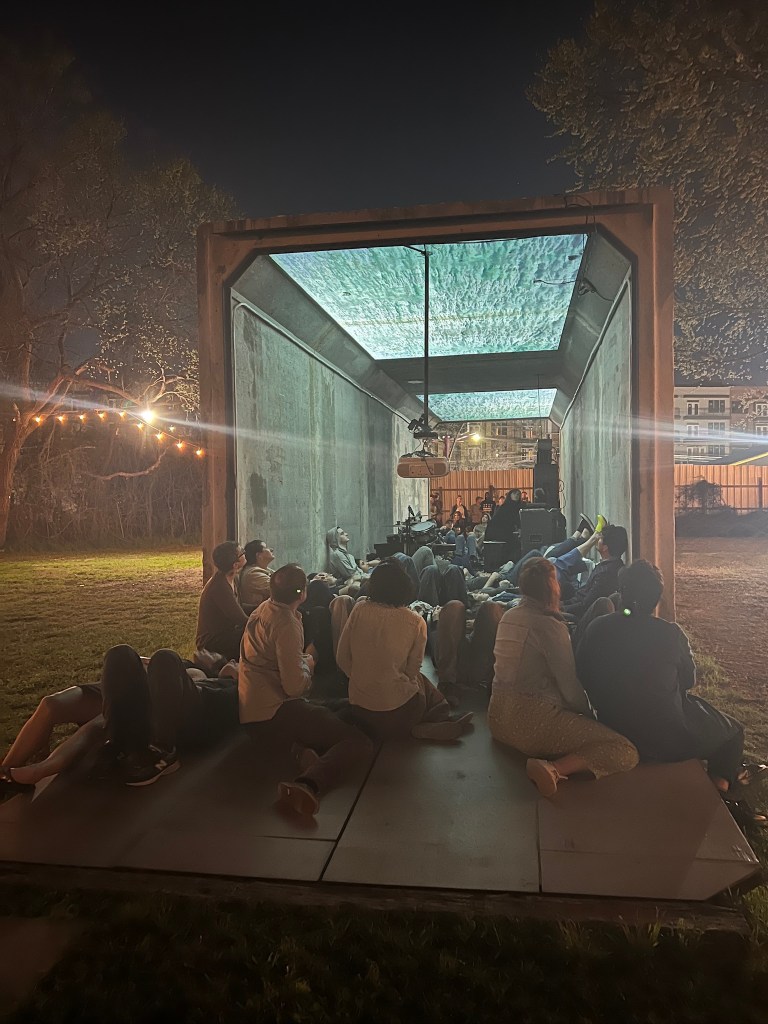
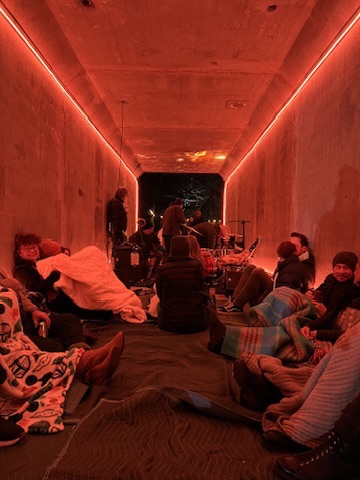
For nearly two decades, Leslie has produced and curated projects across Mexico and the United States, always with an eye toward creating spaces for dialogue and exchange. She’s the co-founder of Unlisted Projects Residency and Co-Lab Projects, a unique, artist-run nonprofit in Austin dedicated to experimental and collaborative art. (Fun fact: Co-Lab is housed inside five massive concrete culverts)—those structures that usually carry water underground—gifted by a neighboring concrete factory. Leslie, and partner Sean Gaulager, along with their team transformed the concrete culverts into an imaginative and unconventional exhibition space on an acre of Texas land).
In 2022, she was both the inaugural curatorial fellow at New Mexico State University and curator-in-residence at Casa Otro in Mexico. Her work has earned two National Endowment for the Arts grants and a State Department fellowship for her research on borders.
Leslie’s global perspective is also shaped by residencies from Estonia to Tepoztlán, from Miami to Mexico City. She’s curated several major biennials, including the 2018 Texas Biennial, the 2021 Amarillo Museum Biennial, and most recently, the 2024 Aurora Biennial. From 2021 to 2024, she was also the guest editor of Glasstire, Texas’s leading online arts magazine.
She’s the founder of AtravesArte, a platform dedicated to transborder art practices—and she’ll be the first to tell you: Mariachi makes everything better.
Click below to hear all about Co-Lab, the art gallery housed inside five massive concrete culverts, structures that usually carry water underground—gifted by a neighboring concrete factory. Leslie, and partner Sean Gaulager, along with their team, transformed the concrete culverts into an imaginative and unconventional exhibition space on an acre of Texas land).


































/media/img/authors/2021/06/Jeffrey_Goldberg_Headshot_bw_1/original.png)









 DigiDame