
A Profile On Our Pals

Why We Collect: Ian and Serge Krawiecki Gazes

The Miami-based couple on how a Keith Haring work started their journey

‘We met in New York in the early 1980s and became immersed in the East Village scene with Keith Haring and his generation of artists. We moved in together after about 3 weeks of dating and hung our first piece: a Keith Haring print from his ‘Fertility’ series (1983). That was the catalyst. It’s a small community and we met a lot of gallerists and artists, and later, collectors like Susan and Michael Hort who helped widen our horizons. Hilary is right: it does take a village.

‘We principally collect emerging artists who we enjoy discovering and supporting. We like to think of our collection as a sort of intellectual and experiential investment. It does more than just add flavor to our space: the artworks immerse us in different cultures, philosophies, and artistic viewpoints. Every work of art is a snapshot of an era, capturing reflections of society, human emotions, and thoughts. Watching an artist grow and seeing their works change over time is profoundly satisfying.
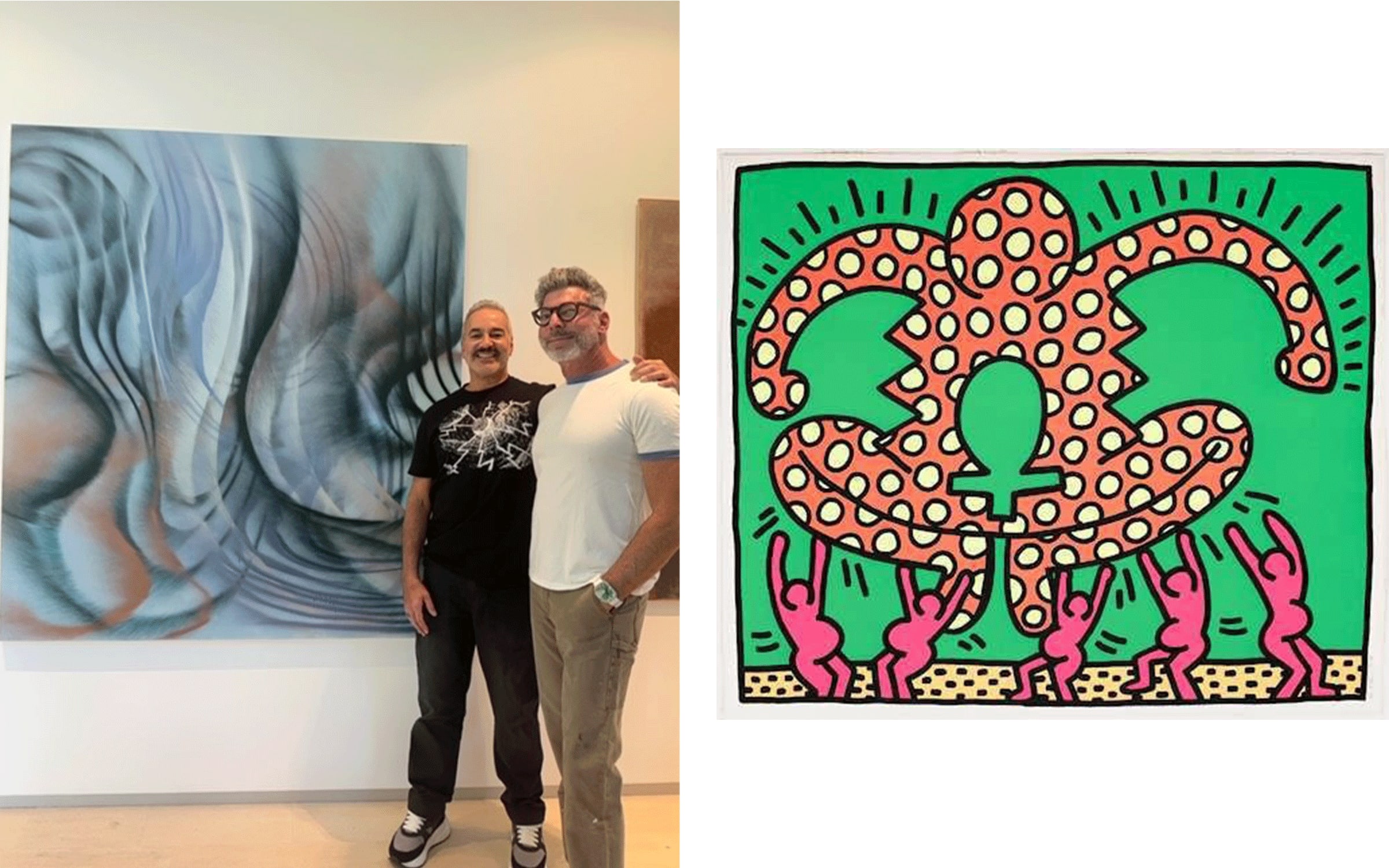
Left: Serge and Ian Krawiecki Gazes. Courtesy of the collectors. Right: Keith Haring, from the ‘Fertility’ suite, 1983. Courtesy of the collectors.

Left: Serge and Ian Krawiecki Gazes. Courtesy of the collectors. Right: Keith Haring, from the ‘Fertility’ suite, 1983. Courtesy of the collectors.

There are many artists from whom we’ve bought very early works. We bought one of Rashid Johnson’s signature mirror reliefs when we visited his studio and we’ve also collected work by his wife, Sheree Hovsepian. There has to be a mutual interest in what we purchase. We really enjoy the back-and-forth discussion it creates between us.   

‘In New York, we would open our home during the Armory fair each year. The art community could come and kick off their shoes and have a martini, and it enabled the artists see what their work looks like installed there. We didn’t only hang art that we had just acquired. We wanted to remind people that just because there are artists who are new and different, these other works are still great. We had Benjamin Degan’s first big painting Town Car (2010) in our living room above the sofa. He was so happy to see it – there were so many people there. It was very inspirational to us to feel that energy. 

Artwork by Rashid Johnson presented by Hauser & Wirth in the Unlimited sector of Art Basel in Basel 2018.

Artwork by Rashid Johnson presented by Hauser & Wirth in the Unlimited sector of Art Basel in Basel 2018.

‘We have lots of collector friends and mentor younger collectors. Of course, they are going to think about whether an artwork will appreciate, there’s nothing wrong with that. But you must buy what you love and be capable of living with it.

‘We have art that we’ve recently collected throughout our homes in Miami and New York, but this is just a sample. We have several facilities where we store it too. It really is everywhere. Our hallway is so long, and Serge came up with a fantastic idea for it: We created an art shelf that runs its length to show our smaller works on paper and photography, with larger works on the wall opposite. This space includes works by Holly Coulis, Emma Coleman, and Van Hanos; a painting by Nicole Eisenman of her brother; a painting by Hilary Pecis of the Hollywood Hills; a small work by Eddie Martinez that he gave us as a gift; an early portrait by Henry Taylor; and photography by Zanele Muholi and Wolfgang Tillmans. We fell in love with a painting by Sophie Larrimore which features a poodle (we have one so we’re partial to them).

‘A favorite work is Carlos and John Arthur (2021), a painting by Doron Langberg, which spoke to us because it portrays two lovers on the beach in Fire Island. It’s the place where we met in 1982 and we spotted many artists there at the time, including David Hockney and Andy Warhol. Doron is a gay artist who we knew before he was taken up by his dealer, Victoria Miro, and we always wanted to support him.

‘In Serge’s office there are paintings by Emily Mae Smith, Benjamin Senior, Maud Madsen, and Aaron Garber-Maikovska. In Ian’s office the artists include Andrea Marie Breiling, who works with spray paint. In the stairwell, where you might hang a chandelier, we have a light installation that we commissioned from James Clar. We even have a sculpture by Hugh Hayden in our wine room. We were so intrigued by his work when we saw it in London – a huge sculpture with tree branches stuck through it. We couldn’t buy it because we had no idea how to transport it, but right after we had a chance to acquire works here in the US, and then he had a show at the ICA Miami.

Artwork by Emily Mae Smith presented by Perrotin at Paris+ par Art Basel 2023.

Artwork by Emily Mae Smith presented by Perrotin at Paris+ par Art Basel 2023.

‘Much of our collection is work by artists who we’ve known since they began. In East Hampton, we bought a very rural property with a 100-year-old potato-peeling barn next to the house. In the summer, we gave the barn over to artists to work in whatever way they wanted, and we used to host galleries that would hold group shows. The artist Ryan Wallace used it as his studio for many years to make quite complicated multimedia pieces. 

‘Art is an education. It gives us so much pleasure to share the success of an artist in the sense that they’re being recognized, and people want to see their work.’ 

Artworks by Wolfgang Tillmans presented by David Zwirner in the Unlimited sector at Art Basel in Basel 2016.

Artworks by Wolfgang Tillmans presented by David Zwirner in the Unlimited sector at Art Basel in Basel 2016.

Skye Sherwin is an art writer based in Rochester, UK. She contributes regularly to The Guardian and numerous art publications.
Tech Onboard

The Carnival Vista arriving in the Port of Miami today in the early morning hours.

One of the many advantages of living in Miami is that you hear a lot about the cruise industry. You always meet someone who works for one of the cruise lines, or the “Miami Herald” has a news story about some development.

The other day there was a story in the Herald about the technological advancements in cruising. I wanted to write about it because so many DigiDame readers cruise all over the world. The changes that will be incorporated over the next five years will be astonishing.

One big attraction for guests is that new “smart” technology will help eliminate long lines and waiting time. This will be accomplished by facial recognition and geo-location. Carnival Corporation, Royal Caribbean Cruises, Norwegian Cruise Line Holdings and MSC Cruises are leading the way.

Other advances are using your smart phones for hotel keys, wearable, customized mini discs that will track your whereabouts for personalized service, interactive screens in staterooms, and RFID tags on luggage to track delivery times to cabins.

For more good news read the Miami Herald.

.

Get Rid of the Sex Toys Before You Can’t Remember Where You Put Them

20131112-222808.jpg

John Shalam, Founder, Voxx and Gary Shapiro, CEO of CES

I went to a CES event tonight at the Metropolitan Pavilion on 18th Street. This is a preview event for the annual CES held every January in Vegas. It was good to see that writers in their 50s and 60s were still very much in attendance. Most have been in the consumer electronics business for three decades. Over the years, many of these folks have accumulated lots of gadgets because they had to bench test them or write features on them.

One of the topics a few of us talked about tonight was what we were going to do with all the devices. Some had closets and bathtubs filled with them. Being the age we are, many claimed they wanted to dispose of their inventories so they could downsize. One guy who recently moved to Arizona from New Jersey said, “One of the toughest things about my move was getting rid of all the samples I’ve kept over the years.” Most of the products were out-of-date, but he couldn’t bear to part with them. He finally boxed them up and dropped them off at a nearby church. To this day he feels like he abandoned his children.

When I got home tonight, I read a story in the Boomers section of The New York Times about a similar topic: getting rid of sex paraphernalia before your children find these embarrassing items when you are no longer around.

I am going to let you read this study on your own. Be sure to catch the part about human sense of embarrassment after death. Ouch!

20131112-223824.jpg
Marc Finer

20131112-223946.jpg
Jason Henriques with Steve Greenberg and Adam Sohmer.

20131112-224327.jpg
Murray Slovak and Ken Sander

20131112-224509.jpg
Peter Lesser .

Combating the Tech Itch

I can’t remember if I found this cartoon on Facebook or someone sent it to me in an email. Either way, it applies to many of us.

20130211-154220.jpg

The Faces Behind The Names

As I mentioned in an earlier post, I attended a tech convention last week where I met up with a number of tech journalists when I was stationed at my client’s exhibit, Westinghouse TV’s. I thought it might be fun for you to see the faces of some of the people whose stories you read all the time.

John R. Quain, New York Times, chatting with Rey Roque, Senior VP, Westinghouse

Roy Furchgott, New York Times

Dennis Wunderlin, The Giz Wiz, and Dick De Bartolo, Mad Magazine

Tobey Grumet, Details Magazine and iVillage

Jim Willcox (on left), Consumer Reports

Gary Shapiro (right), CEO of the Consumer Electronics Show

Barry Myers of gdgt (right)

Steve Smith, TWICE Magazine

TO BE OR NOT TO BE

One of the greatest things about being in the tech industry for so many years is that I get to meet hundreds, maybe thousands, of people who have a dream of building or creating something. I can probably tell within minutes of meeting that person if he or she is going to be successful. 

Scary isn’t it? Not really. Most of the time the person’s success really depends on his or her personality. There are certain ingredients that an inspiring entrepreneur must have in order to be successful. Sadly, most people just don’t have what it takes. I know a lot of seniors live vicariously through some of the young folks today who created something out of nothing and sold it for a billion dollars, like Instagram, or now have their companies valued at a $100 billion, like Facebook. I have to tell my generation that 99.9 per cent of the young people in the digital world today are not capable of inventing something and turning it into gold. 

My advice is to hold on to your money. I am not trying to be mean or negative. I just want to be the conveyor of reality.  Most angel investors are prepared to lose their money. They deal with percentages. If one out of 10 deals work, they have made back their losses and if they are really lucky they made a sizeable profit. Investing in social marketing or smartphone apps is an art. The average person doesn’t know what questions to ask or how to evaluate the business plan. A word to grandparents. If you finance a grandchild’s dream, consider it a gift. You most likely will never see a return. 

Everyone thinks they are Mark Zuckerberg or Steve Jobs but the truth is unless today’s tech entrepreneur is obsessed with his or her work, compulsive, controlling, fearless, articulate and a problem solver, they will fail sooner or later.  I even dare to say that unless today’s entrepreneurs are willing to give up quality time with their families, they are dead ducks. That is just what it takes to make it in the age of the Internet where one week is like one day, one day is like an hour and one hour is like one minute. Internet time is much different than what the rest of the world is used to. Everything is instant response and instant gratification. 

I have witnessed so many people with tons of ideas that went nowhere fast. They just didn’t know how to execute. They were either so in love with their concept that they thought it would just take off, or they liked the idea of creating something but really had no interest in exerting enough sweat to see it to fruition. I can remember so many times, when I truly got excited about handling the public relations for a new invention or service only to have the creator flame out.  Many of these guys are screw ups and can’t handle success so they unconsciously do something that causes their downfall. 

My next blog post will be about some of the characters I’ve come across over the years. Get ready for a good laugh. You can’t make this stuff up.

BABY IT’S COLD OUTSIDE

One of the first things I want to write about is the desire I have to stay relevant in the work force. I don’t know where this ambition comes from. I have my suspicions but it is too early in this series of blog posts to discuss that. I was never a good student unless I had an excellent teacher who inspired me.

The workplace was a whole different story. I was 18 when I got a job as a copy girl (messenger) at WWD in Greenwich Village on September 9, 1966. The minute I entered that copy room I felt a rush of excitement that has stayed with me for 45 years. Being a part of a content engine that produces editorial has been totally exhilarating. Without it, I am not sure what would happen to me.

I have had friends who felt the same as I do about their fields of work. Months after they retired or got fired, they got debilitating or terminal illnesses. Some say I am exaggerating. Maybe those folks love their retirement so that they don’t understand those of us who identify ourselves by our work. That may be a sad statement to some but not to those who love the rewards of their careers.