I Can Get It For You Wholesale

My good friend Ron Goldberg has been working on bringing a revolutionary, intelligent (that means it has digital capabilities) walking assistant (cane) to market for a few years. Ron is a veteran writer in the consumer electronics industry and is highly regarded as an authority both in products and in the marketing of new technologies. I am not exactly sure how and why he came up with this new concept for canes, but he did, and he has been following his dream of introducing it while continuing to do his day job.

Yesterday, the dream came true for Ron and his wife Brenda. They officially launched the Isowalk, a walking assistant that will definitely replace primitive canes with ergonomics, biomechanics, and digital intelligence. Isowalk debuted on the popular Indiegogo crowdfunding site. Many new products and concepts now launch this way if they are still interested in raising funds for marketing budgets. The Indiegogo campaign will be live until July 25th and will be featured at the FashionWare wearable technology expo during CE Week in New York, June 26-27.

The press release announcing the product is below and the video above gives you a fabulous demo. Remember, you read it here first.

Isowalk is the first modern update of what is perhaps the world oldest technology by introducing the first digital walking stick. Holder of two U.S. patents, Kineticane, LLC will unveil its revolutionary digital cane at the January 2014 Consumer Electronics Show in Las Vegas, assuming a successful campaign to raise marketing funds via Indiegogo.

“We’re thrilled to unveil Isowalk through Indiegogo,” said company founder and CEO Ron Goldberg. “This human-facing technology fills a need that’s universal and very much in the spirit of the ‘crowd’ — we all know someone who has needed help with walking at one time or another. Our prototypes have electrified everyone that’s seen and used them, and, through this campaign, we will not only bring Isowalk to market, but also add the intelligence that will make it an important new smart object for digital health applications.”

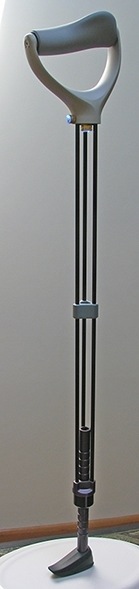
Groundbreaking design distinguishes Isowalk on numerous levels. First, a unique semi-spherical handle aligns the hand, wrist, and arm into ideal orthopedic positions, eliminating strain and maximizing leverage. Next, Isowalk’s innovative center of gravity produces a pendulum action that advances automatically for each new step or stop, to or from any angle, with virtually no effort required.

Isowalk’s personalized technology uses a patented omnidirectional shock relief system that conforms to each user’s weight, force, and specific gait, providing customized cushioning for every step. Isowalk’s hand grip, modeled from fine bicycles and reversible for left- and right-handed users, intelligently distributes weight and eliminates both the direct and associated body strains inherent to cane use.

Isowalk’s novel tip offers triple the ground contact of a conventional cane tip for superior stability and safety. A series of thin carbon fiber shafts, stronger than steel but lighter than aluminum, replace conventional aluminum tubes and wooden rods, and make a distinctive visual statement.

In addition to raising marketing funds, Isowalk’s crowdfunded Indiegogo campaign will also propel the deployment of the wireless platform that can enable a host of related applications for this breakthrough device. “Smart” Isowalk models can transmit alerts, monitor and archive wellness and recovery data, provide short and long range location feedback, and more. Noted Goldberg, “Isowalk will be an important new carrier for connected applications. It’s wearable technology that the user doesn’t have to wear.”

Isowalk’s Indiegogo campaign runs through July 25. Indiegogo contributors will receive the first models; general availability via e-commerce will follow.

Contributor perks, and demonstrations of Isowalk features, can be seen at http://www.indiegogo.com/projects/isowalk-intelligent-mobility

20130619-221602.jpg

20130619-221614.jpg

Jobs, Gates, Page/Brin, and Now Musk

Many of you have never heard of Elon Musk, but I urge you to write his name down and watch the video I have attached because he may be the next Benjamin Franklin, Thomas Edison, or even Isaac Newton. He is still not as accomplished as Steve Jobs, Apple; Bill Gates, Microsoft; or Larry Page and Sergey Brin, Google — but chances are he could surpass them.

Musk has a greater chance of becoming the holy name in history books for his work on the Internet (founded PayPal), bringing electric automobiles to fruition (CEO of Tesla Motors), and furthering rocket technology so we can all eventually have multi-planet lives (founded SpaceX).

There must be something to this guy. At 42 years old, this South African native is worth $3 billion, has been married twice, is currently available (he denies he is in a relationship with Cameron Diaz), lives in Los Angeles, has five children, and plans to bring us innovation like we have never seen before.

During a milestone interview with Walt Mossberg and Kara Swisher at the recent AllThingsD conference, Musk revealed some startling hints about his energy efficient car company,Tesla (NASDAQ: TSLA) and other inventions he is working on.

For example, Tesla cars, in the not-too-distant future, will be able to travel from coast to coast thanks to the recent addition of a network of super-charger stations. Musk also says the Tesla car, at a price of $70,000 now, will sell for $30,000 in three years.

Watch the news today or tomorrow, because some other kind of invention — a cross between a Concorde airplane, a railgun, and an air hockey table — is being unveiled as the fastest and cheapest vehicle to get from Los Angeles to San Francisco.

The interview also reveals what SpaceX is developing and why he feels we may all be leaving planet Earth someday. Thank you Walt and Kara (the two of them are geniuses in their own right, bringing cutting edge news to us around the clock throughout the year) for posting this video on YouTube. It is truly history in the making. And I didn’t miss the extraordinary appearance of Esther Dyson during the Q and A. All that brain power in one room makes me so happy to be able to watch this power conversation over and over.

Zipcar-Style Service for Renting Small Airplanes

20130617-221126.jpg

I just may never leave my house again. There are objects flying all over the place. A few days ago, I wrote about flying automobiles, yesterday I covered flying bicycles, and today I have discovered that the aircraft industry has given birth to a Zipcar-style service for renting small airplanes.

OpenAirplane is an online company that makes renting an aircraft much easier. OpenAirplane has small airplanes for rent at airports in New York, Los Angeles, Chicago, San Jose, Kissimmee, and Detroit. Many more are being added all over the United States.

This is how it works. You become a member of OpenAirplane and then take a standardized flight exam so you will be granted the ability to rent an airplane quickly.

It’s as simple as that. If you are granted to be an OpenAirplane pilot, you can then book an airplane online, even using a new mobile app. This is getting too easy. You don’t have to stop at the rental office. The keys are inside the craft.

20130617-221136.jpg

Get Ready to Get High

A few years ago, we never would have believed that most of us would be reading electronic books. Ebooks have definitely gone mainstream. Now it’s time for bicycles and automobiles to go through major transformations. As difficult as it is to believe, both moving vehicles will be climbing to new heights.

The other day, I showed you a well-funded company from Woburn, MA, that is testing the potential of a flying automobile. If this company doesn’t make it, another will. That is just how technology evolves. The first person with an idea is not necessarily the one that brings it to market. Just be prepared; it’s going to happen.

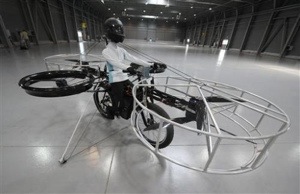
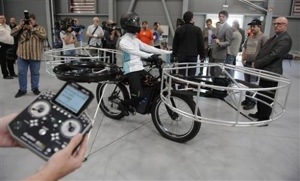
Now we learn that there is a flying bicycle in the works. Three Czech companies have teamed up to make a prototype of an electric bicycle that can fly. One of the first trials took places in a Prague exhibition hall last week. The bike, which was controlled remotely, landed safely after a five-minute flight.

Looking like a heavy mountain bike, it weighs 95 kilograms (209 pounds). It has two battery-powered propellers in the front, two in the back, and one on each side.

Bike frame manufactures are excited about these trials. Some are even designing the proper housing. That means if and when the flying bikes are ready to go, the frames will be available. Looks like we all may be flying through the air on a personal vehicle, one way or another in our lifetime.

20130616-225455.jpg

20130616-225502.jpg

20130616-225510.jpg

Google Sky’s the Limit

I feel like I’m writing a science fiction story. Some of the digital developments in the last decade have been beyond whatever I expected to see in my lifetime. This one is no exception.

The other day, Google announced its newest experiment, “Project Loon,” an endeavor to connect the entire world to the Internet. Google’s blog explains that it’s sending up countless giant balloons to beam down Internet access to remote regions around the globe.

“Balloons make sense for this purpose — they’re cheap to deploy and can provide wireless coverage in areas that would otherwise be difficult to serve due to geography.”

The pilot program has already started with 50 balloons in New Zealand. Google’s balloons fly 60,000 feet high and provide Internet speeds as fast as 3G networks. No surprise, Google is making all this happen with algorithms and a combination of wind and solar power. The balloons potentially float around the entire globe and communicate with specialized antennas. Internet providers on the ground transfer the signal to users for the last mile.

Google just started talking about this but the project has been in the works just under two years. When I first heard about it, I thought it was a joke. I felt the same way about Google glasses and their cars that drive themselves. This company never ceases to amaze. Oh, one last thing. Google calls this “Project Loon” because it is just that: crazy. However, they are determined to make it work.

Watch the video. It will blow you away. Excuse the pun.

20130615-231042.jpg

An Emergency Room in the Palm of Your Hand

Everyone has an emergency room story.

1) I had to wait five hours in the lobby before a doctor was available.
2) It took me forever to qualify my insurance coverage.
3) They couldn’t find a bed for me.
4) No one spoke English.

No matter what your complaint may be, we all agree that ERs are a necessity. I do have friends who suffer for days before they will go to the ER. I have other friends who look for ER alternatives like 24-hour, seven-day-a-week clinics. These places are popping up all over the country. ERs need relief. The doctors and nurses are overworked and underpaid for the true value they deliver.

You will be glad to know that now there is a new thing that puts an “emergency room in the palm of your hand.” All the details are in the video above.

Walter De Brouwer, the founder, came up with the idea for the first Star Trek-style medical scanner. The whole idea behind the Scanadu Scout is to capture the same information that is normally collected upon first entering the ER.

The Scanadu Scout is a clever, handheld sensor that measures your temperature, heart rate, blood pressure, respiration, and oximetry just by holding a sensor to your temple for a few seconds, “almost like a salute.” It collects your body data by measuring electrical changes. The person’s data is recorded to an iOS or Android phone app. It’s designed to be used by the most non-technical person.

De Brouwer told CNET, a tech news site, that the availability of the Scanadu Scout means all of us should be taking our vitals when we are feeling good as well as when we hurt. We should think of our bodies as “a river of data.” If you know the state of your health today, then you can take better care of yourself. Why wait until you get into crisis?

Puff the Magic E-Cig

20130613-184253.jpg

I’m just not prepared to give my opinion about e-cigarettes because I’m as envious as I can be. I’m desperate for a piece of chocolate cake right now but I have to suffer because there is no digital solution for my cravings. Yet, those who are addicted to cigarettes now have a solution called e-cig. Using technology that turns nicotine-infused propylene glycol into an inhalable vapor, e-cigarettes smoke almost like the real thing.

While the news media is just now declaring the e-cig is all the rage in the United States, I first saw it almost a year and a half ago when my friend Nadia from Bologna, Italy lit one up in my Miami apartment. Nadia has been a serious smoker her entire life and cannot be without a smoke for more than an hour. I know that many of you will have plenty to say about that, but Europeans and Asians don’t have the same attitude we do about smoking. They would rather have a cigarette than a slice of pizza. It doesn’t compute for me, but it does for the cigarette smokers, who are skinny as can be.

The e-cig was new to Nadia at the time, too, but I could see that it saved her from going nuts for a smoke. It was much more money than the price of a regular cigarette, but you could tell that was not even a consideration. At the time Nadia didn’t even want to face a flight across the ocean without the ability to smoke. When I questioned whether the airlines allowed e-cigs to be lit up, the answer was that every row had a user. I don’t know if Nadia is smoking the real thing or an e-cig at home in Italy now, but I will find out more next Christmas when she visits again.

Meanwhile, my substitute for food is chewing gum. Three o’clock every day is a killer for me. I just want to eat the refrigerator. I run for a pack of gum. Stick by stick, I complete the pack. I’m chewing now as I write this post. I need my mouth to be chewing something when I write, when I create. It’s all part of the process to me. I chew and the words come flying out. No gum, I get stumped.

Everyone has their schtick. Figure this, e-cigarettes are still a small percentage of the $80-billion-a-year smoking market in the United States. In Europe, however, the practice known as vaping is growing like crazy. E-cigs are so popular that the British government wants to treat it as medicine just to prove that it’s perfectly safe. The Food and Drug Administration in the United States is not so sure and is looking into the possibility of regulating it. Everyone wants to know the public health benefits or risks.

Meanwhile, I view it as a gadget that should be accompanied by an e-coffee.

20130613-184306.jpg

My First Speaking Engagement as DigiDame

20130612-230835.jpg

20130612-230824.jpg

Photos by Eliot Hess

Today was my maiden voyage as a guest speaker to senior groups around the country. The topic of the tour is “Why should seniors embrace technology?” My first stop was the Lenox Hill Neighborhood House Senior Center at Saint Peter’s Church, right next door to Citicorp Center in New York City.

Pardon the pun, but BINGO! Not only is this senior center one of the finest in the country, but the church that houses it is legendary. I really lucked out that they were one of the first to accept my offer.

I thought I was going to teach seniors who are in their 80s and 90s a thing or two about technology. I was so wrong. They taught me a thing or two about life.

If I want to be the champion of seniors delving into technology, then I better be ready to be thick skinned. This group was feisty and aggressive.

If they didn’t like something I said, they instantly demonstrated their displeasure: shallow weeping, holding heads in their hands, and, from one, a short nap. This is no different than some of the client presentations I have been involved in over the years.

Personally, I loved this group because it was a great indoctrination. My grandparents lived with us in tight apartment quarters for the first 22 years of my life. I wasn’t surprised by any of the abrupt reactions from some of the senior citizens or nasty remarks to each other.

While my talk was well received, I now know that future presentations will have to be spontaneous. Seniors don’t want prepared remarks. They want you to be ready to answer their questions immediately. There was zero tolerance for my agenda.

I really had a good attitude today before, during, and after the discussion, thanks to my entertainer friends Ron Abel and Chuck Steffan. Walk in prepared and play your heart out no matter if two or 200 people show up. I also spend a lot of time around Steve Greenberg, a TV personality. He has shared many war stories about last minute show biz changes.

Hanging out with them over the last few years has taught me that I shouldn’t have any pre-conceived notions about how things were going to go, and to expect anything.

Only a dozen participated in the discussion, even though there were 50 nearby in the main room which was occupied by other activities. It really didn’t matter to me because my only concern was what I was prepared to deliver. I was so ready that when they turned the tables on me, it was easy to be flexible.

My job was to get the senior citizens motivated. If that meant taking a few detours along the way, so be it. We were there to beat the clock.

20130612-230949.jpg

20130612-231034.jpg

20130612-231215.jpg

Your Own Personal Elevator

20130611-212958.jpg

DigiDame learned a new elevator trick today, but if you share it with too many people, it won’t work anymore. The whole exclusivity thing goes right out the window. In order to share with others, make sure they are a member of the DigiDame club.

That means they subscribe to my blog. If they don’t receive an email blast from my WordPress blog in the wee hours of the morning, then they don’t deserve to know the following. Pinky swear that you will shut them out.

This will only work for believers. Like Peter Pan says, “You have to believe.” This is for everyone who enjoys an express elevator ride. No stopping for the other guy. Just look straight ahead and act as innocent as you can.

Remember, you now have a first class ticket, bypassing all other stops on your way to your hotel room or apartment in the sky.

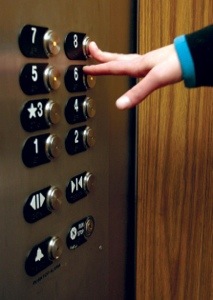
Step into the elevator and face the door. Note your room assignment and keep in mind which floor you need to press on the display panel at the front of the elevator. Some elevators have two panels, one on either side of the door, while others have only one.

Prepare to hold down two of the buttons on the panel at the same time before the door to the elevator starts to close. Press the number button for the floor you need and the button that closes the elevator door simultaneously. Note that the designation for the button that closes the door may show two arrows facing each other.

Hold the two buttons down together for at least five seconds to make the elevator go straight to your floor. Ignore the confused looks of the other patrons riding the elevator and enjoy your nonstop ride to your floor.

Remember, you have to believe. Then it works.

20130611-213008.jpg

Jog Your Memory

20130610-225835.jpg

I’m not sure how and when it started, but the big communications platform today is conference calling. Anyone who is heavily involved in business today has several conference calls set up on a routine basis every week, if not every day. I call these Checkpoint Charlies which means that strategic partners working on the same project all call into a conference number at a designated time to give their status on the project.

Most workers set up conference calls through an outside service where the person who initiates the call can choose options like record, mute, and transcribe. It’s really a wonderful way to communicate because there is no travel involved, many parties can participate, and you can call in from anywhere in the world.

Today, I found out about another kind of conference call service that possesses a total wow factor. Of course it comes in the form of an app. Wait’ll you read this. MindMeld is a voice and video calling app that totally understands your conversation. While you are talking, the app finds and shares related information for everyone involved.

MindMeld lets you make calls with up to eight people. Everyone has to use their iPad. MindMeld actually understands what you say and proactively finds relevant pictures, videos, and articles from documents on your iPad or from the Internet.

What’s more, MindMeld continuously analyzes the last 10 minutes of any conversation to anticipate the information you may need in the next 10 seconds. This all sounds like magic to me. Watch the video below for a detailed demonstration.