152 Minutes With Robert Gottlieb

I love this book publishing and New York City story —LWH
By Matthew Schneier

The 91-year-old book editor waits for his 87-year-old star writer, Robert Caro, to turn in his latest book.

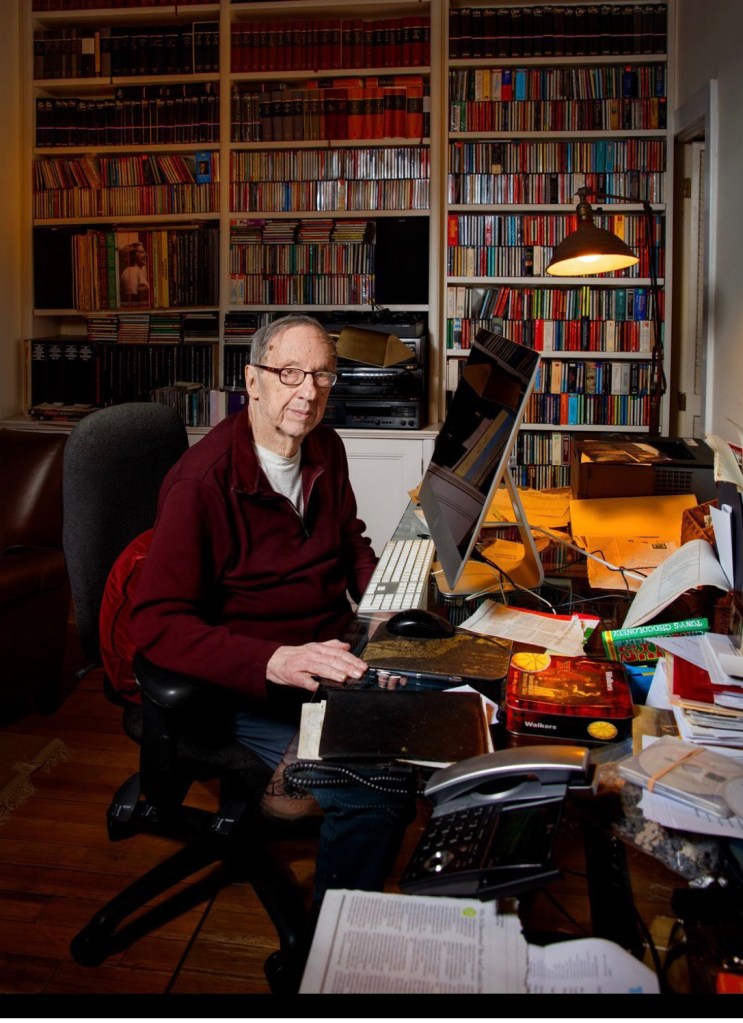
The life of the editor Bob Gottlieb, at a spry 91 years old, is nowadays largely limited to a single room on the second floor of his East 48th Street townhouse — by choice, not necessity. He can bound up Second Avenue just fine to the diner that he considers an extension of his home, where the waitress knows he takes his chocolate milkshakes extra thick. But everything he needs, his library and his pencils, is right here, so why go farther? To receive guests like this one, he didn’t even have to put on shoes or tame the gull’s-wing sweep of his silver hair. Burbling away in a leather club chair in his book-lined office (they are arranged according to a system, he says with a point to his head, that’s “up here”), with piles of more books on the floor and in the corners, beneath giant MGM publicity posters of Marion Davies, Clark Gable, and Norma Shearer from the early 1930s, he is a man in his element. “I don’t want to go anywhere because there’s nowhere I want to go,” he says in his fluty register. “My life is very calm, just the way I like.”

It is here that he waits for one of his most famous writers — and he has edited many of the past century’s most famous ones, including Cheever, Rushdie, Lessing, and Naipaul — to turn in a long-awaited manuscript. Assuming, that is, the pair beat what Gottlieb notes dryly are the “actuarial odds.” Robert Caro, 87, whom Gottlieb has edited since his first book, The Power Broker, published in 1974, is at work on the fifth and final volume of his Lyndon B. Johnson biography. Their long relationship is the subject of a documentary, Turn Every Page, directed by Gottlieb’s daughter, Lizzie, which arrives (well before the Johnson book) on December 30.

Gottlieb is perhaps the longest-serving man in publishing, a living link to those days when a successful book editor and his stage-actress wife could buy themselves an entire Manhattan townhouse like this one and stuff it full of books. Their house, and his office, looks out onto the private, semi-communal Turtle Bay Gardens, shared with their neighbors on the block. “Bob never goes into the garden, you have to understand,” says Gottlieb’s wife, Maria Tucci, who has come home with lunch. “He says real Jews don’t like nature.”

Among their fellow Turtle Bay Gardeners over the years were Janet Malcolm and Gardner Botsford, the late New Yorker writer-editor couple, whose teenage daughter, Anne, became their babysitter. Katharine Hepburn lived along there, too (next door to Stephen Sondheim), and when Gottlieb was editing her book, he’d nip across to her house for meetings, entering through her back door.

Gottlieb joined Simon & Schuster in 1955 and eventually became editor-in-chief, then ran Alfred A. Knopf. In 1987, S. I. Newhouse hired him to take over The New Yorker from William Shawn and then fired him a few years later in favor of Tina Brown (Newhouse must’ve felt guilty because he promised him his New Yorker salary for life). Then it was back to Knopf.

Even at 91, he continues to work on occasional projects as an editor-at-large. (His next, Flora Macdonald: “Pretty Young Rebel,” out in January, is by Flora Fraser, whose mother and grandmother he has also edited.) What Gottlieb does, what he has always done, is read — widely and voraciously, if not, he says, as quickly as he once did.

At the moment, he is making his way through a recent biography of George III, the essays of V. S. Pritchett, and the work of the Soviet novelist and journalist Vasily Grossman, though I also spot copies of Janet Evanovich and Colleen Hoover, the currently best-selling romance writer. An editor, he notes modestly, is really just a reader — although he also likened the editing process to psychoanalysis, including the occasional transference.

Editors, as any editor can tell you, live in the shadow of their writers, reacting quietly behind the scenes, unheralded and little known. This is, evidently, how Gottlieb prefers it. “This glorification of editors, of which I have been an extreme example, is not a wholesome thing,” he once told The Paris Review. “The editor’s relationship to a book should be an invisible one,” he said then and believes today. “The last thing anyone reading Jane Eyre would want to know, for example, is that I had convinced Charlotte Brontë that the first Mrs. Rochester should go up in flames.”

He insists editing is neither an art nor a craft. It’s just “what I do,” he says. “I’m not an abstract thinker. I don’t think, really — I just react, which is what editors are supposed to do.” When I tried to press him further, he waved me away. “Don’t you feel like an idiot having to ask questions like that?”

Turn Every Page attempts to answer some of them. The film is a tender portrait of the two men that is saved from schmaltz by their occasional testiness, Caro’s in particular. According to Gottlieb, it has always been thus. “He was very wary about revealing himself,” he says of Caro. “I used to joke when we first met each other — I felt that if I said to him, ‘How are you?’ that was too invasive a question.”

Fifty years later, and thanks in part to the film, he adds, “he’s finally acknowledged that we are friends.” Until making it, Lizzie Gottlieb had barely met Caro, and it took some persistence to wear down his resolve. Her father was easier to crack. “Anything she wants is hers by definition,” he says.

Caro was a broke former Newsday reporter when he started work on The Power Broker, his megalithic study of Robert Moses. He delivered to Gottlieb a manuscript that, at over a million words, would be impossible to fit in a single volume and suggested publishing it in two. “We may be able to get people interested in Robert Moses once,” Gottlieb tells me — he’s said this before — “but we certainly can’t do it twice.” They set about trimming it by a third, but the finished book is still 1,200 pages. It won the Pulitzer Prize and is in its 66th printing.

Caro was not going to be limited by single volumes after that. From the start, the Johnson biography was planned to be three, though since then it’s grown to four published and one more on the way. “I don’t see anything while he’s writing,” Gottlieb says. If he has any idea when the book will issue from Caro’s Smith Corona, he isn’t saying. (Gottlieb himself uses a Mac.)

Turn Every Page plays up the drama of the editing process, emphasizing the (offscreen) sparring between the two men on subjects great and small. (There were, apparently, many blowups about punctuation, most especially the semi-colon: Caro for, Gottlieb against.) According to Gottlieb, these contretemps barely count. “I would say if there were any real disagreements between us,” he says genteelly, though I doubt he would tell me or anyone. The men did allow Lizzie to film them working together side by side — but only with the sound off.

This hands-on, cheek-by-jowl editing, once rare, is now basically extinct. “Publishing has grown more and more corporate,” he says. “I think it’s all changing. Luckily, I don’t have to deal with any of that.” Yet he remains chipper and uncynical, certain that Americans are still avid readers like him. (Avid Reader is the title of his memoir.) He seems less like a lion in winter than a springy Candide, though he thinks of himself more as a Norman Vincent Peale — mid-century author of The Power of Positive Thinking and, probably not irrelevantly, a best-seller.

I ask him if he was able to resist the impulse to try to edit his daughter. “We had one disagreement about the film,” he says. “I suggested she put an exclamation point at the end of the title. Because, to me, Turn Every Page is an exhortation. But she resisted.” He relented. “It’s here to take advantage of,” he says about his editorial guidance. “If it’s not an advantage to you, forget it.” Just to be safe, this article includes not one semicolon


More and More Jews Are Choosing Cremation

These rabbis aren’t happy about it.

According to one rabbi’s estimate, about half of American Jews are choosing cremation

By Stewart Ain January 5, 2023

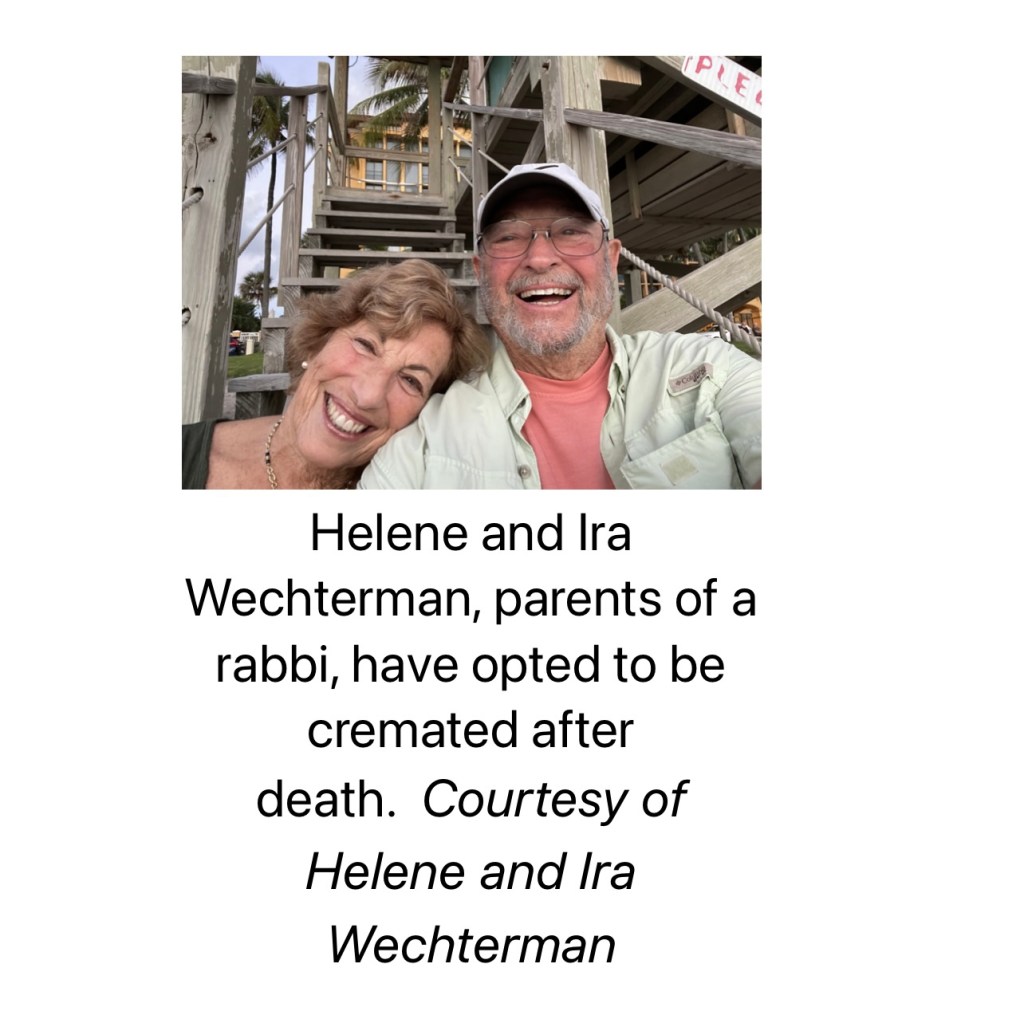
Ira Wechterman knows that Jewish tradition says Jewish bodies should be interred. It’s what he was taught, and what his own daughter, a rabbi and executive director of the Reconstructionist movement, encourages.

But Wechterman, 82, and his wife, Helene, 80, have decided they’re going to be cremated after they die. He sees cemeteries as a waste of land, and said he doesn’t tend his own parents’ cemetery plots but is pretty sure they don’t care about the weeds growing around their graves.

“I would rather have my children go to a place that was meaningful to us — they can go to any body of water and think of mother and dad sailing,” said the retired Long Island dentist who now lives in Deerfield Beach, Florida. “If my wife and I are cremated, we can have our ashes put into the Gulf Stream and eventually they will float up to Port Jefferson where we used to live.

The Wechtermans’ choice is one more and more Americans are making. According to the Cremation Association of North America, more than half — 58% — of Americans who died in 2020 were cremated. The National Funeral Directors Association expects about 80% to be cremated by 2040.

Cremation figures for Jews are lower because a traditional Jewish funeral involves a burial. Even the more liberal streams of Judaism, including the Reform and Reconstructionist movements, call for it.

There are nuances among Jewish viewpoints. Orthodox Jews are more likely to describe cremation as unacceptable and a desecration. Jewish law “is unequivocal that the dead must be buried in the earth,” states a Chabad website. According to a Reform movement document, cremation should be discouraged, but in Biblical text “nowhere do we find an express prohibition of the burning of the corpse.”

What is clear across movements is that an increasing number of Jews are opting for cremation. There are no hard numbers on this. But rabbis, Jewish funeral directors and others who work closely with bereaved families are estimating numbers not far behind those for Americans in general. Some are trying to push back against the trend. A leader in this countermovement, Rabbi Elchonon Zohn, has called on rabbis to dedicate this coming Shabbat to combatting “the cremation crisis.”

Zohn, who is Orthodox and the founder and director of the National Association of Chevra Kadisha, or Jewish burial societies, said that based on reports from members, about half of American Jews who die are cremated. It is growing “by leaps and bounds,” he said.

Among those who seek out Jewish burial societies, which tend to attract Jewish families seeking more traditional funerals, the numbers may be lower. But they are climbing, said Charles Hirschberg, of the Dallas Chevra Kadisha. About 20% of the families his group serves request cremation, up 50% in the last three years, he said.

These figures are far higher than the single and low-double digits that the Forward found 10 years ago when it asked clergy and others to estimate the number of Jews being cremated.

But Hirshberg, Zohn and others who want to dissuade Jews to stop choosing cremation are working against increasingly strong convictions within the larger Jewish community that people should be free to decide how they want to dispose of their bodies and that their families and clergy should support them.

Zohn has organized a national campaign to “help all Jews choose burial.” Its website lists more than 650 synagogues in the U.S., Canada, Great Britain and Australia that are taking part.A flyer for a campaign to dissuade Jews from cremation.

“Burial is not merely a Jewish ‘tradition,’” the website states, explaining that the mitzvah, or commandment, of burying the dead comprises two of the 613 compiled by Maimonides: “a positive commandment of burying a body, and a negative commandment of not leaving a body unburied.”

Zohn, who is hosting two webinars on the topic on Saturday night and Sunday, said he picked this Shabbat to dedicate to the cause because the Torah reading this week, Vayechi, deals with Jacob’s death and his directive to his children that he be buried in Israel and not in Egypt, where he was then living.

He also wants rabbis to talk to their congregants this weekend about other end-of-life issues, “purchasing a grave and about having a living will and life insurance.”

But Zohn and others who are trying to convince more Jews to choose burial also know they are up against compelling financial realities. In general, burial costs more than cremation.

“Ninety percent of the problem is that the cost of a funeral in Dallas is about $10,000 and the cost of cremation is $2,700,” said Hirschberg of the Dallas Chevra KadishaIn response, his group is offering loans to families to shoulder the burden.

A 2021 study from the National Funeral Directors Association shows the median cost of burial to be closer to that of cremation, with a viewing and burial of a body at $7,848, compared to $6,970 for a viewing and cremation.

Jews who are trying to get other Jews to reject cremation also invoke the Holocaust, in which 6 million Jews died, many in crematoria.

“From time immemorial Jews have avoided cremation,” Hirschberg said. “One of the reasons the Nazis used cremation is because they knew what a shanda” — a disgrace — “it was for Jews.”

A survey of the four major Jewish movements — Orthodox, Conservative, Reform and Reconstructionist — shows that all discourage cremation, some more strongly than others. All also indicate that there are rabbis within them who will take part in a memorial service for someone who was cremated.

Rabbi Avi Shafran, a spokesperson for Agudath Israel of America, a group that represents Orthodox Jews, said that while he believes some Orthodox rabbis might decline to speak at a memorial service for a person who was cremated “as a matter of principle,” others would agree no matter the plans for the body. He also noted that Judaism does not call for a rabbi to be present at a Jewish burial.

The Reform movement has changed its position on cremation over the years, and not in the direction some might expect. In past years the movement had considered cremation permissible, but a recent statement from the Central Conference of American Rabbis calls for its members to “discourage” the practice. The position is based upon two threads of argument: that burial is the traditional Jewish practice and that, since the Holocaust, cremation has become associated with “one of the darkest periods in Jewish and human history.”

And “every rabbi can respond to requests for cremation based on their own understanding of tradition, Jewish history, the needs of the family, and their own conscience,” said Tamar Amitai, a spokesperson for the conference.

The Conservative movement holds that cremation “should be discouraged, but it is not formally forbidden,” according to Rabbi Jeremy Kalmanofsky, spiritual leader of Congregation Ansche Chesed on the Upper West Side of New York City. His writings on the subject were adopted by the movement’s Committee on Jewish Law and Standards.

Rabbi David Steinhardt, spiritual leader of Congregation B’nai Torah in Boca Raton, one of the largest Conservative congregations in Florida, takes a stance on cremation that many rabbis favor — keeping a distance from the process but embracing the family that chooses it. He said he will preside at a service for a person whose body was cremated, but only after shloshim, the 30 days following a funeral.

Rabbi Elyse Wechterman of the Reconstructionist movement said she will officiate at the funeral for a person who is to be cremated, reasoning that “just because there wasn’t a traditional burial, does not mean the mourners can’t have traditional mourning.”

She said she has seen tahara, the traditional washing of the body, performed in advance of a cremation. And she notes a case in which someone donated his body to science and research. “What came back six to eight months later were cremated remains and the family then had a funeral to make sure those remains were buried.”

Wechterman refers to her parents, Ira and Helene Wechterman, when she explains her willingness to serve families who have chosen cremation. It is a choice she would not make, she emphasized, but one she will honor.“So I approach it with an eye towards Jewish tradition and a pastoral response,” she said. “The key is flexibility with an eye on kavod hamet, honoring the deceased and comforting the mourners.”

Happy New Year

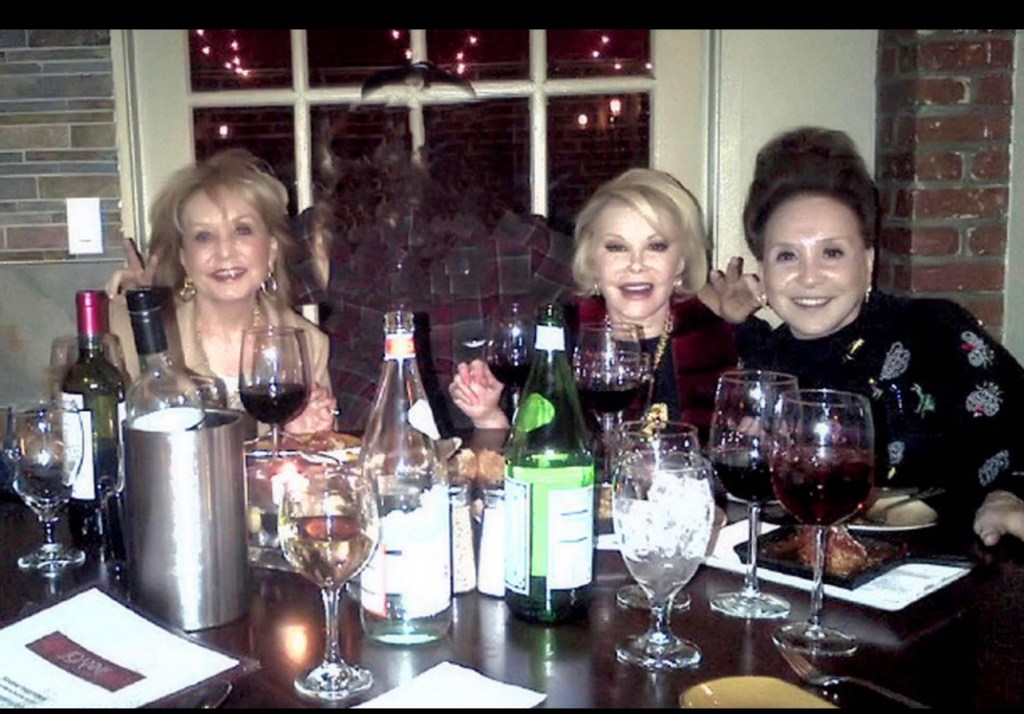
Eliot, Whitney and I sat next to these legendary ladies at Sarabeth’s, Central Park South, the first night of Roshashona, in the early 21st Century. It was such a “shanda” that we were eating out on a Jewish holiday but that’s what we decided to do that year. The restaurant was empty except for us. Then three old friends showed up and sat down right next to us. I got so “ferklempt” when I saw who they were : Barbara Walters, Joan Rivers, and Cindy Adams.

The three of us couldn’t believe our eyes. It seemed impossible that these women didn’t have other plans. We found out that they wanted to be with each other. Joan acted as the caregiver. She took care of the coats, pulled out the chairs, poured the drinks, secured extra napkins, and placed the food orders. I was proud that we didn’t bother them. A few other parties of two, or three, showed up an hour or two later. No one recognized the women. This is a typical New York City story. The women just wanted to be left alone to talk women stuff. Zei Gezunt!

💋💋💋💋💋💋💋💋💋💋💋💋💋💋💋💋💋💋

Happy New Year from the fireworks at 3601 on Miami Beach. Still drinking what Ruth Steinik Greenberg served at Christmas. Thx Ruth. We’ve been bubbly ever since.