Twice a year, New Year’s Eve and July 4th, we have a big bash at our Miami condo. That doesn’t mean we don’t entertain during the year, but not the size of tonight.
We are expecting around 75 people, but that number can swing either way depending on the weather. Everyone loves us on a clear night when they can see the fireworks.
Unlike parties of yesteryear, most friends come equipped with digital cameras. While it’s fun to try to capture the fireworks, it’s not necessarily an easy task. The trick is to press down and hold, only releasing at the instant you want to take the shot.
It’s now 5:51pm on my iPhone. As soon as guests start showing up, at 8pm or before, I will start snapping photos to post here. I just wanted to scratch this out first.
I don’t know if any of you remember, but just over a year ago I did a blog post about Sarah Main, a mommy blogger and PR agent whom I met on an American Airlines flight from New York to Los Angeles.
Sarah was traveling with her son Max to see her family in Santa Barbara. We became fast friends on the flight and were emailing each other from our seats over WiFi. We found it very funny at the time. One minute complete strangers, the next minute email and work buddies.
Fast forward to last week. Sarah assisted HWH PR at a trade show for two days, meeting and greeting the press. The remarkable feat was that Sarah had given birth to her second son, Harrison, just four weeks before. When I first told her about the assignment, she was nine months pregnant. She said that by the time I’d be needing her she would be in great shape, ready to leave home to spend some time with her peers. Let me remind you we’re talking a month after giving birth.
Sarah showed up at CE Week ready to work. I kept telling everyone she had given birth just a few weeks ago, but I don’t think anyone believed me. She was so involved with my client and the press you would have thought she didn’t have a care in the world.
I finally couldn’t stand it any longer. “Sarah, I don’t get it,” I said. “Aren’t you at all concerned about what’s happening at home?” Then she told me a shocker. “I know exactly what is going on: every feeding, every diaper change, every “movement” (even the color, sorry), the naps, the baths, etc. You name it, I know it!”
I didn’t see Sarah make one call to check on the new baby. Then she told me her secret weapon which, according to her, is all the rage with working moms. It’s called Baby Connect. Sarah demonstrated it for me and drew a crowd, even from daddies nearby, since everyone is looking for a way to keep an eye on their baby all the time. Be sure to tell as many young mommies as you can about Baby Connect. It can do the following:
1) Easily track feeding (bottle, nursing, solid food), diapers, sleep, activities, mood, milestones.
2) Track pumping and expressed milk.
3) Track medicines, vaccines, sickness, weight, height, head size.
4) Automatically synchronize data between accounts over the Internet.
5) Display graphical charts of the baby’s activities.
6) Display growth charts with percentile comparison.
7) Display all entries on a graphical timeline view.
8) A timer to track nursing duration. Which side was nursed last is indicated as a reminder.
9) A timer to track naps, activities, feeding sessions, mood.
10) Easily view entries from current and prior days.
11) Email formatted reports to spouses, doctors, and nannies or sitters.
12) Email graphs.
13) Upload child photo, indicate birthday, note blood type and allergies.
14) Track as many babies as you like, setup as many parents and caregivers as you like.
15) More than 100 built-in activities descriptions.
16) Existing built-in descriptions can be customized, new descriptions can be added.
17) Display real-time log of activities during the day.
18) Track the average duration and number of sleep sessions per day, and the longest sleep session.
19) Track the average number of bowel movements and wet diapers per day.
20) Track the average number, total, and average duration of feedings and pumping per day.
21) Track the number and average duration of nursing sessions per day.
The application has been designed for maximum security. Everything is password protected.
This is a very sensitive subject but one that needs to be addressed. CNN covered it today but I wanted to expand on it. The topic is “Helicopter Parents” or, in some of our cases, “Helicopter Grandparents.” In case you don’t know what that means, let me spell it out.
CNN claims the fate of the term “helicopter parent” as part of the American lexicon was sealed when it was introduced into the Merriam-Webster Dictionary in 2011 as “a parent who is overly involved in the life of his or her child.”
For some reason, “Helicopter Parents” have infiltrated the tech industry in epidemic proportions. Perhaps it is because many of them are still supporting their adult children in startups, or it’s just the nature of the baby boomer. Many of us made much more money than our parents, so we feel the necessity to try to control our children’s lives in order to insure their success. Notice I use the word “try.”
Some adult children are strong enough (like mine) to ward off any attempts of parental interference in their personal and business lives. Other adult children allow it because the demands on personal and business lives are so intense that it’s comforting to know that mommy and daddy are there as safety nets.
Let me offer one piece of advice. Parents and grandparents today are in no position to be dispensing advice. This goes for me, too. While we want to offer the wisdom of our experience, those lessons no longer necessarily apply. The world has changed so much because of technology that what worked for us doesn’t mean a thing to our offspring now. The mentality of how business and adult children function is so foreign to us that it would take us a lifetime to catch up. I couldn’t be more involved than any other business hustler in today’s workforce, yet I will be the first to tell you that my thinking is still foreign to how many leaders lead today.
You really should read the CNN piece. I’m not saying that many of you (us) are 100 per cent guilty, but the tech industry is starting to revolt about some of the scenarios they are witnessing. Being an employer for 37 years, I have had only two or three incidents where parents tried to insert themselves in my business decisions regarding their little darlings. They went away wounded but came back soon after to thank me because valuable lessons were learned, which CNN describes in detail.
The next time you get undressed in the comfort of your own home, start thinking that you’re not necessarily alone. The Massachusetts Institute of Technology (MIT) is working on a new technology that will allow smartphone users to see behind walls. Okay, cell phone users may not be able to see your naked body, but they sure will be able to tell where you are in the room.
I started hearing about this technological breakthrough a few months, ago but now it’s receiving more and more attention because MIT is getting closer to making it a reality.
Their PR machine is going into full swing for MIT professor Dina Katabi and her graduate student Fadel Adib. The two have announced “Wi-Vi,” a technology that uses Wi-Fi to allow a viewer to “see” a person moving behind a wall. “Wi-Vi” stands for “Wi-Fi” and “vision.”
The two educators explain it this way:
Wi-Vi is a new technology that enables seeing through walls using Wi-Fi signals. It allows us to track moving humans through walls and behind closed doors. Wi-Vi relies on capturing the reflections of its own transmitted signals off moving objects behind a wall in order to track them. Wi-Vi’s operation does not require access to any device on the other side of the wall.
The video above shows a demo of how Wi-Vi can track the motion of a person inside a closed room. While no one will confirm, my sources tell me MIT plans to license the technology to first responders and homeland security agencies who need to track the whereabouts of accident victims and terrorists. This should be interesting.
I am so lucky to be writing DigiDame because it forces me to focus on tech subjects that I think you, my 50-plus crowd, would like to know more about. Sometimes I get stories on the job, contacts, research, and even from industry discussion groups.
I learned about the “so called” Steve Jobs of China from a techie girl friend who just returned from a whirlwind Asian tour. She actually met the young, billionaire entrepreneur who consistently wears black turtlenecks and jeans and behaves a lot like the Apple founder. The Chinese media is already calling Lei Jun and his company, Xiaomi, the “Apple of the East.”
We all heard of Chinese knockoffs but this is too much. All kidding aside, Lei Jun is nothing to snicker at. His company is selling millions of mobile phones (some say they look just like iPhones) and the Chinese market is counting on him to put that country on the map in the innovation category.
The reason Xiaomi (pronounced SHAO-mee) is being taken so seriously is because it did actually sell $2 billion in handsets last year. The potential is huge. China is the world’s largest mobile phone market.
Just like Jobs, Lei is highly regarded as a successful startup expert. He has a software company called Kingsoft that he took public in 2007 and walked away with $300 million. He also invests in other successful software and Internet companies, takes them public, and accumulates more and more wealth. His first success was a biggie, Amazon paid $75 million to acquire his e-commerce company Joyo.com. in 2004.
Forbes calls Lei one of China’s wealthiest entrepreneurs, worth $1.7 billion. It’s going to be interesting to see if Lei becomes as popular and beloved as Jobs on a worldwide basis. Can it happen twice in one lifetime?
I wanted to share some interesting facts about the Internet with you today. The information below was accumulated by Business Insider.
What The Internet Looks Like
The World Wide Web wasn’t always a sprawling network of computers circling the Earth. It was first invented by Tim Berners-Lee in 1989 on his NeXTcube from NeXT, the company started by Steve Jobs after he was ousted from Apple.
The Creation of the Word Internet
The word “internet” first appeared in the “Internet Transmission Control Program” booklet in 1974 as a shortening of the term “internetworking” or “inter-system networking. The entire story is featured in the book “Tubes.”
A Coffee Pot Inspired the Webcam
Once upon a time, there was only one coffee pot located in the computer lab at the University of Cambridge. The webcam was created to help people working in other parts of the building avoid pointless trips to the coffee room by providing a live 128×128 greyscale picture of the state of the coffee pot on several desktop computers.
Google Bought the Gmail Domain from Garfield, the Comic Strip
Before its acquisition by Google, the gmail.com domain name was used by a free email service offered by Garfield.com, online home of the comic strip Garfield.
When I was a youngster, I used to lose my keys all the time. It drove my mother crazy. Every time I did that, it turned into an ordeal. It meant finding a locksmith to change the locks, providing everyone in the household with a new set of keys, and spending money that was not in the budget.
Now that I’m writing about my carelessness, I can better understand why my mother was so upset. Back then, I didn’t see what the big deal was. It seemed like an easy cure to me.
Just as with many other things in life, I should have been born in these times. If you lose your keys in the digital age, all you have to do is reach for the clouds to retrieve another one. Wait till your hear this.
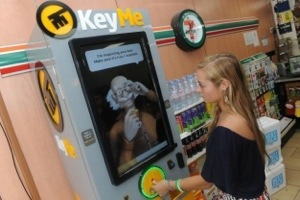
A new startup (there’s that word again) called KeyMe is putting kiosks in 7-Elevens across the nation so that you will be able to store a copy of your house key in the cloud and print a new metal one right on the spot if you ever need an extra copy.
This could have saved me a lot of grief. The first set of kiosks are in different Manhattan locations. Users are asked to scan and store key creation information in the cloud. That is completely free. Now comes the part my mother used to get upset about. Replacements cost approximately $20.
By now you must be thinking, this idea is a recipe for disaster. Thieves are all over the place. Not so. KeyMe requires you to scan your fingerprints when you set up your account, so you are the only one who can access the data needed for a duplicate key. Nice!
This start up tells big institutions like schools how much energy they are using each month and how to cut back.
This startup has an app that eliminates the need for a key to your home or office. You can now do it all remotely.
This startup has a music app that motivates you to do a more strenuous workout.
This startup as a monitor for you to check your dog’s health when you are away from home.
Want to stay young? Mingle with youngsters in their 20s or 30s involved in startups, especially in the tech industry. Today, I met up with a bunch of them at CE Week in NYC. I don’t remember this league of people when I was growing up, but there seems to a proliferation of young entrepreneurs every week.
When I was in my 20s, we finished school and got a job. I didn’t have friends, or friends of friends, who had a dream and got subsidized by family or outside investors until they managed to develop a revenue stream that they could live on. The usual protocol in my time was that you saved enough money to support yourself until you could to strike out on your own.
I am not sure when everything changed, but now an increasing number of kids want to be their own boss and carve out their own niche. This year alone I must have personally met 75 young founders at different startups where they had an idea and somehow, somewhere, got enough people to help support them with finances and services like housing, food, supplies, and tons of connections until they could make it on their own.
One day I really want to do a piece on how these kids manage to survive. It doesn’t matter if they have rich parents, convince money people to fund them, or work at a car wash on weekends. They all have a talent to make it happen. We will explore more about this in future posts.
It is fascinating to go behind the scenes and explore their voyages.
My feet are killing me. I just finished a full day of press appointments at CE Week, a consumer electronics trade show. I was standing in heels while talking to members of the media about a new touchscreen product Westinghouse Digital was introducing. It is totally revolutionary and, right now, geared for the presentation market.
The presentation market is made up of educators, trainers, medical, and any other folks who need a big whiteboard for demonstration. Imagine a tablet on steroids. The touchscreen unit is available from 55-inch high-definition to a massive 84-inch 4K (UltraHD). The largest screen will set you back $15,000. All of the models are compatible with the latest Windows 8 and 7 operating systems. That means the info on the whiteboard can be downloaded to a PC or laptop.
The specs on the unit are so technical that it would be crazy to list here. Look at the pictures that accompany this story to get an idea of the capabilities of whiteboards. They are quite magical.
I just read a report in the MIT Technology Review about how technology is destroying jobs. There is bit of a debate about this so I encourage you to read the report. Click here.
I worry about some of the people in the workforce who are stuck in the Mad Men era. They function in a time warp. Many of them are about to get a rude awakening. It is just a matter of time. Technology is replacing many jobs at every level imaginable. Americans need to prepare.
Erik Brynjolfsson, a professor at the MIT Sloan School of Management, and Andrew McAfee, associate director of the MIT Center for Digital Business at the Sloan School of Management, published a study that says there is a dismal future for many types of jobs in manufacturing, clerical, retail, law, financial services, education, and medicine.
They claim “advances in computer technology, from improved industrial robotics to automated translation services, are largely behind the sluggish employment growth of the last 10 to 15 years. People are losing their jobs.”
Brynjolfsson and McAfee still believe that technology could leave the typical worker worse off than before. “People are falling behind because technology is advancing so fast and our skills and organizations aren’t keeping up.”
They point out that technologies like the Web, artificial intelligence, big data, and improved analytics, all made possible by the ever increasing availability of cheap computing power and storage capacity, are automating many routine tasks.
Other MIT academics debate them. No one knows for sure, but be forewarned.