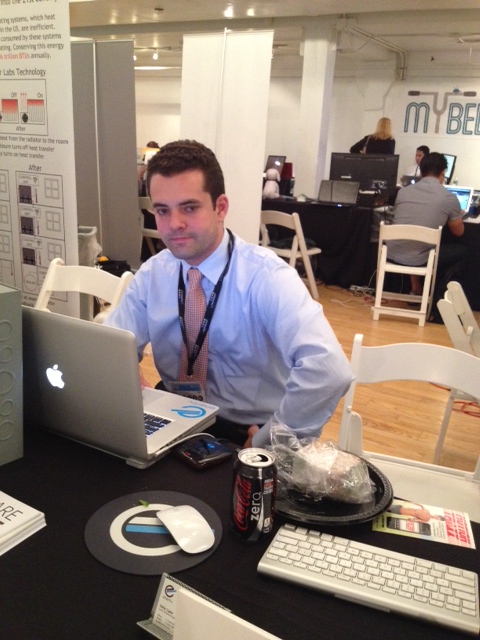
This start up tells big institutions like schools how much energy they are using each month and how to cut back.
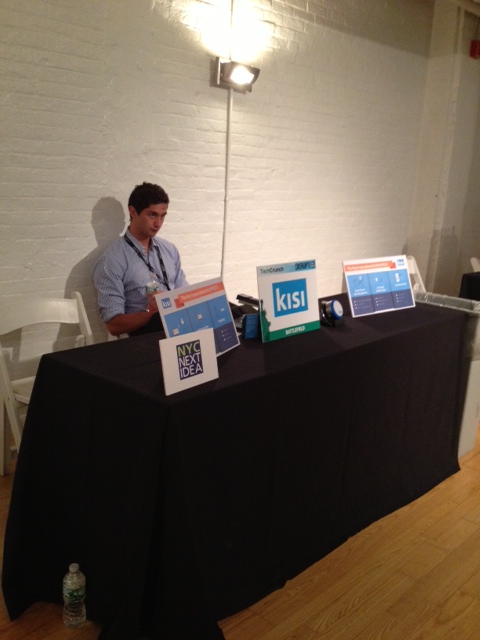
This startup has an app that eliminates the need for a key to your home or office. You can now do it all remotely.
This startup has a music app that motivates you to do a more strenuous workout.
This startup as a monitor for you to check your dog’s health when you are away from home.
Want to stay young? Mingle with youngsters in their 20s or 30s involved in startups, especially in the tech industry. Today, I met up with a bunch of them at CE Week in NYC. I don’t remember this league of people when I was growing up, but there seems to a proliferation of young entrepreneurs every week.
When I was in my 20s, we finished school and got a job. I didn’t have friends, or friends of friends, who had a dream and got subsidized by family or outside investors until they managed to develop a revenue stream that they could live on. The usual protocol in my time was that you saved enough money to support yourself until you could to strike out on your own.
I am not sure when everything changed, but now an increasing number of kids want to be their own boss and carve out their own niche. This year alone I must have personally met 75 young founders at different startups where they had an idea and somehow, somewhere, got enough people to help support them with finances and services like housing, food, supplies, and tons of connections until they could make it on their own.
One day I really want to do a piece on how these kids manage to survive. It doesn’t matter if they have rich parents, convince money people to fund them, or work at a car wash on weekends. They all have a talent to make it happen. We will explore more about this in future posts.
It is fascinating to go behind the scenes and explore their voyages.
My feet are killing me. I just finished a full day of press appointments at CE Week, a consumer electronics trade show. I was standing in heels while talking to members of the media about a new touchscreen product Westinghouse Digital was introducing. It is totally revolutionary and, right now, geared for the presentation market.
The presentation market is made up of educators, trainers, medical, and any other folks who need a big whiteboard for demonstration. Imagine a tablet on steroids. The touchscreen unit is available from 55-inch high-definition to a massive 84-inch 4K (UltraHD). The largest screen will set you back $15,000. All of the models are compatible with the latest Windows 8 and 7 operating systems. That means the info on the whiteboard can be downloaded to a PC or laptop.
The specs on the unit are so technical that it would be crazy to list here. Look at the pictures that accompany this story to get an idea of the capabilities of whiteboards. They are quite magical.
I just read a report in the MIT Technology Review about how technology is destroying jobs. There is bit of a debate about this so I encourage you to read the report. Click here.
I worry about some of the people in the workforce who are stuck in the Mad Men era. They function in a time warp. Many of them are about to get a rude awakening. It is just a matter of time. Technology is replacing many jobs at every level imaginable. Americans need to prepare.
Erik Brynjolfsson, a professor at the MIT Sloan School of Management, and Andrew McAfee, associate director of the MIT Center for Digital Business at the Sloan School of Management, published a study that says there is a dismal future for many types of jobs in manufacturing, clerical, retail, law, financial services, education, and medicine.
They claim “advances in computer technology, from improved industrial robotics to automated translation services, are largely behind the sluggish employment growth of the last 10 to 15 years. People are losing their jobs.”
Brynjolfsson and McAfee still believe that technology could leave the typical worker worse off than before. “People are falling behind because technology is advancing so fast and our skills and organizations aren’t keeping up.”
They point out that technologies like the Web, artificial intelligence, big data, and improved analytics, all made possible by the ever increasing availability of cheap computing power and storage capacity, are automating many routine tasks.
Other MIT academics debate them. No one knows for sure, but be forewarned.
Every year I forget about Wimbledon. I am hardly a tennis buff but I thoroughly enjoy watching these matches. There is something about Wimbledon that draws you into the sport.
The problem is by the time I turn on the TV and accidentally catch a game, half the matches are over. I guess I’m not the only one. YouTube has just announced a fabulous solution for everyone who is ultra busy in this digital age.
I never imagined having a choice like this, but now you can watch all of the matches online, live or at your convenience. They are showing it all, the games, the press conferences, interviews, and content from behind the scenes that was never available before.
Since I haven’t viewed YouTube’s new offering yet myself, I am not sure how the multiple live matches will be shown. I wanted to get the news to you as soon as possible. I have heard that YouTube is experimenting with their broadcasts to make sure you see the most exciting plays as they happen.
Since we are all experiencing this for the first time, be sure to share what you find out so we can equally enjoy this new development and not miss a thing.
I just took a peek. I wanted to see the replay where Steve Darcis beat Rafael Nadal. I am a big Nadal fan and all I could pick up was a Bosnia broadcast. I had to suffer watching the crushing moment without an English explanation.
Tom Twomey, an attorney with Twomey, Latham, Shea, Kelley, Dubin & Quartararo, a well known East End law firm, and his 1926 Flint Motor Car in front of the American Hotel. Both photos by Eliot Hess.
I love days like yesterday because it took me back to the time when we all weren’t so connected. Oh yes, we were connected, but in a much different way. We actually went to the local candy store to hang out, spent hours talking on the phone to our friends, and wrote letters to our loved ones.
A trip to Sag Harbor, smack in the middle of the Hamptons, is not exactly yesteryear, but it is a small village that frowns on using wireless communications equipment during restaurant meals and doesn’t put TV sets in their hotel rooms.
Dawn, the manager at the front desk at The American Hotel (a favorite of Keith Hernandez and Billy Joel), told me, “We really encourage guests to wind down.” She admitted that they are wired for the Internet but keep it on the quiet side.
Not everyone realizes this, but more public places than not lack cell and Internet coverage. It has always been a problem in the Hamptons. The town folks don’t want any part of it because they like their peaceful existence. They are not interested in hearing some advertising manager screaming slogans on his cell in the vegetable section at King Kullen. They also refuse to expand the width of Montauk Highway, the main road that goes from west to east. It is their way of saying “Go back home you city slickers.”
Most of the weekend homes have their own wifi connections. The same thing is true in Silicon Valley. Clients and friends have complained for years that the corridor south of San Francisco, home to Internet billionaires, has spotty connections. The main thoroughfare, Route 101, where millions of folks travel hours to and from work, has no coverage.
The Hamptons and Silicon Valley are like time machines. One minute you have the world at your fingertips, the next you wish phone booths still existed.
For almost two years, I have been trying to see all of my Tweets, yes, from the first post. Twitter allows you to scroll down just so far. Facebook does the same thing. For some reason, social media sites don’t like you to live in the past.
I was still determined to check out my history. I wanted to see who I said what about. Lo and behold, after searching for my Twitter archives, I found a full explanation in Settings.
I thought I would share it with you. It’s not that easy find on your own.
Downloading your Twitter archive to allows you to browse a snapshot of your Twitter information, starting with your first Tweet.
To download and view your Twitter archive:
Go to your account settings by clicking on the gear icon at the top right of the page and selecting Settings from the drop-down menu.
Click Request your archive. When your download is ready, we’ll send an email with a download link to the confirmed email address associated with your Twitter account.
Once you receive the email, click the Go now button to download a .zip file of your Twitter archive Unzip the file and click index.html to view your archive in the browser of your choice.
Please note: It may take a few days for us to prepare the download of your Twitter archive.
If you work for a large corporation today, you are required to change the passwords on all of your business accounts once a month. When I first heard about that, I gasped. I have approximately 87 passwords. Changing each of them every four weeks would be a full time job. Thank goodness I own my business. I will take my chances.
Interestingly enough, David Pogue, the personal technology editor of The New York Times, recently made a plea to all of his readers to change their passwords in order to avoid having their identities stolen.
“This is not a suggestion,” said Pogue in a recent video he did on the subject. “This is an order. Don’t take chances. Life can be pretty ugly when others have access to your banking, housing, and insurance accounts.”
Experts recommends using long passwords that contain digits, punctuation, and unrecognizable words. He also said that we should use separate passwords for every website we frequently visit. And just like the demands of corporations, we should change all of our passwords once a month.
As far as I am concerned, this is an overwhelming task. Like me, David has 87 account names and passwords for 87 websites, including banks, games, airlines, blogs, shopping, email, Facebook, Twitter, Instagram, Skype, Pinterest, Google+, and YouTube.
Even if I wrote all the passwords on one long piece of paper or stored them digitally in a folder, there is a great chance that I would forget where I put the paper or where I filed the folder. David has recommended many different software solutions to help retrieve your passwords. Today he swears by Dashlane, the 2.0 version, because it has timesaving features and it’s available for Mac, Windows, iPhone and Android. What’s more, it’s free.
The big bonus is that you can import current existing passwords from previous programs. It also has some extraordinary features. It’s a password memorizer. Dashlane actually takes over every time you try to type your account name and password into a web page and press enter. It’s all done for you.
There are so many other magical features like the creation of passwords and a display of pictures of your credit cards.
Ever since Natasha Richardson suffered a severe head injury on my mother’s birthday, March 16, 2009, I think about her every time I hear about someone getting banged around. I can’t get her out of my mind. I just feel her death was so senseless. This world-renowned talent, and a beautiful mother, wife, and daughter, died at such an early age (45) because of two lousy decisions while taking a beginners ski lesson. She wasn’t wearing a helmet and refused medical attention when the paramedics were called in after her fall. Three hours later Natasha was in critical condition and she lasted only two days more. An autopsy revealed that the cause of death was an epidural hematoma due to the blunt impact to her head.
I know of a new invention that “might” be a life saver in this type of circumstance. Before I tell you about it, I want to make a disclaimer that frees me of any legal obligation for my remarks. In no way do I mean that this new invention is going to be a cure all. I am merely suggesting that the new invention may be a good option to monitor any head injury.
Reebok and MC10, have joined forces to introduce a new impact-sensing cap that blinks yellow or red if you suffer a moderate or severe blow to the head. Blows to the head are pretty common to millions of girls and boys who play hockey, soccer, lacrosse and other contact sports.
The CheckLight is a washable beanie that has an electronics module tucked inside it. It can be worn under a helmet for football or hockey, or by itself for soccer and other helmet-free sports. It will sell for about $150.
Reebok makes the beanie and MC10 developed the flexible and stretchable electronics. Sensors in the cap — a tiny accelerometer and gyroscope — measure the head’s forward and twisting movements.
The sensor can be used for about 13 hours continuously and can be recharged with a USB cable. The total number of hits can be read when the battery is recharged.
Definitely look into this new product. Active people wear all kinds of protective gear. Start from the head down.
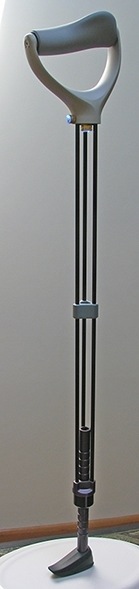
My good friend Ron Goldberg has been working on bringing a revolutionary, intelligent (that means it has digital capabilities) walking assistant (cane) to market for a few years. Ron is a veteran writer in the consumer electronics industry and is highly regarded as an authority both in products and in the marketing of new technologies. I am not exactly sure how and why he came up with this new concept for canes, but he did, and he has been following his dream of introducing it while continuing to do his day job.
Yesterday, the dream came true for Ron and his wife Brenda. They officially launched the Isowalk, a walking assistant that will definitely replace primitive canes with ergonomics, biomechanics, and digital intelligence. Isowalk debuted on the popular Indiegogo crowdfunding site. Many new products and concepts now launch this way if they are still interested in raising funds for marketing budgets. The Indiegogo campaign will be live until July 25th and will be featured at the FashionWare wearable technology expo during CE Week in New York, June 26-27.
The press release announcing the product is below and the video above gives you a fabulous demo. Remember, you read it here first.
Isowalk is the first modern update of what is perhaps the world oldest technology by introducing the first digital walking stick. Holder of two U.S. patents, Kineticane, LLC will unveil its revolutionary digital cane at the January 2014 Consumer Electronics Show in Las Vegas, assuming a successful campaign to raise marketing funds via Indiegogo.
“We’re thrilled to unveil Isowalk through Indiegogo,” said company founder and CEO Ron Goldberg. “This human-facing technology fills a need that’s universal and very much in the spirit of the ‘crowd’ — we all know someone who has needed help with walking at one time or another. Our prototypes have electrified everyone that’s seen and used them, and, through this campaign, we will not only bring Isowalk to market, but also add the intelligence that will make it an important new smart object for digital health applications.”
Groundbreaking design distinguishes Isowalk on numerous levels. First, a unique semi-spherical handle aligns the hand, wrist, and arm into ideal orthopedic positions, eliminating strain and maximizing leverage. Next, Isowalk’s innovative center of gravity produces a pendulum action that advances automatically for each new step or stop, to or from any angle, with virtually no effort required.
Isowalk’s personalized technology uses a patented omnidirectional shock relief system that conforms to each user’s weight, force, and specific gait, providing customized cushioning for every step. Isowalk’s hand grip, modeled from fine bicycles and reversible for left- and right-handed users, intelligently distributes weight and eliminates both the direct and associated body strains inherent to cane use.
Isowalk’s novel tip offers triple the ground contact of a conventional cane tip for superior stability and safety. A series of thin carbon fiber shafts, stronger than steel but lighter than aluminum, replace conventional aluminum tubes and wooden rods, and make a distinctive visual statement.
In addition to raising marketing funds, Isowalk’s crowdfunded Indiegogo campaign will also propel the deployment of the wireless platform that can enable a host of related applications for this breakthrough device. “Smart” Isowalk models can transmit alerts, monitor and archive wellness and recovery data, provide short and long range location feedback, and more. Noted Goldberg, “Isowalk will be an important new carrier for connected applications. It’s wearable technology that the user doesn’t have to wear.”
Isowalk’s Indiegogo campaign runs through July 25. Indiegogo contributors will receive the first models; general availability via e-commerce will follow.
Musk has a greater chance of becoming the holy name in history books for his work on the Internet (founded PayPal), bringing electric automobiles to fruition (CEO of Tesla Motors), and furthering rocket technology so we can all eventually have multi-planet lives (founded SpaceX).
There must be something to this guy. At 42 years old, this South African native is worth $3 billion, has been married twice, is currently available (he denies he is in a relationship with Cameron Diaz), lives in Los Angeles, has five children, and plans to bring us innovation like we have never seen before.
During a milestone interview with Walt Mossberg and Kara Swisher at the recent AllThingsD conference, Musk revealed some startling hints about his energy efficient car company,Tesla (NASDAQ: TSLA) and other inventions he is working on.
For example, Tesla cars, in the not-too-distant future, will be able to travel from coast to coast thanks to the recent addition of a network of super-charger stations. Musk also says the Tesla car, at a price of $70,000 now, will sell for $30,000 in three years.
Watch the news today or tomorrow, because some other kind of invention — a cross between a Concorde airplane, a railgun, and an air hockey table — is being unveiled as the fastest and cheapest vehicle to get from Los Angeles to San Francisco.
The interview also reveals what SpaceX is developing and why he feels we may all be leaving planet Earth someday. Thank you Walt and Kara (the two of them are geniuses in their own right, bringing cutting edge news to us around the clock throughout the year) for posting this video on YouTube. It is truly history in the making. And I didn’t miss the extraordinary appearance of Esther Dyson during the Q and A. All that brain power in one room makes me so happy to be able to watch this power conversation over and over.