Donald Trump Can Snarl All He Likes, But He’s Making a Star Out of Letitia James
The fraud trial playing out in New York “adds a lot of value to her political future,” says one Democratic strategist, but taking on a prominent Biden surrogate role in 2024 “would feed into the narrative that Trump wants, that this case is about politics.”
Donald Trump is doing a brilliant job of promoting Letitia James. The former president had been punching at New York State’s attorney general sporadically for more than a year, calling James a “racist” and a “disgrace” as her office investigated whether Trump and his company had committed fraud by manipulating the value of his businesses. But now, as Trump is on trial, he has taken to attacking James on a daily basis, raging to reporters outside the lower Manhattan courtroom while calling her “grossly incompetent,” a “monster,” and even a “deranged lunatic” on social media.
The publicity offensive is certainly ugly and perverse, but it is elevating James’s profile. The attorney general has already won one enormous victory against the former president: Last month, state judge Arthur Engoron ruled that James had proven that Trump and his companies committed long-running fraud in their financial statements. “This case was brought simply because it was a case where individuals have engaged in a pattern and practice of fraud,” James said on Wednesday. “And I will not sit idly by and allow anyone to subvert the law.” Upon the former president’s departure, James told reporters that “the Donald Trump show is over” and suggested his voluntary appearance in court “was nothing more than a political stunt, a fundraising stop.”
The current legal proceedings, which could last until December, are to determine what penalty Trump will pay, from a monetary fine to being barred from doing business in New York State. Perhaps Engoron will allow Trump to walk away with an anticlimactic slap on the wrist. But the odds that James will earn a large legal triumph and accumulate a sizable stockpile of political capital look far better.
Political capital that she will cash in to go…well, probably nowhere. The earnest, consensus view is that James will stay put because she loves her current job. “Tish is not interested in publicity or what drives most elected officials,” says Roberto Ramirez, a former New York Democratic state assemblyman who knows James well from his work as a strategist on several of her campaigns. “She is the unicorn of New York politics. She is obsessed with the substantive nature of being a lawyer for the state.”
There is also the hard political reality that James is boxed in. New York senators Chuck Schumer and Kirsten Gillibrand aren’t departing anytime soon. Two years ago James mounted a brief, half-hearted run for governor (“The people around her wanted it far more than she did,” a state Democratic insider says), and the incumbent, Kathy Hochul, won’t be on the ballot again until 2026. In the past, James has talked far more enthusiastically about running for mayor of New York City—but it is very hard to see her giving up a powerful statewide office for a bloody 2025 primary challenge to fellow Democrat and fellow Brooklynite Eric Adams.
And then there’s the more intriguing constraint on James’s enhanced prestige: She would undermine a defeat of Trump by trying to capitalize on it. Joe Biden’s reelection campaign is highly worried about turning out crucial Black voters, particularly women, in battleground states. James would be an energetic, effective surrogate—except that making her a prominent part of the president’s campaign would hand Trump ammunition. “This case adds a lot of value to her political future, and it inoculates her from what a lot of women in her position have to deal with, being more credentialed and validated in ways that men don’t,” says Cornell Belcher, a Democratic strategist who worked on both of Barack Obama’s White House runs. “But the Biden campaign couldn’t and wouldn’t use her, because it would feed into the narrative that Trump wants, that this case is about politics.”
James certainly doesn’t lack ambition. She maneuvered through the treacherous, corruption-prone ranks of the Brooklyn Democratic Party to be elected a city councilwoman, before winning one of New York’s three citywide offices, as public advocate. James had entered politics as a candidate of the left-wing Working Families Party—but ditched the WFP to make a useful alliance with its mortal enemy, former Governor Andrew Cuomo, in her successful 2018 run for AG. In 2021, after conducting an investigation requested by Cuomo, James delivered a 165-page report detailing multiple sexual harassment allegations against him. One week later the governor announced his resignation.
One year into her second term as New York’s top prosecutor James, 64, looks as if she’s settling in for at least the medium haul. Which is not necessarily a bad thing, when too many pols are fixated on the next rung of the ladder. Yet unpredictable things have a way of happening in politics. “It’s natural for a person to feel maybe I should consider other options,” Ramirez says. “Her future is only limited by what she wishes to do.” For the moment, though, James is the rare politician whose future is paradoxically restricted by the nature of her imminent triumph.
Chris Smith
CONTRIBUTING EDITOR
Chris Smith is a contributing editor at Vanity Fair. He is the best-selling author of The Daily Show (the Book) and Till the End (with CC Sabathia). Smith joined VF after covering politics, entertainment, sports, and crime for New York magazine.
I feel the New York Times non-fiction book writer, Jennifer Szalai, was a little tough on critiquing Michael Lewis. She made some assumptions about Lewis’s writing that wasn’t necessarily true. He wasn’t overwhelmed by Sam Bankman-Fried to the extent that he had trouble writing the book. He just wanted to be sure that the reader understood the way Bankman-Fried’s mind works. That’s something most people will never understand—LWH.
Even Michael Lewis Can’t Make a Hero Out of Sam Bankman-Fried
“Going Infinite,” Lewis’s new book about the disgraced crypto billionaire, defies the author’s winning formula of upbeat narratives and unsung genius.
Sam Bankman-Fried leaving a U.S. federal courthouse in New York City in February. Credit…Justin Lane/EPA, via Shutterstock
GOING INFINITE: The Rise and Fall of a New Tycoon, by Michael Lewis
Reading “Going Infinite,” Michael Lewis’s strange new book about the disgraced crypto entrepreneur Sam Bankman-Fried, you soon get the sense that Lewis felt unusually flummoxed by his material. Among the reliable pleasures offered by a Michael Lewis book are his formidable storytelling skills, his comic timing, his winsome confidence. He makes sure to give you an unsung hero to root for: the dedicated public servant, the renegade baseball general manager, the contrarian investor who doesn’t get snookered by the hype. Even Lewis’s first book, “Liar’s Poker,” which recounts all kinds of bad behavior on Wall Street, is structured around a young man named Michael Lewis who leaves the “absurd money game” of finance for the bright lights of journalism and best-sellerdom.
Bankman-Fried was supposed to be another hero in this vein — or at least that’s what Lewis suggests in the opening pages of “Going Infinite,” recalling how a friend who was about to close a deal with Bankman-Fried had asked Lewis to look into him. After his first meeting with Bankman-Fried at the end of 2021, Lewis says, he “was totally sold.” He called up his friend: “Go for it! Swap shares with Sam Bankman-Fried! Do whatever he wants to do! What could possibly go wrong?”
The profusion of exclamation points is a tipoff that Lewis is at least somewhat aware how dumb such optimism looks in retrospect — especially now that jury selection for Bankman-Fried’s trial on fraud charges is scheduled to begin on Tuesday, which is also the book’s publication date. But “Going Infinite” still contains zombie traces of the old unsung hero project, one that should have taken a definitive drubbing last November, when Bankman-Fried’s crypto empire imploded. Lewis, who traveled back and forth from the Bahamas, where Bankman-Fried was based, had, in the months leading up to the disaster, a front-row seat — from which he could apparently see nothing. “As late as the final days of October 2022,” he writes, “you could have ransacked the jungle huts until you were blue in the face and have had not the faintest sense that anything was amiss.”
“Not the faintest sense”? That April, Bankman-Fried had given an infamous interview to Bloomberg’s Matt Levine in which he all but admitted that the cryptocurrency industry — the linchpin of the Bankman-Fried edifice — was like a Ponzi scheme. (Zeke Faux’s recent book “Number Go Up” offers a shrewdly skeptical view of crypto where “Going Infinite” is stubbornly credulous.) Not to mention that a crypto crash had already begun earlier that year.
But Bankman-Fried had long been positioning himself as a different kind of crypto guy. He was a vegan, because he cared about the earth; he slept on a beanbag chair by his desk, because he didn’t care about his personal comfort. In 2017, he helped found a crypto trading firm, Alameda Research, and two years later built a crypto futures exchange, FTX, because he was an effective altruist whose goal was to make enormous amounts of money to donate to worthy causes.
“Infinity dollars” was in fact how Bankman-Fried put it to Lewis at their first meeting, explaining how much money he needed to address existential risks, like an apocalypse started by artificial intelligence. Lewis found the discrepancy between Bankman-Fried’s grand ambitions and disheveled self-presentation intriguing. He was far from alone. The incessant video game-playing, the furtive lack of eye contact, the unkempt hair — it all became part of the billionaire’s brand, which was burnished by his supposed do-gooder intentions. While Lewis was shadowing Bankman-Fried, Bankman-Fried also seemed to be on an endless publicity tour, eager to sing to any journalist who was willing to listen.
And Lewis listened. He offers the quirky portrait that is standard fare in his books. We learn that Bankman-Fried is someone who is unmoved by art and disdainful of Shakespeare (“unrealistic characters, illogical plots and obvious endings”). He cares a lot about “humanity” but little about individual humans (“I guess I should care the same amount about everyone”). He has little patience with the concept of responsibility (“fault is just a construct of human society”). He allowed Lewis to read his “private writings,” in which he complained about being consistently misunderstood. “No one is curious,” a morose Bankman-Fried wrote while working at the quantitative trading firm Jane Street after college. “No one cares, not really, about the self I see.”
Given the financial wreckage in FTX’s wake, this kind of self-pity might sound like the world’s tiniest violin. Bankman-Fried is given ample space in this book to air his pet theories about what led to the collapse, while insisting that his intentions were always pure. Occasionally, Lewis will hand the mic to a devastated subordinate who finds Bankman-Fried’s excuses hard to swallow. “He made me try to believe it was an accounting error,” says one woman. He “let me go out and lie” for him, says another former employee. Lewis, for his part, says he kept trying to get to the bottom of what happened — though his endless interviews with Bankman-Fried seemed to yield diminishing returns: “I’d poke and prod and always come away with the sense that I’d learned less than I need to know.”
But this isn’t a book of investigative journalism; this is Lewis’s account of being a fly on the wall — a perspective that’s all well and good when your subject isn’t a billionaire savant who is charged with defrauding people who trusted him. Lewis seems so attached to the protagonist of his narrative that he takes an awful lot in stride. He tells us that Bankman-Fried is so worried about the threat to democracy posed by Donald Trump that he was planning to give the Republican Senate minority leader Mitch McConnell “$15-$30 million” to “defeat the Trumpier candidates in the U.S. Senate races.” Thirty million? To Mitch McConnell? To save democracy? (Bankman-Fried also said that he was told that Trump might be willing to sit out the next election for $5 billion.)
Lewis ends his story by describing how Bankman-Fried’s parents were so fearful for their security that they purchased a German shepherd named Sandor, who had been trained to kill on command when given the correct instructions in German. The parents had learned the commands, but Sam had not. “So when Sam was in a room with the dog, it always felt as if some accident was waiting to happen,” Lewis writes. “It would have been very Sam Bankman-Fried to have been eaten by his own guard dog.”
Is this supposed to be a metaphor? Or maybe an attempt at a joke? Is Lewis trying to suggest that the guard dog is somehow like those former employees who are expected to testify against Bankman-Fried?
Lewis is an undeniably talented writer, but the subject of Sam Bankman-Fried doesn’t play to his strengths. He knows how to write a happy story, not a tragic one. I keep thinking about what Christina Rolle, the chief financial regulator in the Bahamas, said about Bankman-Fried soon after everything came crashing down. “I don’t think he knows why people don’t trust him,” she told Lewis. “It’s not hard to see you are being played by him, like a board game.”
GOING INFINITE: The Rise and Fall of a New Tycoon | By Michael Lewis | Norton | 254 pp. | $30
Jennifer Szalai is the nonfiction book critic for The Times.
Today is the official launch. Susan Warner’s book is available in print, ebook and audio. Check out her podcast as well. Www.susanswarner.com. Susan has been my client for almost two years.
How do you survive the catastrophic loss of a son to suicide and then six months later the loss of your spouse to a virulent cancer eight weeks after his diagnosis, and find happiness again?
Never Say Never, Never Say Always…Love, Loss, and Loving Again (The Three Tomatoes Publishing) is Susan S. Warner’s extraordinary journey from loss to happiness, from despair to empowerment.
What sets Susan’s journey apart is her unwavering commitment to keeping the memories of her son and husband alive. Rather than moving on from their loss, she has found solace and strength in moving forward with them as integral parts of her life. Susan believes that cherishing their memories has played a pivotal role in her healing process.
Never Say Never, Never Say Always is not just a memoir. It’s a guide to embracing the path to the next chapters of life with empowerment and excitement. Susan’s story is a testament to the indomitable human spirit and the capacity for healing and happiness even in the face of profound loss.
Susan S. Warner is a coach and motivational speaker whose mission is to help others regain happiness and fulfillment after suffering loss. In her popular podcast, Susan is Suddenly Single, she shares her ongoing journey with an audience of growing listeners. By sharing her story, she hopes to help others who have suffered loss – loss of a spouse, a child, a friend, a parent, a sibling—understand that with loss, life doesn’t have to end, and it doesn’t need to define them. Everyone deserves happiness. However, happiness is not to be found, but to be made. The path to the next chapters of life can be empowering and exciting.
🌺🌺🌺🌺🌺🌺🌺🌺🌺🌺🌺🌺🌺🌺🌺🌺🌺
The former President of our NYC coop (Eliot) with the present day one (Josh Rubinger) lunching at the Fontainebleau Hotel because age and miles can’t keep us apart. Josh was in Miami on biz. Love to all of our NYC neighbors.
You have to watch the video. Miami NBC spontaneous coverage of a police car chase at 6pm. It started on the North Turnpike and onto the 836 East Dolphin Expressway and stopped at Northwest 22nd Avenue. Fabulous reporting by anchors Tina Robinson and Jawan Strader. They showed how good they really are. Great helicopter coverage too. The cops were chasing two guys who were involved in a shootout. They are now in custody.
🌺🌺🌺🌺🌺🌺🌺🌺🌺🌺🌺🌺🌺🌺🌺🌺🌺🌺
🌺🌺🌺🌺🌺🌺🌺🌺🌺🌺🌺🌺🌺🌺🌺🌺🌺🌺
A Hip Hop NYC Rooftop Birthday Party For Our Favorite Twins
Our co-op building in Manhattan, where we lived for 40 years, is still a hip happening place. Ten year old twins, Lila and Sam, celebrated their birthday on our very spacious rooftop with Dance Influencer Sean Green. He is the dance coach for the Miami Heat cheerleaders. He flew to NYC from Miami for this special occasion. Mom Stacey arranged the whole thing. Eliot and I are still friendly with lots of our former neighbors. We are having lunch today with Josh, the dad, at the Fontainebleau Hotel who is in town to see Romero Britto.
Lila and Sam far right
🌺🌺🌺🌺🌺🌺🌺🌺🌺🌺🌺🌺🌺🌺🌺🌺🌺🌺🌺🌺🌺🌺🌺🌺🌺🌺🌺🌺🌺🌺🌺🌺🌺🌺🌺🌺
This photo was not doctored. This actually happened a few buildings down the street from us yesterday. Instead of taking the driveway, the cab driver decided to take the steps. Everyone is okay. The driver is still scratching his head. He said he has been to the building many times, He doesn’t know why he made the wrong turn.
ARMANI SYED IS A WORLD AFFAIRS REPORTER AT TIME. SHE COVERS GLOBAL AFFAIRS, WITH A FOCUS ON THE SWANA REGION, ARTS AND CULTURE, AND ROYAL INSTITUTIONS.
Away from the glamor of Paris’ ongoing Fashion Week, French officials have warned of a “widespread” outbreak of bedbugs across public spaces in the capital. With tourists expected to flock to the city next year for the 2024 Olympics, concerns about health and safety implications are rising.
Transport Minister Clement Beaune has vowed to “reassure and protect” the public by convening a meeting of public transport operators this week to establish countermeasures against the blood-sucking pests which have been spotted in cinemas, at Charles-de-Gaulle Airport, and on public transportation.
Deputy Mayor of Paris Emmanuel Gregoire wrote a letter on behalf of City Hall Thursday, calling on Prime Minister Élisabeth Borne to take action against the “scourge.”
“The state urgently needs to put an action plan in place against this scourge as France is preparing to welcome the Olympic and Paralympic games in 2024,” Grégoire wrote, according to Reuters.
Despite being firm in his requests, the deputy mayor cautioned against “hysteria,” adding that there is “no threat to the Olympic Games,” and they should all work together to solve the issue. He added: “Bedbugs existed before and they will exist afterward.”
On Friday, Gregoire categorized the rise in bedbugs as “widespread,” telling French TV station LCI that “no one is safe.” He added: “Obviously there are risk factors but in reality, you can catch bed bugs anywhere and bring them home.”
Transport operators, including RATP, the metro operator in Paris, have said they remain “extremely vigilant” but there have been no more recent sightings since a suspected sighting on line 8 of the metro was reported on Wednesday, according to The Local France. RATP told the outlet that “each sighting is taken into account and is subject to a treatment,” adding that “these last few days, there have been no proven cases of bedbugs recorded in our equipment.”
According to the Center for Disease Control and Prevention, bedbugs are flat, parasitic insects that feed on the blood of humans and animals while they sleep. Infestations occur in all parts of the world, but particularly in areas where people are asleep, such as mattress seams, bed frames, cracks and curves, or behind wallpaper.
Bedbugs often occur in places where a lot of travel takes place as their bodies allow them to fit into crevices in luggage and clothing. Hygiene is not a determining factor in any case. While the pests are not known for carrying diseases, they can cause skin irritation. Those experiencing symptoms from bedbug bites are advised to wash clothing and fabrics at high temperature and contact pest control services to treat their home.
France’s problem is far from a new one. Bedbugs were much more common in France before they effectively disappeared in the 1950s. But a rise in global travel accessibility led to a surge in the 1990s. Three years ago, the government launched its anti-bedbug efforts, comprising an informational website and telephone hotline amid surging infestation. By last year, the French government agency ANSES reported that 11% of French households had experienced bedbugs at some point in the years between 2017 and 2022, adding that such occurrences were not linked to wealth.
Thank you Gail Williams for telling us about the T&C article
Adam Shefferwantedhis money.
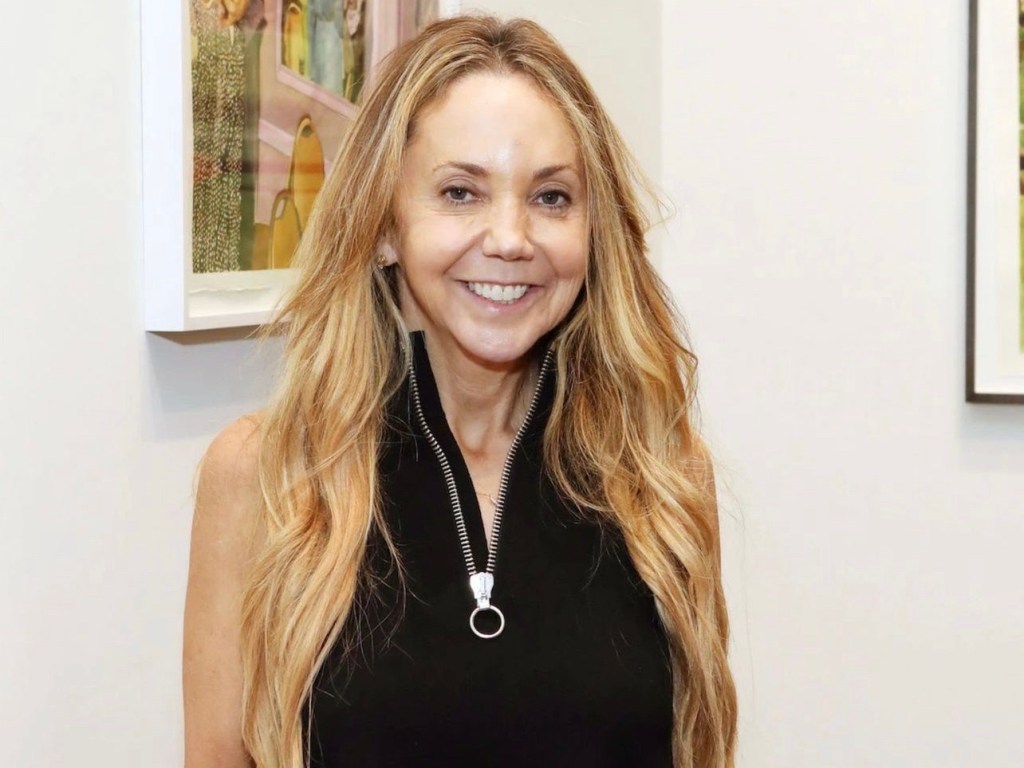
It was May 8, 2023, and Sheffer, a veteran art dealer and former executive at Pace Gallery and Lisson Gallery, stood face to face with Lisa Schiff, an art advisor and founder of SFA Advisory, who over the past two decades has acted as an art market fortune teller for the rich, famous, and powerful. Schiff could seemingly do it all: unearth the next hot painter, find highly coveted classics, negotiate sales at breakneck speed, and defy conventional wisdom by acting as a genuine mentor rather than a stuffy art snob.
Sheffer had been a client and close friend of Schiff’s for years. She was a conduit through which he bought and sold fine art. Sheffer’s most recent sale was an Adrian Ghenie painting. It was jointly owned with his husband, real estate developer Richard Grossman, and the real estate heiress Candace Barasch—who also happened to be one of Schiff’s best friends.
Schiff offloaded the painting for $2.5 million in late 2022 through Sotheby’s Hong Kong, and she transferred to Sheffer and Barasch $225,000 each from the sale back in January. But she still owed them $1.8 million. Sheffer asked Schiff when he and Barasch would get their money.
Schiff had built a brand so steadfast, so unimpeachable, and she had counted so many of the art world’s elite as friends and confidants—including Leonardo DiCaprio, her most high-profile client—that Sheffer was shocked when Schiff told him that she didn’t have the money and that he should call her lawyer.
These allegations form the basis of a lawsuit by Grossman and Barasch against Schiff and her advising companies filed in the spring. One month later Barasch and her husband filed a second lawsuit against Schiff and her companies relating to other artwork dealings. According to the allegations in these lawsuits, when Schiff told Sheffer she didn’t have the money, she just turned around and walked away.
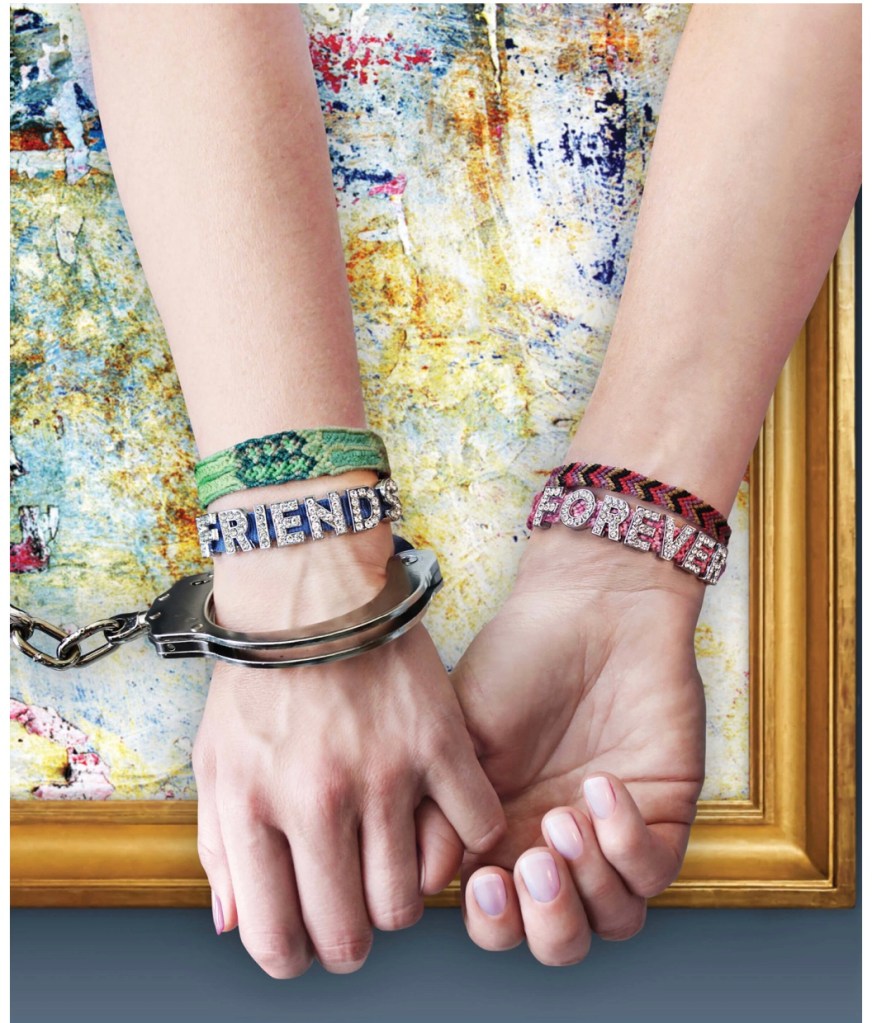
For Sheffer and Barasch, they were given a valuable lesson: Never mix friendship with business.
By all outward appearances, Lisa Schiff was a cornerstone of the art ecosystem. She had been lauded as a highly successful entrepreneur who carved out a coveted career consulting for wealthy individuals who wanted to amass valuable collections, or at least park some of their money in art. She wasn’t merely a dealer or a gallerist or a broker but an amorphous oracle, someone whose taste and expertise granted her access to moneyed circles in New York, Los Angeles, and London.
In the fine art world, where social posturing and business jockeying are part and parcel of success, Schiff seemed to have accomplished the ultimate coup, elbowing her way into a market that was drowning in money. The Financial Times once said that Schiff was “disrupting the art advisory business.” Schiff herself put it this way to CNN Style: “I’m always flying by the seat of my pants.”
It had been a meteoric rise for Schiff. She wasn’t a nepo baby from Manhattan art royalty; she grew up in Florida and majored in art history at the University of Michigan. She studied for a time in France, received her master’s in art history at the University of Miami, and pursued a PhD at the City University of New York (she never finished her dissertation).
While in New York, Schiff worked at the auction house Phillips (“It was a shitshow,” she told Artsy) and later became the director of Edward Tyler Nahem Fine Art, where, Schiff once said, she learned “the art of the deal.” She also held teaching positions at Hunter College, the College of Staten Island, and Nassau Community College. The world of academia, however, was not very lucrative, and in 1999, after Schiff turned 30 and her parents stopped subsidizing her big city lifestyle, she had to find a new way to make a living.
In 2002 she hung up a shingle, launching SFA Advisory. “It was kind of ballsy. I had no idea what I was doing,” she told Artsy. “I just couldn’t function in the system. I was always feisty and frustrated.” Schiff promoted her gritty, built-from-the-ground-up personal brand and, helped by her nerdy love of art history and penchant for luxury, quickly found herself gathering clients and fitting in among Manhattan’s one-percenters and power brokers.
When Schiff founded her consulting firm, few fine art advisors existed. According to the Association for Professional Art Advisors (APAA), in 2000 there were only 60 enrolled members. Over the past two decades, however, the practice has expanded dramatically; the APAA now has 156 members, and untold more have staked their claim in this largely unregulated corner of the industry. “There are many practitioners who adopt the title of ‘art advisor’ without the schooling, experience, and integrity to properly facilitate the collecting ambitions of their clients,” says APAA president Alex Glauber. “APAA membership standards are designed to counter the realities of a field with no barriers to entry. Collectively, these standards aim to define advisory best practices within an amorphous field often impugned by those unqualified at best and deceitful at worst.”
Schiff, for her part, has never been a member of the APAA, and she admitted in 2012, in a live discussion with Jane Morris of the Art Newspaper of the Institute of Contemporary Arts in London, that “the art world is the easiest place to do shifty business on every level, shape, or form. You can scheme…you can lie, you can double-dip.” She added that “it takes a long time to figure out that you’re talking to someone who is a bit of a shyster. There’s a lot of shysters around.” At Art Basel years later, Schiff said of her relationship with clients, “I don’t own them. It’s not my money. I’m just a sounding board.”
Nonetheless, Schiff hoped to be a guiding light for would-be collectors and eager aficionados by “getting in the head of my clients, helping them find the best of what they love,” she told CNN Style, adding cryptically that “some of the machinations behind the scenes are so disgusting.” Above all, she said, she wanted to protect her clients, and on LinkedIn she wrote that her company had “been able to cultivate critical trust on all sides, ensuring access to the most desirable and highest-quality works.”
In a profession where proximity to money means everything, Schiff landed her most formidable and enduring client in 2004: the multimillionaire real estate heiress Candace Barasch, whom everyone, including Schiff, calls Candy. As stated in Barasch’s legal complaints, they met through Adam Sheffer, who was then the sales director at the Cheim & Read gallery and who had recently become Schiff’s client. Barasch had been dipping her toe into the high-end art market since 2000, focusing primarily on photography, but she soon graduated into all manner of modern and contemporary art, which gave her and Schiff a shared passion.
They quickly became best friends. “Almost immediately after I met Schiff, she began cultivating a personal friendship with me that transcended our business relationship,” Barasch said in court documents, “to the point that my family and I considered Schiff like a member of our family.” Schiff shared the same deep-seated connection with Sheffer and Grossman, who in 2013 attended the bris of Schiff’s son and acted as “adjunct parents” to him, even attending Father’s Day events at his school. They also went on trips together. In a post on Schiff’s now-deleted Instagram account, she featured a photo of Sheffer walking with her son on the beach in St. Barts with the caption, “We love you Uncle Adam.”
By 2012 Schiff claimed to have a dozen clients and was presumably making a lot of money advising them. And as the years went on, she and Barasch seemed to be virtually joined at the hip, with Schiff babysitting Barasch’s pet and “removing and storing personal correspondences for her,” Schiff wrote in a court filing. This may have muddied Schiff’s perception of her professional obligations to her client. “You have to draw a line between being friendly with your clients and being friends with your clients,” says Todd Levin, who spent 12 years on the APAA board of directors and has 40 years of experience as an advisor. “Becoming friends makes things more complicated.”
As alleged in her legal complaints, Barasch trusted Schiff so much that she allowed her to be the exclusive custodian of her art inventory and transaction records, and even gave her access to her credit cards for expenses. Every dollar that Barasch spent on art passed through Schiff’s bank accounts. They spoke on the phone every day and, over time, became more like sisters than friends. “I think it’s important to find advisors who aren’t clinging to their clients in a way that they own them,” Schiff once said.
In 2014 Schiff wrangled her most high-profile client: Leonardo DiCaprio, as well as his fledgling namesake nonprofit. This raised Schiff’s status in the industry immensely—and gave her a heightened sense of importance. According to a source with knowledge of the incident, Schiff once attended a show on behalf of DiCaprio at the Gagosian Gallery in Beverly Hills. When she was told that she was not first in line for a specific piece, she became irate. DiCaprio allegedly gave Schiff Larry Gagosian’s cell phone number to try to work out a deal. Schiff called Gagosian at 7 a.m. and made her displeasure extremely clear. After the call Gagosian asked one of his employees, “Who the fuck is Lisa Schiff?” (It’s unclear whether the sale ever transpired.)
Nonetheless, Schiff curated DiCaprio’s annual art auction galas in St.-Tropez and Sonoma County; they featured works by Pablo Picasso, Jeff Koons, Ai Weiwei, David Hockney, and Damien Hirst. Schiff’s relationship with DiCaprio, however, was short-lived. They parted ways in 2018, for undisclosed reasons. “I loved working with Leo,” Schiff told CNN Style. “I miss Leo.” (Her son is named Leonardo.)
Schiff’s proximity to the über-wealthy appeared to have elevated her taste for luxury, a shift that Barasch saw firsthand as her friendship with Schiff deepened. According to detailed allegations in Barasch’s lawsuits, Barasch and Schiff frequently traveled together to art-related events, and Schiff would spend lavishly: $32,400 at Loewe in Paris, $20,000 worth of jewelry, international first class travel with concierge and limousine services, and accommodations at five-star hotels. Her expenses were also piling up at home: $25,000 in monthly rent for her Manhattan apartment, a luxury unit in the Colonial House apartment complex in West Hollywood (where Bette Davis once lived), and her son’s private school tuition. While speaking on a panel at Art Basel in 2019, Schiff said, “I’m pretty much broke.”
Lisa Schiff
Despite this admission, nothing seemed amiss to those who knew Schiff best. In fact, she was working harder than ever. She traveled to China, Brazil, and India to find art for her swelling list of clients. This included Barasch, who alleged in her lawsuits that she paid Schiff a 10 percent commission on all transactions and had presumably become Schiff’s most prolific source of income. As reported in the New York Times, by 2019 she had helped Barasch amass a collection of roughly 600 pieces, likely worth tens of millions of dollars. (According to Schiff’s court filings, she also helped Barasch secure more than $10 million in profit by selling pieces from her collection.) They rotated pieces in and out of Barasch’s Park Avenue apartment once per year, according to the culture’s current theme. “It’s a shared vision,” Barasch told the Times. “Hopefully, we’ll put this story together so down the line there’s a coherent idea about where we are as a society.”
In 2018 Schiff plotted her next move: a luxury ground floor commercial outpost on White Street in Tribeca that acted as her office, an exhibition space where she could sell pieces on consignment, and a swanky artist hangout. She signed a 10-year lease and enlisted famed interior designer Rodman Primack to reimagine it. The slightly wonky open-concept space was transformed over the next year into a frenetic menagerie of colors and textures and bric-a-brac, a fireworks display of maximalism that seemed to reflect Schiff’s personality and outlook on life. “She obviously had a lot of money,” says Gennaro Brooks-Church, an artist who designed and built a $36,000 plant installation for the space. Brooks-Church says that he and Schiff had a falling out after Schiff refused to pay his fee for ongoing upkeep of the organic statement piece. “Looking back, I think she was very naive. The feeling I got was, Yeah, we’ll spend all this money on this space, and then it will all work out. But there was no real plan that I knew of.”
Schiff also opened an office in London, which raised some eyebrows within the industry. “I knew who some of her clients were, and I had some idea of what they were buying, and the math didn’t add up,” Todd Levin says. “I didn’t know where all the money was coming from.”
After Schiff unveiled her Tribeca space, in 2019, she told Architectural Digest that everything inside was purchasable, a sort of hyper-expensive, bohemian garage sale. “The Richard Princes, the rug—if people wanted to come and buy any of it, I would be okay with that,” she told the magazine. It was a befuddling expansion for someone who largely operated in the shadows of the art market (why have a public-facing space if she dealt only with private clients?), but as a publicity stunt, it worked: Schiff’s business seemed to be booming. Later that year she celebrated her 50th birthday with a party during Art Basel in Miami. Swizz Beatz and Rosario Dawson attended.
They next year, however, wasn’t so sunny. As alleged in Barasch’s lawsuits, Schiff told her that in January 2020 she checked herself into a drug and alcohol rehabilitation program in San Francisco that allegedly cost $100,000, “for her addiction to chardonnay.”
When the pandemic hit, she went back to New York and laid off some of her staff (she admitted to Artsy that she “sucks” at being a manager), and saw the art market change from the rarefied world of gatekeepers in which she had established her prowess to a speculative free-for-all dominated by NFTs. She continued to focus on breaking through the noise and elevating her brand. A media blitz followed, with a lengthy profile on Artsy claiming that Schiff wanted to “fix the art market” and another piece in Cultured that covered an exhibition hosted in her Tribeca storefront. The Cultured reporter pointed out the apparent conflict of interest of an advisor moonlighting as a gallerist and a dealer and asked her why she was hosting a for-profit show. “That’s a bit more complicated,” Schiff said, without explaining further.
In hindsight one could see the professional moves Schiff made over the past half decade as a desperate bid to generate more income. Truthfully, all was not well behind the scenes. Her business was floundering, and according to Barasch’s lawsuits she had allegedly begun to misappropriate customer funds to prop up her lavish lifestyle and settle outstanding debts to clients, galleries, and dealers. The two lawsuits that Barasch filed against Schiff and her companies earlier this year include detailed allegations suggesting that, by 2022, Schiff’s financial difficulties were coming to a head. For example, they allege that in the summer of 2022 David Kordansky of the Kordansky Gallery called Barasch about an outstanding payment—despite Barasch’s having already paid Schiff for the artwork in full. Schiff dismissed the snafu as an innocent oversight caused by her busy schedule. Their friendship stayed intact. (Kordansky did not respond to requests for comment.)
Despite her financial turmoil, Schiff appeared to be living her life as if nothing were wrong. Throughout 2021 and ’22 she documented on social media luxurious vacations to Mexico, the Caribbean, Rhode Island, and Italy, and she also bounced around the Hamptons, Denver, and Miami. She even went to Paris and London with Barasch to look at, and presumably purchase, art. But the foundation under Schiff continued to crumble, and as the walls closed in she became more desperate to broker sales and buy time.
Barasch’s lawsuits allege that although Schiff had been paid in full by Sotheby’s for the sale of the Adrian Ghenie painting in January 2023, Schiff told Barasch, Sheffer, and Grossman that the buyer needed more time to come up with the full amount of the sale. On April 10 Schiff texted Sheffer, “Just checked in on [G]henie payment!… What else can we work on?”
The lawsuits further allege that two weeks later Schiff again tried to delay, texting Sheffer: “Ok so…they are trying but can’t guarantee. Buyer is also trying. No one is worried. So trying for 2 weeks but could be 1 month and no longer—guaranteed.” Schiff continued to encourage Sheffer to buy artwork and pressured Barasch for payments on pieces that she had earmarked for purchase. On May 4, Barasch wired Schiff $190,531.
On May 8 Sheffer confronted Schiff in person about the payment still owed to him, Grossman, and Barasch. Schiff finally admitted that the money was gone. After their meeting Schiff texted him, “I am sorry and have every intention to make things right. It’s just complicated. I know you will never speak to me again but I will try to make it right regardless.” Schiff, likely knowing that Barasch had gotten word, texted her the same day, saying, “Know that I love you. Not able to talk but later today…”
When they got on the phone, Schiff allegedly explained that over the past few years she had dug herself a vast financial hole and had debated filing for bankruptcy before the pandemic but decided against it for fear of criminal exposure. She also claimed that she had used her time in rehab to map out a plan to fix the mess that she had created for them both. Barasch says she was shocked, dismayed, and heartbroken. She asked the woman she considered a member of her family where her most recent payments—more than $300,000—had gone. “I don’t know,” Schiff responded. Barasch pressed further. How much of the art that she had supposedly purchased through Schiff hadn’t actually been paid for, and how long had this been going on? To the former, Schiff couldn’t give a concrete answer. To the latter: more than three years.
After Schiff’s alleged admission that she had essentially lost vast sums of her best friend’s money, Barasch says she dove into a frenzied game of telephone, contacting many of the galleries from whom she had instructed Schiff to purchase art since 2020. The results were not good: She found at least 16 pieces for which she alleges she gave the money to Schiff but the sellers of which had not been paid. The damage stung like a fastball hitting a catcher’s mitt: $1.5 million.
Barasch tallied up the total she had transferred to Schiff for artworks just over the past 18 months: $6.6 million. Barasch feared that most if not all of that money was likely gone, with no art to show for it. She was forced to take a drastic step: sue her former best friend in New York Supreme Court. In May 2023 Barasch filed her first lawsuit, along with Grossman, alleging that Schiff and her companies had failed to pay them for the sale of the Ghenie painting. A month later Barasch filed a second lawsuit, this time with her husband and the family trust, claiming that Schiff had mismanaged other art transactions.“Schiff and her businesses have effectively been running a Ponzi scheme,” the first lawsuit claimed.
After talking to Barasch, Schiff emailed her other clients and told them that she had “fallen on incredibly hard financial times” and was currently “indebted to you and others and am simply unable to meet my obligations.” Everything going on was “very complicated from a legal perspective,” she said. She wouldn’t be answering any questions. They too would have to go through her attorney. In papers filed with the court, Schiff denied running a Ponzi scheme but admitted that a number of her clients are “owed money because expenses and flawed payment practices left the Company with more payment obligations than funds.”
Schiff tried to cut a couple more deals to make some quick cash but, according to Barasch’s suit, eventually settled on trying to sell thousands of dollars’ worth of jewelry that she had purchased. Despite her best efforts, Schiff couldn’t hold it together. In May she shuttered SFA Advisory, liquidated its assets, and admitted in court records that she can afford neither the rent on her Manhattan apartment nor legal representation. (She planned on moving “elsewhere” once her son finished the school year.) The lawsuits filed against her are ongoing, and her attorney admitted in court filings that both federal and state law enforcement are investigating her financial dealings. Schiff’s attorney disclosed in a court filing that she is cooperating with the investigation. Both Barasch and Schiff declined via their attorneys to comment for this article.
It was a stunning fall from grace for a once revered pillar of the art world, made so much more tragic by the fact that Schiff leveraged the trust placed in her by her best friend to raise her profile and amass (and eventually squander) a small fortune. In a 2012 panel discussion in London, an attendee posed a question to Schiff regarding the Wild West quality of the art market and the dubious practices of some people angling to make large sums in it. “I find it very dangerous, actually. I don’t really see a good outcome for that kind of behavior,” Schiff said with unfortunate prescience. “What is that, Icarus flying too close to the sun? You’re just going to fall… I don’t think in the long run it will sustain itself.”
“I don’t think that anybody thinks I actually operate my company,” Gwyneth Paltrow said.
Ms. Paltrow, an actress and the founder and chief executive of Goop, was draped horizontally over a chair in the living room of her home in Amagansett, N.Y., in late July.“I think people think I’m the figurehead,” she said. “I definitely operate the company, but I’ve never been a person to try to correct public opinion or a misconception. I think it’s a bit of a fruitless exercise.”
She gestured with her hands while she talked and pointed and kicked her shoeless feet for emphasis.
This month, Goop will celebrate its 15th anniversary. And Ms. Paltrow, 51, was feeling reflective, drinking tea and wearing a blue and white striped caftan she bought from a sponsored post on Instagram that had no tag other than a size medium.
Goop started in 2008 with a newsletter she wrote from her home in London, where she was living with her two young children — Apple, who is now 19, and Moses, 17 — and her first husband, the Coldplay singer Chris Martin.
“I had a very small, nice life in North London with my mother, mummy friends and married to a rock star, which came with a set of complications,” she said. “If you’re married to someone who’s a touring musician, you’re home by yourself a lot. And so I was in this little bubble with my kids, and I obviously had not wanted to travel and work and be on a set.”
It had been about a decade since she won the Academy Award for best actress for “Shakespeare in Love.” “Hold on,” she said. “What year was it? I have it in the other room, I’ll go look what it says.” She jogged to an adjoining room to retrieve the Oscar statuette from 1998.
Her Amagansett home has a great deal of security, including a guard dog, a house manager and a room of security cameras. The interior smells aggressively of cedar and is decorated in neutral tones of cream, with a guest bathroom that has Aesop hand soap and a digital scale. Outside there are manicured lawns and a tub filled with flip-flops.
At first, Goop was mostly recommendations. “I always felt like I got the biggest buzz out of, ‘I have the answer to your question,’” she said. “‘There’s a great reflexology place around the corner.’”
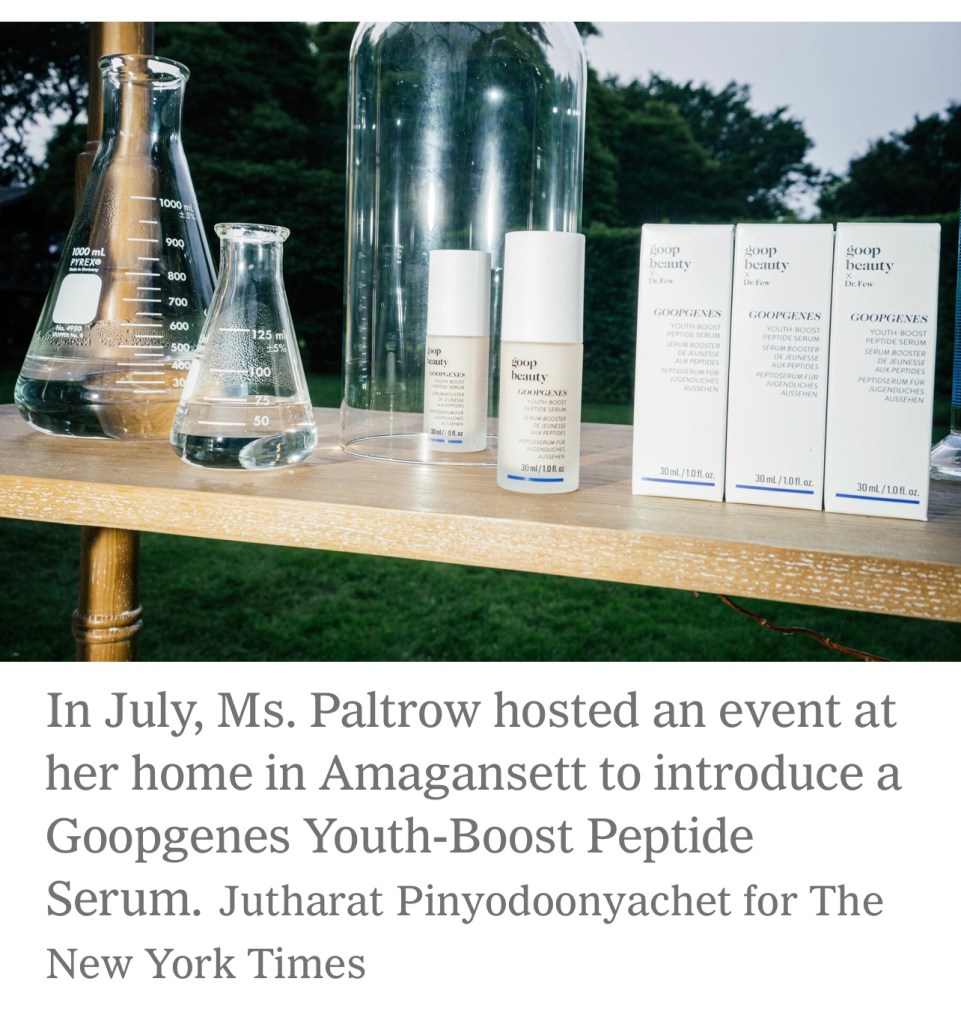
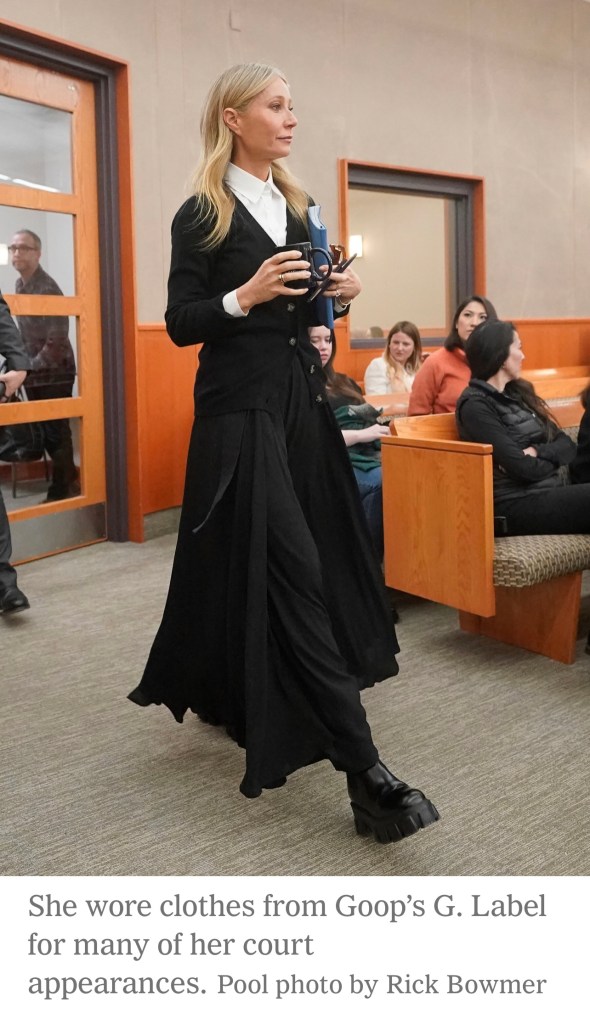
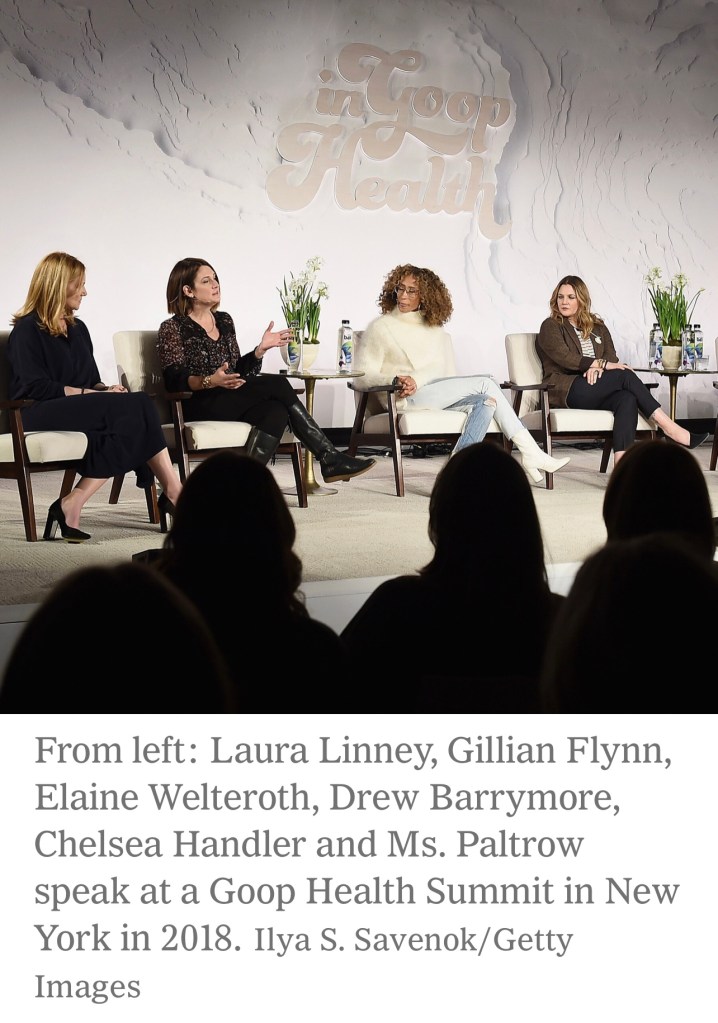
Now the company has 170 employees, Ms. Paltrow estimated, and encompasses a whole constellation of healthy-ish, wellness-flavored brands. There is the newsletter; a podcast with more than 100 million downloads; a line of beauty products called Goop Beauty; clothing — G. Label by Goop — made of soft fabrics in neutral shades; Goop Wellness, which sells vitamins and sexual aids; two shows on Netflix; five stores; a takeout chain in Southern California called Goop Kitchen; In Goop Health, a franchise of wellness summits; and a cruise that was the subject of a cover story for Harper’s Magazine.
Its anniversary products and services will include a two-bedroom Goop villa to stay in at the Colony Hotel in Palm Beach, Fla., complete with Goop products in the bathrooms and decorated with Goop x Fromental wallpaper; a $2,500 limited-edition Lobmeyr crystal vase, designed in collaboration with the FoundRae jewelers; and products like Goopglow Microderm Instant Glow Exfoliator in commemorative packaging.
ADVERTISEMENT
“Goop is an irreplaceable provocateur in the cause for good” is a line from one of its own news releases. But whether that is true beyond its customers and fans remains to be seen. The brand is responsible for candles called This Smells Like My Vagina and This Smells Like My Orgasm. Her 2014 post on her divorce from Mr. Martin brought the phrase “conscious uncoupling” to the world.
“If history has shown me anything, it’s that I’m always looking back, going, ‘Wow, that was an interesting thing to experiment with,’” she said.
Earlier this year, Ms. Paltrow was roundly mocked online for a filmed interview in which she talked about intermittent fasting and her seemingly stringent diet.
“About the bone broth? Oh my God,” Ms. Paltrow said. “Was I aware? Apple was like, ‘Mom, you’re on TikTok.’” Ms. Paltrow said she eats three meals a day and has a broad range of what she considers healthy foods.
“I think a European croissant is a superfood, by the way,” she said. “Today I had a peanut butter smoothie. And for lunch we had a chopped Italian chicken salad.” (She married the producer Brad Falchuk in 2018.)
Even if Ms. Paltrow has not had a starring role since “Proof” in 2005, she is still an actress who the Puck News writer Lauren Sherman wrote, “can convincingly sell anything.”
“I was just getting dressed and going to a pretty intense experience every day,” Ms. Paltrow said. “And the sartorial outcome was so weird to me. That whole thing was pretty weird. I don’t know that I’ve even processed it. It was something I felt like I survived. Sometimes in my life it takes me a long time to look back and process something and understand something.”
Ms. Paltrow has posted sponsored online content for a posture corrector. Last year she publicly supported the Los Angeles mayoral candidate Rick Caruso, a wealthy real estate developer and former Republican who changed his party affiliation before entering the race. “I think I’m open-minded about everybody,” she said. “I love to hear what people have to say.”
“It was very interesting to hear his point of view,” she said. “Since then he’s said some things that I think are tricky, let’s put it that way.” (Later, a representative for Ms. Paltrow called me to express concerns that her political views would be a focus of this article and said that she is more of an “independent thinker.”)
As an entrepreneur, Ms. Paltrow may have more power to wield than she ever did when she was acting regularly. “I’ve thought about it in terms of my lived experience of being an actor who was told to be here at this time, to wear that and to stand there and to do it again,” she said. “So, you never feel on a movie set that you have power. It was hard for me to do what I’m told, but I also never had any desire to be a director or be behind the scenes in that industry at all. I feel like I was always tugging a little at the constraints of it.”
Her friend Brit Morin, the founder of the e-commerce site Brit + Co, said Ms. Paltrow’s cultural impact through Goop was different. “Although the win-loss rate of movies and start-ups is similar, the difference is there are outsize returns in venture capital in start-ups,” said Ms. Morin, whose site sometimes features Goop products. “You can get a 1,000 times return on investment, and a box office has never seen that. Entertaining is a short-term way to influence someone. She’s created products people have in their homes, are using on their faces, wearing, eating.”
Goop declined to give The Times revenue or income figures and would not say if it is profitable.
Ms. Paltrow has been the chief executive of Goop since 2017. “In terms of learning the lessons of how to be a leader, it took me a long time because I was learning on the job,” she said. “Especially on the people front. If you don’t come up through a corporate culture, it’s really hard to understand how to manage people and how to set good boundaries.”
She did not cite specific examples. But one increasingly high-profile former employee comes to mind: Elise Loehnen, who left the company in 2020 and wrote “On Our Best Behavior: The Seven Deadly Sins and the Price Women Pay to Be Good,” a New York Times best seller.
In August, Ms. Loehnen spoke to The Times about her departure from Goop. “My interests were moving out of this idea of self-optimization,” she said. “I think what happens in the wellness world is this desire for control and certainty.”
Exactly what Goop’s strategy is for long-term growth, or an exit in the form of an acquisition or an I.P.O., remains to be seen. “If Gwyneth and team want to build the business with the scale and margin structure to be a large stand-alone as a public company or as part of a business, we are supportive,” said Tony Florence, of New Enterprise Associates, which has invested in the company.
Dana Settle of Greycroft, another fund that has invested in Goop, said, “I would love for her to take this company public and have her do it as the C.E.O., but it’s her life.”
Ms. Paltrow would say only: “The burden of taking money, I took that responsibility probably too seriously. And it was hard to be the person who was both trying to grow, but also being very conservative with company funding. I was kicking the horse and pulling on the reins at the same time. But I’m so grateful now when I look back that it’s taken its time to evolve into what it is and that we didn’t have this crazy meteoric rise.”
Goop’s beauty brands, which make up 60 percent of its sales, are competing in a crowded market that includes a spate of celebrity brands. “We have so many other brands that are sort of like us now,” she said. “I feel good about it. Competition is what keeps everybody honest.” In September 2018 Goop settled a false-advertising lawsuitbrought by district attorneys in California.
Even her ex-fiancé Brad Pitt has his own line of skin-care products, called Le Domaine Skincare. He sent her some. “It’s good,” she said. “Yeah, it’s really beautiful.”
Don’t expect a tell-all memoir anytime soon. “You don’t want to index too much into the sort of love-affair part and expose people for that, so I don’t know,” Ms. Paltrow said, adding, “Don’t put me on truth serum.”
She talked about her future in a manner that doesn’t seem to involve Goop. The company has been approached for possible acquisitions, she said, but she has never felt it was the right time.
“I don’t think I can have this job forever,” she said. “I think it would be nice to return my investors’ money, and I really want to do that. That’s important to me.”
As for a life post-Goop, she wants to embrace what she calls her “crone” years, “this very real sort of sweetness that I’m starting to feel about the back part of life.” She wants to cook, be in her garden and become a grandmother. “It can reveal itself, “ she said.
She did remember one thing. “I mean, I did say to my mom” — the actress Blythe Danner — “that I would do a play when I sell the company.” With Ms. Danner or solo? Broadway or a one-woman show?
“She just says I have to, and I have to keep my promise to her.”
Kris Kristofferson, 87, Faces ‘Final Days’: Getting His Ducks in a Row ‘to Make Things Easier for His Family’.
By Aaron Johnson
RadarOnlineFollow
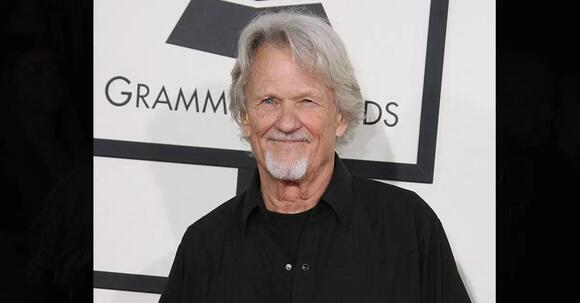
Kris Kristofferson has put his 550-acre California ranch on the market for $17.2 million, with friends saying the 87-year-old country music icon is facing his final days, RadarOnline.com has learned.
The father of eight, who is worth an estimated $50 million, and his third wife, Lisa Meyers , 66, live on Hawaii’s Maui in the town of Hana, which narrowly escaped the recent deadly wildfires , spilled a pal. It was later revealed his memory loss was due to Lyme disease. MEGA
The Blade vampire killer was diagnosed with Alzheimer’s in 2013, but later, doctors concluded his memory loss and other symptoms were due to Lyme disease. Medication helped the Why Me singer, but he still retired from music in 2021.
“Kris didn’t feel he was up to touring anymore,” one pal revealed. “Now, he just wants to make things easier for his family by turning his holdings into cash that will go to them when he’s gone.”
Friends said Kristofferson’s continued to slow down in his older years.
RadarOnline.com has reached out to Kristofferson’s rep for comment. Kris retired from music in 2021. MEGA
Years ago, Kristofferson and some of his closest pals opened up about his health struggles and misdiagnosis.
The A Star is Born actor struggled with memory issues, which he was told stemmed from Alzheimer’s disease. However, he later learned that his symptoms were caused by a tick-borne illness.
Lyme disease sometimes mimics Alzheimer’s with dementia-like symptoms, as reported by Closer Weekly .
“For the past six or seven years, there was this slow realization that he was becoming forgetful. It was apparent,” one of his pals stated years ago.
However, once doctors ruled out Alzheimer’s, everything changed.
“Kris is as sharp as he’s been in the past 20 years because of his treatments,” another friend told Closer in 2016. “His wife, Lisa, and his eight children see a different Kris now. It really is a modern-day medical miracle.” The movie star recently put his beloved California home on the market. MEGA
His wife also addressed his health, telling Rolling Stone that his debilitating memory loss was due to being hit in the head repeatedly while playing sports like boxing, football, and rugby when he was younger.
According to the outlet, his memory issues got so bad that “some days, Kristofferson couldn’t even remember what he was doing from one moment to the next.”
“He was taking all these medications for things he doesn’t have, and they all have side effects,” Lisa said. He wants his family to be taken care of when he goes, says friends. MEGA
She also pinpointed the exact timeframe she believed the star contracted the infection.
She told Rolling Stone that Kristofferson most likely got it from a tick while crawling in the Vermont forest while filming the 2006 film Disappearances.
A concept gaining momentum in cardiology over the past 25 years: that inflammation is a key culprit in atherosclerosis.
By Ron Winslow
The drug colchicine has been used for more than 2,000 years to treat the fiery joint-pain ailment called gout. It also is a remedy for a genetic disorder called familial Mediterranean fever, and for pericarditis, an inflammation of the sac around the heart.
Now colchicine may be set for a surprising new role. In June, the Food and Drug Administration approved a new low-dose version of the drug as the first-ever medicine to treat cardiovascular inflammation, marking a new approach for heart-attack prevention.
Several things could limit the adoption of colchicine by cardiologists, at least at first, including side-effect concerns and the emergence of several other new options for reducing the risk of heart attacks. But the drug’s approval provides fresh validation for a concept that has been gaining momentum in cardiology over the past 25 years—that inflammation is a key culprit in atherosclerosis, the artery-clogging disease, and that treating it can reduce the risk of a heart attack.
The bedrock strategy for heart-attack prevention has long been lowering LDL cholesterol with drugs called statins. Adding low-dose colchicine—which in one study reduced cardiovascular risk by 31% in patients already treated with statins and other preventive medicines—would enable doctors to simultaneously hit two biological targets that cause heart attacks.
“This is about combining therapies” that are both effective ways to reduce risk, says Dr. Paul Ridker, director of the Center for Cardiovascular Disease Prevention at Harvard-affiliated Brigham and Women’s Hospital, Boston. “They’re not in conflict, they’re synergistic.”
Ridker is a scientific adviser to Agepha Pharma, the company that owns the rights to market 0.5-milligram colchicine for cardiovascular-risk reduction, but wasn’t involved in the studies that led to the drug’s approval.
Making it personal
More broadly, colchicine is now part of a burgeoning arsenal of medicines that will enable cardiologists to personalize treatment as they seek to maximize heart protection for their high-risk patients beyond that achieved with statins.
For example, new drugs that treat diabetes and obesity, two major risk factors for cardiovascular disease, are among medicines doctors say could play an important role in reducing heart risk. Nonstatin drugs that lower cholesterol are also in the mix.
“The pivot here is to precision cardiology as opposed to one-size-fits-all cardiology,” says Dr. Richard Kovacs, a professor at Indiana University, Bloomington, and chief medical officer of the American College of Cardiology. Instead of routinely doubling down on cholesterol-lowering for most patients already taking statins, “we need to tailor treatment to the individual risk factors of the patient.”
The baseline strategy for high-risk patients won’t change, doctors say: statins, blood-pressure control, and aspirin or anti-platelet drugs to prevent clots. Add to that quitting smoking, a healthy diet and regular exercise.
“After that, it’s personalized approaches,” says Dr. Michael Blaha, director of clinical research at Johns Hopkins Ciccarone Center for the Prevention of Cardiovascular Disease, Baltimore.
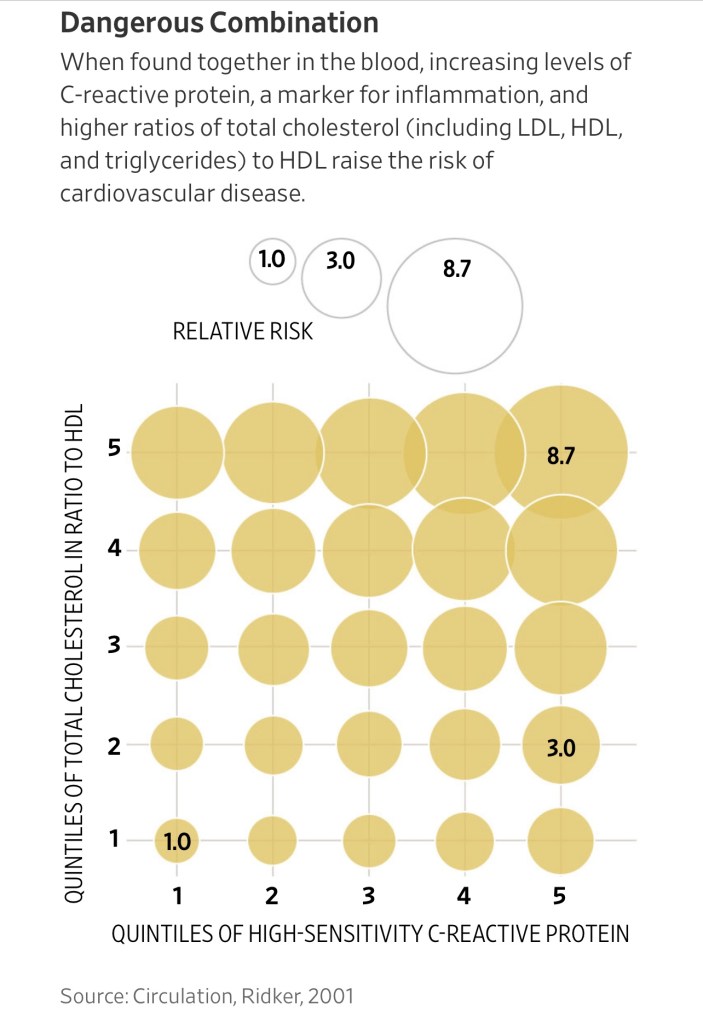
He envisions a scenario in which doctors consider inflammatory risk—which can be measured with a high-sensitivity test for a marker called C-reactive protein—cholesterol levels and diabetes and weight status to determine what’s driving a patient’s risk and then prescribe a drug best targeted to address that risk.
“Preventive cardiology is undergoing a renaissance,” he says. “We can do more than ever for our patients who have high risk.”
Like Ridker, Blaha is a scientific adviser to Agepha Pharma but wasn’t involved in the studies that led to the drug’s approval.
Hurdles to clear
Colchicine is cheap and safe and would be an effective option for many patients, study data indicate. But it faces challenges carrying the banner for a potentially important shift in medical practice. Diarrhea is associated with much higher doses typically used to treat gout flares and could make doctors hesitant, though researchers said it wasn’t a big issue with the once-a-day low dose tested in the heart-related trials. Updated treatment guidelines from the American College of Cardiology and American Heart Association gave colchicine a weak endorsement.
Another hurdle: lack of pharmaceutical companies marketing muscle to get the word out to clinicians and patients. The FDA gave approval for the drug to Agepha Pharma, a tiny family-owned company based in Dubai that has neither a sales force nor a presence in the U.S. market. It hasn’t been able to find a partner to co-promote the drug, which it calls Lodoco.
The potential market for an anti-inflammatory agent to reduce heart risk is huge. Data from clinical trials indicate that about half of patients with atherosclerosis have elevated levels of an inflammatory marker called C-reactive protein, or CRP, despite being on intensive statin therapy. Such patients are significantly more likely to suffer a heart attack or other cardiovascular event than those with low CRP and low LDL.
Colchicine “is the first practical option we have now” for these patients, Kovacs says. Danish drugmaker Novo Nordisk is among several companies with new anti-inflammatory drugs in development to reduce heart risk.
Anti-Inflammatory Trial
In a randomized trial, roughly 5,500 patients with chronic coronary disease were divided into two equal groups; one received 0.5 mg of colchicine once daily, the other a placebo. The results showed a reduction in cardiovascular incidents, including heart attacks, for the patients taking colchicine.
Establishing a link
Inflammation is a normal part of the immune system’s response to injury and generally subsides once its healing work is done. But when the walls of the coronary arteries are under constant assault—from LDL cholesterol or, say, the effects of smoking or dietary fat—the inflammation that comes with the immune system’s response doesn’t subside. It becomes a chronic part of a process that causes accumulation of fatty deposits in the artery walls called plaques, which can rupture and cause heart attacks. Cholesterol can also crystallize in atherosclerosis, further provoking an immune-system response.
As research brought the link between inflammation in the coronary arteries and the risk of heart attacks into focus, the question was, would a drug that targeted inflammation lower that risk?
The answer came in a 10,061-patient study called Cantos, published in 2017 and led by Ridker, that tested canakinumab, an antibody from Novartis that targets an inflammatory immune-system protein called interleukin 1 beta. In patients with elevated CRP already on statin therapy, those treated with canakinumab had a 15% reduction in major cardiovascular events compared with those on a placebo, even though the drug had no effect on LDL cholesterol.
Dr. Steven Nissen, chief academic officer at the Heart Institute, Cleveland Clinic, who wasn’t involved in the study, says the result was “a landmark” because it was the first to show that inhibiting inflammation could reduce cardiovascular risk without lowering cholesterol.
“The more you look and the deeper you look, you have to believe that inflammation matters,” he says.
.
But canakinumab was already on the market under the brand name Ilaris for several rare diseases at a price that would be prohibitive for use as a preventive therapy. The drug also sharply reduced new cases of lung cancer, but led to a slightly higher number of fatal infections, compared with a placebo. Novartis ultimately decided against pursuing an FDA indication for heart-risk reduction for the drug, leaving cardiologists with a proven new target but no drug to use against it.
Enter colchicine. Its path to FDA approval began in a hospital ward in Western Australia in 2006, where Dr. Mark Nidorf, a cardiologist at the Harry Perkins Institute of Medical Research, in Perth, was treating a patient with severe pericarditis. He gave him a single dose of colchicine.
“The next day he just felt fantastic,” Nidorf says. He wondered if a drug that had such a rapid impact on pericarditis might be useful against atherosclerosis by treating arterial inflammation.
He recruited a group of his own patients who were on statins and had high CRP levels and randomly allocated them to take colchicine or no colchicine. A month later, CRP levels of those given the drug had come down “quite dramatically,” Nidorf says.
Nidorf was also struck by research describing the role of cholesterol crystals in cardiovascular inflammation. Colchicine treats gout pain, which is caused by a similar biology—uric-acid crystals that attack the joints.
On that basis, he and his colleagues launched—without drug-company funding—a four-year pilot study called Lodoco that recruited some 500 patients from his own practice, using a commonly available 0.5 milligram dose of colchicine.
The results, which Nidorf presented at an American Heart Association conference in 2012, were so encouraging that the Australian team, together with colleagues in the Netherlands, mounted a major randomized double-blind study, called Lodoco2. They enrolled 5,522 patients with stable cardiovascular disease.
About the same time, researchers in Canada mounted their own colchicine study, called Colcot. It enrolled 4,745 patients to test whether colchicine added to statin therapy would reduce recurrent events in patients who had suffered a heart attack within the previous 30 days.
The positive canakinumab results came out in 2017, part way through Lodoco2. “We were thrilled,” Nidorf says. Colchicine works differently, but hits canakinumab’s main target, providing optimism that the Lodoco2 trial would be positive too.
Sure enough, Lodoco2’s 31% relative reduction in cardiovascular events was reported in 2020. A few months earlier, the Colcot study found a 23% reduction in risk. In absolute terms. Colchicine prevented 2.5 to 3 heart attacks or other events for every 100 patients treated.
Agepha Pharma, which had acquired rights to market 0.5-milligram colchicine for cardiovascular-risk reduction from an Australian company, used the data to make its case for FDA approval.
The company launched the drug in the U.S. earlier this month at a list price of $99 a month. It is still negotiating arrangements with insurers, but plans to make it available at no charge to anyone who can’t afford it. Lacking a sales force or a budget for television marketing, it began promoting the drug to cardiologists online last week.
“We’re a small company trying to do big things for patients,” says Antonia Riel-Köllmann, Agepha’s managing director.
A tough market
Colchicine faces a challenging market. Other potential candidates for risk reduction beyond statins include Wegovy, from Novo Nordisk, and other so-called GLP-1 agonists that treat obesity and diabetes, as well as another class of diabetes drugs known as SGLT2 inhibitors. Full details on their risks and benefits in heart prevention aren’t yet known.
Amgen’s Repatha and Regeneron’s Praluent, drugs known as PCSK9 inhibitors, and bempedoic acid, marketed as Nexletol by Esperion Therapeutics, are other options. They are nonstatins that achieved modest additional reductions in LDL and heart risk in clinical studies when added to intensive statin treatment.
At $99 a month, Lodoco is much cheaper than drugs such as Wegovy, which lists for more than $1,600 a month at a Walgreens drugstore (before insurance coverage or discounts), or a PCSK9 inhibitor such as Repatha, which runs about $650 a month. Studies suggest the relative reduction in heart risk achieved with Lodoco is at least as large as with any of the other options.
Caveats and hesitation
Ridker and other cardiologists familiar with the drug say doctors may take it slow in prescribing it. The drug “is not for everybody,” Ridker says. It shouldn’t be given to patients with kidney or liver disease, for instance.
The approved once-a-day 0.5-milligram dose is slightly lower than 0.6-milligram generic colchicine already on the U.S. market and may mitigate kidney risks associated with the higher dose. But there are other reasons cardiologists may take time to get used to colchicine before adopting it as a regular option for their patients.
One is the history of other anti-inflammatory treatments. The painkiller Vioxx, once viewed as a potential candidate to curb cardiovascular inflammation, was pulled from the market in 2004 after it was found to have caused heart attacks and death from heart attacks. And soon after canakinumab’s success in reducing coronary events was reported, Ridker presented data from another study showing methotrexate, a generic drug for treating the inflammatory disorder rheumatoid arthritis, failed to curtail heart risk.
The updated treatment guidelines from the American College of Cardiology and the American Heart Association, issued in July, acknowledged inflammation’s role in the development of atherosclerosis for the first time. But the guidelines stopped short of recommending colchicine, saying only that “it may be considered” as an option to reduce “recurrent” cardiovascular events. Citing among other reasons potential interactions with other drugs and a slight increase in non-heart-related deaths, the guidelines say use of colchicine should be limited to patients at very high risk “until further data become available.”
Cleveland Clinic’s Nissen, who has been prescribing the 0.6-milligram dose for selected patients, says he’ll likely give one of the two versions (depending on price) to more patients in the wake of FDA approval.
“I think it is going to have a role to play, but it’s going to come after we’ve done other things we can do,” he says.
Indiana University’s Kovacs cautions that high-risk patients already on several medicines may resist adding another, especially one that while potentially reducing a serious risk, doesn’t make them feel better, a challenge facing many preventive drugs.
Dr. Roger Blumenthal, director of the Ciccarone Center for the Prevention of Cardiovascular Disease at Hopkins, says given the lukewarm advice from the new guidelines, he’ll likely urge patients to work harder on healthy lifestyle changes—quitting smoking, weight loss and exercise all lower inflammation—before prescribing the drug.
With growing interest in Wegovy and other obesity drugs, colchicine “is going to enter a crowded space,” Hopkins’s Blaha says. “But it will be a unique drug—the only anti-inflammatory drug approved for heart disease.”
Ron Winslow is a writer in North Conway, N.H. He can be reached at reports@wsj.com.
Bob Ross’s YouTube videos have turned my girlfriend Magda into a gifted artist. The following story, in the art publication called HyperAllergic, reminds us of all the joy he shared with others.—LWH
Bob Ross’s First On-Air Painting Could Fetch Nearly $10M
“A Walk in the Woods” (1983) was the first of 1,000 artworks created during the artist’s The Joy of Painting television show that ran on PBS for 11 years
Bob Ross – A Walk in the Woods (Season 1 Episode 1)
Bob Ross, “A Walk in the Woods” (1983), oil on canvas, 24 x 18 inches (all images courtesy Modern Artifact)

Wake up, happy little tree-huggers! Bob Ross’s first on-air landscape from the beloved The Joy of Painting television series is up for auction in Minneapolis, Minnesota, with an estimated valuation of $9.85M through the Modern Artifact Gallery. “A Walk in the Woods” (1983), a wet-on-wet oil painting of trees surrounding rain puddles from the first episode of the series, marked the beginning of the show’s 11-year run on PBS, underscoring Ross’s motto that anyone can paint.
The permed painter, who died in 1995, continues to hold the title as one of the world’s favorite art instructors not just for his quick and approachable teaching guides for lush landscape art, but also for his gentle and encouraging demeanor that emphasized the enjoyment of art-making over the final result.
Born and raised in Florida, Ross joined the military at 18 after a brief stint with carpentry was cut short and was transferred to a base just outside of Fairbanks, Alaska, in 1963. Ross cited exposure to the Alaskan wilderness as well as access to painting classes through the United Service Organization club as the fire-starter of his art practice, and spoke about painting as an escape from the military prior to his retirement in 1981, when he was able to dedicate his life to teaching others to paint.

Based in Minneapolis, Modern Artifact only recently acquired “A Walk in the Woods” before putting out feelers on the market. The gallery, which has acquired, authenticated, and sold rare works by Bob Ross before, is “in no hurry to sell the painting,” a spokesperson confirmed, but it’s accepting offers with no slated end date for the sale.
The Joy of Painting, which ran on PBS from 1983 to 1994, was made up of 403 30-minute episodes full of Ross’s quintessential optimism and love of nature infused into accessible lessons for deceptively achievable alla prima oil paintings. One of Ross’s most-quoted mantras was that there were no mistakes but “only happy accidents,” assuaging people’s anxieties about messing up or not positioning things correctly. Ross’s soft but motivational TV mannerisms were also bolstered by appearances from his rescued pocket squirrels, Bobette, Peapod, and Peapod Jr., among other woodland friends.
“Bob Ross has surpassed Andy Warhol and Pablo Picasso as the internet’s most searched for artist according to data from Google Analytics,” Modern Artifact owner Ryan Nelson said in a statement shared with Hyperallergic. “It’s an incredibly impressive feat, especially considering that there is virtually no official marketing and his original paintings are nearly impossible to find.”

Bob Ross was known to sign off on his paintings in separated letters with red paint only.
Ross regained popularity in the age of the internet in 2015 after the streaming site Twitch hosted an eight-day marathon screening the entirety of The Joy of Painting to millions of viewers, and the entire series became available on YouTube. Many found comfort and inspiration in Ross’s instruction and personality during the height of the COVID-19 pandemic as well.
While Ross made approximately 1,000 paintings for his television series, that figure was merely a drop in the bucket across his entire practice which spans over 30,000 pieces of art. It’s remarkably difficult to come by an original Bob Ross painting on the market, though, as the New York Times reported that a large portion of them are squirreled away at the Bob Ross Inc. headquarters in Virginia, and Ross donated a good chunk of the rest to the Smithsonian Institution and PBS. The woman who handed over “A Walk in the Woods” to Modern Artifact actually won the painting during a PBS auction in 1983.
“It’s a truly irreplicable, one-of-a-kind painting,” Nelson remarked. “While the gallery is accepting offers to purchase ‘A Walk in the Woods,’ they would prefer to share it with a museum or traveling exhibit to allow as many people as possible to view such an exciting work of art.”
Family Behind Bob Ross Inc. Responds to Unflattering Documentary Depiction