Leading Museums Remove Native Displays Amid New Federal Rules
The American Museum of Natural History is closing two major halls as museums around the nation respond to updated policies from the Biden administration.
The American Museum of Natural History will close two major halls exhibiting Native American objects, its leaders said on Friday, in a dramatic response to new federal regulations that require museums to obtain consent from tribes before displaying or performing research on cultural items.
“The halls we are closing are artifacts of an era when museums such as ours did not respect the values, perspectives and indeed shared humanity of Indigenous peoples,” Sean Decatur, the museum’s president, wrote in a letter to the museum’s staff on Friday morning. “Actions that may feel sudden to some may seem long overdue to others.”
The museum is closing galleries dedicated to the Eastern Woodlands and the Great Plains this weekend, and covering a number of other display cases featuring Native American cultural items as it goes through its enormous collection to make sure it is in compliance with the new federal rules, which took effect this month. That will leave nearly 10,000 square feet of exhibition space in the storied museum on the Upper West Side of Manhattan off-limits to visitors; the museum said it could not provide an exact timeline for when the reconsidered exhibits would reopen.
“Some objects may never come back on display as a result of the consultation process,” Decatur said in an interview. “But we are looking to create smaller-scale programs throughout the museum that can explain what kind of process is underway.”
Museums around the country have been covering up displays as curators scramble to determine whether they can be shown under the new regulations. The Field Museum in Chicago covered some display cases, the Peabody Museum of Archaeology and Ethnology at Harvard University said it would remove all funerary belongings from exhibition and the Cleveland Museum of Art has covered up some cases.
The changes are the result of a concerted effort by the Biden administration to speed up the repatriation of Native American remains, funerary objects and other sacred items. The process started in 1990 with the passage of the Native American Graves Protection and Repatriation Act, or NAGPRA, which established protocols for museums and other institutions to return human remains, funerary objects and other holdings to tribes. But as those efforts have dragged on for decades, the law was criticized by tribal representatives as being too slow and too susceptible to institutional resistance.
This month, new federal regulations went into effect that were designed to hasten returns, giving institutions five years to prepare all human remains and related funerary objects for repatriation and giving more authority to tribes throughout the process.
“We’re finally being heard — and it’s not a fight, it’s a conversation,” said Myra Masiel-Zamora, an archaeologist and curator with the Pechanga Band of Indians.
Even in the two weeks since the new regulations took effect, she said, she has felt the tenor of talks shift. In the past, institutions often viewed Native oral histories as less persuasive than academic studies when determining which modern-day tribes to repatriate objects to, she said. But the new regulations require institutions to “defer to the Native American traditional knowledge of lineal descendants, Indian Tribes and Native Hawaiian organizations.”
“We can say, ‘This needs to come home’ and I’m hoping there will not be pushback,” Masiel-Zamora said.
Museum leaders have been preparing for the new regulations for months, consulting lawyers and curators and holding lengthy meetings to discuss what might need to be covered up or removed. Many institutions are planning to hire staff to comply with the new rules, which can involve extensive consultations with tribal representatives.
The result has been a major shift in practices around Native American exhibitions at some of the country’s leading museums — one that will be noticeable to visitors.
At the American Museum of Natural History, segments of the collection once used to teach students about the Iroquois, Mohegans, Cheyenne, Arapaho and other groups will be temporarily inaccessible. That includes large objects, like the birchbark canoe of Menominee origin in the Hall of Eastern Woodlands, and smaller ones, including darts that date as far back as 10,000 B.C. and a Hopi Katsina doll from what is now Arizona. Field trips for students to the Hall of Eastern Woodlands are being rethought now that they will not have access to those galleries.
“What might seem out of alignment for some people is because of a notion that museums affix in amber descriptions of the world,” Decatur said. “But museums are at their best when they reflect changing ideas.”
Exhibiting Native American human remains is generally prohibited at museums, so the collections being reassessed include sacred objects, burial belongings and other items of cultural patrimony. As the new regulations have been discussed and debated over the past year or so, some professional organizations, such as the Society for American Archaeology, have expressed concern that the rules were reaching too far into museums’ collection management practices. But since the regulations went into effect on Jan. 12, there has been little public pushback from museums.
Much of the holdings of human remains and Native cultural items were collected through practices that are now considered antiquated and even odious, including through donations by grave robbers and archaeological digs that cleared out Indigenous burial grounds.
“This is human rights work, and we need to think about it as that and not as science,” said Candace Sall, the director of the museum of anthropology at the University of Missouri, which is still working to repatriate the remains of more than 2,400 Native American individuals. Sall said she added five staff members to work on repatriation in anticipation of the regulations and hopes to add more.
Criticism of the pace of repatriation had put institutions such as the American Museum of Natural History under public pressure. In more than 30 years, the museum has repatriated the remains of approximately 1,000 individuals to tribal groups; it still holds the remains of about 2,200 Native Americans and thousands of funerary objects. (Last year, the museum said it would overhaul practices that extended to its larger collection of some 12,000 skeletons by removing human bones from public display and improving the storage facilities where they are kept.)
A top priority of the new regulations, which are administered by the Interior Department, is to finish the work of repatriating the Native human remains in institutional holdings, which amount to more than 96,000 individuals, according to federal data published in the fall.
The government has given institutions a deadline, giving them until 2029 to prepare human remains and their burial belongings for repatriation.
In many cases, human remains and cultural objects have little information attached to them, which has slowed repatriation in the past, especially for institutions that have sought exacting anthropological and ethnographic evidence of links to a modern Native group.
Now the government is urging institutions to push forward with the information they have, in some cases relying solely on geographical information — such as what county the remains were discovered in.
There have been concerns among some tribal officials that the new rules will result in a deluge of requests from museums that may be beyond their capacities and could create a financial burden.
Speaking in June to a committee that reviews the implementation of the law, Scott Willard, who works on repatriation issues for the Miami Tribe of Oklahoma, expressed concern that the rhetoric around the new regulations sometimes made it sound as if Native ancestors were “throwaway items.”
“This garage sale mentality of ‘give it all away right now’ is very offensive to us,” Willard said.
The officials who drew up the new regulations have said that institutions can get extensions to their deadlines as long as the tribes that they are consulting with agree, emphasizing the need to hold institutions accountable without overburdening tribes. If museums are found to have violated the regulations, they could be subject to fines.
Bryan Newland, the assistant secretary for Indian Affairs and a former tribal president of the Bay Mills Indian Community, said the rules were drawn up in consultation with tribal representatives, who wanted their ancestors to recover dignity in death.
“Repatriation isn’t just a rule on paper,” Newland said, “but it brings real meaningful healing and closure to people.”
In an internal note about the job cuts at Business Insider, the company’s chief executive cited its plan to shift focus solely to news coverage of business, tech and innovation.
Business Insider said on Thursday that it was laying off 8 percent of its staff, the latest in a wave of sharp job cuts in the media industry this month.
Barbara Peng, Business Insider’s chief executive, said in an internal note that the job cuts were part of a plan, announced late last year, to shift focus solely to news coverage of business, tech and innovation.
“We have already begun to refocus teams and invest in areas that drive outsize value for our core audience,” Ms. Peng wrote. “Unfortunately, this also means we need to scale back in some areas of our organization.”
Ms. Peng added: “We’re committed to building an enduring and sustainable Business Insider for the coming years and beyond.”
In November, the company changed its name from Insider back to Business Insider, and its co-founder Henry Blodget stepped aside as chief executive. At the time, the publication’s top editor, Nicholas Carlson, wrote that it was a “new era” for the company: “It’s now about recommitting to what we do best.”
A Business Insider spokeswoman declined to comment on Thursday on the specifics of the layoffs.
Business Insider previously laid off 10 percent of its staff in April, citing economic pressures. At the time, Business Insider had about 950 workers around the world.
Business Insider is owned by the German publishing giant Axel Springer, which also owns Politico. It recently became embroiled in a dispute with the billionaire hedge fund manager Bill Ackman after it published an article saying his wife, Neri Oxman, a prominent academic and architect, had plagiarized in her dissertation.
After an internal review, Business Insider defended the article. “The process we went through to report, edit, and review the stories was sound, as was the timing,” Ms. Peng said this month.
If your art collecting has been focused on paintings and drawings, please don’t miss this episode of Art Lovers Forum with Artist Robin Schwalb. Robin is a quilt maker who introduced textile art into the world of pop culture. Her creations make you stop, stare and think “I would like to look at that every day.”
That is exactly why Robin has become so popular. She loves combining her graphically compelling quilts with the digital realm of manipulated photography. She then adds the extremely analog craft of stenciling, screen-printing, patchwork, appliqué and quilting. She also explores the rich variety of the written word, balancing an appreciation of their abstract beauty with the desire to include the “found art” of relevant texts. Subject matter might be drawn from her travels; the urban environment; film and/or video technology; or even mannequins.
Schwalb’s quilts have been widely shown in both juried and invitational exhibitions in the United States, Europe and Japan including The Gold Standard of Fiber and Textile Art (2020); “Deeds Not Words”: Celebrating 100 Years of Women’s Suffrage (2020); Semper Tedium: The Slow Art of Quiltmaking (2015); Art Quilt Elements (2012); Outside/Inside the Box (2012); Crossing Lines: The Many Faces of Fiber (2011); Talking Quilts (2004); Language Arts: Text as Imagery (2003); Six Continents of Quilts: The American Craft Museum Collection (2002); Seeing Yellow (1999); 9 x 9 x 3; Edge to Edge: Selections from Studio Art Quilt Associates (1998); Visions: Quilt San Diego (1996); Five Perspectives: American Art Quilts in Moscow (1996); Artists + Language (1993); and eleven Quilt Nationals, from 1987 to 2017. She was a juror for Art Quilt Elements 2010 and 2020. She curated the 1991 Manhattanville College exhibition Essences and Presences: Art Quilts and wrote the catalog for this six-artist show. Her work has appeared in numerous publications, including American Craft; The New York Times; Canadian Surfacing Journal; Fiberarts; The Detroit News; and Patchwork Quilt Tsushin. The artist received the Quilts Japan Prize from Quilt National ’05, the Award of Excellence from Quilt National ’89 and Jurors’ Choice from Tactile Architecture 1992. She was awarded a grant by the Empire State Crafts Alliance in 1989.
A native of New York City, Schwalb studied painting at the State University of New York at Binghamton, receiving her BA in 1974.
Today Robin is going to tell us what we need to know about textile art and why we should pay more attention to it. Robin thank you so much for taking time to speak to us today.
From runways to grocery runs, bottomless looks are everywhere
A classic coat and knit polo blend perfectly with the daring sans-pants trend. Miu Miu coat, $9,200, and polo, $2,600, MiuMiu.com, Live the Process briefs, $128, LiveTheProcess.com, Marlo Laz earrings, $1,200, MarloLaz.com. PHOTOGRAPHY BY IAN KENNETH BIRD FOR WSJ. MAGAZINE; STYLING BY JENNY HARTMAN
By Rory Satran
Was Edie Sedgwick the first “it girl” to ditch her pants? In 1965, Life magazine wrote that the Warhol muse was “doing more for black tights than anyone since Hamlet.”
Sedgwick might be pleased to see that the sans-pants look she pioneered is now reigning the runway, with designers from Coperni to Ferragamo to Victoria Beckham to Valentino showing very dressed-up looks missing one (some would say) crucial element. Stars have taken up the pantsless mantle too. Emma Corrin donned green Miu Miu briefs with a matching cardigan at the Venice Film Festival. Even in the dead of winter, Hailey Bieber left a leather jacket orphaned on a January walk in New York City. On Jan. 2, the artist Ye posted a picture of his frequent companion Bianca Censori in a fur top, thong and heels, captioned: “No pants this year.”
“Listen, I hate pants,” says Beverly Nguyen, a New York stylist and founder of the home-goods store Beverly’s—who is, admittedly, lithe, brave and fashionable. At a recent dinner party at her house, she wore a spin on a Bottega Veneta outfit Kendall Jenner wore in Los Angeles in 2022: navy sweater, black tights, black heels. She thinks the look works best with a conservative pairing; business up top and party on the bottom.
Celebrities including Kendall Jenner, Tessa Thompson and Emma Corrin have sported the no-pants look, while designers such as Miu Miu and Alaïa have sent the trend down their runways. PHOTO: FROM LEFT: ALIX NEWMAN/SHUTTERSTOCK; MIU MIU; ZACK WHITFORD/BFA.COM; ALAÏA; FRANCO ORIGLIA/GETTY IMAGES
Nguyen, who has worked out on the treadmill wearing a silk slip skirt from The Row, is somewhat inclined to think outside the confines of dress codes. “It was definitely main-character energy” to forgo pants, she says, but she doesn’t think it’s that wacky, especially since brands like Miu Miu are going all in on the trend. Nobody was asking her, What happened to your pants?
Miu Miu, the sassier sister to Prada, has been a vanguard of the style since it first sent Kate Moss down the runway in a bathing suit and a trench in 1996. In recent years, the brand’s designer Miuccia Prada flirted with increasingly disappearing skirts: a viral mini-kilt followed by a fully sheer polka-dotted pencil skirt. For spring, the brand returned to its ’90s roots, with many looks featuring boy-brief-style underwear and bare legs, grounded by preppy boat shoes.
Consider the pantsless look with a conservative pairing; business up top and party on the bottom. Ferragamo jacket, $2,400, cardigan, $1,190, earrings, $410, briefs, $590, bag, $3,700, and shoes, $995, Ferragamo.com; Miu Miu coat, $9,200, polo, $2,600, and shoes, $950, MiuMiu.com, Live the Process briefs, $128, LiveTheProcess.com. PHOTOGRAPHY BY IAN KENNETH BIRD FOR WSJ. MAGAZINE | STYLING BY JENNY HARTMAN
Clare Vivier, the Los Angeles designer and founder of accessories brand Clare V., was also inspired by Miu Miu, which she says has “hit a cultural nerve.” So when she was getting ready for a recent party, she put on a new pair of flat Mary Jane shoes, an oversize hoodie and blazer, and then called it a day. She says she was not the only one at the party who’d left her pants at home.
“There’s a whimsy about the look, a lack of preciousness,” says Leandra Medine Cohen. The New York writer has sported several pants-free outfits recently: an embellished jacket over a turtleneck and sheer tights; a white boatneck T-shirt with a funky belt and polka-dotted stockings; a baggy gray sweater tucked into sparkly Calzedonia tights.
The no-pants style requires more courage and effort than its nonchalant appearance lets on. The Row blazer, $4,350, shirt, $1,150, and briefs, $1,050, TheRow.com, and Marlo Laz earrings, $1,200, MarloLaz.com. Model, Georgia Moot at One Management; hair, Edward Lampley; makeup, Stevie Huynh; production, Harbinger. PHOTO: PHOTOGRAPHY BY IAN KENNETH BIRD FOR WSJ. MAGAZINE; STYLING BY JENNY HARTMAN
She admits that the air of nonchalance is a bit deceptive, as the style requires quite a bit of courage and effort to plan the proper full-coverage underwear, find the perfect tights and coordinate an appropriate top. “And yet it still exudes this sense of unfinished business,” she says. Right—the whole putting-on-your-pants business.
“I do like how it looks,” Paris stylist Ondine Azoulay says, “but not for real life.” When she styles models in pantsless looks for magazines, that’s a “fantasy,” she says. But out on the street, it’s weird. “Can you imagine if guys started walking around in Speedos?”
New York stylist Beverly Nguyen. PHOTO: BEVERLY NGUYEN
If you’re going to try no pants for yourself, choose your venue wisely. Nguyen and Medine Cohen have both done it to entertain at home, which is as low-stakes as it gets.
“I’m not trying to walk into the synagogue attached to my kids’ school in just a pair of tights,” Medine Cohen says.
And the right attitude is just as important as the right underpinnings. “You can’t have no pants on and be a bitch,” says Nguyen
There’s an old saying about the news business: If you want to make a small fortune, start with a large one.
As the prospects for news publishers waned in the past decade, billionaires swooped in to buy some of the country’s most fabled brands. Jeff Bezos, the founder of Amazon, bought The Washington Post in 2013 for about $250 million. Dr. Patrick Soon-Shiong, a biotechnology and start-up billionaire, purchased The Los Angeles Times in 2018 for $500 million. Marc Benioff, the founder of the software giant Salesforce, purchased Time magazine with his wife, Lynne, for $190 million in 2018.
All three newsrooms greeted their new owners with cautious optimism that their business acumen and tech know-how would help figure out the perplexing question of how to make money as a digital publication.
But it increasingly appears that the billionaires are struggling just like nearly everyone else. Time, The Washington Post and The Los Angeles Times all lost millions of dollars last year, people with knowledge of the companies’ finances have said, after considerable investment from their owners and intensive efforts to drum up new revenue streams.
“Wealth doesn’t insulate an owner from the serious challenges plaguing many media companies, and it turns out being a billionaire isn’t a predictor for solving those problems,” said Ann Marie Lipinski, the curator of the Nieman Foundation for Journalism at Harvard. “We’ve seen a lot of naïve hope attached to these owners, often from employees.”
Losing Money: In the past decade, billionaires like Marc Benioff and Jeff Bezos swooped in to buy some of the country’s most fabled brands in media. Now, they are struggling just like nearly everyone else in the industry.
Pitchfork: The music criticism website will be merged with the men’s magazine GQ, leading to layoffs within the online publication, according to a memo from Anna Wintour, the chief content officer of Condé Nast, their parent company.
The Baltimore Sun: The largest newspaper in Maryland has been sold to David Smith, the executive chairman of the nationwide Sinclair network of television stations and other media.
The losses may have the most immediate impact at The Los Angeles Times, where journalists are bracing for bad news. Kevin Merida, the newspaper’s widely respected editor, announced last week that he was resigning, a decision made after tension with Dr. Soon-Shiong over editorial and business priorities, according to two people familiar with the matter.
In the middle of last year, The Times was on track to lose $30 million to $40 million in 2023, according to three people with knowledge of the projections. Last year, the company cut about 74 jobs, and executives have met in recent days to discuss the possibility of deep job cuts, according to two other people familiar with the conversations.
Members of The Los Angeles Times Guild met in an emergency meeting on Thursday to discuss the possible job cuts. By the end of the day, the workers had planned to walk off the job on Friday in protest.
A spokeswoman for Dr. Soon-Shiong declined to comment on specific financial figures for The Los Angeles Times but said in an email that the company had “a significant gap between revenue and expenses,” even with the layoffs and other cost-saving measures from last year.
She said his family had invested “tens of millions of dollars” each year since acquiring The Times. “They are committed to continuing to invest,” the spokeswoman, Jen Hodson, said in the statement. “But relying on a benevolent owner to cover expenses, year after year, is not a viable long-term plan.”
Mr. Bezos hasn’t fared much better at The Washington Post. Like many news organizations, The Post has struggled to hold on to the momentum that it had gained in the wake of the 2020 election. Sagging subscriptions and advertising revenue led to losses of about $100 million last year. At the end of the year, the company eliminated 240 of its 2,500 jobs through buyouts, including some of its well-regarded journalists.
Patty Stonesifer, who filled in as chief executive last year, called the buyouts “difficult,” but said they were necessary to “invest in our top growth priorities.” Employees at The Post sent a letter in recent weeks to their top editor, Sally Buzbee, and their new permanent chief executive, Will Lewis, expressing concern over the lack of research firepower for their articles in the wake of the buyouts.
A spokesman for Mr. Bezos did not respond to repeated requests to arrange an interview for this article. In the past, Mr. Bezos has said he purchased The Post because it was an important institution but wanted the company to be profitable.
“I said to myself, ‘If this were a financially upside-down salty snack food company, the answer would be no,’” Mr. Bezos said of his decision to buy The Post in a 2018 interview.
A Time spokeswoman had no comment on the company’s 2023 finances, citing a note to employees from Jessica Sibley, its chief executive, proclaiming growing audiences and advertising revenue. In a statement, Mr. Benioff said Ms. Sibley was making “lots of exciting changes based on an amazing vision.”
“We are fortunate to have an amazing new C.E.O., Jessica Sibley, and she has done an incredible job restructuring the company over the last year,” Mr. Benioff wrote. “We have never had a bigger year, including Taylor Swift, driven by Jessica’s vision for the company.”
Time is exploring brand licensing deals overseas, according to a person with knowledge of the discussions, who said the efforts mirrored approaches by magazine companies like Forbes and Condé Nast, which have been reliable moneymakers.
Still, there are some bright spots in the firmament of traditional news organizations owned by billionaires. The Boston Globe, purchased by John W. Henry, the owner of the Boston Red Sox, from The New York Times Company in 2013 for $70 million, has been profitable for years, according to a person familiar with the company’s finances. Those profits have been reinvested in The Globe, the person said.
The Atlantic, which Laurene Powell Jobs bought in 2017, has set a target of reaching one million combined digital and print subscribers and achieving profitability. The company said it had more than 925,000 subscribers as of last summer, though it was not yet profitable.
The difficulties facing the companies are getting only more severe. Web traffic has waned for many publishers as referrals from search engines like Google ebb, and the rise of new applications powered by artificial intelligence has the potential to erode readership further.
“These vitally important news publications still find themselves ‘transitioning’ from print to digital — with major ongoing legacy business costs — as they build brick by brick a mainly digital future,” said Ken Doctor, an analyst and media entrepreneur.
Mr. Doctor said the billionaires in the news industry were showing “greater signs of fatigue,” stemming from challenges including “news anxiety and avoidance and fierce advertising competition.”
“The very rich find it very difficult to lose money year over year,” Mr. Doctor said, “even if they can afford it.”
Benjamin Mullin reports on the major companies behind news and entertainment. Contact Ben securely on Signal at +1 530-961-3223 or email at benjamin.mullin@nytimes.com. More about Benjamin Mullin
Today I am speaking to Benjamin Sack, a one-of-a kind, creative artist, who draws composites of imaginary cities with pen and on paper. You have never seen anything like this. I saw Ben’s work 10 years ago, and knew immediately that I had to own one of his masterpieces. It doesn’t matter what other pieces of art a collector has in his, or her, home, visitors will be immediately drawn to Ben’s work.
It’s fascinating, it’s inspiring, it’s so captivating. It’s also complicated, secretive and mysterious. So who is this person who can create these unimaginably intricate cityscapes with complex spatial arrangements? I love that they have been branded “abstract urbanism.”
Ben is an American artist who received his BFA from Virginia Commonwealth University in 2011.
Ben has often said he draws a majority of his inspiration from art history and classical music. He is also influenced by historical cartography, symphonic orchestration, architectural drawing and extensive travel.
Let’s meet this most unusual artist and find out what makes him tick.
First off, “a hummingbird flew into our house and made the rounds in the kitchen, and the living room and the dining room.”
The bird then “hovered” in front of a framed picture of lovebirds Hamel and Somers in their breakfast nook, and even “landed on top and stayed there.”
Hamel even snapped a pic of the bird.
After that, “the fireplace started all by itself,” and “some music came on by Suzanne’s favorite composter.”
Odder, “No one’s ever heard of this guy,” he said of the obscure maestro. “I’m a believer now that there is an afterlife. I’m convinced of it,” Suanne Somers’ widower, Alan Hamel, told Page Six. WireImage A hummingbird landed on a picture of Hamel and Somers. Hamel told us, “the fireplace started all by itself.” WireImage
When Hamel, 87, is just about to fall asleep, “I feel her laying beside me,” he exclusively told us.
The couple, who was known for their prodigious love life , “rarely spent an hour apart in 55 years together,” Somers’ rep previously told Page Six. The couple was married for nearly 50 years.
Hamel now tells us: “I’m a believer now that there is an after life. I’m convinced of it… I think there’s something we don’t understand. I think there’s a plane somewhere… after we discard our bodies. We still have our soul. I think our soul is energy. The soul must go somewhere and do something.”
Since Somers passing, “The time when I’m with my family … and I have one of my moments when I have to leave, I go into the bedroom… I’m alone there. And I feel her presence. Once I interact with her presence, I go back and interact with the family.”
“Her grandkids, one by one, have told me the same thing.” Somers was first diagnosed with breast cancer in 2000.
“I hope it’s all true,” he figures. “It certainly makes the grieving process a lot easier,” and, “If it is, we’ll be reunited.”
The couple even talked about the afterlife when Somers was still alive.
“We joked about it. Before she was sick. Before the last chapter,” Hamel said. “We joked about when one of us passed, it would likely be me because I’m 10 years older.” The “Three’s Company” icon passed away at age 76.
But Somers told him, “Knowing you, you’ll be on your way back before you’ve left,” he recalled.
The “Step by Step” star died of breast cancer in October. She was first diagnosed in 2000, and credited a healthy lifestyle for her longevity.
Thank you Franklin Karp for sharing this story with me.
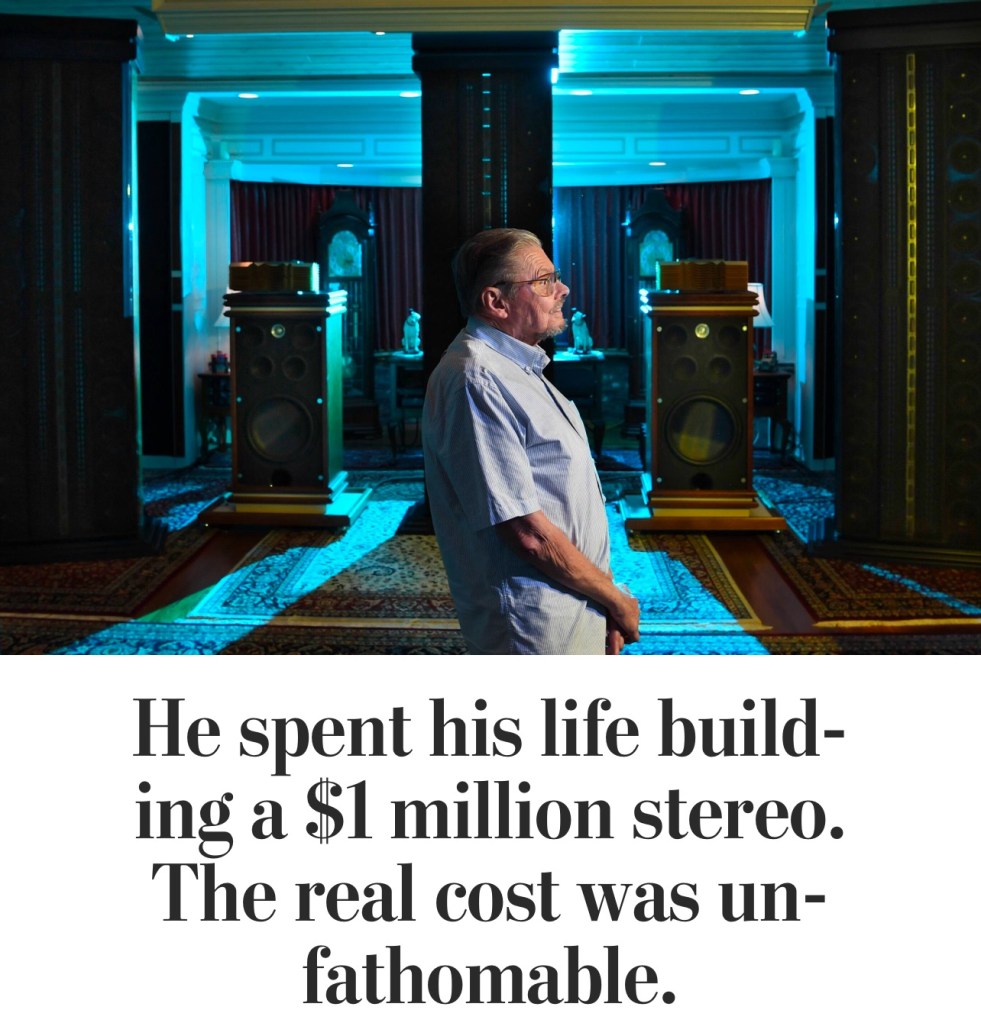
Ken Fritz turned his home into an audiophile’s dream — the world’s greatest hi-fi. What would it mean in the end?
Ken Fritz was years into his quest to build the world’s greatest stereo when he realized it would take more than just gear.
It would take more than the Krell amplifiers and the Ampex reel-to-reel. More than the trio of 10-foot speakers he envisioned crafting by hand.
And it would take more than what would come to be the crown jewel of his entire system: the $50,000 custom record player, his “Frankentable,” nestled in a 1,500-pound base designed to thwart any needle-jarring vibrations and equipped with three different tone arms, each calibrated to coax a different sound from the same slab of vinyl.
“If I play jazz, maybe that cartridge might bloom a little more than the other two,” Fritz explained to me. “On classical, maybe this one.”
No, building the world’s greatest stereo would mean transforming the very space that surrounded it — and the lives of the people who dwelt there.
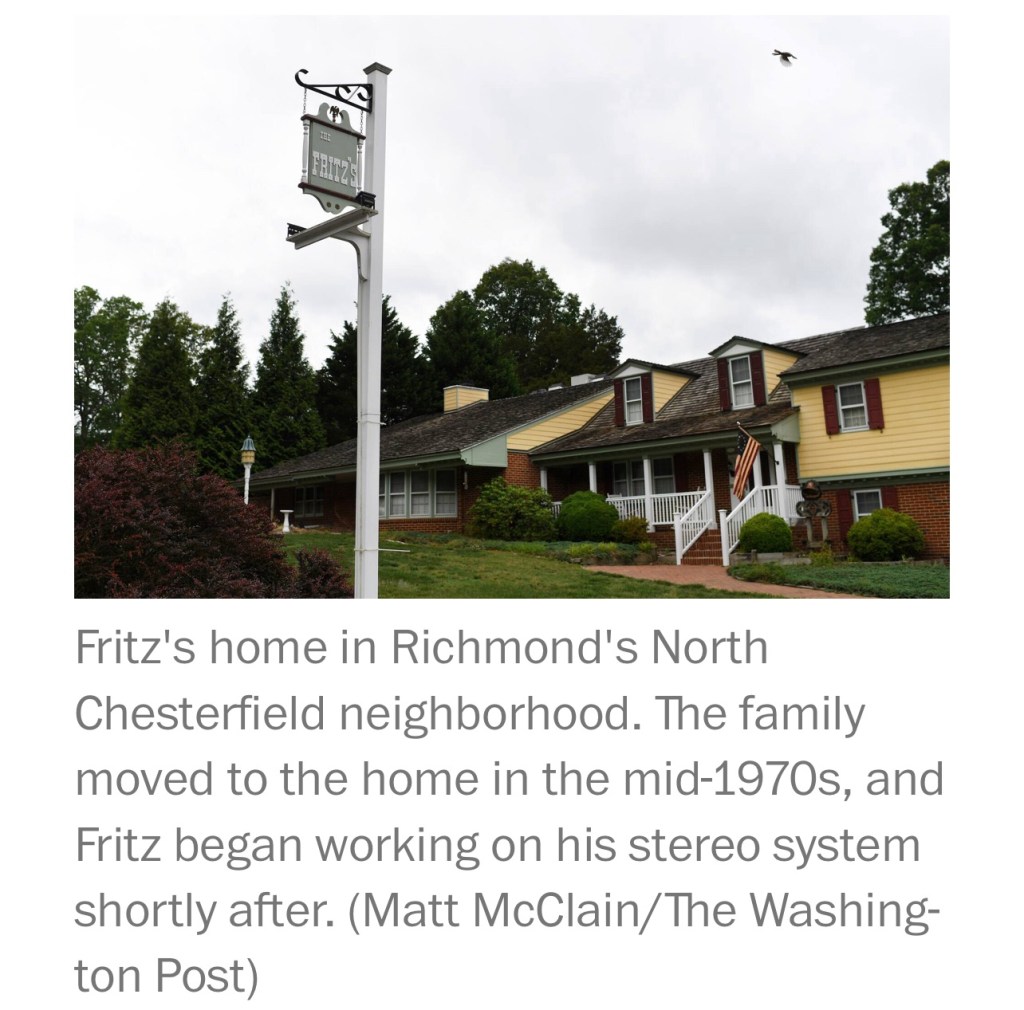
The faded photos tell the story of how the Fritz family helped him turn the living room of their modest split-level ranch on Hybla Road in Richmond’s North Chesterfield neighborhood into something of a concert hall — an environment precisely engineered for the one-of-a-kind acoustic majesty he craved. In one snapshot, his three daughters hold up newsiding for their expanding home. In another, his two boys pose next to the massive speaker shells. There’s the man of the house himself, a compact guy with slicked-back hair and a thin goatee, on the floor making adjustments to the system. He later estimated he spent $1 million on his mission, a number that did not begin to reflect the wear and tear on the household, the hidden costs of his children’s unpaid labor.
“My dad had a workshop,” is how Rosemary, the youngest girl, now 56, puts it. “We were forever building, rebuilding.”
But for the final flourish of his epic engineering project, in 2020, Fritz would go it alone.
He found just the right suction cups, four in total and the perfect size, from a company in Germany. He ordered a small vacuum pump online.
It would allow him to place a record on the turntable without even lifting the disc.
It was hardly the Frankentable’s most expensive enhancement, but it would fulfill a desire he could scarcely have imagined when he began his lifelong search for the perfect sound:
What’s the value of the world’s greatest stereo? Soon, everyone would know. But for now, just hit play.
Camille Saint-Saëns’s Symphony No. 3. It’s a favorite. Famous for its glorious pipe organ, it was the last symphony finished by the great French romantic composer.
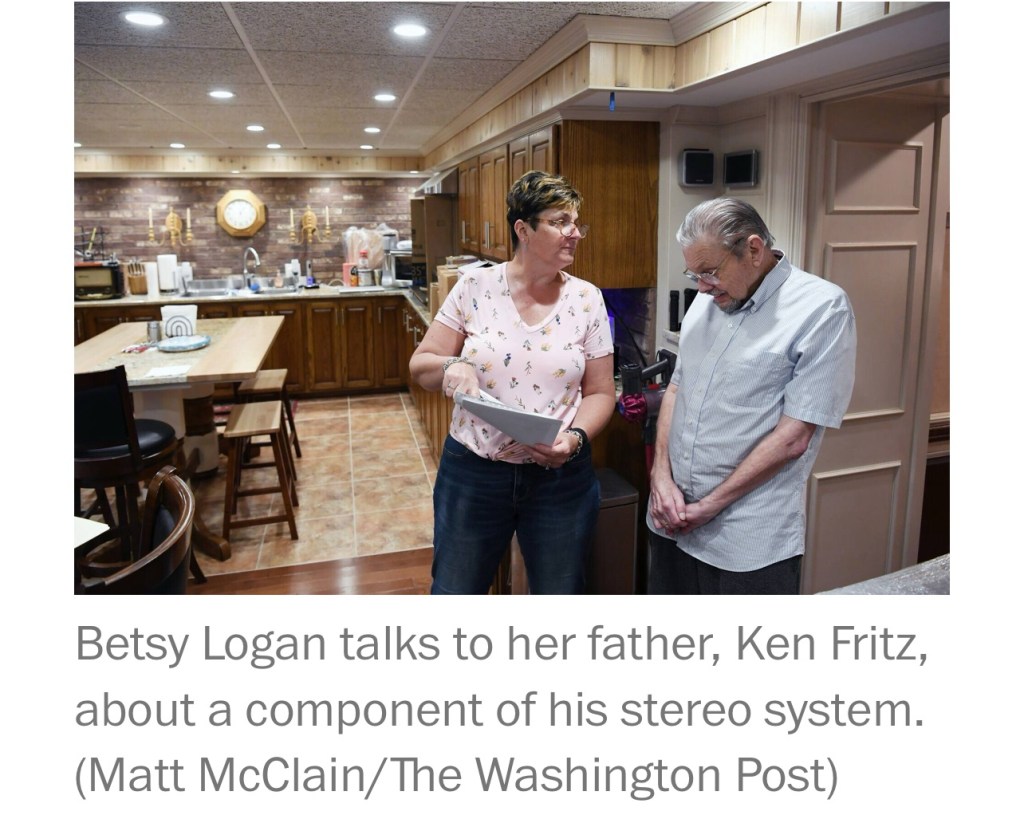
“Should we listen, Dad?” asked Betsy, 59, the oldest of Fritz’s five children, and the only one up to help inventory his life’s work as his 80th birthday approached.
Fritz laughed.
“You won’t get a no from me,” he said.
The music builds slowly, lush strings answered by woodwinds, until the organ crashes into the mix and sparks a cascading piano dialogue that requires four hands. Its fullness and power washed over Fritz’s listening room.
He was a boy at the dawn of the hi-fi revolution. This was 70 years ago, long before holograms and virtual realities tried to fool our brains into seeing something that’s not there, when stereo first sold us an auditory experience like no other.
Just lower the needle, and an invisible 70-piece big band was transported into your living room — or a whispering crooner would come to life on the couch cushion beside you.
The trick, pioneered in the early 1930s by engineers working at Bell Labs in New York and Abbey Road Studios in London, was in the two channels of sound. Recorded from separate microphones and played back through separate speakers, they could simulate the swirling warmth and depth of life.
By the 1950s, the first bulky hi-fis were marketed for home use, blowing open the closed feel of the old phonographs — and offering a newly affluent nation a sophisticated new field of connoisseurship to conquer. The Mantovani Orchestraor Rosemary Clooney, pouring out of the Klipschorns with the after-dinner martinis.
One day, Fritz’s teacher at his Milwaukee grade school set up a turntable and speakers in the classroom. He was stunned by the beauty of the classical music. But he was especially thrilled by the sense of being on the cutting edge of a new technology.
Within a couple of years, teenage Fritz had bought his own recording machine and started capturing the music of live bands. He started the Hi-Fi Club at Bay View High School and took a part-time job in an appliance store that sold audio gear. With his earnings, he picked up a Heathkit, one of the hot, new build-it-yourself amplifiers, for $49.
You probably know a Ken Fritz. Maybe you are a bit of one yourself. Prosperous mid-century America produced a lot of Kens. The kind of people who gave their all to their hobbies — bowling, gardening, woodworking, stamp collecting — and refused to pay somebody else to manifest their dreams for them.
Like a lot of kids born to the children of the Depression, Fritz absorbed his DIY ethos from the previous generation. When their ’51 Chevrolet broke down, Ken Fritz Sr. didn’t have the money for a mechanic. So he took the engine apart himself and figured out how to install new piston rings. “He had never done that before,” Fritz recalled. “But he was smart enough to know how.”
At an audio show in 1957, Ken Jr. met Saul Marantz — an engineering legend in this burgeoning field, who a decade earlier had been so driven to convert an old car radio for home use that he took it apart and reconstructed it into a new invention, a preamplifier he dubbed the Audio Consolette. For a kid like Fritz, it was better than meeting Willie Mays.
“He looked like the guy on ‘Breaking Bad,’ just a little, but smaller,” Fritz recalled. “I told him I wanted to buy his amplifier. He knew I didn’t have the money.”
Fritz persuaded his boss at an audio shop to set Marantz up as a dealer. That earned him a discount, though he still had to work Saturdays to make up the rest.
After college, he worked for a business that made fiberglass molds and eventually moved to Virginia. He started his own company there, settling into the family home on Hybla Road in the mid-’70s.
He added a workshop and eventually built a swimming pool, something of a sop to his wife, Judy, and their kids, since he was too busy for travel or vacations. His company consumed the days. His audio obsession filled the nights and weekends.
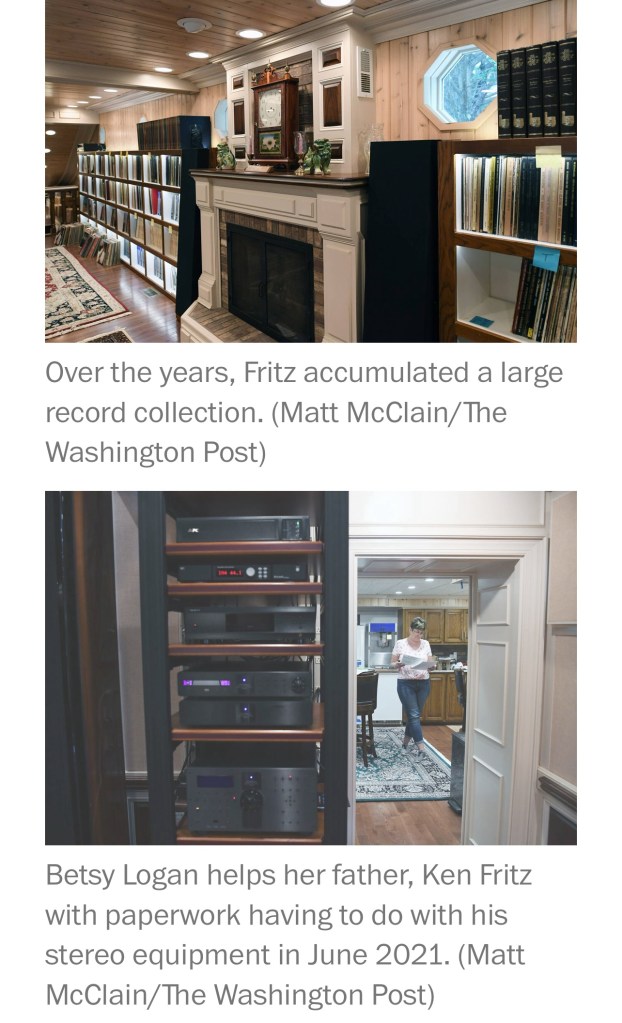
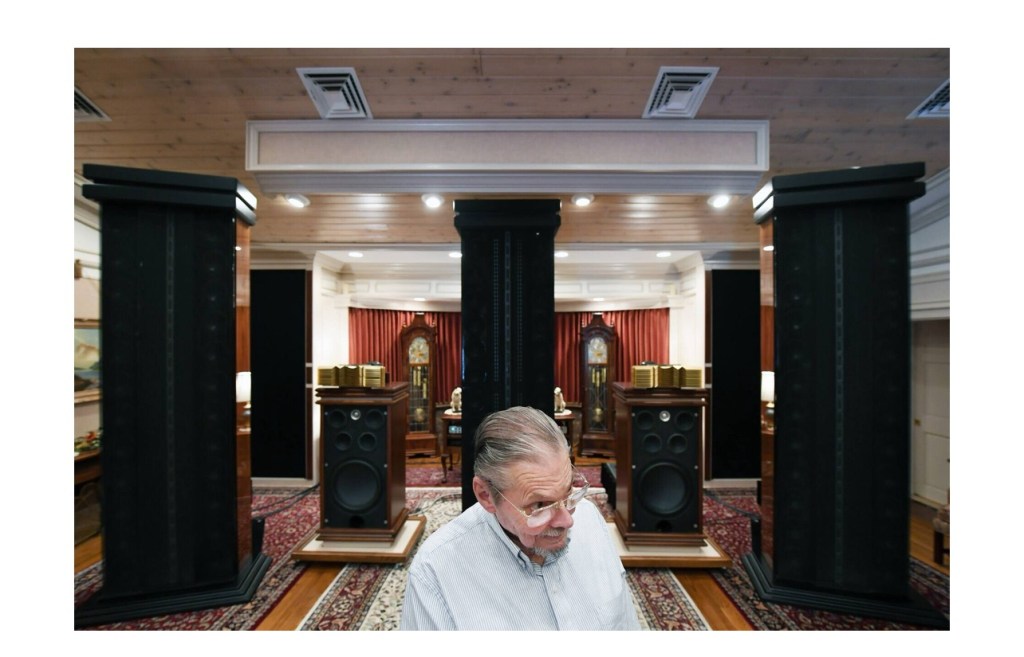
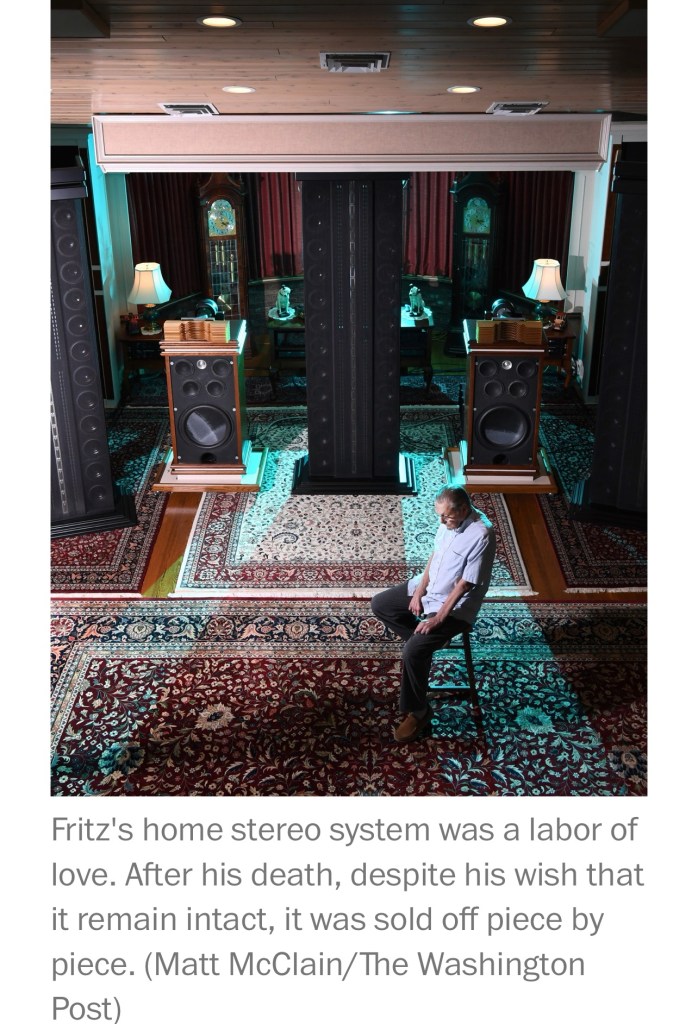
In the 1980s, Fritz launched his project by blowing up the living room into a listening room, a 1,650-square-foot bump-out based on the same shoe box ratio, just under 2 to 1, that worked magic in concert halls from the Musikverein in Vienna to the Concertgebouw in Amsterdam. The idea was that the acoustic waves would similarly roll off Fritz’s long, cement-filled walls and 17-foot-high, wood-paneled ceiling to bathe the listener in music.
He got his older son, Kurt, to help pour the concrete floors. Then he worked alongside a construction crew to put up the 12-inch-thick walls and the sound panels to line them.
To minimize hum and potential electrical interference, Fritz outfitted the room with its own 200-amp electrical system and HVAC system, independent from the rest of the house.
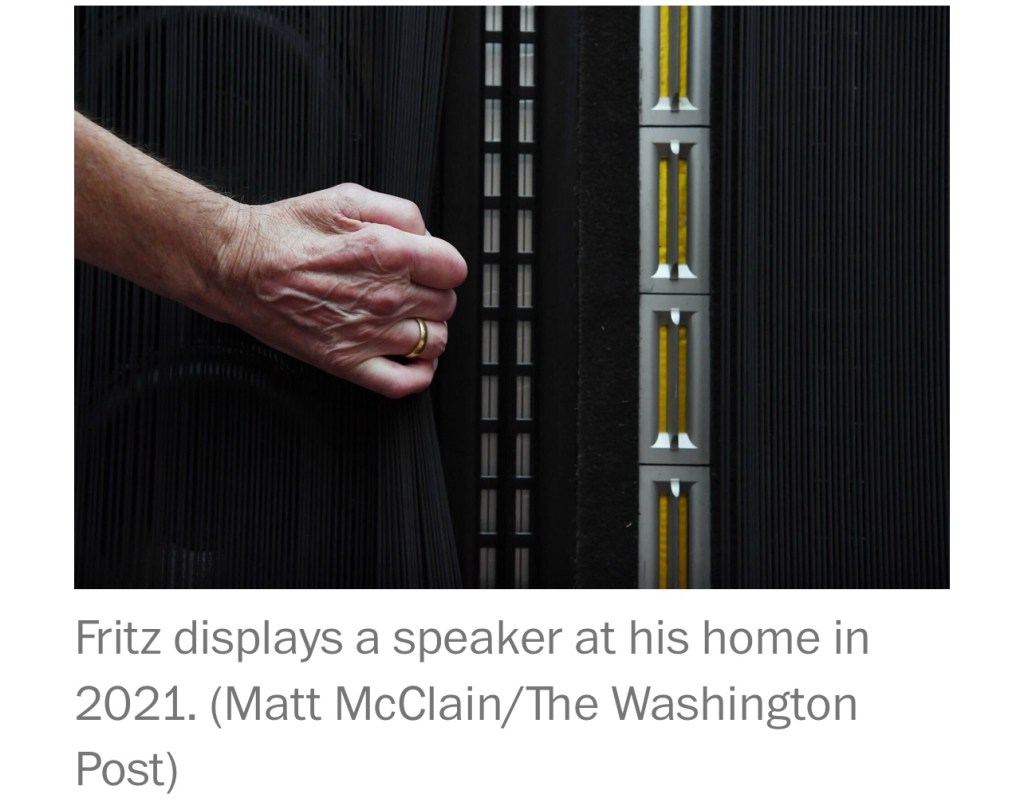
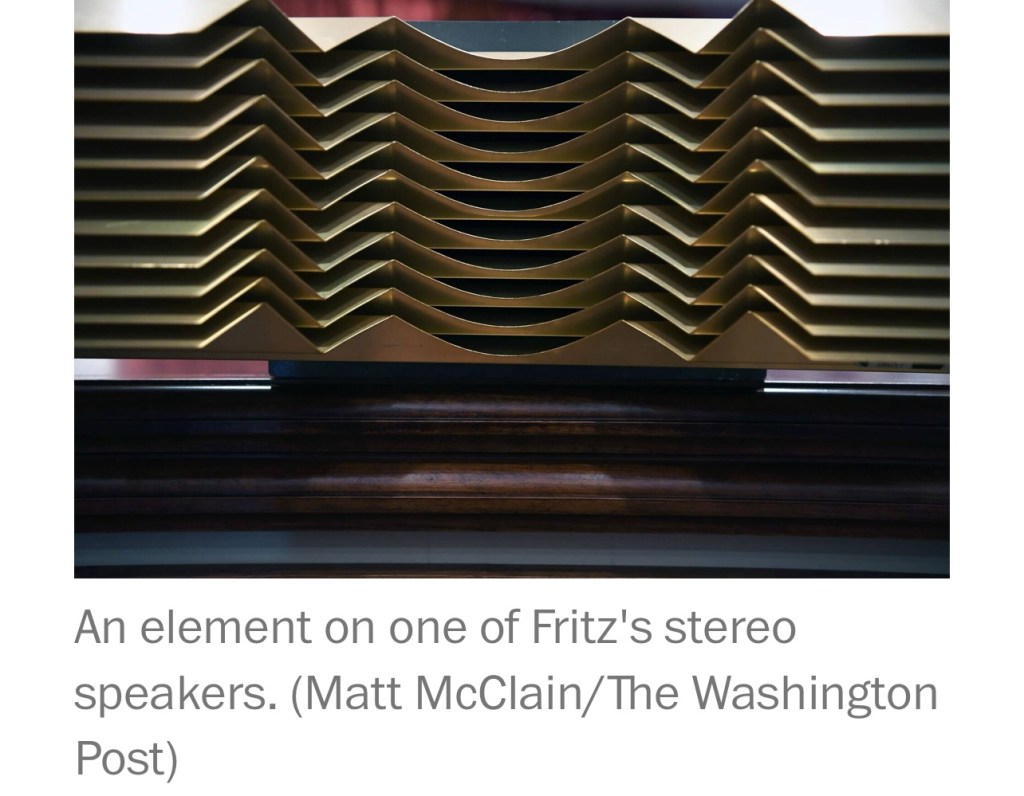
He crafted by hand the three 10-foot speakers that loomed like alien monoliths at the head of the room, with the help of Paul Gibson, a former employee at his fiberglass company. Each 1,400-pound slab pulsed with 24 cone drivers for the deeper tones and 40 tweeters — 30 shooting into the room, 10 toward the crimson curtains draping the wall behind — to project the upper-range sounds.
He bought only a few of the components ready-made from a retailer. Fritz and his audiophile friends believed it was idiotic to invest in the kind of top-shelf equipment that gleamed from the glossy pages of High Fidelity magazine. Only a home-crafted system could achieve the audio you desired.
“You’re going to spend $250,000 for the name brand on the rack so everybody comes in and will be impressed,” scoffed Mark Mieckowski, a retired electrician who had helped Fritz fine-tune his system over the years. “DIY, there’s no name tags, nobody knows nothing. And I guarantee you those will probably sound a million times better.”
It was thrilling work. At night, Fritz would lie in bed and think about the progress he had made that day and the tasks that lay ahead for the next.
“I firmly believe that by the time a person, man or woman, is 19, 20, 21, they know what they’re going to do with their life,” he said. “And if you’re on that path and things are being done to your satisfaction, it’s easy to keep going to look for the next goal.”
Not everyone in the rapidly metastasizing house on Hybla Road shared this excitement.
In the faded photos taken as they worked alongside him, the five Fritz kids are offering pinched smiles, at best.
“Nobody wanted to come to our house, because he wanted to put them to work,” said his daughter Patty, 58. “I think we went camping twice, never took vacation. It was just work, work, work.”
Fritz thought he was teaching them about hard work and focus. A hard-driving boss at his company, he brought the same energy to his after-hours hobby, which he sometimes seemed to think of as everybody’s hobby.
He could be short. He held grudges. Devoted to sound, he often seemed not to listen.
Judy drank too much in those days. She also was unimpressed by her husband’s music. When he played “Swan Lake,” she’d call it “Pig Pond” in front of the kids and crank up the TV to annoy him.
After the divorce, she stopped drinking and found a longtime partner. Fritz moved on as well, finding happiness with Sue, who worked on making molds at his company; they married in 1995.
The biggest strain remained with older son Kurt, whom Fritz had once hoped would take over his business. But Kurt moved to New York for a job as a technology consultant. He needed the distance.
“Growing up, I had to get up at 6 in the morning to work,” Kurt, 55, said. “I basically was his slave.”
As he got older, Fritz sometimes wondered if he could have made space within his own vast ambitions to consider other people’s goals and wishes.
“I was a father pretty much in name,” Fritz told me. “I was not a typical father or a typical husband.”
The big blowup with Kurt came in 2018, about two years after Fritz had declared that, at last, the world’s greatest stereo and listening room was complete. Kurt, on a visit home, decided to ask his father for a couple of family heirlooms: his grandfather’s 1955 Chevy and an old Rek-O-Kut turntable.
It wasn’t the size of the ask. The record player wasn’t worth more than a few hundred dollars. But the tone of the demand set off Fritz. He heard in it a sense of entitlement.
“It could have been a monkey wrench, the way he told me,” Fritz recalled later. “I told him: ‘Not going to happen.’”
It was past 1 a.m. when Kurt, with a few drinks in him, told his father he was going to stay up later and listen to some more music. All the work he had put into building that stereo system — pouring concrete, painting the walls — now Kurt wanted to enjoy it.
But Fritz hit the off switch on the Krells. And Kurt delivered the words the two of them could never come back from.
“I need you to die slow, m—–f—–,” he told his father. “Die slow.”
His meaning was coldly clear to both of them.
Just a few months before, Fritz had noticed a weakness in his right hand. The diagnosis: amyotrophic lateral sclerosis — the progressive and inevitably fatal neurological disorder known as ALS.
That was it. Fritz called his attorney and disinherited Kurt.
His doctor had explained the cruel reality of Fritz’s disease. A small percentage of people go on to live years with ALS, continuing to work and function. But for most others, the transformation is rapid and devastating. People in the prime of life and health are robbed of muscular control and eventually the ability to speak, swallow and breathe.
For Fritz, there was initial hope, as he began treatment at Duke University Medical Center in North Carolina and continued to stay on his feet, that his case would progress slowly. But one day in 2020, he tried to use the Frankentable and found he couldn’t lift his arms.
“I can’t listen to these records anymore,” he told Sue.
“Well, if you want to sit down and tell me what you want to hear, I can put it on,” she replied.
But Fritz was not ready to relinquish control over his creation. That sparked the suction-cup idea. Fatal condition? Like all other hurdles on the path to the world’s greatest stereo, he would simply try to out-engineer it.
His plan was ingenious. It would involve rigging the suction cups to secure a record so he could shift it onto the turntable with a mere flip of a switch — a tiny gesture he felt confident his failing body would still allow for a while.
But before getting too deep into the project, he stopped. His neurological deterioration was accelerating. By the time he finished constructing the device, he realized, he wouldn’t even be able to remove a record from its sleeve.
A friend in Texas mailed Fritz a hard drive packed with thousands of songs, from Motown to Mozart. Now he could play music with his iPad. It might not have had the analog warmth of a Shaded Dog vinyl pressing of Arthur Rubinstein playing Beethoven, but on the Fritz system, through those mighty speakers, it wasn’t half-bad.
His younger son, Scott, 49, offered another welcome distraction.
They, too, had clashed over the years and occasionally stopped talking. Scott didn’t like how his father sometimes treated people. There was the time that Fritz blew up when a friend didn’t return some borrowed microphones promptly and insisted Scott go retrieve them, even though the man’s wife had just died. And Scott hatedhow his dad acted toward Kurt.
“He definitely taught me my work ethic,” Scott said. “But I don’t need to spend time with people who behave like that.”
Still, the two maintained a special bond, Scott having followed their shared passion into a career as a sound engineer in Chicago. In 2018, he and a filmmaker friend, Jeremy Bircher, drove to Virginia to make a documentary: “One Man’s Dream.”
The 58-minute film opens with Fritz, moodily backlit at his record shelves, grazing a hand across the jacket spines before landing on Tchaikovsky’s “Swan Lake.” In slow-motion close-ups, we see him press the disc to the turntable with a custom weight, lower the needle of an Air Tight PC-1 cartridge to the spinning grooves and carry a glass of wine to the paisley wing chair in the center of the Historic Williamsburg-meets-Victorian listening room. He faces those stalagmite speakers as the brass section collides with the swooning strings, taking it all in with a mesmerized smile.
Some audio professionals found it unbearable.
“You’re mining the lunatic fringe,” Jonathan Weiss, the owner of Brooklyn-based high-end audio boutique OMA, warned me when I told him about this story. Fritz, he argued, was the kind of obsessive who gives audiophiles a bad name.
But Steve Guttenberg, host of the popular Audiophiliac YouTube channel, shared the documentary with his 240,000 subscribers, calling Fritz “one of a kind.” It has now been viewed more than 1.9 million times on YouTube.
“This room/house must be listed in UNESCO World Heritage List. So much passion, soul and heart!” wrote one of the thousands of commenters.
“This is truly something that needs to be conserved,” wrote another, “as a memory to this inspiring man.”
One day in April 2021, Fritz hosted a small listening party. Before the pandemic, he frequently invited the entire Richmond Audio Society for sound and sandwiches. But on this day, it was just two of his closest audio-geek friends and me.
Ray Breakall, a professional piano tuner whose record collection is split between jazz and classical, remembered the first time Fritz played for him a 1950s recording of the Chicago Symphony Orchestra with Fritz Reiner conducting.
“It was almost like the orchestra was in the room,” Breakall said. “That’s impossible if the room isn’t this size. Very scary and very realistic.”
Mieckowski — the sound buddy whose tastes ran more toward Five Finger Death Punch, a thrash-metal combo from Nevada, and who didn’t even own a turntable — was there, too.
“I can flat-out say this is the best system I’ve ever heard,” said Mieckowski. “Period.”
They talked more about the room, Fritz occasionally piping in but more often sitting back and listening, seemingly worn out. Betsy put out deli meat and rolls, and Fritz worked his way slowly through a sandwich, cutting up the pieces small enough to swallow. He seemed re-energized by the time they returned to the stereo.
“Here’s a great rock song, and it gets your juices going,” Fritz told us.
He punched up “Do You Love Me,” the 1962 hit featured so prominently in the musical melodrama “Dirty Dancing.”
And here it was, the inevitable moment in every meeting with an audiophile, when the proud owner of the system in question presses play.
I had experienced it when Weiss invited me to the OMA showroom to listen to the enormous horn speakers he sells for about $300,000 a pair; and when I sat in the cramped basement of veteran stereo-and-vinyl journalist Michael Fremer as he blasted the Beatles’ “Rubber Soul” through his Wilson speakers.
They all want to know: What do you think?
But as Fritz cranked the loudest version of the Contours hit I’d ever heard, it was impossible to listen critically. Was the bass flabby or tight? Did the mids sound right? What about the drums? The voice?
Fritz nodded, his eyes brightening. I found myself reflexively smiling, meeting his look with an expression of wonder, mouthing “wow.”
I was rooting for a man who had devoted his life to this system. I wanted it to sound better than any other. Even if I really couldn’t tell.
Was it truly “wow?” Or merely loud?
I noticed Mieckowski shake his head, involuntarily and almost imperceptibly, as soon as the music kicked in. He remained politely appreciative in front of his friend. But later, I followed him out to his car, where he confessed that, no, it sounded off that day.
He speculated that the Fritzes had probably been watching a DVD in the listening room and accidentally left the speakers on movie mode. A common mistake. But the fact that Fritz could no longer detect an imperfection in a system he had spent years honing to his impossibly high standards was a heartbreaking reminder of his friend’s physical decline.
“He can’t remember half the time what he’s listening to and what he’s left on,” Mieckowski said, referring to the system’s smorgasbord of settings.
Three years earlier, in Scott’s documentary, Fritz had talked frankly about his condition, the limited number of years that remained for him and his hope that the world’s greatest stereo system would live on without him.
“I’d hate like heck to see this room parted out,” he had said. “That’s just like breaking up a dream.”
But on this night, Mieckowski had a glimpse of the not-so-distant future. Fritz’s stereo system may as well have been a load-bearing wall. His dream had been woven into the actual structure of his home. They were virtually inseparable.
And who would want to buy a stereo that cost more than the house?
“Anybody that’s got that kind of money,” Mieckowski said, “doesn’t want to live here.”
They gathered in the listening room one last time. Ken Fritz was turning 80. His sons weren’t there. Kurt remained estranged. Scott couldn’t make it down from Chicago. But Fritz’s three daughters and their husbands came and sang “Happy Birthday.” He sat for a portrait and even had a small spoon of ice cream, as much as his constricted throat muscles could tolerate.
It was February of 2022. Six years after he had finished his life’s project. Four years after he was told he only had so much longer to enjoy it.
Betsy, while helping him inventory his collection, had observed how her hard-charging dad had softened. He was able to share his regrets about his style of fathering. But he had no regrets about the hours, weeks and years that he had devoted to the world’s greatest stereo.
At some point, Betsy flicked the power on the 35,000-watt amplifiers and put on a selection of Christmas songs. Fritz always preferred his booming classical works, but the holiday tunes worked as background music, since they still had the 10-foot tree and the garlands on the banister. And Fritz wasn’t making a lot of musical choices anymore.
He was beyond the point where music could make him feel better, especially since he could no longer operate the system himself.
In April, around the time Betsy arranged to put a hospital bed on the ground floor so Fritz could avoid the stairs, she also tried to broker a peace.
Kurt called and tried to talk to his father. Betsy urged him to take the call. Fritz refused. In the end, they never spoke. On April 21, 2022, Fritz died.
And then it fell to Betsy to try to fulfill her father’s last, greatest wish.
For a time, it looked like an old audiophile pal of her father’s would buy both the house and the system. But he and his wife changed their minds.
Betsy talked to dealers about looking for other potential buyers. They were not enthusiastic.
Adam Wexler, with the Brooklyn-based StereoBuyers, told her he could resell the Krells. The custom-designed equipment would be a lot harder.
“Hi-fi is extremely subjective,” Wexler told me later. “So this guy built something that sounded good to him. How many people out there are going to say, ‘These are the speakers for me’ — and go through the hassle of acquiring these gigantic speakers that probably wouldn’t fit in most people’s homes, even if you could get them to their homes?”
Late last summer, Betsy realized she had to let go. Another couple wanted to buy the house — but not the stereo. She made a deal with a local online auction site, eBid Local, to catalogue and sell her father’s life’s work.
These people knew nothing about concert-hall acoustics, setting the vertical tracking angle or the magic of the perfect “Swan Lake” recording. They knew marketing.
“We euphemistically refer to it as the ‘million-dollar, monumental, magical, musical masterpiece,’” said David Staples, the owner of eBid Local. “It may be the best, most elaborate and exquisite private residential audiophile system in the country, perhaps even in the world.”
Many of the records her father had spent a lifetime collecting had already been sold — and Betsy understood that the system itself would almost certainly be parceled out to multiple buyers as well.
So what, ultimately, would be the value of the world’s greatest stereo?
The auction closed just before Thanksgiving.
The Frankentable? There were 44 bids, the top at a mere $19,750.
The 10-foot-tall speakers? After 18 bids, an Indiana man named Carlton Bale snagged all three for $10,100. Less than you’d pay for a pair of Yamaha NS-5000 bookshelf speakers.
A fan of Fritz’s YouTube documentary, Bale had set out a couple of years ago to build what he imagined would be “the second-best loudspeaker in the world” — until he heard about the Fritz auction.
“I thought, ‘Do I really have the time to build the speakers I want that probably aren’t going to sound as good as the ones Ken built?’” Bale recently recalled, after driving to Virginia with a U-Haul to fetch them last month. The price, he conceded, was “a steal. The bargain of a lifetime.”
The total take for the million-dollar stereo system, including the speakers, the turntable, the dozens of other components from detached cones to the reel-to-reel decks? $156,800.
But perhaps that was always going to be its fate. Last summer, when pressed about the value of Ken Fritz’s life’s work, Staples had demurred.
The value, the auctioneer said, was whatever somebody else was willing to pay for it.
Geoff Edgers, The Washington Post’s national arts reporter, covers everything from fine arts to popular culture. He’s the author of “Walk This Way: Run-DMC, Aerosmith, and the Song That Changed American Music Forever.”
Enter the world of art by meeting artists, collectors, and gallerists who will tell you how and why they love their creative life.
Episode 1 —Doug Garr .
Doug Garr is a friend of mine who has spent 40-plus years as a journalist, editor, author, blogger, ghostwriter and speechwriter. Doug is the guy who helped New York Governor Mario Cuomo sound so good at the mic. If that’s not astonishing enough, Doug is also an active skydiver with an expert license rating of 2,200 jumps.
One day I will interview Doug about his life as a dare devil. Today I want him to tell us all about his connection to art.
He was married for nearly 42 years to the late Meg Perlman, a prominent art curator. Everyone in the art world knew her. Most knew Doug too because he accompanied Meg to art events around the world.
Meg was the founding director of the Pollock-Krasner House and Study Center in East Hampton, N.Y. She also worked at the Museum of Modern Art, and the Metropolitan Museum of Art. Meg was the director of the James Brooks and Charlotte Parks Brooks Foundation. Meg also served as the curator of a number of important private art collections, including those of William A.M. Burden, Mrs. John D. Rockefeller III, Sandra Rockefeller Ferry, Senator and Mrs. John D. Rockefeller IV, and the Pierre Noel Matisse Trust, among others.
Meg was the one who discovered Jackson Pollock’s paint drippings under the floor coverings of the Pollock-Krasner House and Study Center in East Hampton, N.Y. She instantly became world famous.
The Art Lovers Forum Podcast is also available on popular podcast sites:
What I do is about living. It’s about living the best life you can and enjoying the fullness of the life around you — from what you wear to the way you live to the way you love.
Our homes are a canvas for living. Whether we live in the city, the country, on a farm, at the beach, in a penthouse or cabin, each is home and tells our story. And just as we dress differently in each of these places, we want to live differently as well.
My homes have always offered refuge, warmth and comfort for my family and me. My recent book celebrates those homes and the collections they’ve inspired since the first Ralph Lauren Home Collection in 1983. Just like my collections for men and women, my home collections have traveled far beyond the lifestyles and borders of America. They are inspired by the way people live out their dreams all over the world.
I remember the first time I visited the Guggenheim. Walking into that white, soaring space away from the noise of the city had a powerful effect on me. When Ricky and I found our apartment on Fifth Avenue, not far from the museum, I had that feeling in mind. We wanted it to feel more like a loft, totally open and clean, and with a focus on city views. I wanted a downtown loft, but uptown on Fifth Avenue.
This was in some ways our real first home. I wasn’t looking for glamour or making an impression. It was just the simple, almost primitive desire to have a kind of freedom — room for our three children to race around and room to take stock of ourselves and to discover who we really were and what we wanted.
Personally, I needed that open space and serenity. That’s why we had the apartment done all in white — white lacquer tables, white canvas sofas — with natural bamboo armchairs, polished-wood floors and lots of plants. It was such a relief to come back to after a long day of looking at endless swatches, patterns and colors. Part of that peacefulness came from the views of the sky and the Central Park Reservoir and watching the lights coming on all over Manhattan at the end of the day.
I think I was 25 when I first came out to the Hamptons. Even when I didn’t have a house, I’d drive out. It was so beautiful. I wanted to be able to feel the fresh air and wind. I wanted a home where I could feel simplicity and peace.
After Ricky and I were married and had our first child, Andrew, we rented a house in Southampton — a faded red barn that sat in a big meadow. It was the perfect place for a young family. A couple summers later, we moved to Amagansett. By then, Andrew had a younger brother, David, and the two of them loved chasing each other down to the beach. When Dylan was born, we found a charming shingled saltbox house in East Hampton, right on the ocean. It was in a compound of six other cottages set off from the main roads with lots of little private paths for running and biking with the children. Those summers when the children were so little are the ones I’ll always remember. Life was so simple and easy.
Then we discovered the house in Montauk. It was built in 1940 by an architect who had worked with Frank Lloyd Wright. It had such integrity, constructed to follow the contours of the land. The low ceilings and warm wood gave it a modern kind of coziness.
When I first came to Colorado, I didn’t want to build a new house; I wanted to find an old one. Someone told me about a 100-year-old barn on a large piece of property looking out at the San Juan Mountains. I remember so well the morning Ricky and I went to look at it: the light on the meadows and striking the barn. We immediately knew this was where we wanted to live.
I love land for itself — the look and beauty ofundisturbed land. I felt pained to have to build here at all, so I chose low, inconspicuous sites where the houses would be half-hidden by the trees. Driving by on the road, you could miss the Lodge, our family house. It looks like a little log cabin from the outside, but when you go inside, it seems spacious. Our pole-rail fences handcrafted of locally sourced pine border our land along the highway for more than seven miles. We constructed them so that the rails face outward for a smooth appearance. The fences are part of the journey to our home.
I love the character of old things. I built the house out of old barn wood. I wanted a screen door with a squeak. If something’s really old, let it feel that way. Over time, the Lodge has become a home to things we felt belonged here — Native Americanpaintings, pottery, woven baskets, serapes, weavings and trade blankets. Their bold color and handcrafted textures bring a special beauty and brightness against the dark wood of the cabin walls.
Though we had our houses in the mountains and by the beach, we realized that we wanted a getaway closer to home — a place we could get in the car and drive to on the spur of the moment. We started taking drives north of the city and eventually discovered a house and property nestled in what we felt to be one of the most beautiful parts of America. There were little dirt roads that wandered through woods and fields, passing paddocks of horses, stables and weathered red barns set off by miles of rustic stone walls. It was rural yet sophisticated, which was perfect. I like faded and old — a certain kind of genteel shabbiness. It’s a reverence for integrity. This property had that; it was sort of a combination of a hunting lodge and a stately home.
The mood was right, but we wanted to give it a warmth and individuality, and at the same time, a glamour. It was the kind of house where we could express our love of antiques and timeless elegance, yet at the same time be young and eclectic.
When I was a kid, I always looked forward to summer because I could go out and play ball and go swimming. Then, years later, I discovered Jamaica. In the middle of winter, I could step out of time.
We went there on holiday as a young family more than four decades ago. It wasn’t long before we moved into a romantic old villa on the highest point of Round Hill, a resort overlooking the Caribbean. We called it High Rock. It had a spirit and a glamour that harkened back to the days when Grace Kelly, Noël Coward, the Astaires, Errol Flynn and Ian Fleming wintered there — there was a timelessness that we loved. Surrounded by a jungle of trees and flowers, it was our own Garden of Eden.
Ralph Lauren (/ˈlɔːrən/; LOR-ən; néLifshitz; born October 14, 1939) is an American fashion designer, philanthropist, and billionaire businessman, best known for the Ralph Lauren Corporation, a global multibillion-dollar enterprise. He has become well known for his collection of rare automobiles, some of which have been displayed in museum exhibits. He stepped down as CEO of the company in September 2015 but remains executive chairman and chief creative officer. As of April 2022, his net worth was estimated at US$6.9 billion.[2]
On December 20, 1964, Lauren married Ricky Ann Loew-Beer in New York City. She is the daughter of Margaret Vytouch and Rudolph Loew-Beer. The two had met six months earlier, in a doctor’s office where she was working as a receptionist; on alternate days she was teaching dance. She is the author of The Hamptons: Food, Family and History.[35] The Laurens are members of the Park Avenue Synagogue in Manhattan, leading the synagogue’s capital campaign that ended in 2019.
They have three children: Andrew Lauren (b. 1969), a film producer and actor; David Lauren (b. 1971), an executive vice president at Ralph Lauren Corporation; and Dylan Lauren (b. 1974) In September 2011, David married Lauren Bush, granddaughter of former U.S. President George H. W. Bush. Lauren and David have three children and live in Manhattan. Dylan Lauren, owner of Dylan’s Candy Bar in New York City, was married in June 2011 to hedge fund manager Paul Arrouet. Dylan and Paul had twins on April 13, 2015, via surrogate in New York City.
In April 1987, Ralph Lauren underwent surgery to remove a benign brain tumor and made a full recovery.
His cars have won “Best of Show” at the Pebble Beach Concours d’Elegance twice, his 1938 Bugatti Type 57SC Atlantic won in 1990 and his 1930 Mercedes-Benz SSK “Count Trossi” roadster won in 1993. In 2005 his collection was displayed at Boston’s Museum of Fine Arts. Seventeen cars from his collection were exhibited at the Musée des Arts Décoratifs, Paris, in 2011.[51] In 2017, Lauren’s now $600 million dollar car collection took center stage during New York Fashion Week.
Philanthropy
Lauren has focused a substantial amount of his philanthropy to address cancer. In 1989, he co-founded the Nina Hyde Center for Breast Cancer Research at Georgetown University Hospital in Washington D.C. in memory of the late Post fashion correspondent. He served as chairman and created the name and symbol for Fashion Targets Breast Cancer, a charitable initiative of the CFDA that founded in 1994 that marshals the goodwill and services of the fashion industry to raise public awareness and funds for breast cancer internationally. In 2003, Lauren supported the establishment the Ralph Lauren Center for Cancer Care and Prevention in Harlem, Manhattan, New York City. The Center is a collaboration between Ralph Lauren, Memorial Sloan-Kettering, and North General Hospital in Harlem.
In 2014, the Ralph Lauren Corporation partnered with the Royal Marsden, the largest and most comprehensive cancer center in Europe, to develop a world-class breast cancer research facility. They opened the Royal Marsden Ralph Lauren Center for Breast Cancer Research in 2016.[56] In 2023, the Ralph Lauren Center for Cancer Prevention was opened at the Lombardi Comprehensive Cancer Center of Georgetown University.
In 2000, the Ralph Lauren Corporation launched its Volunteer Program, which energizes employees and creates meaningful connections with the communities in which they work. On Friday, September 15, Ralph Lauren Corporation launched the Pink Pony Campaign, a national initiative to reduce disparities in cancer care by raising awareness as well as enhancing prevention, screening, and treatment in poor and underserved communities. Similarly, in 2006, the Polo Jeans G.I.V.E. (Get Involved, Volunteer, Exceed) campaign was created to inspire and encourage community service through volunteerism by supporting the efforts of dedicated volunteers and their causes, including Habitat for Humanity.
The Polo Ralph Lauren Foundation established the American Heroes Fund following the September 11th attacks to allow Polo’s 10,000 employees worldwide, as well as their customers, the opportunity to participate in the relief effort.
The Polo Fashion School was established in 2004, in which company executives work with inner-city youth to offer insights into the fashion business.
As recently as 2012, with a $35,800 donation to the Obama Victory Fund, Lauren made regular small donations to U.S. Democratic candidates. In 2022 the Ralph Lauren Corp, through individuals, donated $63,000 to democratic organizations and individuals