The Literary Life with Mitchell Kaplan is by far the best podcast available today. If you donโt believe me listen to this one with John Grisham. If you ever wanted to write a book, or get tips on how to sell your book, listen to Mitchell get secret tips from Grisham.
On this edition of The Literary Life, John Grisham is live at Books and Books in Coral Gables for a great night with a room full of readers, basking in the brilliance of a master storyteller. John’s new book is The Exchange, and he brings back Mitch McDeer, the hero of The Firm — and he talks with Mitchell Kaplan about this new book and much, much more.
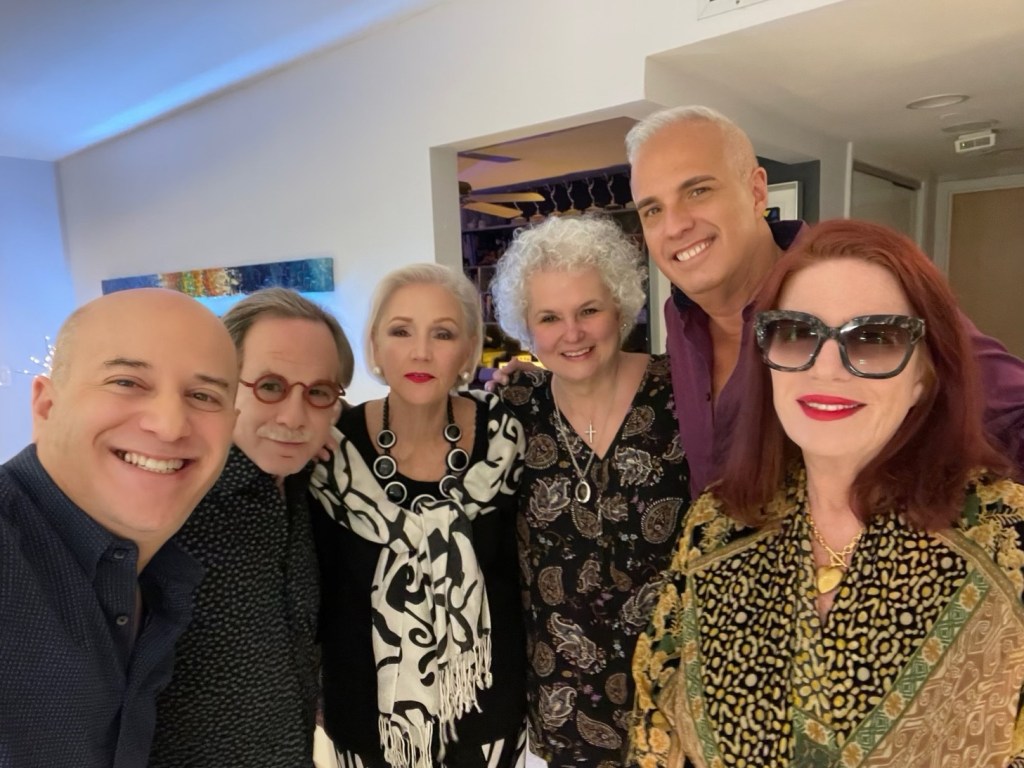
The tall guy, Robert Armada, made a dinner party for the six of us last Friday night that was fit for royalty. The two middle women, Susie Proenza and Lucrecia Boullon, entertained us with stories about their swinging years. The rest of us, Steve Greenberg, Eliot Hess, moi, laughed so hard that our sides hurt today. Thank you Robert and Steve.
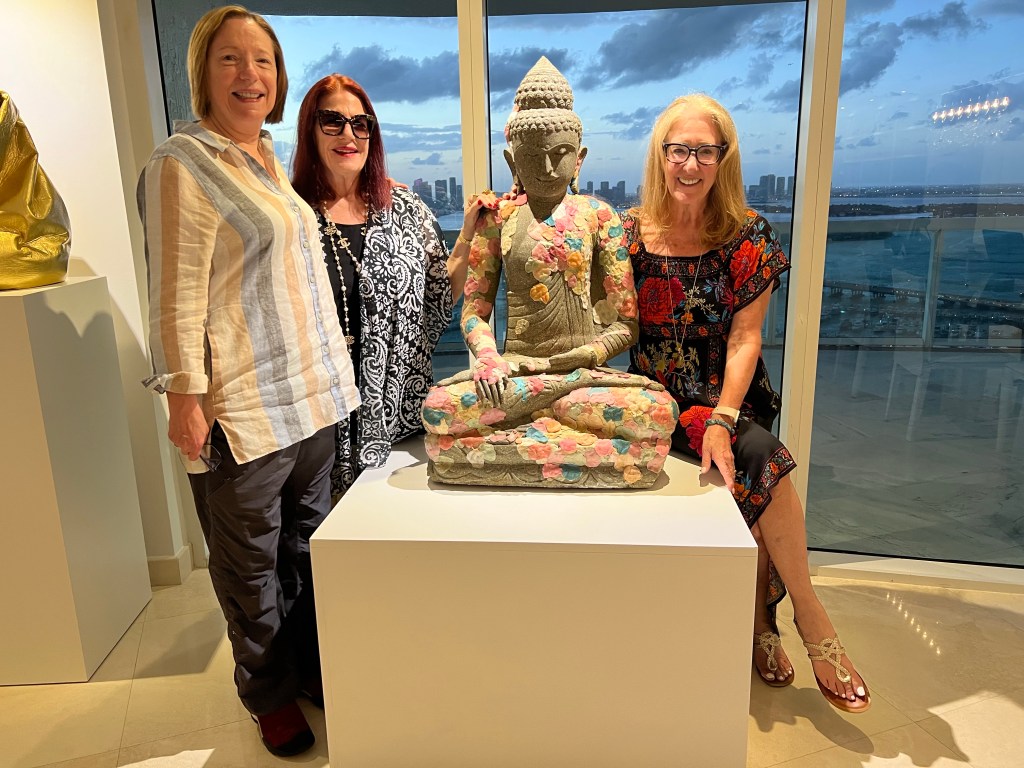
Three women in media. Advertising agency owner Joanne Davis, moi, and the head Tomato http://www.thethreetomatoes. Onward with Eliot and Stu to Joeโs Stone Crab which was packed last night like old times. Early season crabs, delicious.
Married billionaire Eric Schmidt launched Steel Perlot with 29-year-old entrepreneur Michelle Ritter while they were dating โ a venture that has blurred his professional and personal life.
Since leaving Google as chairman, Eric Schmidt has wielded a $20 billion fortune to build an ecosystem of influence, overseeing a vast constellation of companies and investments and taking on prestigious advisory roles that have cemented his reputation as Silicon Valley statesman and AI policy whisperer to the Pentagon.
And for the past two years, the 68-year-old has extended that clout โ and committed at least $100 million, according to three sources โ to a startup accelerator called Steel Perlot, which he leads as executive chairman with CEO Michelle Ritter, a 29-year-old entrepreneur who he has been dati
Schmidtโs funds were intended to support the acceleratorโs business, launching and investing in new ventures under the Steel Perlot umbrella. But just over a year after it launched, the company was asking Schmidtโs family office, Hillspire LLC, to pay its bills.
In a January 2023 email to Hillspire, a Steel Perlot executive requested nearly $2.5 million to meet payroll and credit card debts racked up by the company and its subsidiaries that month. โEric, copied, has the context,โ wrote Gal Treger, Steel Perlotโs head of VC funds, according to a copy of the email seen by Forbes. Hillspire covered the payroll costs, said people familiar with the matter. (Treger didnโt respond to a request for comment.)
๏ฟผ
๏ฟผ
Schmidtโs extramarital relationships have been splashed across Page Six for years, though he remains married to his wife of four decades Wendy Schmidt. But his role in Steel Perlot appears to be the first time heโs publicly entered into a major business relationship with someone he is dating. (Wendy Schmidt declined to comment.)
The former Google CEO is typically quiet about the degree of his involvement in the sprawl of funds, foundations and LLCs with which he is associated. Steel Perlot is an exception: He has publicly stated his role as Steel Perlotโs executive chairman, and sources in a position to know recalled Schmidt participating in business operations, such as deciding which startups to look at for potential investment. He would occasionally appear in meetings alongside Ritter. He is a โvery, very active chairman,โ Ritter told Forbes. โWe have a very typical CEO-chairman relationship.โ
Schmidt has made it clear to employees that Steel Perlot is Ritterโs company and she has full autonomy to run it. But in her role, Ritter appears to have overstated financial commitments and overhyped involvement from industry leaders in Steel Perlot, according to documents and interviews with 11 former employees and people linked to Steel Perlot.
In an interview with Forbes, Ritter claimed the company has multiple backers beyond Schmidt. She added that Steel Perlot now also manages a total of $450 million on behalf of institutional investors and high-net-worth individuals, and had been deploying that capital โsince April.โ
But Forbes was unable to find evidence that anyone other than Schmidt had provided significant funds to Steel Perlot, and Ritter declined to identify other investors. When pressed for more details on the asset management portfolio, Ritter clarified that Steel Perlot had only received a โpreliminary [letter of intent]โ from institutional investors, including a family office and sovereign wealth fund. She declined to comment further.
โWe were sold this bill of goods that we were participating in Eric Schmidtโs concept to fund the future. Instead it was a vanity project.โ
According to multiple employees who worked with her, Ritter also implied that tech elite including Jeff Bezos and Michael Bloomberg, with whom she and Schmidt attended social events, were โcommittedโ or โinvolvedโ in Steel Perlot projects. Other times, employees said Ritter implied that Steel Perlot had financial or business commitments from Middle Eastern investors, such as the Emirati sovereign wealth fund Mubadala. Bloomberg and Mubadala did not respond to a request for comment; a spokesperson for Bezos declined to comment.
In a statement, Ritter said that Steel Perlot had discussions with Mubadala, but the sovereign fund is not a โformal partner.โ Regarding Bezos and Bloomberg, she added: โSteel Perlot leadership regularly engages with business leaders across the technology industry, including these individuals, though they are not formal partners.โ
โWe were sold this bill of goods that we were participating in Eric Schmidtโs concept to fund the future,โ a former Steel Perlot employee told Forbes, who requested anonymity for fear of retaliation from Schmidt and Ritter. โInstead it was a vanity project.โ
Schmidt declined to respond to questions about Steel Perlot, his relationship to Ritter and his investments. When asked, spokesperson Matthew Hiltzik told Forbes that any relationship between Schmidt and Ritter isnโt related to the success of the business and the billionaire intends to continue supporting Steel Perlot financially.
โWe have built something within two years that I’m proud of, and there are things that I would edit,” Ritter told Forbes. She added: “I’m really, really grateful for the great talent that we have. I’m also very grateful for the funding that I’ve gotten from friends and family, but also from Eric, who is a very significant investor at the top.โ
Ritter, who graduated from Columbia Law School in 2021 after completing stints as a cybersecurity research assistant at the Department of Homeland Security and a summer intern at the law firm Skadden, told Forbes she was introduced to Schmidt via a law school connection. The same year she graduated, it was reported by the New York Post they were romantically entangled when they attended the launch of Richard Bransonโs Virgin Galactic rocket plane in New Mexico.
A few months after Bransonโs event, the pair launched Steel Perlot, which has offices in New York and Los Angeles, at a party at Manhattanโs swanky Zero Bond club. Schmidt later described it as โan AI and analytics company of companiesโ that would invest in a fruit salad of verticals from virtual reality to space. Elaborating on that mission to some employees, Ritter invoked the empires of Jeff Bezos or Elon Musk as an array of world changing companies run under the aegis of a single person, according to three former employees.
Steel Perlotโs name is something of a mystery, and several former employees said they still donโt know its origins. Forbes found an image of Ritter standing next to a small teak sailboat, named Steel Perlot. She described it as a gift from a friend that she named after the company, not vice versa. Beyond that, she would say only that she uses the nameโs origins as an interview question for prospective hires. โIt’s a secret no one knows other than me,โ Ritter said. โI let people guess.โ
To date, Steel Perlot has invested at least $20 million into more than a dozen startups, such as the AI company Pryon, a crypto trading company called Tristero and payments platform Keeta. It has also launched two companies, including a decentralized banking platform called Knox Networks, which Ritter claimed has pilot programs with the Bank of England and the World Bank (neither responded to a comment request).
She told Forbes that another company, StarX โ of which she is founder and CEO โ recently signed an agreement with FIFA (International Association Football Federation) to beta test โa cohesive global football community through various technologies to be developed by StarX.โ In a statement, FIFA said it is โexploring with StarX new ways of fan engagement across our tournaments.โ
But lines between Steel Perlot and other Schmidt outfits seemed to blur at times. In one case, Ritter told Forbes a stealth AI moonshot called Future House was โspun outโ of Steel Perlot and funded through a philanthropic arm of the company. A document addressed to Ritter from Future House, and obtained by Forbes, thanked her for backing them and proposed naming one of its โearly discoveriesโ after Steel Perlot. However, two sources close to the AI project claimed its founders received only a small sum from Ritter in consulting fees. These sources additionally claimed that Future House, Inc. received more than $10 million from entities controlled by Schmidt. Future House declined to comment.
Closer to home, multiple employees told Forbes that they were required to meet Ritter for business meetings at several of Schmidtโs estates, where she was residing at the time. That included a $60 million former Hilton compound in Los Angelesโ Holmby Hills, a penthouse in Manhattan and a sprawling lakeside estate near East Hampton that Schmidt purchased for $47 million in 2021, according to sources and property tax records. (The purchase has not been previously reported.)
Two former employees said that some Steel Perlot staff received salaries from another entity, Audem Management, LLC, which was established in 2021 after Schmidt and Ritter started dating and is managed by Ritterโs father. The company serves as a contractor of a Schmidt-owned entity and is used to pay a staff of butlers, housekeepers, maintenance and construction workers at properties owned by Schmidt and at times occupied by Ritter, including the Holmby Hills residence. Ritter said Audem is a โpersonal endeavorโ; a person close to Schmidt said Audem had saved the billionaire approximately $5 million in costs at his properties.
In recent weeks, it appears to have been business as usual for Schmidt and Ritter. The former Google CEO gave a talk at Harvard University about AI and national security, and this month a venture capital firm he co-founded, Innovation Endeavors, raised $600 million for a new fund. Meanwhile, on Instagram, Ritter posted a photo of her posing between tennis star Maria Sharapova and former Hillary Clinton advisor Huma Abedin; another shows her standing with Barack Obama on a golf course.
As for Steel Perlot, Ritter told Forbes she is planning several announcements in the next six months. She added that she is currently in talks for a new cash infusion into the company (though she declined to identify the potential investors).
When asked, representatives for Schmidt and Ritter declined to discuss the current status of their relationship. However, a person close to the situation said they are currently spending โless time together.โ
One of the smartest guys in advertising wants to know why anyone would not understand why Israel must protect itself. If Mexico attacked the United States the way Hamas attacked Israel would you call for a cease fire? Click and scroll down for interview.
Back to the future. Photo taken yesterday of the Trick or Treaters on the rooftop of our former NYC co-op building on 62nd and Second Ave. We are thrilled that life is still so vibrant in the building we lived in for 40 years. The children who now live in our apartment are pictured here too. Pretty amazing.
(I was so happy to read this article in The New York Times. This is where we went with clients over the years when we wanted to feel like big shots. We sat next to DeNiro, Rushdie, Wintour, and Karan. It was thrilling). โLWH
For decades, Silvano Marchettoโs Greenwich Village trattoria was a celebrity haven, serving Brad Pitt, Beyoncรฉ and Jay-Z. Then he vanished. What happened?
Alex Vadukul reported this story from Florence, Italy.
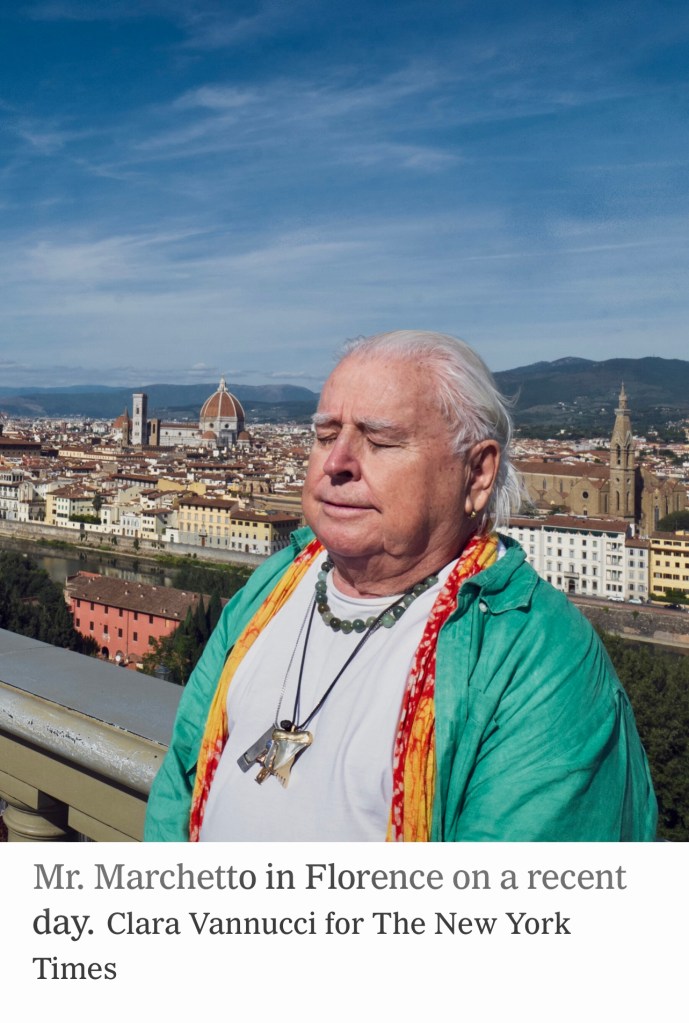
One recent morning, in the bustle of Florenceโs ancient central market, Silvano Marchetto, a stout 76-year-old man with a mane of white hair, sat nursing a Negroni as he considered what he wanted to cook for dinner. The butchers and fishmongers who walked by threw respectful nods his way.
The silver bracelets on his wrists jangled as he polished off his drink. Shuffling past meat displays and fruit stands as he went deeper into the market, he grunted reminiscences about his old life in New York City, back when he ran a celebrity haven in Greenwich Village, Da Silvano.
โLou Reed always said I served the best branzino.โ
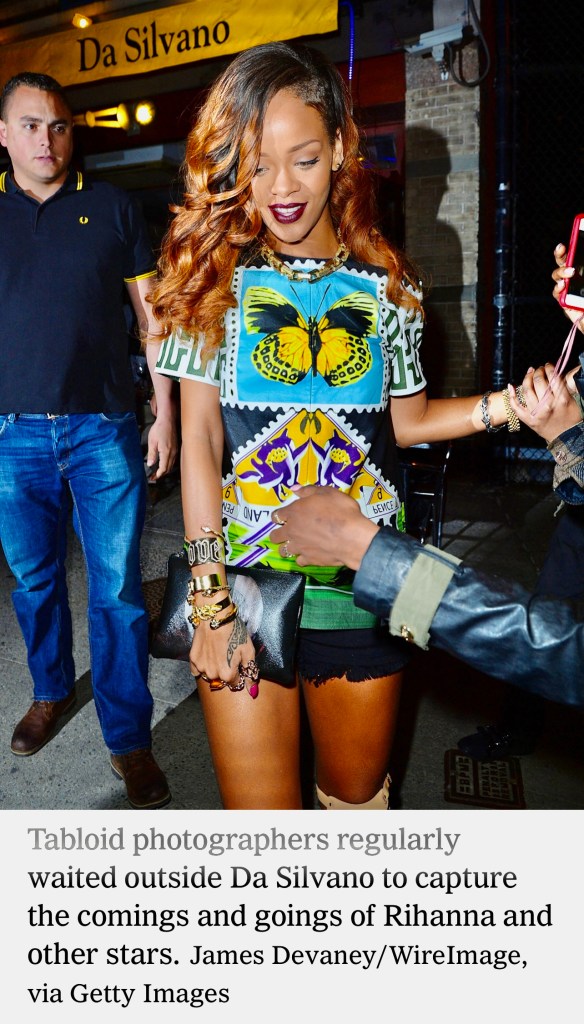
โRihanna loved my taglierini contadina.โ
โAnna Wintourโs ex-husband used to love my rabbit.โ
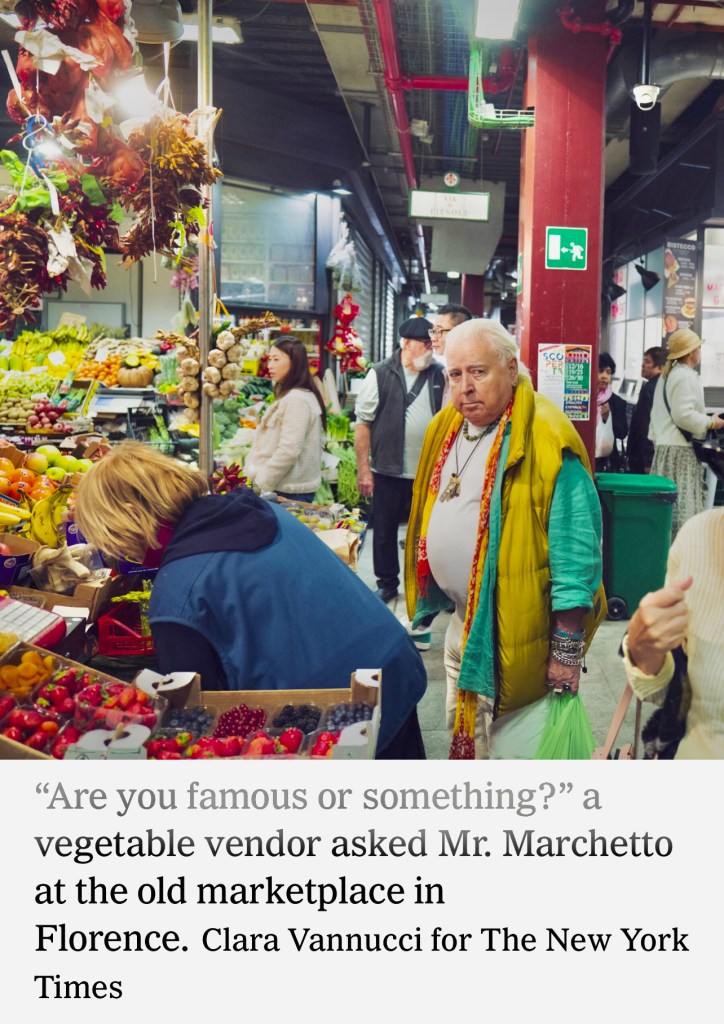
Mr. Marchetto liked the look of some fresh porcini, so he resolved to cook monkfish with mushrooms. His next stop was a vegetable stall. Its operator, Elena Popa, gave him a look.
โAre you famous or something?โ she asked in Italian.
โI ran a restaurant in New York called Da Silvano,โ he said. โClosed now.โ
โWhy?โ
โBecause. The rent. My knees. Divorce.โ
โIf it was successful, couldnโt someone have just kept running it for you?โ she asked.
โSomeone else run Da Silvano?โ he said. โAbsolutely not!โ
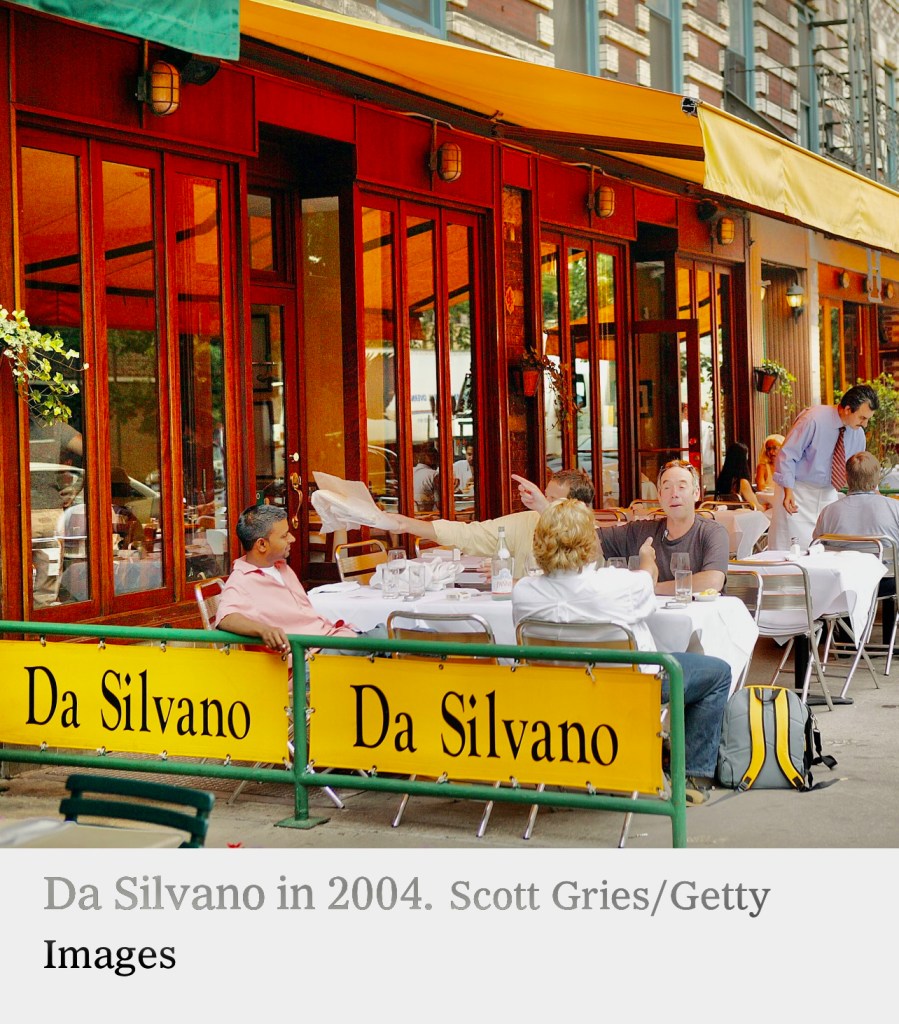
In certain New York circles, Da Silvano needs no introduction, and neither does Mr. Marchetto, who for four decades ran his trattoria as one of the cityโs reigning downtown canteens for the art, fashion, film and media crowds.
That reign ended when he closed Da Silvano with little warning in 2016. Then Mr. Marchetto vanished from public view.
This summer, when I started making calls in an effort to track him down, some of the tips I heard were outlandish: He was on the run in the South of France; heโd opened a beach pizzeria in Cyprus; he was operating a tiny, one-man trattoria in rural Italy; a Vogue photographer I spoke with had heard he was dead; and the designer Isaac Mizrahi, a onetime regular, said he had โno idea what happened to him.โ
โDa Silvano now represents a lost era of downtown New York, and he was its rustic host,โ Mr. Mizrahi said. โIโm still mourning it, and I still glance at its old address whenever I go up Sixth Avenue and think, โWhere did he go?โโ
Mr. Marchetto opened the restaurant in 1975 with the idea of serving New Yorkers the rustic cuisine he had grown up with in Tuscany. Italian fine dining in the city was then typified by spaghetti and meatballs served with Chianti from straw-covered bottles, so his preparations of liver crostini and tripe stew proved revelatory.
โI was just cooking what I knew to cook,โ he said as he drove from the market back to his villa in the Tuscan hills. โEarly on, I even served birds off-menu. I bought robins at a pet shop on Thompson Streetand served them roasted with bacon.โ
The art dealers Leo Castelli and Mary Boone were starting their galleries in SoHo around the same time that Da Silvano opened, and they soon made it their hangout. โCastelli used to go crazy for my polenta,โ Mr. Marchetto said. Gradually, the patio tables beneath the yellow awning became prime seating for those who wanted to be seen. Paparazzi posted up to document Sarah Jessica Parker eating steamed artichokes and Jay-Z and Beyoncรฉ on one of their first public dates.
The crowd came to include Calvin Klein, Yoko Ono, Lindsay Lohan, Joan Didion, Harvey Weinstein, Madonna, Salman Rushdie, Uma Thurman, Stephanie Seymour, Susan Sontag, Graydon Carter and Larry Gagosian. While Gwyneth Paltrow and Brad Pitt were engaged in 1997, they left notes in Da Silvanoโs guest book: โThank you for letting us smoke,โ she wrote. โAnd smoke and smoke,โ he added.
Da Silvano also provided endless fodder for The New York Post, which covered the trattoria as if it were the White House. A typical 2013 itemfrom its Page Six column reported that the art dealer Tony Shafrazi shouted at Peter Brant and Owen Wilson, while Wilson ate a dandelion and heirloom tomato salad, because they hadnโt been returning his calls. In 2014, while Rose McGowan was having a meal, a man emergedfrom a subway grate and tossed a smoke bomb at Bar Pitti, the Italian restaurant next door. The tabloid speculated that the incident was connected to the feudbetween the trattorias.
โPage Six covered us so much people asked if I owned The New York Post,โ Mr. Marchetto said. โBut it was good for Da Silvano, whatever they wrote.โ
Mr. Marchetto became a downtown celebrity in his own right, and a cartoon logo of him wearing sunglasses was branded onto Da Silvanoโs espresso cups and olive oil bottles.
He lived a block away with his wife, Marisa Acocella, a New Yorker cartoonist and graphic novelist, and he went home for midday naps. He parked his Ferraris ornamentally outside the restaurant. He wore scarves, yellow pants and Hawaiian shirts.He hired young Italian waiters who flirted with the models and actresses.
But as blogs and social media began to rival Page Six as a source of celebrity gossip, his restaurant lost some of its luster. And as smartphones ushered in an era in which a celebrityโs nightlife indiscretions could be documented, the machismo-fueled party at Da Silvano began to look a little dated. In 2013, a rival Italian restaurant, Carbone, opened nearby to praise from critics, who welcomed the swing back to red-sauce recipes, and became a haunt for Drake, Jennifer Lopez and multiple Kardashians.
Around the same time, Mr. Marchettoโs life turned tumultuous. A manager at his garage filed a sexual harassment suit, claiming that Mr. Marchetto had grabbed his genitals after dropping off one of his Ferraris; waiters filed a class-action lawsuit, claiming that he had withheld wages. Mr. Marchetto denied the allegations, and both caseswere settled out of court. In 2016, after 12 years of marriage, his wife filed for divorce, leading to a contentious trial.
Mr. Marchetto abruptly closed Da Silvano on the night of Dec. 20, 2016. His explanation was straightforward: The rent had spiked to $42,500 a month. โA fortune, I couldnโt handle it,โ he told The New York Times that week. โEverybody is sad; itโs been 41 years and 51 days exactly since I opened, but I donโt care.โ
Celebrities mourned its closing. A few stayed in touch.
โI visited him in Florence because I was playing a show, and he was living outside the city with his olive trees,โ Patti Smith said. โI think Silvanoโs heart was broken when he had to close his restaurant, so he needed to leave New York. When I saw him, he looked like he was finding happiness out there.โ
When I finally reached Mr. Marchetto in Italy by phone, he hastily explained that he hadnโt received my numerous messages because he does โnot really check email,โ and instructed me to meet him outside Florenceโs train station in three days.
That afternoon, he drove me to a hilltop hotel, Villa San Michele. A doorman, Paolo Greco, greeted Mr. Marchetto and announced him to a young hostess, saying: โDo you know who this is? Heโs a myth. Back in New York, he knew them all: the angels and the scoundrels.โ
In the courtyard, Mr. Marchetto savored a vermentino and described his life now: โI let the days go by. I have a drink for lunch. I go home and nap. Then I go out again. Iโll sit in a piazza for hours. I grow figs and bottle olive oil from my trees.โ
Do you look back?
โOnce in a blue moon. I miss the action, but I never feel sorry for myself.โ
Any gossip?
โDonald Trump came in once. Wanted spaghetti and meatballs. I said, โWe donโt do that here.โ He said, โBut thatโs what I eat.โ So we made it for him.โ
Do you remember your last night of service?
โI bought two kilos of caviar and handed it to people,โ he said. โI told them, โTonight is our last evening.โ They looked at me like I was joking, but I was crying inside.โ
Coldplay blared as we drove to his hillside villa near Bagno a Ripoli. While he took a nap, I perused the relics of his old life: a framed letter from Barack and Michelle Obama wishing him a happy 70th birthday; some Da Silvano business cards; a portrait of him from the 1970s in Greenwich Village in which he has flowing dark hair and is riding a Honda motorcycle.
That evening, at a restaurant on a lonely piazza, he was joined by an old friend, Aldo Antonacci. Over Sangiovese, they reminisced about how heads would turn when Monica Bellucci walked into Da Silvano, and Mr. Antonacci said he still dreamed about the fiori di zucca.
For dessert, Mr. Marchetto ordered Gorgonzola. Then he leaned forward to tell Mr. Antonacci: โDid you hear about my restaurant in Cyprus? It was un casino.โ
The Italian term un casinomeans a disaster.
The precise details of the recent reboot of Da Silvano on the island of Cyprus are somewhat opaque, because the restaurant is now closed and its existence was barely publicized. But for a moment Mr. Marchetto got back into the game this summer, opening a beachy version of his trattoria in Ayia Napa, a resort town known for its nightlife.
For four months, Da Silvano Cyprus served British and Swedish tourists and young women who stopped in for Instagram selfies before going clubbing. The cartoon logo of Mr. Marchetto appeared in a sign above the entrance and was branded onto menus and place mats. The restaurant offered Da Silvano hits like spaghetti puttanesca.
According to Mr. Marchetto, the restaurant came into being after a longtime former Da Silvano regular, Stephen Conte, a radiologist from New Jersey who vacations in Cyprus, pitched him the idea.
โHe said he could make me good money if I lent my name, so I figured why not,โ Mr. Marchetto said. โSo I went to Cyprus to teach them how to make osso buco and my signature pastas. I noticed problems, like it was hard finding good ingredients and cooks, but I was just excited to get back into a restaurant.โ
By midsummer, Da Silvano Cyprus was struggling. There were kitchen staffing troubles, and the restaurant started selling mostly pizza.
โWe tried doing something this summer, it didnโt work out, but it was an honor working alongside Silvano,โ Mr. Conte said. โI plan to try opening again next season.โ
โItโs not easy running a restaurant,โ Mr. Marchetto said. โThe experience reminded me I should follow what Iโm good at more. If someone asked me to open a place tomorrow, now I probably would.โ

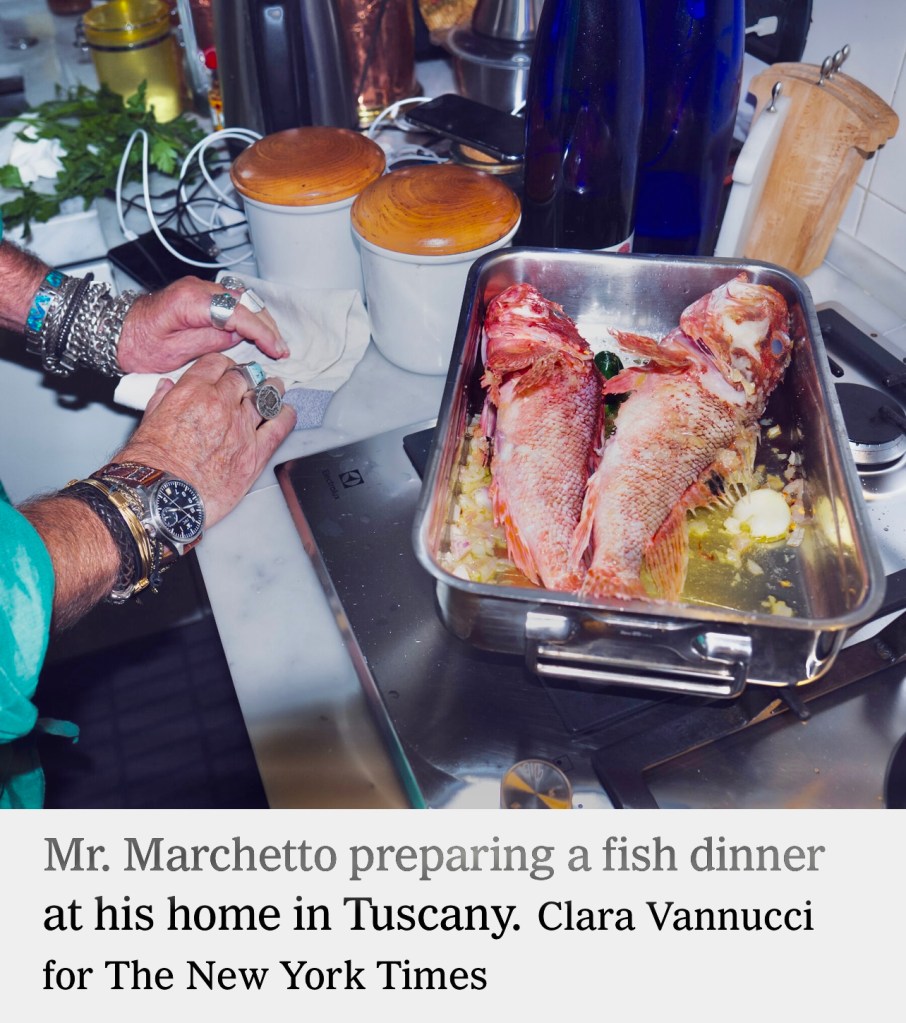
After the next dayโs afternoon nap, Mr. Marchetto poured himself a Montepulciano and started preparing the monkfish with porcini. As the glow of a sunset crept into his villa, he chopped the mushrooms and skinned the fish, setting aside its head for a stew. He swatted away a fly as he tossed the porcini into a sizzling pan filled with the monkfish fillets, grape tomatoes and shallots.
As we ate at his kitchen counter, he took out his phone and pulled up a video posted to Da Silvanoโs Facebook page in 2013. It showed Rihanna, wearing sunglasses and a baseball cap during a busy night at the restaurant.
โHello Mr. Silvano, itโs your favorite customer, Rihanna, wishing you a happy 38th anniversary,โ she said. โYouโve been here since 1975. Thatโs a big deal to be here in New York City at the same spot. This place is legendary. I love coming here. And I will always come here as long as you are here.โ
He smiled as the clip finished. Then he poured himself another glass of wine and stepped outside to take in the silence of the Tuscan night.

Alex Vadukul is a city correspondent for The New York Times. He writes for Styles and is a three-time winner of the New York Press Club award for city writing and a three-time winner of Silurians Press Club medallions for his feature writing. He was a longtime writer for Sunday Metropolitan and has been a reporter on the Obituaries desk.More about Alex Vadukul
The Miami-based couple on how a Keith Haring work started their journey
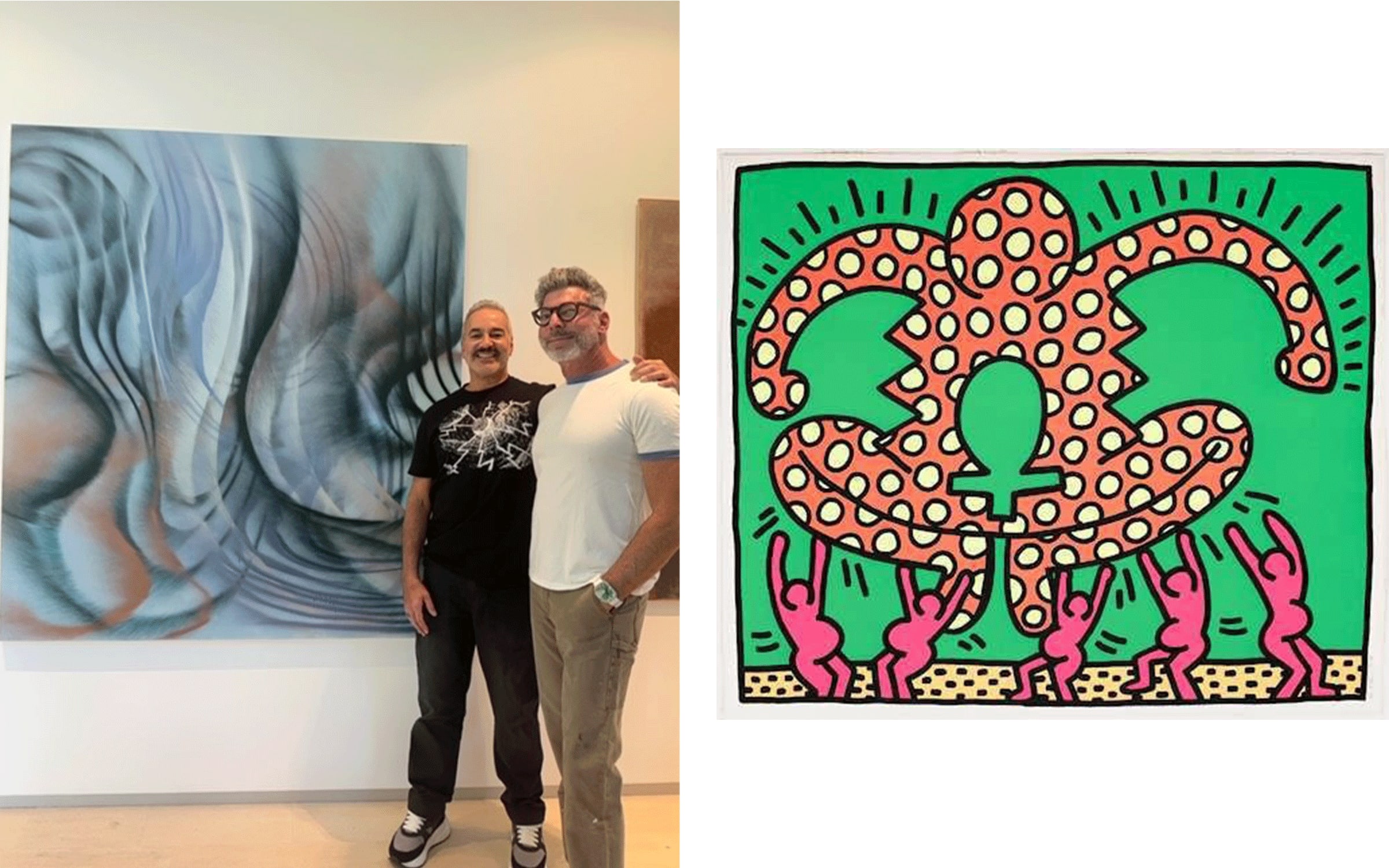
โWe met in New York in the early 1980s and became immersed in the East Village scene with Keith Haring and his generation of artists. We moved in together after about 3 weeks of dating and hung our first piece: a Keith Haring print from his โFertilityโ series (1983). That was the catalyst. Itโs a small community and we met a lot of gallerists and artists, and later, collectors like Susan and Michael Hort who helped widen our horizons. Hilary is right: it does take a village.
โWe principally collect emerging artists who we enjoy discovering and supporting. We like to think of our collection as a sort of intellectual and experiential investment. It does more than just add flavor to our space: the artworks immerse us in different cultures, philosophies, and artistic viewpoints. Every work of art is a snapshot of an era, capturing reflections of society, human emotions, and thoughts. Watching an artist grow and seeing their works change over time is profoundly satisfying.
Left: Serge and Ian Krawiecki Gazes. Courtesy of the collectors. Right: Keith Haring, from the โFertilityโ suite, 1983. Courtesy of the collectors.
There are many artists from whom weโve bought very early works. We boughtโฏone of Rashid Johnsonโs signature mirror reliefsโฏwhen we visited his studio and weโve also collected work by his wife, Sheree Hovsepian.โฏThere has to be a mutual interest in what we purchase. We really enjoy the back-and-forth discussion it creates between us. โฏ
โInโฏNew York, we would open our homeโฏduring the Armory fair each year. The art community could come and kick off their shoes and have a martini, and it enabled the artists see what their work looks likeโฏinstalled there. We didnโt onlyโฏhangโฏart that weโฏhadโฏjust acquired. We wanted to remind people that just because there are artists who are new and different, theseโฏotherโฏworks are still great. We hadโฏBenjaminโฏDeganโs first bigโฏpaintingโฏTown Car (2010) in our living room above theโฏsofa. He wasโฏsoโฏhappy to see itโฏโ there were so many people there. It was very inspirational to us to feel that energy.
Artwork by Rashid Johnson presented by Hauser & Wirth in the Unlimited sector of Art Basel in Basel 2018.
โWe haveโฏlots ofโฏcollector friends and mentor younger collectors. Of course, they are going to think about whether an artwork will appreciate, there’s nothing wrong with that. But you must buy what you love and be capable of living with it.
โWe have art that weโve recently collectedโฏthroughoutโฏour homes in Miami and New York, but this is just a sample. We have several facilities where we store it too. It really is everywhere. Our hallway is so long, andโฏSergeโฏcame up with a fantastic idea for it: We created an art shelf that runs its length to show our smaller works on paper and photography, with larger works on the wall opposite.โฏThis space includes worksโฏby Holly Coulis, Emma Coleman, and Van Hanos; a painting by Nicole Eisenman of her brother;โฏaโฏpainting by Hilary Pecis of the Hollywood Hills; a small work by Eddie Martinez that he gave us as a gift; an earlyโฏportraitโฏby Henry Taylor; and photography by Zanele Muholi and Wolfgang Tillmans. We fell in love with a painting by Sophie Larrimore which features a poodleโฏ(we have oneโฏsoโฏweโre partial toโฏthem).
โA favorite work is Carlos and John Arthur (2021),โฏa painting by Doron Langberg, which spoke to us because itโฏportraysโฏtwo lovers on the beach in Fire Island.โฏItโsโฏthe place where we metโฏin 1982 and we spotted many artists there at the time, including David Hockney and Andy Warhol.โฏDoron isโฏa gay artist who we knew before he was taken up by his dealer, Victoria Miro, and we always wanted to support him.
โInโฏSergeโs office there are paintings by Emily Mae Smith, Benjamin Senior, Maud Madsen, and Aaron Garber-Maikovska. In Ianโs office the artists include Andrea Marie Breiling, who works with spray paint. In the stairwell, where you might hang a chandelier, we have a light installation that we commissioned from James Clar.โฏWe even have a sculpture by Hugh Hayden in our wine room. We were so intrigued by his work when we saw it in London โ a huge sculpture with tree branches stuck through it. We couldnโt buy it because we had no idea how to transport it, but right afterโฏweโฏhad a chance to acquireโฏworks here in the US, and then he had aโฏshowโฏat the ICA Miami.
Artwork by Emily Mae Smith presented by Perrotin at Paris+ par Art Basel 2023.
โMuch of our collection is work by artists who weโve known since they began. In East Hampton, we bought a very rural property with a 100-year-old potato-peeling barn next to the house. In the summer, weโฏgaveโฏthe barnโฏoverโฏto artists to work in whatever way they wanted, and we used to host galleries that would hold group shows.โฏTheโฏartist Ryan Wallace usedโฏitโฏas his studioโฏfor many years to make quite complicated multimedia pieces.
โArt is an education. It gives us so much pleasure to share the success of an artist in the sense that they’re being recognized, and people want to see their work.โ
Artworks by Wolfgang Tillmans presented by David Zwirner in the Unlimited sector at Art Basel in Basel 2016.
Skye Sherwin is an art writer based in Rochester, UK. She contributes regularly to The Guardian and numerous art publications.
By Steven Rosenbush, Isabelle Bousquette and Belle Lin
A bewildering array of new terms has accompanied the rise of artificial intelligence, a technology that aims to mimic human thinking. From generative AI to machine learning, neural nets and hallucinations, weโve gained a whole new vocabulary. Hereโs a guide to some of the most important concepts behind AI to help demystify one of the most impactful technology revolutions of our lifetime:
Algorithm: Todayโs algorithms are typically a set of instructions for a computer to follow. Those designed to search and sort data are examples of computer algorithms that work to retrieve information and put it in a particular order. They can consist of words, numbers, or code and symbols, as long as they spell out finite steps for completing a task. But algorithms have their roots in antiquity, going at least as far back as clay tablets in Babylonian times. A Euclidean algorithm for division is still in use today, andbrushing your teeth could even be distilled into an algorithm, albeit a remarkably complex one, considering the orchestration of fine movements that go into that daily ritual.
ILLUSTRATION: MARTIN TOGNOLA
Machine Learning: a branch of AI that relies on techniques that let computers learn from the data they process. Scientists had previously tried to create artificial intelligence by programming knowledge directly into a computer.
You can give an ML system millions of animal pictures from the web, each labeled as a cat or a dog. This process of feeding information is known as โtraining.โ Without knowing anything else about animals, the system can identify statistical patterns in the pictures and then use those patterns to recognize and classify new examples of cats and dogs.
While ML systems are very good at recognizing patterns in data, they are less effective when the task requires long chains of reasoning or complex planning.
Natural Language Processing: a form of machine learning that can interpret and respond to human language. It powers Appleโs Siri and Amazon.comโs Alexa. Much of todayโs NLP techniques select a sequence of words based on their probability of satisfying a goal, such as summarization, question and answering, or translation, said Daniel Mankowitz, a staff research scientist at DeepMind, a Google subsidiary that conducts research on artificial intelligence.
It can tell from the context of surrounding text whether the word โclubโ likely refers to a sandwich, the game of golf, or nightlife. The field traces its roots back to the 1950s and 1960s, when the process of helping computers analyze and understand language required scientists to code the rules themselves. Today, computers are trained to make those language associations on their own.
ILLUSTRATION: MARTIN TOGNOLA
Neural Networks: a technique in machine learning that mimics the way neurons act in the human brain. In the brain, neurons can send and receive signals that power thoughts and emotions. In artificial intelligence, groups of artificial neurons, or nodes, similarly send and receive information to one another. Artificial neurons are essentially lines of code that act as connection points with other artificial neurons to form neural nets.
Unlike older forms of machine learning, they train constantly on new data and learn from their mistakes. For example, Pinterest uses neural networks to find images and ads that will catch the consumerโs eye by crunching mountains of data about users, such as searches, the boards they follow and what pins they click on and save. At the same time, the networks look at ad data on users, such as what content gets them to click on ads, to learn their interests and serve up content that is more relevant.
Deep Learning: a form of AI that employs neural networks and learns continuously. The โdeepโ in deep learning refers to the multiple layers of artificial neurons in a network. Compared with neural nets, which are better at solving smaller problems, deep learning algorithms are capable of more complex processing because of their interconnected layers of nodes. While they are inspired by the anatomy of the human brain, writes University of Oxford doctoral candidate David Watson in a 2019 paper, neural networks are brittle, inefficient and myopic when compared with the performance of an actual human brain. The method has exploded in popularity since a landmark paper in 2012 by a trio of researchers at the University of Toronto.
ILLUSTRATION: MARTIN TOGNOLA
Large Language Models: deep learning algorithms capable of summarizing, creating, predicting, translating and synthesizing text and other content because they are trained on gargantuan amounts of data. A common starting point for programmers and data scientists is to train these models on open-source, publicly available data sets from the internet.
LLMs stem from a โtransformerโ model developed by Google in 2017, which makes it cheaper and more efficient to train models with enormous amounts of data. OpenAIโs first GPT model, released in 2018, was built on Googleโs transformer work. (GPT stands for generative pretrained transformers.) LLMs known as multimodal language models can operate in different modalities such as language, images and audio.
ILLUSTRATION: MARTIN TOGNOLA
Generative AI: a type of artificial intelligence that can create various types of content including text, images, video and audio. Generative AI is the result of a person feeding information or instructions, called prompts, into a so-called foundation model, which produces an output based on the prompt it was given. Foundation models are a class of models trained on vast, diverse quantities of data that can be used to develop more specialized applications, such as chatbots, code writing assistants, and design tools. Such models and their applications include text generators like OpenAIโs ChatGPT and Google Bard, and OpenAIโs Dall-E and Stability.aiโs Stable Diffusion, which generate images.
Interest in generative artificial intelligence exploded last November with the release of ChatGPT, which made it easy to interact with OpenAIโs underlying technology by typing questions or prompts in everyday language. Similarly, OpenAIโs Dall-E 2 creates realistic-looking images.
Such models are trained on the internet as well as on more tailored data sets to find long-range patterns in sequences of data, enabling AI software to express a fitting next word or paragraph as it writes or creates.
ILLUSTRATION: MARTIN TOGNOLA
Chatbots: a computer program that can engage in conversations with people in human language. Modern chatbots rely on generative AI, where people can ask questions or give instructions to foundation models in human languages. ChatGPT is an example of a chatbot that uses a large language model, in this case, OpenAIโs GPT. People can have conversations with ChatGPT on topics from history to philosophy and ask it to generate lyrics in the style of Taylor Swift or Billy Joel or suggest edits to computer programming code. ChatGPT is able to synthesize and summarize immense amounts of text and turn it into human language outputs on any number of topics that exist in language now.
Hallucination: when a foundation model produces responses that arenโt grounded in fact or reality, but are presented as such. Hallucinations differ from bias, a separate problem that occurs when the training data has biases that influence outputs of the LLM. Hallucinations are one of the primary shortcomings of generative AI, prompting many experts to push for human oversight of LLMs and their outputs.
The term gained recognition after a 2015 blog post by OpenAI founding member Andrej Karpathy, who wrote about how models can โhallucinateโ text responses, like making up plausible mathematical proofs.
ILLUSTRATION: MARTIN TOGNOLA
Artificial General Intelligence: a hypothetical form of artificial intelligence in which a machine can learn and think like a human. While the AI community hasnโt reached broad consensus on what AGI will entail, Ritu Jyoti, a technology analyst at research firm IDC, said it would need self-awareness and consciousness so it could solve problems, adapt to its surroundings and perform a broader range of tasks.
Companies including Google DeepMind are working toward the development of some form of AGI. DeepMind said its AlphaGo program was shown numerous amateur games, which helped it develop an understanding of reasonable human play. Then it played against different versions of itself thousands of times, each time learning from its mistakes.
Over time, AlphaGo improved and became increasingly better at learning and decision-makingโa process known as reinforcement learning. DeepMind said its MuZero program later mastered Go, chess, shogi and Atari without needing to be told the rules, a demonstration of its ability to plan winning strategies in unknown environments. This progress could be seen by some as an incremental step in the direction of AGI.
Sign up for Your Places: Global Update. All the latest news for any part of the world you select. Get it sent to your inbox.
This column doesnโt always abound with praise for President Biden and his administration. This weekโs is an exception.
On Oct. 8, the day after the greatest atrocity in Jewish history since Auschwitz and Bergen-Belsen, Jews in Israel and the diaspora woke up without a leader. The prime minister of Israel has never been, in a formal sense, the leader of the Jews โ even when the office was held by people far worthier than Benjamin Netanyahu.
But the prime minister does have the most important job in the Jewish world, which is to ensure that Israel be a safe haven for Jewish life. The Jewish people have long memories; whatever happens next, Netanyahu will be remembered, irrevocably, as the man who failed โ not tragically, much less heroically, but selfishly, arrogantly, despicably. He maintains political authority but is devoid of moral authority. I cannot imagine a future for him or his cabinet of blowhards and toadies except in exile, walled compounds or prison cells.
Biden stepped into the vacuum. I have read, probably a half-dozen times now, his Oct. 10 speech about the massacres. For its moral clarity, emotional force and political directness it deserves a place in any anthology of great American rhetoric. Without equivocation, without the mealy-mouthed clichรฉs and evasions that typified so many institutional statements about the assault, the president said what Jews desperately needed to hear.
That the massacres were โpure, unadulterated evil.โ That there is โno excuseโ for what Hamas did. That Israel has an affirmative โdutyโ to defend itself, not simply a passive โright.โ That the United States will make good on its commitment to a Jewish state not with feeble statements of solidarity but with the surge of military force. A few days later, in an interview with โ60 Minutes,โ he called the assault โbarbarism that is as consequential as the Holocaust.โ
We need political leaders who maintain the capacity to call out barbarism by name and who commit themselves to its defeat. We need it especially on the political left, certain corners of which waited only a few days before returning to their usual program of denouncing Israel for its alleged or anticipated war crimes. These are the same people who sometimes pretend to believe in Israelโs right to self-defense but offer no plausible strategy for how Israel can exercise it against a terrorist enemy that hides behind civilians.
We also need Bidenโs leadership given the moral void on the right. I spent the years of Donald Trumpโs presidency being hectored by a certain type of Jewish conservative who insisted that Israel had never had a better friend in the White House. Today, Trump takes a dimmer view of Netanyahu โ less because of his failed performance than because he canโt forgive the prime minister for calling Biden in 2020 to congratulate him on his victory. Four days after the Hamas attacks, Trump also called Hezbollah, without reprobation, โvery smart.โ About Vladimir Putin, he said, โI got along with him very good.โ
Very good. Very smart. The Republican front-runner.
Now Biden is going to Israel. Itโs a brave trip, even for a president with his vast security apparatus, given that Hamasโs rockets continue to fall indiscriminately on Israel and a second front with Hezbollah could open at any time. He is going, almost surely, to do what he does best: console the bereaved and bereft, give courage to those in fear. This is statesmanship in the teeth of far-left opposition and incessant right-wing criticism. Itโs the presidentโs finest hour.
I have seen some criticism that the hidden purpose of the trip is for Biden to hug Israel close so that he can stay its hand, or at least slow it. I doubt it, since he could hardly have been clearer in his โ60 Minutesโ interview that Hamas would have to be eliminated entirely, even as there needed to be a path to a Palestinian state. That path is a long one, but Biden gets the big thing right โ the former is the basic precondition for the latter. No Israeli leader can ever allow a Palestinian state to exist if a group like Hamas has even the whisper of a chance of gaining power.
I expect Biden to caution Israelโs war cabinet that a military campaign that concludes with a long-term Israeli occupation of Gaza would be a Pyrrhic victory. I expect the Israelis to reply that they cannot be asked to eliminate Hamas as Gazaโs dominant military and political actor without the cooperation of the United States and moderate Arab regimes, particularly Egypt. This is not a confrontation; itโs a potentially fruitful dialogue that will work much better once Netanyahu is out of office and cannot put his personal needs ahead of the national interest.
I also hope that Bidenโs leadership can remind the decent left โ and whatโs left of a decent right โ of what American moral leadership looks like. To stand with our allies and hold our friends. To see our enemies for what they are and treat them accordingly. To remind ourselves that as others see us, so should we: as the last best hope of earth.
Us Swifties, Gail Williams, Dawn McCall, Eliot and yours truly, went to see Taylorโs concert movie yesterday, three hours long. Even if you are not a Swifty, you become one immediately just for the sheer entertainment. The production, special effects, fashion, and music, not necessarily in that order, are definitely worth the price of the ticket. Taylor Swift did it right. She picked a topic that females love to sing about, โmen.โ She and her family are now billionaires.
Iโve included a link to a New York Times article that profiles her stardom and and a link to her Wikipedia page. Thatโs enough information for one day.
Thank you Gary Shapiro, President of the Consumer Technology Association, for sending a group of us this video from the Mayor of New York City. Gary explained that it made him think of his dad being a NAACP member and fighting for civil rights. My parents too taught us at an early age to love and respect all mankind. I think about this all the time. We have lived a good life because of that teaching. Again, thank you Gary.