I hope you had a very Merry Christmas with your family. If you’re working this week I’m sure it feels like no one else is working and everyone seems to be on vacation. It may feel like you’re wasting time, with no ability to make any progress, right?
Wrong! The fact that work is a ghost town right now can totally be used to your advantage! The way I like to think about it is now is the time to
Get your House in Order and your Shit Together
That’s right! Get your house in order and your shit together. Now is the perfect time to plan for 2022, tie up any loose ends from 2021, set your goals, clear your desk, clean out your office, and get ready for your best year yet. In an effort to increase my accountability and share with you my goals for the coming year, I have outlined my objectives and key results (OKRs) for the year here! The time when no one else is around is a perfect time to look inward, do an assessment of how well you did in 2021 on your goals, and prepare your goals and objectives for the year to come.
Good luck navigating the GHOST town to set yourself up for success in 2022, and I wish you a very happy and healthy New Year to you and your family!
The story below comes from tech newsletter Mashable.
Will 2022 be the year you finally put a (smart) ring on it?
With Oura and Movano set to duke it out for market share, we may soon have one smart ring to rule them all.By Rachel Kraus on December 28, 2021
Movano smart rings are the newest fashionable offerings in the smart ring arena. Credit: Movano
Finger-worn wearables are so hot right now. Smart rings, the lovechild of jewelry and fitness trackers, are designed for anyone who longs to log health metrics without the bulk and annoyance of a notification-happy computer on their wrist.
But in contrast to the many screen-based options in the fitness tracker space, smart rings have been thin on the ground so far. Your main choice as of December 2021 was the pricey Oura ($300 for the second generation model, plus a $6 monthly subscription for ongoing health insights). Celebrities such as Jack Dorsey and Gwyneth Paltrow are among Oura’s devotees.
But as of January 2022, the smart ring universe is expanding. Health wearables company Molano just announced its first product, the Movano Ring, which will be unveiled at the Consumer Electronics Show in Las Vegas. (Yes, Omicron notwithstanding, CES is still going ahead.)
The Movano tracks sleep and activity metrics, and is working to gain FDA clearance to monitor vital signs such as body temperature — something even the latest Oura can’t provide yet. Movano’s companion app is focused on combining these metrics to predict how you’ll be feeling on any given day. Tracking body temperature isn’t just good for figuring out when you have a fever. It could also be useful for anyone who is trying — or not trying — to get pregnant.
Here is the scoop on what really happened with NFT’s at Art Basel. My good friend, Robin Raskin, wrote the article about this subject for Techonomy, the new tech newsletter that seems to beating out many others for getting an increasing number of readers. Maybe it’s because their posts are so relevant and timely. I knew Robin was working on this story because she called to ask me what happened with NFT’s at Art Basel. I immediately referred her to Dan Mikesell of Blackdove and co-founder of Fountainhead Arts, because he is very involved in the emerging art world. I knew she would be in good hands. I copied and pasted the article for you. The photos are not exactly in the right order. Oops!
By Robin Raskin | December 17, 2021, 1:25 PM | Techonomy Exclusive
•
If life imitates art (Oscar Wilde) then NFTs imitate both art and life. NFTs, if you haven’t heard, are digital things — art, music, video, and even, sometimes, physical things, that you can purchase, collect, own and display. Your proof of ownership is stored on a blockchain and you can trade or sell whenever you can find somebody else to buy it. But the NFT craze, which along with its crypto parent has created much new wealth, is decisively blending with the traditional worlds of wealth.
Earlier this month, at Art Basel in Miami, the crypto and art worlds converged, in a multitude of parties, events, conferences and glitz-outs. At a minimum, Miami reinforced its status as the hottest place (in all senses) for everything wealthy and glittery. Ultimately, Art Basel may have been transformed, perhaps forever, by the technorati. And the NFT contingent insisted that NFT art will be attached to the world of high art forever after, for better or worse.
Miami for those few days in early December was reminiscent of the story of the blind man and the elephant, depending on which part of the festivities you touched. Jon Wayne Gurman, the father of WooshiWorld, a new NFT property he hopes will become a physical property and series of merchandise, attended both the Art Basel show and the many surrounding NFT events. “Art Basel was very boring compared to the energy and excitement generated at the NFT events,” he said.
Jordan French, editor of Grit Daily and an events producer, took a page from the Art Basel playbook by co-locating there the Token Society, a crypto-VIP gathering. Its speakers spanned both the art world and that of NFTs. The soiree included creators, comedians, TV hosts, and as well as the usual hangers-on. French promoted it as a “classy” event, worthy of Miami’s see and be seen vibe.
Meeting of the Token Society (photo by Jordan French)
Akbar Hamid’s PR firm, 5th Column, is a rising star for helping NFT properties get launched and noticed. What jazzed him the most in Miami Beach was the feeling that he was witnessing the birth of a work in progress. “You know you were hearing brilliant ideas that have not been realized yet, “ he told me. Hamid’s clients included Sandbox, whose party-event featured Blond:ish. His other client, Wax, appeared at NFT BZEL event that Hamid helped organize. Wax’s William Quigley was a featured speaker. It aimed to cross-pollinate entertainment, investment, and collecting to create a conference covering a spectrum from “NFT for newbies” to a roadmap to the future. Aku — a helmeted digital explorer whose story is told across 10 NFT “chapters” – was unveiled by former MLB player Micah Johnson (who made $2 million during his own debut NFT sale in March). Fans and collectors of Bored Ape Yacht Club, whose owners include a roster of celebrities, celebrated their newfound status over BAYC-branded beers.
With 4000 attendees, NFT BZL was probably the largest of the numerous NFT soirees. (Confusingly, both #NFTBASEL and #NFTBZA were other events.)
The DNA connecting NFTs and the art world is clear. You create a piece of art and instead of framing it, mint it into an NFT, which you can sell at any number of sites like Rarible and OpenSea. This past March, the gavel heard round the world was sounded by the venerable Christies auction house, when when it sold an NFT created by the relatively-unknown Mike Winkelmann, aka Beeple, for an astonishing $69.3 million. With that gavel thump, Beeple became the third most valuable living artist at auction, after Jeff Koons and David Hockney. At Art Basel, 255–year-old Christie’s partnered with 6-month-old nftnow in Miami to produce The Gateway, a music art celebration heralding the NFT world.
The Miami Art Week is summed up in a tweet from Janet Lee.
NFTs weren’t the sole province of sideshows. Humans + Machines: NFTs and the Ever-Evolving World of Art exhibited at Art Basel proper, with an interactive show built on the energy-efficient blockchain Tezos. Guests created their own NFTs by fusing their video-captured likeness with an algorithm and then selecting the visual image they found most engaging. More than 4,500 unique NFTs were thus populated.
Growing the NFT Ecosystem
Daniel Mikesell, an art collector-cum-technologist, seized the moment with his company Blackdove. It has a top-of-the-line platform aiming to create world-class display frames for NFT art. It wants to liberate NFT art from its paltry home on your mobile phone and turn it into a beautiful true collectible displayed in the same way you’d display any piece of fine art. “I’m not judgemental about the importance of the value of art, “ says Mikesell. “It’s in the eye of the beholder,” he says when comparing NFTs to physical art. (Many NFTs are not the slightest bit visually or artistically sophisticated.) But, Mikesell believes NFTs need to be showcased somewhere else than the screen of a phone to be enjoyed and properly shown to others. “When you buy a painting, you don’t carry it around with you. Why would you want artwork you collect to stay on your phone?”
Mikesell suggested that this year’s Art Basel Miami was not a takeover of traditional art fairs but rather the beginning of a true melding of the worlds of physical artworks and NFTs. Many artists, he noted, are showcasing real-life artworks side by side with NFT digital counterparts.
The Great Co-mingling
For the FOMO crowd, it was hard to know where to be. The Information reported on the scene in a piece called The NFTS that Ate Miami: “The Winklevoss twins sauntered through a private waterfront mansion dressed identically. DJ Khaled bellowed “Gem-in-i” and “Cryp-to” from the stage. NFT pioneer Beeple, pop star Macy Gray, and Larsa Pippen, ex-wife of Scottie and ex-friend of Kim Kardashian, all made appearances.” Artist Jason Keath, founder of NFT Fresh, summarized for The Information:“A lot of people walking around with millions of dollars of JPEGs in their pockets.”
Even Time Magazine and Conde Nast went ga-ga over the high celeb quotient and meteoric rise of NFTs. Interviewing Diplo, the Grammy Award winning DJ, Conde Nast explained what inspired him to buy a Bored Ape NFT: “I like the apes the most because they remind me of the stuff I collected as a kid, like Ninja Turtles. And it feels cool to have one — I can show it to Post Malone at a party, and he’ll be like, “Oh cool, you got that one?” It’s kind of silly, but it’s a flex — like buying a really nice outfit.”
Seeing, being seen, and being seen owning the trendiest most whimsical and perhaps evanescent collectible may have come at a cost to some who were there. The rich and connected are no more immune to COVID-19 than to a money-drenched fad. One investor in the know told me that many of the crypto crowd were using fake proof of vaccinations cobbled together from QR codes. Another told me that eight of his colleagues left Miami with the Omicron variant.
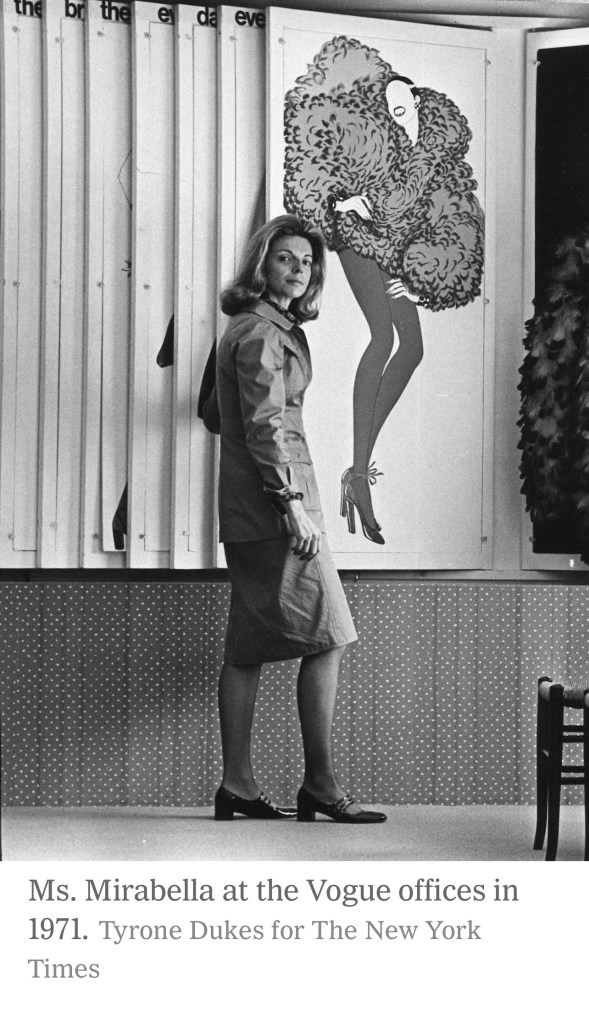
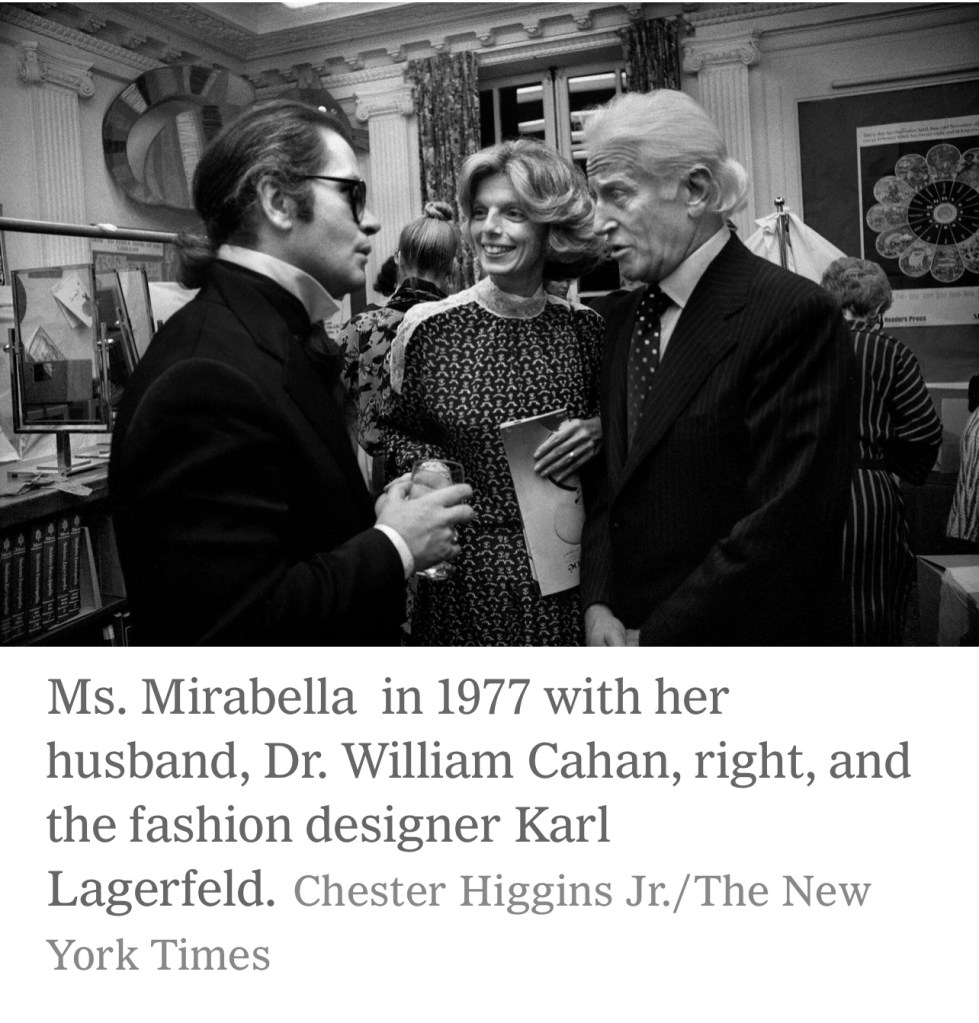
I offer this edition of DigiDame to Grace Mirabella, a pioneer in fashion journalism. I was just starting out when she was named editor of Vogue. She succeeded Diana Vreeland and preceded Anna Wintour. After several decades at Vogue, she started her own magazine, Mirabella. Bravo to a woman who had the most rewarding and fruitful career. The following is from the New York Times.
Grace Mirabella, Who Brought Vogue Down to Earth, Dies at 92
In her 17 years at the helm of the fashion magazine, she took a more practical-minded approach, in line with a rise in women’s participation in the work force.
By Phyllis MessingerDec. 23, 2021
Grace Mirabella, who as editor in chief transformed Vogue magazine from a glittery, color-splashed paean to the spirit of the 1960s into a more sensible adviser to women entering the work force in the 1970s and ’80s, died on Thursday at her home in Manhattan. She was 92.
The death was confirmed by her stepson Anthony Cahan.
Ms. Mirabella went on to found Mirabella, a magazine for women as interested in culture and travel as in clothes and interior design. But she made her biggest impact at Vogue. Her years there, from 1971 to 1988, coincided with women’s increasing financial independence. Many women were among the first in their families to work outside the home and were looking for guidance on a range of issues, starting with what to wear to their new jobs. Go-go boots and love beads would not do; they needed more practical clothes that fit their new lifestyles.
At the same time, as these women participated in the broader world, their interests widened, too. But Vogue, under its flamboyant editor Diana Vreeland, had entered the ’70s still stuck in the ’60s. The magazine’s circulation was falling, and advertising along with it.
Even so, Ms. Vreeland’s firing by Vogue’s publisher, Condé Nast, in 1971 came without warning. The move was so abrupt that Ms. Mirabella, Ms. Vreeland’s second in command, was notified of her promotion while on a photo shoot in California.
Where Ms. Vreeland was colorful, electric and theatrical, Ms. Mirabella was pragmatic and businesslike. Her mandate was to change the character of the magazine, and Vogue quickly took on the values of its new editor, becoming more accessible and down to earth.
To signal the new mood, Ms. Mirabella had the red walls of the editor’s office repainted beige, and she often wore tailored beige clothes to work.
“I’m not a clothes girl if it means talking about them all the time,” she said in an interview shortly after her appointment. “But I think they’re interesting, and I have quite a lot of them.”
Ms. Mirabella’s Vogue emphasized the natural in hairstyles, makeup and clothing over artifice — the spare designs of Ralph Lauren, Calvin Klein and Giorgio Armani over fashion as fantasy or work of art.
The magazine added sections on the arts, fitness, health and beauty while keeping its emphasis on fashion. Circulation tripled during Ms. Mirabella’s tenure, to more than 1.2 million in 1988 from 400,000 in 1971.
But while she was considered the most powerful woman in fashion, she kept the focus on fashion and not herself, said Samir Husni, a professor of journalism and director of the Magazine Innovation Center at the University of Mississippi School of Journalism. “She was an icon, a legacy,” Professor Husni said in an interview for this obituary.
She was also hard-working.
“Nobody,” he said, “ever wrote a book about her, ‘The Devil Wears Prada,’” a reference to the novel, later made into a movie, based on Ms. Mirabella’s successor at Vogue, Anna Wintour. “She wore the Prada without the devil.”
By the mid-1980s, though, the pendulum of fashion had swung again. There was new money and a new interest in the comings and goings of celebrities. Fashion was becoming more about trendiness, and Vogue was not reflecting these sensibilities.
Though it still dominated the world of fashion magazines, Vogue was facing new competition. One of its competitors, American Elle, had become a force almost overnight, with an emphasis on a youthful European approach.
Elle was introduced in September 1985; by the end of the next year, its paid circulation was 861,000. In June 1988, Ms. Mirabella was ousted — as abruptly as Ms. Vreeland had been before her — and replaced with Ms. Wintour, 20 years her junior. Ms. Wintour had been creative director at Vogue from 1983 to 1986 before becoming editor of British Vogue and then House & Garden (which was renamed HG in 1988).
In an interview after the move, S.I. Newhouse Jr., the chairman of Condé Nast, made no apologies, saying it was time to “reposition Vogue for the ’90s.”
“There have been clear lines of what was high fashion and casual fashion,” Mr. Newhouse said. “I think those lines are less apparent now. I think the change in the 1990s, when we look back, will be as decisive as the shift from the ’60s to the ’70s.”
A few months later, Ms. Mirabella announced that she would launch her own publication. Mirabella magazine, which was backed by Rupert Murdoch, was meant to be about “much more than clothes or interior design,” she wrote in the inaugural issue, dated May 1989. It was to be about style, she said, which “informs every aspect of our lives,” and it would offer serious articles along with fashion and beauty advice.
Ms. Mirabella never explicitly stated what age group her magazine was aimed at, but she did say that it was targeted at educated women concerned with politics, psychology and business.
She left the magazine in 1996 to lecture and do freelance writing. The magazine, which never turned a profit and often struggled to find a coherent voice, was shut down in 2000.
But Professor Husni said that the mere existence of the magazine reflected Ms. Mirabella’s stature in the industry. “I give a lot of credit to Rupert Murdoch,” he said. “When you’re on your way out, no one honors you. But that’s how important she was.”
Marie Grace Mirabella was born on June 10, 1929, in Newark, the daughter of Anthony Mirabella, a sales manager for a liquor importing company, and Florence (Belfatto) Mirabella, who had immigrated from Italy.
Shortly after graduating from Skidmore College in Saratoga Springs, N.Y., in 1950 with a bachelor’s degree in economics, she joined the executive training program at Macy’s. She then briefly worked at Saks Fifth Avenue before taking a job at Vogue in 1952 verifying store credits in photo captions.
She was on the public relations staff of the designers Simonetta & Fabiani in Rome from 1954 to 1955 before returning to Vogue in 1955 as the shopping editor, searching small shops for unusual fare. With a reputation for working hard, she climbed her way up through a succession of jobs at the magazine.
In November 1974 she married William G. Cahan, a thoracic surgeon who specialized in breast and lung cancer at Memorial Sloan Kettering Cancer Center in Manhattan. Dr. Cahan was an early leader in national efforts to combat smoking.
In addition to her stepson Anthony Cahan, she is survived by another stepson, Christopher Cahan; seven step-grandchildren; and three step-great-grandchildren.
In her book “In and Out of Vogue” (1995), written with Judith Warner, Ms. Mirabella settled some scores from her days at the magazine. She described Ms. Wintour as “a vision of skinniness in black sunglasses and Chanel suits” and claimed that the photographer Richard Avedon had “achieved some of his best results with girls who were utterly strung out on dope.”
As to the reasons she was pushed from her perch, she wrote that the 1980s were “an emperor-has-no-clothes era, start to finish.” Clothes, she said, “were about labels, designers were about being celebrities, and it was all, on a bigger and bigger scale, about money.”
Fashion had degenerated, she wrote, “into a self-reverential game full of jokes and pastiches that amused the fashion community enormously and did nothing at all for the woman shopping and trying to find something to wear.”
Rabbi Marc Philippe is no longer with Temple Emanu-El. He is starting his own cultural and spiritual center. Every Friday night he and his wife Valerie welcome folks into their garden to celebrate everything wonderful in the world and to pray for peace and harmony everywhere. Their efforts are bringing hope to all.
Author and screenwriter Joan Didion died this week at 87. Joan Didion put Miami under a microscope 30 years ago — and saw the city of today | Editorial by the Miami Herald Editorial Board.
Famed author Joan Didion died this week, more than 30 years after Miami caught her eye, and she turned her sharp, insightful sense of observation on us.
Didion began visiting the city in 1985 to soak in what made it tick. By 1987 she had published her book, simply titled “Miami.” It made a splash.
The Los Angeles Times’ obituary described Didion — a California girl — as a “novelist and screenwriter who chronicled American culture and consciousness with cool detachment, humor and a brittle awareness of disorder.”
Cuban exiles and their impact on Miami, socially and politically, were at the crux of Didion’s book, but “Miami” also talked about the newly built Metrorail, the shame of Overtown, drug dealers everywhere and the dreamers and scammers that this lured — and still does.
She was one of the first literary voices, before Tom Wolfe tried with “Back to Blood,” to notice there is something unusual and unique about us. Something that happens when a city channels Casablanca, a place where refugees, Cubans, Haitians, Nicaraguans, Salvadorans turn a foreign city into an outpost of the political upheaval in their homelands. And how that influences that rest of us.
Here’s a review of “Miami” from the Los Angeles Times in 1987:
“The theme of Joan Didion’s book is the powerfully seductive exploration of the political maelstrom in Miami. She sees, in the vortex plotting by exiles against Fidel Castro’s Cuba and Daniel Ortega’s Nicaragua and in the splintering rivalries among the exiles themselves, something far beyond ideology. They have become, she argues — so vividly that you can smell every crushed frangipani blossom — an invasion, a tropicalization of the causes dear to the American Right; a contamination, if you like … Miami is us.”
Back then, Miami was called the city of the future, this nation’s future. And Didion was astute enough to see it first
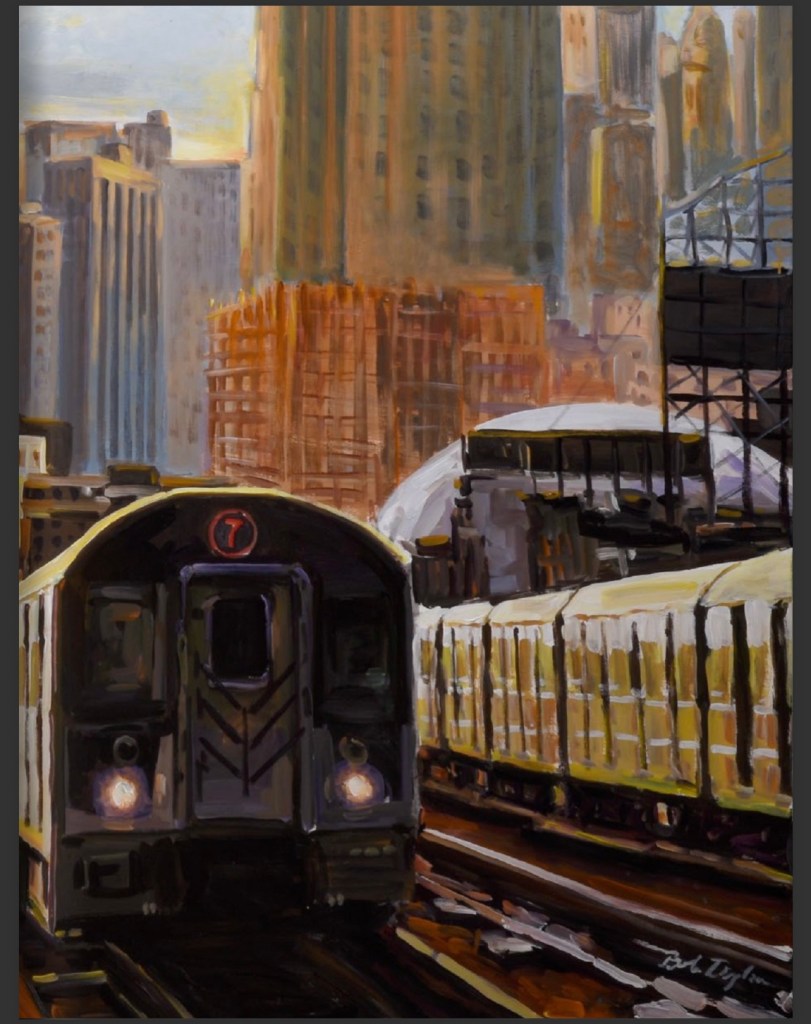
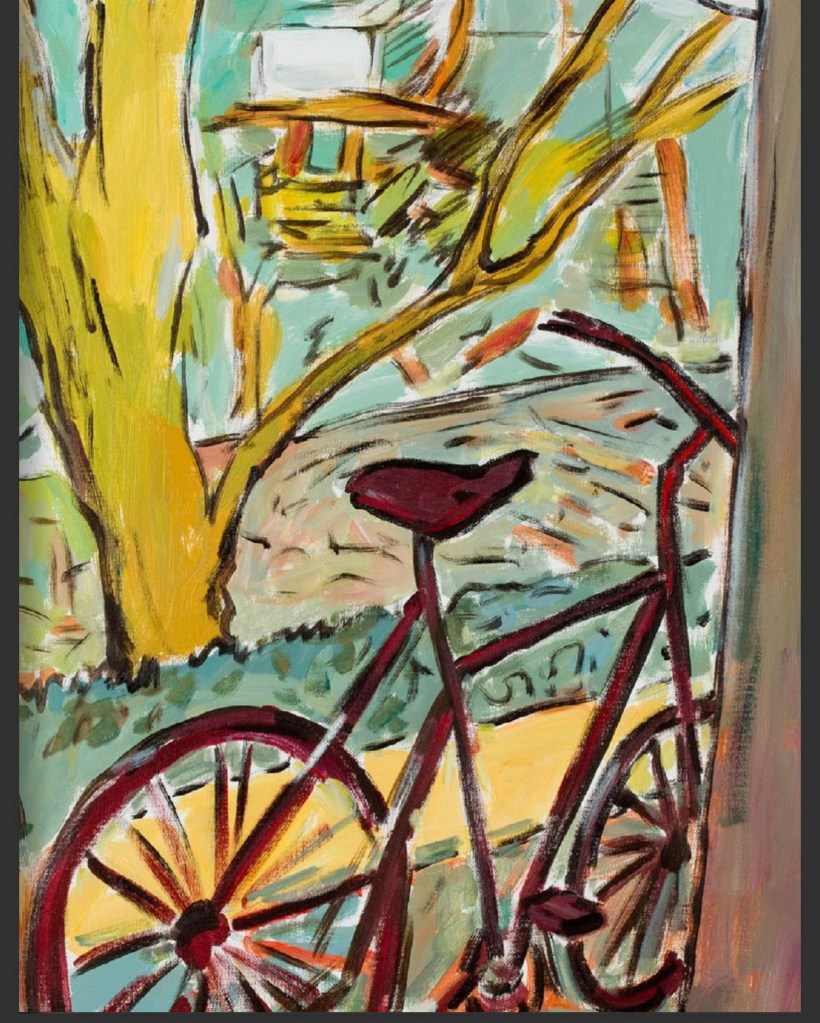
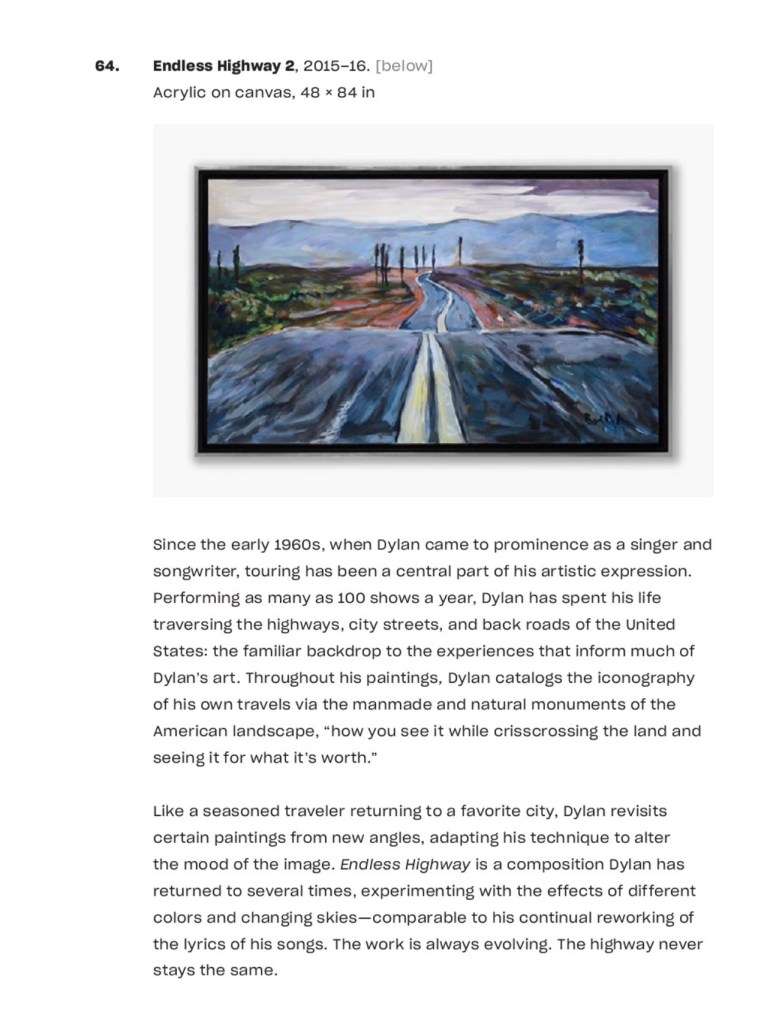
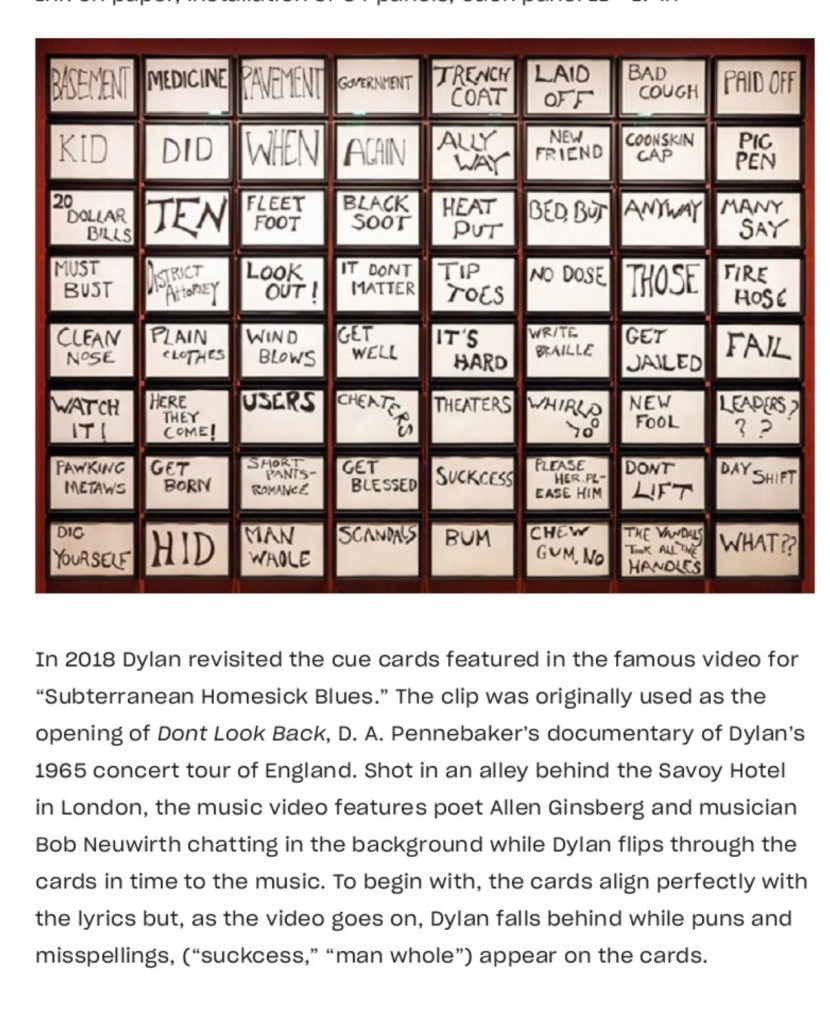
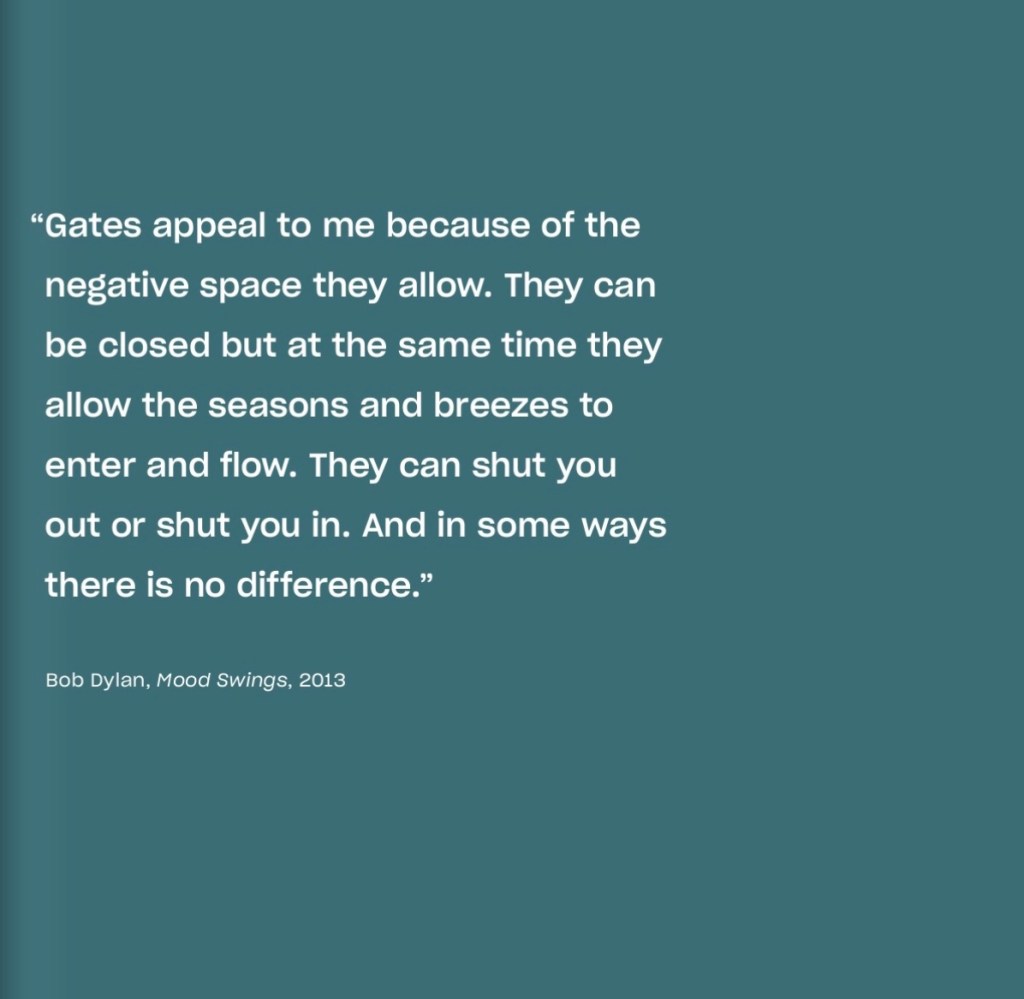
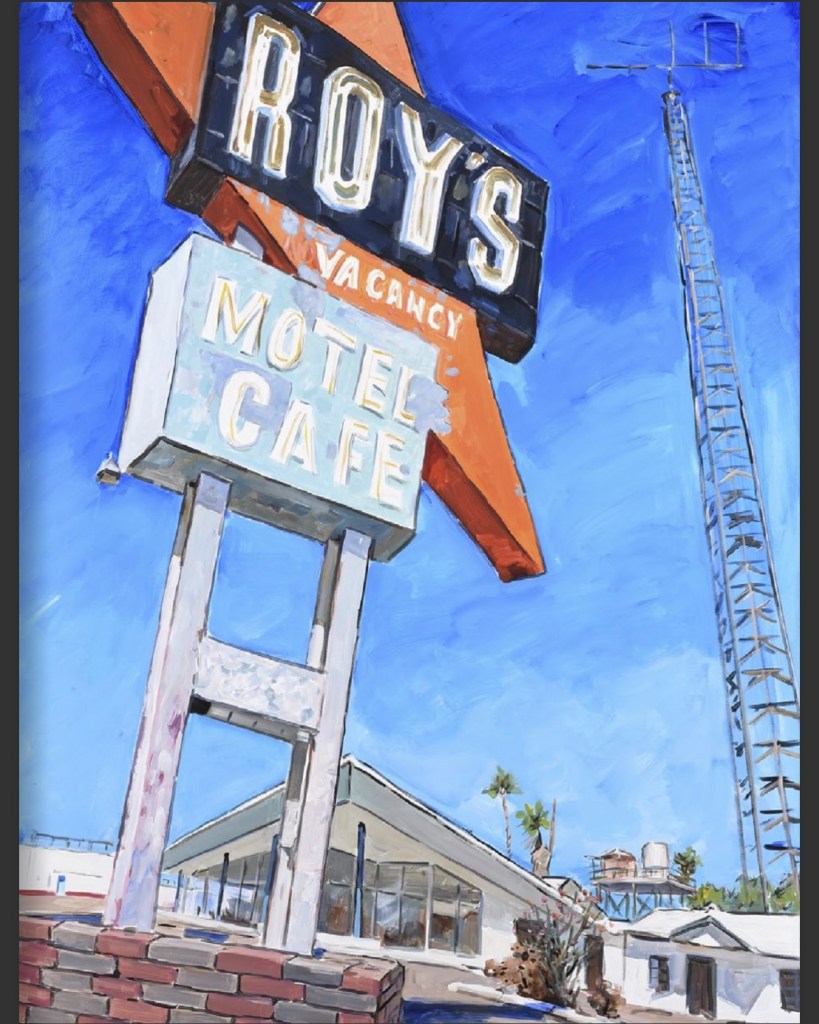
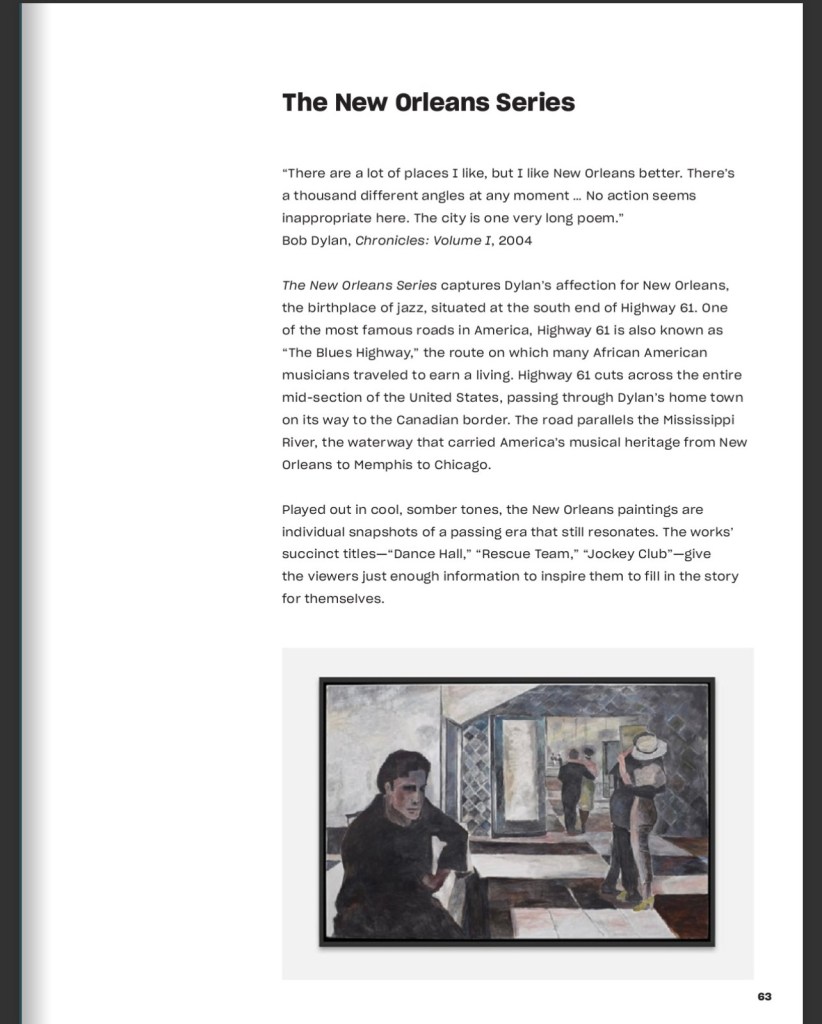
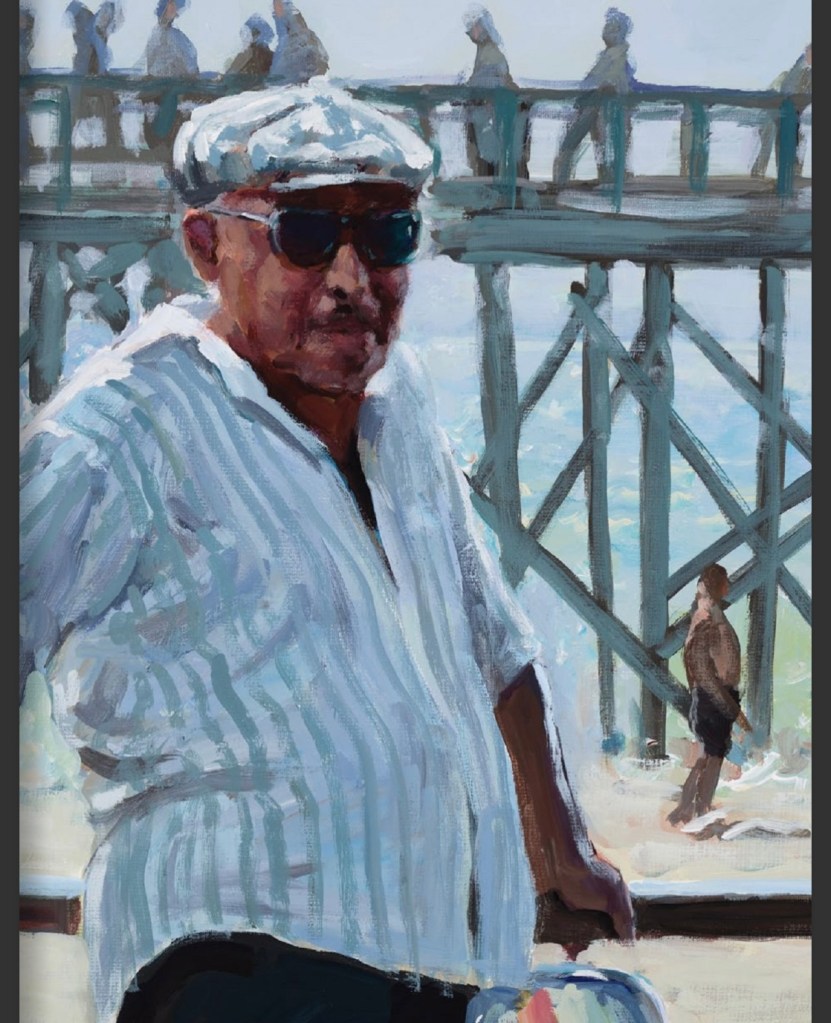
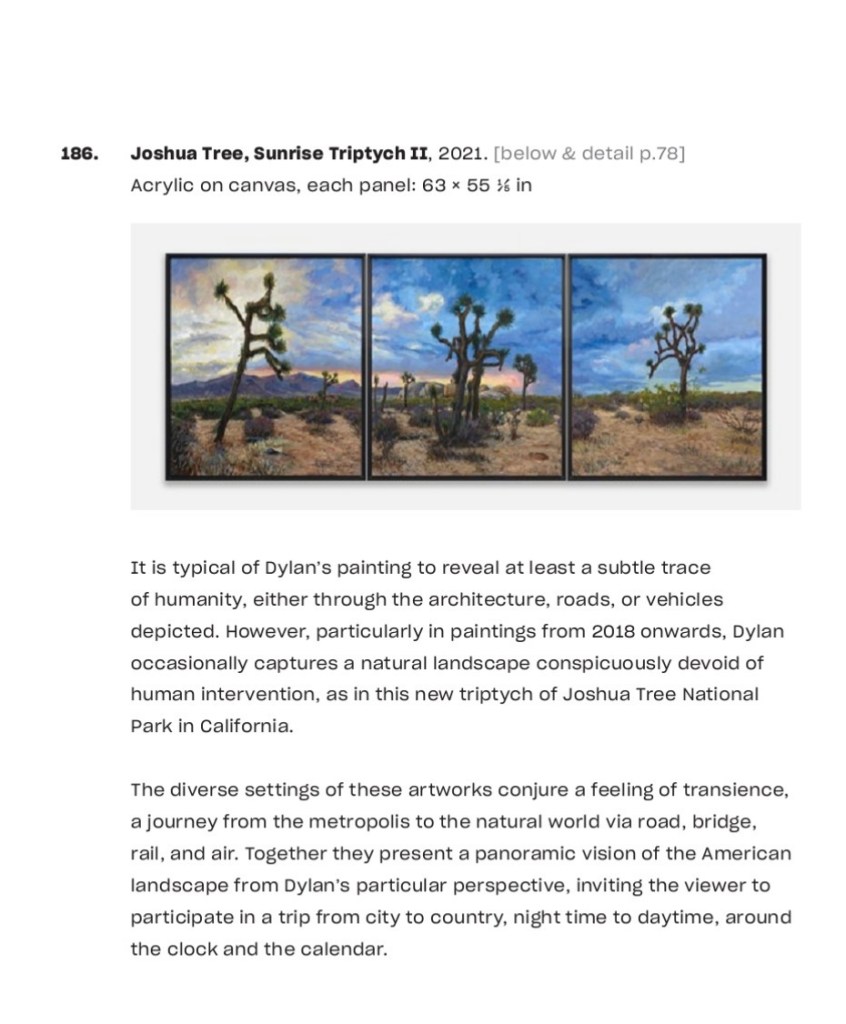
The Patricia and Phillip Frost Art Museum, on the Sweetwater (an area in Miami) campus of Florida International University, FIU, is featuring the works of Bob Dylan. Museum visits are rare these days with so many viruses being passed around. Thank goodness for digital experiences. I could stare at these paintings forever and wonder what was Dylan thinking about? I want to know why he chose certain subjects. His songs make us think about what he is describing. His paintings make us think for ourselves. The following is a small representation of what is being shown.
A man is getting into the shower just as his wife is finishing up her shower, when the doorbell rings. The wife quickly wraps herself in a towel and runs downstairs. When she opens the door, there stands Bob, the next-door neighbor.
Before she says a word, Bob says, “I’ll give you $800 to drop that towel. “
After thinking for a moment, the woman drops her towel and stands naked in front of Bob After a few seconds, Bob hands her $800 and leaves.
The woman wraps back up in the towel and goes back upstairs. When she gets to the bathroom, her husband asks, “Who was that?”
“It was Bob the next door neighbor,” she replies.
“Great!” the husband says, “did he say anything about the $800 he owes me?”
Moral of the story :
If you share critical information pertaining to credit and risk with your shareholders in time, you may be in a position to prevent avoidable exposure .
Lesson 2:
A priest offered a Nun a lift. She got in and crossed her legs, forcing her gown to reveal a leg. The priest nearly had an accident. After controlling the car, he stealthily slid his hand up her leg.
The nun said, “Father, remember Psalm 129?” The priest removed his hand. But, changing gears, he let his hand slide up her leg again.
The nun once again said, “Father, remember Psalm 129?”
The priest apologized “Sorry sister but the flesh is weak.”
Arriving at the convent, the nun sighed heavily and went on her way.
On his arrival at the church, the priest rushed to look up Psalm 129
It said, “Go forth and seek, further up, you will find glory.”
Moral of the story:
If you are not well informed in your job, you might miss a great opportunity .
Lesson 3:
A sales rep, an administration clerk, and the manager are walking to lunch when they find an antique oil lamp. They rub it and a Genie comes out.
The Genie says, “I’ll give each of you just one wish.”
“Me first! Me first!” says the admin clerk. “I want to be in the Bahamas , driving a speedboat, without a care in the world.”
Puff! She’s gone.
“Me next! Me next!” says the sales rep. “I want to be in Hawaii , relaxing on the beach with my personal masseuse, an endless supply of Pina Coladas and the love of my life.”
Puff! He’s gone.
“OK, you’re up,” the Genie says to the manager.
The manager says, “I want those two back in the office after lunch.”
Moral of the story:
Always let your boss have the first say.
Lesson 4
An eagle was sitting on a tree resting, doing nothing. A small rabbit saw the eagle and asked him, “Can I also sit like you and do nothing?”
The eagle answered: “Sure , why not.”
So, the rabbit sat on the ground below the eagle and rested. All of a sudden, a fox appeared, jumped on the rabbit and ate it.
Moral of the story:
To be sitting and doing nothing, you must be sitting very, very high up.
Lesson 5
A turkey was chatting with a bull. “I would love to be able to get to the top of that tree,” sighed the turkey, “but I haven’t got the energy.”
“Well, why don’t you nibble on some of my droppings?” replied the bull. They’re packed with nutrients.”
The turkey pecked at a lump of dung, and found it actually gave him enough strength to reach the lowest branch of the tree. The next day, after eating some more dung, he reached the second branch. Finally after a fourth night, the turkey was proudly perched at the top of the tree.
He was promptly spotted by a farmer, who shot him out of the tree.
Moral of the story:
BullShit might get you to the top, but it won’t keep you there.
Lesson 6
A little bird was flying south for the Winter. It was so cold the bird froze and fell to the ground into a large field. While he was lying there, a cow came by and dropped some dung on him.
As the frozen bird lay there in the pile of cow dung, he began to realize how warm he was. The dung was actually thawing him out! He lay there all warm and happy, and soon began to sing for joy.
A passing cat heard the bird singing and came to investigate. Following the sound, the cat discovered the bird under the pile of cow dung, and promptly dug him out and ate him.
Morals of the story:
(1) Not everyone who shits on you is your enemy.
(2) Not everyone who gets you out of shit is your friend.
(3) And when you’re in deep shit, it’s best to keep your mouth shut!
We were introduced to Elizabeth Sutton by our lawyer Neil Goldstein who I featured in yesterday’s DigiDame. It didn’t take too long for Neil to suggest that we work with Elizabeth to promote her super stardom career. We are now in collaboration with Elizabeth to make that happen.
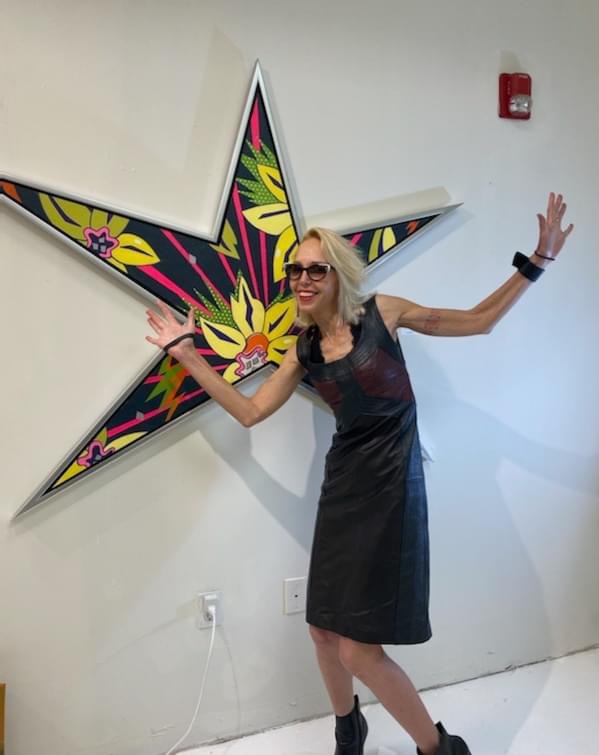
Elizabeth Sutton Is The Artist And Designer You Need To Know About Right Now
In just four years, Elizabeth Sutton has seemingly come out of nowhere to become an incredibly successful artist, designer, entrepreneur, and podcaster. Combining whimsy, lots of color and a big dose of humor into her work, it still remains sophisticated.
Raised in a Modern Orthodox Jewish household in Brooklyn, Sutton married young and lost (almost) everything in a divorce. However, that’s not the only challenge she’s experienced on her way up. But, like her signature butterfly designs, she’s managed to come out of the cocoon of pain to a thriving business and beautiful new life.
Artist As Influencer
Elizabeth Sutton’s story isn’t that of a typical New York City artist. She didn’t rise through the ranks at Parsons, or another prominent art school. Rather, she began to create out of necessity. After getting married at 21, things began to fall apart both with her marriage as well as financially. In the middle of renovating her apartment, she realized she wasn’t going to be able to afford the art she wanted. So, she decided to make her own.
Then, after a no-pressure arts and crafts day with a friend, she posted a few of her paintings to Instagram for fun. “Somebody sent me a message saying I love your art. I just moved, would you be interested in making me something? And I said sure, a little bit of time, a little bit of money, why not? And that’s really how my career started,” Sutton tells me.
But this wasn’t the first time there was interest in her work “Over the years, people have come to my apartment and saw the collages that I made and asked me to buy them. I didn’t take them seriously,” she reveals.
However, after realizing she could have a career in art, Sutton circled back. “I hit a bunch of them up and asked if they were still interested. Some of them said yes.”
Then things just began to happen. Sutton would leave her art in the lobby of her Upper East Side apartment while pulling her car around to transport her work for delivery. Women in the building would notice the art and ask the doormen where it came from. Sutton started to get clients.
In 2016, star of Bravo’s Million Dollar Listing New York, Ryan Serhant contacted Sutton to place her art in a new development in Tribeca. It ended up on the show, which was yet another win for the emerging artist.
Elizabeth Sutton Collection
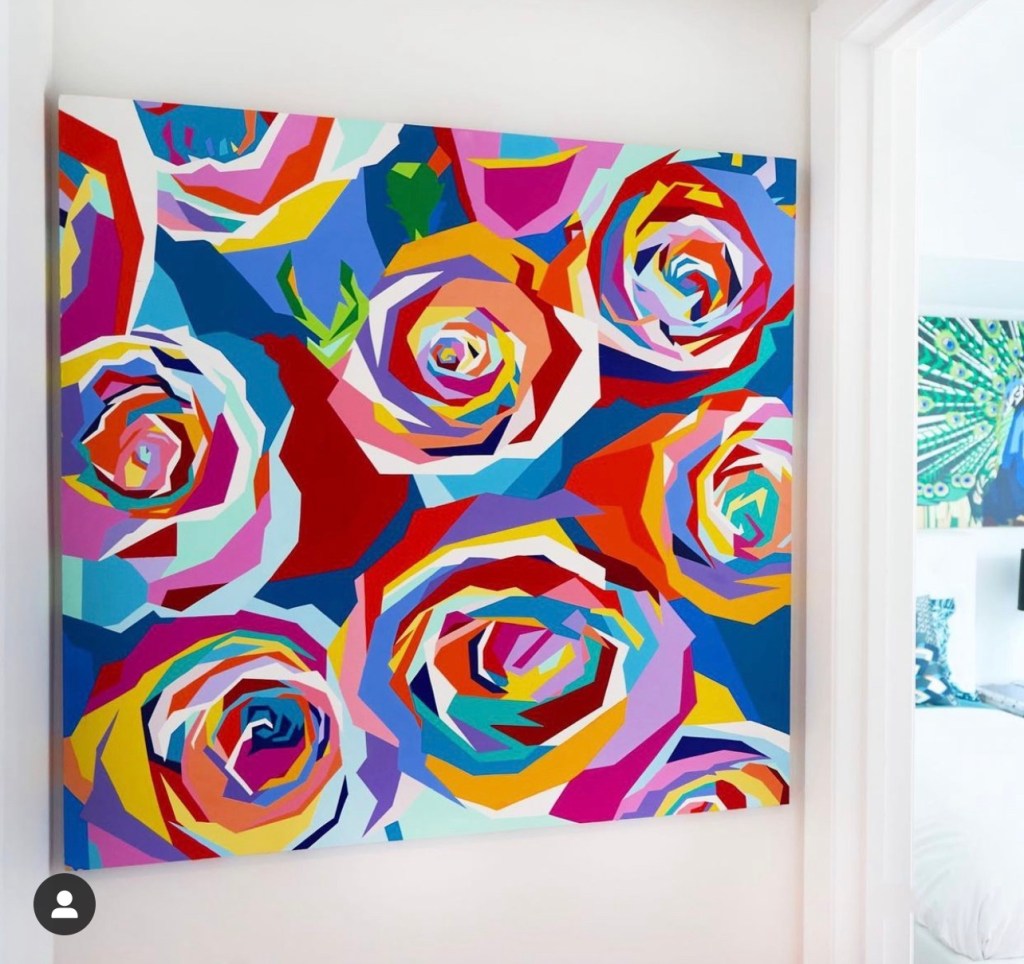
Today, Sutton’s fine art and print collections fall into several categories: Animals, Geometrics/Patterns, Florals, Landscapes, Portraits, Quotes, and Butterflies, which are her signature. This design is used on her logo, packaging, and many of the other products she creates.
If there is another component of Sutton’s work that truly reflects who she is as a person, it’s her “Quote Line.”
A large acrylic and glitter work reads: “Thank you Daddy. I appreciate your issues,” which is a tribute to the father who left her family as a teenager. She still doesn’t have a relationship with him.
Other pieces read “Dance Through The Pain,” and “Art Heals All Wounds,” which tell the story of the challenges she’s had in life such as her assistant and close friend tragically dying in a car accident the night of her birthday party a few years ago.
But perhaps the most telling piece is a black and white mixed media sign that reads “Life is fucking complicated.” What could be a better reflection of life right now?
Home Decor Line
Sutton isn’t just an artist, she’s a true creator whose designs can be integrated into any room of the home. She’s translated her butterfly logo into chic drawer knobs perfect for adding a touch of whimsy onto a dresser or étagère.
They’re even beautiful in a bathroom. Made of solid brass, the gold-plated pulls are available in gold, rose gold, and nickel finishes.
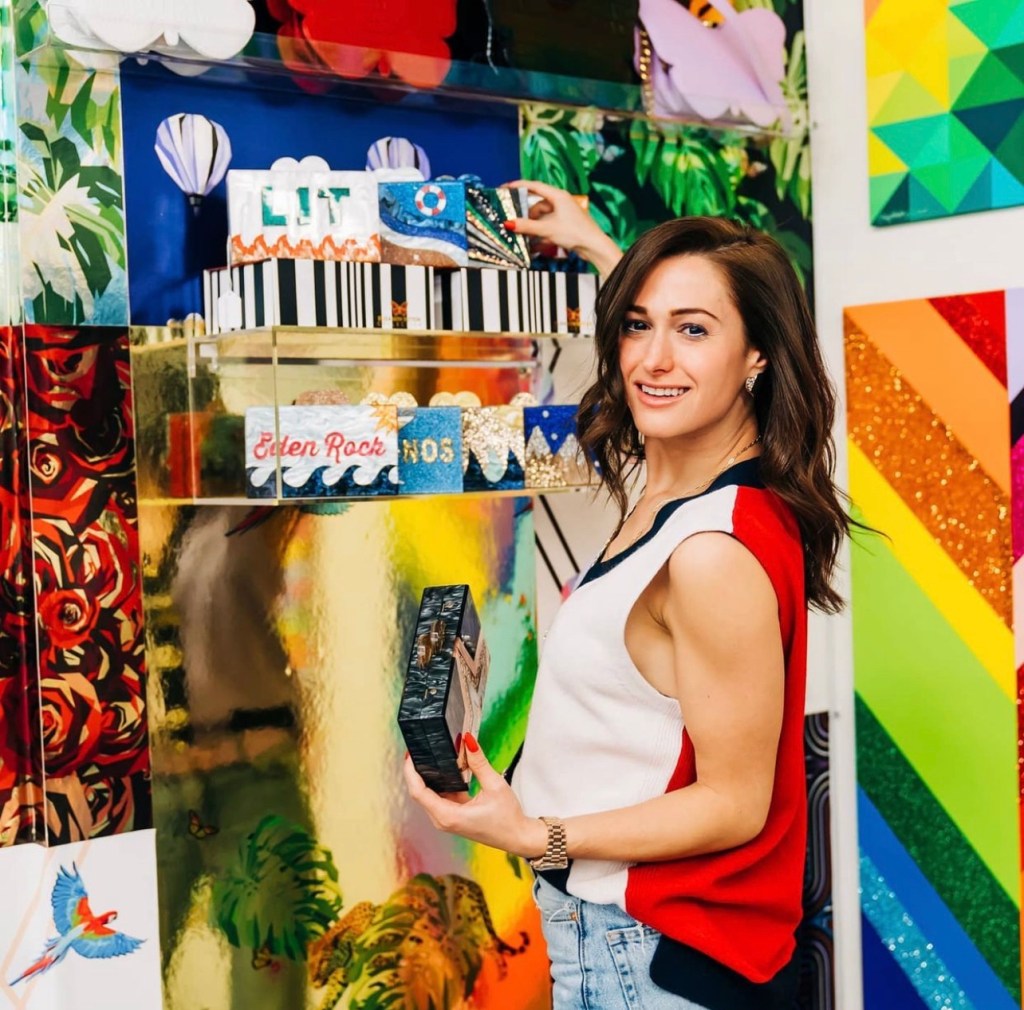
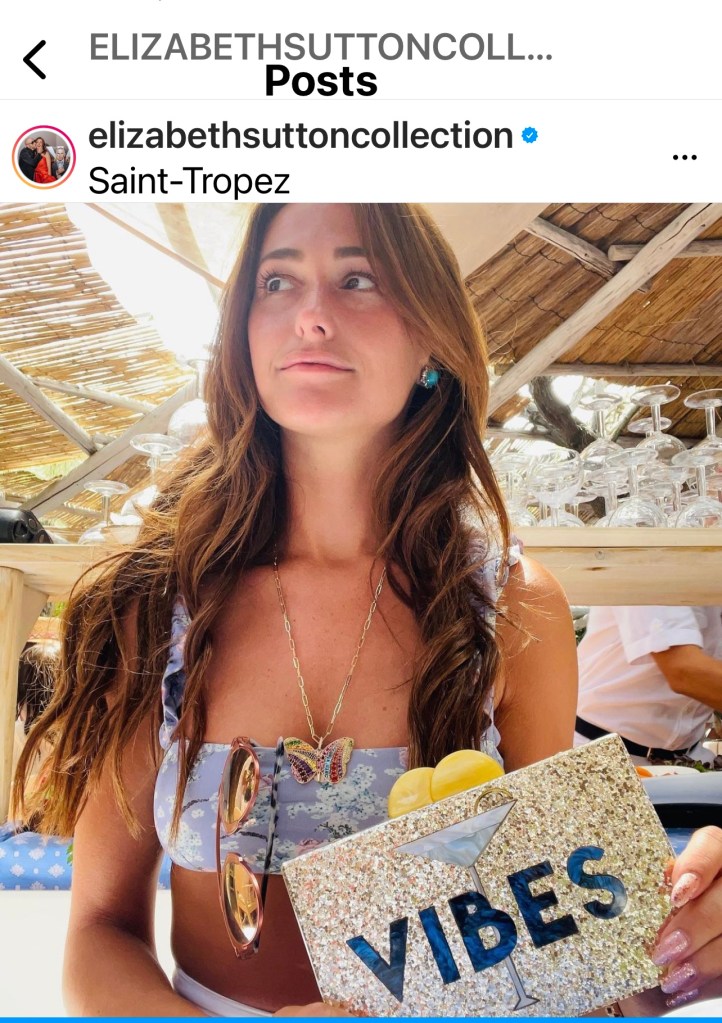
In addition to her decor line, Sutton also has a stunning fashion accessory collection with handbags, handbag straps, belts and luggage tags.
Collaboration With Tile Bar
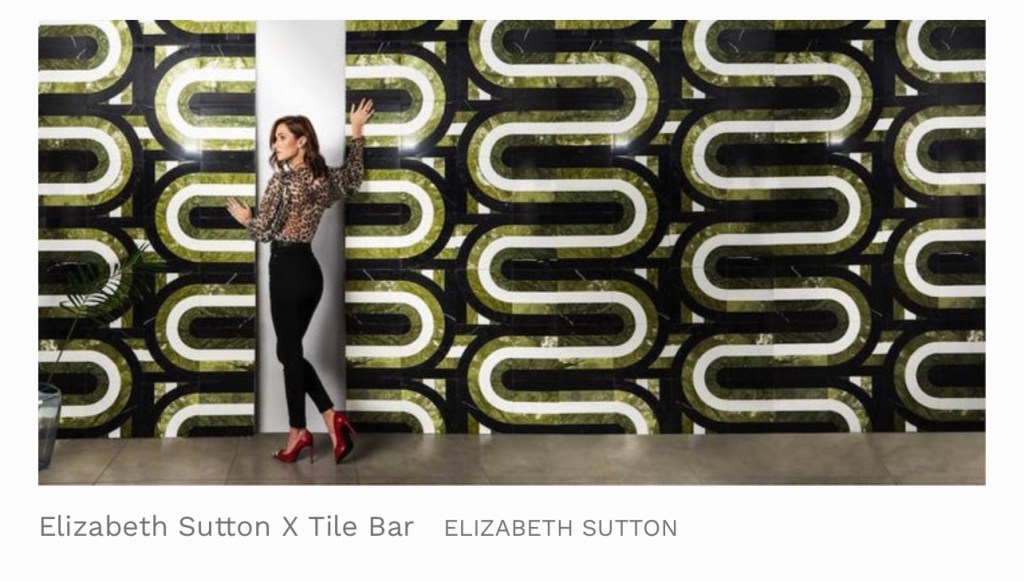
Her most successful collaboration to date has been with TileBar, which debuted during the 2019 Architectural Digest Design Show in New York and won Best In Show for wall treatments.
With six colorways in three formats, these polished marble tiles can have more than 100 different layouts. The style of these tiles, like everything else the artist does, truly embodies elevated whimsy.
Paint Collection With Janovic
The same year, Sutton partnered with New York City paint institution Janovic on a line of Benjamin Moore paints inspired by her life called Shades of Grey, Autumn Allure, New York Goes to the Eden Rock, St. Barth’s, Earth Wind and Fire and Head in the Clouds.
To promote the collaboration, Sutton painted murals on the facades on four of Janovic’s buildings.
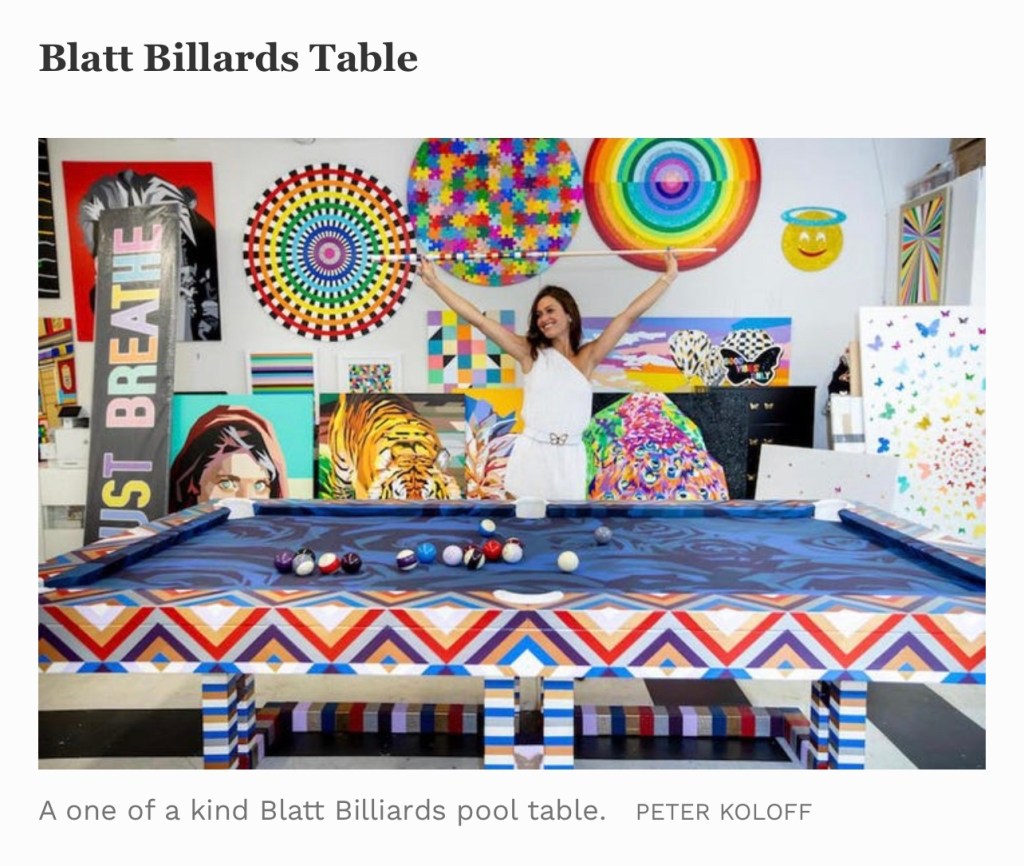
Sutton recently completed what she considers her most creative work to date— a custom built Blatt Billiards pool table. It features three different hand painted geometric abstractions, custom dyed and embossed Italian leather wrap around the base as well as printed felt featuring her noted artwork, Buy Yourself Roses. There are even custom balls with her trademark butterfly logo. “This table is my creative baby and included over 1000 hours of labor,” Sutton tells me. The price tag?
The Summer Of Staying Home
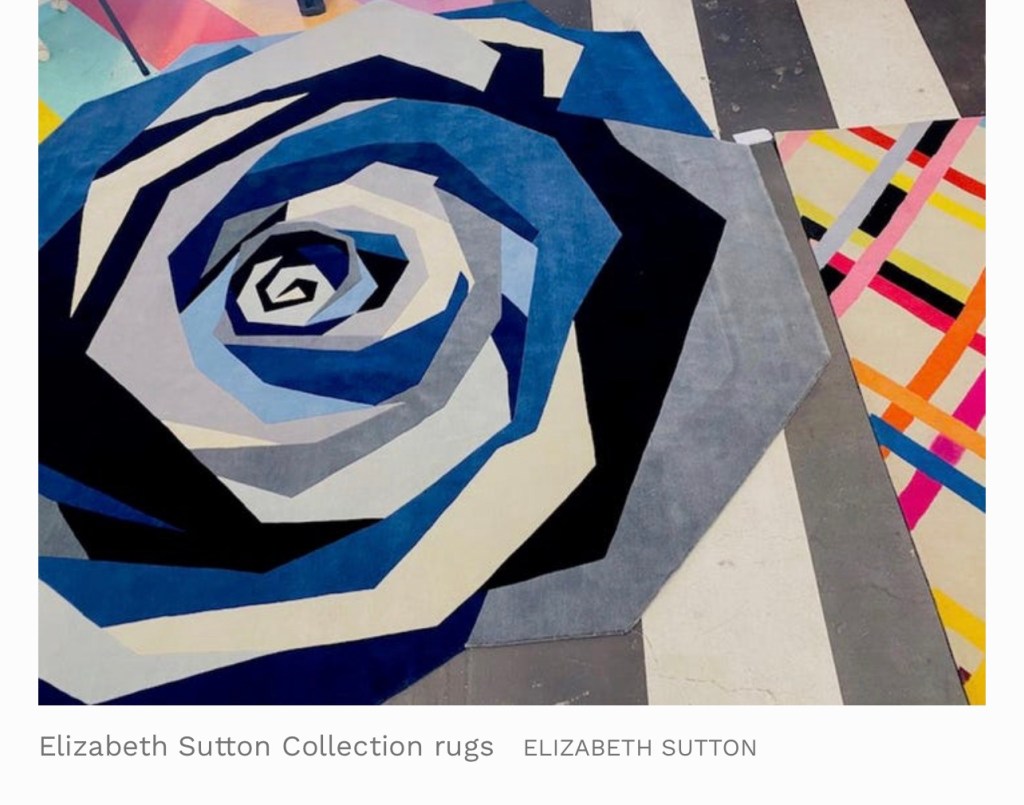
On July 22nd, Sutton launched a rug line featuring five different designs including a blue rose (which is rose-shaped), a round butterfly rug, a plaid rug as well as prisms and starbursts.
These are the artist’s signature designs in a combination of both bright and contrasting colors. Made of wool with a cotton foundation, these pieces are more than accents, they’re true statement decor.
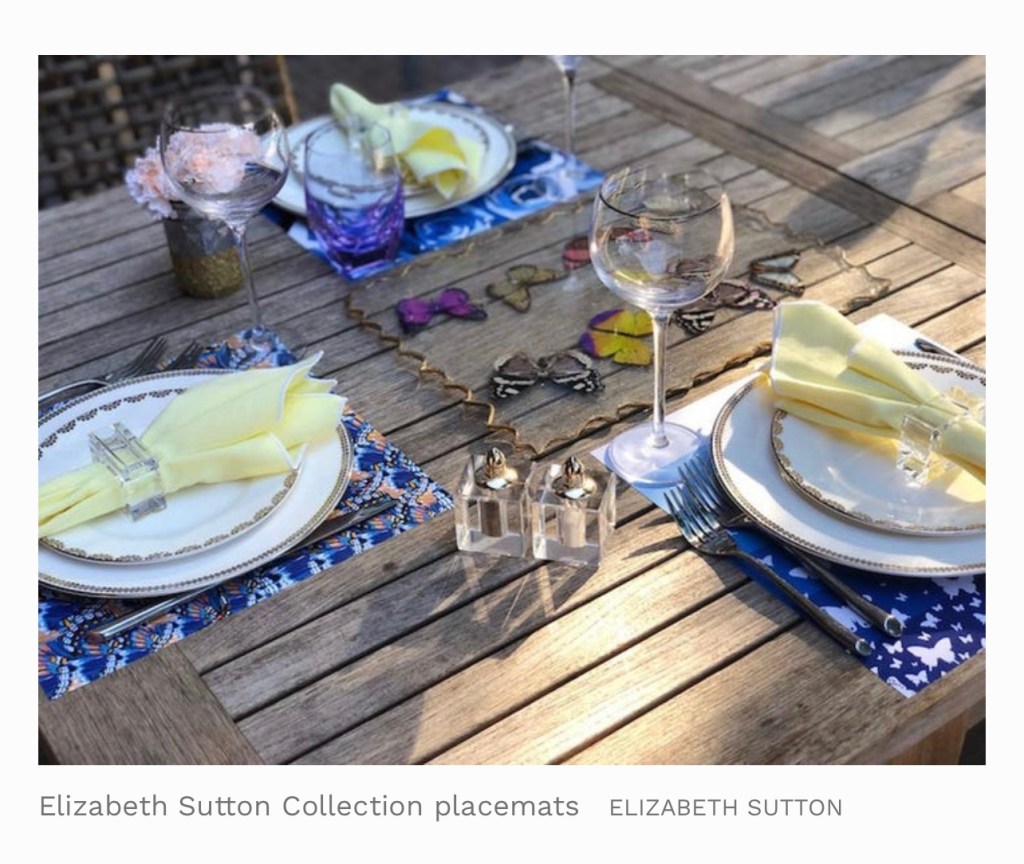
In addition to rugs, Sutton also launched an affordable line of 32 different placemats in a variety of styles from floral to butterflies, hot air balloons, and other animal designs.
Made of sustainably sourced materials, these disposable placemats are ideal for dinner parties and as Sutton personally knows, families with children.
Looking Forward
As for the future, even after a challenging time, Sutton is incredibly optimistic. The artist tells me, “I am so grateful to have found something I truly love to do, something that fulfills me from the inside and makes me happy on the outside. I feel I am a much better role model for my children as well, having gotten more intelligent and confident thru my career, and I hope to instill these values into them—that with hard work and passion they can achieve their dreams. And of course, I am grateful for my team and my support system that provides me with the opportunities and assistance to make my dreams come true, one day at a time.”
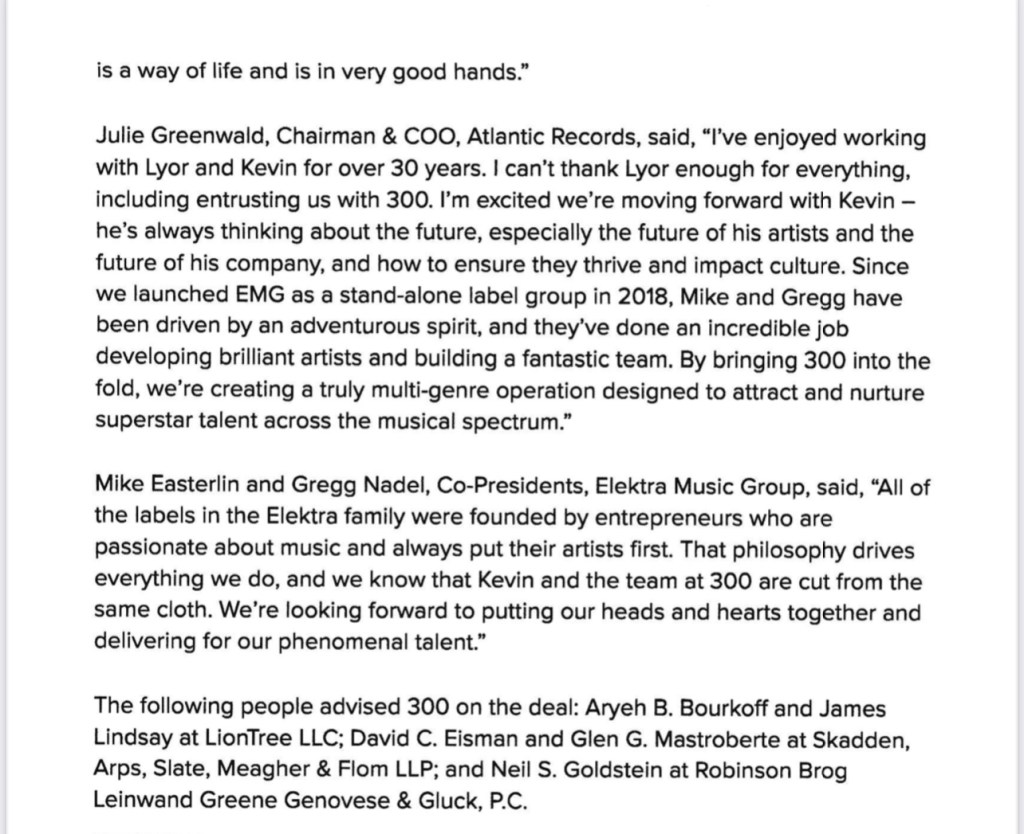
Our winning NY lawyer, Neil S. Goldstein, was a major player in the Warner Music Group deal this week. Lawyers around the world call on Neil for his strategic brilliance. He has been our attorney for 43 years. He was working on the deal while he stayed with us during Art Basel. He worked around the clock but never told us what it was all about. He shared it with us today. Congrats Neil. You are a rock star.
The following people advised 30O on the deal: Aryeh B. Bourkoff and James Lindsay at LionTree LLC; David C. Eisman and Glen G. Mastroberte at Skadden, Arps, Slate, Meagher & Flom LLP; and Neil S. Goldstein at Robinson Brog Leinwand Greene Genovese & Gluck, P.C






























































 DigiDame