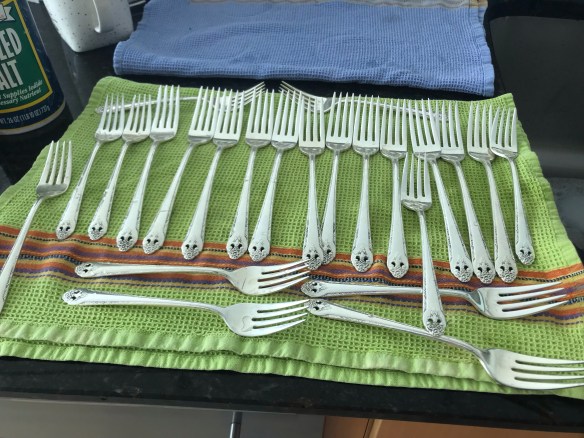
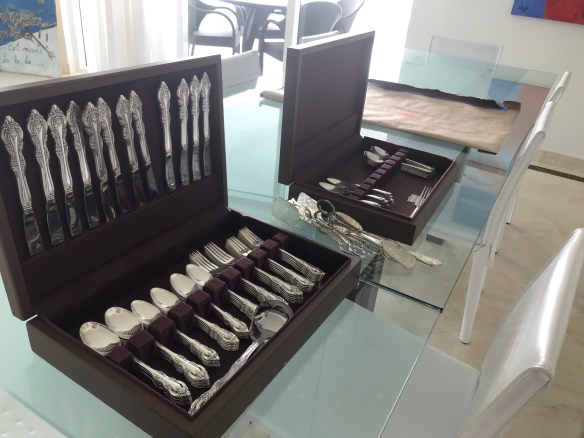
Eliot and I own two sets of silver plate silverware. Each set is for 12 people. Both sets are about 45 years old. Needless to say, they are not as shiny as they once were.
I don’t like to use them when we have company because they look slightly tarnished. It’s a shame because they are valuable, and in today’s market, it would be very costly to replace them.
Francis and Guy came to the rescue. That’s a couple we met on a tour in Ireland last summer. I don’t remember how or why, but I told them about my silverware situation during one of our many conversations. I wanted to know how I could clean the silverware without spending days polishing the many knives, forks, spoons, etc.
When they told me how they clean their silver, I couldn’t believe it. It seemed so simple. It’s been months since they told me what to do. I finally got the courage to try.
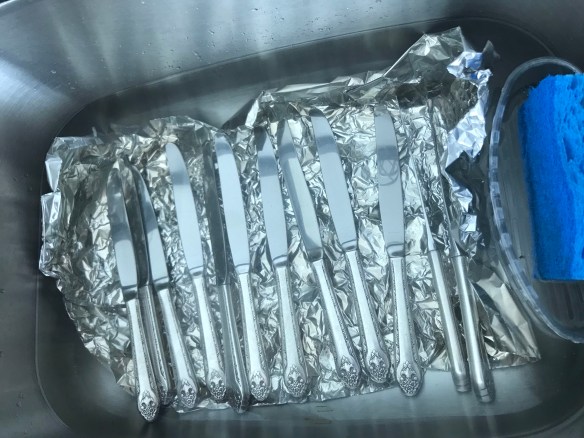
I filled a 1/3 of my sink with hot water. I lined the sink with aluminum foil, and then added a tablespoon of baking soda and a table spoon of salt. I then stirred the water so everything was evenly distributed.
I placed 12 utensils in the sink at a time and let them soak for 15 minutes. After, I rinsed them off, I put them in the dishwasher for a good cleaning. The results? Spotless and shiny silverware. It was that simple.
If you want to learn this trick, and not spend hours polishing your silverware, watch the video for specific instructions.
I always wondered why my friend, Doug Garr, had the guts every month to jump out of an airplane. I sometimes would stare at him, and wonder, what makes him tick? He looks pretty normal, and never exhibits any daredevil tendencies. Why is he so different? Surprise, surprise! A blog for the company, 23andMe, a genetic service company, explained that Doug may have the right type of genetics that gives him the ability to take high risks.
The blog said that scientists, from the Social Science Genetic Association Consortium (SSGAC), conducted a study that “identified 124 genetic variants associated with a person’s willingness to take risks.”
They were able to capture “the combined effect of a million genetic variants to reach an estimate showing that genetics accounts for about 1.6 percent of the variation in risk tolerance across individuals.”
The blog also pointed out that the role of genes that regulate neurotransmitters such as glutamate and GABA — are chemical messengers that both stimulate and calm the brain.
Are you a risk taker? The study examined “whether having a risk tolerance in one area, say a willingness to bungee jump, corresponds with taking a risk in another realm, like taking a risk financially.” The researchers found evidence of shared genetic influences across risk tolerance and risky behaviors.
I wonder if this information is going to influence your future behavior?







 DigiDame