Do You Remember Elian Gonzalez?

Can you believe it’s been 24 years?


Once cherished in Miami, Elián González is set to become a legislator in Cuba.

NGAMEZTORRES@ELNUEVOHERALD.COM
GAGUILA@MIAMIHERALD.COM

Elián González, the Cuban boy found clinging to an inner tube near Florida shores who became the center of an international child custody dispute as well as a political battle between Cuba’s late leader Fidel Castro and Cuban exiles in Miami, is set to become a member of the island’s National Assembly after Cubans go to the polls Sunday.

González, 29, was proposed as a candidate for the municipality of Cárdenas, in Matanzas, where he lives and works as assistant director of AT Comercial Varadero, a food import company run by the Cuban Ministry of the Armed Forces. 

Married and father of a 2-year-old girl, González said in an interview with the Juventud Rebelde newspaper that he had been encouraged by the Castro brothers to enter politics and thought Fidel Castro “would be proud” of his nomination. He has sometimes spoken in the past about how Cuba’s population has lost confidence in government institutions.

And because Cuba’s electoral system is designed in a way official candidates face no competition and only need a small percentage of the vote to get elected, there’s little doubt that González, who as a boy was at the center of one of the most emotional stories in Miami’s history, will become a member of the same government his mother tried to escape from.

''

In this file photo taken April 22, 2000, in Miami, Elián González is held in a closet by Donato Dalrymple, one of the two men who rescued the boy from the ocean, right, as government officials search the home of Lazaro González for the young boy. The boy was eventually reunited with his father in Cuba, but the ordeal put a spotlight on bitter relations between the U.S. and Cuba. (AP Photo/Alan Diaz, File)

“Throughout these years, my family has been very important, trying to maintain that simplicity, that humility of always staying in the right place where I should be, not believing that I was different from anyone or that I deserved something better,” he said in an interview with Cuban television station TvYumurí after he was nominated. He also praised his teachers, who he said made him understand that he “was not the star of that story, the star was the people.”

González, then 5 years old, was rescued by fishermen on Thanksgiving Day 1999 when he was spotted on an inner tube floating at sea near Fort Lauderdale. His mother, Elizabeth Brotons, who took him on the dangerous trip to flee the island regime, drowned with a dozen other passengers when their small fishing boat capsized. The boy miraculously survived. 

In Cuba, his father, Juan Miguel Gonzalez, wanted him back. But in Miami, some of his relatives believed the boy should stay in the United States. After all, the boy’s mother died trying to get him freedom, the relatives said at the time.

Then politics entered the scene.

After the economic crisis in Cuba in the 1990s known as the Special Period, Castro needed an issue that could revive old ideological battles and reinvigorate his grip on the population. And he seized on the opportunity, quickly making Elián’s return a subject of national priority and the beginning of a years-long propaganda campaign that would be known as the Battle of Ideas. 

In Miami, local politicians quickly made it their mission to resist Castro and support the claims of the boy’s relatives in the U.S. to keep him here. A media frenzy followed in both countries, and Elián became the center of a diplomatic crisis and legal dispute that made headlines around the world. No less dramatic was the middle-of-the-night raid by federal agents on his relatives’ Little Havana home that put an end to it all after U.S. Attorney General Janet Reno ordered that the boy should return to Cuba.

A photograph of the boy’s scared face when a federal agent points his gun in his direction further enraged Cuban exiles. But after seven months, he eventually returned to Cuba with his father after the Miami relatives exhausted all legal pathways to get him to stay.

His life, however, never quite returned to normal. The entire country knew who he was, his face printed on thousands of banners and T-shirts. While he was in Miami, Cuban state workers and students held weekly rallies calling for his return, and a daily television show was dedicated to discussing any developments in the case.

On the island, González received a military education and became a vocal supporter of the Castro brothers, who, after his return to the island developed a close relationship with him and his father, who went from a waiter at a Varadero restaurant to a member of the National Assembly. 

Over the years González was frequently seen in public with Fidel and later Raúl Castro. When he graduated as an industrial engineer in July 2016, he read a letter his class sent to Fidel Castro promising to “fight from any trench that the Revolution demands.” And when Castro died a few months later, González said he had been “like a father until he became a friend. And like my father, I wanted to show him everything I achieved so that he could be proud of me.” His Facebook account is full of pictures with Fidel Castro and hashtags like #FidelViveenMí, Fidel lives in me, and #YoSoyFidel, I am Fidel.

In 2020, González announced he was going to be a father of a girl and that he had become a member of the Communist Party.

He has rarely spoken of his family in Miami, but in a 2015 interview with ABC News he said he wanted to visit the United States and was willing to talk to his relatives — if they acknowledged it was wrong to keep him from reuniting with his father. 

Though not surprised, Manny Díaz, the lawyer who represented the boy’s Miami relatives during the saga and who later became mayor of Miami, said he was saddened to hear about González’s choices.

“How does he explain the fact that his mother gave her life to bring him to freedom, and he’s now a representative of a system that oppresses people, jails anyone who dissents, kills people who dissent and is an economic failure?” he asked.

In Miami, Elián played with Díaz’s daughter. When Diaz saw them together, he said, he saw children — not a battle between democracy and communism.

Diaz said he knew that Elián’s return to the island would involve indoctrination. Elián, he said, was groomed to be a poster child for the Cuban government.

Donato Dalrymple, 63, one of the fishermen who rescued him at sea and the man appearing in the iconic photo the night of the raid trying to shield him from the armed federal agent, said he isn’t surprised to hear about González’s new role. Dalrymple said he noticed something different about Elián from watching him play with his cousins in Miami.

“He was always a leader,” he told the Miami Herald.

For Dalrymple, González’s future as a lawmaker could be a good change for the island nation.

“I live with high hopes,” he said. “I wish him all the best.

Fountainhead Arts And Women’s Fund Miami Dade Celebrate Women’s History Month

Kathryn and Dan Mikesell, co-founders of Fountainhead Arts hosted the annual woman’s history month event tonight for The Women’s Fund Miami-Dade
https://womensfundmiami.org/. Mayor Daniella Levine Cava, Miami-Dade County’s first-ever woman Mayor, elected in November, 2020, was an honored guest. The Woman’s Fund creates positive change for women and girls through grantmaking, advocacy, research and leveraging collective impact.The four pillars: Economic Mobility, Leadership, Health & Well-being, and Freedom From Violence

Mayor Daniella Levine Cava, Miami-Dade County’s first-ever woman Mayor, elected in November, 2020, was an honored guest.

Miami is big on presenting movies on the water. Fountainhead Arts premiered a foundation video
Me, Alison, Hesty , Fountainhead artist
Fountainhead’s Nicole Martinez delivering second baby this weekend. Congrats !
Fountainhead’s Francesca Nabors with members Lucy, Emily, me and Hesty
Spring McManus, art advisor and Melissa Wallen, director of De La Cruz Collection

Goodnight Freddie Roman

Sad Obit: The Friars Club is Padlocked Shut, Closed After Years of Mismanagement and Malfeasance Comes End of Era

by Roger Friedman – March 16, 2023 7:53 pm

The Friars Club is closed.

It’s padlocked shut with a gate blocking the entrance.

In truth, the Friars Club has been gone for years. All that remains is the 1957 “monastery” built into a classic townhouse(originally constructed in 1904) at 57 East 55th Street, a grim tombstone to remember the halcyon years of Alan King, Larry King, Jerry Lewis, Frank Sinatra, Joan Rivers, Freddie Roman, Dick Capri, and so on.

The group that was once so vaunted long ago lost its 501 c3 status as a charity. The Friars used to raise money for philanthropies. Now they need a GoFundMe page and a rescue from the Landmarks Commission ASAP.

Gone are the roasts that became so famous that Ted Danson’s career was almost ruined at one when he wore blackface. No one who attended the famous roast at which Gilbert Gottfried repeated “The Aristocrats” has ever recovered from it.

But I began reporting on the financial malfeasance at the Friars Club in 2016, which led eventually to them being raided by the federal government. Down the line, the club’s president Michael Gyure was found guilty of fraud and tax evasion. He’s long gone. I reported that a sexual harassment claim was filed by the club’s long time receptionist and ultimately settled for around $1 million. The club refused to get rid of the person at the center of the suit, Bruce Charet, who is still with them. 

Three years ago, just before the pandemic killed off inside dining and entertainment, the club — loaded with debt — suffered a burst water pipe that flooded the place.Renovations took place thanks to insurance. In the spring of 2021 I was invited over by new president Arthur Aidala, the defense attorney who counts among his clients Harvey Weinstein. The kitchen was closed. There was no hot food, just some cold hors d’ouevres. Aidala was very upbeat that a new day was coming including an outside restaurant operator who’d make the ground floor public. 

That was two years ago. Months ago there was talk of private gatherings. No celebrities will set foot in the Friars Club thanks to the litany of people who’ve destroyed its reputation. The Club “fired” many beloved members, others quit. Once a famed pinnacle of success for comics and entertainers, it’s now a husk of itself. 

What will happen? New York’s history is disappearing very quickly now. The famed 21 Club closed during the pandemic and there’s no sign of its return. The Friars Club is one of the last vestiges of the city’s dominance as a cultural force. But in the last two or three decades, the group was unable to attract contemporary comics like Jerry Seinfeld, Dave Letterman, Stephen Colbert, Jon Stewart, the “SNL” gang, etc. 

PS The Friars Club has little to no social media. Its Twitter account hasn’t been used in three to four years, and there are no updates on Facebook.

A Miami Housewife Tells Her “Dateline” Experience

Miami Life —Lois Whitman-Hess
Www.thethreetomatoes.com

If you are a “NBC Dateline” fan then you will want to meet my friend Gloria Winkowski who lives a few blocks away from me in Miami Beach. She was actually involved in solving a 40-plus year murder mystery that took place in Rochester, NY. She
appeared on Dateline on Friday, January 20 to discuss the case with NBC news correspondent Andrea Canning.

When Gloria first told me about the murder of her girlfriend in Rochester and how she was working with Dateline to tell the nation about what happened so long ago, I couldn’t believe my ears. My husband Eliot and I became huge Dateline fans during the Covid-19 pandemic when we were shut-ins. After a while we realized that most of the cases were about small town, husbands and wives, who killed their spouses to collect on life insurance policies.

That wasn’t the case with Gloria’s friend Kathy Krausneck who was murdered February 18, 1982. Gloria said her husband killed her because she was planning to leave him. Jim Krausneck was very abusive. He wasn’t going to let her go on her terms. He took an ax and plunged it into her head before he went to work that day at Eastman Kodak.

If that wasn’t bad enough, he also left his three year old daughter home alone while his wife was stretched out dead in her bloody bed. The little girl, who is now 40 years old, said she has no recollection of being by herself without food, water, and adult supervision. Her father wanted to make the scene look like an intruder busted into his home and killed his wife. He claimed that when he returned home that evening he was shocked to see what took place in his absence.

Gloria didn’t believe a word he said because Kathy had been telling her that she was basically living a life totally being controlled by her husband Jim. He didn’t allow her to talk on the telephone when he was home because he wanted her totally devoted to him. He also kept her captive at home everyday because he refused to buy a second car for her use. Kathy often relied on Gloria to drive her daughter to school, the doctor, and food shopping. Gloria said Jim was generally very nasty to Kathy.

It took 40 years and several marriages later for Jim to be convicted and sent to jail for the rest of his life. It sickens Gloria to think it took the Rochester police all those years to gather enough evidence to put him away. Smaller cities just do not have the investigation resources as bigger ones.

Gloria was also upset with Dateline. She felt they didn’t tell the true story of Jim Krausneck. They just gave the highlights to fit the two hour slot and never gave Kathy the justice she deserved. “She was a sweetheart and he was disturbed. Jim was under investigation at Eastman Kodak for claiming he had a PhD when he never finished the program. They kept asking him to see his documents but he never produced it. He was about to be fired. Dateline, with all of their resources, also never covered that fact and that the Krausneck dog was locked up in the basement for the day. That was something Kathy would never do.”

Gloria realizes that Dateline produces a shows for TV entertainment. She just wishes they showed more facts why Jim was the killer. It was bad enough that Gloria had to tolerate Jim being free for four decades while her girlfriend’s life was cut short.

Gloria lives with her husband Bill, a retired pharmacist, in Miami Beach. They have a beautiful life filled with their four adult children and 11 grandchildren.

Dateline is a newsmagazine that has been an airing staple since in 1992. Cases involving murders and missing people are frequent topics on the series that has won multiple Emmys in the news and documentary category.

Every Democrat Needs To Watch This Video

Leigh McGowan launched PoliticsGirl as a way to help people reconnect with politics. She started the YouTube channel in 2015 as a way to inform and inspire because she said, “when you understand you care, and when you care you vote”. After watching the fallout from the Trump years, Leigh relaunched the project on TikTok in September of 2020 doing rants in her kitchen as a way to engage the younger generation whose participation, she believed, was essential to the future of the country. People loved her no-nonsense, casual approach and the way she was able to break down complicated issues into everyday speak. As her numbers grew so did her popularity and influence. People like her because she’s smart in a way that doesn’t make them feel dumb.

@iampoliticsgirl

Second option, click on link below to access the video

https://www.tiktok.com/t/ZTR7hEPDD/

William Shatner on ‘Star Trek,’ Space Travel and Mortality: ‘I Don’t Have Long to Live

By Brent Lang

https://img.particlenews.com/image.php?url=2XBp9t_0lDVzYT700

William Shatner kicks things off with a compliment. 

We’re talking via Zoom — he’s beaming in from the sprawling kitchen of his Los Angeles home, which overlooks the San Fernando Valley. I’m dialing in from the living room of my walkup apartment in Brooklyn, a much more modest setting. But Shatner is impressed by the over-stocked bookcase behind me, as well as the paintings, a seascape and an impressionist pastoral scene that I inherited from my grandmother, that line the wall around it. 

“You have terrific taste,” Shatner exclaims with the kind of brio that Captain James T. Kirk, his most famous alter-ego, approached his mission “to explore strange new worlds, seek out new life and new civilizations, [and] boldly go where no man has gone before!” 

But Shatner isn’t just here to talk about “Star Trek,” though his time commanding the Starship Enterprise invariably comes up. Instead, he’s discussing “You Can Call Me Bill,” a new documentary that covers Shatner’s career highlights — from the “Star Trek” films and series to “T.J. Hooker” and “Boston Legal” — as well as his acting idols (Brando and Olivier) and love of nature. The film, which is directed by Alexandre O. Philippe and which premieres at SXSW, is also a meditation on mortality, something that the 91-year-old Shatner has been thinking a great deal about these days. 

Why did you decide to make the documentary? 

I’ve turned down a lot of offers to do documentaries before. But I don’t have long to live. Whether I keel over as I’m speaking to you or 10 years from now, my time is limited, so that’s very much a factor. I’ve got grandchildren. This documentary is a way of reaching out after I die. 

Did you learn something about yourself that you didn’t know before you made this film? 

Time and time again, I’ve come across some interesting thought or idea. That can be because of a thoughtful interviewer sparking something in me. In the movie, I didn’t just want to go on about I did this or that when I was 7 or this is my favorite color . I’m trying to discover something I’ve never said before or to find a way to say something I’ve said before in a different way, so I can explore that truth further. I read all the time — newspapers and books. I’m feeding my mind. The sad thing is that the older a person gets the wiser they become and then they die with all that knowledge. And it’s gone. It’s not like I’m going to take my ideas or my clothing with me. Today, there’s a person going through some of my clothes in order to donate or sell them, because what am I going to do with all these suits that I’ve got? What am I going to do with all these thoughts? What am I going to do with 90 years of observations? The moths of extinction will eat my brain as they will my clothing and it will all disappear. 

That’s sad. What about your legacy? 

When Leonard Nimoy died a few years ago, his funeral was on a Sunday. His death was very sudden, and I had obligated myself to go to Mar-a-Lago for a Red Cross fundraiser. I was one of the celebrities raising money. That event was on Saturday night. I chose to keep my promise and go to Mar-a-Lago instead of the funeral, and I said to the audience, “People ask about a legacy. There’s no legacy. Statues are torn down. Graveyards are ransacked. Headstones are knocked over. No one remembers anyone. Who remembers Danny Kaye or Cary Grant? They were great stars. But they’re gone and no one cares.” But what does live on are good deeds. If you do a good deed, it reverberates to the end of time. It’s the butterfly effect thing. That’s why I have done this film. 

Your decision not to attend Leonard Nimoy’s funeral was controversial . How did the backlash feel? Do you regret your decision? 

Who cares? I know what I did was right. So it doesn’t matter. We’re criticized when we lift a finger. I don’t read that stuff. I try to not to indulge in the evil that’s out there. 

Everyone thinks about dying, but actors actually get to act out what it’s like to die on stage or on film. Does that change your perspective on death? 

William Shatner Documentary Beams Up $790,000 in Equity Crowdfunding, Selling Out in Less Than a Week 

There was a time when actors, and I include myself in this, would portray death by falling to the ground and your eyes would flicker and you’d slump around and then you’re dead. That’s not how you die. This is how you die [Shatner’s eyes go wide abruptly and his breath stops] . See? I’m dead. Ever put a dog down? When I have to put a dog down and I’m at the vet, I cup my dog’s head and I say, “I’m with you baby, I’m with you.” And the injection goes in and the dog looks at me with love, and that’s it. You don’t know they’re dead. That’s how you die. It’s abrupt. My wife’s brother walked out of the living room and into the bedroom. There was a thud. His wife walked in, and he was dead. Death comes anew to all of us. 

In “Star Trek: Generations” you got to have some say in how Kirk died. In that scene , he approaches his last moments with wonder. Why was that something you pushed for? 

I’m of the opinion that you die the way you live. I thought Kirk would die with a “Wow, look at that coming at me. There’s a guy with a scythe. Holy shit!” He’d seen all these weird aliens before. Here comes death and he meets it with awe and a sense of discovery. 

You’ve been touring the country doing sold-out screenings of “Star Trek II: The Wrath of Khan,” a movie that came out in 1982. Danny Kaye and Cary Grant aside, some of your movies are going to outlast you. Is that comforting? 

They’ll be good for another 10 years, maybe five. I’ve made all these films that are popular, so I’m sure they’ll pop up every so often. But I don’t need validation from a film I made in 1982. I get pleasure in talking to you right now. 

In “You Can Call Me Bill,” you talk about thinking frequently about how you’re 91-years-old and you won’t get to see the people your grandchildren grow up to be. What is that like to realize that? 

I have a grandson named Sebastian, who is 3 months old and already he’s got a mischievous smile. He’s already a little bit of a comic. His mother and father are lovely people. You look into his eyes, and you can see the aspects of what he will be like. If hunger and disease and bad fortune don’t disturb him too much, he should become this wonderful, amusing human being. So with the time I have left, I like to look at all my grandchildren and try to extract what I can out of my impressions. 

Do you like going to these “Star Trek” screenings and conventions and being in front of all those fans? 

I don’t enjoy being tugged at, but I enjoy answering questions and being in front of thousands of people. 

Do you have a favorite role? 

No. I just try to have a good time on the set. I just did a commercial for a watch that I designed. It has a face with a telescope, a sun, the milky way. And the watch company did this whole science fiction background for me to talk about it. Well, there’s a part of the commercial where they use CGI to have a meteorite land next to me. I ad lib, “That’s a lot of meteorite.” That was a pretty funny improv. I did that on Monday, and that’s become one of my favorite moments. I don’t know what it’s like for others. I went to watch Dwight Yoakam record an album last night, because I have no idea how a great artist makes their art. It’s like, how does everybody else fuck? You have no idea. I don’t know if he has a favorite album, and I don’t know if I don’t have a favorite role. 

In 2021, you went into space on Jeff Bezos’ Blue Origin space shuttle and you said it made you weep because it gave you a better sense of what is happening to the planet. What did you mean? 

When I came out of the space ship I was crying, just sobbing, and I thought why am I crying? What’s going on? I’m in grief. What am I grieving about? Oh shit, I’m grieving about the world, because I now know so much about what’s happening. I saw the Earth and its beauty and its destruction. It’s going extinct. Billions of years of evolution may vanish. It’s sacred, it’s holy, it’s life and it’s gone. It’s beyond tragic. We stupid fucking animals are destroying this gorgeous thing called the Earth. Doesn’t that make you angry? Don’t you want to do something about it? 

My Palm Beach Faux Pas

My Palm Beach Faux Pas:
Old Money Vs New Money
Lois Whitman-Hess
Www.thethreetomatoes.com

I was recently told that I made a faux pas in Palm Beach that I shouldn’t repeat again. I love the person who tried to correct me, but I am too old, and too satisfied with who I am, to change my ways.

This is what happened. I was at a Palm Beach party a few weeks ago and one of the other female guests was staring at me as if she wanted to have a conversation. Instead of standing there awkwardly, I said, “Hello I’m Lois Whitman-Hess, how do you know our host and what do you do?” She was around my age so I thought she might be retired but would have plenty to say. She could just give me a one liner about her career so we could strike up a conversation. Instead, she looked me straight in the eye and said, “I do nothing.”

I have to admit that most people would have backed off and tiptoed away in embarrassment. Not me. I didn’t let men order me around in business, so I sure wasn’t going to let this uptight senior get the better of me. I said, “You did nothing? Surely you had to do something.” She cleared her throat, paused to think, and then blurted out, “I raised my children.”

I wasn’t finished. I never am. “I’m sure you worked before having children.” She stepped back in an attempt to run away but she snapped back, “I was a writer for Seventeen Magazine.”

I was flabbergasted. Standing before me was someone I would have loved to know better so we could reminisce about our journalism days. I was a reporter for WWD and HFD for eight years in the 1960’s and early 1970’s. I read every issue of Seventeen Magazine as a young girl. I wanted to know so much more. I told her how thrilled I was to meet someone who wrote for a leading magazine during my reporting heyday. She wasn’t interested. She politely ended the conversation and walked away.

I was baffled by this encounter, so I mentioned it to the Palm Beach woman who hosted the party a few days later when we spoke on the phone. Her response was like she found out I was picking my nose in the middle of her party. “You don’t ask people what they did for a living in Palm Beach. It’s rude and classless.” I didn’t answer her because after 55 years of successfully navigating myself in the business world, I wasn’t going to listen to someone telling me right from wrong. I Iet it go.

A few weeks later I read a chapter in Laurence Leamer’s book, entitled, Mar-a-Lago: Inside the Gates of Power at Donald Trump’s Presidential Palace about the protocol at parties in Palm Beach. Apparently, Donald Trump and I have bad etiquette in common.

I will let Laurence Leamer’s book explain. “After one of the dinner parties at Mar-a-Lago, when the waiters were serving coffee, Trump stood up at the head of the table. ‘I’d like to go around the table,’ he said, sweeping the room with his hand, ‘and have everyone get up and say a little about themselves, where they are from and what they do.’One of the grandes dames rose slowly and stood quietly as she looked across the table. ‘I live in Palm Beach,’ she said finally. ‘And I do nothing.’ With that she sat down while the other guests contemplated her words. Another of the ladies, copying the first speaker’s words, rose and said, ‘I live in Palm Beach. And I do nothing.’

Trump had merely been trying to enliven the island’s tired social rituals, but he discovered that most of these people did little. That was the point. They didn’t have to do anything. They stayed among their kind. They never went places where someone would ask anything so impertinent and expect one to stand up and answer.

Another of the dinner guests, Richard Cowell, observed these proceedings with astonishment. Born in 1927, Cowell had lived in one of the first fifty houses on the island and gone to the Palm Beach Day School. To him, Mar-a-Lago was not a legendary estate but the landed expanse that he and Dina Merrill, the actress and Mrs. Post’s daughter, had roamed as children. Cowell was the second generation of his family to belong to the Everglades and the Bath and Tennis, and he saw himself as the keeper of certain aristocratic traditions.

Cowell watched that evening at Mar-a-Lago with bemused fascination as Trump belly-flopped in front of the social arbiters of the island. ‘All of the top people were there, the peak of the Bath and Tennis and the Everglades,’ Cowell said three decades later, his memory vivid. ‘Everybody was laughing at him. That was his first major blunder with that group.’ The guests left right after coffee, and by the next morning the story of Trump’s behavior was all over the island.

“Trump paid no attention to the naysayers. He would rise to the heights of Palm Beach life, and Mar-a-Lago would be the splendid device that would take him there.”

The moral of the story. Marry rich and do nothing, or live in Miami, a wonderful melting pot, where everyone wants to know who you are.

PODCAST EPISODE 22 – The Subject Of Suicide

My client Susan S Warner

Not too many people understand why a growing number of men, women and children are choosing death by suicide. The press is filled with young people and celebrities alike that take their own lives. It is now time to take a hard look at this phenomenon. Susan’s 32-year-old son died by suicide six years ago. Tragically her husband of 38 years died of an aggressive cancer six months later. Susan has spent the last year sharing her experiences and thoughts with others through essays, editorial interviews, podcasts and quotes from her soon to be released book “Never Say Never, Never Say Always.”

It’s time for Susan to focus on the subject of suicide in ways we haven’t heard from her before. She wants to be very careful about the way she addresses the topic because she is not a trained mental health counselor. Unfortunately, she has had more personal experience in this area than many others. She wants to share her insights and clear up many misconceptions.


Listen to episode 22 of Susan’s podcast here – https://susanswarner.com/episode22/


The Susan is Suddenly Single Podcast is also available on popular podcast sites:


Amazon Music – https://music.amazon.com/podcasts/40b861c5-ffe5-4154-9100-546ee878dd74

Apple Podcasts – https://podcasts.apple.com/us/podcast/susan-is-suddenly-single/id1614156310

Google Podcasts – https://podcasts.google.com/feed/aHR0cHM6Ly9zdXNhbnN3YXJuZXIuY29tL2ZlZWQvcG9kY2FzdA

PocketCasts – https://pca.st/pan920jg

Spotify – https://open.spotify.com/show/1E9r3nWgusLU2gTMhRMtky

Audible – https://www.audible.com/pd/B09VFZZLHX

Less Is More. I Love The Simplicity. That’s His Style.

eric ripert

Step Inside Chef Eric Ripert’s Sag Harbor Oasis

Zen Buddhism inspired the tranquil design of this Long Island home

By 

Photography by 

​​The principles of Zen Buddhism can cover all dimensions of life, and, for Chef Eric Ripert,that was the focus when designing his Sag Harbor home. Austerity, simplicity, naturalness, subtlety, imperfection, originality, and stillness—those were the concepts the French culinary force presented to architect Blaze Makoid for his new home’s design. Considering Ripert has been seriously practicing Zen Buddhism since the mid 1990s, it was only natural for him to easily have this top of mind.

“My challenge was to create a monastery, but I didn’t want my wife to know that she was living in a monastery,” says Ripert, referring to his partner, Sandra. “I wanted her to think it was a beautiful luxurious house, which meant creating a bridge between what we both wanted: a sanctuary and a monastery.” Luckily, the Riperts were able to find the perfect team to execute their combined visions. Besides Makoid, a key member of that team was Marie Aiello Design Studio, with whom the Riperts worked on the interior design of the home. Another was Landscape Details, who spearheaded the landscape architecture. And finally, Greg Diangelo Construction, who handled the building.

“Landscaping was very important because the house is part of nature and vice versa,” Ripert says. “I wanted it to feel like the house is in a forest—cultivated and a little bit wild.” Ferns, towering oaks, and wild grasses surround the home in natural and deliberate ways. “The bedroom, in my mind, looks like a tree house. You are in the trees when you take a shower too,” he says, adding that bird feeders and statues are placed in perfect sight lines throughout the yard. Ripert notes the beauty of simply coming down the driveway—trees and animals everywhere. Naturalness and stillness: check.

housepool househousebeddining roomkitchenbedroombathroom sinkstub

Since the home is in the woods, the metal roof was a practical choice to avoid damage. The industrial look was also a perfect interpretation of the principle of austerity.


Of course, another very important aspect of the home’s design is the kitchen. Ripert being the co-owner of Le Bernardin—which has been awarded three Michelin stars for excellence in cuisine and has received four stars from The New York Times four consecutive times, making it the only restaurant to maintain that unique status for that length of time—the kitchen is a big deal. And, though the kitchen doesn’t necessarily look flashy, it is all about simplicity and efficiency. “I went to Gaggenau, the very best for building kitchens, and they made sense of my nonsense,” says Ripert, who chose to outfit his with an induction stove top, which is easy to maintain and saves energy, and worked with SieMatic on the space’s design. “It’s very effective to have a one-man show. I call it a Formula One kitchen.”

Ripert’s other passion, his Zen Buddhism practice, is most apparent in his meditation room. “It was very important for me to have that room, and it was designed with the help of a Nepalese monk—my teacher—to have the right feng shui.” Filled with statues made in Nepal that are sanctified and sealed with precious stones and prayers, the room was designed to host these pieces collected over the years. From the window, one can spot a more than 12-foot-tall statue of Buddha.

When Ripert and Sandra bought this land in Long Island nearly 22 years ago, it included a cute 1980s house, but, at a certain point, everything about the house began falling apart. Still, the couple liked the energy of the location, so they decided to rebuild. With the space complete, it’s clearly become an oasis. Chef Eric Ripert adds, “Every detail in the house was nonnegotiable.”

Reflections

It occurred to me the other day that one of the reasons why I like writing about art is that it lasts longer than technology. Most of the tech stuff I wrote about for decades never made it to the market, or fizzed out after a few years. Art hangs on your wall forever. Twin stars by Jayda Knight

🌺🌺🌺🌺🌺🌺🌺🌺🌺🌺🌺🌺🌺🌺🌺🌺🌺🌺

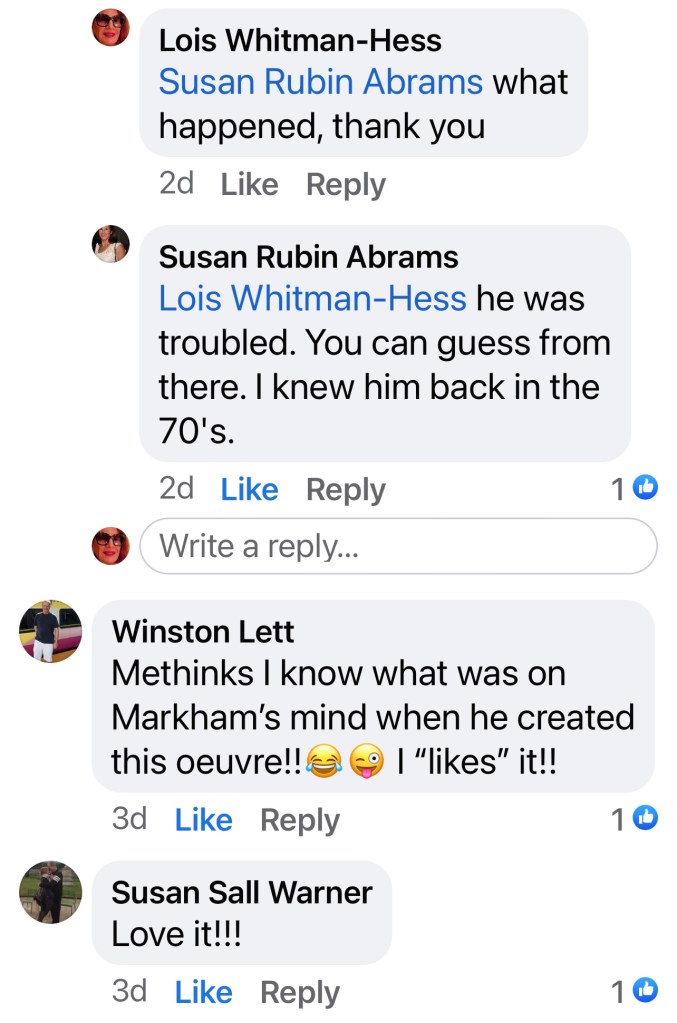
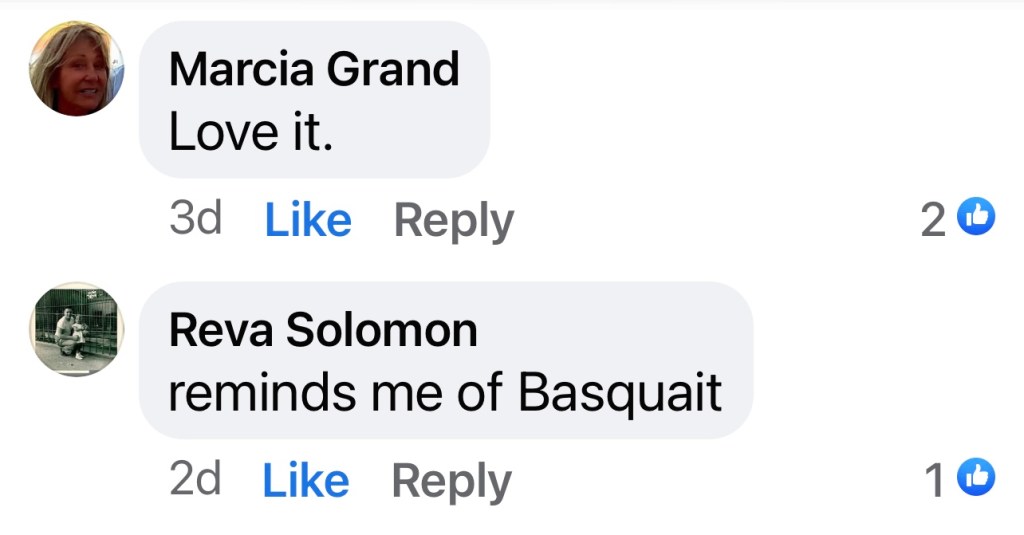
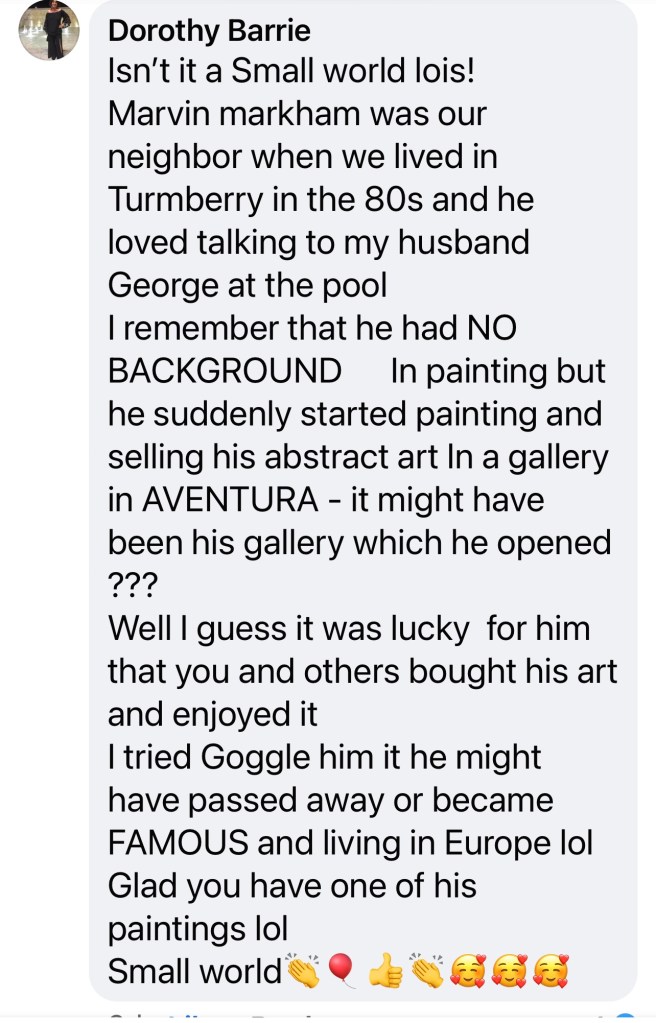
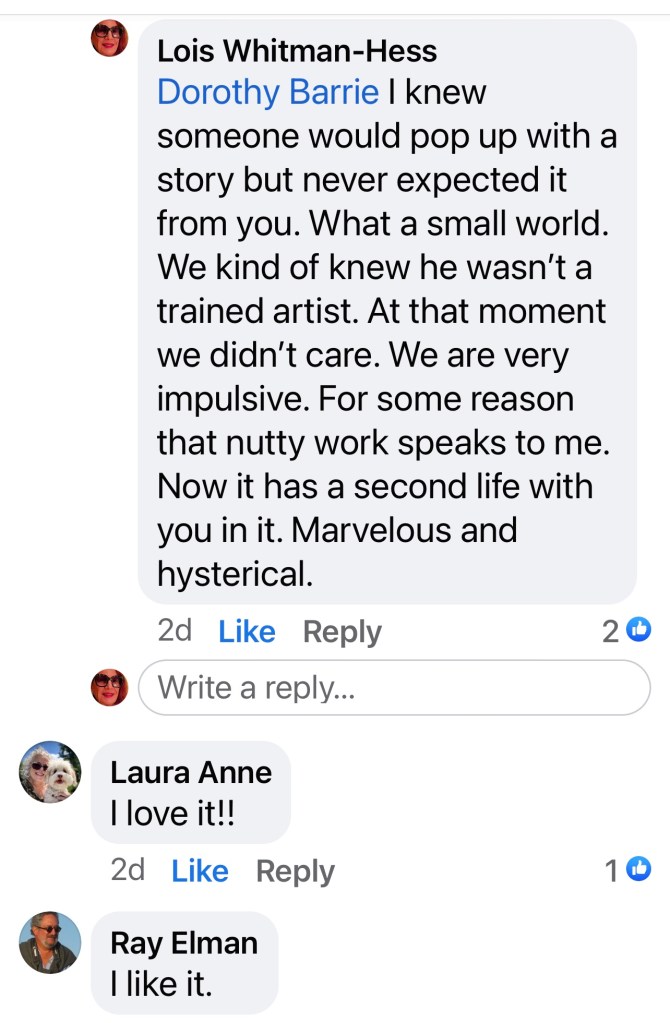
We bought this painting over 20 years ago from an artist in Aventura, Marvin Marham. We found out he recently died. He advertised it in Ocean Drive magazine. It’s insane looking, half amateurish, half daring. That’s why we wanted it.

I posted it a week ago on Facebook to see what others thought of it. I thought everyone would say we had bad taste in art. The response has been just the opposite. We even got offers to buy it. I have posted other art work hoping for sales but never received the kudos like this one. Life is a mystery.

🌺🌺🌺🌺🌺🌺🌺🌺🌺🌺🌺🌺🌺🌺🌺🌺🌺🌺

Our amazing trip to Iceland and Greenland, September 2019 with Rene Alberto Rodriguez Bellucci,Dr. Howard Stark, Marcos Andreos and Greg Walton.

🌺🌺🌺🌺🌺🌺🌺🌺🌺🌺🌺🌺🌺🌺🌺🌺🌺🌺