Jump Start Your Car And Charge Your Smartphone With Same Battery

20140526-001635-995178.jpg

20140526-001634-994814.jpg
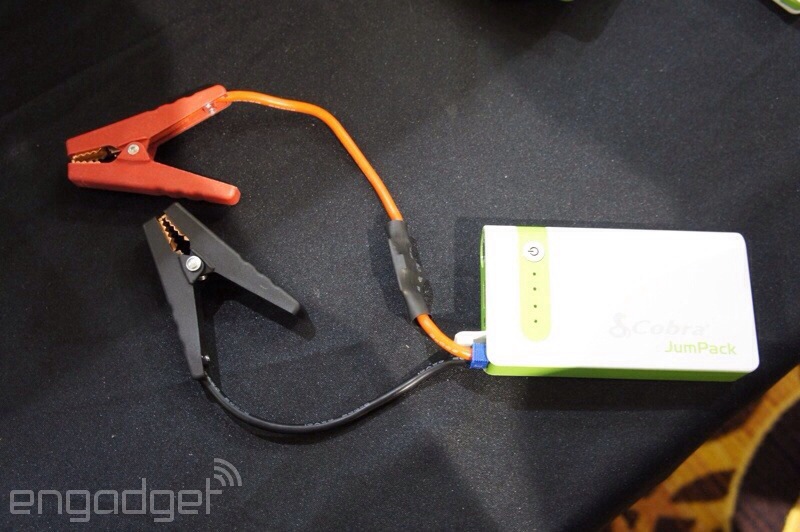
I first heard about this product at CES last January and now it has become a reality. The Cobra JumPack at $129.95 is a battery pack that can jump start your car and charge your smartphone. The best part? It’s small enough to fit in a backpack or purse.

I know there are worse things in life, but not being able to start your car or running out of power during a cell call is pretty frustrating. I truly hate that out-of-control feeling when the power goes out. It feels like you are going to be stuck in neutral forever.

Finally a remedy. One power source that can handle everything. I love it. I have been carrying extra battery chargers for my iPhone for months now. Sometimes I carry two extra batteries for fear that one will fail. Since my office is virtual, I have to make sure I have the power for all emergencies.

The reason why I like the Cobra JumPack so much is because I have had a dead battery in my car more than once. We go for long spells not using our car, so sometimes the battery dies. I think it would be totally awesome to be able to whip out a battery charger to jump start the car. No more looking for battery cables and other cars for a charge. Now, you are totally self-sufficient.

To give you a rough idea of its power capability, the Cobra JumPack has enough juice to jump start most cars multiple times on a single charge.
Cobra said, “The compact portable power pack also contains a 7,500 mAh battery with a 2.1 Amp USB output to rapidly charge any mobile device from smart phones to tablets to digital cameras, making it the ideal emergency battery pack for a home, office, vehicle or the outdoors.

“The Cobra JumPack has a built-in LED flashlight with a strobe and S.O.S function for emergencies. It also includes jumper cables and two different charging methods; a wall charger for home, and a 12V charger to charge your battery pack on-the-go.”

I never realized that one battery charger could handle so many functions. I really hope this new
device lives up to its expectations.


Blind Calls

.

20140525-010746-4066525.jpg
.
OwnFone, a London company, has introduced what they claim is the world’s first Braille mobile phone. It’s so difficult to believe that it has taken until now to develop something like this given how many people in the world are sight challenged. I’m glad there is finally an option for those who can’t see.

The OwnFone is retailing right now in London and will be available in the United States in a few months.

The mobile phones feature 3D printing on the front and the back so that they can be more affordable. 3D printing is much less expensive than other manufacturing options. The phones should sell anywhere from $60 to $80.

The Braille mobile phones can be customized. For example, the company can print raised text on the keyboard for those who can’t read Braille. It can also personalized with two or four Braille buttons which are pre-programmed to call friends, family, carers or the emergency services.

In today’s world everyone should have a cell phone. It’s nice to know that those you care about are just a call away in time of need,

YouTube Continues To Evolve

YouTube is becoming much more user friendly. I always thought it was user friendly, but I guess its owner, Google, is determined to make it even more so. It wants YouTube to become as popular as television.

We already know that well-known personalities plus average people on-the-street have created their own channels with original content. Some of them, including Jerry Seinfeld and Joan Rivers, are getting a lot of notoriety,

Now, YouTube wants to make sure that everyone is completely up-to-date on all of its features. To keep its “creators” (that’s you) better informed, YouTube plans to release regular “Creator Preview” videos that cover all of the changes. Please watch the first video above.

A new Creative Preview app will also allow users to manage features on their mobile devices. That’s great news for people like me. I use my smartphone for everything. I barely touch my laptop or iPad.

The biggest news is that YouTube is going into the Crowdfunding business. Viewers will be allowed to contribute money directly to YouTube creators. That is going to be big competition for Kickstarter and Indiegogo. For example, if I wanted to start a YouTube show called “I love Lois,” I could raise money for the project right on my YouTube page. Everything contained in one spot.

That is pretty amazing. I predict that YouTube is going to change the entire world of entertainment now that it is giving users many more tools to create , get exposure, and attract supporters.

I hope many more people my age take advantage of what YouTube has to offer. Now is the time to finally express yourself.

Working For A Good Cause

For the last week or so, I have been working around the clock to help Direct Relief, a leading worldwide medical relief organization, promote the fact that it received the CECP Directors’ Award for Corporate Humanitarian Collaboration with FedEx.

CECP stands for the Committee Encouraging Corporate Philanthropy. It was founded by the late actor Paul Newman and a group of cooperate executives in 1999. CECP is now a coalition of 150 CEOs that unite to encourage American businesses to be involved in worthwhile causes.

HWH PR’s Jason Henriques and David Nieves, worked tirelessly to help me secure editorial coverage on Bloomberg TV and then Businessweek. Click here to see the results. We were able to reach thousands of members of the media via email, Facebook, Twitter, texting, and phone calls. Thanks guys. I also want to thank Stephen Adler of Charity Brands, for recommending HWH PR to Direct Relief.
20140521-220111-79271281.jpg

20140521-220133-79293810.jpg

20140521-220146-79306151.jpg
Thomas Tighe, President and CEO of Direct Relief.

Here is part of the press release that was issued to mark the occasion.

SANTA BARBARA, Calif., May 20, 2014 – CECP today presented its 2014 Directors’ Award to humanitarian aid organization Direct Relief at the annual CECP Summit in New York City for its collaboration with FedEx to help tens of millions of people in need in the U.S. and around the world access life-saving medicines and supplies.

The Directors’ Award honors an exemplary partnership between a company and a nonprofit in combating a critical societal issue. Of the more than 1.4 million charities in the United States, Direct Relief is the single nonprofit to be recognized with the CECP Directors’ Award in 2014.

Since 1993, Direct Relief and FedEx have worked together, both during emergencies and on an ongoing basis, to equip healthcare providers throughout the U.S. and around the world with critically needed medicines and supplies so that they are able to provide these resources to people who would otherwise be unable to afford or access them.

“FedEx is a force multiplier in Direct Relief’s humanitarian efforts and has brought amazing scale, efficiency, and precision to helping people in poverty or affected by disasters get the critical help they need,” said Thomas Tighe, President and CEO of Direct Relief.

In the U.S. alone, more than 10 million people have received over $400 million in needed medications – all delivered by FedEx. In November 2013, FedEx provided Direct Relief an emergency airlift of medical supplies to care for 250,000 people affected by the typhoon in the Philippines.

“This is a powerful example of the essential, lifesaving activity that simply could not happen without this type of collaboration,” said Tighe of the Philippines airlift. “Although a strong case for a profitable business simply does not exist in every situation where a compelling human case does, businesses insight, tools, and skills are equally applicable to address many of the inherent challenges involved, which are essentially the same.”

Corporate participation in disaster relief efforts has been increasingly important to the business bottom line, as employees and customers look to companies – not just governments or aid organizations – to provide critical relief assistance. Many companies are moved to participate in humanitarian efforts because they have seen the staggering losses inflicted when disasters destroy communities and interrupt the flow of business. Working to alleviate the economic impact of such disruptions makes good sense for society and business.

A Smart Crockpot

I was recently in a meeting with a group of advertising executives when a chief marketing officer (CMO) asked for a time-out so he could adjust his Crock-Pot. I was mystified and fascinated at the same time. What was he talking about?

He whipped out his iPhone, pressed a few buttons, checked his train schedule, pressed a few more buttons, closed his phone, and told us it was okay to proceed with the meeting.

I couldn’t resist asking him after the meeting what took place during the time-out he called for. He told me once again that he was adjusting his Crock-Pot. At first I thought he was saying something obscene to me. Then I realized he was for real.

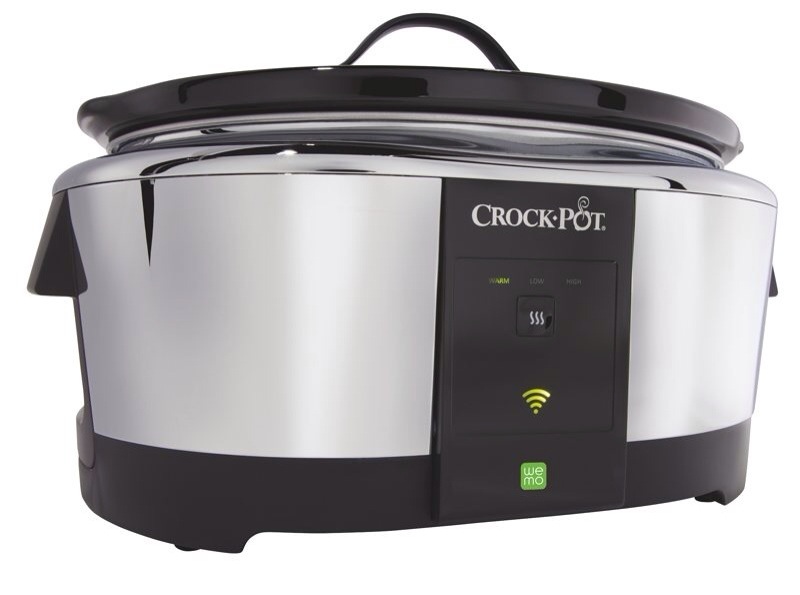
The meeting was running overtime and the CMO wanted to slow down the meal being cooked in his new Crock-Pot® Smart Slow Cooker Enabled by WeMo. This was the first time I ever heard that you can adjust the cooking time on a Crock-Pot from a remote location.

It’s new and it can be done. The Crock-Pot® Smart Slow Cooker Enabled by WeMo now allows you to control the slow cooker settings from your smart phone. The CMO said he often has to shut the Crock-Pot down because of spontaneous client dinners that pop-up.

Since he lives alone in Westchester, he claims he always needs the flexibility of changing the settings on his one-pot cooker. The six-quart pot features one-touch controls and three heat setting options. At $129.99, this also seems like an invaluable tool for seniors as well. Many want the freedom of making decisions last-minute. Here is their chance,

20140521-020456-7496636.jpg

Robots Care For Seniors

Some of us may actually have a virtual nurse taking care of us when we can no longer take care of ourselves. Now that’s something to think about. In some ways I would rather have a robot watch over me rather than a professional aide. I like the idea of being monitored 24/7 via computer software. I don’t like depending on another human being who may have his or her own agenda. I know I’m being paranoid.

I don’t want to worry if the aide is going to show up or be in a bad mood. I want this all to be very clinical. There is always room for family and friends to provide human contact. The robot will give me serenity and independence.

As I write this, I realize that I may change my mind many times before I get to that stage. I recently read about six elderly people in different parts of Europe who have robots taking care of them. It’s part of a new experiment called GiraffPlus, an EU-funded project to use robotics to help older people who want to live alone. The robot is part of a central system that monitors movements and vital signs. Robot sensors also measure weight, blood pressure and blood sugar.

There is a lot more to this experiment that you might like to read about. Click here.

I’m curious if you would like a robot to live with you? Are you thinking about this subject? Please share.

Shoulda, Coulda, Woulda

20140518-235520-86120998.jpg
I have many friends in their 50s, 60s, and 70s who often wonder what their lives would have been like if they tried to execute some of the creative ideas they have had over the years. Many of them claim they didn’t act on their impulses because they were afraid their ideas weren’t good enough. They didn’t understand the concept back then of tweaking a good idea until it became a great one.

Obviously, the Google co-founders didn’t have any of those inhibitions. There were other search engine algorithms already in place when Larry Page and Sergey Brin met at Stanford in 1995. They started Google in 1998 because they felt their algorithm made more sense. It examined “the number and relevance of links between pages, not just the keywords on them.” Business Insider has a good story explaining this.

BI also explain how Page attended a conference given by an Italian science and math professor that changed his thinking about the efficiency of a search engine. In 1997, Massimo Marchiori of the University of Padua, Italy, shared information about a project he was working on called Hyper Search. The program scanned links between web sites, not the text in them.

Long story short, Page latched on to Marchiori after the seminar. He spent the day talking about algorithms, Marchiori remembers Page saying, “Man, I would like to develop your idea further.”

The net net. Page and Brin developed an algorithm that completely changed our lives. I am sure, however, they will have their own set of regrets when they reach our age.

Did you have an idea that ran away? Share it with us.

Email Buddies

Back in the day, when we were teens, I had a number of pen pals. Today, I have email buddies. These are people who I met in person, but kept the relationship alive via frequent emails.

One such couple is Dan and Kathryn Mikesell. They are very serious art collectors who we met during a PAMM, Perez Art Museum of Miami, outing. They created The Fountainhead Studios in 2008, which now provides affordable studio space to over 30 Miami-based artists.

Twice a year the studios open to the public. Here is my pictorial essay.

20140518-013915.jpg
Sandra Ramos and her daughter. She is one of Cuba’s most famous artists. We visited her home and studio in Cuba and finally met her in person.

20140518-014347.jpg

20140518-014518.jpg
Dan and Kathryn Mikesell

20140518-014653.jpg

20140518-014732.jpg

20140518-014808.jpg

20140518-014908.jpg

20140518-014935.jpg

20140518-015001.jpg

20140518-015040.jpg

20140518-015119.jpg

20140518-015151.jpg

20140518-015215.jpg

20140518-015238.jpg

20140518-015324.jpg

20140518-015401.jpg

20140518-015439.jpg

20140518-015538.jpg

One Cuban Blogger Is About To Make History

20140517-024153.jpg

Yoani Sanchez

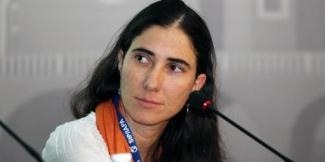
I am beyond excited. I feel like I am truly watching history in the making. Maybe I can be a small part of it real soon. Cuban blogger, Yoani Sanchez, is planning to launch Cuba’s first online digital newspaper next week that will not be government owned and controlled. I only know what I read in newspapers and on the web. Sanchez is very well known in Cuba for a blog called Generation Y. Now she is going to launch 14ymedio which stands for the date she announced the daring new enterprise and because she lives on the 14th floor of an apartment building in Havana.

When I was in Havana last October, I was told never to go too high in an office or apartment building because the infrastructure was so bad. The building might not fall down but the elevators were always out-of-order. There was also a great possibility that if you got stuck in a high rise elevator it could take a very long time to get you out. I made a mental note of it. I found it pretty fascinating that Sanchez lives so high up. Maybe she takes the stairs. Anyone who is going to take on Communism the way she plans to, has to be very strong, One day when I hopefully meet her, I will ask her about living arrangements.

Meanwhile Cuban government officials have already warned members of Sanchez staff that this was not a good idea. Sanchez is determined anyway she can to get this digital newspaper live and active. She believes the Cuban government is in transition and times are changing. The premise is to write stories about Cuban life in every area newspapers in America cover: news, sports, fashion, education, the arts, tech, etc.

Read a more in-depth story about this new endeavor in the Miami Herald.

Later today, I will call my girl friend Carmen Santamarina, who leads legal tours to Cuba every other week, to find out if she can get me an introduction to Sanchez. I want to help this endeavor anyway I can.

20140517-081516.jpg
Carmen Santamarina

A Bike Lock That Talks To You

20140516-005619.jpg

What a surprise. Another product is now connected to your smartphone!!! Wait a minute. This one makes more sense to me than a lot of others who have smartphone apps.

Skylock is a solar-power bike lock that lets you know via a real-time alert if someone is tampering with your bike. This product comes to life if Velo Labs raises $50,000 on its website.

Personally, I hope Velo makes it. I hate it when someone gets their bike stolen. This product will stop thieves and give bike riders piece of mind. The part I love the most about this lock is that it will automatically disengage as you get closer to your bike. Thank you Bluetooth for allowing this to happen. 🎈🎈🎈🎈

The mechanics behind Skylock are really clever. The lock has a sensor that detects motion. Too much motion and you get notified. This also works if you are in an accident. The built-in accelerometer communicates with your iPhone to find out if you have been in an accident. If you don’t respond, the app will alert emergency responders.

The Skylock will retail for $249. You can get it today for $159 during the crowdfunding campaign. Let’s make this happen.