Everything You Wanted To Know About Instagram

This photo was altered by using Instagram

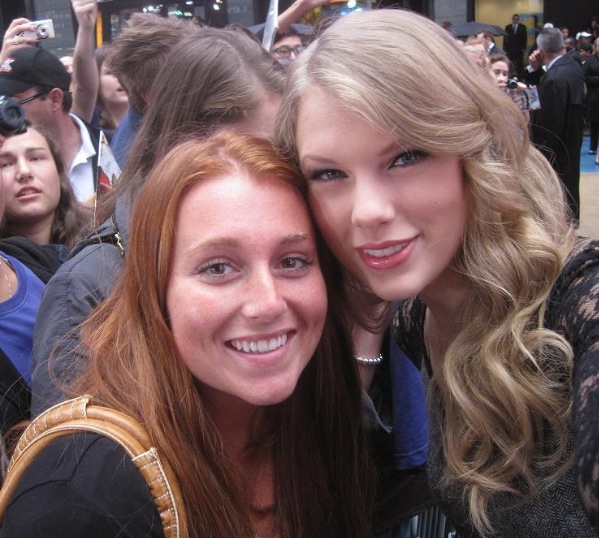
Intern Kiersten Daly with Taylor Swift

This post was written by an intern who works for me because she is an expert on Instagram. So many of you have asked me why Instagram is so popular. Kiersten Daly spells it out. I have included a picture of Kiersten because she got up at 4am this morning to see Taylor Swift in concert on Good Morning America. She was one of hundreds who arrived outside of ABC’s studios waiting to meet the mega star.

By Kiersten Daly

Many of you may be wondering what Instagram is and what is the point of it? Plain and simple, it is a fun and interesting way to vamp up your pictures and share them with friends and family. That is called social media photo-sharing. Instagram is now officially owned by Facebook. With the touch of a few, easily identifiable, buttons on Instagram, you can instantly change the appearance of your picture and post it on the Instagram site for all of your followers, or friends, to see. Followers are the people that are connected with your Instagram site.

Similar to Facebook, you look up family members or friends and request to follow their page so that you can see their profile, pictures, and other information that they choose to share. In return, those people will usually ‘follow’ your page. Followers are a simple way of stating, “I agree to follow what’s going on with your life and I will look at your pictures that you want to share with me.” You can make pictures look older, enhance them, make them different colors, blur out background images that you don’t want in the picture, crop them and much more!

What started out as a simple idea quickly transformed into a system utilized by Facebook, Flickr, Twitter, Android , and of course the iPhone and the iPad. Each system mentioned above has Instagram installed or available for download. By clicking on the Instagram icon or link you can log in and begin to take pictures or load previously taken pictures onto the site and share them with all of your followers. This fun product captures events with snapshots that will make memories last a lifetime. Instagram allows you to take all kinds of pictures and transform them into a more beautiful image than you started with, thanks to the various filters available to change the look of the photo. Capture the Eiffel Tower in France, the Statue of Liberty in New York City, or a day out with your grandchildren, and have a unique picture to last a lifetime.

Users have the option to ‘hashtag’ photos as well. This universal popular symbol, #, attaches itself to a word or phrase to categorize similar topics on a subject together so that it can be easily searched. This gives other users the ability to know what the photo is about or where the photo was taken. For instance, if a person were to hashtag one of their photos #NYC, than when you search that topic, their picture will appear. It makes things easier when trying to group pictures together under a specific topic. Yet, if you don’t want people other than your friends and family to be able to view your pictures, you can make your Instagram profile private. People will have to ask permission to follow your photos and those without permission cannot see anything on your profile.

The pictures can also be easily uploaded to your computer to print out and hang up or store until a later time. Using the explore option; you can look up family members and friends to follow their page when they share photos as well. You can also look up a specific topic or theme. By typing in the topic you are interested in, numerous pictures come up that relate to your topic. You can enjoy other users pictures of places you may want to see, ideas you may be interested in for yourself, and even inspirational sayings to help you through a difficult day. Once you start, you’ll never want to stop.

Facebook Has Become A Political War Zone

20121017-230954.jpg

If you are not a Facebook user, wait until after the Presidential election is over to become a member. That is if you are considering it. The social media site has turned into a soap box for vicious, political grandstanding.

One gal I know named Marcia is using her news feed as a whipping stick for every crappy thing that has ever happened to her. Her remarks about the current administration are so slanderous that I wonder where she plans to live if her team doesn’t make it.

Then there is Frank, the ultimate liberal, who keeps talking to Romney as if he is standing in the room with him. He reminds me of Robert De Niro from the movie “Taxi Driver.” “Are you talking to me, Mitt? Are you talking to me?”

Formerly “so-called” nice people have transformed themselves into hostile, hot heads, who will say anything that comes to mind, just to be heard. Everyone is out of control.

There is no limit to what folks will say and do on Facebook. The one that unnerved me the most recently was one from an executive from the Consumer Electronics Show. He placed a poster of the two leads from the TV series “Fantasy Island” on his page, but replaced the heads with Obama and Biden.

I thought it was totally inappropriate for an association person to take political sides. I publicly scolded him. He then sent me a private message. “Lois, I’ve always liked you, but if you have an issue with me, I would appreciate a one-on-one conversation. This is my personal page and has nothing to do with CES.”

All of a sudden I was the bad guy. I never answered him because I felt he was out of line and apparently he knew it. The poster was deleted.

See what USA Today has to say on this subject. Click here.

A Gay Facebook Debacle

The Wall Street Journal did an article a few days ago about privacy on Facebook. A couple of gay people complained that they were “outed” on Facebook because friends inadvertently exposed their sexuality. They were keeping their sexual orientation a secret from immediate family members for personal reasons.

I posted the Wall Street Journal story below because unless you are a paid subscriber you can’t access it. It is important that you read it so you understand that we are living in an age where Big Brother is watching you. There is no such thing as “I shouldn’t have to think about every move I make” or “There should be a law that doesn’t allow……”

If you continue to believe that there is a way around the new technologies in place that track your every move, you too will fall victim. It happened to me three years ago this December and there isn’t a day that goes by that I don’t think of the blemish that will live with me forever. Do not make the mistake to think that just because you are not on a social media platform or don’t have a smartphone you are not being watched. Every street has a video recorder and every credit card company is tracking your existence.

I feel very sorry for the Facebook users who tried to hide their sexual identity. However, you can’t join a group named the Queer Chorus and not expect someone to identify you as one of their members. It was bound to happen, on or off a social network. This reminds me of cheating spouses who are more upset about getting caught then the act of cheating.

If you have something to hide, hide it. Don’t blame Facebook. Take responsibility for your own actions. For those who use Facebook’s privacy tools, let me remind you that there are no guarantees that the technology works all the time. Your TV breaks, your car breaks down, and Facebook has its “shit happens” issues.

I asked a few gay friends to review my thoughts. They were in complete agreement. They said this is not the fault of Facebook. “There is no such thing as privacy when it comes to technology. Trust no one.”

Here is the Wall Street Journal story:

AUSTIN, Texas—Bobbi Duncan desperately wanted her father not to know she is lesbian. Facebook told him anyway.

One evening last fall, the president of the Queer Chorus, a choir group she had recently joined, inadvertently exposed Ms. Duncan’s sexuality to her nearly 200 Facebook friends, including her father, by adding her to a Facebook Inc. discussion group. That night, Ms. Duncan’s father left vitriolic messages on her phone, demanding she renounce same-sex relationships, she says, and threatening to sever family ties.

The 22-year-old cried all night on a friend’s couch. “I felt like someone had hit me in the stomach with a bat,” she says.

Then she learned that another choir member, Taylor McCormick, had been outed the very same way, upsetting his world as well.

The president of the chorus, a student organization at the University of Texas campus here, had added Ms. Duncan and Mr. McCormick to the choir’s Facebook group. The president didn’t know the software would automatically tell their Facebook friends that they were now members of the chorus.

The two students were casualties of a privacy loophole on Facebook—the fact that anyone can be added to a group by a friend without their approval. As a result, the two lost control over their secrets, even though both were sophisticated users who had attempted to use Facebook’s privacy settings to shield some of their activities from their parents. “Our hearts go out to these young people,” says Facebook spokesman Andrew Noyes. “Their unfortunate experience reminds us that we must continue our work to empower and educate users about our robust privacy controls.”

In the era of social networks like Facebook and Google Inc.’s Google+, companies that catalog people’s activities for a profit routinely share, store and broadcast everyday details of people’s lives. This creates a challenge for individuals navigating the personal-data economy: how to keep anything private in an era when it is difficult to predict where your information will end up.

Many people have been stung by accidentally revealing secrets online that were easier kept in the past. In Quebec, Canada, in 2009, Nathalie Blanchard lost her disability-insurance benefits for depression after she posted photos on Facebook showing her having fun at the beach and at a nightclub with male exotic dancers. After seeing the photos, her insurer, Manulife Financial, hired a private investigator and asked a doctor to re-evaluate her diagnosis, according to Ms. Blanchard’s lawyer.

Ms. Blanchard didn’t realize her photos were visible to the public, according to the lawyer, who added that depressed people often try to disguise their illness to family and friends. Ms. Blanchard sued to have her benefits reinstated. The matter was settled out of court.

A Manulife spokeswoman declined to discuss the case, saying “we would not deny or terminate a valid claim solely based on information published on websites such as Facebook.” Losing control online is more than a technology problem—it’s a sociological turning point. For much of human history, personal information spread slowly, person-to-person if at all.

The Facebook era, however, makes it possible to disclose private matters to wide populations, intentionally or not. Personal worlds that previously could be partitioned—work, family, friendships, matters of sexuality—become harder to keep apart. One solution, staying off Facebook, has become harder to do as it reaches a billion people around the world.

Facebook is committed to the principle of one identity for its users. It has shut down accounts of people who use pseudonyms and multiple accounts, including those of dissidents and protesters in China and Egypt. The company says its commitment to “real names” makes the site safer for users. It is also at the core of the service they sell to advertisers, namely, access to the real you

Closeted gays and lesbians face particular challenges in controlling their images online, given that friends, family and enemies have the ability to expose them.

In Austin, Ms. Duncan and Mr. McCormick, 21, deliberately tried to stay in the closet with their parents, even as they stepped out on campus. Ms. Duncan’s parents home-schooled her and raised her in Newton, N.C., where the family attended a fundamentalist church. Now a linguistics student, she told her best friend in the summer of 2011 that she might be gay.

As she struggled with her sexuality, she adjusted her Facebook privacy settings to hide any hint of it from her father, whom she had helped sign up for Facebook. “Once I had my Facebook settings set, I knew—or thought I knew—there wasn’t any problem,” she says.
Mr. McCormick, studying to become a pharmacist, came out in July 2011 to his mother in his hometown of Blanco, Texas, but not to his father, whom Mr. McCormick describes as a member of a conservative church that teaches homosexuality is sin.

He set Facebook controls for what he calls a “privacy lockdown” on posts that his father, in San Antonio, could see. “We have the one big secret when we’re young,” he says. “I knew not everyone was going to be accepting.”

UT Austin was more accepting. As many university campuses have for years, it offered a safe space for young people to come out without parents knowing. Last fall, Ms. Duncan and Mr. McCormick attended the first rehearsal for the Queer Chorus, a group for gay, lesbian and transgender students and their allies.

“This is a great place to find yourself as a queer person,” says the chorus’s then-president, Christopher Acosta. The group is known for renditions of pop songs in which it sometimes changes the gender of pronouns. Ms. Duncan agreed to play piano and sing alto. Mr. McCormick, who has a slight frame, surprised the chorus with his deep bass.

At the rehearsal, on Sept. 8, Mr. Acosta asked if any members weren’t on the chorus’s Facebook group, where rehearsals would be planned. Mr. McCormick and Ms. Duncan said they weren’t.

When Joining a ‘Group’ Reveals Too Much

How Facebook Shares Users’ Memberships With Their Friends Online Someone creates a ‘group’ on Facebook around a shared interest or activity. If the group’s creator sets it to be ‘open,’ other Facebook users can see its activities. The creator has the ability to add his or her Facebook friends to the group.

Getting added generates a notice that can appear on their friends’ Facebook pages—alerting others to their membership. People added to a group this way have the option to leave, but are first added by default.

That night, Mr. Acosta turned on his MacBook Pro and added the two new members to the chorus Facebook group. Facebook, then and now, offers three options for this sort of group: “secret” (membership and discussions hidden to nonmembers), “closed” (anybody can see the group and its members, but only members see posts), and “open” (membership and content both public).

Mr. Acosta had chosen open. “I was so gung-ho about the chorus being unashamedly loud and proud,” he says. But there was a trade-off he says he didn’t know about. When he added Ms. Duncan, which didn’t require her prior online consent, Facebook posted a note to her all friends, including her father, telling them that she had joined the Queer Chorus. When Mr. Acosta pushed the button, Facebook allowed him to override the intent of the individual privacy settings Ms. Duncan and Mr. McCormick had used to hide posts from their fathers. Facebook’s online help center explains that open groups, as well as closed groups, are visible to the public and will publish notification to users’ friends. But Facebook doesn’t allow users to approve before a friend adds them to a group, or to hide their addition from friends.

After being contacted by The Wall Street Journal, Facebook adjusted the language in its online Help Center to explain situations, like the one that arose with Queer Chorus, in which friends can see that people have joined groups. Facebook also added a link to this new explanation directly from the screen where users create groups. “I was figuring out the rules by trial and error,” says Mr. Acosta.

A few hours later, Ms. Duncan’s father began leaving her angry voice mails, according to Ms. Duncan and a friend who was present.
“I remember I was miserable and said, Facebook decided to tell my dad that I was gay.” Bobbi Duncan “No no no no no no no,” Ms. Duncan recalls telling a friend. “I have him hidden from my updates, but he saw this,” she said. “He saw it.”

Ms. Duncan’s father didn’t respond to requests for comment for this article.

Her father called repeatedly that night, she says, and when they spoke, he threatened to stop paying her car insurance. He told her to go on Facebook and renounce the chorus and gay lifestyles.

On his Facebook page, he wrote two days later: “To all you queers. Go back to your holes and wait for GOD,” according to text provided by Ms. Duncan. “Hell awaits you pervert. Good luck singing there.” Ms. Duncan says she fell into depression for weeks. “I couldn’t function,” she says. “I would be in class and not hear a word anyone was saying.”

Mr. McCormick’s mother phoned him the night his name joined the Queer Chorus group. “She said, ‘S—has hit the fan…Your dad has found out.’ I asked how,” Mr. McCormick recalled, “and she said it was all over Facebook.” His father didn’t talk to his son for three weeks, the younger Mr. McCormick says. “He just dropped off the face of my earth.”

Mr. McCormick’s father declined to participate in this article. Privacy critics including the American Civil Liberties Union say Facebook has slowly shifted the defaults on its software to reveal more information about people to the public and to Facebook’s corporate partners.

“Users are often unaware of the extent to which their information is available,” says Chris Conley, technology and civil-liberties attorney at the ACLU of Northern California. “And if sensitive info is released, it is often impossible to put the cat back in the bag.”
Facebook executives say that they have added increasingly more privacy controls, because that encourages people to share. “It is all about making it easier to share with exactly who you want and never be surprised about who sees something,” said Chris Cox, Facebook’s vice president of product, in an interview in August 2011 as the site unveiled new privacy controls. Facebook declined to make Mr. Cox available for this article.

Still, privacy advocates say control loopholes remain where friends can disclose information about other users. Facebook users, for example, can’t take down photos of them posted by others. Enlarge Image [Not sure how this cut-&-paste will appear on the blog, but if it will be this version, you may want to delete this line. Also add paragraph breaks above.]

A greater concern, they say, is that many people don’t know how to use Facebook’s privacy controls. A survey conducted in the spring of 2011 for the Pew Research Center found that U.S. social-network users were becoming more active in controlling their online identities by taking steps like deleting comments posted by others. Still, about half reported some difficulty in managing privacy controls.

This past September, the National Football League pulled referee Brian Stropolo from a game between the New Orleans Saints and the Carolina Panthers after ESPN found a photo of Mr. Stropolo wearing a Saints jacket and cap that he had posted on Facebook.

It remains unclear whether the photo was intended to be public or private.

An NFL spokesman said, “I don’t believe you will see him back on the field.” The NFL declined to make Mr. Stropolo available.

Privacy researchers say that increasing privacy settings may actually produce what they call an “illusion of control” for social-network users. In a series of experiments in 2010, Carnegie Mellon University Associate Professor Alessandro Acquisti found that offering people more privacy settings generated “some form of overconfidence that, paradoxically, makes people overshare more,” he says.

Allison Palmer, vice president of campaigns and programs at the Gay and Lesbian Alliance Against Defamation, says her organization is helping Facebook to develop resources for gay users to help them understand how best to maintain safety and privacy on the site.

“Facebook is one of the few tech companies to make this a priority,” she says.

Mr. Acosta, the choir president, says he should have been sensitive to the risk of online outings. His parents learned he was gay when, in high school, he sent an email saying so that accidentally landed in his father’s in-box.

Today, he says, his parents accept his sexuality. So before creating his Facebook group, he didn’t think about the likelihood of less-accepting parents on Facebook.

“I didn’t put myself in that mind-set,” he says. “I do take some responsibility.”

Some young gay people do, in fact, choose Facebook as a forum for their official comings-out, when they change their Facebook settings to publicly say, “Interested In: Men” or “Interested In: Women.” For many young Americans, sexuality can be confidential but no longer a shameful subject. Sites like Facebook give them an opportunity to claim their sexuality and find community.

For gays, social media “offers both resources and risks,” says C.J. Pascoe, a Colorado College sociology professor who studies the role of new media in teen sexuality. “In a physical space, you can be in charge of the audiences around you. But in an online space, you have to be prepared for the reality that, at any given moment, they could converge without your control.”

Facebook founder Mark Zuckerberg has long posited that the capability to share information will change how we groom our identities. “The days of you having a different image for your work friends or co-workers and for the other people you know are probably coming to an end pretty quickly,” he said in an interview for David Kirkpatrick’s 2010 book, “The Facebook Effect.” Facebook users have “one identity,” he said. Facebook declined to make Mr. Zuckerberg available.

Days after their outings, Ms. Duncan and Mr. McCormick met at the campus gender-and-sexuality center, which provides counseling. On a couch, they swapped tales. “I remember I was miserable and said, ‘Facebook decided to tell my dad that I was gay,’ ” she says. “He looked at me and said, ‘Oh really, you too?'”

Mr. McCormick’s mother, Monica McCormick, meanwhile, was worried how the Facebook disclosure might affect her business selling insurance. “Every kid in this town now knows,” she says. “I am sure that I have lost clients, but they are not going to tell you why. That is living in a small town.”

Mr. McCormick and his father eventually talked about his sexuality over an awkward lunch at a burger joint and haven’t discussed it much since. But Mr. McCormick feels more open and proud about his sexuality. He changed his Facebook profile to “Interested In: Men.”

After Ms. Duncan’s Sept. 8 outing, she went through long periods of not speaking with her father. For a while, Ms. Duncan’s mother moved into her daughter’s apartment with her. “I wanted to be with her,” says her mother, who is also named Bobbi. “This was something that I thought her father had crossed the line over, and I could not agree with him.”

Speaking of Mr. Duncan, she says: “The big deal for him was that it was posted and that all his friends and all his family saw it.”

The younger Ms. Duncan says she tried to build bridges with her father around the year-end holidays. But the arguments persisted.

“I finally realized I don’t need this problem in my life anymore,” she says. “I don’t think he is evil, he is just incredibly misguided.”

She stopped returning her dad’s calls in May.

She and Mr. McCormick remain in the chorus. Mr. Acosta changed the Facebook group to “secret” and the chorus established online-privacy guidelines. Today, Ms. Duncan has her first girlfriend. “I am in a really good place,” she says, but wouldn’t want anybody to have her experience. “I blame Facebook,” she says. “It shouldn’t be somebody else’s choice what people see of me.”


Jerry Seinfeld’s Take On Twitter And Facebook

The following appeared in People Magazine’s app for smartphones. I had to cut and paste the copy for you to read.

Jerry Seinfeld’s long-awaited return to stand-up saw him tackle Twitter and Facebook at the same time Mark Zuckerberg’s site was boasting it has 1 billion users. The former NBC star told the Beacon Theater crowd in New York City recently: “Facebook is one of the great trash receptacles of human time. Of course when you are young and dumb you think people are great . . . When you are 50, your first thought is the fewer people you have anything to do with, the better.

“Then there’s lawyers and Mace and cease-and-desist letters.” On the topic of Twitter, the comic espoused, “Why say a lot of things to everybody when I can say absolutely nothing to anybody? . . . Twitter of course was based on a bird, the logo is a bird and the bird was first to tweet. Why should they be the only ones dropping a series of small daily turds on the world — we can do it, too! A turd in 140 characters or less.”

Asked during an audience Q&A about his favorite “Seinfeld” episodes, he admitted, “Like you, I can’t really at this point remember which stories go with which episodes. But . . . I remember when George [Jason Alexander] accidentally poisoned his fiancée, when he hit the golf ball into the blow hole of the whale and the time I got to steal the rye bread from the old lady.”

We’re told Jerry didn’t have an after-party following the show, but instead went home six blocks away to be with his family.

A Facebook Experience

Larry Hymes and Ben Stiller–Larry’s Facebook photo

I wrote a blog post months ago about a guy who I always see around New York City but never say hello to because he claims he doesn’t know me. His name is Larry Hymes and he lives in Los Angeles but travels to Manhattan frequently. He used to live near Queens College and I lived in Hilltop Village in Hollis, Queens, maybe five miles apart. I knew him for almost two years, 16 to 18 years old. He was at my Sweet 16 Party the night John F. Kennedy was killed. We were friends (no sweetheart crush) and saw each other once a week and spoke on the telephone to each other practically every night.

Larry was very good looking, the perfect example of tall, dark and handsome. He wasn’t a scholar and neither was I. We were a perfect friend match. Larry dated a few of my girlfriends, but no long term relationships. I don’t remember what happened but we lost touch.

About seven years ago, just after my mother died, I couldn’t sleep and I started searching the Internet for lost friends. This was way before Facebook and LinkedIn. Larry was one of many I was searching out. Somehow, someway, I found him on the Internet because he had a career in men’s clothing and there were a lot of pictures of him.

I researched his email and sent him a message. “Larry, surprise. This is Lois. Wow, I can’t believe I found you. Long time. How are you?” That was all I said. A few days later, I get an email back. “You sound familiar. Tell me something about you.”

I was shocked. “Tell you something about me? Are you crazy?” are the words I told myself. I know a lot of years have passed but how can you be friendly with someone for two years, go to the gal’s Sweet 16, and not remember her? He spent more time talking to me than most other people in his life.

Since we reconnected, every once in a while we send Facebook messages to each other but nothing serious. A” Happy Birthday” and a “Like” for a comment. Larry is a Facebook friend now but he still doesn’t remember me from way back when. The really weird thing is how I keep seeing him all over the city. The first time I spotted him was on 58th and Sixth. He was walking west. I was in a taxi and I was flabbergasted. I passed him right by. This happens two or three times a year for the last seven years. One time Eliot was driving our car right near our office and he quickly turned the corner (something Eliot is infamous for) and almost knocked a guy over. When I looked out the passenger window to see if the guy was all right, it was Larry. I just slid down in the seat.

About three years ago, Larry started showing up in the same restaurants I frequented. At first I would duck and then I realized he said he didn’t know me so I stopped doing that. A few months ago, I had his name on Four Square, a location-based app that tells you where people are located at a particular time. When I “checked in” with Four Square I saw he was at the same restaurant as me. I looked around the room and spotted Larry. I went over to the table on purpose to ask him and his friend if they knew the time. They answered politely. I stood there long enough to see if Larry recognized me. Nothing.

When I told Eliot and my girlfriend Ruth about the encounter, I got accused of exaggerating. I am not stalking Larry, but it’s very funny that I bump in to him more than most people I know.

Last night, Eliot and I went to a Broadway Show, Chaplin. We were waiting for the show to start and I once again saw Larry. I said to Eliot, “There’s Larry.” Eliot said that was not him. Eliot said it didn’t look at all like the pictures I showed him. “Eliot, that is him,” I insisted. Eliot quipped, “Sorry, different nose.” I kept insisting that it was him but then the show started.

At intermission, Eliot and I stayed in our seats but Larry walked by. I didn’t yell out his name but after the show Eliot and I looked for him. He must have rushed out. Once again, Eliot said it wasn’t him. So late last night I sent Larry a Facebook message:

Lois: Are you in NY right now ? Thought I saw you
Like • • 15 hours ago •

Larry Hymes: Yes, where did you see me? Why didn’t you say hello? I am going back to L.A. Today.
8 hours ago via mobile • Like
o
Lois: At Chaplin, the broadway show. Were you there?
7 hours ago via mobile • Like
o
Larry Hymes Yes I was.
3 hours ago via mobile • Like

The saga continues.

Politics On Social Media

USA Today ran a story the other day that said if you want to run for the President of the United States you better be on social media. Most politicians are making their important political announcements on Facebook and Twitter before traditional media.

Since many of you are not on Facebook and Twitter, I decided to bring Facebook and Twitter to you.

I did a little research and found a list of politicans who frequently use Facebook and Twitter. Don’t ask me why Paul Ryan is listed twice. I don’t make the lists but let me explain the numbers.

F—Facebook fans
If there is no F, that means the person is not on Facebook
+—the followers on Twitter today
T—the total number of followers on Twitter
Last number is the total reach on Facebook and Twitter

After you view the list of the 20 people I found, be sure to see recent political tweets from Romney and Obama.

#1
Barack Obama
F 27,754,142
+ 24,490 Today
T 18,484,176
46,238,318

#2
Paul Ryan VP
F 369,993
+ 7,980 Today
T 80,432
450,425

#3
Mitt Romney
F 4,052,321
+ 5,757 Today
T 837,031
4,889,352

#4
Paul Ryan
F 189,663
+ 183,640
373,303

#5
Arnold Schwarzenegger
Politician
F 2,104,636
+ 2,516 Today
T 2,552,903
4,657,539

#6
UK Prime Minister
+ 1,981 Today
T 2,061,265
2,061,265

#7
Hugo Chavez
+ 1,916 Today
T 3,305,268
3,305,268

#8
Queen Rania Al Abdullah
F 1,067,437
+ 1,424 Today
T 2,241,002
3,308,439

#9
Shashi Tharoor
+ 1,092 Today
T 1,443,084
1,443,084

#10
Nelson Mandela
+ 885 Today
T 212,435
212,435

#11
The British Monarchy
F 580,233
+ 529 Today
T 375,789
956,022

#12
Sarah Palin
F 3,464,345
+ 513 Today
T 816,346
4,280,691

#13
Al Gore
F 81,158
+ 370 Today
T 2,475,254
2,556,412

#14
Cory Booker
F 97,629
+ 284 Today
T 1,177,710
1,275,339

#15
Nicolas Sarkozy
F 772,171
+ 243 Today
T 285,571
1,057,742

#16
Kevin Rudd
F 70,657
+ 235 Today
T 1,140,498
1,211,155

#17
Newt Gingrich
F 293,848
+ 234 Today
T 1,466,114
1,759,962

#18
Gabrielle Giffords
F 146,714
+ 217 Today
T 93,499
240,213

#19
John McCain
F 882,719
+ 193 Today
T 1,739,489
2,622,208

#20
Sarah Brown
+ 188 Today
T 1,199,265
1,199,265

If there is an ‘h” sign in front of Obama or Romney’s name that means the comment was posted today and how many hours ago.
The date means which day the post was tweeted.

Mitt Romney

1h Mitt Romney‏@MittRomney
If your priority is creating more jobs and putting more people to work, that’s what we know how to do. #RomneyRyan2012

11h Mitt Romney‏@MittRomney
Higher unemployment, declining incomes, and crushing debt is not a new normal. America needs a comeback http://mi.tt/R4leel

11 Aug Mitt Romney‏@MittRomney
RT @PaulRyanVP Join America’s Comeback Team tomorrow in Waukesha, WI. Doors open at 4pm, RSVP and get tickets here http://mi.tt/P1ltEb

11 Aug Mitt Romney‏@MittRomney
On the deck of the USS Wisconsin with @PaulRyanVP. Excited to share our vision of a brighter future http://mi.tt/P8Unsk #RomneyRyan2012

11 Aug Mitt Romney‏@MittRomney
I am proud to announce @PaulRyanVP as my VP. Stand with us today. http://mi.tt/Romney-Ryan #RomneyRyan2012

10 Aug Mitt Romney‏@MittRomney
.@BarackObama can’t run on his record. America deserves better than a president who will do anything to stay in power http://mi.tt/MI1B4q

Barack Obama

2h Barack Obama‏@BarackObama
President Obama’s response to the drought affecting the U.S. is all hands on deck: http://OFA.BO/N2BGGb

3h Barack Obama‏@BarackObama
FACT: Paul Ryan endorsed a bill that would ban several common forms of birth control, including certain birth control pills.

4h Barack Obama‏@BarackObama
Make sure the women in your life know: Paul Ryan supports banning all abortions, even in cases of rape or incest.

4h Barack Obama‏@BarackObama
FACT: Paul Ryan would turn Medicare into a voucher program, forcing seniors to pay up to $6,350 a year more in health care costs.

5h Barack Obama‏@BarackObama
FACT: Paul Ryan supports writing discrimination into the Constitution with an amendment banning gay marriage.

6h Barack Obama‏@BarackObama
FACT: Paul Ryan voted against repealing the discriminatory policy of “Don’t Ask, Don’t Tell.”

A Do-It-Yourself Digital Funeral


I grew up believing that you judged a person’s life by the size of his or her funeral. I remember when I was 13, there were over 25 cars in the procession at my grandfather Jake’s funeral. When we were sitting Shiva someone said, “That was a really good funeral. A lot of people showed up.” I felt so proud. Over the years I have been to small and large funerals. I snickered at the small ones thinking. “The guy was no good.” I also remember counting the ‘get well” cards in the hospital room when my mother was sick. We would make a list of the do-gooders. Those who did not send one were carefully recorded as “shitheads” and were no longer considered part of the inner circle.

That was 44 years ago. A lot has changed since then. When my mother was 58 and my father died, she started to realize that her favorite and most important sport, “people collecting” was not all that important. The same woman who was the centerpiece of my old neighborhood, now only wanted to be with her closest girlfriends. That threw me for a loop because I was a second generation “people collector.” Sometime after that, I started to feel the same way as my mother. When she died (pieces of me died too) a tough skin formed around me as my brother and I opted for a grave side ceremony for a limited group. I felt I had grown up and didn’t need a lot of people getting in my way when all I wanted to do was think about the loss of my mother.

That was my attitude for the last seven years until today. We attended a funeral for my friend’s father. It was at Riverside Chapel on the upper west side and there had to be over 1000 people in attendance. It was in the main Chapel and no less than a dozen people got up to speak. The running time was over an hour. The accolades were plenty. Judging by the speeches of his four adult children, their spouses, the nine grandchildren, his law buddies and community leaders, my friend’s father deserved a standing ovation. They said everything he did was surrounded by a meal. When he was diagnosed with pancreatic cancer six months ago, he said he was in the mood for “Chinese.”

I panicked sitting in the Chapel. Maybe I wanted a big crowd so others could see I wasn’t really a “bitch.” Reality set in very quick. I am a “bitch.” I worked hard at being a “bitch.” The years of dealing in the fast lane trains you to be a “bitch” or get “bitched” at. I am not saying that there is not a soft, giving side to me, but day- to-day I err on the side of bitchiness.

The big question is how am I going to be a draw when I am dead? I thought a lot about it today, then moved on to something else when I got back to the office. About an hour ago I was on Twitter when I spotted a tweet from my girlfriend last Friday announcing her father’s death. It was less than 140 characters and it simply announced his death and the funeral arrangements. I then saw the same post on Facebook and Linkedin. My girlfriend is well known in the digital community and one post from her was instantly recognized by hundreds, if not thousands of people. I am not going to ask her, but she probably did a few email blasts, text messaging and other social media call outs.

When I thought about it, I had received my notification by email. There is no question that my friend’s father deserved the attendance of every single person in that room. But for us late bloomers who are not so revered, we can put together a social media/marketing plan that can really pull in those numbers. I have to get more followers on Twitter, more fans on Facebook and more connections on Linkedin. Maybe, I can go after friends of friends and relatives of relatives. I can also join meetups, online book clubs, and take senior courses online. That could easily add another 100 or so. As you can see, I have a lot of work to do. If that is not a good reason to live a lot longer, tell me what is?

What’s The Story With Instagram?

I don’t know about you, but I do not have any artistic talent. I can’t draw, paint, or sculpt. I always wanted to, but just don’t have the skills to create something that would be worthy of showing in public until now.

Along comes Instagram, a free photo sharing application for both iPhone and Android, which allows you to apply a digital filter to your mobile pictures that changes the entire look of the composition.

You can now create photos that just two years ago you could only do using expensive digital photo editing software, such as Adobe Photoshop.

Yesterday, I discussed how my cousin Milo changed the look of his photos with a new filter being offered by Olympus on their digital cameras. When I saw what he was doing, I quickly dug out my two year old digital camera — the Panasonic Lumix — to see if I could do the same thing. I abandoned my camera over a year ago when I found myself using the iPhone for most of my photo needs. As I quickly found out, since most of these filter features are so new, my two year old digital camera was now outdated.

Once again, a smartphone app comes to the rescue. There are many apps being offered today on iOS and Android formats that allow you to creatively alter photographs. One of the most popular apps is Instagram.  Instagram became widely popular because it offered the amateur picture taker the opportunity to alter photos in a number of different ways and instantly exhibit them on Twitter and Facebook. While Instagram photos can’t compete with the shots cousin Milo takes with his Olympus camera, it certainly is perfect for the average smartphone user who wants to get creative.

I guess that is why Facebook paid $1 Billion to purchase Instagram this past April.

Click on Instagram (shaded) above for some amazing facts about the company.

Straight shot taken by David Nieves

With Instagram’s Amaro Filter

Straight shot by David Nieves

With Instagram’s X Pro Filter

Fixing Facebook Typos

I had to share this with you. So many people have asked me about this.

GADGETWISE BLOG: Q&A: Fixing Typos in Facebook Comments

A new Facebook feature lets you correct mistakes in your posted comments.

Please cut and paste the URL to get to the story.

Mr. iPad

You never know who you are going to meet when you sign up for a Smartours trip. Even though I am traveling throughout Croatia, Slovenia and Montenegro with my husband and friends, I was still a little concerned about the 25 others joining us.

When I first met Jan Gronski on this trip, he reminded me of a deep sea fisherman with his stocking cap and a flannel looking shirt. Boy was I wrong. He turned out to be a retired executive from Cisco who was in charge of product development in China for many years. Yes he lived there and has a stunning Chinese wife who is on this trip as well.

Jan carries an iPad with him everywhere. I have never seen anything like it. While others use digital cameras or iPhones to shoot photos on the trip, Jan uses his iPad. He said he is able to frame the picture better and capture all of the details. Jan admits that an iPad is heavy and cumbersome for walking tours, but the quality of pictures just can’t be beat. He doesn’t understand how everyone else can shoot photos through little view finders. After you see Jan’s photos you begin to think the iPad is the way to go.

Jan also uses his iPad to read Kindle books on the bus rides from city to city, and in the hotel lobbies late in the evening. He is upset with Apple and Amazon, owner of Kindle, because you can’t buy ebooks through the app. You must always purchase via the web.

The iPad is very important to Jan because of an iOS application called NCIKU that allows him to access a Chinese dictionary. He checks on Chinese characters that help him express what he is trying to say. When I see him using the program it looks like he is drawing stick figures but he is actually practicing the alphabet.

Jan posts most if his photos on Facebook. He lives down the street from the HQ in Palo Alto, CA and his daughter works there as well. She is one of many responsible for more people to respond to Facebook advertisements posted on member pages. Jan admitted he is involved in some secret Facebook assignment with another friend who works for the company. I can’t say anything further.

He doesn’t know that I devoted an entire post to him so let’s see if he ever finds out.

20120608-050552.jpg

20120608-050634.jpg

20120608-050651.jpg