Thank you Marcia Grand for emailing this WSJ article to me. As many of you know, I never studied art appreciation. Eliot knows much more than I do, yet we both found happiness in art many years ago. We just love seeing a piece of art, then finding out who created it, why it was created, and how the world views it. I am just getting used to looking at a piece of art without any explanation at all. That’s what most folks do. They look deep into the work and make their own determinations. Either way, the world of art gives me the ability to fantasize and build new beginnings
The consumer electronics trade show salutes 2022 with some of the strangest technologies we’ve seen in a while. Here are the highlights.
By Chris Velazco and Tatum Hunter
The world’s biggest consumer electronics trade show known as CES feels weird this year, with far fewer attendees gracing the Las Vegas conference halls where consumer tech companies show off their latest and greatest (almost) every January.
One thing stayed the same, though: Companies are delighting, confusing and angering us with their ideas for what the tech of the future might look like. Autonomous John Deere tractors? Check. A smart home for cats? Absolutely. Dozens of pitches about the metaverse, a place we would like to visit if we could figure out what and where it is? You bet.
As always, some of the industry’s plans are raising eyebrows. People still don’t have legal protections for the personal data they generate in normal old smartphone apps, yet consumer tech is marching forward into virtual reality.
Other ideas — like what we’d argue are the first-ever non-ridiculous augmented reality glasses — are worth feeling excited about. Artificial intelligence, faster processing and more connected objects are thrusting us into an entirely new era of technology. Join us, if you dare, for a frequently updated selection of the most interesting — and sometimes strangest — tech you can expect in the future.
Garments made for gaming — and the metaverse
The age of the metaverse is nearly upon us, according to some of the biggest names in tech. But what good is palling around with people in a sprawling, interconnected virtual space if you can’t feel the “world” around you?
That’s where the smart — and sometimes painful — garments from Owo enter the picture.
Each of the Spanish company’s skintight vests comes fitted with electrodes in 10 locations across your torso and arms, all controlled by an app running on your phone. Why electrodes? Obviously, to stimulate your muscles to simulate the sensation of falling through the air, bugs buzzing on your back and, uh, being stabbed.
CEO Jose Fuertes hopes to make his smart clothing compatible with the virtual spaces we’ll all soon be running in, but for now, support is limited to certain games. And while haptic feedback isn’t exactly a new phenomenon for gamers, Owo’s muscle stimulation approach hits differently than standard vibration motors. Take our word for it: After being shot a few times by drones in a demo VR game, we’ll never let our guard down again.
Augmented reality glasses that don’t look (that) ridiculous
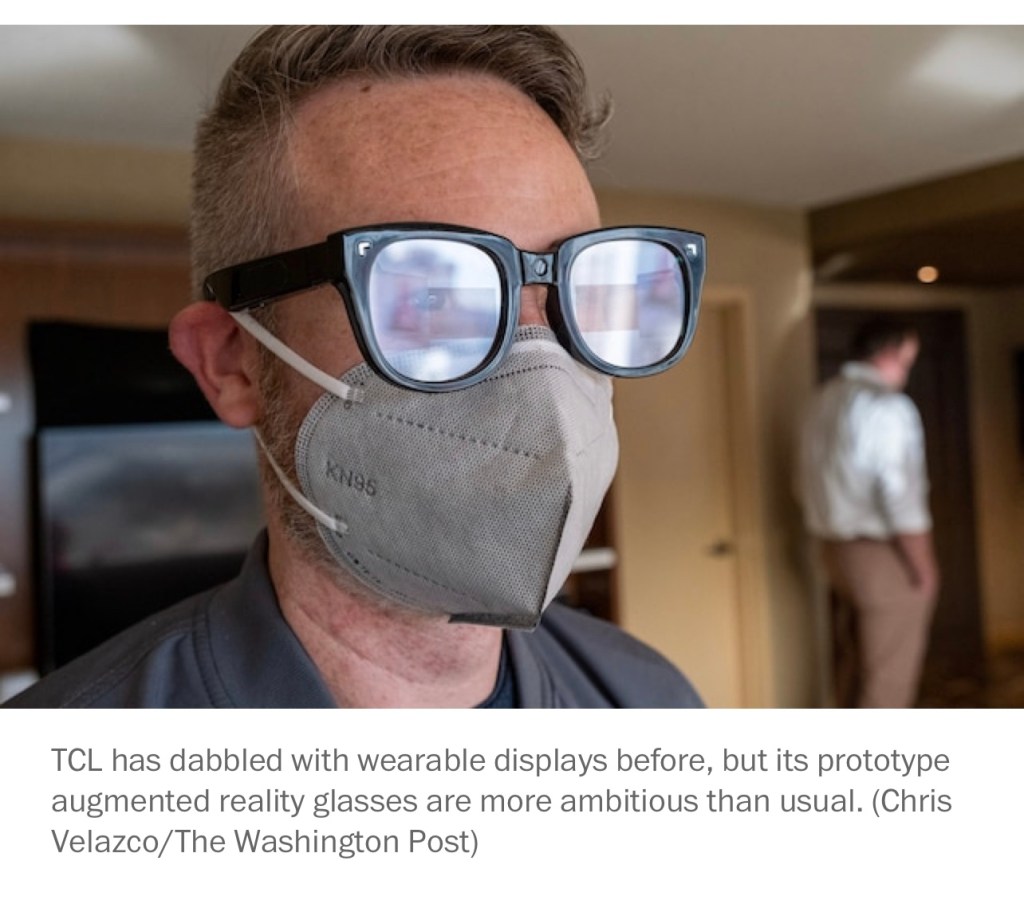
If you come to CES in search of wearable displays, you’ll never leave unsatisfied. But if your goal has been to find one that doesn’t make you look at least a little silly, well — that’s a different story. A prototype developed by TCL just might fit the bill.
Unlike its earlier wearable screens, TCL’s latest face computer uses what it calls holographic waveguide technology to display an image in front of your eyes without letting anyone else see it. And because the lenses built into these glasses are almost completely transparent, we’re left with a pair of augmented reality specs you can wear all the time. Even better, they actually look like something you might want to wear.
But what’s a wearable like this actually meant to do? The software on the prototype we saw was far from finished, but it mentioned the ability to control phone calls, view photos and even display text on a virtual teleprompter.
Down the road, though, TCL hopes this headset — or some descendant of it since this one runs on a chip meant for smartwatches — will become sophisticated enough to offer turn-by-turn directions and display multiple virtual screens without shutting you off from the rest of the world. It’ll probably be years before the company cracks the code, but hey — at least it’s getting the look down.
Spacious space abodes
Some CES presenters are thinking forward to when people live in entirely connected homes. Sierra Space is thinking about when people live in giant inflatable houses on the moon.
Along with a space plane called Dream Chaser, the company is showcasing a scaled-down version of a large inflatable space home named the LIFE Habitat. LIFE arrives in space folded up inside a launch vehicle then expands to a full three stories — enough living space for four astronauts, scientists, filmmakers or even tourists, the company says.
From the sound of it, LIFE’s inhabitants will be very productive, with room to exercise on equipment, fabricate robots, grow their own produce and compact their trash into bricks to use for radiation protection. I’m getting tired just thinking about it.
A fitness tracker for your cat
At least according to companies selling biometric devices for pets, including Korean brand PurrSong, which introduced a fitness tracker for customers of the feline variety called LavvieTAG at CES this year. It’s part of a suite of connected products from the company, which bills itself as IoT (Internet of Things)-enabled “lifestyle design” for cats.
You might be tempted to scoff at owners who turn to artificial intelligence to monitor how often cats fall asleep or use the bathroom (PurrSong sells a product for that too). But not so fast: Biometric analysis can be a valuable preventive measure to help the pets we love live longer, healthier lives, says Amélie Caudron, CEO of French company Invoxia, which unveiled an AI-powered dog collar at this year’s CES.
“The pet’s place in the family is changing,” says Caudron. “It’s no longer a dog-master relationship. We think of ourselves as parents and our dogs as a member of the family.”
Furthermore, heart conditions are about as common for dogs as they are for humans, she noted. By analyzing data on heart and breath rate from a bunch of different pets, Invoxia could help owners detect and treat problems sooner, Caudron says. And all that data will be useful for veterinarians and researchers, too. (Dogs tend to not show up on time for normal clinical trials.)
A projector that works in unexpected places
Even now, in the middle of the strangest CES on record, companies have devoted big chunks of the show floor to showing off their flashiest, best TVs. But for Samsung, one of its biggest new products might actually be one of its smallest.
Weighing in at less than 2 pounds, you could tote Samsung’s new Freestyle projector from room to room without much fuss. And despite its compact size, the Freestyle can project a 1080p image as large as 100 inches on a screen, a wall, or the side of your house.
Now, small home theater projectors aren’t exactly new — what makes the Freestyle interesting is what it might be able to do down the road with the help of a few accessories. Samsung plans to release a battery add-on that should power the Freestyle away from outlets for up to two hours at a time. (You can also run the Freestyle off a more common power bank, but you may not get that kind of longevity.)
And with the help of another forthcoming adapter, you screw a Freestyle directly into a lightbulb socket. Why? We’re not exactly sure, but one of Samsung’s demos featured a Freestyle projecting the image of a sumptuous meal down onto some empty plates. That’s one way to host a dinner party, we suppose.
A robot that nibbles your fingers and warms your heart
True comfort is priceless, and for some people, that kind of peace only comes when animals or babies cutely gnaw on them. If that’s you, a tiny product from Japan just might be the best impulse buy of your life.
Amagami Ham Ham might look like a small plush cat or dog, but its robotic innards mean it can give you a light chomp when you need a little reassurance — all you need to do is put your finger in its mouth. And since there’s nothing worse than uninspiring chewing, Amagami Ham Ham relies on a set of HAMgorithms (no, seriously) to make sure its nibble patterns don’t get too repetitive.
At this point, you might be wondering why Amagami Ham Ham even exists. For creator and Yukai Engineering CEO Shunsuke Aoki, the answer is simple: It’s all about giving people moments of happiness whenever they need it. That same desire inspired the company’s last hit product, a robotic cat butt named Qoobo, and that’s exactly the kind of mission we can get behind.
Aoki hopes to usher Amagami Ham Ham through a crowdfunding campaign in a few months, and — assuming that’s successful — he aims to sell the robot in Japan and abroad for the equivalent of about $30.
Humanoid robots are getting more lifelike, but only compared to their predecessors.
Just take the Ameca robot from Engineered Arts, a true-to-scale, metal-and-plastic robot person who blinks, shrugs and grimaces just like you and me — if you and me were stilted human facsimiles.
Companies that buy an Ameca model can station it at events and tradeshows to greet attendees and “strike an instant rapport with anybody,” its creator’s website claims. Video from Engineered Arts shows Ameca performing hand and facial gestures that are indeed natural looking, though markedly slow. The company takes care to describe her as “nonthreatening,” though robot threat level is in the eye of the beholder.
And Engineered Arts isn’t the only company peddling human look-alikes at CES. DeepBrain AI is showcasing its new software called AI Studios: Just type in a video script and the program will instantly generate a deepfake human to perform that script. YouTubers, corporate trainers and news anchors beware (maybe).
A foldable screen that doubles as a laptop
Gadgets with foldable screens are inching toward the mainstream, but there’s one thing the tech industry hasn’t figured out yet: how to make a good laptop out of a screen that folds in half. Now, Taiwanese PC maker ASUS has taken up the challenge.
Its new Zenbook 17 Fold is a whopper of a tablet — it’s slightly heavier than Apple’s new 14-inch MacBook Pro — and it packs a 17-inch touch screen just like its name suggests. And while you could certainly prop up the Zenbook and binge YouTube videos, you may sometimes be better off folding the whole thing in half and plopping a combination Bluetooth keyboard/trackpad on the bottom. Voilà: your tablet just became a full-blown laptop, albeit one with a 12.5-inch screen.
But do we need a foldable screen on our computers? ASUS rival Lenovo tried a similar approach with the ThinkPad X1 Fold PC it released more than a year ago, and reviewers almost universally panned the thing. Hopefully, ASUS’s attempt at a laptop with a foldable screen is at least a little more polished.
An air purifier/ear bud mash-up
Wearable tech is almost inescapable at CES, and that’s especially true when you wander into the start-up wonderland that is Eureka Hall. And that’s where we found Ible, a Taiwanese company that created a very specific kind of wearable.
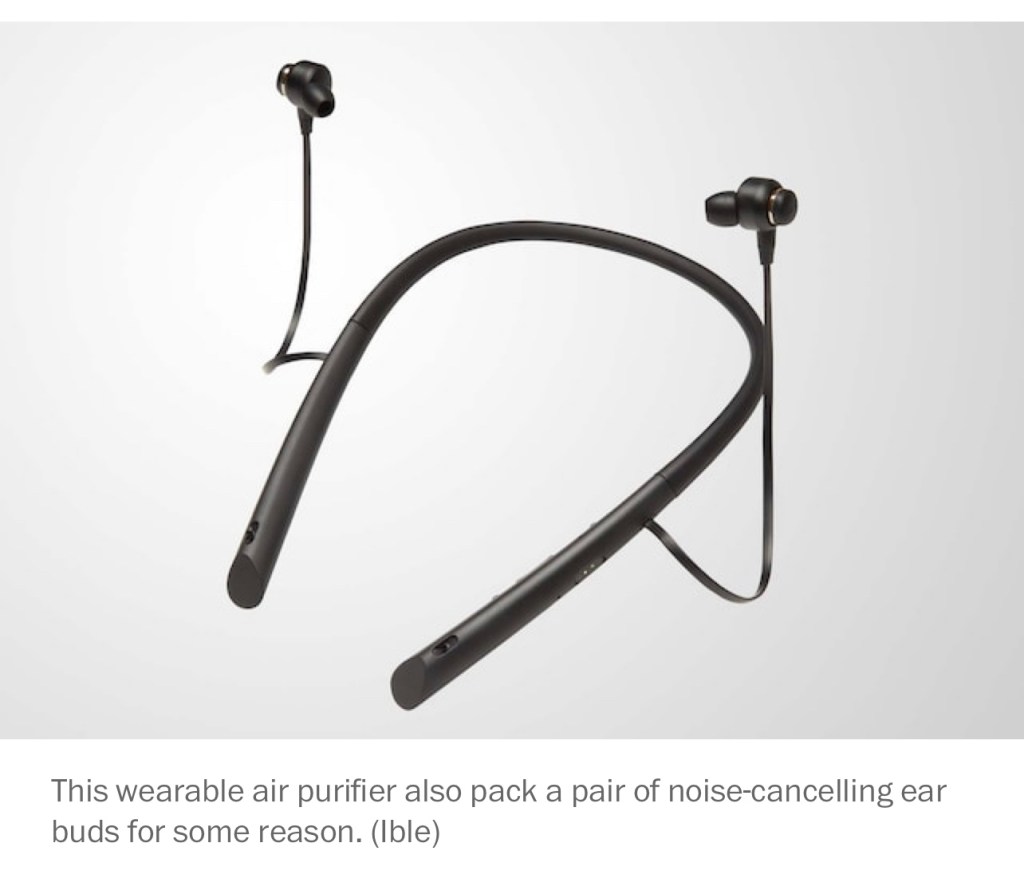
The Airvida E1 is, at its core, a negative ion air purifier that goes around your neck. (This isn’t all that new; the company has released a handful of similar devices over the years.) But because this is 2022, and we always need a quick way to avoid interacting with other people, this new model has a set of noise canceling Bluetooth ear buds built-in.
Like similar air purifiers, the Airvida is meant to help you breathe more easily when pollen or smoke start hanging in the air. The company claims that tests by labs in Taiwan and Japan show that Airvida could be effective in removing covid particles from the air.
As with many claims that come out of CES, it’s probably a good idea to take that one with a grain of salt, and we’d argue you’re better off following CDC recommendations for vaccination and mask use. If nothing else, though, this thing is proof that people are preparing to settle into pandemic life for the long haul.
Eliot and I are going to resume normal activities today. We have isolated ourselves in our condo for two weeks after contracting the virus on Christmas Eve. We both had mild cases but it knocked us out a bit. This blog post is dedicated to Miley Cyrus and Pete Davidson who entertained us on New Year’s Eve. There was something so natural, yet so talented, about their performance on NBC, that it made us feel much better when the clock struck 12.
Thank you kids. You made us feel young again. The following is their appearance on Jimmy Fallon before their New Year’s Eve event just blocks away from us in Miami.
———————————————————————-
——————————————————————
Eliot Hess captures the big wave outside our windows We plan to see our friend, singer Nicole Henry, this Saturday at the Colony Theater, Lincoln Road. Ron Abel, Mr. Showbiz, will be flying in from New York, to join us.
Neither Covid, Nor Vanishing Partners, Nor Supply Shortages, Can Keep Artist Allen Hirsch Away From Introducing His Best HANDL Inventions Yet At CES
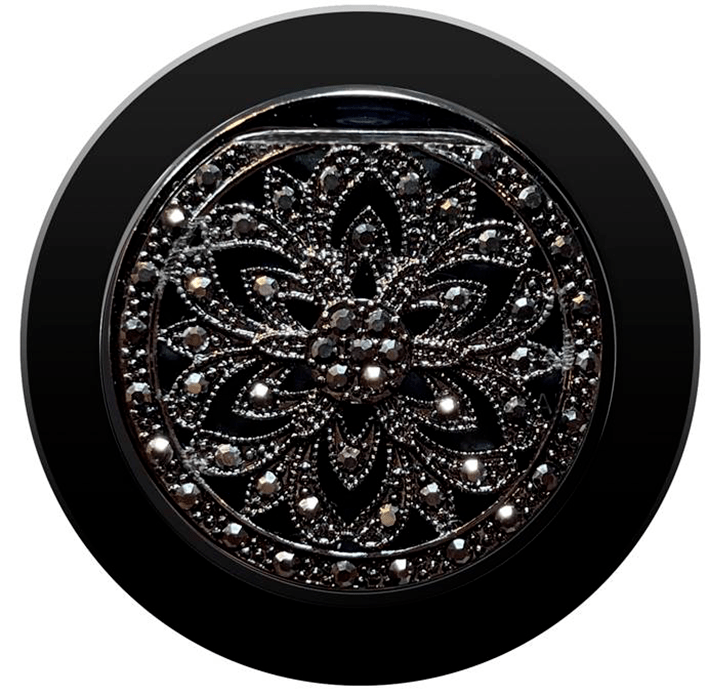
HANDL is excited to unveil new HANDL Jewelry which includes handmade pieces by the artist/founder
A person holding a phone to her face
Description automatically generated with low confidence
Las Vegas — In spite of reports of people backing out of attending CES, Allen Hirsch, founder and creator of HANDL, a leading smartphone accessory company, will go ahead with his plans to man booth #60535 in Eureka Park at the Venetian hotel. Allen Hirsch (while fully vaccinated) has just finished his second bout with Covid several weeks ago.
Hirsch recently was forced suddenly to switch from Creative Founder to Operational CEO when his previous partnership vanished abruptly back in July without orienting Hirsch to any aspect of operations and logistics. “I had no experience in this field at all.” Nonetheless in the spirit of HANDL-ing it, Hirsch was able to keep the ship afloat and salvage relationships and supply chain flow to major retailers such as Target.
“HANDL is excited to unveil its new HANDL Jewelry line, which includes handmade pieces by the artist/founder. “This is revolutionary to the fashion/hand jewelry/cell accessory market,” added Hirsch. Coupled with HANDL’s comfortable and versatile elastic and brace system, this is by far the most useful and attractive product in its class. HANDL jewelry is magSafe compatible and removable so you can match your mood or outfit or accessories at will. This will no doubt turn heads and hands going forward.
———————————————————————-
————————————————————————
Cave Syndrome: A Continuing Problem
Just when we thought it was a little safe to resume some of our outdoor activities, we have to take cover again. Hello Omicron.
Dr. Arthur Bregman, former Chief of Psychiatry of Nicklaus Children’s Hospital for several decades, and now head of the private psychiatric practice of Bregman Medical Group in Coral Gables, Florida, claims “We are seeing a major increase in cases of ‘Cave Syndrome.’ That’s the mental health problem afflicting huge numbers of the population around the world. When I coined the term I had no idea how many people would be traumatized by the pandemic that they stay home all the time because they are scared of the outside world. This is happening all over the world.”
In the US, 30% of us adults say it will take them at least a year from now before they feel safe again to leave their homes.
Cave syndrome is an agoraphobia based disorder related to OCD (obsessive comptoulsive disorder) and PTSD.
But there’s a difference. Regular agoraphobia has a lot of different triggers keeping sufferers out of contact with the outside world. But Cave syndrome is specifically caused by pandemic fears. It’s borne of uncertainty from the virus. The compulsive behavior that follows is essentially staying at home even though the rest of the world is springing into action.
Dr. B says some folks have severe cases where they can barely leave the house, they don’t even want to see family. The holidays was a real reckoning for these sufferers. It’s hard to see the compulsion when anxiety about sickness comes from a survival instinct that is present in all humans. In this case, the instinct has gone into overdrive.
————————————————————————-
Frameworks, the Miami Based Art Framing And Fabrication Company,
Is Being Featured On “Manufacturing Marvels” TV Show Tonight
SHOW IS AIRING ON FOX BUSINESS NETWORK,
JAN 3, 2021-APPROX 9:30PM CST(10:30 PM EST)
Miami, Fl—”Manufacturing Marvels,” the TV show that features cutting edge companies that are truly unique, will be showcasing Frameworks tonight because of its “manufacturing marvels’ in the world of interior art design.
Frameworks has long been recognized as the premier resource for art curation and creation, framing and fabrication located in the United States.
FrameWorks redefines what is possible. FrameWorks invests heavily in state of the art technology, including large flatbed printers, CNC machines, wall covering printers and dye sublimation metal printers. All production is done in-house at FrameWorks, allowing for greater cost savings to their clients and total control of all aspects of a project.
Claire Lardner and Cris Sweeney, founders and owners of Frameworks for the last 30 years, said, “The company has been the leading force behind thousands of creative projects. Our clients inclde luxury resorts, cruise ships, boutique hotels and healthcare facilities of all kinds.”
They added that art is a key element to any well-designed interior. In the world of hospitality design, at is the finishig touch that makes a space more memorable.”
FrameWorks tag line is “Limitless Possibilities.’ The FrameWorks team brings this to each and every project, creating out of this world results for their clients.
Whether it is a signature lobby piece or thousands of framed images for a cruise ship, no job is too small or too large for Team FrameWorks.
FrameWorks collaborates with individuals, interior designers, architects, hotels, cruise ships and healthcare companies to produce fine art packages that enhance their properties.
This comes from Graydon Carter’s Air Mail newsletter. While most of us know all this, we never quite think of big tech in this fashion.
After rioters stormed the US Capitol on January 6, some of the most powerful US institutions sprang into action to punish the leaders of the failed insurrection. But they weren’t the institutions you might expect. Facebook and Twitter suspended the accounts of President Trump for posts praising the rioters. Amazon, Apple, and Google effectively banished Parler, an alternative to Twitter that Trump’s supporters had used to encourage and co-ordinate the attack, by blocking its access to web-hosting services and app stores. Financial service apps, such as PayPal and Stripe, stopped processing payments for the Trump campaign and for accounts that had funded travel expenses to Washington DC for his supporters.
The speed of these technology companies’ reactions stands in stark contrast to the feeble response from the governing institutions. Congress’s efforts to establish a bipartisan, 9/11-style commission failed amid Republican opposition. Law enforcement agencies have been able to arrest some individual rioters but in many cases only by tracking clues they left on social media about their participation in the fiasco.
Nation states have been the primary actors in global affairs for nearly 400 years. That is starting to change, as a handful of large technology companies rival them for geopolitical influence. The aftermath of the January 6 riot serves as the latest proof that Amazon, Apple, Facebook, Google and Twitter are no longer merely large companies; they have taken control of aspects of society, the economy and national security that were long the exclusive preserve of the state.
The same goes for Chinese technology companies, such as Alibaba, ByteDance and Tencent. Non-state actors are increasingly shaping geopolitics, with technology companies in the lead. And although Europe wants to play, its companies do not have the size or geopolitical influence to compete with their American and Chinese counterparts.
Most of the analysis of US-Chinese technological competition, however, is stuck in a statist paradigm. It depicts technology companies as foot soldiers in a conflict between hostile countries. But technology companies are not mere tools in the hands of governments. These companies are increasingly shaping the global environment in which governments operate. They have huge influence over the technologies and services that will drive the next industrial revolution, determine how countries project economic and military power, shape the future of work, and redefine social contracts.
It is time to start thinking of the biggest technology companies as similar to states. These companies exercise a form of sovereignty over a rapidly expanding realm that extends beyond the reach of regulators: digital space. They bring resources to geopolitical competition but face constraints on their power to act. They maintain foreign relations and answer to constituencies, including shareholders, employees, users and advertisers.
They have taken control of aspects of society, the economy and national security that were long the exclusive preserve of the state.
These categories illuminate the choices facing the biggest technology firms as they work to shape global affairs. Will we live in a world where the internet is increasingly fragmented and technology companies serve the interests and goals of the states in which they reside, or will Big Tech decisively wrest control of digital space from governments, freeing itself from national boundaries and emerging as a truly global force? Or could the era of state dominance finally come to an end, supplanted by a techno-elite that assumes responsibility for offering the public goods once provided by governments?
To understand how the struggle for geopolitical influence between technology firms and governments will play out, it is important to grasp the nature of these companies’ power. The tools at their disposal are unique in global affairs, which is why governments are finding it so hard to rein them in.Amazon workers in Germany went on strike to protest low pay and poor working conditions as Prime Day began in 2019.
Today’s biggest technology firms have two critical advantages that have allowed them to carve out independent geopolitical influence. First, they do not operate or wield power exclusively in physical space. They have created a new dimension in geopolitics — digital space — over which they exercise primary influence. People are increasingly living out their lives in this vast territory, which governments do not and cannot fully control.
The implications of this fact bear on virtually all aspects of civic, economic and private life. In many democracies today, politicians’ ability to gain followers on Facebook and Twitter unlocks the money and political support needed to win office. For a new generation of entrepreneurs, Amazon’s marketplace and web-hosting services, Apple’s app store, Facebook’s ad-targeting tools and Google’s search engine have become indispensable for launching a successful business.
Second, these companies are increasingly providing a full spectrum of both the digital and the real-world products that are required to run a modern society. Currently, just four companies — Alibaba, Amazon, Google and Microsoft — meet the bulk of the world’s demand for cloud services, the essential computing infrastructure that has kept people working and children learning during the Covid-19 pandemic. The future competitiveness of traditional industries will depend on how effectively they seize new opportunities created by 5G networks, AI and massive internet-of-things deployments.
Along with owning the world’s leading search engine and its most popular smartphone operating system, Google’s parent company, Alphabet, dabbles in healthcare, drug development and autonomous vehicles. Amazon’s sprawling ecommerce and logistics network furnishes millions of people with basic consumer goods. In China, Alibaba and Tencent dominate payment systems, social media, video streaming, ecommerce and logistics.
Big Tech’s eclipse of the nation state is not inevitable. Governments are taking steps to tame an unruly digital sphere: whether it is China’s recent moves targeting Alibaba and Ant Group, which derailed what would have been one of the world’s biggest ever initial public offerings; the EU’s attempts to regulate personal data, AI and the large technology firms that it defines as digital “gatekeepers”; the numerous antitrust bills introduced in the US House of Representatives; or India’s continuing pressure on foreign social media companies — the technology industry is facing a political and regulatory backlash on multiple fronts.
Moreover, technology firms cannot decouple themselves from physical space, where they remain at the mercy of states. The code for the virtual worlds that these companies have created sits in data centres that are located on territory controlled by governments. Companies are subject to national laws. They can be fined or subjected to other sanctions, their websites can be blocked and executives can be arrested if they break the rules.
Politicians’ ability to gain followers on Facebook and Twitter unlocks the money and political support needed to win office.
But as technology grows more sophisticated, states and regulators are increasingly constrained by outdated laws and limited capacity. Digital space is ever growing. Over 64 billion terabytes of digital information was created and stored in 2020, enough to fill some 500 billion smartphones. In its next phase, this “datasphere” will see cars, factories, and entire cities wired with internet-connected sensors trading data. As this realm grows, the ability to control it will slip further beyond the reach of states.
In the United States, a combination of congressional dysfunction and Silicon Valley’s potent lobbying power will probably continue to preclude expansive new regulations that could pose a serious threat to the digital giants. It is different in Europe, where the lack of homegrown cloud, search and social media conglomerates makes passing ambitious legislation easier. And it is certainly different in China, where a recent round of regulatory crackdowns has sent shares of the country’s own technology heavyweights reeling.
Technology companies’ orientations are no less diverse than the states with which they compete. Strands of globalism, nationalism and techno-utopianism often coexist within the same company. Which outlook predominates will have important consequences for global politics and society.
First there are the globalists — firms that built their empires by operating on a truly international scale. These companies, including Apple, Facebook and Google, create and populate digital space, allowing their business presence and revenue streams to become untethered from physical territory. Each grew powerful by hitting on an idea that allowed it to dominate an economically valuable niche and then taking its business worldwide.
The likes of Alibaba, ByteDance and Tencent emerged at the top of China’s massive domestic market before setting their sights on global growth. But the idea was the same: set up shop in as many countries as possible, respect local rules and regulations as necessary, and compete fiercely.
The forces of globalism and nationalism sometimes clash with a third camp: the techno-utopians. Some of the world’s most powerful technology firms are headed by charismatic visionaries who see technology not just as a global business opportunity but also as a potentially revolutionary force in human affairs. In contrast to the other two groups, this camp centers more on the personalities and ambitions of technology CEOs rather than the operations of the companies themselves.
Whereas globalists want the state to leave them alone and maintain favorable conditions for global commerce, and national champions see an opportunity to get rich off the state, techno-utopians look to a future in which the nation state paradigm that has dominated geopolitics since the 17th century has been replaced by something different altogether.
Over 64 billion terabytes of digital information was created and stored in 2020, enough to fill some 500 billion smartphones.
Elon Musk, the CEO of Tesla and SpaceX, is the most recognizable example, with his open ambition to reinvent transportation, link computers to human brains and make humanity a “multiplanetary species” by colonising Mars. Yes, he is also providing space lift capacity to the US government, but he is chiefly focused on dominating near-space orbit and creating a future in which technology companies help societies evolve beyond the concept of nation-states.
Mark Zuckerberg, the CEO of Facebook, has similar tendencies, even if he has become more open to government regulation of online content. Diem, a Facebook-backed digital currency, had to be scaled back dramatically after financial regulators almost universally raised concerns.
As technology companies and governments negotiate for control over digital space, US and Chinese technology giants will operate in one of three geopolitical environments: one in which the state reigns supreme, rewarding the national champions; one in which corporations wrest control from the state over digital space, empowering the globalists; or one in which the state fades away, elevating the techno-utopians.
In the first scenario, the national champions win and the state remains the dominant provider of security, regulation and public goods. Systemic shocks, such as the Covid-19 pandemic, and long-term threats, such as climate change, coupled with a public backlash against the power of technology companies, entrench government authority as the only force that can resolve global challenges. A bipartisan push for regulation in the United States rewards “patriotic” companies that deploy their resources in support of national goals. Beijing and other authoritarian governments double down on cultivating their own national champions, pushing hard for self-sufficiency while competing for influence in important global markets.
In the second scenario, the state holds on but in a weakened condition, paving the way for the ascendancy of the globalists. Unable to keep pace with technological innovation, regulators accept that governments will share sovereignty over digital space with technology firms. Big Tech beats back restrictions that could curtail its overseas operations, arguing that the loss of market opportunities will harm innovation and, ultimately, governments’ ability to create jobs and meet global challenges. Rather than accept a technological cold war, companies press governments to agree on a set of common rules that preserve a global market for hardware, software and data.
The globalists need stability to succeed over the coming decade. Their worst fear is that the US and China will continue to decouple, forcing them to choose sides in an economic war that will raise barriers to their attempts to globalize their businesses. Their fortunes would improve if Washington and Beijing decided that over-regulation risks undercutting the innovation that drives their economies.
In the final scenario, the oft-predicted erosion of the state comes to pass. The techno-utopians capitalize on widespread disillusionment with governments that have failed to create prosperity and stability, drawing citizens into a digital economy that reduces the role of the state. Confidence in the dollar as a global reserve currency erodes or collapses. Cryptocurrencies prove too much for regulators to control and they gain wide acceptance, undermining governments’ sway over the financial world. The disintegration of centralized authority renders the world substantially less capable of addressing transnational challenges.
The implications of a world in which techno-utopians call the shots are the hardest to tease out, in part because people are so accustomed to thinking of the state as the principal problem-solving actor. Governments would not go down without a fight. And the erosion of the US government’s authority would not give techno-utopians free rein; the Chinese state would also need to suffer a collapse in domestic credibility.
As US-Chinese competition grows more entrenched, these firms will wield their leverage more proactively. If they manage to establish themselves as “the indispensable companies”— much like the US considers itself “the indispensable nation”— the national champions will push for greater government subsidies and preferential treatment over their rivals. The globalists will argue that governments will be unable to sustain economic and technological competitiveness over the long haul if they turn inward and adopt a bunker mentality.
And the techno-utopians? They will be happy to work quietly, biding their time. While the national champions and the globalists duke it out over who will shape government policy, the techno-utopians will use traditional companies and decentralised projects such as ethereum, the world’s second-most popular blockchain after bitcoin, to explore new frontiers in digital space, such as the metaverse, or new approaches to providing essential services. They will strike an understanding tone when the US Congress hauls them in every now and then to denounce their egos and power, taking minimal steps to appease policymakers but deploying aggressive lobbying efforts to undermine any efforts by Washington to bring them to heel.
This does not mean that societies are heading towards a future that witnesses the demise of the nation state, the end of governments and the dissolution of borders. But it is simply no longer tenable to talk about big technology companies as pawns their government masters can move around on a geopolitical chessboard. They are increasingly geopolitical actors themselves.





































 DigiDame