
A Profile On Our Pals

Why We Collect: Ian and Serge Krawiecki Gazes

The Miami-based couple on how a Keith Haring work started their journey

‘We met in New York in the early 1980s and became immersed in the East Village scene with Keith Haring and his generation of artists. We moved in together after about 3 weeks of dating and hung our first piece: a Keith Haring print from his ‘Fertility’ series (1983). That was the catalyst. It’s a small community and we met a lot of gallerists and artists, and later, collectors like Susan and Michael Hort who helped widen our horizons. Hilary is right: it does take a village.

‘We principally collect emerging artists who we enjoy discovering and supporting. We like to think of our collection as a sort of intellectual and experiential investment. It does more than just add flavor to our space: the artworks immerse us in different cultures, philosophies, and artistic viewpoints. Every work of art is a snapshot of an era, capturing reflections of society, human emotions, and thoughts. Watching an artist grow and seeing their works change over time is profoundly satisfying.
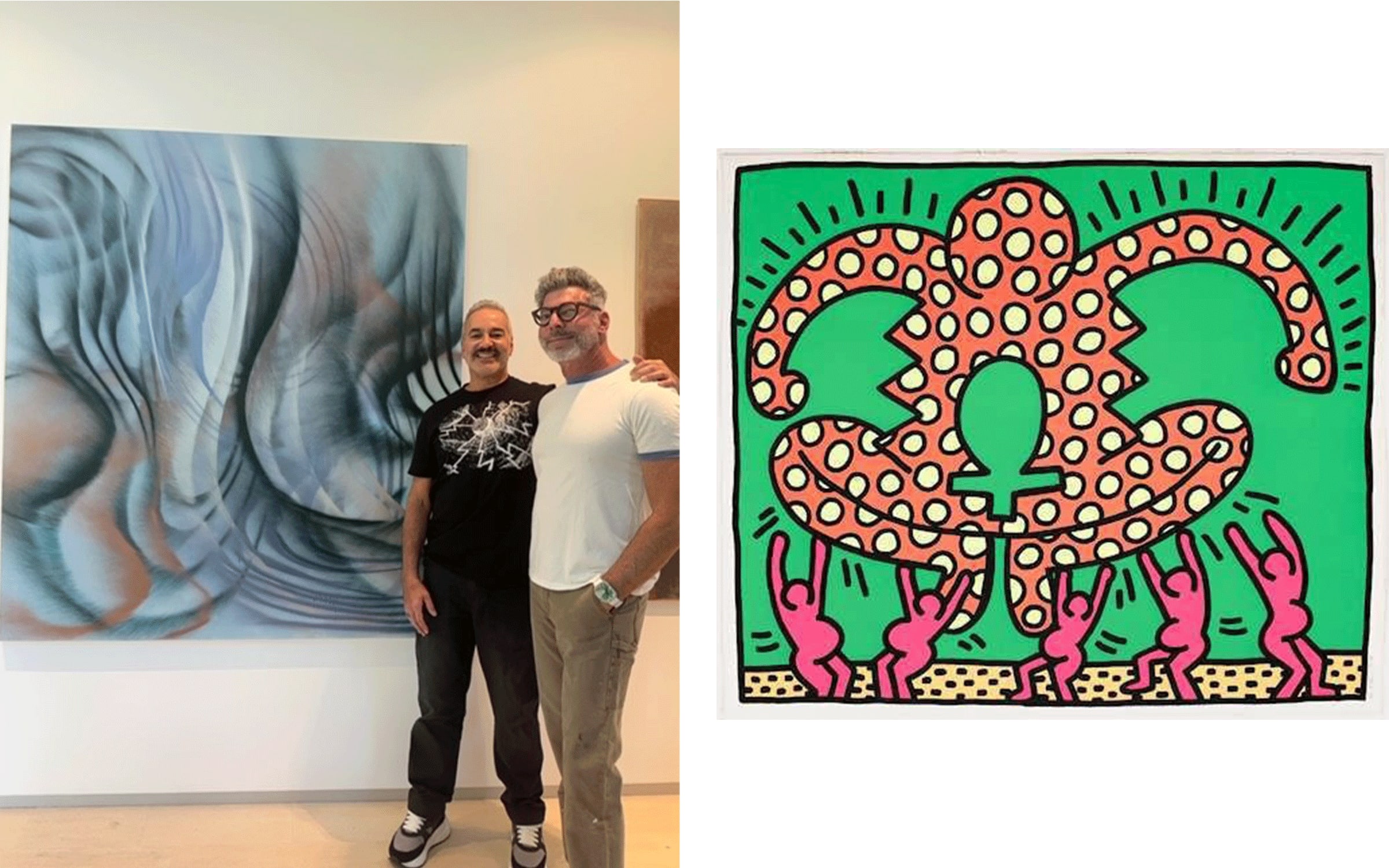
Left: Serge and Ian Krawiecki Gazes. Courtesy of the collectors. Right: Keith Haring, from the ‘Fertility’ suite, 1983. Courtesy of the collectors.

Left: Serge and Ian Krawiecki Gazes. Courtesy of the collectors. Right: Keith Haring, from the ‘Fertility’ suite, 1983. Courtesy of the collectors.

There are many artists from whom we’ve bought very early works. We bought one of Rashid Johnson’s signature mirror reliefs when we visited his studio and we’ve also collected work by his wife, Sheree Hovsepian. There has to be a mutual interest in what we purchase. We really enjoy the back-and-forth discussion it creates between us.   

‘In New York, we would open our home during the Armory fair each year. The art community could come and kick off their shoes and have a martini, and it enabled the artists see what their work looks like installed there. We didn’t only hang art that we had just acquired. We wanted to remind people that just because there are artists who are new and different, these other works are still great. We had Benjamin Degan’s first big painting Town Car (2010) in our living room above the sofa. He was so happy to see it – there were so many people there. It was very inspirational to us to feel that energy. 

Artwork by Rashid Johnson presented by Hauser & Wirth in the Unlimited sector of Art Basel in Basel 2018.

Artwork by Rashid Johnson presented by Hauser & Wirth in the Unlimited sector of Art Basel in Basel 2018.

‘We have lots of collector friends and mentor younger collectors. Of course, they are going to think about whether an artwork will appreciate, there’s nothing wrong with that. But you must buy what you love and be capable of living with it.

‘We have art that we’ve recently collected throughout our homes in Miami and New York, but this is just a sample. We have several facilities where we store it too. It really is everywhere. Our hallway is so long, and Serge came up with a fantastic idea for it: We created an art shelf that runs its length to show our smaller works on paper and photography, with larger works on the wall opposite. This space includes works by Holly Coulis, Emma Coleman, and Van Hanos; a painting by Nicole Eisenman of her brother; a painting by Hilary Pecis of the Hollywood Hills; a small work by Eddie Martinez that he gave us as a gift; an early portrait by Henry Taylor; and photography by Zanele Muholi and Wolfgang Tillmans. We fell in love with a painting by Sophie Larrimore which features a poodle (we have one so we’re partial to them).

‘A favorite work is Carlos and John Arthur (2021), a painting by Doron Langberg, which spoke to us because it portrays two lovers on the beach in Fire Island. It’s the place where we met in 1982 and we spotted many artists there at the time, including David Hockney and Andy Warhol. Doron is a gay artist who we knew before he was taken up by his dealer, Victoria Miro, and we always wanted to support him.

‘In Serge’s office there are paintings by Emily Mae Smith, Benjamin Senior, Maud Madsen, and Aaron Garber-Maikovska. In Ian’s office the artists include Andrea Marie Breiling, who works with spray paint. In the stairwell, where you might hang a chandelier, we have a light installation that we commissioned from James Clar. We even have a sculpture by Hugh Hayden in our wine room. We were so intrigued by his work when we saw it in London – a huge sculpture with tree branches stuck through it. We couldn’t buy it because we had no idea how to transport it, but right after we had a chance to acquire works here in the US, and then he had a show at the ICA Miami.
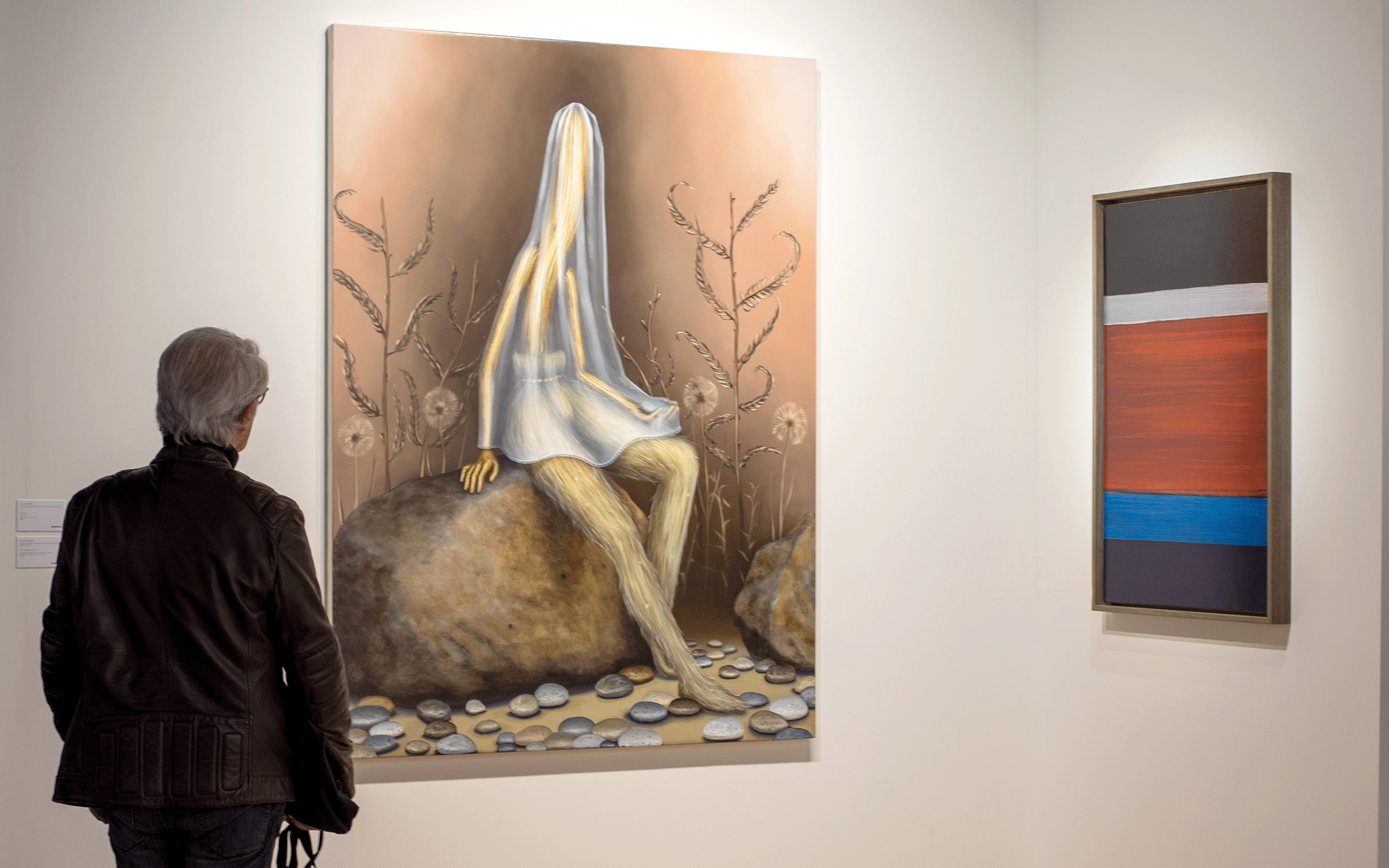
Artwork by Emily Mae Smith presented by Perrotin at Paris+ par Art Basel 2023.

Artwork by Emily Mae Smith presented by Perrotin at Paris+ par Art Basel 2023.

‘Much of our collection is work by artists who we’ve known since they began. In East Hampton, we bought a very rural property with a 100-year-old potato-peeling barn next to the house. In the summer, we gave the barn over to artists to work in whatever way they wanted, and we used to host galleries that would hold group shows. The artist Ryan Wallace used it as his studio for many years to make quite complicated multimedia pieces. 

‘Art is an education. It gives us so much pleasure to share the success of an artist in the sense that they’re being recognized, and people want to see their work.’ 
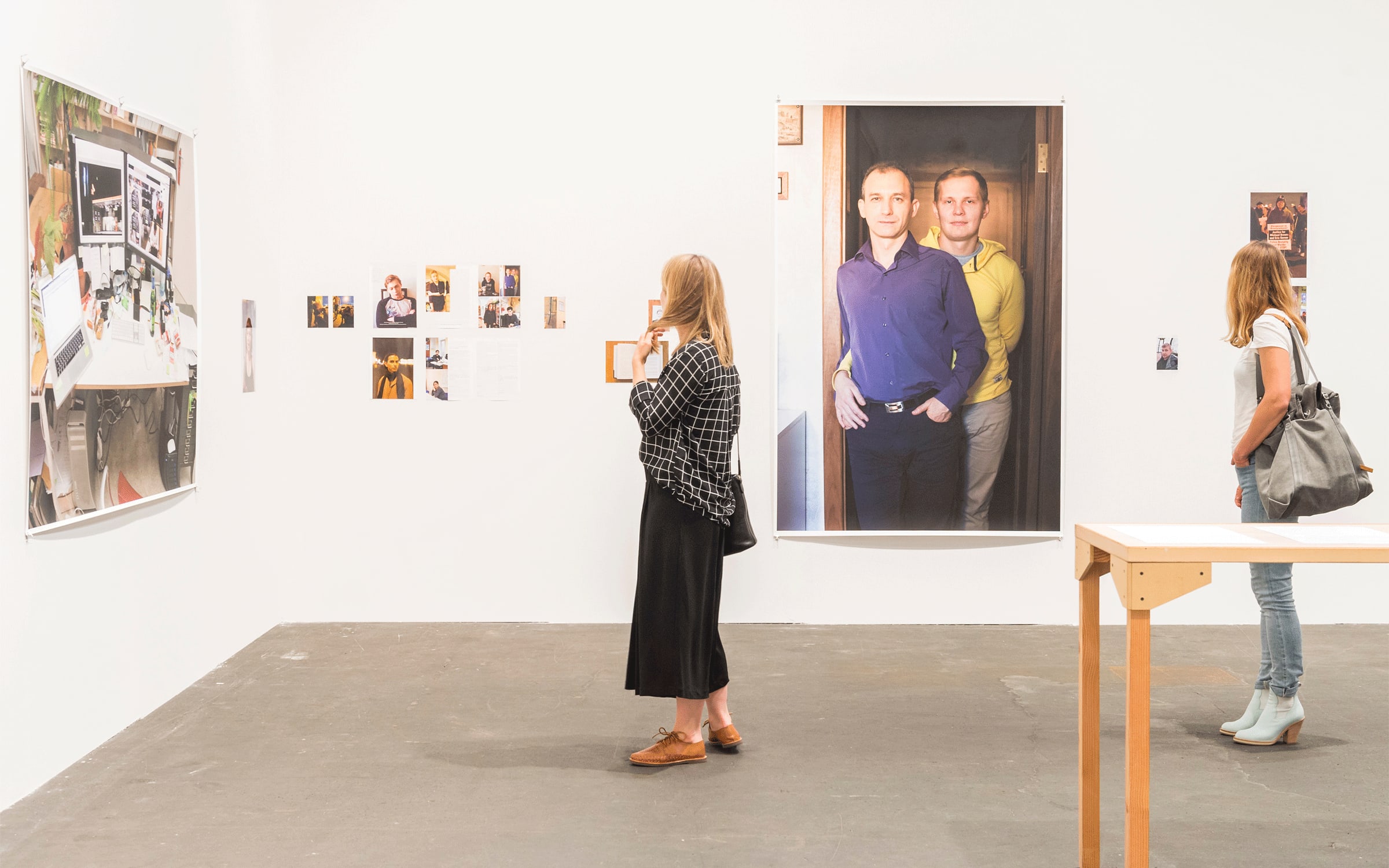
Artworks by Wolfgang Tillmans presented by David Zwirner in the Unlimited sector at Art Basel in Basel 2016.

Artworks by Wolfgang Tillmans presented by David Zwirner in the Unlimited sector at Art Basel in Basel 2016.

Skye Sherwin is an art writer based in Rochester, UK. She contributes regularly to The Guardian and numerous art publications.

A Buddha In Paris

Photo by Eliot Hess who states,”This is very much a real Buddha, possibly Indonesian or Thai. It is the Calling the Earth to Witness or earth-witness pose (bhumisparsha mudra). It depicts the moment of Buddha’s enlightenment, sitting under the bodhi tree.”

A short interview with the artist Yornel Martinez. He lives in Havana, Cuba. Eliot and I bought the Buddha in Paris at the home of Isabelle Saltiel-Nahum, an art collector and art advisor. She and her husband exhibited the project “Cuba is in!” in their art filled Parisian home in partnership with Galleria Continua during Art Basel Paris. Thank you Kathryn Mikesell of FountainheadArts and Sarah Bartesaghi Truong of Venividi Paris for the introduction.

I reached out to Yornel on Instagram. I asked if I could interview him.

Yornel: “Hello, yes we can talk.”

Lois: “What’s with the Chiclets chewing gum?

Yornel: “Yes, chewing gum is an unusual material for a sculpture. The Buddha refers to meditation and is a cultural element of Asia. Chewing gum is something of our contemporary culture and of many activities. These two elements generate opposing forces. However, the opposing forces generate a certain harmony in the sculpture. It is exciting to see a sculpture with unusual materials.


Found this on YouTube. A more in-depth interview about Yornel’s work.
The 300 pound delivery

Yornel Martinez

Born: 1981

Hometown: Manzanilla, Cuba

Lives & Works: Havana, Cuba

URL: http://www.artapartamento.com/en/artists/yornel-martinez

Selected recent solo and group exhibitions include: 2016 Mi mano derecha no sabe lo que escribe mi mano izquierda, Biblioteca Nacional José Martí. La Habana, Cuba; Transhumance, Beyond Cuban Horizons, CAB Art Center. Bruselas, Belgium; Intersecciones, The Hoffman Gallery. Portland, USA; Nano, (Remake), Centro de Desarrollo de las Artes Visuales CDAV. La Habana, Cuba; Puente abierto, Galería Evolución. Lima, Perú; Line up, Galería La Acacia. La Habana, Cuba; Poesía para ver. Expo de poesía visual cubana, Casa de la Poesía. La Habana, Cuba; 2015 Intervención en la librería, Librería Fayad Jamís. XII Bienal de La Habana. La Habana, Cuba; 2014: El arte es nuestra última esperanza, Phoenix Art Museum, Arizona, USA.

For more detailed CV click here

Education: 2007 Fine Arts Faculty degree at Instituto Superior de Arte ISA. Havana, Cuba; 2001 Painting and Drawing degree at Academia de Artes Plásticas José J. Tejada. Santiago de Cuba, Cuba.

Bio / Statement:

Yornel Martinez is a post-conceptual artist who subverts the function of discursive elements – books, fonts, texts, archives – in order to alter their meaning. Creating a connection between words and image plays a leading role in his practice. Martinez’s interests reside in “visually transcending limits of language.” Inviting other artists to participate in the deconstruction and reconstruction of textual objects and their related environments is another focus. For the XII Havana Biennial in 2015, he collaborated with Damian Ortega and other artists in a project comprised of interventions in the Fayad Jamis bookstore in Havana, as well as featured “books as art” objects by contemporary Cuban artists.

Support: Yornel Martinez’s work is made possible with support from the Rockefeller Brothers Fund and the Cuban Artists Fund. .

I’m Next

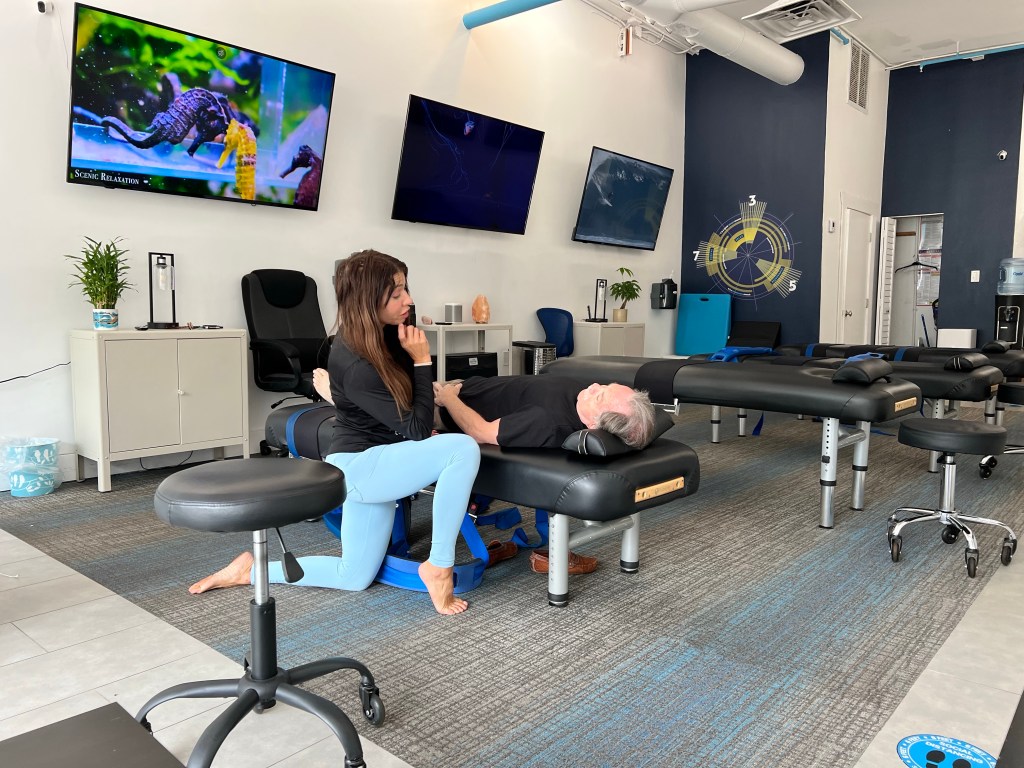
We finally made it to “Stretch Zone” in Miami Beach. I am writing about it for “Thethreetomatoes.com.” I made Eliot try it first. I took the photos. If you have Sciatica problems, this is the place for you. They have franchises all over the country.

Their website explains, “Thanks to the modern sedentary lifestyle many of us are living, most people start losing flexibility at an average rate of 1% a year. Strains and micro-stresses on your muscles compounded over time can glue them together. This “glue,” or scar tissue, tightens the surrounding tissue and restrains how you’re able to move. Over time, the snowballing loss of flexibility ages you.

“Stretch Zone’s isolation of individual muscles within a muscle group breaks up the glue, unwrapping the strangle hold on your posture and valuable energy. Proper stretching slows down the aging process. You can even feel younger by improving posture, circulation, and pain-free full range of motion.”

News Tips

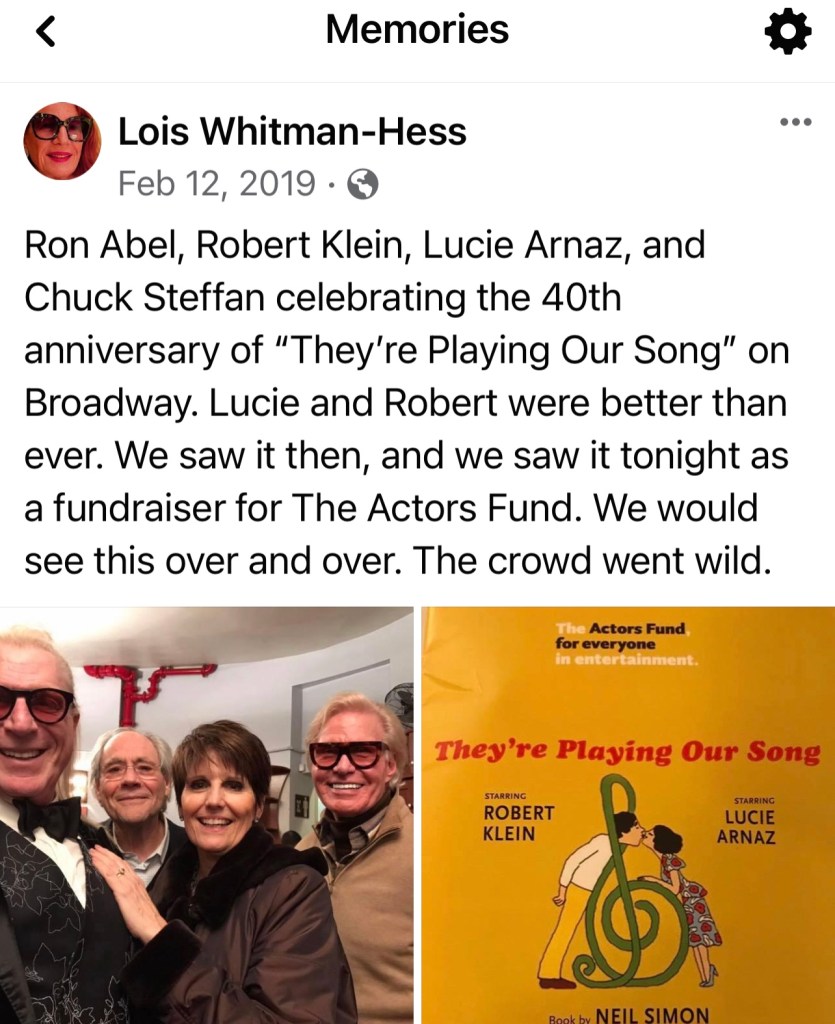
Lucie and hubby Larry Luckinbill are smiling from Palm Springs where they live. The play Lucie is referring to below is still one of best ever. Eliot and I were the first to see it because our PR agency helped to secure props for the show. We didn’t know the Luckinbill’s then but we certainly do now. They are the best.

Click here

https://m.soundcloud.com/user-23603826/i-still-believe-in-love-2-11-22-43-w-cmarlowe?si=a9f9c29e341c4ee1941213ae522d7070&utm_source=facebook&utm_medium=post&utm_campaign=social_sharing&fbclid=IwAR3KAP7Kicd4EJZkwe2b1OT4vvOV6XWgbjU1ROh9Mrt52POVK3DcpI0LacU
Lucie with Robert Klein on stage

———————————————————————-

BFF at the new Via Emilia Garden at 3500 N Miami Ave was an absolute delight. Best food at affordable pricing. Outside terrace with overhang makes it just perfect. Same owners as the one on the beach. Steve Greenberg Robert Armada Ruth Steinik Greenberg Howard Greenberg and Eliot. Photos by SG.

————————————————————————

Our good friends, Ron Abel and Lissa Levin Guntzelman, wrote a show together, (words and music), “Twist of Fate” that was previewed in NYC last week. The crowd roared for these two uber talented folks. We are so proud of them.

———————————————————————

Mr. à la mode

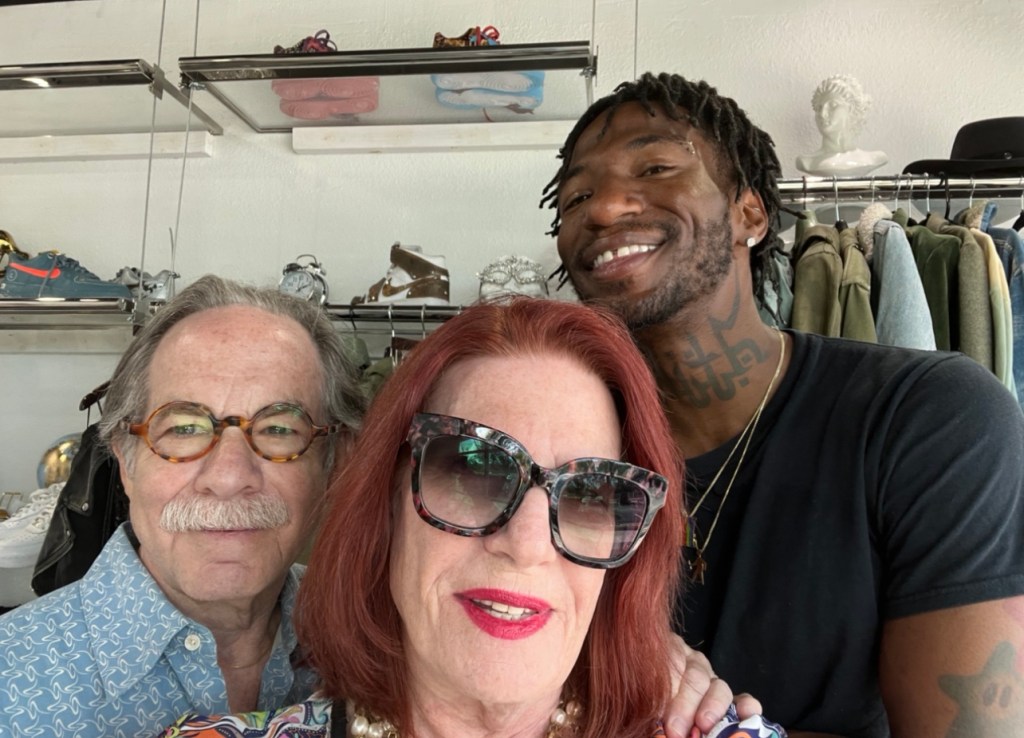
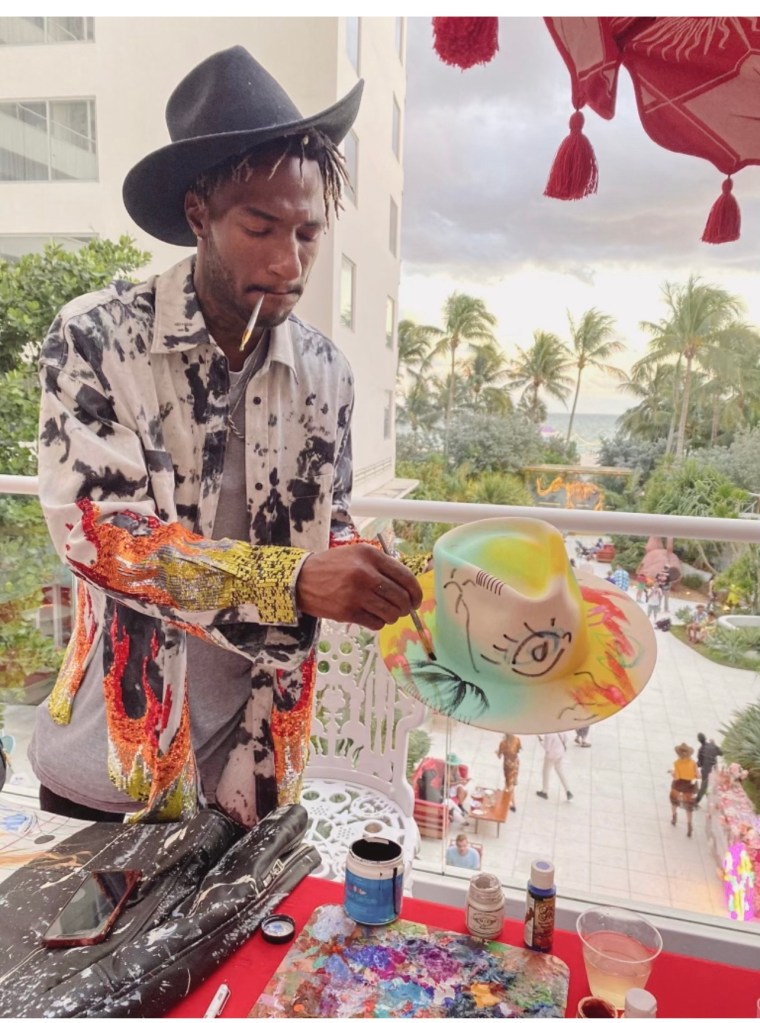
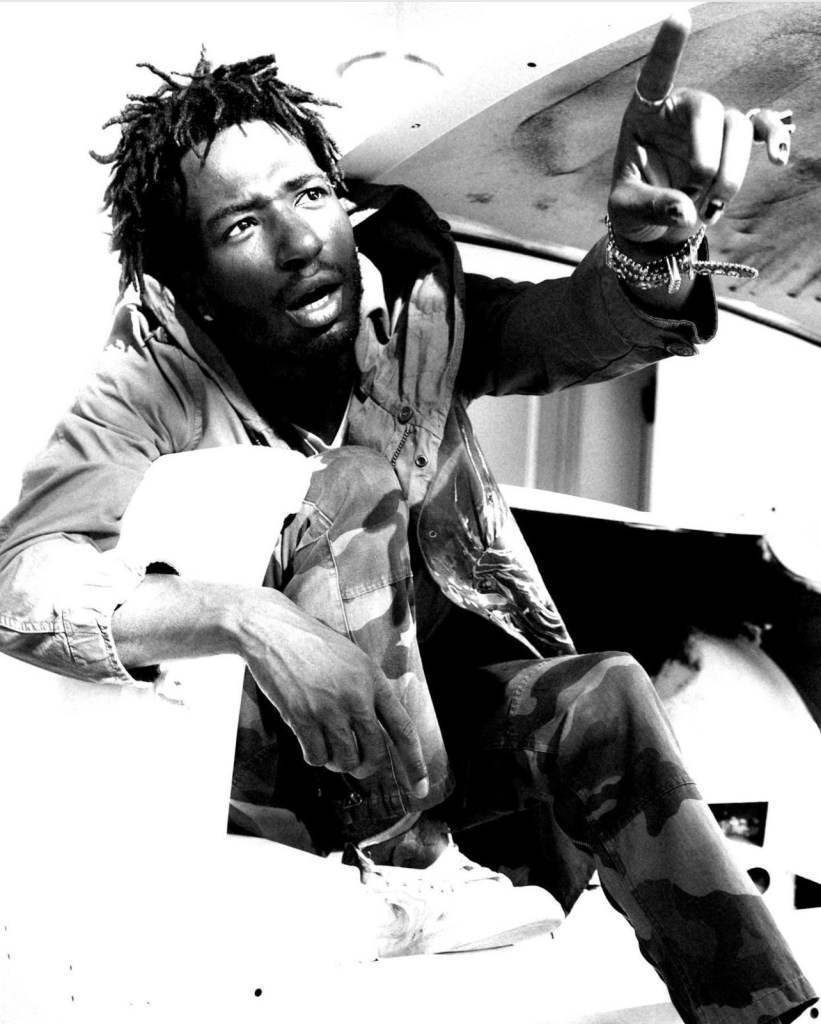
I recently asked my client, Mr. Moda, what his greatest challenge was being an artist today. His answer startled me. “People look at me and all they can see is an African American man who looks like trouble.” The reason I was so surprised by his answer was because that thought crossed my mind the first time I met him.


Eliot and I were meeting our friends, Ruth and Howard, for dinner at this fantastic Italian restaurant in downtown Miami, Soya e Pomodoro, when Eliot and I pulled up behind a truck with its back opened for moving goods. The street was dead quiet because most businesses were closed for the day.


Inside the truck was a very odd looking Black young guy who was talking very loudly on his cell while waving his hands in the air. There were two other guys, one White, standing outside the truck with items that were tightly wrapped for transporting. I didn’t know what was going on but it looked like a heist to me
.


I turned around to Eliot from the passenger seat to tell him not to get out of the car. By the time the words were ready to come out of my mouth, Eliot was out of the car checking to see if he parked close enough to the curb. I thought to myself, “Good luck to us. Who the hell knows what’s really going on here.” I exited the car only to hear the young man in the truck tell Eliot that the car was positioned well. I went to the front of our Jeep to get a closer look at what was being carried out of the adjacent building. It turned out to be art work. Mr. Moda was bringing a painting to Music Artist “Lil Baby” when he headlined the iTHINK Amphitheater in West Palm Beach. I still thought it was strange that they were doing this in the dark.

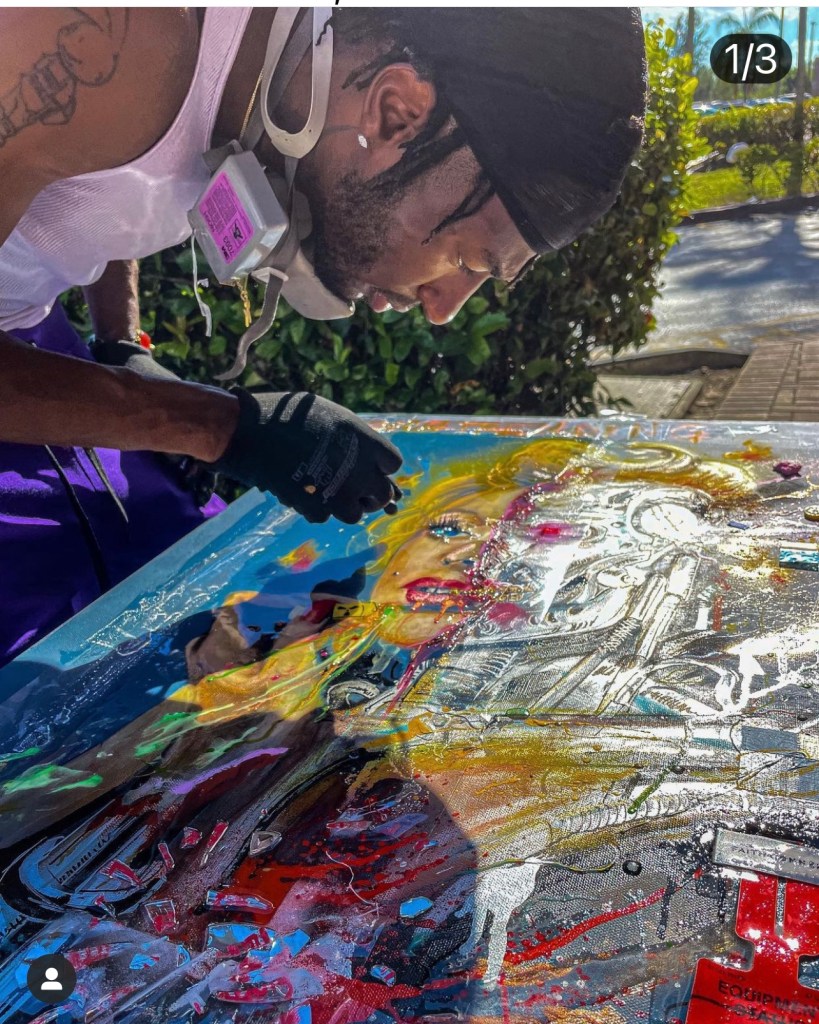
We all introduced ourselves to each other, and when Mr. Moda heard I was a publicist he wanted to show us his work. Eliot and I loved all of his pieces because they were so complex, so graphic and so daring. I immediately told him I would help him get some publicity for his art, some of which he said sells for six figures. I was amazed. Not many artists achieve that kind of success. He explained that many people who are making big money like to own his art because they think it makes them look cool. However, that doesn’t make himself feel better about himself. “I don’t want people to see Black when they see me. I want them to see inside my head. I have a lot to say.”


I promised I would become his self appointed Jewish mother that would help him cross racial barriers. Meanwhile, Eliot pointed out later that I was one of those people who jump to conclusions without knowing the facts. “That is what Mr. Moda complains about.” To my defense, I would have been nervous about getting out of our Jeep if they were all White young men. The older I get, the more vulnerable I feel in all kinds of situations.
Mr. Moda loved the idea of working together. I was thrilled too because I would get the chance to promote his talents, his thoughts, and his endless energy that could possibly be applauded by very wide audiences.


Mr. Moda, who grew up in Jamaica, Queens, not far from where I lived as a child, wants to devote his life to expressing his feelings on canvas, clothing, sculptures, jewelry and footwear. It’s not uncommon to find weed, pills, blood, blades, masks, and even a gun incorporated into his work. He is all about making the world see and understand what Black men have to deal with all the time.


Mr. Moda’s recent sales prove that an increasing number of people really appreciate his work. Several well known real estate developers spent over six figures for his paintings in the last year or two. They particularly zeroed in on his work because they felt he would help them attract a young crowd in the offices and residential complexes they were building.

One of his collectors said “No one walks by anything that Mr. Moda creates. You are forced to stop and stare at the art because every piece has a serious story that we all have to confront today. The more we all face the realities of a young person’s life in these times, the more we will appreciate each other.”

One Of Our Secret Weapons

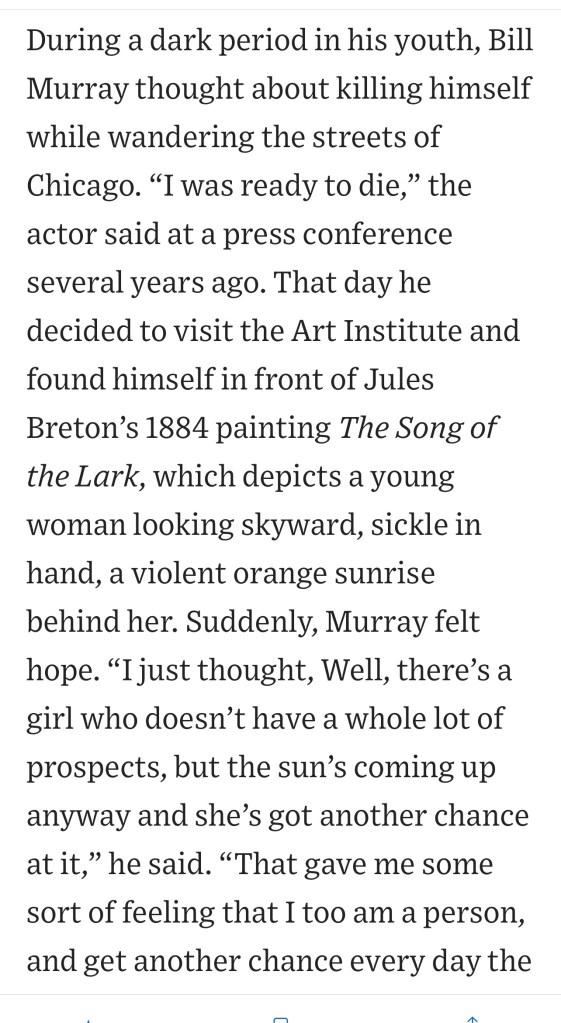
Thank you Marcia Grand for emailing this WSJ article to me. As many of you know, I never studied art appreciation. Eliot knows much more than I do, yet we both found happiness in art many years ago. We just love seeing a piece of art, then finding out who created it, why it was created, and how the world views it. I am just getting used to looking at a piece of art without any explanation at all. That’s what most folks do. They look deep into the work and make their own determinations. Either way, the world of art gives me the ability to fantasize and build new beginnings