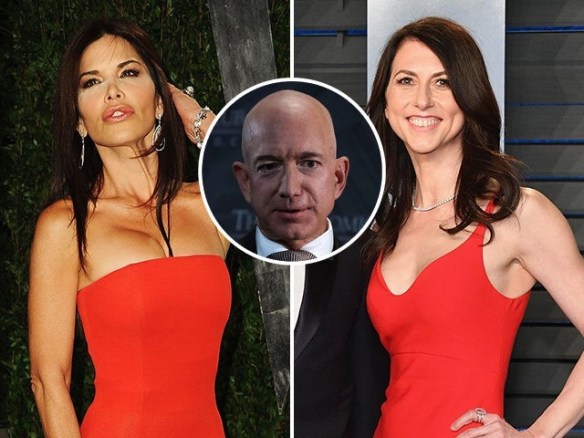
The girl friend (l), Bezos, and the wife.

The girl friend (l), Bezos, and the wife.


https://www.engadget.com/2018/07/04/a-beginners-guide-to-space-tourism/
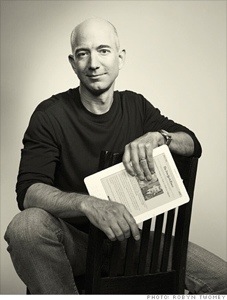
I can’t wait until October 15. The print, Kindle, and Audible editions of “The Everything Store: Jeff Bezos and the Age of Amazon” will become available. I love biographies, autobiographies, and memoirs. The book is going to tell all of us who don’t know much about Bezos just how he built a $75 billion empire.
The book was written by Brad Stone, a senior writer for Bloomberg Businessweek. I know Brad from his days at The New York Times when he covered technology. He is extremely well respected and very precise, so this book is going to be as close to accurate as you can get.
Bezos was not interested in being interviewed, but he didn’t stop Stone from speaking to hundreds of his closest contacts. As I read an excerpt of the book, featured recently in Businessweek, I soon started to see some uncanny similarities between Bezos and Steve Jobs.
1) No level of tolerance and humiliate those who screw up.
2) Never met their real fathers.
3) Very peculiar. Amazon office desks are repurposed doors. Jobs lived in a house with no furniture.
Amazon will shortly be celebrating its 20th anniversary. Stone says “Amazon rivals Wal-Mart as a store, Apple as a device maker, and IBM as a data services company.”
“In the past few months, Amazon has launched a marketplace in India, opened a website to sell high-end art, introduced another Kindle reading device and three tablet computers, made plans to announce a set-top box for televisions, and funded the pilot episodes of more than a dozen TV shows. Amazon’s marketplace hosts the storefronts of countless smaller retailers; Amazon Web Services handles the computer infrastructure of thousands of technology companies, universities, and government agencies.”
Bezos, 49, surprised everyone last August when he personally bought The Washington Post. He believes he can turn the newspaper around. He also spends one day each week heading his own private rocket ship company, Blue Origin, which seeks to lower the cost of space travel.
Stone’s book is going to be a great read. I look forward to finding out more about Bezos and how he became one of the biggest successes in the digital marketplace.
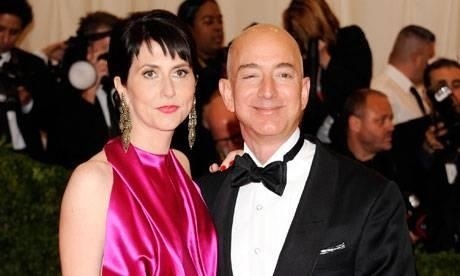
Mackenzie and Jeff Bezos
By now most of you have heard that the founder of Amazon, Jeff Bezos, purchased The Washington Post with his own personal money, $250 million to be exact. He is worth $22 billion according to Bloomberg business press. At 49, Bezos is also politically active, a libertarian who supports gay marriage.
I have been in discussions with the tech writers at The Washington Post recently. I was trying to get them to write about the kind of land mobile radios that first responders like EMS, fire, and police need to properly do their jobs. It wasn’t an easy pitch, so I was on the phone with a few reporters over many recent weeks.
No one told me that Bezos was in negotiations to buy the newspaper, but the usual eager-beaver “scoop” reporters were just not their usual energetic selves. They now claim they didn’t know that anything was going on at the time, but their dispositions have changed in the past few days.
They are now acting like they have something to prove. If they write a startling story about a certain topic, they may get noticed for breaking news. All of a sudden, I am important. I knew that my news was worthy of page one, but I couldn’t get them to focus. Now I am getting calls several times a day requesting further information or additional contacts.
If and when the story gets picked up, I will let you know. It’s an interesting one that should have been told a long time ago. Of course, bureaucracy kept it on the back burner. Hopefully, that all will be history soon.
Meanwhile, I truly believe Bezos bought The Washington Post because he understands that he needs content for his current and future businesses. There is lots of other speculation going around, like maybe his political aspirations, but I don’t think that has anything to do with it.
I do think that the editorial staff at The Washington Post will see changes over the next year or two. Those changes will help them survive and then prosper. There is nothing to fear. The changes Bezos will make will not have anything to do with the stories the reporters write, but rather the way they are delivered.
The fast pace of the Internet will dictate the changes, and if I were a journalist today I would be thrilled to be a part of his regime rather than work for a publisher who refuses to change with the times.
Here are some of the ways I think newspapers will change.
1) No more print. The Washington Post folks better get used to it. Print is a waste of money and everyone should read everything electronically. Those who are balking now will love the performance of digital once they give it a chance.
2) Layouts will not look like the newspaper of today. Stories will appear in capsule forms. If you want more information, you just click for additional coverage.
3) Every story will have suggestions and cross references to similar or related articles.
4) The newspaper will alert you to the most popular stories, which ones were the most emailed and posted on Twitter and Facebook, and suggested articles based on your previous preferences.
5) Articles will be much more current. New ones will appear every half hour if not sooner.
6) Relevant stories will be pushed out to you via email or alerts. You will check off what topics you want to know about firsthand.
7) Readers will contribute to the news and feature pages with any pertinent information they are privy to, much like a Twitter feed.
8) Readers will be able to access all the former stories that were previously written on the same topic. This will serve as a great reference. No one is left in the dark.
I will let Bezos surprise you with the rest. I gave you my best guesses