I’m getting a Cozy Desk this week. We ordered it today and it should be here by Friday. I’m very excited because my work environment is not what you think it should be.
I start working very early every day on my bed, then move to my club chair, then the terrace, and then back to bed. It works for me. Not having a desk gives me the freedom to relax in many different spots.
The Cozy Desk is engineered with venting holes so my laptop will not overheat and it is adjustable for desired heights.
You can buy this new portable desk around $70 on Amazon.
I just finished reading an essay about how to feel good about your age in your senior years. Jane Brody, the long-term writer of Personal Health, in the New York Times, wrote the piece. It’s very worth your time.
She talks about two books she recently read and then said, “I have a new way of looking at myself: as a ‘good-enough aging adult who continues to pursue and enjoy a variety of activities commensurate with the limitations imposed by inevitable changes in body and mind that accrue with advancing years.” It’s a must read. Click here.
President Jimmy Carter lives life to the fullest at 94. This interview with Stephen Colbert shows us attitude is so important. Fabulous.
Isabella Rossellini details how it was to lose her Lancôme contract at 43, and then regain it at 65. Great inspiration.
I could never do a blog post without showing off Lyn.
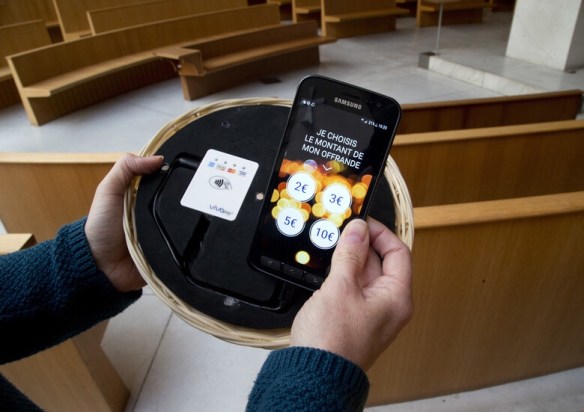
I have several friends who spend a great deal of their time raising funds for houses of worship. They recently told me their efforts are now completely digital. No more pass the plate. It’s now, pass the smartphone.
Boy have things changed.
There is a growing list of online donation sites and apps right across the United States.Those in the lead are NYCharities.org, PushPay, Venmo and Network for Good, FaithStreet.and Tithe.ly.
The New York Post recently ran a story that said, “Americans gave $122.9 billion to religious institutions in 2016. These sites are reportedly boosting donations around 30 percent.”
Mobile payments overall in the US soared 72 percent, to $187.8 billion, in 2017, according to Juniper Research.
A well-known audio enthusiast/tech writer friend of mine, Steve Guttenberg, (not the actor), told me not to miss the “David Bowie Is” exhibit currently at the Brooklyn Museum, March 2 to July 15th. I plan to see it in May when I’m in New York for an extensive period of time.
Steve just wrote about the exhibit for CNET where it caught my eye because he usually writes audio reviews. He wanted to do the Bowie piece because the entertainer was one of the most talented performers of his time. He was a musician, writer, dancer, actor, painter and a mime.
Steve said when you see the exhibit you realize that Bowie was always full of surprises. He led a free-spirited life that allowed him to explore many different paths. For folks who have had lots of aspirations, but never acted on them, Bowie’s exhibit is a reminder of what could have been.
Everyone who visits the exhibit gets a state-of-the-art headphone by Sennheiser, which provides what the Brooklyn Museum calls a “total immersive audio experience through the theatrical scene-settings and animation videos. There is quite a lot to see from stage costumes and portrait photographs to Bowie’s handwritten lyrics and even his coke spoon.”
Steve said what makes this exhibit so different is that the visitor receives the audio presentation automatically through the Sennheiser headphones when he or she stands in front of each showcase. They do not have to keep changing exhibit numbers. It’s one -of-a-kind.
Steve Guttenberg is another free spirit who refers to himself as the Audiophiliac. You can see Steve explain his love for music and the world of audio in the above video. For many years Steve was a movie theater projectionist, a high-end audio salesman and a record producer. He now reviews audio products for CNET, and freelancers for Home Theater, Inner Fidelity, Tone Audio and Stereophile.
Steve is a character. Be sure to watch all of his videos on YouTube. He certainly takes you behind the scenes in the world of music.
Photography and filming are not allowed in the exhibition.
Organized with unprecedented access to David Bowie’s personal archive, this exhibition explores the creative process of an artist whose sustained reinventions, innovative collaborations, and bold characterizations revolutionized the way we see music, inspiring people to shape their own identities while challenging social traditions. David Bowie is has been touring globally for the past five years and is taking its final bow at the Brooklyn Museum, providing an opportunity to view this one-of-a-kind material.
David Bowie is presents approximately 400 objects drawn primarily from the David Bowie Archive, including the artist’s original costumes, handwritten lyric sheets from famous songs, original album art, photographs, and videos, all tracing Bowie’s creative process from his teenage years in England through his last twenty years, when he resided in New York City. The archive is presented within an immersive, multimedia installation that includes continuous audio along with projected animation and video.
Highlights of the exhibition include more than 60 custom-made performance costumes, including six designed by Freddie Burretti for Ziggy Stardust / 1980 Floor Show and seven designed by Kansai Yamamoto for Aladdin Sane. There are 85 handwritten lyric sheets, including those from “Fame” and “Fashion”; drawings, including a sketch for the Young Americans album cover; and oil paintings, including two of musician Iggy Pop, all by Bowie.
There are also more than 40 pioneering music videos, television clips, and filmed roles as well as a multimedia presentation of international tour footage with rare scenes from the legendary Diamond Dogs tour, filmed in Philadelphia. A custom audio mix made up of snippets of Bowie’s songs—produced by longtime collaborator Tony Visconti—is also featured.
David Bowie is is organized by the Victoria and Albert Museum, London.
I don’t know about you, but every time a stranger hands me a drink at a bar, or at an event, I wonder if the beverage is safe. I just know too many people who have been drugged. One of my friends was sexually assaulted, and another one was in a deadly accident after someone slipped a roofie (a date rape drug) in his drink.
After Danya Sherman, a George Washington junior, experienced a life-threatening situation, she decided to help others avoid the same horrendous situation.
This story should be shared with all the young people you know. Sherman’s idea is brilliant. She is creating the KnoNap, a drug-detecting cocktail napkin, that will tell you if it’s safe to drink. All you have to do is drip a drop of your drink on the KnoNap napkin. If the napkin changes colors, you have been drugged. Put down the drink, and head for the door.
Sherman plans to launch a Kickstarter campaign to help fund the first round of manufacturing in April. The goal, she says, is to roll out the product by the end of the year.
You are expecting a delivery from Amazon. Alexa, the voice-activated robot, makes an announcement in your living room that your package is about to arrive. You immediately go outside in front of your home and look up to the sky.
You see a drone hovering over. You lift your arms just like an air traffic controller and start directing the drone to land a few feet from where you are standing. As the drone gets closer, you verbally tell it exactly where to land.
You may think this is fiction, but it’s definitely not. Amazon has a patent for a drone that can deliver packages based on its recognition of human gestures and voice commands.
According to Chain Store Age, “The drone features propulsion technology that manages the drone’s speed and trajectory, a sensor, and management system. The management system can be programmed to detect human gestures — both visual and audial — via the sensor, a move that will instruct the drone where to go.”
The trade publication also said that Amazon recently filed a patent application for “ground-based mobile maintenance facilities for unmanned aerial vehicles. The hubs would be dedicated to accommodating, loading, launching, receiving and maintaining the delivery drones.”
I just can’t believe that Dubai is actually home to the world’s first rotating skyscraper. One day I have to see it in person.
When I first heard about it from some friends, I think I got a little dizzy. When I read about it in some tech pubs, my heart started to race. If I ever get to see it for real, I hope I have the courage to visit a high floor. While I might be very nervous, I wouldn’t want to miss the experience.
The rotating skyscraper is supposed to be complete in 2020. David Fisher of Dynamic Architecture, created the concept.
Fisher is building an 80-story, 1,273-foot tower in Dubai with floors that can rotate 360 degrees in both directions. Please watch the video. It’s absolutely amazing. Fisher wants to create a building that gives condo owners the opportunity to see sunsets and sunrises. Entire floors rotate.
The building will feature voice-activated technology that allows residents to spin their apartments just by a verbal request. Seventy nine wind turbines placed horizontally between the floors and solar panels on the roof produce the tower’s energy. The central elevator lets residents transport cars to their floor and park them next to their apartment.
Each unit is prefabricated with steel, aluminum and carbon fiber materials. They are assembled at the factory and then attached to the tower.
That scares me. What if it falls off? That is going to be an expensive fall. Units are priced from $4 million to $40 million.
Everyone is after Mark Zuckerberg, CEO of Facebook. We all want to know about the company’s privacy protections. It might be months before we really understand the damage from Cambridge Analytica, the company that had access to vast amounts of data on approximately 50 million Facebook users.
Who has that information now?
Until we really know, Facebook users are being urged to eliminate all of their personal information in the settings section. To learn how to do that, watch the video.
As we get older, we may be required to tell one of our doctors exactly what we ate for the day. If this is going to determine something detrimental to my health, I want the information to be completely accurate.
Technology is going to save the day.
The scientists at Tufts University have developed a new type of sensor that fits right on your tooth so it can measure and transmit readings about glucose, salt and alcohol intake. It’s very tiny, only 2 millimeters.
The device features an unpowered chemical sensor combined with RFID (radiofrequency ID) technology. The readings come from RF waves and the device measures the nature of the returning signal.
Tufts gives a bit of a complicated explanation, “The sensor consists of a material that absorbs the compounds to be measured, fattening in the process, and two square gold rings on the outside. As an analyte is absorbed, the gold rings move apart and the returning radio waves that bounce off of the device change accordingly.”
Tufts is hoping to get the device to attach to the skin. It could be useful in measuring chemical composition of sweat, body temperature, and other parameters.