Driving Me Crazy

20140206-020627.jpg

20140206-020640.jpg

Every time we get in our car, I remind Eliot that his job is not just to drive but to watch out for others. I guess you can call me a backseat driver. In my estimation, I have good reason to be a nervous wreck when we go out for a drive. Driver distraction has increased dramatically thanks to texting. I have watched more and more cars weave in and out of lanes. It is so unnerving I beg Eliot to be extra careful.

I am all in favor of requiring automakers to equip new vehicles with technology that lets them warn each other which way they are going. That would be such a great relief for me. I spend all my time navigating and directing. Eliot hates it.

A radio beacon can be placed on each car to continually transmit a vehicle’s position, heading, speed, and other information. All automobiles would receive the same information from other vehicles. The car’s computer would alert the driver to an impending collision.

The National Highway Traffic Safety Administration estimates vehicle-to-vehicle communications could prevent up to 80 percent of accidents.

I’m all for it.

Timing is Everything, What Else is New?

20140205-022754.jpg

20140205-022806.jpg

Yesterday, I told you about the fate of Egreeting cards. Today, I want to shed light on how the now defunct company Excite@Home paid $780 million for a digital greeting card business, bluemountain.com, when they really could have started one on their own for a tenth of the price.

That’s the story of my former client, Susan Polis Schutz, when Excite@Home came prancing by in 1999 and handed her and her family a whopper check for the digital part of their business that was just a few years old.

Susan and her husband Steve Schutz originally started Blue Mountain Arts in 1970 as a greeting card, poster, and gift book publisher. Twenty-five years later, their son Jared suggested they enter the digital world by offering e-cards. At the time, Blue Mountain was generating around $35 million in printed greeting cards. I am sure you have seen or even bought their cards. Susan was the poet who wrote the flowery words and they were designed with lots of pastel colors. Blue Mountain usually had its own display rack and the cards were sold in a wide variety of stores.

Steve Schutz, who had a doctorate in physics from Princeton, and son Jared worked together to build one of the first e-card sites. It was fortunate that they did. The timing was perfect. As I mentioned before, the family sold the digital division of Blue Mountain Arts in 1999 for $780 million. It wasn’t long after that, in 2001, that Excite@Home went bust and American Greetings grabbed up whatever was left for just $35 million in cash.

Today, Susan is a documentary maker, Steve runs an educational website, and Jared Polis is a United States Representative from Colorado and the first openly gay man elected to Congress as a freshman. The Schutz’s have two other adult children besides Jared.

I met Susan in 2004 and helped her promote Blue Mountain: Turning Dreams Into Reality, the story of how her publishing company, Blue Mountain Arts, and electronic greeting card website bluemountain.com were founded and developed. In the book, she describes some of the experiences she and Steve had from the time they silk-screened their first posters and lived in the back of their pickup-truck camper to when their poetry greeting cards became the number-one-selling card line in America.

I can remember sitting across the table from Susan at one of our meetings thinking about all that money in her bank account. It didn’t change her and her family very much. By the time they had gotten that big check, their print business had already bought them everything they desired.

A lot of the new money has been donated to good causes and helping those they love.

Egreetings Folds

20140203-190900.jpg

I was sad to learn that Egreetings is going out of business next week. It was announced on Twitter without any explanation. After so many years in existence, just a little tweet announced its demise. I remember some of the first Egreeting cards I received from friends in the late 90s. I thought they were so progressive using digital cards for all occasions.

Egreetings was one of a number of eCard companies who made a fortune during the first Internet gold rush. Big brands wanted to own Internet businesses and were willing to pay astronomical fees for promising companies.

Egreetings took a different route. It went public in 1999, even though it lost $1.5 million on sales of $22 million over a nine-month period. Egreetings was valued at more than $350 million. While folks were cheering at first. they became disillusioned over time. The business went nowhere fast.

In February 2001, American Greetings bought Egreetings for what they thought was a great deal at $28 million. This year American Greetings generated $1.8 billion in sales and a $50 million profit.

Guess what? Most of that money came from paper cards. To learn more about the financial transaction that took place, read what the tech site Re/code had to say about the matter.

Tomorrow, I will tell you about Blue Mountain Arts. They became my client after they got a check for $780 million for their young digital business.

Repeating Email Alerts Out Loud Can Cause Painful Reactions

20140202-224342.jpg

20140202-224225.jpg

Philip Seymour Hoffman

So there I was shopping for one-of-a-kind, clip-on earrings in Pomegranate, an upscale, edgy boutique in La Jolla Village, CA, when I heard my iPhone chirp. That meant I had received an email alert. I usually don’t rush to check news flashes, especially when I am picking out accessories to wear.

Something made me do it this time. I couldn’t believe my eyes. The CNN alert said “Philip Seymour Hoffman Found Dead.” Then without thinking, I repeated what I had read out loud. “No!” yelled a very attractive, silver-haired woman in her late 60s who was just a few feet away from me. “That can’t be. I am friendly with his mother. I just spoke to her. I live right near her in Rochester.”

I felt so awful. My outburst had thrown this woman into a frenzy. I watched her drop the clothes she picked out to buy and reach inside her handbag for her cell. She quickly walked out of the store.

Everything seemed so surreal. I was the reason why someone else was in pain. I didn’t mean it but still felt like I did it on purpose because I wanted to share the horror of what I read.

I think a lot about email alerts because I get so many: CNN, AP, USA Today, Huffington Post, NY Times, WSJ, People, Twitter. I voluntarily sign up for all of them. When something happens in the world, they all go into action. The problem with email alerts is that they get flashed so fast you can barely read them. It is impossible to retrieve an alert because most of the time the site that sent it doesn’t even have it posted. This drives me crazy.

I looked outside of the store for the woman, but she was nowhere in sight. I walked back in to finish up the transaction I had started to purchase three pairs of earrings. There I had been joyfully buying jewelry when something tragic had just occurred. I started to feel very strange.

We just don’t know what is going to happen from one minute to the next. Scary, isn’t it?

Hope This Isn’t My Third Strike

20140201-202340.jpg

Something went wrong with my DigiDame email blasts for the last two nights. I am checking to see if I screwed up some setting. Anyway, I hope this works. Do let me know. And be sure to always check http://www.digidame.com if the email connection doesn’t work.

Until I am sure this works, here are some of my favorite digital signs.

20140201-202419.jpg

20140201-202440.jpg

20140201-202541.jpg
By the way, I miss my mother more and more each day. So much of what she told me has really come true. Rats!

The Death of the Shopping Mall

20140201-001427.jpg

If you want to visit a ghost town, take a trip to your local shopping mall. I knew retail was in trouble, but I really didn’t understand the severity of the situation. On a recent trip to Las Vegas, I stopped by the Fashion Show Mall on the strip. It was early Saturday night. This place is usually packed because it combines traditional boutiques plus the gaudy ones that Vegas is so well known for. It was really empty. Maybe I saw 15 people on each level. I thought it was unusual but didn’t focus on it.

Then I learned that approximately 15% of all U.S. malls will fail or be converted into non-retail space within the next 10 years. Green Street Advisors, a real estate and REIT analytics firm, just released that figure. It will probably get worse. Green Street Advisors thought that only 10 per cent of malls would fail less than two years ago.

The report never revealed the reason why shopping malls are doing so poorly, but you don’t have to be a rocket scientist to figure it out. The economy coupled with the increase of people shopping online is killing the mall experience. It had to happen eventually. Rich or poor, Americans are looking for the best online deals. Even my friends over the age of 60, who wouldn’t use a computer a few years ago, now spend hours online looking for the best values

The biggest insult to retailers today is something called “show-rooming.” I am pretty sure I explained this to you before, but it is worth going over again. Today, more and more Americans will visit a store just to see and touch a product they are interested in. Once they’ve decided what they want, they go back to their computers to find the best possible price from a variety of discount e-commerce sites. Retailers hate this with a passion. They threaten manufacturers that if they sell to online discounters, they will not carry their brand. Some retailers insist on custom made models so customers can’t shop around. This is too costly for all sorts of manufacturers, so everyone continues to suffer.

I remember when going to a shopping mall was my big Saturday night out. This was long before the Internet. We would visit the Roosevelt Shopping Mall in Garden City, Long Island with great anticipation for what new stuff we would find. We spent hours there. It was our social life.

There are about 1,000 malls in the U.S. They say the lower-end ones are doing worse. Anchor stores like JCPenney, Macy’s, and Sears have all recently announced closures and layoffs. JCPenney is closing 33 stores, Macy’s is closing five, and Sears is closing its flagship in Chicago. Mall owners are going after movie theaters, restaurants, and discount retailers like TJ Maxx, Ross Stores, and Marshalls to take up the slack. Green Street Advisors think that community colleges, business offices, and health care facilities will take over the vast properties.

No one knows for sure. But if it eliminates all these random shooting sprees, I’m all for the change.

A Night with Michele Lee

I am taking a night off from writing about tech because we were out pretty late with our good friends Chuck Steffan and Ron Abel. They are both major talents in the world of music. Ron was the musical director tonight for the cabaret act of actress Michele Lee at 54 Below. Her rare NYC appearance continues for the next two nights.

20140131-004455.jpg
TV and radio personality Joe Franklin stood in the way of my picture of the stage.

20140131-005629.jpg
Ron with Liza Minnelli, Michele Lee, and Sandra Bernhard

20140131-010615.jpg
Chuck and Liza

20140131-010824.jpg
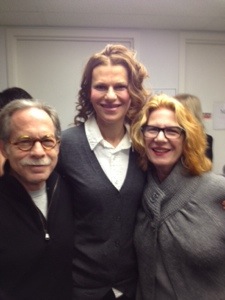
Eliot, Sandra, and me

20140131-010932.jpg
Eliot entertaining the women

20140131-011230.jpg
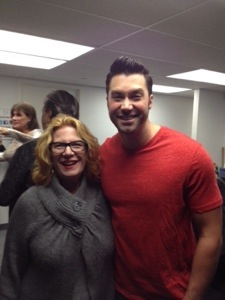
Ace Young and me

20140131-011356.jpg
Ron and Liza

20140131-011554.jpg
Critic Rex Reed and me

Exploring the Ocean

20140129-003719.jpg

20140129-003728.jpg

Here’s something for your bucket list. For the man or woman who has everything, you can ride on a personalized submarine that lets users “fly” underwater. The DeepFlight Super Falcon is a two-seater submarine that takes passengers on undersea joyrides.

The DeepFlight Super Falcon is designed to dive below the surface, allowing you to explore marine life, caves, hidden treasures, and vegetation. The submarine is 21 feet long and has a wingspan that stretches nearly 9 feet.

The Super Falcon currently retails for $1.7 million, and includes on-site pilot and operations training.

Last Deep Breath for the Stethoscope

20140127-000957.jpg

I suggest you make a quick trip to your doctor. I don’t think there is anything wrong with you, but you might want to say goodbye to an old friend, the stethoscope. Almost 200 years old, the stethoscope is slowly but surely going to be replaced by hand-held ultrasound devices.

Ultrasound devices are smaller, becoming increasingly accurate, and in a few years will be less expensive.

Medical officials are now declaring ultrasound devices to be the stethoscope of the 21st century. Many of the hand-held ultrasound machines are just slightly larger than a deck of cards, kind of like a smartphone.

As I sit here reporting on this story, I wonder how my doctors will react to giving up their lifelong neck accessories. It has long been the symbol of the medical profession.

Let us hear your comments on this subject.

Scary Being a Google Employee These Days

20140125-004618.jpg

Created by Pando.com

For the last few years, Google employees were the envy of seniors like me who had careers in very traditional offices. We never heard of companies that offered the benefits that Google provided: three free meals a day from an international cafe, meditation areas, a game room, TV viewing spaces, ping pong, a never ending list of perks.

All that envy went out the window recently when we heard that anti-Google activists were out in force in the Bay Area to protest the way rich Silicon Valley tech companies like Google have displaced low- and middle-income workers. Since 2011, rents in many Silicon Valley neighborhoods have increased by 40 percent thanks to the kids from tech companies who can afford the fancy new condos and homes real estate developers are building for them.

Not everyone who lives in Northern California makes the same salaries as those at Apple, Facebook, Twitter, Oracle, and scores of other tech companies. Calling themselves the Counterforce, the protestors are also against what the government is doing with our personal data, surveillance, control, and automation.

Google was one of the first to be targeted because the company just rolled out a bunch of new luxury, Wi-Fi enabled buses to shuttle workers from San Francisco to Mountain View, headquarters of Google. Activists claim Google buses are picking up workers at city bus stops, disrupting the already busy public transportation vehicles.

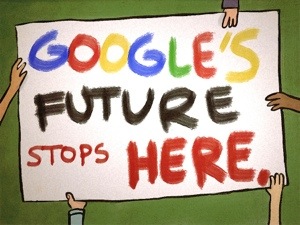
A group of protestors even showed up at the Berkeley home of Google developer Anthony Levandowski, preventing him for 45 minutes from getting to work. He is the engineer who is developing the self-driving car. Protestors held signs that said “Google’s Future Stops Here.”

Whose future are the protestors going to try to stop next and in what city? This could escalate.