
Fear Versus Precaution

20131103-220520.jpg

I don’t even have a grandchild, yet I find myself involved in the controversy of whether parents should arm their young children with miniature sensing devices in order to keep track of them just in case they wander off in supermarkets, department stores, or even playgrounds. A story appeared in today’s New York Times by Anne Eisenberg about the introduction of a watch from Filip Technologies that tracks the location of a young child and lets him or her easily communicate with just the push of a bottom.

Surprisingly, many of the therapists Eisenberg interviewed for the story gave somewhat negative reviews of the Filip product and others like it because they felt children need to learn problem-solving skills and learn to manage stress. That means if they get lost they should experience fear and independence.

That’s all fine and good, but what about the distraught parents? Twenty-seven years ago, I lost Whitney in a Caldor’s in Riverhead. She was four at the time. I thought she was at my side, but she had wandered around the bend and proceeded to sit down on the floor. I immediately started to call her name and stood on my tippy toes to find her. No answer. In three seconds I imagined I had lost her forever, and my whole body started to shake. Of course, once I started running up and down the aisles, I spotted her on the floor. Had I bent down, rather than stood on my toes, I may have seen her through the racks of clothes. To this day I have no idea why she didn’t answer me.

I met up with a very well-known international physiatrist this morning at a friend’s brunch. I told him about the story in The Times as well as about my experience with Whitney. He had a different opinion than the ones you will read in the story. I didn’t ask permission to quote him so I am leaving out his name. “I don’t see anything wrong with using a gadget to locate a child, but let’s really evaluate the facts. The chances of losing a child is not very likely, so the GPS monitoring solution is a little extreme. What’s more, a gadget shouldn’t really replace good parenting skills. No harm, either way.”

If I had to do it all over again, I would have had ten alarms on Whitney. I am really curious about your opinion. To be clear, here’s the question: Is it better to teach young children independence by letting them experience fear, or to buy one of the various GPS monitoring devices as a safety precaution?


Our Biking Days Are Just Beginning

Here are all my excuses for not taking a bike ride.

I feel I will exert myself too much, possibly causing a heart attack.

I will not be able to get to a bathroom fast enough.

I may get completely exhausted and can’t peddle home.

I can’t keep up with my biking companions.

My back and neck ache after a few miles.

I have had several cardiologists tell me that biking is a great exercise for seniors. First and foremost, it gets you off the couch and in the fresh air. When you are peddling along you are prone to enter a fantasy zone that takes you away from your usual everyday thoughts. You can feel ageless. That’s a good thing.

Also, the misconception about biking is that it is only good for young people. That’s not true at all. In fact, a physical trainer told a male friend of mine that bike riding is not a true workout. It may be a great exercise for riders who do 40 miles a day but for the average person it just gets the heart pumping more than usual.

For those senior folks who would love to ride a bike but really need assistance along the way, let me remind you that there is such a thing called electric bikes. You can peddle manually or turn the switch for the motor to take over. You feel like you are on a quasi scooter. It is that simple. Electric bikes come in all shapes, sizes, and price ranges.

I have included a recent New York Times article that covers electric bikes. Here is a link to a site that will show you a wide range of electric bikes and various prices. Be sure to watch the video above to see a collapsible electric bike.

Happy peddling!

Capturing Halloween

20131101-224637.jpg

I just had to devote one blog post to the stunning pictures Eliot took Thursday night at the Greenwich Village Halloween Parade. Stretching more than a mile, this event draws two million spectators and 50,000 costumed participants.

The characters were so colorful that Eliot’s photos look like art pieces. It is wonderful to be able to share them this way. The digital world has made us all really appreciate moments like this.

20131101-224700.jpg

20131101-224739.jpg

20131101-224759.jpg

20131101-224826.jpg

20131101-224840.jpg

20131101-224857.jpg

20131101-224912.jpg

20131101-224944.jpg

20131101-224958.jpg

20131101-225019.jpg

20131101-225051.jpg

20131101-225106.jpg

Start Spreading the News

20131031-212803.jpg

20131031-212817.jpg

You are now officially allowed to do what many people have been doing for years — not turning off their mobile devices during take-off and landing on commercial airplanes. The Federal Aviation Administration announced today that airline passengers can listen to music, read, and play games from the minute they get on a flight until the minute they get off. The start date has not been announced yet, but it will be before the end of the year.

This only applies to U.S. carriers. Overseas airlines have to make their own determinations. The FAA in the U.S. finally came to the conclusion that the use of mobile devices does not interfere with pilot controls and communications. This new ruling has nothing to do with making calls or texting. You are absolutely not allowed to do that.

Passengers are only allowed to browse the web and check emails when the Wi-Fi network has been turned on, usually above 10,000 feet. Prior to that moment, the FAA will still requires all mobile devices to be placed in airline mode.

Personally, I am a bit relieved. There hasn’t been a flight I’ve been on where I haven’t been annoyed by a seat mate who is still sending emails or texting while we are charging down the runway. Many flight attendants gave up trying to enforce the rule a long time ago. Passengers are just getting worse and worse. They think they are the exceptions to the rule.

I fear the day the FAA approves cell phone usage during flights. There will not be a minute’s peace.

One More Day of Cuba, Maybe

20131030-223204.jpg

After today, I will get back to talking about tech. Before I do, I have to tell you about a fantasyland we walked into in the fishing town of Jaimanitas, just on the outskirts of Havana. Our tour guide told us he wanted us to see the works of José Rodríguez Fuster, who is my age, born in August 1946, in Villa Clara, Cuba. Fuster is an artist specializing in ceramics, painting, drawing, engraving, and graphic design.

Everyone in my travel group couldn’t believe their eyes when we entered Jaimanitas, Fuster’s hometown. He turned it into a unique work of public art. It took him over ten years to rebuild and decorate the houses with ornate murals and domes to suit the personality of all the neighbors. Fuster even installed a chess park with giant boards and tables. Watch Fuster’s video.

We might not know him in the United States, but Fuster’s art is right up there with Gaudi in Barcelona or Brâncuși in the Romanian city of Targu Jiu. His work makes you happy. You don’t have to love contemporary art to love Fuster. You only have to love life.

20131030-222441.jpg

20131030-222740.jpg

20131030-222756.jpg

20131030-222823.jpg

20131030-222846.jpg

20131030-222932.jpg

20131030-223247.jpg

Who Knew?

The following information was gathered by me during my recent trip to Cuba and supplemented by research on the Internet. I am always amazed about the depth of information you can get from Google. No matter how many interviews I did in Cuba to get the correct information, Google had all of the facts in one neat package. It will be interesting to see if you can tell which pictures I took myself and which ones I got off the Internet.

20131029-190512.jpg

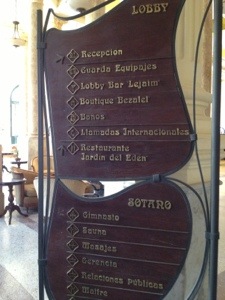
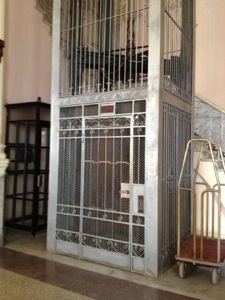
The last thing I ever expected to see in Havana was a hotel dedicated to the Jewish religion. As I explained yesterday, Jews are a small part of the Cuban population. Apparently the building was a textile factory before the revolution and most of the workers were Jewish. Thanks to a restoration process carried out by The Company Habaguanex S.A., belonging to the Office of the City Historian of Havana, the Hotel Raquel is a permanent tribute to the Hebrew culture and its presence in the Cuban contemporary art.

The building is completely captivating because of its Art Nouveau style, including the marble columns that rise in the hall of the entrance, an extensive roof of dark glass, and a watchtower where guests can view the streets and squares of Old Havana.

Raquel’s name is biblical for a beautiful woman, an inspiration of the Hebrew culture. The Hotel Raquel also has a restaurant of Jewish cuisine and a Judaic gift shop. How cool is that?

20131029-190747.jpg

20131029-190820.jpg

20131029-190838.jpg

20131029-190908.jpg

20131029-190933.jpg

20131029-191007.jpg

20131029-191024.jpg

20131029-191041.jpg

20131029-191051.jpg

20131029-191123.jpg

The Days of Rum and Cigars

20131029-002141.jpg

Last minute photo before takeoff at 6 a.m. on Tuesday, October 22nd: Gail, Dawn, Eliot, and Lois

When Eliot and I passed through customs yesterday at Miami International Airport, one of the security guards asked us, “So how did it feel to vacation in a Communist country?”

For a moment, I felt a sense of terror not knowing what to expect next from this guy who was heavily armed. Luckily, Eliot quickly answered, “I like living here much better.” He smiled, we smiled, and we quickly rolled our luggage away from him. That was the only part of the six day trip where I felt even slightly threatened.

I woke up early this morning and received an email from my young Israeli cousin asking me how safe I felt in Cuba? Are Jews accepted there? First of all, I am no authority on politics, security, or economics. I can only tell you what I experienced.

I met a young Jewish gal in Havana who has a high level job in the arts. She told me that one of the reasons she lives in Cuba is because there is no anti-Semitism and life is simpler, better. While she would migrate to the United States were she to meet a nice Jewish boy, right now she enjoys the closely knit family and community life she leads there. She swore to me she has never experienced an ounce of discomfort.

There are about 1,500 Jewish people in Cuba, 85 percent of whom live in Havana. Most are conservative. Several synagogues are free-standing buildings; others are housed in store-fronts or other available spaces. There is supposedly one Kosher butcher on the entire island. Before Castro, there was a huge Jewish community. Now most of the offspring live in Miami, Dallas, and New York.

After talking to several young folks in the arts (our trip was all about looking for young emerging talent), I have come to the conclusion that for the time being, life in Cuba, on a day-to-day basis, is peaceful with a subtle touch of Communism. Things that are important to me (continuous access to the Internet, the ability to buy the finer things in life, and modern conveniences) are not necessarily what others desire. Those who agree with me left Cuba a long time ago or have an upwardly mobile lifestyle where they are free to travel as much as they want. Most of the artists we met who have received significant recognition from the United States or from other countries are constantly doing road shows but keep their headquarters in Cuba. Artists, musicians, and sports stars are revered in Cuba and live much better than the rest of the Cubans.

Rich or poor, most Cubans in Havana have cellphones. Texting is a big part of their lives. They also love to talk, although their calls are limited to inside Cuba. Despite what anyone tells you, Cubans do have access to the Internet. I am sure many sites are blocked, but at least they are slowly gaining access. The big problem is the cost: five dollars an hour when many Cubans only earn twenty dollars a month. That’s why most workers only access the Internet when they’re at work.

20131029-002339.jpg
The Group

20131029-054854.jpg

20131029-054840.jpg

20131029-055100.jpg

They Don’t Know Desi in Cuba

20131027-182738.jpg

Our Cuban tour guide warned us upon arrival last Tuesday that no one in Cuba ever heard of Desi Arnaz, or his alter ego Ricky Ricardo. Arnaz left Cuba in 1934 and became famous in the United States a decade later. That somewhat disappointing piece of information was one of many misconceptions Americans have about Cuba.

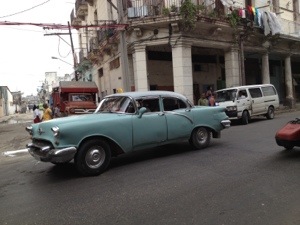
The Chevy that the “I Love Lucy” show made so famous in the ’50s is one of an estimated 60,000 pre-1960 American cars now in use in Cuba. Other than some newer models infiltrating from Europe and South America, Cuba looks like a movie set with 50-year-old Chryslers, Plymouths, and Chevys lining the streets. Most of them have been repaired with Asian parts. Don’t look too closely. They are being held together in creative makeshift ways.

Americans believe that Cubans love old American cars. Nothing could be further from the truth. Cubans love new American cars, but they can’t get their hands on them. Shortly after the 1959 revolution, American automobile manufacturers were forced to stop selling to Cuba in order to conform to the embargo established by the United States. It has never been lifted.

The vintages cars, known as cacharros (translation: pieces of junk), sell in Cuba for around $10,000. You are basically buying a piece of tin for that money because the inner workings all have to be repaired. Our tour guides arranged transportation for us a few times in these precious beauties. Fortunately, a government agency or a private concern reconditioned the ones we rode in. They still lacked the safety and stability we are used to.

20131027-182721.jpg

20131027-182648.jpg

20131027-182550.jpg

20131027-182533.jpg

20131027-182451.jpg

20131027-182414.jpg

From My Camera Roll

For those of you who are not on Facebook, I wanted to share some of my photos. I consider them collectibles.

20131022-000732.jpg
A friend posted this.

20131022-001036.jpg
Former HWH staffer Meghan Dougherty visited with us recently. She is a wife, mommy of two, and author of a soon-to-be-published tween novel. Remember, you saw her here first.

20131022-001316.jpg
The townhouses on East 62nd Street — all dressed up for next week!

20131022-001755.jpg
Congresswoman Debbie Wasserman Schultz spoke at the 92 Street Y. We live in her district in Miami.

20131022-002114.jpg
Dylan’s Candy Store getting ready for Chanukah.

20131022-002854.jpg
The real Teri Garr wrote this message on a blackboard hanging in Georgio’s Country Grill on 9th Avenue at 53rd Street.

TV Watching Waning Among Millennials

20131021-235929.jpg

Boy, has life changed since I was a young! I watched TV all the time and still do. But not the 18-to-34-year-old group known as the Millennials. So if young folks are not watching TV, who is buying all those big flat-screen TVs? Are people of our generation the only true coach potatoes?

A recent survey by The New York Times showed that broadcast TV viewership appears to be slowing down generationally.

Roughly one in three youngsters watch less TV than online videos. Some young folks claim they do not watch TV at all. At the same time, fifty percent say they watch video online at least once a day.

The Times survey said thirty-four percent of those surveyed reported watching mostly online video or no broadcast TV, as opposed to equal amounts of TV and online video, or only TV. Fifty-six percent of youngsters said they want immediate access to their choices, while forty-nine percent said they like being able to watch multiple episodes online. Another forty-four percent said mobile devices allow video viewing in places and at times they can’t watch traditional TV.