It’s probably my age, but I love listening to podcasts where baby boomers, or even older people, reflect on their lives. I find out that many of us, rich or poor, famous or unknown, all end up trying to figure out what our lives were all about.
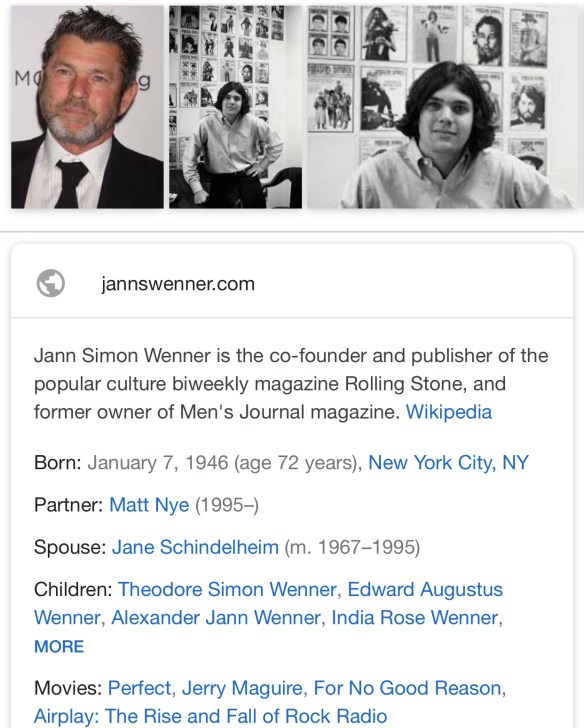
Alec Baldwin, the actor you know so well from his portrayals of Trump on Saturday Night Live, (he desperately wants to be remembered for more serious roles), hosts a podcast called, “Here’s The Thing.” He interviewed Jenn Wenner, the founder of Rolling Stone Magazine, just before he sold it last February. I just got around to listening to the interview now.
I wanted to share it with you because it talks about the music we grew up on and how that stays our favorite forever. Most of the interview focuses on his ownership of Rolling Stone, what it was like knowing so many rock stars, and why he decided to start a second family in his 60’s.
Click here to listen to the podcast. (The podcast starts with a quick commercial, then you will hear Alec introducing the interview.)
I thought after living in Manhattan for over 40 years, nothing could impress me. That was the case until last night. Whitney and Fredrick arranged for all of us to celebrate Eliot’s birthday at Manhatta, Danny Meyer’s newest restaurant on the 60th floor of 28 Liberty St., formerly the Chase Manhattan office building.
It just took our breath away. We have all seen the sights from the World Trade Center, but that was nothing compared to this 360 degree advantage point. It’s just the right height to see every detail of what a map of the city looks like in real life. You see all airports, bridges, rivers, highways, roads, and every major building NYC is known for.
The food doesn’t take second place to the view. Every dish was remarkable, and much different from what you have ever experienced. Our BFF, Bonnie, was amazed about how delicious each course tasted. The service was also impeccable and the decor was in excellent classic design. By now you must be questioning the prices. All I can say is that it was extremely reasonable. No tipping allowed. That was tough to deal with because you always want to show your appreciation.
Trust me, when I tell you that this is an experience you don’t want to miss. A big thank you to Whitney and Fredrick for discovering this restaurant and nailing the reservation.
And a big happy birthday to Eliot who went home totally exhausted from eating one of the best meals ever, and snapping away more photos in an evening than most people take on a vacation. The photos posted here were taken on an iPhone by Whitney and Lois. Tomorrow we will get to see Eliot’s photographic eye.
For $25, you can give a child, or even an adult, an augmented reality T/shirt that reveals what’s going on inside the body. It’s really awesome because very few people have ever seen anything like this before.
It also makes a very powerful gift. All you have to do is point a smartphone, or a tablet at the Virtuali-Tee shirt when it is being worn, and you see the heart and digestive system. It works with a companion app. It was first introduced on Indiegogo.
Yes, it’s a little scary but it’s very educational. Watch the video. You are going to remember this forever.
Scenes from the town of Dingle, and the Dingle Peninsula, which are as far west as you can get in Europe. We could practically see the United States.
Tomorrow is our last day in Ireland. We fly to NY on Tuesday. It was a terrific trip. My eyes are smiling. Landscapes by Eliot Hess.
Spread the word. The next time you go to a hotel, ask to speak to the management. Tell them one of the best amenities they can give a guest is the free Travel Buddy from Handy.
I just found out about it when we check into Randall’s Court, Killarney, Ireland. All of the hotels rooms have a Travel Buddy smartphone. As long as you are a guest in the hotel, you get to use the international cell for free. You can call anywhere in the world, and for as many times as you want/need to. You can also make free local calls. If you are out-and -about, you now have the ability to call folks nearby.
I thought this was a bit generous so I questioned the the hotel staff. The concierge told me that they heard about the service from a hotel in Hong Kong, and decided that they wanted to offer it too. Since they started the service a year ago, hotel reservations have dramatically increased.
The Travel Buddy by Handy also offers guests navigation maps so they can learn how to walk around the neighborhood without getting lost, and a list of local restaurants, retail stores, events, hospitals, Churches/Synagogues, gas stations, etc.
The guests in my hotel love the Travel Buddy by Handy because they can call home for free. That is a huge bonus for people who travel without international telephone plans.
The only way to get more and more hotels to feature the Travel Buddy by Handy is to keep educating everyone in the hospitality business. Tell them to visit
Every tech publication is talking about the new robot dog Sony is introducing to the U.S. market in a few weeks. Bow wow. You can read about it by just Googling Aibo, but I’m prepared to tell you all you need to know.
It cost $2,899 and the battery only last two hours. I can justify the price for early adopters, but I don’t think two hours is enough time for any new gadget. You are just getting warmed up when the batteries run out. That doesn’t work for me, even though I would love to be one of the first to own a dog that I could leave home for days, or weeks, without any worries.
The other negative is that Aibo should only be used indoors.
Most tech folks who have played with Aibo say it is adorable and a lot of fun.
They also said that Aibo features artificial intelligence and sensor technology. I have posted several videos here that will explain all of the fancy features.
I love the fact that Aibo includes a companion app for picture taking, commands, and learning tricks and navigation.
The wonderful thing about Aibo is that you can develop a personal relationship with the doggie robot. Again, watch the videos.
A new era is about to dawn in the art world. Christie’s Prints and Multiples will be auctioning a series of paintings next month that were actually created by artificial intelligence.
The first piece will be a portrait of a fictional man named Edmond De Belamy. The other 11 portraits will feature members of the so called De Belamy family.
Christie’s said The De Belamy portraits were conceived by a group of artists called Obvious and the algorithm was created by Generative Adversarial Networks, also known as GANs.
The portrait of Edmond De Belamy could sell for $7,000 to $11,500. It’s going to be very interesting to see the reaction of folks attending the auction. Who will be the first person to make the AI purchase?
This is small part of a three mile wall that separates the Protestants from the Catholics in Belfast. Take a look at the future of America. This is exactly where we are headed.
We are staying at the Europa Hotel. It was bombed 33 times during the conflict. It gives me the creeps that hatred still lives here.
I’m standing in front of Queens University in Belfast. This is where the mobile defibrillator was invented and Milk of Magnesia.
I like hearing what other seniors have to say about the stage of life they are in. I think it’s important to know that most of us have the same challenges, at one time, or another. I guess it’s all about attitude. Here are some thoughts on that.
I had a big awakening today. I found out that a product I have been using for years, is owned by a very destructive #metoo man, I have no respect for. The minute I found out, I stopped buying the product.
I told a few friends about the incident. One of my pals then told me that I needed to use Buycott. It’s an app that let’s you scan the barcode of any package. It could be on a bottle of soap, or a cereal box, or even a tomato. Once you do that, you can find out information about the company that produces it.
It’s wonderful to be able to have real-time information about the standards or background of a company. It gives you the power you need to make the right decisions. Read more about Buycott here.
( Diane Dahli has been a faithful and loyal reader of DigiDame for many years. Thank you Diane. Diane is also a blogger. She wrote a post about mood swings that I wanted to share with you. It’s fascinating. I feel it’s very relevant for people our age.)
On some days, even perfect ones like today, when everything is fine in my world, I’ve been known to suddenly experience what I can only describe as a bad mood. I don’t obsess about it, or even question it. A wave of sadness appears out of nowhere, and usually, if I practice gratitude for a few minutes, it melts away. Even anger, (which momentarily appears as irritation with small things that can go wrong in life), doesn’t linger for long, and can be dispersed with a few philosophical thoughts.
Dealing with my emotions has become part of my everyday existence, and I accept this as proof that I am vitally alive and responsive to life’s situations.
We all have the capacity to experience a bad mood, or to be more specific, the full range of emotions—happiness, sadness, joy, anger, envy, resentment—it’s what makes us human. Most people go through life on an emotional even keel, feeling basically happy most days, and reserving the deeper emotions for specific situations. But some people are more expressive, and feel things more keenly. It doesn’t mean they are unbalanced, or disturbed or deficient in any way. It’s just that their feelings seem to be more accessible, and closer to the surface.
Who knew that a bad mood can be good for us?
In fact, psychologists claim that all emotions, even negative ones, such as fear, anger, shame or disgust, are useful to us. They stem from ancient, primordial instincts, which help us recognize, and avoid dangerous situations.
Mild, temporary bad moods help us cope with everyday challenges and alert us to issues in our lives that need to be addressed.
Having always felt that bad moods are undesirable, I was surprised to learn that, according to some studies, the following benefits, among others, can occur as a result of experiencing a bad mood:
better memory: A bad mood has been known to focus the memory, so that details are sharper, particularly in the case of eyewitness accounts. By being less distracted during an event, evidently, people who are in a bad mood can weed out irrelevant information and recall these details more accurately.
more motivation: It’s no surprise to me that people who are ‘driven’, and possibly angry, try harder and persevere more when performing a task. This drive may come from a need to prove something—a desire a more happy, complacent person may not have.
better communication has been indicated by subjects who are in a bad mood.
more accurate judgments were made by subjects in a bad mood, who relied less on stereotypes and rumors.
Seeing someone in a bad mood makes people uncomfortable
So if feeling bad is not bad for us, and may even be beneficial, why is our society so consumed with the need to be happy at all times? Why does seeing someone in a bad mood—expressing sadness, anger or distress—become a cause for concern?
In our culture, unhappiness is looked upon as an illness. People who are ’emotional’ are considered sick in some way, and in need of therapy. Teenagers, particularly, in their period of emotional development, are understandably unstable, and not necessarily in need of ‘help’. Older people, experiencing natural feelings of loss or sadness are sometimes too hastily considered risks for dementia or worse.
I agree with the current studies that we have emotions for a reason, that they may be ultimately beneficial and necessary to our existence. I would add that it is important to acknowledge them, and to allow ourselves to experience them. Denying our feelings has become an outcome of the current “cult of happiness” in our culture. It is not natural, and it is not healthy.
I think that the issue here is not if and how we experience our emotions, but how we manage them.
Wellness coach and author Elizabeth Scott, discusses this in her February 12, 2018 article “How Negative Emotions Affect Us and How to Embrace Them”:
“The idea of “managing” negative emotions is a complex one. It doesn’t mean avoiding feeling them—avoidance coping is actually a form of coping that attempts to do this, and it can often backfire. It also doesn’t mean letting these negative emotions wreak havoc on your life, your relationships, and your stress levels. Unmanaged anger, for example, can compel us to destroy relationships if we allow it to.
…Managing negative emotions also means not allowing them to overrun us; we can keep them under control without denying that we are feeling them.”
There are many different ways to manage our emotions. As we grow up and grow older, we discover them, usually without professional help.



























 DigiDame